Thick blanket of smoke envelops Dubai after Al Quoz fire
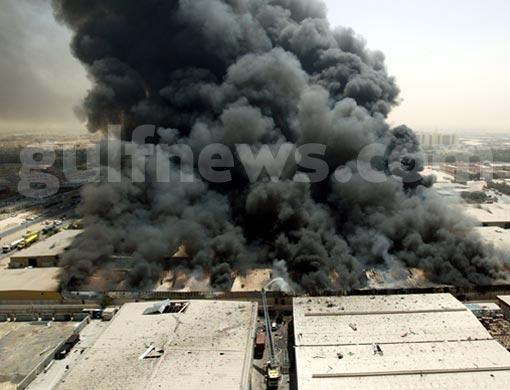
Thick blanket of smoke envelops Dubai after Al Quoz fire By Alia Al Theeb, Kevin Scott and Alice Johnson, Staff Reporters GULF NEWS Last updated: March 26, 2008, 20:53
Dubai: Two people were killed and five injured when a huge explosion ripped through a warehouse in Dubai’s Al Quoz industrial area on Wednesday.
Three people are also unaccounted for as a result of the fire which sent plumes of black smoke spiralling across Dubai on Wednesday morning.
Three firefighters suffered moderate burns trying to contain the inferno and two passersby were also hurt.
The fire, which started in a warehouse that stored fireworks illegally, soon spread to more than 70 warehouses that stocked a variety of goods, ranging from electrical equipment, clothes, plastic toys and food.
The losses have been estimated at around Dh600 million.
A 29-year-old Filipino died after being hit by a piece of flying shrapnel and another person — still to be identified — was in the warehouse when it exploded.
Dubai police said one person is missing.
A huge mushroom cloud of smoke formed over the city’s skyline after the explosion at about 7.15am. Thousands of residents were woken by the huge blast and the trail of smoke was visible to motorists making their way to work all over the city.
Debris from the fire spread across the area, reaching as far as Safa and Jumeirah.
Dubai Civil Defence said illegal fireworks had been stored in the warehouse, hindering the control operation. Firefighters also blamed the presence of flammable materials as a factor contributing to the ferocity of the fire.
The blaze was eventually brought under control by late evening.
Flames covered one square kilometre of the industrial estate.
The UAE armed forces, along with teams from Abu Dhabi Police and Civil Defence personnel from Abu Dhabi, Sharjah, Ajman, and Al Ain, helped Dubai personnel in fighting the fire. The department of Environment, Health and Safety at Jebel Ali also joined the efforts.
Major General Khamis Mattar Al Mazeina, Director of Dubai Police’s Criminal Investigation Department (CID), said the owner of the warehouse containing the firecrackers has been detained and is being interrogated.
Al Mazeina said investigations were ongoing to discover how the firecrackers were brought into the country. He said the authorities were waiting for firefighters to complete cooling operations before examining the scene.
The Roads and Transport Authority closed a number of roads around the blast site, leading to huge traffic jams on major arteries including Shaikh Zayed Road, Al Khail Road, Muscat Road and Umm Suqueim Road.
Hussain Al Banna, Director of the Right of Way Services Department and head of the emergency team, said: “The road closures were intended to provide easy access for fire engines as well as rescue and ambulance vehicles.”
History of disasters
– February 6, 2003: Powerful explosion and fire rip apart three warehouses in Al Qouz. Seven people were killed. Ten others were also injured in the blast said to caused by firecrackers.- March 13: Massive warehouse blaze in Al Quoz, but no one was injured. Some 2,660 barrels of petroleum compounds and 6,500 lumber planks, which were soaked in a highly inflammable liquid were gutted.
– August 9: A fire destroys workshop of a factory in Al Quoz Industrial Area. No injuries reported.
–January 24, 2004: Goods worth over Dh15 million go up in smoke when a massive fire destroyed at least three warehouses in the Al Quoz Industrial Area. No injuries or casualties reported in the incident
–May 2: Fire guts two warehouses in Al Quoz Industrial area, causing more than Dh10 million in damage.
–April 1, 2007: Fire guts a warehouse and three others partly burn down. No injuries were reported. The fire broke out in a warehouse which stocked paint and construction materials and spread to the surrounding warehouses.
–March 18: Huge blaze breaks out at a site for recycling paper in Al Quoz Industrial area number 3 behind Al Ghurair University. No injuries were reported in the fire.
Expat pension plan under study
Expat pension plan under study
Gulf News Report Published: March 27, 2008, 00:18
Abu Dhabi: Expatriates are likely to be brought under the national pension scheme, according to a government plan.
A proposed “Pension Savings” draft law is being studied by the General Authority for Pensions and Social Insurance (GAPSI), and aims to include all expatriates working in the public and private sectors, a senior official said yesterday.
At present, pensions in the private sector are provided through an end-of-service payment (gratuity) relative to the employee’s length of service calculated on the basis of basic salary.
“The law is still being studied, and we expect the studies to conclude by the end of April, and that will be followed by receiving the necessary initial approvals,” Abdul Rahman Al Baqer, GAPSI’s deputy director, told Gulf News.
Raft of proposals
“The proposal covers all expats in the country’s public or private sectors, and I want to make it clear that this endeavour was not commissioned or directed by the government … it comes as an initiative from the authority itself according to the outline set by the leadership, within the framework of our strategy to include all those working in the UAE in the pensions scheme,” Al Baqer said.
The study includes various pension proposals and mechanisms to implement it. “We are not consulting businessmen or companies over the proposed legislation,” Al Baqer said.
As per the proposed legislation, the pension amount will be collected by an entity other than the companies of the employees, through monthly subscriptions to be cut from their salaries in favour of their respective accounts with GAPSI.
Photo Speaks – Sheikh Zayed Cricket Stadium Abu Dhabi
Somerset and Yorkshire Cricket teams are here in Abu Dhabi now, playing for the ARCH Trophy. Here are some action scenes from one section of the match played yesterday.

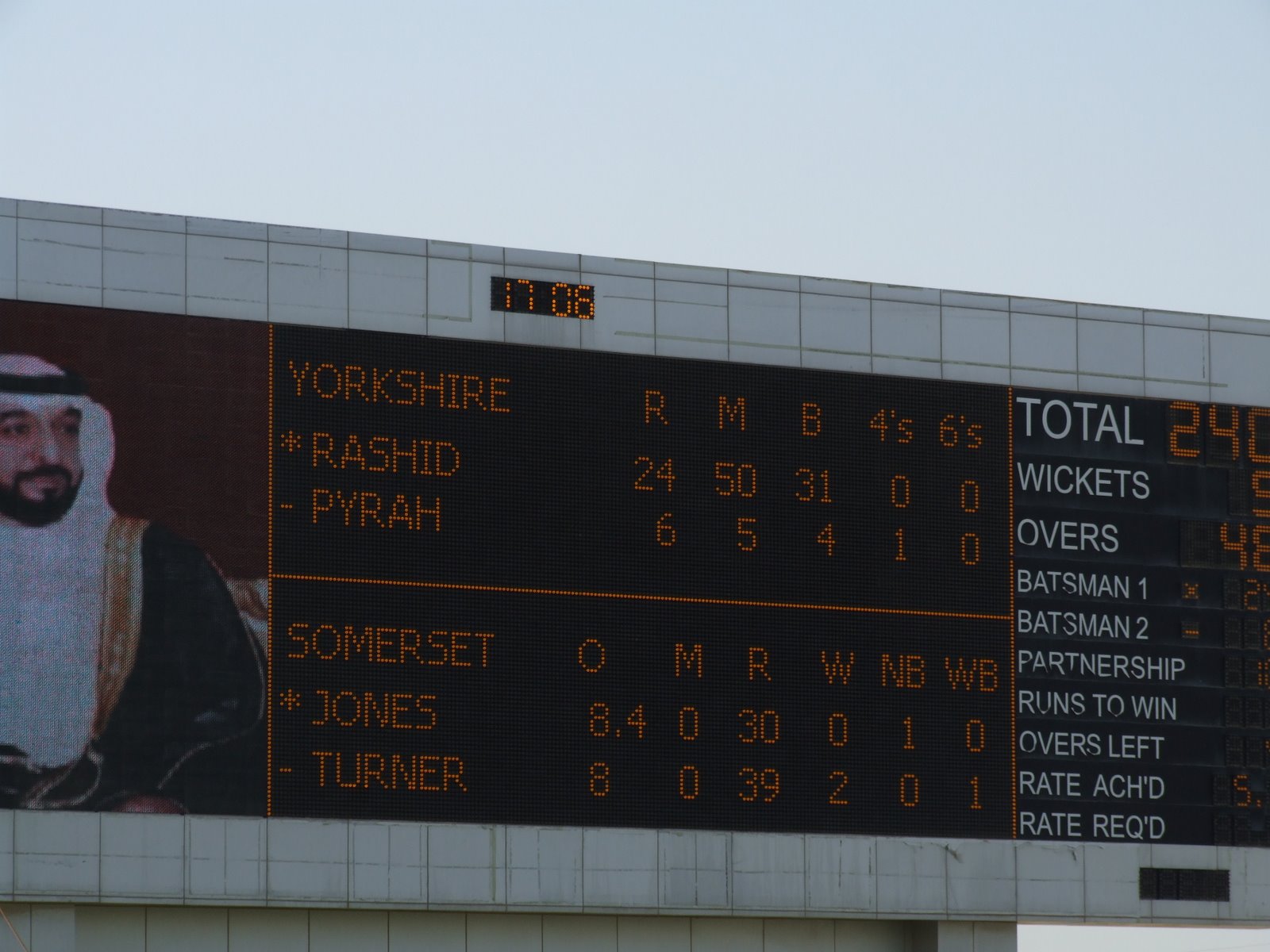
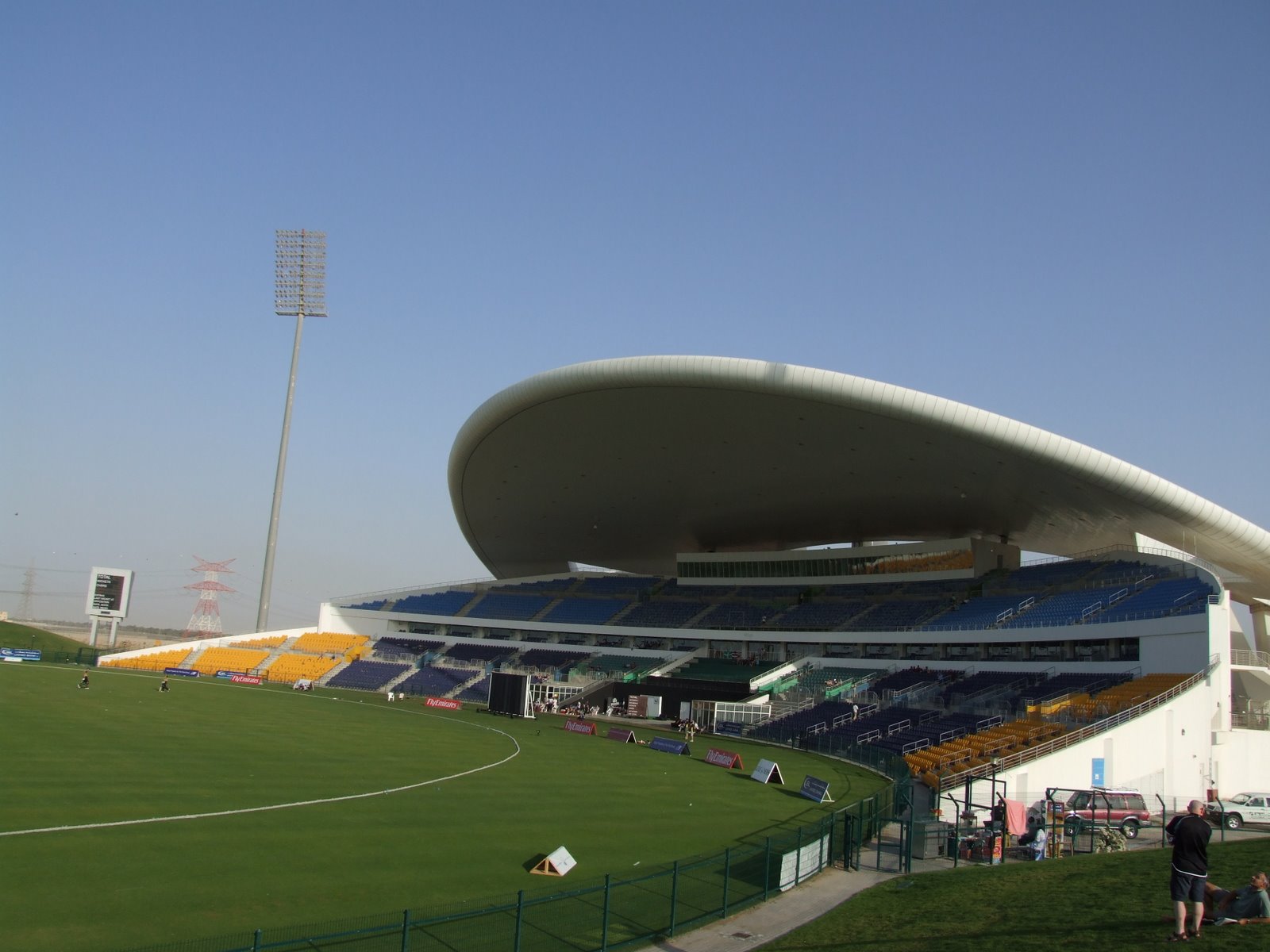
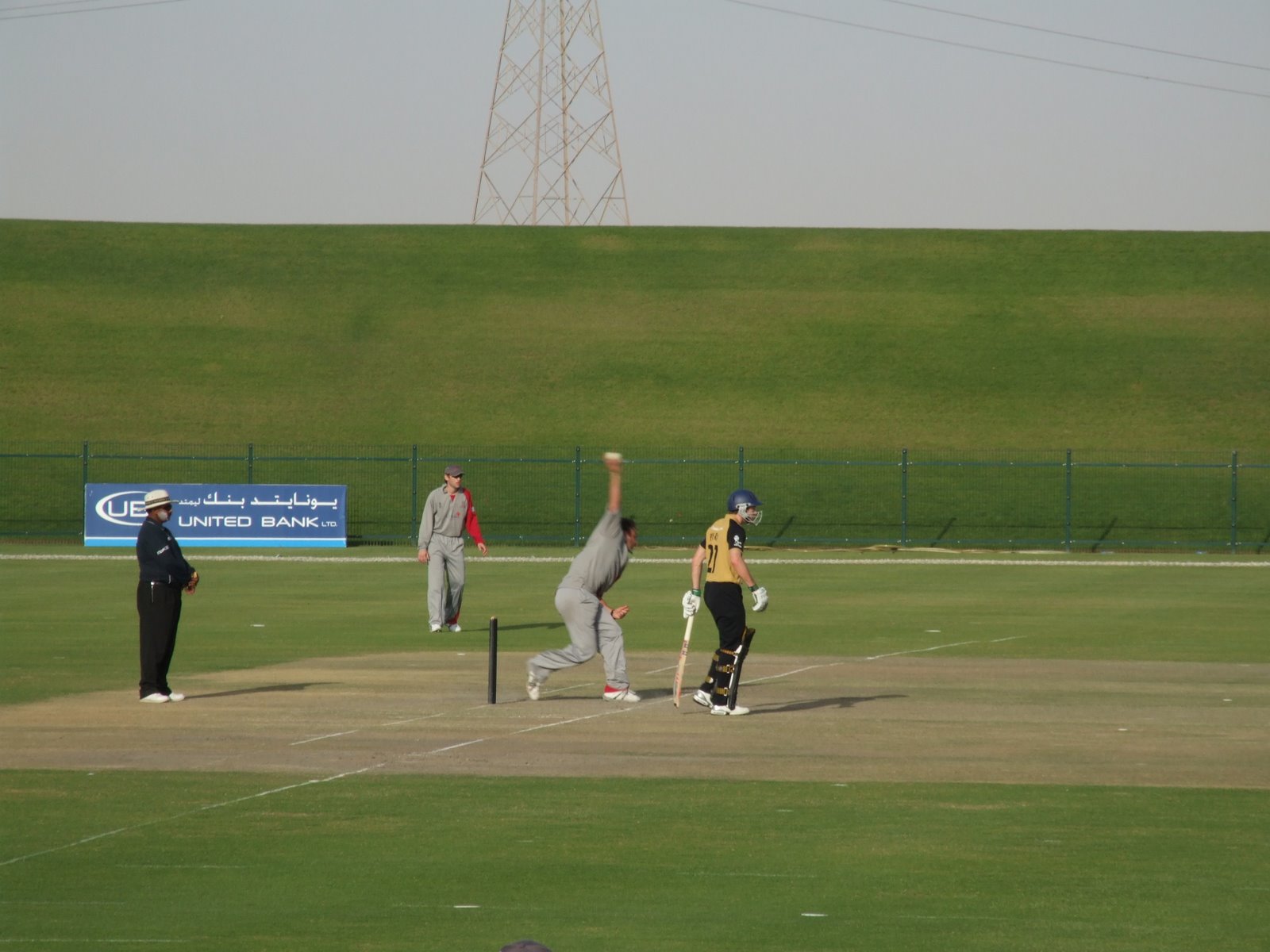
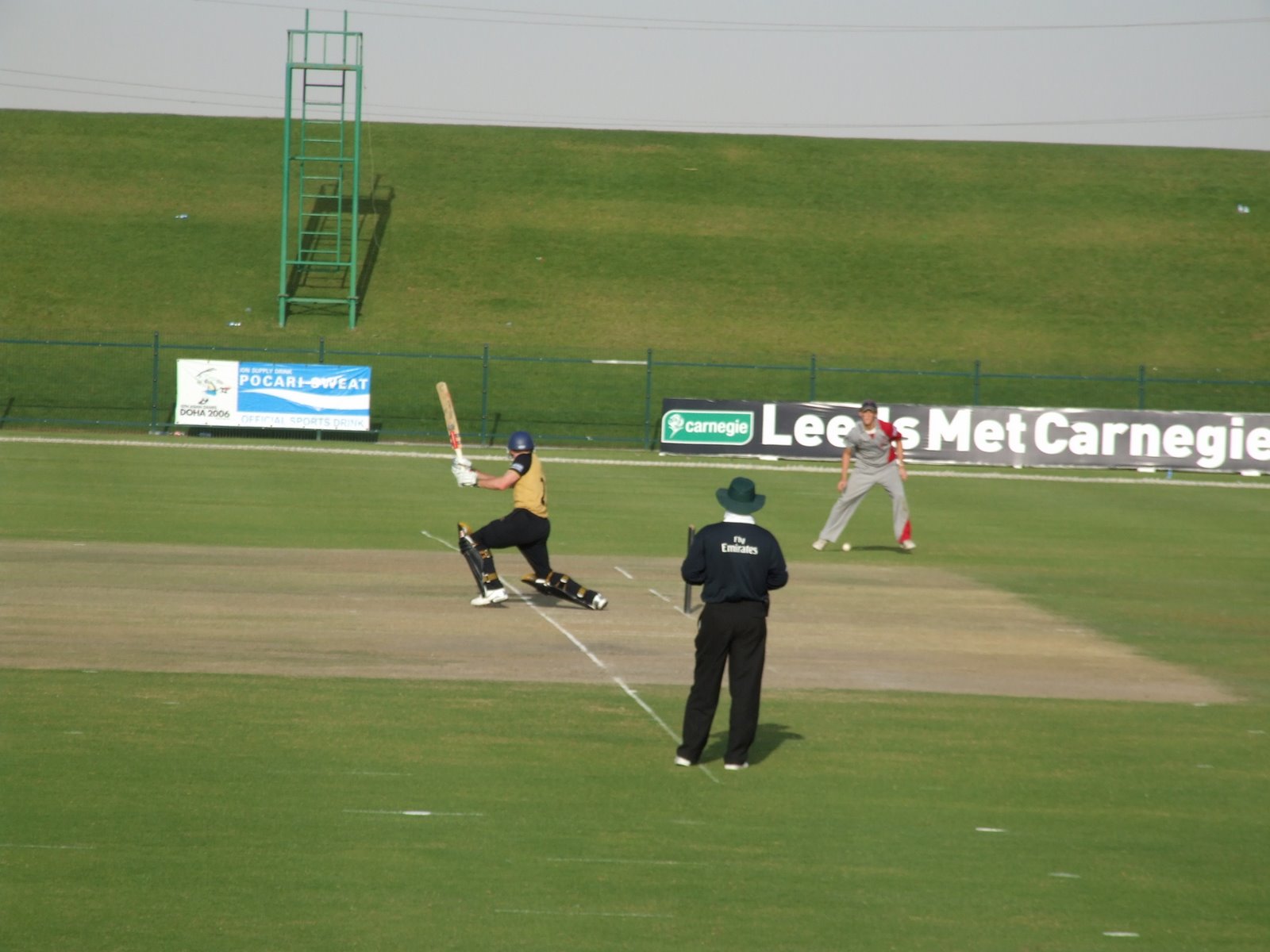
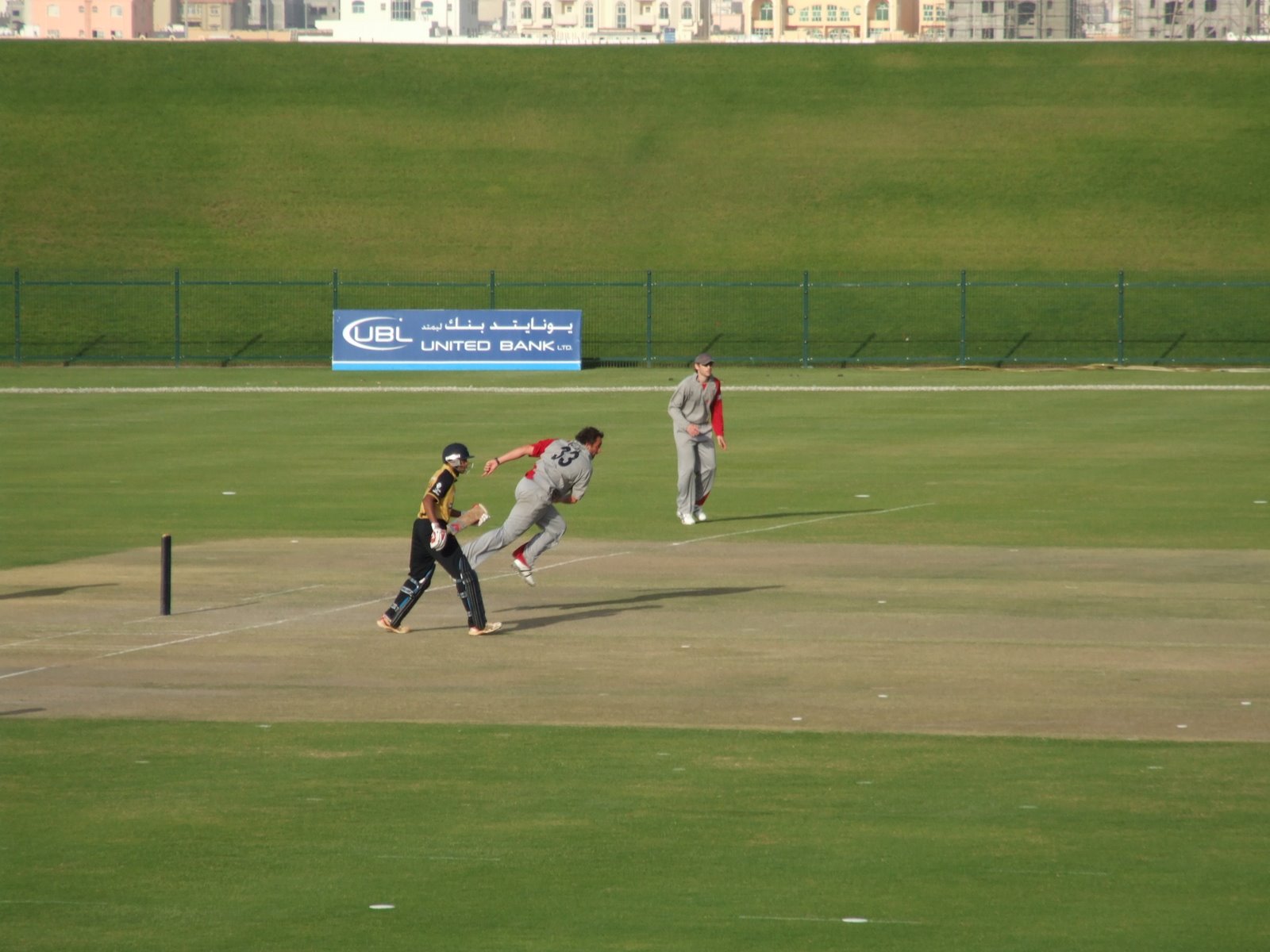
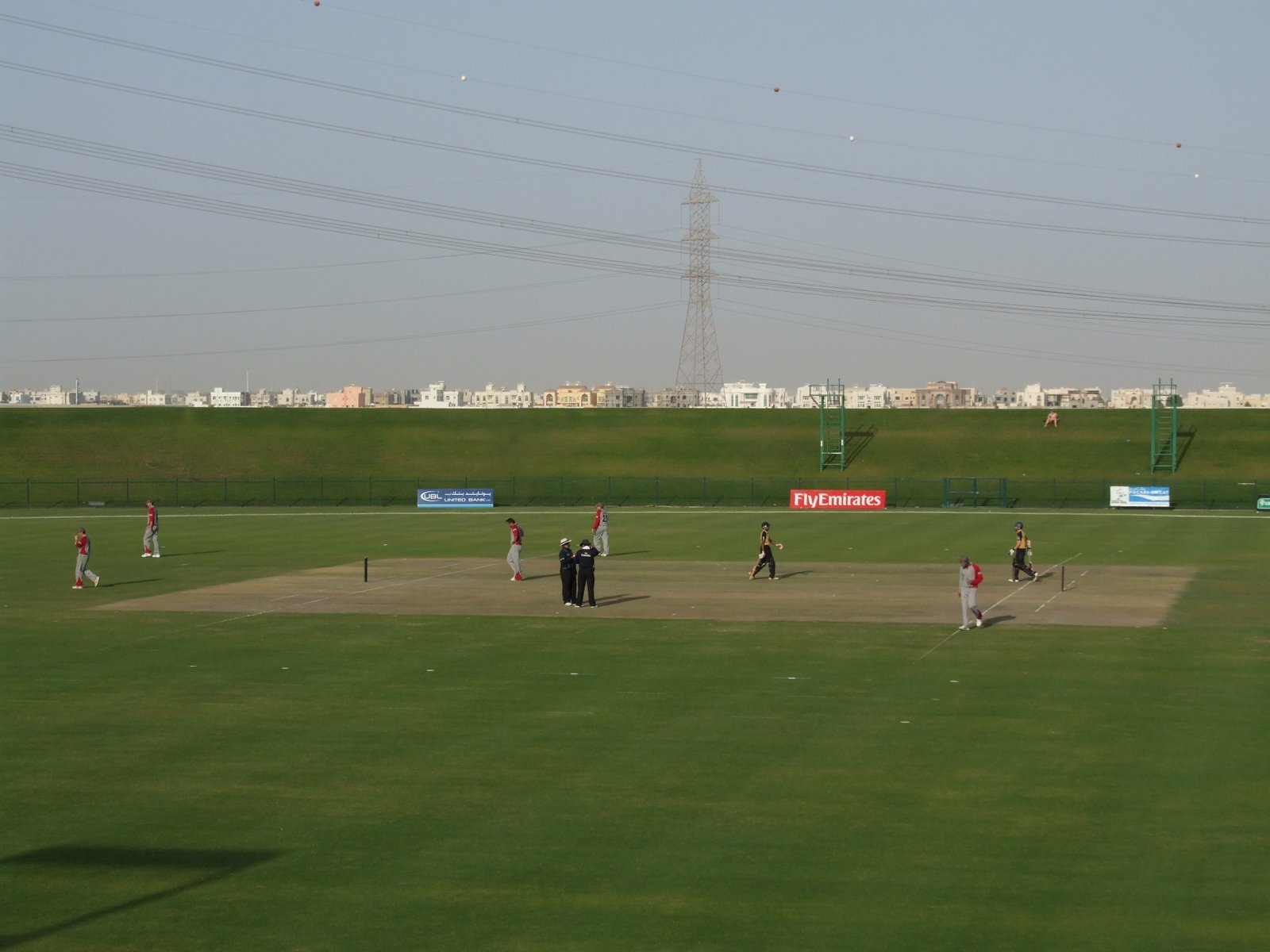
Photos by Ramesh Menon

Remove the fear of failure

Remove the fear of failure
Mr Amitava Roy, President, Symphony Services
One teacher I remember, and why: Prof. Bhola Nath Roy, my grandfather, for the values he instils in me.
One most valuable work lesson thus far: I am humbled by the intelligence of my colleagues and juniors.
My role is to unleash the untapped potential in people around me.
One thing I look for the most in a new recruit: Attitude.
A book that I am currently reading: How to manage in a flat world, by Susan Bloch & Philip Whiteley.
One tip for time management: Prioritisation.
One key thing in my fitness routine: Walk.
One signal that tells me there is a problem: Slowdown in communication.
One technique for handling anger: Deep breath.
One essential ingredient in my investment portfolio: Common sense.
One good thing about a new generation: Passion.
One worrying thing about the young: Affluence affecting their survival instincts.
One thing that clinches a deal: Trust.
One definition of values: Truth.
One way that I use for resolving conflicts: Listening.
One favourite activity when travelling: Photography.
One indicator of performance: Success.
One macroeconomic variable I keenly watch: India’s GDP growth.
One dream I’d like to chase, later in life: Travel — sightseeing.
One good way to foster innovation: Removing the fear of failure.
One clue that tells me I’m the leader: When others listen.
Trust those you depend on

Trust those you depend on
Ms Ranjini Manian, Founder and CEO, Global Adjustments.
One teacher I remember, and why: Robin Sharma’s List of Heroes. I made my wish-list and it has resulted in my actually meeting them!
One most valuable work lesson, thus far: Trust those you depend on.
One thing I look for the most in a new recruit: Multi-tasking ability.
One thought from a book that I am currently reading: “One pointed attention is key to success,” from Eknath Easwaran’s Book on Meditation.
One tip for time management: Cut through the knot of the most pressing thing that seems to weigh in your very stomach!
One key thing in my fitness routine: Pranayama.
One signal that tells me there is a problem: When I can’t think of a new idea.
One technique for handling anger: Postpone speech.
One essential ingredient in my investment portfolio: Land.
One good thing about the new generation: Superbly gadget savvy.
One worrying thing about the young: Do they know their roots?
One thing that clinches a deal: Asking sincerely.
One definition of values: Do what you want others to do to you.
One way that I use for resolving conflicts: Mediate.
One favourite activity when travelling: Listening to talks on the Bhagwad Gita on my iPod.
One indicator of performance: Societal admiration.
One macroeconomic variable I keenly watch: Dollar-rupee exchange.
One dream I’d like to chase, later in life: Teach Indian philosophy.
One good way to foster innovation: Adapt learning to your field.
One clue that tells me I’m the leader: There is actually someone following.
Tips for small retail investors to ease their nightmares
Tips for small retail investors to ease their nightmares
17 Mar, 2008, 1620 hrs IST,Shakti Shankar Patra, TNN
Ranjit Sehgal works as a system analyst at one of the top IT companies of India. Apart from forwarding emails, which his job requires him to do, he passionately tracks the domestic equity market. His favourite anecdote about the market until recently was: “Each time the market crashes, if you sell your house and invest in the stock market, in a month, you’ll be able to move a couple of suburbs closer to South Mumbai.”
Two months ago, all you had to do was name a stock and he would have told you its last traded price. You name a brokerage and he would have told you which stocks they were betting on. Any news or rumour, no matter how trivial, as long as it was remotely related to the equity market, he had it covered.
A day didn’t pass by without him arguing, disputing, advising or seeking advice on various message boards on the internet. He was a much sought-after man by friends and acquaintances, who had all heard of his uncanny ability to spot a multi-bagger and wanted to find a better avenue for their cash than the low-risk low-return bank deposit. He followed his own advice and put all the money he had to spare into stocks — for he believed that stocks were king.
But that was then. Today, with the Sensex in a free fall and bears mauling virtually every stock, Ranjit is in a funk. He has not logged on to his demat account for the past couple of days and zaps the business channel the moment it comes on.
His portfolio has lost over half its value and every passing day seems to erode it further. Ditto with the message boards, which are now filled with jokes like: ‘the easiest way to make a million through the stock market is to start with two million’.
He just can’t understand what went wrong. During the past three years, each time the market had corrected sharply, he had bought into it and turned in a heavy profit. He had done his own analysis, mapping the Sensex against the Dow and had been convinced that decoupling was taking place.
This time round, too, he had bought into the Sensex when it first fell in January and sure enough, it had rebounded. Then, when it fell again he bought even more. Unfortunately, it has never recovered since and he suddenly finds himself sitting on a mountain of useless paper.
Most investors are likely to identify with Ranjit’s predicament. Suddenly, that demat account is a nightmare and the fixed deposit a dream investment. While there may be many who are undergoing this traumatic experience for the first time, old market hands will tell you that this is just an umpteenth rerun of greed melting into fear.
The real predicament that they now face is: Where does one go from here? While there is no one-size-fits-all solution, here is some advice that small retail investors can use to mitigate the nightmares they are enduring…
Never hold on to what you won’t buy now
There’s no point in burying your head in the sand like an ostrich and waiting for a miraculous rebound. An active interest in the state of affairs is a must. The first thing you should do is take a long, hard look at your portfolio.
Does it have more of established companies with proven track records, or does it consist more of stocks like Nagarjuna Fertilizers & Chemicals and Reliance Natural Resources (RNRL), which you bought because they were ‘momentum plays?’
Having done that, get rid of the momentum stocks. After all, with the momentum gone, it’s time for these stocks to go as well. The rule is simple: ‘Never hold on to something that you wouldn’t buy now’ . Never ‘hope’ or ‘pray’ . It is either a ‘buy’ or a ‘sell’.
So, it doesn’t matter at what price you bought such stocks — just dump them and collect whatever cash you can. If you have blue-chips in your portfolio like Reliance Communications, Bharti Airtel, Hindustan Unilever or ICICI Bank, to name but a few, you can actually choose not to sell them. In the long run of say, 3-5 years, there is a good chance that you will still earn a return higher than what a bank deposit can give you in the same time period.
Once bitten twice shy
Having lost money in the market, it is but natural that you may have decided to stay away from it totally. That, however, is not such a smart thing to do. As any seasoned investor will tell you, the best time to buy is during a bear market. That said, it is important to keep returns expectations realistic and ensure that you get into stocks, which have a sound business model and visible cash flow. When you invest in a stock, you are basically buying a small stake in a company.
Generally, people tend to ignore this fact. But the moment you ask yourself about the company you want to own, the answer is definitely, Reliance Industries and not Nagarjuna Fertilizers; it is definitely Infosys, but certainly not Himachal Futuristic. It is important to buy stocks for their intrinsic worth and not on the basis of expected short-term gains.
Only fools rush in where angels fear to trade:
If you are someone who was sitting on the fence with cash, praying for a correction, ready to jump in for his first investment in equities, then remember to go easy. For only fools rush in where angels fear to trade. Although buying into a correction is something that has paid rich dividends in the past 3-4 years, the same may not necessarily be the case this time.
With global financial markets in turmoil and a general election looming on the horizon, you would do well not to assume that the market has bottomed out. Just because the stock you were planning to buy has fallen to 50 from 100, doesn’t mean that it cannot go to 25. So, try and enter in a staggered manner. In times such as these, as the saying goes: ‘cash is king’ .
Sense and sensex:
Often, investors get too obsessed with the level of the Sensex and forget to concentrate on the fundamentals of the stocks that they hold. There are umpteen instances of individual stocks underperforming in a bull market and those outperforming even in a bear market.
This is because the index reflects the entire market and does not necessarily reflect what is happening with your stock. So, let analysts talk about Sensex levels while you track your stock.
India, still shining:
With the garbage out of the house, we need to decide what stocks to buy, if any. Just because the decoupling theory has been thrown out of the window doesn’t mean that we are absolutely married to the US economy.
Although a slowdown in the US will affect export-oriented industries in India, it will have a limited impact on most of India Inc, since by and large, the India story is about domestic consumption, rather than exports.
And if the Budget is anything to go by, then the government is definitely in a mood to leave more money with consumers. With more money to spend, the sectors that are expected to benefit are consumer durables, FMCG and retail, to name a few.
The relative outperformance that these sectors have shown during the current turbulence is a good indicator that they may well hold their own even in a bear market. For some of ETIG’s top picks within these sectors, take a look at the stock ideas discussed in the current edition.
Money matters:
Lastly, and most importantly, the fact remains that we had an absolutely unbelievable and overtly extended bull run of around five years. During this period, the Sensex went up seven times, with most stocks going up exponentially.
This couldn’t have continued till eternity. But at the same time, this doesn’t mean the end of the world. Equity markets always swing between overexuberance and absolute despair.
So, don’t lose heart; there will be an end to this carnage. But to enjoy the fruits of the next boom, invest in fundamentally sound companies and always have a substantial amount of cash in hand. For, while you can buy a future multi-bagger today, tomorrow it may end up being a lot cheaper.

Camel gala offers Dh35m in prizes
Camel gala offers Dh35m in prizes
By Eman Mohammed, Abu Dhabi Deputy Editor GULF NEWS Published: March 26, 2008, 00:06
Abu Dhabi: A total of Dh35 million prize money is to be given away during the first Mazayin Dhafra Camel Festival being organised in the Western Region next month, said an official.
Ganem Huraiz Al Mazroui, director of the competition, told a press conferenceon Tuesday the winners will get Dh35 million in cash prizes and 100 cars will also be given away.
He said around 2,000 competitors had registered for the competition so far and the number is expected to increase.
A ‘camel beauty contest’ among other activities will be held during the festival at Zayed City in the Western Region from April 2 to 10.
The festival is being organised by Abu Dhabi Authority for Culture and Heritage (ADACH) and sponsored by General Shaikh Mohammad Bin Zayed Al Nahyan, Crown Prince of Abu Dhabi and Deputy Supreme Commander of the UAE Armed Forces, as part of ADACH’s efforts to promote local folklore through cultural events.
The participating camels are required to be of pure-bred origin and free from any contagious diseases. The camels are to be divided into age groups and owners can participate with more than one camel as long as they can prove ownership.
Mohammad Khalaf Al Mazroui, Director-General of ADACH, and deputy-head of the festival’s committee sees the event as a symbol of the significance that camels enjoy in Arab culture.
“We hope that this event will become an annual one so we preserve that part of our heritage,” Al Mazroui said.
Praise: ‘Part of heritage’
Shaikh Mohammad Bin Butti Al Hamed, Head of the High Committee for the Festival, Representative of the Ruler at the Western Region, praised the status camels held in traditional Arab life.
“Although the camel has always been a companion to the Arab during his travel in the old days, today camels still play a part in our lives, as thousands of people continue to attend camel races and watch what is perceived as part of our heritage.”
 ClicksandWrites
You must be logged in to post a comment.