Camel gala offers Dh35m in prizes
Camel gala offers Dh35m in prizes
By Eman Mohammed, Abu Dhabi Deputy Editor GULF NEWS Published: March 26, 2008, 00:06
Abu Dhabi: A total of Dh35 million prize money is to be given away during the first Mazayin Dhafra Camel Festival being organised in the Western Region next month, said an official.
Ganem Huraiz Al Mazroui, director of the competition, told a press conferenceon Tuesday the winners will get Dh35 million in cash prizes and 100 cars will also be given away.
He said around 2,000 competitors had registered for the competition so far and the number is expected to increase.
A ‘camel beauty contest’ among other activities will be held during the festival at Zayed City in the Western Region from April 2 to 10.
The festival is being organised by Abu Dhabi Authority for Culture and Heritage (ADACH) and sponsored by General Shaikh Mohammad Bin Zayed Al Nahyan, Crown Prince of Abu Dhabi and Deputy Supreme Commander of the UAE Armed Forces, as part of ADACH’s efforts to promote local folklore through cultural events.
The participating camels are required to be of pure-bred origin and free from any contagious diseases. The camels are to be divided into age groups and owners can participate with more than one camel as long as they can prove ownership.
Mohammad Khalaf Al Mazroui, Director-General of ADACH, and deputy-head of the festival’s committee sees the event as a symbol of the significance that camels enjoy in Arab culture.
“We hope that this event will become an annual one so we preserve that part of our heritage,” Al Mazroui said.
Praise: ‘Part of heritage’
Shaikh Mohammad Bin Butti Al Hamed, Head of the High Committee for the Festival, Representative of the Ruler at the Western Region, praised the status camels held in traditional Arab life.
“Although the camel has always been a companion to the Arab during his travel in the old days, today camels still play a part in our lives, as thousands of people continue to attend camel races and watch what is perceived as part of our heritage.”
55,000 pupils to be affected by fee increase

55,000 pupils to be affected by fee increase
By Siham Al Najami and Sunita Menon, Staff Reporters GULF NEWS Published: March 26, 2008, 00:06
Dubai: More than 40 of the 137 private schools in Dubai have been allowed to increase fees by up to 16 per cent for the next academic year.
This means that around 55,475 pupils will be affected by the new fee hike. The Knowledge and Human Development Authority (KHDA) on Tuesday said it would continue with the 16 per cent cap on fee hike it announced last year.
“We are continuing the fee cap for the next academic year and schools, which did not increase their fees last year, are allowed to hike the fee but not more 16 per cent,” said Dr Abdullah Al Karam, Chairman of the Board of Directors and Director General at KHDA.
There were about 92,451 pupils affected by the fee hike last year, most of whom enrolled in schools that implemented the full fee hike.
Currently there are 137 private schools in Dubai with a total strength of 153,000 pupils.
Parents welcome move
The Knowledge and Human Development Authority (KHDA) announced on Tuesday that the decision in consultation with and approved by the Executive Council of the Government of Dubai. The new announcement made by the authority on 16 per cent ceiling on fee hike, however, has not gone down well with many schools in Dubai, but the move has been welcomed by parents.

10 tips to get noticed in your GD
10 tips to get noticed in your GD
Kshipra Singh | March 25, 2008 | 11:19 IST
In the last article, we discussed eight things that you should not do in a group discussion (GD). This week we look at tips that can help you in succeeding in the GD. Your soft skills definitely come into picture here. Here are some of the things that you can do to make a winning impression in your GD.
~ Read voraciously: Make a habit of reading voraciously on every subject. This will keep you ready for any topic for a discussion in GD. Your knowledge is your most important weapon in a discussion.
~ Initiate the discussion: Most of us have a misconception that initiating the discussion would give you an advantage over others. It does give you an advantage but only if you know the subject well and have something relevant to start the discussion otherwise it is a disadvantage.
For instance, when a group was given the subject “Is capital punishment right?” some members of the group heard the word punishment and jumped at starting the discussion with out understanding the meaning of capital punishment. The evaluators kept listening for two minutes after which they intervened and asked the group if they knew the meaning of capital punishment. The members who initiated were quiet, looking at each other’s faces. That is when a silent member of the group got up and explained the meaning of the topic. From this, you can easily tell who must have succeeded in the GD, the ones who initiated the discussion or the one who explained the topic and gave it a right direction.??
They say, “Speaking just for the sake of speaking is noise”. So, don’t create noise in the GD, instead make some useful and resourceful contributions to get noticed in the discussion.
~ Speak politely and pleasantly: As you speak make sure that you do not talk at the top of your voice. You should be audible and clear. Remember?that you are participating in a discussion which is different from a speech given out by the leaders in their rallies. Even if you disagree with the other’s point of view, disagree politely. Use phrases like, ‘I would like to disagree a bit here’ or?’I am sorry, but I think I have a slightly different point of view’.
~ Be precise: Abstain from using irrelevant information and data from your talks during a GD. Speak precisely so that others also get a chance to put across their point of view.??
~ Acquire and apply knowledge: Stay attentive to the ideas put forward by other group members and keep writing the important points discussed during the GD. As you get a chance to speak, put forward your views about the topic. You can also agree or disagree with other’s ideas, based on your knowledge about the subject.?
~ Agree with the right: Don’t take a stand on either extreme when the discussion begins. It might happen that you get convinced by other’s argument and want to change your stand. Respect another’s opinion as well and agree with what is right, even if you initially had a different opinion.
~ Speak confidently: Maintain your confidence as you speak. Establish eye contact with other members of the group and do not let your voice tremble.
~ Moderate: Try to moderate the discussion if any arguments arise. This is necessary to ensure that the group doesn’t wander from the goal of the GD.?
~ Use positive body language: Your body language should not demonstrate dominance or low self confidence. Show your interest in the discussion through your gestures like bending forward a bit, nodding your head.
~ Be a team player: Last but not the least, be a team player as this is a group activity. Be comfortable with the group members and vice versa.
The author is a contributor to http://www.CareerRide.com, a website that addresses technical and personal aspects of an IT interview. CareerRide also provides sample CVs and answers to questions asked in a personal and technical interview.
‘To be successful, you need a compelling vision’
‘To be successful, you need a compelling vision’
March 24, 2008 | 17:30 IST
Shirish Nadkarni has led an interesting life. He studied at some of the world’s most illustrious schools — IIT and Harvard. He was the tenth Indian to join IT behemoth Microsoft back in 1987, contributing to its incredible growth?and played a pivotal role?in the overall online strategy for the MSN portal.
He then went on to set up his own?company TeamOn Systems, which he sold and is now heading portal Livemocha.com, a portal that helps people learn a number of different languages.
In an e-mail interview with rediff.com’s Shifra Menezes, he shares his experiences and lessons young entrepreneurs can learn from them.
Source: rediff.com
Give us a brief sketch of your career in the industry and the agencies you worked with before Livemocha.
I started my career at Microsoft in 1987 in product management. In fact, I was the No 10 Indian to join Microsoft at that time. It was a great time to join Microsoft and was able to contribute to the huge growth that Microsoft enjoyed in the PC software business.
Towards the end of my career at Microsoft, I was responsible for driving the overall online strategy for the MSN portal. In that context, I was responsible for Microsoft’s entry into the two largest application categories on the internet — email and search.
On the e-mail front, I led the acquisition of Hotmail and, on the search front, I led the partnership with Inktomi, a leading search provider. I left Microsoft in 1999 and started my first company, TeamOn Systems.
At TeamOn, we developed a unique wireless e-mail technology for mobile handsets. TeamOn was acquired by RIM (Research in Motion) in 2002 and the technology we had developed became BlackBerry Internet E-mail which now has several million users.
I stayed on at RIM in an executive capacity and helped RIM grow their consumer business. In 2006, I left RIM to start working on my next venture which became Livemocha.
You have studied at some of the illustrious colleges in the world. Tell us a little bit about what it was like at an IIT and Harvard.
It was truly an incredible experience going to both IIT and Harvard. You get to interact with some of the best students and professors in the world and the competition is very tough.
However, the experiences were different in some respects. With IIT, the focus was very much on very rigorous theoretical learning — as you know, the IIT entrance exam is legendary for asking very tough problems.
With Harvard, the focus was much more practical in nature. Instead of just learning theory, it was an all case study based approach with theory being taught in the context of the case studies being taught.
Both approaches have their place in the learning process and one is more effective than the other depending on the discipline that you are in.
How did Livemocha come about? Tell us a bit about what the portal does and its growth.
Livemocha emerged out a personal need to teach my own kids a foreign language. I was disappointed with the existing solutions in the market and felt that the internet provided a perfect platform to connect people so that they could each leverage their native language expertise to help each other.
Livemocha combines in-depth instructional content for six different languages with? a worldwide community of language learners. The site has experienced growth.
We launched the site in Sept 2007 and have already grown to over 300,000 users from 200 different countries in a matter of 5 months. India is one of the biggest source of users on our site.
What kind of assignments did you handle in the early days of your career?
My first assignment at Microsoft was a Product Manager for Microsoft Mail. It was an amazing experience since e-mail (which we take for granted today) was hardly commonplace. It was an opportunity to establish this whole new category of application on the PC platform.
My work schedule was quite hectic in the early days since Microsoft was a fairly small company in those days and one didn’t have access to many resources. It was not uncommon for people to work 60 to 80 hours a week. But we didn’t mind since it was great to be at the forefront of new technology adoption
Tell us a bit about how you went about setting it up TeamOn Systems.
I started TeamOn Systems in 1999. To fund the company, I went to a number of prominent angel investors who I had known. These included people like Sabeer Bhatia, the founder of Hotmail, Pete Higgins, Executive VP at Microsoft, Mike Slade, CEO of Starwave etc.
This was very valuable not just for the funding that they provided but more importantly for the tremendous amount of advice and experience they were able to provide.?
The acquisition by RIM happened in 2002 and was prompted by RIM’s desire to enter the “prosumer” (mobile professional or individual business user) in addition to their traditional enterprise business.
At TeamOn, we had built a unique consumer wireless e-mail technology which was a perfect fit for RIM’s requirements. The acquisition was very successful for RIM — the technology that was built by TeamOn became BlackBerry internet e-mail which is now being used by several million BlackBerry users.
What kind of challenges have you faced in the course of your career, and how have you learned to deal with it?
The biggest challenge I faced was with my first company, TeamOn Systems. We originally started TeamOn Systems with the idea of creating a small business e-mail solution (sort of a super charged Hotmail for business users).
However, the dot com bust happened right after we got venture funding for the company and many of the partners who would distribute our application went out of business. So we had to retrench and look for new opportunities for the technology we had built.
Given the advent of data applications on mobile handsets, we decided to redirect our technology to the mobile space. It turned out to be a fortuitous move and a successful one at the end through the acquisition of the company by RIM.
Do you believe in the ‘lucky break’ factor, or do you believe that an innovative, new idea is all you need to guarantee career success?
I believe in both innovation and luck. You can be very innovative but sometimes you are ahead of your time.
So it is important to have some luck as well to be at the right place at the right time. But luck by itself is not sufficient — you have to be prepared to take advantage of the “lucky” opportunities that present themselves.
What do you think is the most common mistake newcomers make? What advice do you have to give them in this regard?
The most common mistake that newcomers make is to not focus on what exactly is the value proposition that would get people excited about using your offering. Sometimes you get carried away with some interesting idea or technology but if its not something that really solves a real need, it is not going to be adopted. As most venture capitalists would say “You need to sell Aspirin not vitamins!”
Having come such a long way in your career, what do you think remains to be achieved? Which dreams are yet to be realised career-wise?
Right now my immediate priority is to make Livemocha into a global company that is teaching at least 50 different languages to millions of users all over the world and creating a better understanding between people from different countries.
However, beyond Livemocha, I want to dedicate my time to help upcoming entrepreneurs achieve their dreams as well as make a major contribution in the education field (Livemocha is the first effort in this regard).
My dream is to eventually start a series of volunteer schools that provide free math and science tutoring to kids.
Did you have a mentor, and if so, how did he/she inspire you to steer your career in the right direction?
I have not had a specific mentor but have relied on a number of senior executives for advice and guidance. People who have had big influence on my career are people like Pete Higgins, former Executive VP at Microsoft and Jim Balsillie and Mike Laziridis, co-CEOs of Research in Motion.
Has your career impacted your personal life? Do you feel like you’ve had to sacrifice a few personal pleasures in favour of your job, or are you a workaholic, thriving under pressure?
I have been happily married for the last 20 years. My wife Mona is also Indian. I have 2 kids — Rohit and Priyanka who are both in high school in the US. My career certainly has had an impact on my personal life though my family, especially my wife, has been very supportive.
I do, however, take time to spend with my family and also contribute time to the community.
Currently, I am volunteering my time as the President of the Seattle chapter of TiE. I am also on the Board of Trustees of a new school in the Seattle area.
How do you spend your free time?
I love to play tennis and watch sports. In fact, my dream is one day to watch Roger Federer play at Wimbledon before he retires.
What is the last book you read or are currently reading?
I love reading books?– currently I am reading the Age of Turbulence by Alan Greenspan.
What would you say is compulsory reading for young entrepreneurs?
One of all time favourite?business books is called Positioning: The Battle for the Mind by Al Ries and Jack Trout. It describes in very simple terms how to build a compelling and a unique positioning for the product that you are trying to market. Without clear “positioning” that differentiates one’s product from others, an entrepreneur has no real chance of success.
What tips do you have for today’s youngsters looking to set up their own company? Other than a good idea, what is required from them?
To be successful, you need to have a compelling vision that you are willing to go all out to achieve. It can’t just be a product idea. It has to be a vision about how you are going to change the world with this idea. And you need to complement your vision with an incredible amount of drive because undoubtedly, you will experience many challenges and disappointments.
Without the vision and the drive, it will be very hard to get to the pot of gold at the end of the rainbow.
Maitha to represent UAE at Beijing
Maitha to represent UAE at Beijing
By Alaric Gomes, Senior Reporter GULF NEWS Published: March 25, 2008, 00:34
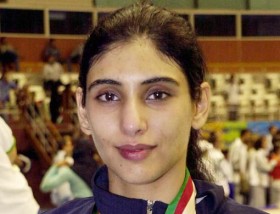
Dubai: Shaikha Maitha Bint Mohammad Bin Rashid Al Maktoum will be representing the country during this summer’s Olympic Games in Beijing.
Shaikha Maitha’s participation at the Olympics was announced by the UAE National Olympic Committee yesterday.
Shaikha Maitha has been cleared to participate in taekwondo in the 67kg category for women.
The UAE NOC received a letter dated March 18 from the International Olympic Committee endorsing Shaikha Maitha’s participation.
Joining the UAE national team captain will be Saeed Rashid Al Qubaisi in Judo in the 73kg category for men.
The UAE athlete was last week endorsed as the Best Female Arab Sportsperson for the second consecutive year following a poll conducted throughout the Arab region by popular website Maktoub.com.
Shaikha Maitha had polled the highest number of votes from among the 13 sportswomen from the 10 Arab countries.
Shaikha Maitha’s training schedule is supervised by renowned former world karate champion Sameer Jumaa in the company of the experienced trainer Moeena Jadeed. Earlier this year, Shaikha Maitha had been bestowed with the World Fair Play Award for 2006.
Memorable effort
Shaikha Maitha created history when she became the first UAE woman to win an international gold when she won gold in the +65 kg category at the 10th Pan Arab Games held in Algeria in 2004.
Probably her most memorable performance came during the 2006 Doha Asian Games when Shaikha Maitha won the silver medal in the +60 kg category.
$50m steel factory opened in RAK
$50m steel factory opened in RAK
By a staff reporter KHALEEJ TIMES 25 March 2008
DUBAI — Shaikh Saud bin Saqr Al Qasimi, Crown Prince and Deputy Ruler of Ras Al Khaimah, on Sunday inaugurated the $50 million RAK Steel factory in Al Ghail, Ras Al Khaimah.
RAK Steel, a joint venture with Ras Al Khaimah Investment Authority (RAKIA), is an energy-efficient, environment-friendly mill that will manufacture 500,000 tonnes of deformed steel reinforcement bars per year. The inauguration ceremony was attended by senior officials of RAKIA, dignitaries from Ras Al Khaimah Government, customers and suppliers.
The establishment of RAK Steel comes at a time when the demand for steel is at an all time high, thanks to the continued construction boom in the UAE and the Middle East region. The value of projects under construction in the UAE alone is estimated at $220 billion, while it is in excess of $800 billion in the GCC as a whole. A significant amount of this value will be for steel. Moreover, the Gulf Organisation for Industrial Consulting (GOIC) recently estimated that the UAE would use 44-66 million tonnes of rebar products over the next 15 years.
RAK Steel produces rebars from 8mm to 40 mm diameter in variable lengths of 6 to 18 metres to both British and American standards. The company uses the superior TEMPERIT process for manufacturing the rebars.
World’s biggest shopping mall to open in Dubai
World’s biggest shopping mall to open in Dubai
(DPA)/KHALEEJ TIMES 25 March 2008
Berlin -The biggest shopping centre in the world is being built in Dubai beside the Burj Dubai skyscraper and is due to open in early September.
“The Dubai Mall will have about 1 million square metres of space,” says Rene Hingst of Dubai Tourism at the recent ITB travel fair in Berlin.
There will be about 1,200 shops, an ice-rink and an aquarium, according to the real estate company behind the venture.
On completion, the Burj Dubai will be highest building in the world.
In addition to offices and private apartments, the building will also house the first hotel laid out by Italian fashion designer Georgio Armani which is due to open in 2009.
Tourists, who do not plan on staying in the hotel, will also be able to visit the building. There will be special tours with the highlight a trip to the tower’s viewing platform, which according to Hingst, will be the highest in the world.
At the moment, the tower has over 165 floors and will have a few more before it is finished.
The building’s final height has not yet been decided on, but the 600 metre mark has been passed. Total height will exceed 700 metres.


You must be logged in to post a comment.