Great Outdoors – Thrills & Spills

Thrills and spills
By Andrea Anastasiou, Staff Writer GULF NEWS Published: December 18, 2007, 22:59
From riding the dunes to skimming the skies and diving into the azure blue of the Arabian Sea, the Top 10 list of outdoor activities in the UAE is a thrill fest.
The end of another uncomfortable UAE summer signals the start of the season for people to enjoy the great outdoors. During the next few months, there is an abundance of outdoor activities and events to be enjoyed by families, thrill seekers and sports enthusiasts alike. Here are ten of the absolutely ripping best.
Dubai Seaplane
Seawings offers you the opportunity to enjoy and marvel at the ever-changing Dubai skyline from a Cessna 208 Caravan Seaplane. There are three tours to choose from, and some of the sights that are to be enjoyed from 1,500 feet are the Palm Jumeirah, Burj Al Arab, Downtown Dubai and Dubai Creek.
Location: Jebel Ali Hotel
Cost: Starts Dh795 per adult
Contact: Seawings (+97148832999) or visit: http://www.seawings.ae
Movies under the stars
Every Sunday from 8 pm you can enjoy some of your favourite movies under the stars at the Wafi City garden rooftop. There is a different theme every week, with Ghost, Seven and American Pie being some of the past movies shown. Giant beanbags, popcorn, pizza and hot dog stands heighten the chilled out ambience.
Location: Wafi City Rooftop, entrance through Carters
Cost: Free
Contact: Wafi City (+971 4 3244555)
Absolute outdoor adventure
For true outdoor activity enthusiasts, Absolute Adventures offers all types of experiences at its beachfront facility in Dibba.
The centre is set among the region’s best trekking, mountain biking, kayaking, rock-climbing, diving and sailing areas, and is equipped with quality outdoor gear. For the full experience, take a group of friends and spend the weekend here and indulge in a fun list of outdoor activities.
Location: Karsha, Oman, on the UAE-Oman border
Cost: By quotation
Contact: Absolute Adventures (+9713459900)
Dubai Surf School
Take to the azure blue waters with Dubai’s first surf school, Surf Dubai, and learn how to ride the waves with the professionals. Dubai’s coastline suits the novice surfer due to the manageable waves. Lessons are offered daily, and specialised learner surfboards are provided.
All lessons are subject to sea conditions; you can receive daily Wave Alerts by signing up on the company’s website, (www.surfingdubai.com) and then call to book lessons at your convenience.
Location: Sunset Beach, Near Ladies Club, Dubai.
Cost: Starts Dh175 for adults, and Dh150 for children
Contact: Surf Dubai (+971505043020)
Desert safari
A popular outdoor experience is the desert safari; trips into the extensive desert are the ultimate UAE pastime. Many companies offer these excursions, with camel riding, dune bashing and safari skiing just some of the activities that are on offer whilst in the desert, in addition to the 4×4 wheel drive to reach ‘camp’.
Some packages include overnight stay with traditional Arabic entertainment in the form of belly-dancing, henna painting and shisha smoking.
Some companies that offer desert safaris are Arabian Adventures (+97143034888), and Desert Rangers (+9714 3402408)
Hot air balloon flight
You can now experience the moon-like landscape of the Hajj mountains, the Dubai skyline, and the giant dunes of the UAE from a hot air balloon. The trip lasts for approximately an hour and is suitable for most people, making it possible for families with children over the age of five to have an adventure in a safe environment.
Cost: Dh880
Contact: Balloon Adventure Dubai (+97142854949)
Dhow boat cruise
Take a dhow cruise on the Dubai creek to marvel at the city’s architecture and changing skyline. Many different tour companies offer cruises with some offering packages including food and beverages and live entertainment such as belly dancers and Arabic music. Some companies that offer Dhow Boat Cruises include Creekside Leisure (+971 4 3368407) and City Smart (+971 4 2246 181).
Tandem Sky Dive
The thrilling experience of a tandem sky dive from 12,000 feet is a must for adventure seekers, and this can be done at the UAQ Aeroclub in Umm Al Quwain. Accelerated free falls are also on offer for the extremely brave.
Location: Umm Al Quwain
Cost Tandem sky dive with an instructor, Dh1000.
Contact: (+971067681447)
Camel racing
Camel racing is a deep-rooted traditional sport that finds its origins in the desert culture of North Africa and the Middle East. The UAE has 15 racetracks with spacious and well-kept stadiums for viewers. Camel races take place from late October to early April, and periodically throughout the rest of the year. The races generally take place on Thursdays, Fridays, and Saturdays throughout the winter season or on five-day events held in the UAE’s larger centres.
Contact: Nad Al Sheba Racecourse (+9714322277)
Water sports
Dubai International Marine Club is a beach resort that offers a large variety of water sports and pastimes including windsurfing, sailing, fishing, and scuba diving. There are also the Beach Olympics for incentive and corporate groups. The DIMC also hosts a number of racing events for vessels ranging from traditional dhows to modern yachts.
Contact: Dubai International Marine Club (+97143994111)
Photo Speaks – Passing Shots – Year 2007 that was
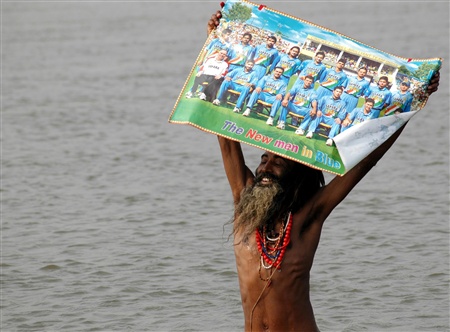
A Sadhu, or holy man, holds a poster of Indian cricketers and shouts slogans for their good luck at Sangam, the confluence of three rivers, the Ganges, the Yamuna and the Saraswati, in the northern Indian city of Allahabad March 12, 2007.
REUTERS/Jitendra Prakash
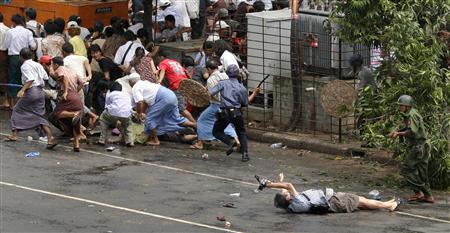
Kenji Nagai of APF tries to take photographs as he lies injured after police and military officials fired upon and then charged at protesters in Yangon’s city centre September 27, 2007. Nagai, 50, a Japanese video journalist, was shot by soldiers as they fired to disperse the crowd. Nagai later died.
REUTERS/Stringer

President George W. Bush departs the Oval Office of the White House for a day trip to South Carolina November 2, 2007.
REUTERS/Kevin Lamarque
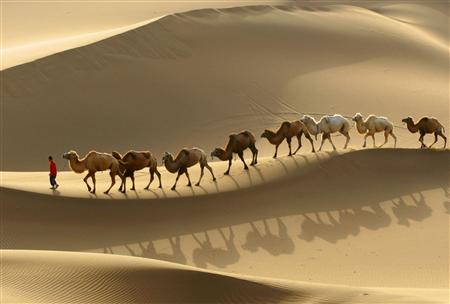
A local farmer leads a row of camels at a tourism resort of the Kumtag Desert in Shanshan county, northwest China’s Xinjiang Uygur Autonomous Region October 4, 2007. Kumtag desert has been developed as a tourist resort where visitors can have a full view of the magnificence of the desert without actually venturing out into it, local media reported.
REUTERS/China Daily
Eid Al Adha holidays in the UAE
Eid Al Adha holidays in the UAE
Staff Report GULF NEWS Last updated: December 18, 2007, 15:39
Dubai: During Eid Al Adha, schools in the UAE are closed from December 17 and will re-open on January 6, 2008.
The UAE stock market will be closed from December 18 to December 22 and will
re-open on December 23.
Banks will be closed for four days from December 18.
Public sector employees get a five-day holiday from December 18, while private sector employess get a three-day holiday from December 18.
Naturalisation and residency departments in Dubai and Sharjah will be open from 9am to 2pm on Tuesday and Thursday for emergency services.
Motorists in Dubai get free parking from December 18 to December 21.
All post offices will remain closed on Wednesday, December 19.
However, postal services will be available at main post offices during rest of the Eid holidays from 9am to 1pm.
The offices which are open includes, in Abu Dhabi: Abu Dhabi Central Post Office, Hamdan, Al Butain, Musafah, Beni Yas, Nadi Al Seyahi and Al Ain Main Post Office.
In Dubai: Dubai Central Post Office, Satwa, Al Khor, Jumeirah, Rashidiyah, Hor Al Anz, Jebel Ali, Deira Main Post Office, International City and The Village (Jumeirah).
In Sharjah: Sharjah Central Post Office, Al Corniche, Al Ghuwair, Kalba and Khor Fakkan.
In Ajman: The Ajman Central Post Office.
In Umm Al Quwain: The Umm Al Quwain Centre Post Office, Sanaiyah and Al Souq.
In Ras Al Khaimah: The Ras Al Khaimah Central Post Office, Al Nakheel and Al Uraibi.
In Fujairah: The Fujairah Central Post Office and Dibba Al Fujairah.
The Airport Post Office will be open 24 hours on all days.
The counters of all other branches of Emirates Post will be closed during the holidays.
Managing anger to cut out negativety
Managing anger to cut out negativety
Harleen Kaur
“I will do what I want to do whether you like it or not.” Have you heard people talk like that without a care for anybody other than themselves?
Have you seen people get angry if things don’t happen their way? What follows is a lot of emotional turmoil for them and their family. We all like to have our way and in today’s world we actually demand it.
God forbid if things don’t happen the way we want them. Are we not experiencing a lot of road rage and rampant killings simply because we don’t have a grip over our anger. We just lose control!
My teacher grand master Choa Kok Sui (modern founder of Pranic Healing and Arhatic Yoga) says, “Anger is destructive.” So when someone is getting angry and you respond with anger, what you get back is only anger and more of it.
He says, “Some people sting a lot. Do not respond to their provocation, unless it is can be done incisively. The moment you react, you are psychologically entangled. This is exactly what they want. They want your attention. They want your energy. Do not respond. Keep your distance.”
Can you imagine not being angry if someone screams and shouts at you? Can you imagine just ignoring such a person or telling a person to calm down or simply walking away from such a situation?
He says, “Do not react or allow yourself to be sucked into a whirlpool of turmoil. Similar energies attract one another Gentleness will draw gentleness. Anger and hatred will only attract anger and hatred.” So what is our lesson from this? The only way to handle such people and situations is to forgive and forget.
Easier said than done but mindful daily practice can really inculcate the habit and give you amazing results. If you learn to forgive and forget you will be free! Free to be happy and peaceful. That is the only way. Otherwise, all of us will go on spreading negative energy and suffering because of it.
One, two, three… click

An effective photo draws your eyes into the shot and then all the way around the frame. Megan Hirons/Gulf News
One, two, three… click
By Megan Hirons
Gulf News photographer Megan Hirons is often asked for advice on how to take great photos. Here she shares 10 tips for improving the quality of your pictures.
1. Know your camera
Read the instruction manual for your camera. Get to know your camera’s features and settings. Experiment with different settings to learn what results they produce. Play. Your camera is your friend, so spend adequate time and energy with your camera. It will serve you to the best of its ability.
2. Move your subject out of the centre of your frame
If you place your subject anywhere in your frame outside of the centre, you are assured of a more dynamic shot.
3. Don’t be afraid to take too many photos
In this age of digital technology, there is no film to waste. So take more pictures than you need; you can always delete them later. Move around, get high, go low, change perspective, use your flash, turn your flash off, zoom in, zoom out. In other words, play. Find out what suits your eye. Taking photos should be fun, so enjoy it.
4. Shoot with the sun behind you
Look at where the sun lights the things around you and go with it. Shooting into the sun causes flare – those circles of light you sometimes see in photos. Flare tends to destroy the saturation and contrast of your pictures. To avoid it, shoot while the sun is on your side or behind you.
5. Get close to your subject
Stay away from zooms and get close to your subject. You can feel the presence of someone who is close to the camera in the final shot. It adds a personal feeling to pictures that tends to be lost when you shoot from far away.
6. Make use of the ‘magic hours’
Try to stay away from taking photos at noon. The light is very bright, high contrast and tends to wash out colours. Try to make use of the ‘magic hours’ – before 10am and after 3:30pm. The light is warm and soft, and colours tend to be more vibrant.
7. Use available light when possible
The flash is highly overused and can flatten images, taking away the shadows that give definition and depth. Make use of natural lighting when you can. It looks the most natural to our eyes.
8. Work with the natural lines of the scene you are shooting
An effective photo draws your eyes into the shot and then all the way around the frame. Work with strong lines, be they vertical or horizontal, to lead into the photo. Frame your image accordingly to take advantage of these lines.
9. Turn your camera to shoot vertical
Remember, you can hold the camera vertically to shoot vertical images. Shooting vertical is effective for portraits and architecture, and can suit many other kinds of photos. Don’t forget to rotate your camera from time to time to vary your shots.
10. Look at photographs
One of the best ways to improve your eye for photography is to simply look at other people’s photos. Use Internet, newspapers, magazines and coffee table books for inspiration.


Top 10 tips to save money for your start-up
Top 10 tips to save money for your start-up
Before you turn to the bank for a loan, think about creative ways to finance your business without raising start-up capital from external sources. Here are 10 top tips:
Start small: Even if you have a grand vision for your business, concentrate on generating short-term revenue to get enough cash to fund the long-term business idea.
Focus on sales: Get on the phone and start cold calling. Go for quick wins — contracts that bring in cash and will lead to other sales. Generating cash flow is the immediate goal in order to start building your business.
Concentrate on networking: Don’t waste money on expensive advertising which can be a hit or a miss. Concentrate on networking and building up contacts, as word of mouth is the most effective form of promotion.
Keep overheads to a minimum: Work from home if you can and borrow or lease rather than buy expensive equipment. It’s easy to get carried away resourcing a new business, but only buy what you really need to get the job done.
Choose wisely: Open a company bank account that offers free business banking for start-ups for at least the first 12-18 months. Internet banking makes it easier to keep a close eye on transactions.
Control debt: Utilise a 0% credit card for essential expenditure, — but be careful to keep debt under control and either pay it off or transfer to another 0% card well before the interest rate goes up.
Invoice your clients in stages: 50% at the half-way point and 50% on completion. Make sure you have clear payment terms in the contract and on the invoice.
Retain cash in the business: Take as little out yourself as possible. This might mean going without a holiday or you may need to start your business whilst still in part-time employment to cover your bills.
Try business bartering: Offer your design services in exchange for goods and services you need. This saves you spending cash and can be a good way to develop relations with a new client base.
Put time into PR: Think of an unusual hook and write a press release or article. Conduct a survey about a topical or controversial issue with your potential customers. Publish the results as a story to attract free publicity for your business.
Excerpts from bytestart.co.uk
Silence yourself, not others!
Silence yourself, not others!
Pramahamsa Sri Nithyananda
In the olden days, people in India did not stitch clothes after sunset. This is because all stitching was done by hand with a needle. In the dim candle or kerosene lamp light it was not possible to see properly and one could get hurt by poking the fingers with needle.
Even now in India, some people will not stitch with a needle after sunset. Even seamstresses and tailors will not do it, though we now have electricity and lights. They may not even stitch using machines!
When we don’t have the necessary understanding of a practice, it becomes a dead rule, a superstition. With understanding, any rule can become a technique, a tool that helps us to lead life happily.
With deep understanding, it will dawn upon us that all rules were basically created to help people live blissfully and happily. The rules were meant to ensure that you were in peace with yourself and the others around you. Today, we have forgotten the basis for these rules. We create hell for ourselves and others with these rules.
There are people who truly believe that meditation and prayer will save their lives. They have been told so! They fuss a lot before they begin to meditate at home. They silence the children and all others around. They turn the whole household upside down. All for the sake of ten minutes of meditation!
Let us see how the meditation proceeds. The moment meditation begins, they doze off! After a minute or two, they will start swatting mosquitoes. A couple of minutes later, a major itch manifests on some part of their body. Then, the back will begin to ache. Enough is enough, they decide, “I will continue this tomorrow. It is enough for today.”
Meditation is done for the sake of peace and silence. Why meditate at all, if inner awareness cannot be created?
It is like a speaker trying to silence the listeners by out-shouting at them. Will it help? If the listener is not interested however much one shouts, it is of no use. You cannot silence your inner chatter by making others quiet. You need to become silent, not others.
We follow rules and tradition blindly. That is why religion has such a powerful hold on us. Let us awaken to the powers that are within us! Nature has endowed us with unimaginable energy to be free. Be alert, awake and reach for this liberation!
Ravi Mathai the living legend
Ravi Mathai the living legend
IIM Ahmedabad turned 46 earlier this week. This is as good an occasion as any to recall the services of its legendary founder-director Ravi Mathai.
Ravi Mathai, son of John Mathai, finance minister in Nehru’s Cabinet, was appointed the first full-time director of IIMA in 1965. (Vikram Sarabhai had been honorary director until then). The choice of Mathai was in itself remarkable. He was not an “insider” — the Institute had been set up earlier.
He did not have an advanced academic degree — he was a corporate executive who had only recently joined IIM Calcutta as professor. In a country that is still gerontocratic, he was obscenely young — he was 38.
It is a tribute to Sarabhai’s own leadership qualities that he made absolutely the right choice. By 1972, when he stepped down as director, Mathai had not only put IIMA on the national map, he had laid secure foundations for its continued success.
If IIMA has since gone from strength to strength, it is very substantially because of the strategic decisions taken in Mathai’s time as well as the culture, systems and processes he put in place.
In my nine-year association with IIMA, I have often been struck by the abiding impress of its founder-director. I remember attending the then director’s welcome address to the incoming post-graduate batch soon after I had joined. In the course of a 20 minute address, the director invoked Mathai’s name four times.
In the initial years, I noted with astonishment how almost any significant process would be traced back to Mathai. (“Oh, that happened in Ravi Mathai’s time”). Heads of institutions fade into oblivion within weeks of demitting office. Mathai is remembered at IIMA all the time.
What explains Mathai’s success and his profound impact on IIMA? First, a clear sense of purpose. IIMA’s concern, as Mathai put it, was “with the application of knowledge”. This meant that the Institute would be involved in teaching, research and consulting. The impact “would be greatest if it were the combined result of all activities”, so faculty must engage in all three activities.
Mathai saw clearly that to focus merely on business would limit IIMA. It would also expose it to charges of being elitist in its orientation. IIMA’s ambit needed to be wider: it would be an institute of management, not just a business school. It would develop expertise in important sectors, including agriculture.
Secondly, Mathai’s conviction that academic activities can flourish only when faculty are given the fullest freedom. In an academic institution, excellence cannot be ordered. It springs forth when people are given the space to grow and to express themselves freely.
Thirdly, the idea of a faculty-governed institute where decision-making rests primarily with the faculty and not with the director or the board. An example is the admissions committee that is independent of the director. The mechanism has been crucial in insulating admissions from unhealthy influence.
Fourthly, what is, perhaps, Mathai’s greatest bequest to IIMA: the principle of a single term for the director. After six years as director, Mathai stunned the community by announcing his decision to step down and stay on as professor. He gave two reasons for doing so.
One, leaders of academic institutions tended to use their positions for career advancement; this was not good for the institutions. Two, it was important to establish the principle that the director’s position is not hierarchical; he is only first among equals. You are professor, you become director and then you become professor again.
This one contribution of Mathai’s cannot be overstated. In the present scheme of things, the director has sweeping powers. The board of governors does not quite have the monitoring authority of a corporate board. Faculty governance can work only to the extent the director is willing to let it work.
Limiting the director to one term is vital to good governance. It is the knowledge that a director’s actions can be looked into once he has reverted to a faculty role, the certainty that he will be cut dead in the corridors by colleagues whom he has mistreated that acts as a check, however inadequate, on the incumbent.
There is more to Mathai’s enduring impact than his grasp of the principles of good governance in academic institutions. He managed the relationship with government with great skill. He was a superb man-manager with the gift of drawing out the best in people. Above all, he had moral authority: he brought to his office high integrity, a spirit of sacrifice and self-effacement.
India has been fortunate in having had great institution builders. At the national level, we had people of the make of Nehru, Patel and Ambedkar. At the organisational level, we have had the likes of Homi Bhabha, Vikram Sarabhai and RK Talwar (of SBI). In that constellation of institution builders, Ravi Mathai shines brightly.
Laser scanner for 3D view of tumours
Laser scanner for 3D view of tumours
ANI
LONDON: Scientists have developed a new laser scanner that can give 3D view of the deformed blood vessels inside tumours.
This scanner could prove beneficial to doctors in determining the boundary between cancerous and healthy tissue during surgery.
A novel form of non-invasive imaging called photoacoustic tomography is used by the scanner. A laser light to “twang” cells is utilized so that they emit an ultrasound wave, which is then detected and used to form a 3D image.
The present day ultrasound scanners capture images by aiming high-frequency sound waves at the body. These waves are reflected whenever the density of tissue changes, for example at the boundary between muscle and bone. The “echoes” that result then used to create a picture.
However, these scanners can be useful in capturing images of high-contrast subjects like antenatal scans, but gives rise to only low-contrast images of the inside of a tumor, as the density of blood vessels is similar to that of the surrounding tissue.
The high-resolution photoacoustic tomography scanner offers a solution for this problem. It has been developed by Paul Beard and colleagues at University College London, UK.
Very short pulses of non-harmful near-infrared laser light are thrown at the tumor. When this light is absorbed by tissue, the cells get heated up and expand a little, creating an ultrasound wave that can be detected by a sensor.
The intensity of the ultrasound wave depends on how well the tissue absorbs the near-infrared radiation. This results in high-contrast images of blood vessels because haemoglobin is very absorbent at these wavelengths.
“It’s very scalable,” NewScientist.com quoted Beard, as saying.
He added: “Our scanner is best suited to providing high-resolutions images at a short range, but the technique could be used to image tumours a few centimetres into the breast.”
The researchers also created a new ultrasound sensor so as to convert the reflected ultrasound into a high-resolution 3D image.
It comprised of a thin layer of a polymer sandwiched between two reflective layers. The outer layers only reflect certain wavelengths of light and the laser light used to penetrate a patient’s tissue shines straight through all three layers.
The polymer layer then picked up the acoustic signal generated using the infrared.
“This work demonstrates progress,” said Hao Zhang, an expert on medical imaging at Washington University in St Louis, US.
He added: “In my opinion, it is important for more precise quantitative measurements.”
However, Zhang points out two potential problems. At the moment it takes a relatively long time to capture the image, while the laser scans each reflective surface. In addition, the sensor is flat making it difficult to scan images over curved parts of the body.
However, Jeremy Skepper, a physiologist at the University of Cambridge in the UK said that the ability to image blood vessels at this resolution is very striking.
“It’s less expensive and more portable than other solutions,” he says. “It’s a powerful additional tool to the ones we already have,” he said.
Skepper also suggested that the device could prove to be highly portable in future owing to advances in laser diode technology.
 ClicksandWrites
You must be logged in to post a comment.