VAT not to be implemented in Dubai soon
VAT not to be implemented in Dubai soon
Staff Report Last updated: December 25, 2007, 00:05
Dubai: The proposed introduction of value-added tax (VAT) in Dubai is at least a year away, Dubai Customs said on Monday.
The emirate’s customs department said it launched the second phase of a VAT study last November to implement the tax on time but that does not mean it will be introduced soon.
“Entering the second phase of the VAT project does not mean that the implementation of the tax will be soon, because the process may take a year or more, due to the need to apply it in a professional manner and to meet, or even surpass the international standards,” Dubai Customs said in a statement, saying that some sections of the media had speculated about the implementation.
Liquefied natural gas poised to surpass oil as energy source
Liquefied natural gas poised to surpass oil as energy source
By Leah Bower, Special to Gulf News Published: December 24, 2007, 22:58
Oil may be the energy source on everyone’s mind right now, but there is a good chance that liquefied natural gas (LNG) will surpass it as oil prices remain astronomical.
Once a bit of a backwater in the energy field, demand for LNG has been on a steady rise because it is relatively clean burning and because its liquefied state allows for transport to remote locations without construction of elaborate and expensive pipeline networks.
And while it can’t hold a candle to oil’s price, quite a few analysts seem to see it as the bandwagon of choice to jump on to.
Worldwide demand for LNG during the first half of 2007 was pegged at roughly 115 billion cubic metres (bcm), roughly nine per cent growth over the same period in 2006, and demand in East Asia has been growing even faster.
Calgary-based Ziff Energy says it expects demand for natural gas in North America will rise by 1.8 per cent a year through 2015, and US Energy Department data backs up that claim, reporting that they expect imported LNG to increase from three per cent of total gas consumption to 14 per cent by 2020.
Currently, Japan is the world’s largest LNG consumer, importing 81.86 bcm of natural gas as LNG in 2006. South Korea is second and the US currently ranks as the fourth-largest consumer.
LNG is natural gas, but it is reduced to a liquid state by cooling it to about minus 160° Centigrade, which reduces the volume of the gas by about 600:1 and makes transportation far simpler. Before it can be used, LNG must be returned to its gaseous state at a regasification plant. For countries like Qatar, which is sitting on the world’s largest natural gas reserves – 25 trillion cubic metres – the renewed interest in LNG is a boon, since there is no need for pesky pipelines that travel through neighbouring countries before reaching their destinations.
Just ask the Europeans, who saw their natural gas get cut off in early 2006. Russia, where the pipeline originated, and Ukraine, which hosted part of the pipeline, had a price dispute. The two countries disagreed and so did the Europe’s energy supply. The dispute even resurfaced in 2007, although the gas continued to flow this time.
So LNG, with its ability to be shipped by sea or land, is slowly building a power base. And people like Qatar’s Energy Minister, who once said it was “bad news” that the country only had gas reserves and no oil, are starting to change their tune.
The International Energy Agency (IEA) reported that by 2010 Qatar could own 20 per cent of the global LNG market.
Other countries with reserves are hopping on board as well.
The Australian government expects energy production growth down under will be led by LNG, with exports of the fuel set to grow by more than seven per cent yearly, through 2030. That would have LNG output rise from less than 16 million metric tonnes in 2007, to 24 million by 2012, and possibly reaching as high as 76 million by 2030 as new projects come online.
Without the ability to ship liquefied natural gas, this type of growth would have been almost inconceivable. Already the $16 billion) North West Shelf venture is expanding LNG capacity, while Perth-based Woodside is building the Pluto project, also in Western Australia.
Chevron is planning to expand its $10 billion liquefied natural gas project known as Gorgon, which now calls for three liquefaction production lines, instead of two. Inpex Holdings and BHP Billiton are also proposing new plants.
Get on board while the year is new.
The writer is a freelance journalist based in Alaska, USA.
Creative wavelengths
Creative wavelengths
By Shalaka Paradkar, Staff Writer GULF NEWS Published: December 21, 2007, 02:31
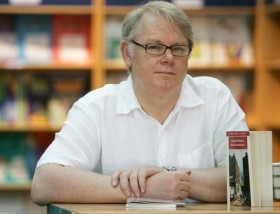
The task of a radio dramatist is … challenging. Aside from working within the limitations of the medium he also needs to compete with its much flashier, more attractive cousin – the television. But, says Nick Warburton, who has straddled both media, it’s all about storytelling and that is the role of his life.
Radio, they say, is a theatre of the mind, and television the theatre of the mindless.
Television supplies one with images to go with a story; radio allows an audience to create their own images from what they hear.
Writing for radio can be liberating: there are no fancy sets or dazzling costumes to worry about when scripting a period piece or science fiction saga.
The writer decrees the story is set in, for instance, the 11th century or the 23rd, and from then on, it’s the audience’s imagination which takes over.
The physicality of the actors also does not matter. They can be of any shape or size or height (or a lack of it), wearing designer clothes or a pair of faded jeans or a potato sack … All that matters is their voice.
If all this makes you think that writing for radio can be immensely satisfying and liberating, you may
not be far off the mark. But you must realise that it can also be considerably challenging.
Success is not easy in this field, thanks in no small measure to radio’s shrinking audiences and the overarching, Godzilla-like presence of television channels.
Nick Warburton is one of an endangered species: a highly successful radio dramatist. Warburton has written more than 50 scripts for radio, including Conversations from the Engine Room (joint-winner of the BBC/Radio Times Drama Award in 1985); adaptations of Tolstoy’s Resurrection, Father and Son by Edmund Gosse, the children’s classic Moonfleet and Lark Rise by Flora Thompson.
A Grove of Straight Trees was short-listed for the BBC/Radio Times Drama Award in 1993, and A Soldier’s Debt was the BBC entry for the 1999 Prix Italia.
He is also a fairly successful television writer, having scripted immensely popular series such as Doctors, Holby City, EastEnders and Born and Bred.
He straddles the divide between radio, television, stage and novel writing with consummate ease. Seven novels for children and young adults have been published, as have short stories and stage plays.
Among his children’s books are The Thirteenth Owl, To Trust a Soldier, Ackford’s Monster and Lost in Africa. He has run courses on creative writing in the UK, in West Africa for the British Council and in Dubai.
Warburton was in the UAE to conduct creative writing classes for school teachers at The Magrudy’s Educational Resource Centre in Dubai. Here he was among his own: Warburton was a primary school teacher for 10 years, before he took the plunge into full-time writing.
Little wonder then that his advice for Dubai’s aspiring writers was born of his own experience: “It seems to me from the people I have been talking to, that there are a lot of people here who are keen on writing. I would say to them, have a go at it, keep trying. You will never know until you have tried.”
I
The education I got … was very formal. We were not encouraged to look at plays – and plays are mostly what I do now. Theatre was a peripheral interest really. We did not come from a privileged background, so I did not go to the theatre much, perhaps just the occasional visit to the pantomime.
As a child, when people asked me what I wanted to be, I would say a policeman or a farmer. Later on, when
I realised those were unreasonable vocations for me, I thought I would be a teacher, work in a library, close to books.
And, in fact, a teacher is what I became. But I always wanted to be a writer, and eventually, I decided I would have to try to be a writer.
I don’t think too much of the audience when I write. It’s not that I don’t care about them, I do.
But you get involved in the story… therefore what you don’t think about is, “What shall I do next to please them”. (This is odd because part of what you do is playing a game with the audience, an imaginary game.) I prefer to get completely absorbed in the story.
I don’t deny myself reading books. I buy more books than I am able to read, it’s an indulgence.
I am also passionate about … cricket. The BBC broadcasts ball-by-ball coverage of every Test match involving England. It’s called Test Match special.
Part of the tradition is they invite a guest on the Saturday of the match. So I got to be Christopher Martin-Jenkins’ guest in View from the Boundary on Test Match Special this July, England v. West Indies at Headingley – it was the highlight of my career.
I had written a cricket-based radio play, entitled Lawn Wars, about a man who tries to bowl the perfect off-break.
Me
Me and school
I can hardly remember a time when I did not want to be a storyteller. When I first knew what stories were, at a very early age, I thought it would be a very wonderful thing to do. But there were very few people where I lived, who told stories for a living. Certainly no one in my family.
Storytelling was the sort of thing you kept as a secret, as a private wish.
I grew up in Woodford, an ordinary suburban area just outside London. I had a happy, ordinary childhood. I didn’t get along too well with my brother (we do now!) – we were too close in age and too different in temperament.
My sister is much younger. One of the things I remember particularly well is our holidays when we went to the Norfolk coast. We had seaside holidays, but also country holidays – where we could run free.
When reel-to-reel tape recorders came in, we managed to save enough to get one. My friend and I, a pair of
11-year-olds, would disappear into our shed, make up stories with sound effects (like a ruler twanging), and record these stories.
They were silly stories, but I suppose (the idea of) working in radio generated quite early in my life.
At school, I was a slow student, dreamy, not very capable, not very good at many things. I liked doing pictures and writing stories – and I thought I wasn’t going to get far with either of these.
Those days we had an exam at 11 – if you passed it, you went to grammar school. If you failed, which a majority did, you went to a secondary modern school. I failed.
But along the way you meet teachers who are keen on their subject, especially English teachers, who loved the language, the stories, the books, and that conveyed itself to me. Many of them took an interest in their pupils.
I had several teachers who were like mentors to me.
I never studied writing. After high school, I went to a training college, to train to be a teacher. I was always interested in writing.
But I had to get a proper, paying job, so I went into teaching – not from any desire to be a teacher. Though later on I did get interested in teaching, and liked it. I taught primary school for 10 years, teaching children everything: games, English, needlework even.
I tried to write at night after teaching in the daytime. But I was quite burnt out creatively and tired (because) teaching is quite a demanding job. It wasn’t until I stopped teaching that I had the chance to write properly.
Me and becoming a writer
My wife Jennifer – whom I met and married when I was teaching – and I discussed it. She knew what I wanted to do, I couldn’t have done it without her. It would have been impossible. She made it possible.
We talked about how I would feel if I got to be 60, and had not even tried to do what I really wanted to do. I thought I would be very disappointed, to put it mildly. So we decided that I would try and give writing two years, and see what I could do in two years. I had never attempted this, I had nothing published.
In 1979, I resigned from my teaching job and went to see my head teacher, a wonderful man called Harold Holt. I told him I wanted to resign, and not because I had another job, but because I wanted to be a writer.
He gave me my first commission – a play that the children could stage next year. It wasn’t much money, but it was a wonderfully supportive gesture.
I wanted to get a professional commission in those two years, and right at the end of it, I did. I got to write a radio play.
We had little savings, since we were not paid much in those days. Jennifer was still teaching, so we lived on her salary. I got a part-time job which enabled me to provide “bread and milk”.
I had self doubts, yes, wondered all the time. But I loved doing it. I did not know what to do: whether I wanted to write a play or a book. I went for short courses to learn writing.
Mostly I picked up enthusiasm from these classes. There’s not a great deal you can learn about how to do it. There are some things you can learn, but you have to be able to do it in the first place, I suspect. In that time, the more I wrote, the keener I was on writing.
Me and radio plays
After my radio play was accepted at the end of the two years, it was enough for me to carry on. The commission seemed like a lot at the time, it was about £300.
The play was called The Colonel’s Wife. It came to me in a dream. I changed a few things, wrote it out and sent it to the BBC who bought it. It wasn’t easy to break into radio then. There were no training courses.
Unlike now when there are university courses and guidance from the BBC. They were, however, open to people sending them scripts. That was a good thing.
After that I continued to write and have ideas for radio plays, as that was the first thing that was accepted. In 1985, I entered the BBC competition called the BBC/Radio Times Drama Award.
I was declared joint winner for my play, Conversations From the Engine Room. That play made a huge difference. There was a cash prize, and they also broadcast the play.
It gave me a lot of confidence. Someone at the BBC then recommended me to get an agent. I got an agent, and that helped me bag proper writing jobs.
There is a strong, faithful and limited audience for radio in the UK. There’s also the World Service. Under recent cuts, the World Service’s drama output is being cut back. It’s a regrettable, backward step.
The BBC is independent from the government, they have their own funding through the license fee and therefore they provide an independent voice.
They can do culturally refreshing, educative things which do not require, or are restricted, by advertising. It would be great to see public service broadcasting in other countries as well.
Me and scriptwriting for television
The transition to television came almost by accident. I was, and still am, very happy writing for radio. A producer I had worked with had moved on to television. She phoned me and told me of someone who was looking for a writer for a new TV show they were producing.
When you are a freelance writer, you say yes. You don’t turn things down, especially at the beginning. So I agreed. It was for a series called Doctors. I sent them some ideas, they liked one and asked me to turn it into a script. They liked it, and I ended up writing for TV.
Script editors move from show to show. My script editor moved to Holby City, so I did and ended up doing a stint there. That was followed by Eastenders, then Born and Bred. Now I am back to Holby City.
In television, the most frustrating part is that you have to realise you are part of a team. That can be a very big team. It can also be rewarding in itself.
But if you have got your own voice, things that you want to say, it’s harder to say those things on television. That’s why I prefer radio. You can say all sorts of things on radio, and there’s someone there prepared to listen to you, at least in the first instance.
The series, Jewel in the Crown, is an example of good television at its best. I don’t watch much television. I watch what I have to watch.
Me and the job of writing
The hardest part is that commissions can be few and far between. Now it’s just the opposite for me. I have got too much to do. It’s very difficult for me to balance the number of commissions.
I have a lot of plays I have to write for Christmas and beyond. Which is fantastic. I am always reminding myself of how lucky I am.
But that can also get relentless, you never get a break from it. But that’s the life of a writer.
I don’t know how I stay creative despite all the pressure. It’s partly because I waited so may years before I started writing, I still have a lot of energy.
Mostly because I still love doing it. It’s never a chore to go in and start writing. I love the opportunities it presents – especially with scripts – to work with other people – directors, actors, producers.
I am a member of the Writers Guild and Society of Authors. They are a kind of unions of writers, so the writer’s voice, though its quite a small voice, is heard.
Solidarity among writers is quite important. Although I am not a very active union person, I think belonging is important.
I have an office in the garden of my home and another in town (Cambridge, UK). I cycle to work, I get there before 9 am and I am usually there till 7 pm, seven days a week (unless I have to go for recordings).
I try and keep a disciplined working life. What I can’t do is sit around and wait for inspiration. I don’t think writers should do that either, or they would never get much done. Even on days when it is hard.
Myself
What is a writer’s role in society?
You can get a bit too grand about this. A writer, in the end, is a storyteller. I would go a bit further and say, people need stories and storytelling. Stories help people understand each other and themselves; at their best, stories help people to reconcile themselves to themselves.
You can very easily say to yourself there are many more important things to do in life, and there are. Jobs where you actually make a difference or where you save lives, or like Jennifer as a teacher who makes a huge contribution to young children in a positive way.
I don’t do that. But I would still argue that stories are important. You don’t come across a culture where there are no stories. Telling and re-telling stories is my role in my life.
Where would you draw the line?
I have never been asked that question, and it is a difficult one to answer. The story is important and I think you have to be true to it. And that means avoiding cheap effects.
It’s hard to say more than that really. I am interested in all sorts of stories from all over the place and all around me. I don’t know if there is an area I wouldn’t write about.
I wouldn’t write about issues I wouldn’t politically agree with – not necessarily as party politics, but cheap, exploitative stuff. I don’t think I have said the final word on any issue.
There isn’t anything that I have written out of my system.
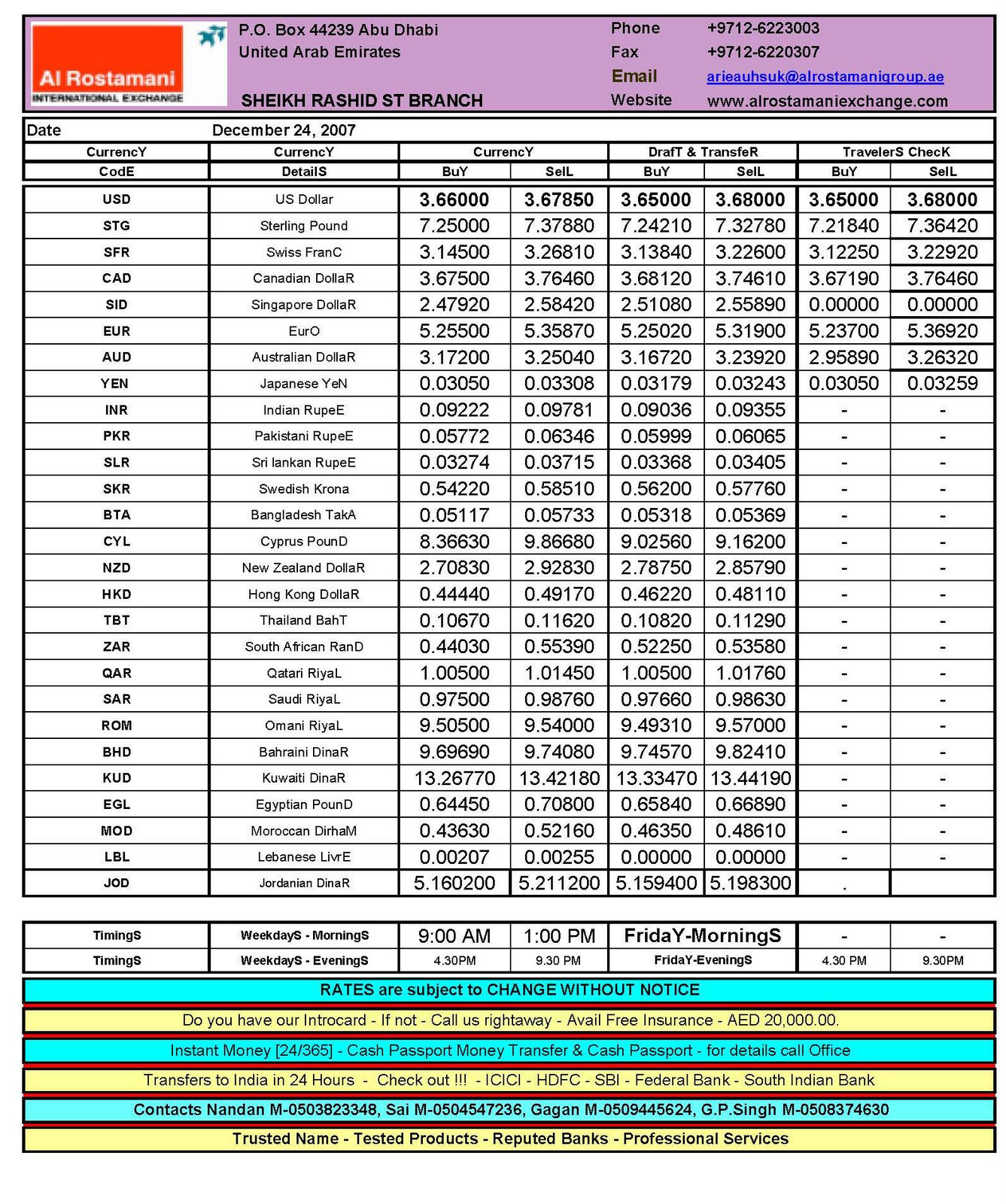
Daily Exchange Rates – Monday, 24 December 2007
Brought to you by
Al Rostamani International Exchange
Abu Dhabi
Phone: +9712 6223003
http://www.alrostamaniexchange.com
UAE’s crude production falls 18% in November
UAE’s crude production falls 18% in November
By Himendra Mohan Kumar, Staff Reporter GULF NEWS Published: December 23, 2007, 00:36
Abu Dhabi: The UAE’s crude oil output fell by more than 18 per cent in November, mainly due to maintenance being conducted on some offshore fields, the Organisation of Petroleum Exporting Countries (Opec) said in its market report for December.
The UAE pumped an average of 2.12 million barrels per day of crude oil in Nov-ember, making it the seventh largest Opec producer last month, the group said.
Citing secondary sources, Opec said that oil production by Saudi Arabia, Iran, Kuwait, Venezuela, Nigeria and Iraq was higher than that of the UAE.
Offshore field maintenance in Abu Dhabi, which produces more than 90 per cent of the UAE’s oil, reduced production in Nov-ember by as much as 481,000 bpd.
The fields that were particularly affected were Umm Shaif, Upper Zakum and part of Lower Zakum.
Industry sources say full output is expected to be restored shortly.
Crude oil production by all 13 Opec members averaged 31.45 million bpd in November.
Abu Dhabi will invest $20 billion to boostoil and natural gas output.
Beware! You could be buying a used e-voucher

Beware! You could be buying a used e-voucher
By Rayeesa Absal, Staff Reporter GULF NEWS Last updated: December 23, 2007, 16:00
Abu Dhabi: Purchasing etisalat’s e-vouchers from unauthorised dealers can cheat you of your money.
etisalat’s prepaid telephone cards printed from a dispenser machine are called e-vouchers and allow customers to recharge credit for their Wasel accounts. However, they are also available at unauthorised shops who trick customers, especially tourists, into buying used pre-paid telephone vouchers.
“I purchased a telephone card worth Dh25 from a mobile shop at Hamdan Street yesterday. After returning home I entered the pin number but heard the automated reply that the number I entered was wrong”, said Hazeef Haneef, an Indian draughtsman, who came to the country a few weeks back.
Haneef contacted the etisalat customer care division to find that the first call using the card was made hours before he purchased the card from the shop.
“The customer care official asked for the serial number on the print out and confirmed that the first call was made at 10 am in the morning while I bought the card at 1 pm”, Haneef said. “It was later that I realised the printout showed the date as December 21 and the time as 6.30 pm, he added.
A grocery owner, who requested anonymity said, “Unauthorised shops who do not have the etisalat dispenser machines purchase evouchers in bulk from shops that have the machine. They staple these printouts together and sell them at the counters.”
SHASHI ON SUNDAY: Kamalesh Sharma: He’s the right choice
SHASHI ON SUNDAY: Kamalesh Sharma: He’s the right choice
TNN
The election of Kamalesh Sharma as Commonwealth secretary-general is a welcome development at various levels. First of all, because it places an able Indian at the helm of an important international institution, something we have not seen in a long while. Second, because it marks the successful culmination of a skilful and focused diplomatic electoral campaign by the government. And finally, because it demonstrates to the world that India is ready and willing to assume additional responsibilities on the global stage.
Kamalesh Sharma has not been well known to the Indian public; this will now deservingly change. I have had the pleasure of counting him as a friend for two decades, since we first met in Geneva when he arrived as a youthful Indian ambassador to the United Nations system there. Since then i have watched him at close quarters as a highly effective Permanent Representative of India to the UN in New York, as a respected and statesmanlike UN head of mission to newly-independent East Timor, and most recently as India’s High Commissioner to the United Kingdom, where he has cultivated close relations across the political spectrum with the Britons whom India needs to advance its interests. He has a first-rate intellect, an eclectic set of passions from cricket to calligraphy, a direct and disarming personal manner and a beautiful and gracious wife, Babli. India could not have found a better candidate to offer the Commonwealth, and that institution is undoubtedly fortunate to have him steering its fortunes in the years ahead.
It is also gratifying that the government did everything right. It nominated an able candidate early enough so that others could not develop momentum before him. It ensured that the key members of the Commonwealth were consulted and brought on board at the very beginning, and that London, in particular, was supportive from the start. And it worked to canvass all 53 member states diligently and repeatedly, at both the political and bureaucratic levels.
One rival, from Malaysia, was sufficiently intimidated by the quality of the Indian effort that he dropped out well before the vote. The other principal contender was no pushover: I have known Michael Frendo, the Maltese foreign minister, even longer than i have known Kamalesh Sharma, and he is a young, smart lawyer with a modest and friendly diplomatic style who was certainly a formidable contender. Victory over him could not have been assumed, and wisely, it was not taken for granted by New Delhi. Given that the last time we ran a candidate for Commonwealth secretary-general (Jagat Mehta in 1979) we came a cropper, this was a sterling effort, even a model of its kind.
It helped, undoubtedly, that the world as a whole is now looking to India to provide global leadership on the multilateral stage. Few developments across the world have received as much attention in the chanceries of influential governments as India’s rise to economic strength in the last 15 years, and with that new-found prosperity and progress has come a revised set of expectations of our country. It is assumed by many foreigners that a self-confident and resurgent India would be prepared to play an even greater role in the world: just as Indian businesses are conquering foreign markets and taking over western companies, from Arcelor to Corus, so, too, might Indians take their rightful place in charge of international institutions. For many years New Delhi had been curiously diffident about projecting its own; the fear of defeat always seemed to prompt hesitation about putting forward possible candidacies. Once upon a time no fewer than three UN agencies were simultaneously headed by Indians – C P Srivastava at the bridge of the International Maritime Organisation, S S Gill at the cockpit of the International Civil Aviation Organisation, and Arcot Ramachandran on the rooftop of the UN Centre for Human Settlements. Today, we only have the estimable Rajendra Pachauri heading the Intergovernmental Panel on Climate Change, but that is a part-time job leading a technical committee, not a full-fledged international organisation. Other possibilities had opened up since the doughty Indian trio retired, but caution usually asserted itself – ”why bother?” contending with ”what if we lose?” Many foreign diplomats used to say privately that they were waiting for India to assert itself. With Kamalesh Sharma’s successful candidacy, we have done so, and other opportunities await.
Some highly-placed people in governmental circles in New Delhi had wondered whether the Commonwealth was an institution worth risking India’s prestige for. I have no doubt that it is. It has the great merit of being a multilateral institution bringing together countries large and small, rich and poor, black and white, from the global North and South, united by a common language. It is also blissfully free of vetoes from either of the two superpowers (one established, the other emerging) of the 21st century – no minor consideration since they are two governments who, for different reasons, might hesitate to share in the general enthusiasm for Indian leadership. As such, the Commonwealth will offer an able and articulate Indian secretary-general an invaluable platform to express an alternative vision of the world. The brilliant Guyanese Sir Shridath Ramphal demonstrated in the 1970s and early 1980s what an important voice a Commonwealth secretary-general can have in world affairs, far more than the mere head of a bureaucratic secretariat. Kamalesh Sharma has the experience, the wisdom and the ability to do no less.
Every thinking Indian, therefore, has reason to be proud of the news from Kampala last weekend, and to wish Kamalesh Sharma well as he puts a firm Indian foot forward in the global march to a better world.
Shashi Tharoor for Times of India
Four-and-half-year old hits karting track

Four-and-half-year old hits karting track
23 Dec 2007, 1914 hrs IST,PTI
CHENNAI: Karoon Murthy is just four-and-a-half years old but he is already blazing the karting tracks, which could possibly make him India’s youngest go-karter.
The UKG student, though cannot race in competitions till he is seven, he is racing here and in Bangalore on adult karts and is giving his elder competitors a run for their money.
Karoon probable has it in his genes, being the son of Kaushik Murthy, three time former national biking champion for TVS.
“Karoon was racing on battery karts since he was two-and-half years. Now he has begun to race on adult karts, which even many adults find difficult to race on,” says Kaushik.
A video of the child racing against a 13-year-old on a Karting track shows his potential. Not only does Karoon take the corners flawlessly but also races his elder competitor easily.
The third generation racer from the family, Karoon, a student at GRT School here, would also begin training in motor racing. Kaushk recently imported a Ninja racing bike for Karoon for this purpose.
“I plan to train him professionally. There is no one who can do both kinds of racing — car and bikes. We hope that he will be able to do both. He will start training on the bike at the Irungattukottai tracks soon,” he said.
Kaushk, who runs a team of professional stunters here called ‘Angels Racing’ and another team in Bangalore ‘Grips Racing’, says he was working on a training modules for Karoon.
“Akbar Ibrahim was my coach. We will put Karoon under his management once he starts racing. He knows what is best,” he says.
‘Fighting it out has made me stronger’

‘Fighting it out has made me stronger’
TNN / Sumit Mukherjee
If things go according to the script, Sourav Ganguly will step on the Melbourne Cricket Ground turf to play his 100th Test on Wednesday. TOI caught up with the ‘Bengal Tiger’ in Melbourne for a heart-to-heart chat.
Excerpts…
Looking back on your career, are you happy with what you have achieved?
I have enjoyed some very good times and also gone through tough periods. What’s important is that I have been lucky to be a part of Indian cricket during one of its most successful phases. It’s easily the high point of my career.
Have you seen many changes in Indian cricket during your time?
A lot of things have changed since I made my Test debut in 1996, especially in terms of training and approach to the game. I have no doubt in my mind that it’s because of these changes that our performances overseas have improved.
You have been a part of a core group of exceptionally talented players. Did you enjoy the ride?
It has been a privilege to play alongside people like Anil Kumble, Sachin Tendulkar, Rahul Dravid and VVS Laxman, for they are special players. Together we have seen Indian cricket progress. The period between 2000 till the end of the Pakistan series in 2004 was easily one of the most successful periods in contemporary Indian cricket. It was also during this period that we were as successful overseas as we were at home.
Of the two comebacks you have made in your remarkable career, which was more difficult, the one in 1996 or 2006?
Returning to the fold in South Africa last year was the biggest challenge of my career. In 1992 when I was dropped after just one ODI on the tour of Australia, I was still very young. After returning, I was happy playing in the Ranji Trophy. At 20, age was on my side. However, when I got left out in 2005 it was tough. When I came back in 2006, I needed to find out for myself that I was still good enough to keep performing at the top level.
What did life in the wilderness teach you?
I realised that there is an entirely different life beyond cricket. It helped to settle my mind. It was a tough phase, but fighting it out helped me to emerge stronger.
Do you have anything left to prove?
Contrary to the popular belief, I have never tried to prove or disprove anything. Every time I enter a cricket ground I just want to reassure myself that I belong at this level. Even today, I need to constantly reassure myself that I am mentally, physically and technically strong to meet the challenges of international cricket.
In the days of image makeovers, you seem to have reconstructed your batting technique…
Nothing major. I just made a few adjustments to my stance and grip. Now that I am no longer the captain, my mind is a lot free and I have more time on my hands. I use it to keep working on my game.
How big a deal is it to be Indian captain?
It’s a great honour and a huge responsibility. I feel every captain has a shelf life. No one can do the job indefinitely because it takes a lot out of you. In India, a captain has to deal with so many things that sometimes he has no time to think about his game.
How do you assess your own captaincy?
I have always felt that wickets overseas are much better than in India. So, to win abroad, we needed a few good seamers to support our two world-class spinners. Of course, we also needed runs on the board. It was, therefore important to make the players believe in their own ability. It was also important to pick players who we thought would do well overseas and persist with them. That helped us as these players played freely and delivered.
So you are happy to be out of the captaincy equation?
Let’s put it this way, the pressure on a captain has increased manifold since I first took of the reins of the team. Rahul and Anil must have found that out by now.
How would you like to be remembered?
As someone who played a small role in showing the world that India is no longer a pushover while playing overseas.
You must be looking forward to playing your 100th Test match. How will it be different?
I don’t think it will feel any different, but of course, it will be hugely satisfying. I am preparing for it just as I normally do for any other match. It will be an important landmark in my career and I will strive to make the occasion more memorable.
How has cricket shaped your persona?
Had I not played this wonderful sport, I wouldn’t have been able to experience or know half the things in the world. Not only has cricket taken me all over the world, it has also taught me how to handle pressure and criticism. I also would not have been able to savour the sweetness of success. It’s been a huge learning process.
Have you visualised your life after cricket?
I have travelled a lot. Probably I will play for some more time, which will include some more travelling as well. I will have to wait and see how I feel mentally by the time I finish. I want to stay at home for some time, with my daughter.
Special prayers for rain
Special prayers for rain
WAM Published: December 23, 2007, 17:18
Abu Dhabi: President His Highness Shaikh Khalifa Bin Zayed Al Nahyan called on all Muslims living in the UAE to gather at prayer sites on Monday to offer special prayers for rain.
Shaikh Khalifa urged all Muslims to pray to God for blessing the land with rain.
He called on all Muslims living in the UAE to turn up at prayer sites at 8am.
 ClicksandWrites
You must be logged in to post a comment.