Al Shindagha Tunnel in Dubai to be partially closed for two months
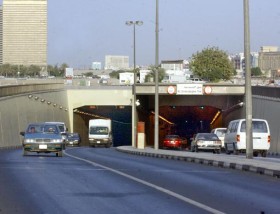
Al Shindagha Tunnel in Dubai to be partially closed for two months Staff Report GULF NEWS Published: April 15, 2008, 14:17
Dubai: Al Shindagha Tunnel, one of the vital links between Bur Dubai and Deira, will be partially closed at night for maintenance work.
“The maintenance work will last for about two months, from April 16 to June 12,” said Hussain Al Banna, Director of Right of Way Service Department at the Dubai Roads and Transport Authority (RTA).
He said the tunnel will be closed from Bur Dubai to Deira side from 1am to 6am from April 16 to 19, May 12 to 15 and June 9 to 12.
The tunnel will be closed from Deira to Bur Dubai side from April 20 to 23, May 5 to 8 and June 2 to 5.
The closure time will be from 2am to 7am on Fridays, Saturdays and any other public holidays falling during the maintenance period.
“In case of closure of one direction of the tunnel, the other direction will be used for two-way traffic,” said Al Banna.
He urged motorists using the tunnel to use alternate routes such as Al Maktoum Bridge and Al Garhoud Bridge to cross Dubai Creek to avoid delays and traffic congestion.
Identical twin camel calves born in Dubai

Identical twin camel calves born in Dubai
By Kevin Scott, Staff Reporter GULF NEWS Published: April 16, 2008, 00:17
Dubai: The birth of identical twin camel calves was announced in Dubai on Tuesday.
Zahi and Bahi, born on February 10 and February 26 respectively, both experienced a natural birth following a 13-month gestation.
Dr Lulu Skidmore and her team at the Camel Reproduction Centre in Dubai said the male twins were created using a technique called embryo micro-manipulation.
The process involved flushing a six-day old camel embryo from the uterus of the donor camel and splitting it into two halves.
Care was taken to ensure the tiny inner cell mass part of the embryo [the part that develops into the foetus] was actually split into equal halves otherwise only one foetus would have developed.
Both halves were then cultured for two hours and transferred into two separate surrogate mother camels. The surrogate mothers were synchronised with the donor mother to ensure they were at the same stage in their reproductive cycles.
Dr Lulu Skidmore, Scientific Director at the Camel Reproduction Centre, told Gulf News the technique may be used to produce identical twin animals that could act as perfect partners in future studies. She said: “Because the camels are genetically identical, any difference between them is a direct result of the treatment they receive.
“For example, you could give one twin a different type of food … and see which one grows quicker or runs faster. Alternatively you could give them both to different trainers and test them out to see which trainer has the best training technique.”
Dr Skidmore said camel owners and trainers would be interested in learning more about the micro-manipulation technique.
She added: “The Molecular Biology and Genetics Laboratory in Dubai has studied the camels and confirmed them to be genetically identical.”

The 64 Kalas (art forms)
The 64 Kalas (art forms)
The 64 Kalas is the classical curriculum of sacred sciences, studies, arts and skills listed in various Hindu shastra.
1. Histrionic Talents, Drama, story telling techniques, mnemonics etc.,
2. Making musical Instruments, simple mechanical devices etc.,
3. Playing Musical Instruments (i.e.) Instrumental music including jalatarangam- creating music with water, percussion and string instruments.
4. Decorating, Dressmaking, costume making, artful dressing and personal grooming.
5. Ornaments and head adornments
6. Singing and Dancing , practicing fine arts
7. Making beds, Bedroom decorations
8. Garland making, flower arrangement, designs with grains on the floor like Rangoli
9. Playing games like dice
10. Mastering eroticism as per Vatsyayana, erotic devices and sexual arts
11. Making honey, liquor , beverages and desserts
12. Plucking out arrows and healing
13. Cooking, eating and drinking skills
14. Horticulture, forestry
15. Breaking and pulverizing hardrock, mining
16. Making Medicines from herbs
17. Sorting, Mixing, Isolating Ingredients
18. Making and using Astras and Sustras
19. Wrestling, Boxing, Gymnastics, physical culture, body building etc.,
20. Making ICBM
21. Parades , Army Bands and Dharmic warfare
22. Ratha, Gaja, Turaga wars ( Chariot, Elephantry and Cavalry)
23. Asanas, Postures & Mudras
24. Training elephants, horses, birds
25. Making Vessels of clay, wood, bronze
26. Drawing
27. Making Paints & Painting
28. Architecture, Sculpture, house and temple construction, mosaic tiling
29. Mixing air, water etc (Air Products and Water Products)
30. Boats, Ships, Chariots etc
31. Making threads, ropes etc
32. Weaving and Spinning
33. Diamond , Precious Stones and gems-distinguishing them from ordinary ones.
34. Alchemy, Chemistry , preparing ointments, unguents for charm and virility
35. Jewellery making including artificial jewelry
36. Gold Plating, metallurgy
37. Skinning and Preserving bodies
38. Leather Technology
39. Dairy Farming
40. Tailoring, Sartorial skills and Embroidery
41. Swimming and water sports
42. Cleaning houses and vessels
43. Laundering and Washing
44. Hair dressing and Shaving
45. Managing Oil Resources
46. Having control over others’ minds, spells, charms ,Omens
47. Tilling and agriculture
48. Handicrafts including Carpentry, furniture making and furnishing
49. Making Vessels of glass , ceramic and pottery
50. Drawing water & resources
51. Gardening and Fencing
52. Caporisoning elephants etc
53. Child rearing & Pediatrics including doll making and toy making for kids
54. Punishing guilty appropriately by Law and Order
55. Learning Languages / dialects (both native and foreign), literary excellence, semantics
56. Preparing ‘Tambool’ etc.
57. Composing impromptu poetry
58. Preparing perfumes, cosmetics, playing poetry games, oratory, elocution, prosody, rhetoric
59. Sorcery, Conjuring, Sleight of hand, Magic, Illusions, Impersonation
60. Composing Riddles, Rhymes, Verses, Puzzles, Tongue twisters and involved recitations
61. Making swords, Staffs, Archery
62. Training fighting partridges and rams, Cock fight, Bull fight etc.,
63. Teaching parrots, mynas to talk and training animals, Veterinary science
64. Writing in cipher codes and languages, secret mantras, coding and decoding.
Jaaju Jaaju Stories – Be thankful for what you have
 Jaaju Jaaju stories are bed time stories narrated by a loving father to his son each night before going to sleep. These stories are collected from various sources. Besides the little one (who loves to listen to the story and sleep with his head on his dad’s shoulder sucking his little thumb), there are three other characters who listen to this daily – they are Kesavan – the elephant, Chakki – the cow, and Sundari – it’s little daughter. Each night, the story is ended at some point, to give curiosity to the listeners and it is started the next night with a question answer session. Enjoy reading each day as it is posted and pass it on to your little loved ones.
A blind boy sat on the steps of a building with a hat by his feet. He held up a sign which said: “I am blind, please help.” There were only a few coins in the hat.
A man was walking by. He took a few coins from his pocket and dropped them into the hat. He then took the sign, turned it around, and wrote some words. He put the sign back so that everyone who walked by would see the new words.
Soon the hat began to fill up. A lot more people were giving money to the blind boy. That afternoon the man who had changed the sign came to see how things were. The boy recognized his footsteps and asked, “Were you the one who changed my sign this morning? What did you write?”
The man said, “I only wrote the truth. I said what you said but in a different way.”
What he had written was: “Today is a beautiful day and I cannot see it.”
Do you think the first sign and the second sign were saying the same thing?
Of course both signs told people the boy was blind. But the first sign simply said the boy was blind. The second sign told people they were so lucky that they were not blind. Should we be surprised that the second sign was more effective?
Moral of the Story: Be thankful for what you have. Be creative. Be innovative. Think differently and positively.
Invite others towards good with wisdom. Live life with no excuse and love with no regrets. When life gives you a 100 reasons to cry, show life that you have 1000 reasons to smile. Face your past without regret. Handle your present with confidence. Prepare for the future without fear. Keep the faith and drop the fear.
Don’t believe your doubts and doubt your beliefs. Life is a mystery to solve, not a problem to resolve. Life is wonderful if you know how to live.
Bhagavan Baba says, “Life has to be an incessant process of repair and reconstruction, of discarding evil and developing goodness…. In the journey of life, if you want to travel without fear, you must have the ticket of a good conscience.”
Extracted from an email forward.
Police campaign highlights dangers of leaving vehicles on
Police campaign highlights dangers of leaving vehicles on
By Alia Al Theeb, Staff Reporter GULF NEWS
Published: April 14, 2008, 00:28
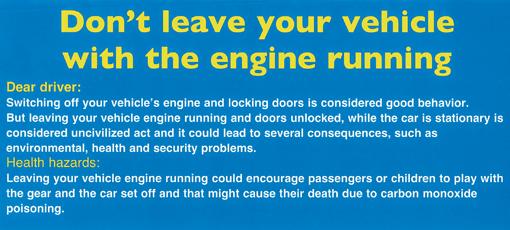
Dubai: If you leave your car engine on and run to the grocery store even for a few minutes, police will fine you Dh300, a senior official warned on Sunday.
Police issued 1,960 fines to motorists who left their vehicle with their engines on in 2007. The fine was increased from Dh100 to Dh300 under the revised Federal traffic law.
Dubai Police are organising a five-day campaign, which started on Sunday, to spread awareness among motorists on the dangers of leaving their vehicles with the engine on.
The campaign also aims to reduce the problem of leaving car engines on in the coming three months by 30 per cent.
Lieutenant Colonel Ali Ganem, Director of Naif Police Station, said some motorists leave the engines of their vehicles on with the car keys inside to get something from a grocery store or a pharmacy. He said this endangers motorists and encourages thieves.
“According to statistics, 66 vehicles with engines on were stolen in 2006, while the number dropped to 26 vehicles in 2007 because of the awareness of some motorists and the efforts of police,” Lt Col Ganem said.
He said according to the ministerial decision number 127 for 2008, motorists who leave the engines of their vehicles on, must be given an on-the-spot or absentia fine of Dh300.
The campaign aims to spread awareness among motorists regarding parking vehicles in appropriate places and making sure they carry their car keys after locking the door, not leaving children alone in the car and not leaving valuables in the car.
He said in the case of an emergency or the dire need to leave the car engine on such as, having sleeping children inside, there must be an adult in the car and he or she must have a suitable communication method to reach the motorist in case of any emergency.
He said in such cases, motorists should also make sure the gear and brakes are placed in a safe mode.







Egg ups death risk in middle age
Egg ups death risk in middle age
10 Apr 2008, 0000 hrs IST,REUTERS
WASHINGTON: Middle-aged men who ate seven or more eggs a week had a higher risk of earlier death, US researchers reported on Wednesday.
Men with diabetes who ate any eggs at all raised their risk of death during a 20-year period studied, according to the study published in the American Journal of Clinical Nutrition . The study adds to an ever-growing body of evidence, much of it contradictory, about how safe eggs are to eat. It did not examine what about the eggs might affect the risk of death.
Men without diabetes could eat up to six eggs a week with no extra risk of death, Dr Luc Djousse and Dr J Michael Gaziano of Brigham and Women’s Hospital and Harvard Medical School found.
“Whereas egg consumption of up to six eggs a week was not associated with the risk of all-cause mortality, consumption of (seven or more) eggs a week was associated with a 23% greater risk of death,” they wrote.
“However, among male physicians with diabetes, any egg consumption is associated with a greater risk of all-cause mortality, and there was suggestive evidence for a greater risk of MI (heart attack) and stroke.” They urged more study in the general population.
Eggs are rich in cholesterol, which in high amounts can clog arteries and raise the risk of heart attack and stroke. One expert on nutrition and heart disease said the study suggests middle-aged men, at least, should watch how many eggs they eat.
“More egg on our faces? It’s really hard to say at this point, but it still seems, if you’re a middle-aged male physician and enjoy eggs more than once a day, that having some of the egg left on your face may be better than having it go down your gullet,” said Dr Robert Eckel of the University of Colorado and a former president of the American Heart Association.


You must be logged in to post a comment.