MBA at Army Institutes of Management
MBA at Army Institutes of Management
July 29 : Army Institute of Management, Kolkata (AIMK) and Army Institute of Management & Technology (AIMT), Greater Noida have invited applications from eligible candidates for admission to their two-year regular MBA Programmes for 2009-11 session.
Of the 120 seats available at AIMK, 80% seats are reserved for Army Wards and 20% are general seats. At AIMT, all the 120 seats are reserved for Army Wards. There is hostel facility for boys and girls at both the Institutes.
Applicant should have a three year Bachelor Degree recognized by AIU in any discipline with 50% marks. Those completing Bachelor Degree in 2009 may also apply.
Selection to the course at both Institutes will be based on score of CAT conducted by the IIMs. Short listed candidates will be called for Group Discussion and Interview at AIMK/AIMT for final selection. Separate application has to be submitted to each Institute.
For applying to AIMK, application and Prospectus can be obtained by post by sending a DD for Rs. 800/- for Army Wards and Rs.900/- for General Candidates drawn in favour of ‘Director AIM’ payable t Kolkata.
They can also be obtained by hand by submitting a DD for Rs.750/- for Army Wards and Rs.850/- for general candidates from AIM, Judges Court Road, Opp. Alipore Tele Exch, Alipore, Kolkata-700027.
For applying to AIMT, Prospectus and Application can be obtained from AIMT, Plot M-1, Pocket P-5, Greater Nioda, UP-201306, by sending a DD for RS.800/- drawn in favour of AIMT payable at Noida. They can also be obtained by hand by submitting a DD for Rs.750/- at AIMT. Only Army Wards are eligible for admission at AIMT.
Prospectus and Application from of the Institutes can also be obtained by hand through DD only, from AWES, Army HQ, Kashmir House, New Delhi and from AWES Cells of all Command HQs. They can also be down loaded from the websites of the Institutes AIMK- http://www.aim.ac.in and AIMT- http://www.aimt.ac.in The Prospectus and Application forms will be available from 4th August 2008 to 29th September 2008.
The last date for submission of AIMK/AIMT applications is December 6, 2008. Application can also be submitted with a late fee of Rs.200/- till 31st January, 2009.
Applicants to AIMK/AIMT should also apply for CAT as per the instructions of CAT. The last date for receipt of Application for CAT 2008 at various IIMs is 5th September, 2008. CAT will be held on 16th November, 2008 (Sunday).
Details of CAT are available at http://www.catiim.in/
Khaleej Times plans relaunch
Khaleej Times plans relaunch
Bradley Hope for THE NATIONAL Last Updated: July 26. 2008 8:03PM UAE
ABU DHABI // Khaleej Times, a 30-year-old English-language newspaper based in Dubai, is preparing for a major relaunch at the end of August to compete in the region’s rapidly expanding media market.
Sources familiar with the newspaper report that earlier this month the board appointed Rahul Sharma, formerly the Delhi editor of Hindustan Times, as editor and Didier Brun, the former senior vice president of strategy and development at the International Herald Tribune (IHT), as the chief executive. Both declined to comment for this article.
The relaunch of Khaleej Times would come less than six months after the launch of The National, which is printed six days a week by Abu Dhabi Media Company.
Earlier this year Arab Media Group, based in Dubai, relaunched a daily newspaper as a business publication, Emirates Business 24/7.
And the Financial Times recently began publishing a Middle East edition, with increased coverage of the GCC countries. Gulf News, which was established the same year as Khaleej Times, 1978, is also a long-standing English-language publication.
“For years Gulf News and Khaleej Times were the established, must-read papers here,” said Austyn Allison, the managing editor of Communicate magazine. “Now there’s this new competition from The National and other publications. Newspapers are having to change.”
To meet the challenge Khaleej Times has been drawing on resources from abroad. For instance, the paper’s layout is being redesigned by Paula Scher, a partner at Pentagram Design in New York, who has done work for The New York Times Magazine.
Mr Sharma, the new editor, has been given an open-ended budget for hiring reporters and editors from around the world, according to sources familiar with the newspaper.
In early May Khaleej Times announced it had formed a strategic alliance with IHT to print and distribute its newspaper in the UAE. The companies said at the time that further publishing arrangements, including running the IHT as an insert in some editions of Khaleej Times, were potentially on the horizon.
IHT has relationships with nine English-language newspapers around the world in which the local affiliate runs a daily edition of the newspaper as an insert, according to the company’s website.
Achilles Tsaltas, the vice president of circulation and development at the IHT, said that his company had signed the agreement with Khaleej Times in the belief that the newspaper would undergo major changes.
“We are investing in the thinking of Khaleej Times – they are very committed to changing their game,” he said. “They want to emulate The New York Times’s editorial credibility. We’re confident that is where they are heading.”
The Government of Dubai has a considerable stake in Khaleej Times and was pressuring its board members to improve the newspaper, the sources said.
Two years ago the Investment Corporation of Dubai, an investment group owned by the Dubai Government, acquired a 30 per cent share of Galadari Brothers, the parent company of Khaleej Times.
The chairman of the newspaper division is Adel al Shirawi, who is the vice chairman of Istithmar World – an investment group owned by the Dubai Government.
Five of the seven boardmembers are employees of companies wholly owned by either Dubai Holdings – a private company of Sheikh Mohammed bin Rashid Al Maktoum, Vice President and Prime Minister of the UAE and Ruler of Dubai – or the Investment Corporation of Dubai.
bhope@thenational.ae
Abu Dhabi and Dubai among world’s most pricey cities
Abu Dhabi and Dubai among world’s most pricey cities
Vivian Salama THE NATIONAL Last Updated: July 26. 2008 8:26PM UAE
ABU DHABI // Abu Dhabi and Dubai remain among the world’s most expensive cities, though at a lower ranking than last year, a new cost-of-living survey has revealed.
This year Dubai ranks as the 52nd most expensive city, down from 32nd place last year, while the capital is number 62, down from 45th, according to Mercer, the international human resources company that conducts the annual survey. The cities rank second and third in the Middle East respectively, behind Tel Aviv, which ranked 14th. Conversely, a number of European cities have risen in the ranks and dominate the top of the list.
Yvonne Traber, a principal and research manager at Mercer, attributed much of the change to exchange rate fluctuations. “Current market conditions have led to the further weakening of the US dollar which, coupled with the strengthening of the Euro and many other currencies, has caused significant changes in this year’s rankings,” she said.
The survey, covering 143 cities in six continents, is designed to help multinational companies and governments determine compensation allowances for their expatriate employees. It charts the cost of more than 200 everyday items, from clothing and footwear, to groceries, personal care needs, transport costs and dining out, as well as the cost of renting a high quality two-bedroom furnished flat.
The cost of living in many European cities has grown more rapidly than in Abu Dhabi and Dubai because, in addition to inflation, the cost of goods is denominated in euros, which have strengthened against the dollar.
On the other hand, soaring oil prices and the rapid growth of GCC economies has fuelled inflation in the Middle East this year at a faster rate than in Europe and the US.
UAE inflation accelerated to a 20-year high of 11.4 per cent last year and will rise slightly to 11.8 per cent this year, a Reuters poll last month showed. Food, beverage and tobacco accounted for 11 per cent of that rise and, according to the Emirates Consumer Protection Society, a division of the UAE Ministry of Economy, food inflation could rise as high as 40 per cent this year.
“The saying goes that Emirates Hills is now more expensive than Beverly Hills,” said Mary Nicola, an economist with Standard Chartered Bank in Dubai. “Day-to-day expenses in terms of groceries and such have become more expensive here.”
Soaring rent prices have also become a burden for UAE residents. A report released by the Abu Dhabi Department of Planning and Economy (DPE) estimated that rents during the first quarter alone increased by 18 per cent.
A recent survey found that rents in the capital had risen by an average of 49 per cent since June of last year and, in some cases, almost doubled since the beginning of the year despite a Government cap of five per cent. The survey by Asteco, a UAE property services company, found that rent for two-bedroom apartments in the Muroor and Tourist Club areas increased by 80 per cent or more in the 12 months from last June.
The annual rent for two-bedroom apartments ranged from Dh180,000 (US$49,000) to Dh194,400 in Hamdan Street, on the Corniche, in the Tourist Club area, Salam Street, Muroor and Khalifa Street. The average rent for one-bedroom apartments throughout the city ranged from Dh110,000 to more than Dh140,000, depending on the quality and location of the unit, the survey found.
In comparison, the UK estate agent Foxtons is offering two-bedroom flats in the fashionable districts of Kensington or Notting Hill for £2,167 (Dh15,843) a month, or Dh190,838 a year. A similar two-bedroom apartment in the Financial District of New York was advertised by the CitiHabitats agency for $4,350 (Dh15,977) a month, or Dh192,000 a year.
Ms Traber said that multinational companies were attracted to countries with a high rate of economic growth. “Companies may assign high priority to expansion in these economies but may have to deal with inflationary pressures due to competition for expatriate-level housing and other services,” she noted.
Ms Nicola said inflation would have an impact on attracting new people to the GCC.
“Businesses trying to set up shop and attract new talent have to fork out more money,” she said.
Worldwide, Moscow ranked as the world’s most expensive city for the second year running, followed by Tokyo, and London. The only US city in the top 50 is New York, which is down from 15th place last year to 22nd this year, due to the weakness of the dollar.
vsalama@thenational.ae
Municipality issues new construction safety rules
Municipality issues new construction safety rules
Praveen Menon THE NATIONAL Last Updated: July 29. 2008
The high number of construction workers being killed or injured after falling from buildings has sparked the introduction of a new set of on-site safety rules.
The municipality yesterday announced all building industry firms will have to meet new standards and that any who fail to do so will be fined.
The major area of change is the safety requirement for workers on tall buildings with four chapters of a new rule book dedicated to this area.
Essa al Maidour, Assistant Director General for Planning and Building Affairs at Dubai Municipality said the new manual was launched following “great concern for safety issues and a need to introduce future standards for the same.”
According to municipality statistics, workers falling from high rise buildings constituted forty-five per cent of the 865 accidents that occurred between 2004 and 2007.
Last year alone, nearly 48 per cent of work site accidents were due to workers falling from buildings.
“We have dedicated four chapters in our new safety manual to this particular issue. This is a serious concern for us and we believe that the consultant as well as the contractor is responsible for these deaths,” said Mr Maidour.
pmenon@thenational.ae
Abu Dhabi house rents soar 49pc in one yearBy Haseeb Haider
Abu Dhabi house rents soar 49pc in one yearBy Haseeb Haider
29 July 2008 KHALEEJ TIMES
ABU DHABI — Rents of quality apartments in Abu Dhabi have gone up by 49 per cent over the past one year as the demand for reasonably priced apartments outstripped supply in a city that is witnessing hyper business activity, says a report.
“The most notable movement comes in the two-bedroom unit category with 66 per cent increase in rents over the last year,” says the report compiled by Asteco, a property management company that is analysing the current demand and supply situation.
The report has, however, painted a rosy picture for the future, as almost 70 per cent of the new projects being built in the Musaffah area have been earmarked as residential because the government is well aware of the shortage in accommodation.
The Asteco report for the second quarter of 2008 estimates that 60 per cent of the new accommodations would be two-bedroom apartments meant for couples and families. Nearly 25 per cent of the new accommodations will be one-bedroom units while the remaining will be three- and four-bedroom units.
Areas such as Muroor, Tourist Club Area (TCA) and Salam Street are witnessing the most activity. Khalidiyah, which showed the lowest growth due to low tenant movement, is still the most-sought-after location.
Khalidiyah attracts a mix of nationalities, specially emiratis and western expatriates, due to its proximity to Marina Mall and a number of international schools in the area.
Hamdan Street continues to command high rents of nearly Dh125,000 for one-bedroom apartments. Units in this area are of poor quality and landlords are taking advantage of the shortage of supply and are charging above average prices
Villas in Khalidiyah, Bateen and Manaser command some of the highest rents in Abu Dhabi starting at Dh150,000 for a three-bedroom property. Nearly 80 per cent of the villas in these areas are high quality and tend to be occupied by a mix of high-income individuals.
Villas in Al Falah and Airport Road areas are of slightly lower quality, yet the rents are high. In addition, many villas are split into separate units to cater to the growing ‘bachelor’ clientele.
According to Asteco report, there is no shortage of villas in Abu Dhabi, yet rents are high.
“This problem is likely to be eased when the more affordable villa projects in Khalifa City, Mohammed bin Zayed City, Al Raha, Sas Al Nakheel and Seashore come on line,” says the report.
Commenting on the situation, Rebekah Savage, of Foundation Property Management Co, which manages a large number of residential buildings, told Khaleej Times that Abu Dhabi Commercial Properties (ADCP) recently estimated that there are 250 buildings in and around Abu Dhabi city centre that would be demolished and 750 buildings would be built in and around Abu Dhabi and the garden city of Al Ain.
Ex-Google workers launch ‘Cuil’ search engine
Ex-Google workers launch ‘Cuil’ search engine
Agencies Published: July 29, 2008, 10:29
San Francisco: A group of former Google engineers have launched a rival Internet search engine Cuil this week, calling it an improved version of the world’s most popular web-scouring tool.
Cuil’s founders include former Google staffer Anna Patterson. Patterson intends to upstage Google, which she quit in 2006 to develop a more comprehensive and efficient way to scour the Internet.
The end result is Cuil, pronounced “cool.” Backed by $33 million in venture capital, the search engine began processing requests for the first time on Monday.
Cuil had kept a low profile while Patterson, her husband, Tom Costello, and two other former Google engineers — Russell Power and Louis Monier — searched for better ways to search.
Cuil’s search index spans 120 billion Web pages. Patterson believes that’s at least three times the size of Google’s index, although there is no way to know for certain. Google stopped publicly quantifying its index’s breadth nearly three years ago when the catalog spanned 8.2 billion Web pages.
Cuil won’t divulge the formula it has developed to cover a wider swath of the Web with far fewer computers than Google. And Google isn’t ceding the point: Spokeswoman Katie Watson said her company still believes its index is the largest.
After getting inquiries about Cuil, Google asserted on its blog Friday that it regularly scans through 1 trillion unique Web links. But Google said it doesn’t index them all because they either point to similar content or would diminish the quality of its search results in some other way. The posting didn’t quantify the size of Google’s index.
A search index’s scope is important because information, pictures and content can’t be found unless they’re stored in a database. But Cuil believes it will outshine Google in several other ways, including its method for identifying and displaying pertinent results.
Minibuses will have their speeds limited, say Dubai police
Minibuses will have their speeds limited, say Dubai police
By Alia Al Theeb, Staff Reporter GULF NEWS Published: July 29, 2008, 00:05
Dubai: Minibuses will soon be fitted with speed limiting devices, a senior police official said on Monday.
Brigadier Mohammad Saif Al Zafein, Director of Dubai Police’s Traffic Department, on Monday held a meeting with representatives of more than 50 companies that own or rent minibuses. The open discussion aimed at pinpointing the problems and the reasons behind the increasing number of traffic offences and accidents involving minibuses.
Check at 100km/hr
Brigadier Al Zafein said there is a plan to install speed limiters in minibuses which will prevent drivers from exceeding the speed of 100km an hour.
He said there is coordination between the traffic department and the Roads and Transport Authority (RTA) regarding this plan which will contribute in reducing fatal accidents.
“Most minibuses which were involved in fatal accidents and resulted in high number of victims were speeding excessively which does not suit the vehicle’s nature,” he said.
He pointed out to the minibus accident which took place on Shaikh Rashid Road two weeks ago and claimed five lives.
“The driver of that minibus was speeding at 140km/hr to 160km/hr,” he said. He said in the next phase, they will meet with drivers of minibuses.
Brigadier Al Zafein said the traffic department confiscated 65 minibuses as part of a campaign launched to crack down on offences committed by minibus drivers. The vehicles were confiscated for 30 days for reckless driving and overloading with passengers.
Offence: ‘Most are reckless’
Brigadier Mohammad Saif Al Zafein, Director of Dubai Police’s Traffic Department, said according to him 99.9 per cent of minibus drivers are reckless drivers and they commit four common offences which are, excessive speeding, changing lanes without indications and not abiding by lane lines, overloading of passengers and tailgating.
UAE get set to Sing and Dance with the Super Stars
 A hoarding announcing the arrival of the Super Stars for their performance on 1st August 2008
 National Theatre Abu Dhabi where the Super Stars Nite will be held on Friday, 1st August 2008
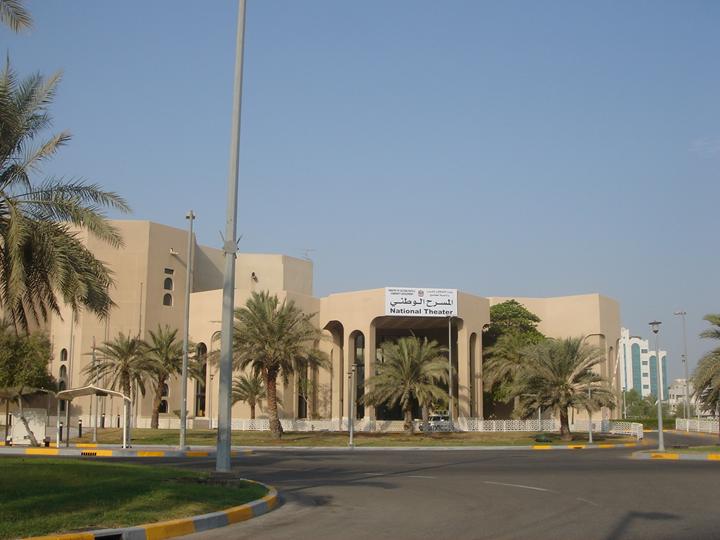 A view of the National Theatre Abu Dhabi where the Super Stars Nite will be held on Friday, 1st August 2008
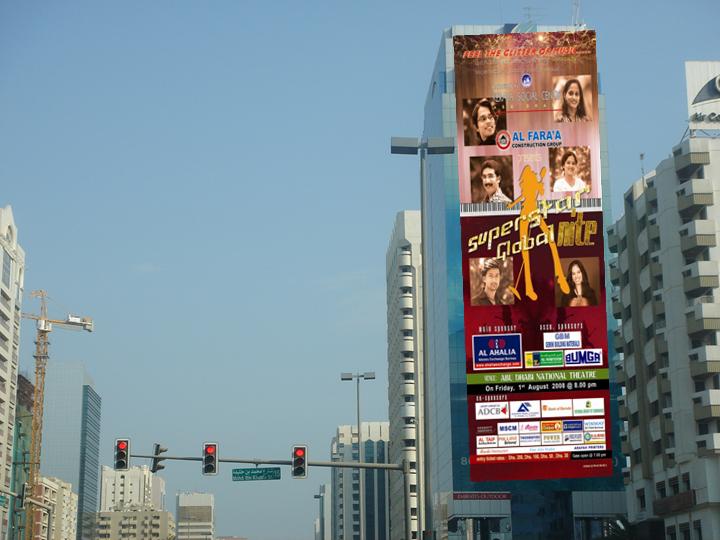 Hoardings in the main street of Abu Dhabi announcing the programme on Friday, 1st August 2008.


Youngster is ‘super star’

Youngster is ‘super star’
By SHILPA CHANDRAN for GULF WEEKLY Bahrain
SCHOOLBOY dancing sensation Vidyuth Menon has returned to Bahrain to a hero’s welcome after starring in one of the world’s most celebrated reality TV competitions.
The Asian School pupil took time away from his classroom to grab the opportunity of shining under the spotlight in the Super Star Junior Dance Competition aired on popular Indian television channel Amrita.
Viewers watched in awe every week from Monday to Friday and thousands of Batelco customers here in Bahrain cast their SMS vote for Vidyuth, 11, who attracted millions of fans in India too as he battled into the semi-finals.
Vidyuth, was one of only 15 children selected from more than 7,000 worldwide entries, and said: “I just love to dance!
“This was an incredible experience and so exciting and I’ve made so many new friends.”
His proud mum Priya, from Hoora, said: “The competition has helped him immensely to overcome his shyness and has brought about a fresh ray of confidence – so I am very thankful.
“It was not one of the easiest ventures we have ever done as we had to travel up and down to India twice. After the first audition which was in August last year, we came back.
“He was selected for the next stage and so we returned in September for rounds two and three of the audition process.”
After the auditions were concluded and Vidyuth was finally selected his family were forced to make some serious decisions. Fortunately Vidyuth’s school permitted him to take a six-month leave of absence but his mum had to resign her position as a maths teacher at Al Noor International School so she could take care of her only son.
Priya explained: “Our jobs are very important but I knew that I could come back and look for a new one. Vidyuth’s chance was a once-in-a-lifetime opportunity. For the sake of our children we sometimes need to make compromises and sacrifices.
“I am glad I made that choice, otherwise I am sure I would have lived to regret not going.”
The pair returned to the kingdom after spending six months back in India.
Although the family live in Kerala where the show was staged their hometown was actually 440km from the set.
They decided to rent a house close to the studios rather than face a daily gruelling train trek.
“Both of Vidyuth’s grandmothers came to stay with us. It was quite demanding … every 10 days there was a shoot for two days.
“This meant choosing two songs, learning the steps, arranging the costumes and preparing for the filming which began at six in the morning.”
Also assisting the family was Jyothi Raj, a well-known dance teacher from Bahrain, who is Vidyuth’s trainer. Priya explained: “He actually came to India and stayed with us throughout the competition – all at his own expense – to be able to help Vidyuth.”
During the adventure Priya was often overcome by the pressure but Vidyuth’s excitement and energy helped soothe over the periods of anxiety.
Priya said: “There were times when I wanted to just leave everything and come back home to Bahrain but my son would tell me not to worry.”
His talent and optimism proved decisive as he was the only contestant not to fall in the ‘danger zone’ – a part of the competition where the participant achieved low audience votes and marks.
In the competition, the selection process was done in two ways. While the judges gave them the marks and comments, the real fate of the dancer rested with the viewers and audience.
Text messages were the main source of voting a favourite dancer and after every performance, the number of votes were counted for each of the contestants.
With Vidyuth’s participation in the competition, the family requested the channel organisers to also accept votes from Bahrain, as this was indeed his home.
Vidyuth’s father, Arun Menon, commercial manager, African and Eastern, had the pressure of coping with the stress all alone in the kingdom.
He said his son had attracted a huge following of fans, adding: “He has one particular supporter living in Saudi who still regularly calls up! He is a dancer himself and has been keeping a track of Vidyuth’s performances since the very beginning.
“There are also two girls – Mary and Lachchu students of the Indian School who regularly keep in touch. They even created a community name ‘Vidyuth the Super Dancer Junior’ on the online friends networking site – Orkut!”
The youngster has faced a few embarrassing moments of fame too. Once he received a greeting card addressed to ‘Vidyuth of Class Five, Asian School’ from an Indian admirer.
Vidyuth also has a growing number of dance fans in Bahrain where he has been performing ever since he returned from India.
Priya said: “Recently during a show organised by the Indian Ladies Association for the Children and Mother’s Welfare Society, Vidyuth performed to an audience of Shaikhas.
“After the performance one lady came and gave him a small packet and congratulated him saying the society’s president sent her regards and a small gift.”
The gift, BD100, helped him purchase a collection of games for his Play Station which is his passion alongside dancing.
Vidyuth also performed at the May Queen 2008 event as part of his dance group – the Rap City Boys. The group was formed by his trainer and consists of six dancers.
His love of dancing began at an early age when he watched his mother give dance lessons at home.
Priya said: “When we first moved to Bahrain I used to hold dance classes at home and he would silently watch me before running to the sitting room and doing his own dance.”
Since his small screen performances, Vidyuth has been approached by TV soap opera producers in India who have expressed an interest in creating a part for him.


You must be logged in to post a comment.