Month: June 2008
Abu Dhabi bus service is route to beating traffic woes

Abu Dhabi bus service is route to beating traffic woes
By Samir Salama, Associate Editor GULF NEWS Published: June 26, 2008, 00:03
Abu Dhabi: From Monday until the end of the year residents in Abu Dhabi will enjoy free bus trips on the island to encourage car owners to leave their cars behind, it was announced on Wednesday.
“Altogether 125 brand-new, handicap-accessible, world-class, white and green buses will be deployed in Abu Dhabi between 6am and midnight to transport people, free of charge, to make public buses the preferred mode of transportation,” said Saeed Al Hameli, general manager of the bus section at the Department of Transport.
He launched a two-year plan to gradually overhaul the emirate’s public transport network and infrastructure in line with “Plan Abu Dhabi 2030”.
The project will be completed in phases, starting June 30, with the gradual deployment of 258 buses as a short-term solution. Of these 125 are new and 133 have been refurbished, Al Hameli told a press conference.
The fleet will enter service gradually with 60 buses being deployed on the first day on high-traffic routes, to immediately enhance commuter comfort and convenience and improve frequency and scheduled services.
“A further 100 new buses are due to enter service in the first quarter of 2009, with more phases to follow. All future phases will aim to increase city, suburban and inter-city capacity by 50 per cent by the end of next year.”
The new buses, Al Hameli said, will initially service four new routes, followed by six additional routes in August with the goal to operate on 21 high-frequency routes by the beginning of 2009, covering most of Abu Dhabi Island.
The department of transport plans to service Abu Dhabi with 1,360 world-class buses by the end of 2010 and has already designed Abu Dhabi’s future bus route network, which will provide comprehensive coverage within cities and link the emirate’s urban areas.
As the emirate’s population is expected to increase to 1.5 million people by 2010, the department is today sowing the seeds for a safe, sustainable, economically viable, efficient and lifestyle-enhancing transport system that will be the preferred mode of transport for the public,” said Abdullah Rashid Al Otaiba, chairman of the Department of Transport.
“This is the first step on the long road ahead that will fuel further economic growth, contribute to the reduction of CO2 emissions, enhance quality of life and establish a sustainable public transportation system for all the people of Abu Dhabi.”
He added that by 2030, Abu Dhabi will be home to 3.5 million people and the aim is to develop a comprehensive public transportation network that will appeal to all segments of society. Our biggest challenge today is to encourage car owners to utilise the new facilities and infrastructure.
“It’s going to be a gradual process but Abu Dhabi residents and tourists will start seeing the changes next week,” Al Otaiba said.
Upon completion of the project, Abu Dhabi will boast one of the world’s most modern bus fleets.
Freedom Bus lanes planned
*From June 30, free bus rides will be offered until the end of the year with the gradual deployment of 258 buses, 125 new and 133 refurbished.
* Routes: Marina Mall to Mina Zayed through Zayed The First Street and Hamdan Street; Abu Dhabi Mall to Marina Mall through Zayed The First Street; Shaikh Rashid Bin Saeed (Airport) Road to Courts Complex and Carrefour Mall and Al Muroor Road to Madinat Zayed Centre.
* Toll free telephone number 800 55555 for information on routes, complaints or suggestions
* Dedicated bus priority lanes may be deployed in key Abu Dhabi arteries that will ensure the smooth flow of buses and connectivity.
* Renovation of the existing 12 bus stations and the development of 25 new bus stations. Over the next five years, the 37 bus stations will feature an array of retail, banking, food and beverage and other facilities.
* Creation of six bus depots.
* Tariff for old buses on other routes will remain unchanged.
World’s First Moving Tower To Be Built In Dubai
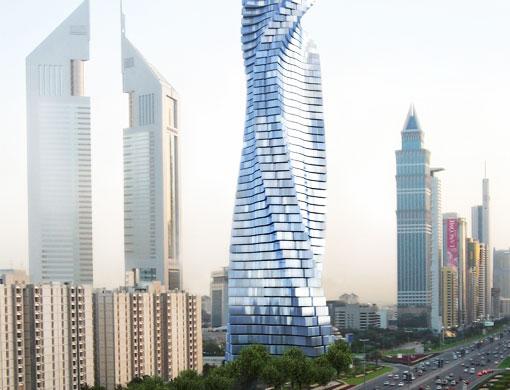



World’s First Moving Tower To Be Built In Dubai
Wednesday, Jun 25, 2008
DUBAI (Zawya Dow Jones)–The world’s first rotating building, an 80-storey tower with revolving floors, will be built in Dubai, New York-based architect David Fisher’s Dynamic Group, the mastermind behind the development, said Wednesday.
The Dynamic Tower will be made up of 80 prefabricated apartments which will spin independently of one another to give the impression that the 420 meter building is constantly changing shape, Dynamic said in a statement.
Work on the tower is due to be completed by 2010, according to Dynamic’s Web site.
The building will have 79 giant power-generating wind turbines located between each floor so that it will be energy self-sufficient.
“The Dynamic Tower is environmentally friendly and the first building designed to be self-powered, with the ability to generate its own electricity, as well as for other nearby buildings,” Fisher said in the statement.
Apartments will range in size from 124 square meters to villas of 1,200 square meters complete with a parking space inside the apartment, the statement said.
Dubai is at the center of the Gulf region’s construction boom spurred by record high oil earnings. It is currently building Burj Dubai, the world’s tallest tower, due for completion in 2009.
The Dynamic Tower will also be the first skyscraper to be built entirely from prefabricated parts that are custom made in a workshop, known as the Fisher Method,
Fisher said just 600 people on an assembly site and 80 technicians on the construction site would be needed to build the tower – compared with around 2,000 workers for a traditional project of a comparable scale.
“Each floor of the building can be completed in only seven days. From now on, buildings will be made in a factory,” he said.
A second, 70-storey skyscraper is planned for Moscow by 2010. Mirax Group will develop the tower, headed by international developer Sergei Polonsky, Dynamic said.
“Our intention is to build the third rotating skyscraper in New York,” Fisher said.
There are also plans to build similar Dynamic Towers in Canada, Germany, Italy, Korea and Switzerland “following an expression of interest from developers, governments, and public officials,” Dynamic said.
Advantage top rank-holders
Advantage top rank-holders
J.S. BABLU for THE HINDU
A change has been made in the seat allocation pattern for courses to the National Institutes of Technology from this year. What could it mean for students from Kerala?
As students appear for counselling at the National Institute of Technology Calicut (NIT-C) from July 4, they would notice a major change in the admissions to NITs. From this academic year, the seats reserved for students from States other than the State in which the NIT is located will be filled based on the all-India merit.
According to a clarification put up on the web site http://www.ccb.nic.in of the Central Counselling Board (CCB) constituted to organise centralised counselling and allocation of seats at the NITs and other participating institutes, 50 per cent of the seats will be filled from students from the State in which the particular NIT is located, while the remaining 50 per cent will be filled on an all-India basis based on the rank in the All-India Engineering Entrance Examination (AIEEE).
There is confusion as to whether these 50 per cent seats is for students from all States other than the State in which the particular NIT is located; or whether the students of all States in the country, including the students from that particular State where the NIT is located, are eligible for counselling to these seats.
It is learnt that CCB has clarified till the time of this report going to the press that students from all States, including the students from the State where the NIT is located, are eligible for counselling to these seats. However, a clear picture will emerge only after the trial allotment of seats starts after the completion of the off-campus on-line counselling.
Impact on Kerala students
There were nearly 200 seats reserved for students who passed their Plus Two from Kerala in NITs other than NIT-C last year. But the change in admission pattern will mean that the Kerala students will now have to compete with students from all over the country to get a seat in the all-India seat category in NITs other than NIT-C.
Definitely, students from all states who have secured high ranks will benefit, but students with lower ranks who otherwise could have got the advantage of State-specific seats will lose out this time. On the positive side, however, Kerala students, provided they have higher ranks than students from other States, can get a branch of his or her choice in other NITs under the all-India seats, which they might not have got last year unless that branch was reserved for students from Kerala.
Another advantage for Kerala students, if they have higher ranks, will be that they could claim a large number of seats in NIT-C itself under the all-India seats category. (Provided CCB is going with the idea of allowing students from all states, including students from Kerala, to compete for all-India seats in NIT-C). This coupled with the 50 per cent reservation for Kerala students in NIT-C could push up the percentage of Kerala students in NIT-C to more than 50. (But an analysis of the previous years’ AIEEE rank list shows that Kerala students having higher ranks were very few compared to students from some other States.)
Another problem that may crop up in the NIT admission scenario would be that students of eight States which do not have an NIT (there are 20 NITs in 20 different States with eight States not having NITs) will not get adequate representation in NITs, unless they garner high ranks in AIEEE. Also, States having the largest number of candidates among the high ranking candidates would bag the maximum number of seats in NITs located in their States.
Courses at NIT-C
NIT-C has begun implementing the Other Backward Castes reservation as per the instructions of the Ministry of Human Resource Development (MHRD) from this academic year.
A total of 703 seats are available at NIT-C currently. The branch-wise seats for courses in NIT-C: (Number of seats reserved for students from Kerala is given in brackets.)
Civil engineering –106 seats (53); computer science and engineering –106(53); electronics and communication engineering – 106 (53); electrical and electronics engineering –106 (53); mechanical engineering – 106 (54); production engineering – 36 (18); chemical engineering – 71 (34); biotechnology – 30 (15) and B.Arch. – 36 (19).
(Information available as of now and subject to change depending on the instructions of MHRD.)
The details of courses and seat availability at NIT-C are available on the web site http://www.ccb.nic.in.
Counselling
The counselling consists of two phases: Off-campus on-line counselling conducted from June 23 to 29. The second phase on-campus online counselling will be conducted from July 4 to 13.
Placement
NIT-C web site says that the average salary of B.Tech. students during the placement session of 2007-08 was Rs.4.75 lakh a year and the average IT salary was Rs.5.5 lakh a year. The average salary and highest salary had grown substantially in 2007-08 compared to the previous year.
One-year Hindi diploma courses
One-year Hindi diploma courses
Wednesday June 25 2008 11:16 IST EXPRESS NEWS SERVICE KOCHI
HINDI Prachara Kendra College of Teacher Education has invited applications from SSLC and Plus-II students for one-year Hindi Certificate and Hindi Diploma courses (Distance Learning).
Rashtrabasha Visharad is the qualifying course for the appointment of teachers in Govt/Aided upper primary schools.
For details, call 0480-2802145.
Continous Education programmes destinations in UAE
Continous Education programmes destinations in UAE
There are a few additional institutions / programmes that I know of which are good. Giving you the contact details and links:
INDIRA GANDHI OPEN UNIVERSITY (IGNOU)
Contact:
Universal Empire Institute of Technology (UEIT)
Dubai
Phone: 04 3672121/22
e-mail: contact@ueitonline.com
All major post graduate and management courses are covered by IGNOU and good study materials are provided added with contact classes by UEIT teachers. Economical too compared to other university study programmes and IGNOU programmes are gaining programmes all over.IGNOU operates through a well organized network of Regional Centers and study centers that cater to the diverse needs of about 1.5 million students all over the world. Website: http://www.ignou.ac.in
ICFAI Professional programmes:
Contact:
The Admissions Officer
ICFAI
Block No. 19, Office 202/203
Dubai Knowledge Village
P.O. Box 502 913.
Dubai, UAE.
Tel: +9714-3694625,
Fax: +9714-3678420.
website: http://www.icfaidubai.org
Manipal Academy of Higher Education (MAHE) Dubai
Contact:
P.O. Box: 500689
Dubai
Tel: 04 366 4577
website: http://www.mahedubai.com/
Mahatma Gandhi University Off Campus Centre Dubai
Contact:
MAHATMA GANDHI UNIVERSITY OFF-CAMPUS CENTER #4
Block #3
Dubai Knowledge Village
Tel : 04-390 2981 / 82
Fax : 04-366 4661
E-mail : contact@ueitonline.com
website: Welcome to http://www.mgudxboc.com/
And if you want to look for rigorous programmes, do visit the BITS PILANI Off-Campus Work integrated programmes site:
http://www.bits-pilani.ac.in/dlp-home/
Excellent and the Semester exams are regularly conducted at their Academic City premises.
For readers from Saudi Arabia, please follow this ad:
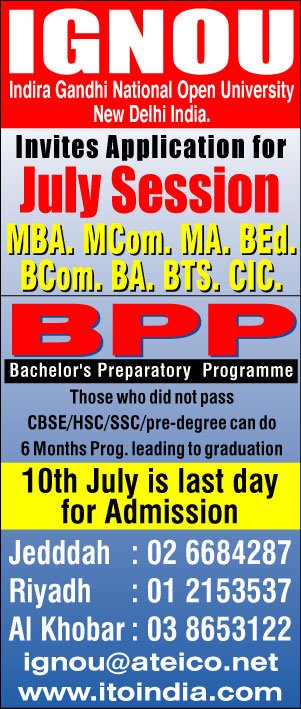
Hope the above are just a few amongst the many we have now as sources for continuing education.
Abu Dhabi considers congestion charges
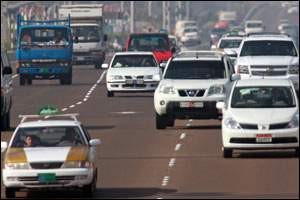
Abu Dhabi considers congestion charges
Ivan Gale and Matthew Chung for THE NATIONAL
Last Updated: June 22. 2008 11:45PM UAE / June 22. 2008 7:45PM GMT
The scenario emphasises road-based public transport options such as new bus fleets, instead of rail-based metro and tram systems. The National
ABU DHABI // The Abu Dhabi Government is considering eliminating fuel subsidies, introducing congestion charges and levying new fees on motorists as part of its efforts to solve the capital’s transport woes, according to documents posted on a new Department of Transport website.
The documents, developed by the DoT and made public on its website, illustrate the dilemma the department is facing. They lay out four scenarios for improving transportation in the city.
Three of the plans call for more public transportation, while one suggests building more motorways, although it is understood that the department could also adopt elements of the different plans.
Just two days ago, the Department of Planning and Economy released a report saying that road congestion and poor public transport were inflicting a “heavy economic toll” on the city and required “urgent remedial measures”.
The DoT has been studying the emirate’s transport problems since it was created two years ago. The city currently has a dearth of buses and many people wait for long periods to catch cabs.
Over the next two decades the department is expected to spend tens of billions of dirhams to improve things, in part to support the emirate’s 2030 plan, aimed at guiding the overhaul of infrastructure over the next quarter of a century.
The developers of the 2030 initiative expect Abu Dhabi’s population to more than triple in size during the period.
The transport department has invited the public to comment on the four scenarios. Then, in February 2009, the agency is expected to issue its recommendations and a blueprint for the transport network.
Abdulla al Shamsi, the director of roads and infrastructure at Abu Dhabi Municipality, said the new website and the publication of the documents were part of a transparency drive to keep the public more informed and actively involved in government planning.
The website, he said, “is really a step forward to the future”. It can be accessed at http://www.transportabudhabi.ae and members of the public are encouraged to comment on the ideas.
The four plans are: a highways-based scenario, a public transport and car alternatives scenario, a demand management scenario and a “low carbon” based scenario.
Under the highways approach, the Government would divert funds towards developing a high capacity, high quality motorway system to cater to private vehicles and road-based public transport and freight.
Existing freeways would be widened and flyovers and underpasses would be added. A one-way street network would be introduced in the central business district to improve flow and capacity.
The scenario emphasises road-based public transport options such as new bus fleets, instead of rail-based metro and tram systems. Toll lanes would be offered for commuters seeking to avoid congestion during peak travel times.
The public transport scenario would expand the mass transit network to include regional rail, trams, metro, bus and water ferries.
The plan calls for a network of integrated services so that journeys can be “door-to-door”. Some road capacity would be allocated to public transit, with the expectation that traffic would be transferred from the road to the public transit.
A regional rail network would be created within the emirate with high-speed rail links to Dubai, Al Ain and potentially Qatar. The public transit plan also calls for air-conditioned walkways. Ferries would service commuters living on the new residential islands of Abu Dhabi and others would run to Dubai.
The demand management scenario would introduce fees for road use, impose vehicle taxes and other maintenance charges, and provide free park-and-ride sites to encourage public transport use. The charges would be introduced in stages after public transport option alternatives are in place.
Fuel subsidies would be removed and fuel taxes introduced, as well as annual vehicle registration fees and safety tests. Congestion charges would be introduced as well as “cordon pricing” for vehicles entering the metropolitan area, similar to the one used in central London. Paid parking would also be extended. Car-pooling and cycling would be encouraged and signs throughout the city would warn drivers about congested areas. Pedestrian-only zones would encourage walking.
However, the report notes that introducing charges on motorists would “most likely” meet opposition.
The low carbon based scenario would rely heavily on public transport but would include a personal rapid transit network on Lulu Island and the use of alternative fuel and low-emission buses.
Low-pollution or electric vehicles or freight trams would be used to transport freight. A low emission zone would be introduced for Abu Dhabi, Sowwah, Reem and Saadiyat Islands, as well as the Capital City development, with charges on vehicles entering the zone based on their emissions. Subsidies would be given for alternative fuels.
In another sign that transport planning is gathering momentum, the DOT last week assembled its largest ever gathering to discuss transport options with key stakeholders from the public and private sector.
More than 70 people attended the meeting. In addition to government agencies, participants included representatives from the emirate’s biggest companies such as Mubadala, Aldar, the Abu Dhabi Investment Agency, Hydra Properties, and Abu Dhabi Basic Industries Corp.
igale@thenational.ae
mchung@thenational.ae
New buses on streets of Abu Dhabi
New buses on streets of Abu Dhabi
Matthew Chung for THE NATIONAL
Last Updated: June 25. 2008 6:06PM UAE / June 25. 2008 2:06PM GMT
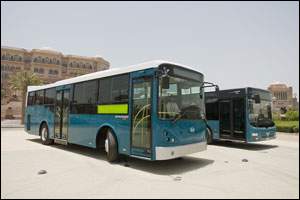
New buses are parked outside Emirates Palace. The Department of Transport has unveiled the new bus service for Abu Dhabi. Phil Cheung / The National
More than 1,300 new air-conditioned and handicap-accessible buses will be plying Abu Dhabi’s streets by 2010, the Department of Transport (DoT) said on today.
The first of the buses will start running on Monday on four routes serving Abu Dhabi Island. Six additional routes are scheduled to be added in August.
By 2009, the department plans to operate on 21 high-frequency routes.
Saeed al Hameli, the general manager for the bus office of the DoT, said the buses serving Abu Dhabi Island would be free until the end of this year to encourage residents to use them.
A further 100 buses are expected to start running by the first quarter of 2009.
The buses are among the first steps the department is taking to solve traffic congestion in the emirate, in which the population is expected to grow to 3.5 million by 2030.
A report issued on Saturday by the Department of Planning and Economy said the UAE was losing about Dh5 billion (US$1.3bn) to traffic congestion and that Abu Dhabi’s roads had outgrown their capacity.
“Our aim is to develop a comprehensive transportation network that will be appealing to all segments of society,” Mr Hameli said.
“Our biggest challenge today is to encourage car owners to utilise the new facilities and infrastructure once they come on line.”
Passengers could expect a reduction in waiting times for buses, Mr Hameli added.
As part of the project, the emirate’s 12 existing bus stations will be renovated and 25 new bus stations built. They will all feature a mix of retail, food and beverage and banking facilities.
Six depots will also be built for bus maintenance. The department is also considering creating dedicated bus lanes on some roads.
mchung@thenational.ae
‘Ashokavaniyankam Koodiyattom’
‘Ashokavaniyankam Koodiyattom’
Ammannur Rajanish as Ravana in ‘Ashokavaniyankam Koodiyattom’ held at Koodalmanikyam Kootambalam


It’s a family affair
It’s a family affair
Wednesday June 25 2008 10:54 IST Gayatri Dwivedi for Express News Service Kochi
WHEN mom and daughters stepped out in tune with the music, ‘Nritha Sandhya’ held at Fine Arts Hall became an event to cherish.
Renowned dancer Mary John and her daughters Ria and Ruby John put up a mesmerising show with spectacular performances of mohiniyattam, bharatanatyam and kuchipudi last week. Their troupe ‘Kalatharangini’ is headed by Mary’s husband KM John. The programme was held as part of the silver jubilee celebrations of Bank Employees Art Movement Ernakulam (BEAME).
John was born into a traditional Christian family in Kerala and nobody ever envisaged that he would be a dancer of international acclaim. As a child, he loved participating in school dramas.
The Duryodhana-Krishna sequences depicted in kathakali performances used to stir him like nothing else could. He felt that kathakali was his calling and made up his mind to study it. The going was tough and the training rigorous.
The painstaking practice sessions of eight hours a day for nine years was no child’s play. But his efforts came to fruition. The first honour that came his way was the AD Bollard gold medal for the best kathakali student in 1977. He started as a teacher at Kalamandalam.
The first tour abroad came in 1981 and after that, there was no looking back.
Marriage blessed him with a perfect partner in Mary. Besides being a leading mohiniyattam artist, Mary is also the first Indian female ‘chutti’ (make-up) artist. Mary’s decision to learn dance after marriage did not take off initially but after the birth of her second daughter, the desire became irrepressible.
Recalls John: “Mary used to get up very early in the morning with the plate and pot for kuchipudi practice. Amidst all this, there would be moments when she would hold the baby in her arms. The commitment in her put wings to her aspirations and soon, she started performing all over the globe.”
Their daughters are following their footsteps and perform kathakali, koodiyattam, mohiniyattam, bharatanatayam, kuchipudi and ottan thullal. While Ria is pursuing dentistry in Kochi, Ruby is a Plus-Two student. The family has given many performances in almost all the European countries. The troupe regularly conducts classes and workshops abroad.
The audiences there are very different. “In India, the number peters out as the night passes; but people abroad sit through the performances even if the next day is a working day,” says John.
The couple runs Kalatharamgini, a centre for performing and fine arts and culture in Cheruthuruthy, Thrissur.
 ClicksandWrites
You must be logged in to post a comment.