Month: December 2007
Four-and-half-year old hits karting track

Four-and-half-year old hits karting track
23 Dec 2007, 1914 hrs IST,PTI
CHENNAI: Karoon Murthy is just four-and-a-half years old but he is already blazing the karting tracks, which could possibly make him India’s youngest go-karter.
The UKG student, though cannot race in competitions till he is seven, he is racing here and in Bangalore on adult karts and is giving his elder competitors a run for their money.
Karoon probable has it in his genes, being the son of Kaushik Murthy, three time former national biking champion for TVS.
“Karoon was racing on battery karts since he was two-and-half years. Now he has begun to race on adult karts, which even many adults find difficult to race on,” says Kaushik.
A video of the child racing against a 13-year-old on a Karting track shows his potential. Not only does Karoon take the corners flawlessly but also races his elder competitor easily.
The third generation racer from the family, Karoon, a student at GRT School here, would also begin training in motor racing. Kaushk recently imported a Ninja racing bike for Karoon for this purpose.
“I plan to train him professionally. There is no one who can do both kinds of racing — car and bikes. We hope that he will be able to do both. He will start training on the bike at the Irungattukottai tracks soon,” he said.
Kaushk, who runs a team of professional stunters here called ‘Angels Racing’ and another team in Bangalore ‘Grips Racing’, says he was working on a training modules for Karoon.
“Akbar Ibrahim was my coach. We will put Karoon under his management once he starts racing. He knows what is best,” he says.
‘Fighting it out has made me stronger’

‘Fighting it out has made me stronger’
TNN / Sumit Mukherjee
If things go according to the script, Sourav Ganguly will step on the Melbourne Cricket Ground turf to play his 100th Test on Wednesday. TOI caught up with the ‘Bengal Tiger’ in Melbourne for a heart-to-heart chat.
Excerpts…
Looking back on your career, are you happy with what you have achieved?
I have enjoyed some very good times and also gone through tough periods. What’s important is that I have been lucky to be a part of Indian cricket during one of its most successful phases. It’s easily the high point of my career.
Have you seen many changes in Indian cricket during your time?
A lot of things have changed since I made my Test debut in 1996, especially in terms of training and approach to the game. I have no doubt in my mind that it’s because of these changes that our performances overseas have improved.
You have been a part of a core group of exceptionally talented players. Did you enjoy the ride?
It has been a privilege to play alongside people like Anil Kumble, Sachin Tendulkar, Rahul Dravid and VVS Laxman, for they are special players. Together we have seen Indian cricket progress. The period between 2000 till the end of the Pakistan series in 2004 was easily one of the most successful periods in contemporary Indian cricket. It was also during this period that we were as successful overseas as we were at home.
Of the two comebacks you have made in your remarkable career, which was more difficult, the one in 1996 or 2006?
Returning to the fold in South Africa last year was the biggest challenge of my career. In 1992 when I was dropped after just one ODI on the tour of Australia, I was still very young. After returning, I was happy playing in the Ranji Trophy. At 20, age was on my side. However, when I got left out in 2005 it was tough. When I came back in 2006, I needed to find out for myself that I was still good enough to keep performing at the top level.
What did life in the wilderness teach you?
I realised that there is an entirely different life beyond cricket. It helped to settle my mind. It was a tough phase, but fighting it out helped me to emerge stronger.
Do you have anything left to prove?
Contrary to the popular belief, I have never tried to prove or disprove anything. Every time I enter a cricket ground I just want to reassure myself that I belong at this level. Even today, I need to constantly reassure myself that I am mentally, physically and technically strong to meet the challenges of international cricket.
In the days of image makeovers, you seem to have reconstructed your batting technique…
Nothing major. I just made a few adjustments to my stance and grip. Now that I am no longer the captain, my mind is a lot free and I have more time on my hands. I use it to keep working on my game.
How big a deal is it to be Indian captain?
It’s a great honour and a huge responsibility. I feel every captain has a shelf life. No one can do the job indefinitely because it takes a lot out of you. In India, a captain has to deal with so many things that sometimes he has no time to think about his game.
How do you assess your own captaincy?
I have always felt that wickets overseas are much better than in India. So, to win abroad, we needed a few good seamers to support our two world-class spinners. Of course, we also needed runs on the board. It was, therefore important to make the players believe in their own ability. It was also important to pick players who we thought would do well overseas and persist with them. That helped us as these players played freely and delivered.
So you are happy to be out of the captaincy equation?
Let’s put it this way, the pressure on a captain has increased manifold since I first took of the reins of the team. Rahul and Anil must have found that out by now.
How would you like to be remembered?
As someone who played a small role in showing the world that India is no longer a pushover while playing overseas.
You must be looking forward to playing your 100th Test match. How will it be different?
I don’t think it will feel any different, but of course, it will be hugely satisfying. I am preparing for it just as I normally do for any other match. It will be an important landmark in my career and I will strive to make the occasion more memorable.
How has cricket shaped your persona?
Had I not played this wonderful sport, I wouldn’t have been able to experience or know half the things in the world. Not only has cricket taken me all over the world, it has also taught me how to handle pressure and criticism. I also would not have been able to savour the sweetness of success. It’s been a huge learning process.
Have you visualised your life after cricket?
I have travelled a lot. Probably I will play for some more time, which will include some more travelling as well. I will have to wait and see how I feel mentally by the time I finish. I want to stay at home for some time, with my daughter.
Special prayers for rain
Special prayers for rain
WAM Published: December 23, 2007, 17:18
Abu Dhabi: President His Highness Shaikh Khalifa Bin Zayed Al Nahyan called on all Muslims living in the UAE to gather at prayer sites on Monday to offer special prayers for rain.
Shaikh Khalifa urged all Muslims to pray to God for blessing the land with rain.
He called on all Muslims living in the UAE to turn up at prayer sites at 8am.
Team 1 Dubai 2008 Calendar
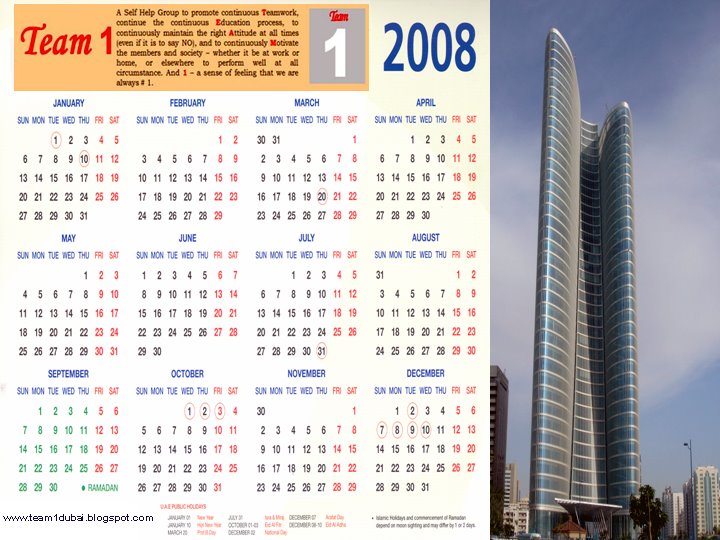
Dear all,
Wish you all a Quality Year 2008.
The calendar attached is with UAE Public Holidays.
God Bless,
Ramesh Menon
23122007

reddit_url='[URL]’reddit_title='[TITLE]’
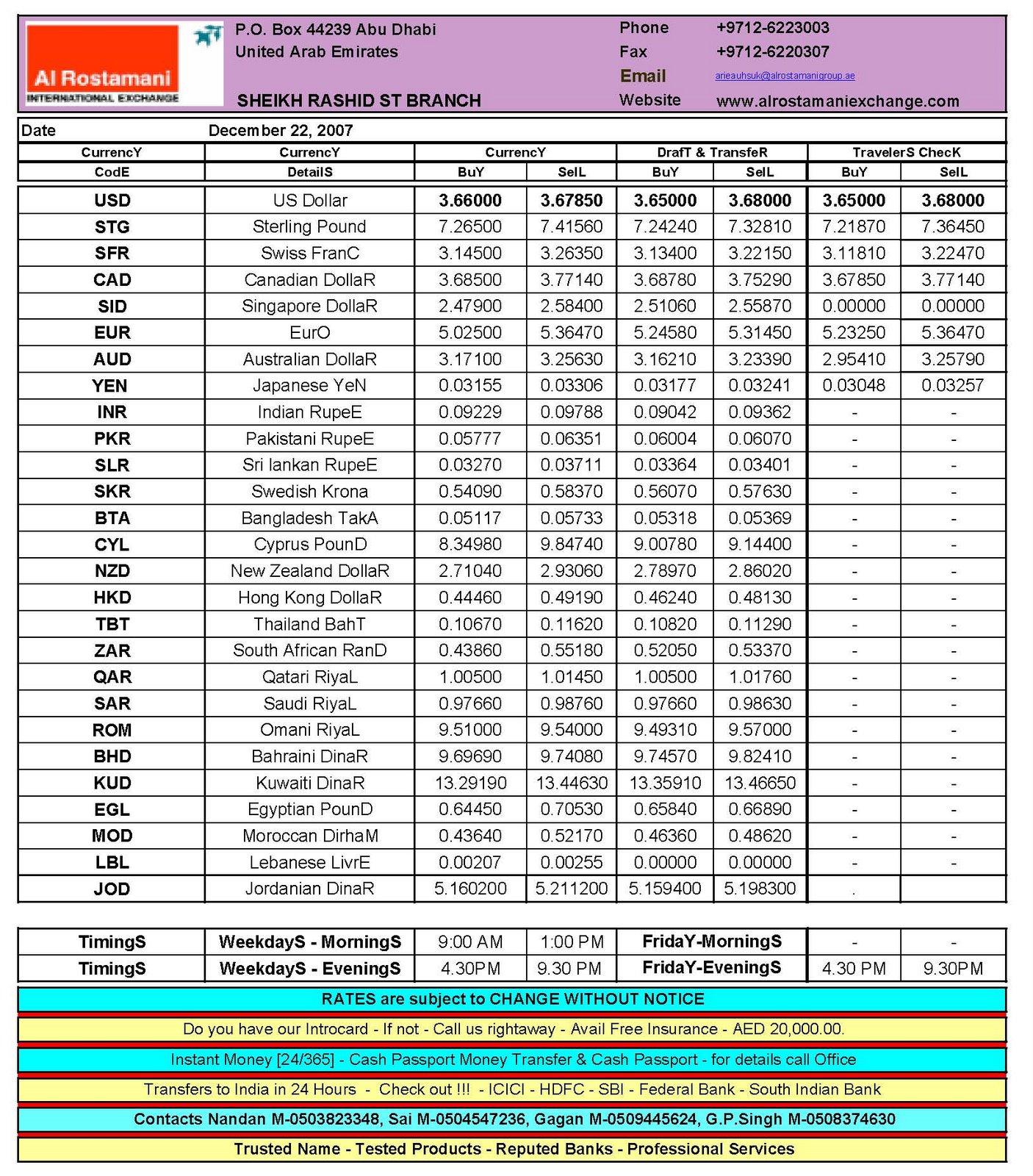
Daily Exchange Rates – Saturday, 22 December 2007
Brought to you by
Al Rostamani International ExchangeAbu Dhabi
Tel : + 9712 6223003
Mind Speaks – Towards Building a Quality ’08
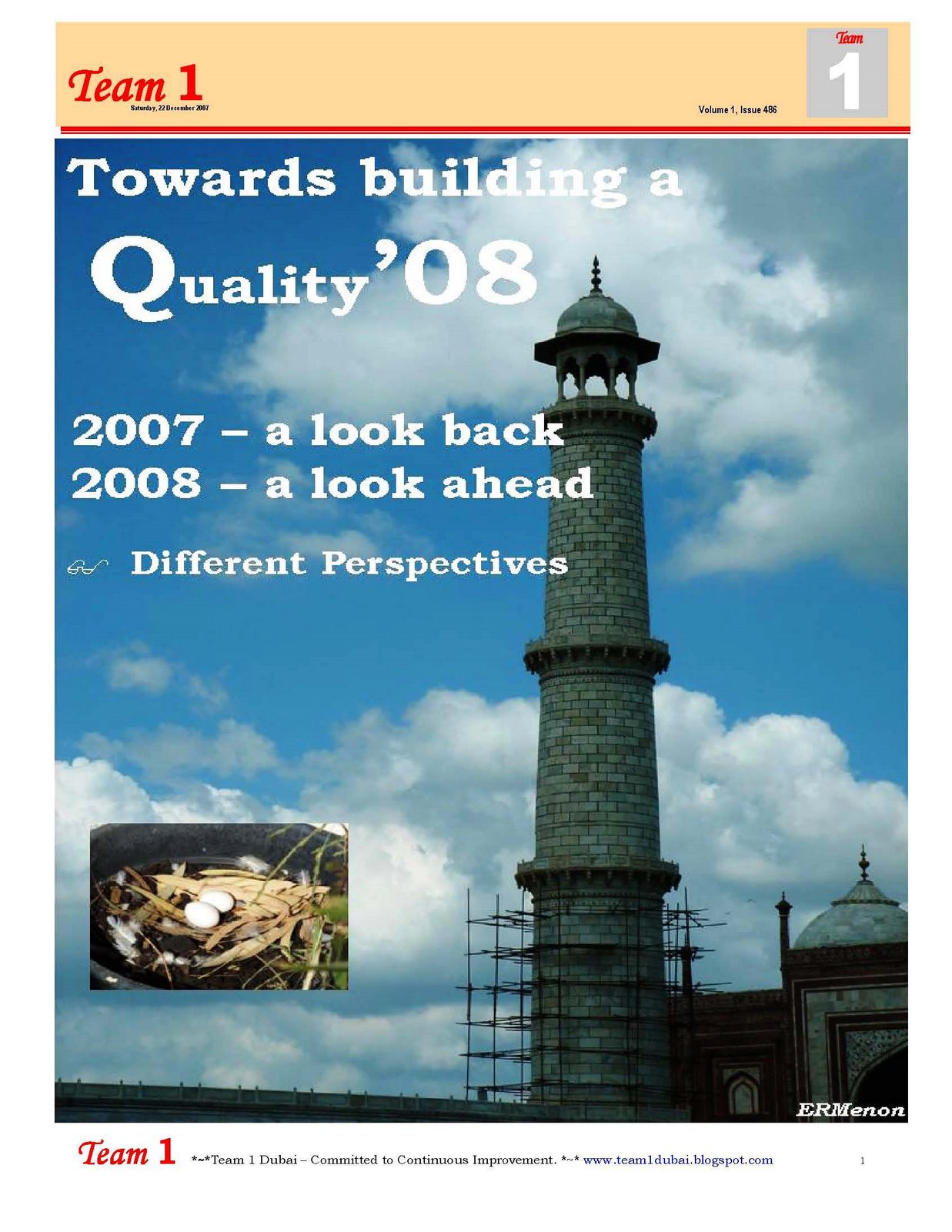
Hello friends,
Team 1 newsletter – Issue 486 – “Towards Building a Quality ’08” is ready and available. Those readers who wish to obtain a personal copy of the same in pdf version, please email us at team1dubai@gmail.com
digg_url = ‘WEBSITE_URL’;
digg_bgcolor = ‘#ff9900’;
digg_skin = ‘compact’;
digg_window = ‘new’;
"You Can Call It Gratitude"– by Sudha Murthy
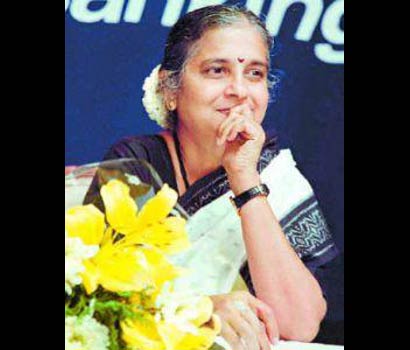
“You Can Call It Gratitude”– by Sudha Murthy
There are two photographs that hang on my office wall. Everyday when I enter my office, I look at them before starting my day. They are pictures of two old people. One is of a gentleman in a blue suit and the other is a black and white image of a man with dreamy eyes and a white beard.
People have often asked me if the people in the photographs are related to me. Some have even asked me, “Is this black and white photo that of a Sufi saint or a religious Guru?” I smile and reply “No, nor are they related to me. These people made an impact on my life. I am grateful to them.” “Who are they?” “The man in the blue suit is Bharat Ratna JRD Tata and the black and white photo is of Jamsetji Tata.” “But why do you have them in your office?” “You can call it gratitude.”
Then, invariably, I have to tell the person the following story. It was a long time ago. I was young and bright, bold and idealistic. I was in the final year of my Master’s course in Computer Science at the Indian Institute of Science (IISc) in Bangalore, then known as the Tata Institute. Life was full of fun and joy. I did not know what helplessness or injustice meant.
It was probably the April of 1974. Bangalore was getting warm and gulmohars were blooming at the IISc campus. I was the only girl in my postgraduate department and was staying at the ladies’ hostel. Other girls were pursuing research in different departments of Science. I was looking forward to going abroad to complete a doctorate in computer science. I had been offered scholarships from Universities in the US. I had not thought of taking up a job in India.
One day, while on the way to my hostel from our lecture-hall complex, I saw an advertisement on the notice board. It was a standard job-requirement notice from the famous automobile company Telco (now Tata Motors). It stated that the company required young, bright engineers, hardworking and with an excellent academic background, etc.
At the bottom was a small line: “Lady Candidates need not apply.” I read it and was very upset. For the first time in my life, I was up against gender discrimination. Though I was not keen on taking up the job, I saw it as a challenge. I had done extremely well in academics, better than most of my male peers. Little did I know then that in real life academic excellence is not enough to be successful.
After reading the notice I went fuming to my room. I decided to inform the top most person in Telco’s management about the injustice the company was perpetrating. I got a postcard and started to write, but there was a problem: I did not know who headed Telco. I thought it must be one of the Tatas. I knew JRD Tata was the head of the Tata Group; I had seen his pictures in newspapers (actually, Sumant Moolgaokar was the company’s chairman then).
I took the card, addressed it to JRD and started writing. To this day I remember clearly what I wrote. “The great Tatas have always been pioneers. They are the people who started the basic infrastructure industries in India, such as iron and steel, chemicals, textiles and locomotives. They have cared for higher education in India since 1900 and they were responsible for the establishment of the Indian Institute of Science. Fortunately, I study there. But I am surprised how a company such as Telco is discriminating on the basis of gender.”
I posted the letter and forgot about it. Less than 10 days later, I received a telegram stating that I had to appear for an interview at Telco’s Pune facility at the company’s expense. I was taken aback by the telegram. My hostel mate told me I should use the opportunity to go to Pune free of cost and buy them the famous Pune saris for cheap! I collected Rs 30 each from everyone who wanted a sari. When I look back, I feel like laughing at the reasons for my going, but back then they seemed good enough to make the trip.
It was my first visit to Pune and I immediately fell in love with the city. To this day it remains dear to me. I feel as much at home in Pune as I do in Hubli, my hometown. The place changed my life in so many ways. As directed, I went to Telco’s Pimpri office for the interview. There were six people on the panel and I realized then that this was serious business.
“This is the girl who wrote to JRD,” I heard somebody whisper as soon as I entered the room. By then I knew for sure that I would not get the job. The realization abolished all fear from my mind, so I was rather cool while the interview was being conducted. Even before the interview started, I reckoned the panel was biased, so I told them, rather impolitely, “I hope this is only a technical interview.” They were taken aback by my rudeness, and even today I am ashamed about my attitude.
The panel asked me technical questions and I answered all of them. Then an elderly gentleman with an affectionate voice told me, “Do you know why we said lady candidates need not apply? The reason is that we have never employed any ladies on the shop floor. This is not a co-ed college; this is a factory. When it comes to academics, you are a first ranker throughout. We appreciate that, but people like you should work in research laboratories.” I was a young girl from small-town Hubli. My world had been a limited place. I did not know the ways of large corporate houses and their difficulties, so I answered, “But you must start somewhere, otherwise no woman will ever be able to work in your factories.”
Finally, after a long interview, I was told I had been successful. So this was what the future had in store for me. Never had I thought I would take up a job in Pune. I met a shy young man from Karnataka there, we became good friends and we got married.
It was only after joining Telco that I realized who JRD was: the uncrowned king of Indian industry. Now I was scared, but I did not get to meet him till I was transferred to Bombay. One day I had to show some reports to Mr. Moolgaokar, our chairman who we all knew as SM. I was in his office on the first floor of Bombay House (the Tata headquarters) when, suddenly JRD walked in. That was the first time I saw “appro JRD”. Appro means “our” in Gujarati. This was the affectionate term by which people at Bombay House called him.
I was feeling very nervous, remembering my postcard episode. SM introduced me nicely, “Jeh (that’s what his close associates called him), this young woman is an engineer and that too a postgraduate. She is the first woman to work on the Telco shop floor.” JRD looked at me. I was praying he would not ask me any questions about my interview (or the postcard that preceded it). Thankfully, he didn’t. Instead, he remarked. “It is nice that girls are getting into engineering in our country. By the way, what is your name?” I replied “I am Sudha” He smiled a kindly smile and started a discussion with SM. As for me, I almost ran out of the room.
After that I used to see JRD on and off. He was the Tata Group chairman and I was merely an engineer. There was nothing that we had in common. I was in awe of him. One day I was waiting for Murthy, my husband, to pick me up after office hours. To my surprise I saw JRD standing next to me. I did not know how to react. Yet again I started worrying about that postcard. Looking back, I realize JRD had forgotten about it. It must have been a small incident for him, but not so for me.
“Young lady, why are you here?” he asked. “Office time is over.” I said, “Sir, I’m waiting for my husband to come and pick me up.” JRD said, “It is getting dark and there’s no one in the corridor. I’ll wait with you till your husband comes.” I was quite used to waiting for Murthy, but having JRD waiting alongside made me extremely uncomfortable. I was nervous. Out of the corner of my eye I looked at him. He wore a simple white pant and shirt. He was old, yet his face was glowing. There wasn’t any air of superiority about him. I was thinking, “Look at this person. He is a chairman, a well-respected man in our country and he is waiting for the sake of an ordinary employee.” Then I saw Murthy and I rushed out. JRD called and said, “Young lady, tell your husband never to make his wife wait again.”
In 1982, I had to resign from my job at Telco. I was reluctant to go, but I really did not have a choice. I was coming down the steps of Bombay House after wrapping up my final settlement when I saw JRD coming up. He was absorbed in thought. I wanted to say goodbye to him, so I stopped. He saw me and paused. Gently, he said, “So what are you doing, Mrs. Kulkarni?” (That was the way he always addressed me.) “Sir, I am leaving Telco.” “Where are you going?” he asked. “Pune, Sir. My husband is starting a company called Infosys and I’m shifting to Pune.” “Oh! And what will you do when you are successful.” “Sir, I don’t know whether we will be successful.” “Never start with diffidence,” he advised me. “Always start with confidence. When you are successful you must give back to society. Society gives us so much; we must reciprocate. I wish you all the best.”
Then JRD continued walking up the stairs. I stood there for what seemed like a millennium. That was the last time I saw him alive. Many years later I met Ratan Tata in the same Bombay House, occupying the chair JRD once did. I told him of my many sweet memories of working with Telco. Later, he wrote to me, “It was nice hearing about Jeh from you. The sad part is that he’s not alive to see you today.”
I consider JRD a great man because, despite being an extremely busy person, he valued one postcard written by a young girl seeking justice. He must have received thousands of letters everyday. He could have thrown mine away, but he didn’t do that. He respected the intentions of that unknown girl, who had neither influence nor money, and gave her an opportunity in his company. He did not merely give her a job; he changed her life and mindset forever.
Close to 50 per cent of the students in today’s engineering colleges are girls. And there are women on the shop floor in many industry segments. I see these changes and I think of JRD. If at all time stops and asks me what I want from life, I would say I wish JRD were alive today to see how the company we started has grown. He would have enjoyed it wholeheartedly.
My love and respect for the House of Tata remains undiminished by the passage of time. I always looked up to JRD. I saw him as a role model for his simplicity, his generosity, his kindness and the care he took of his employees. Those blue eyes always reminded me of the sky; they had the same vastness and magnificence.
* Sudha Murthy is a widely published writer and chairperson of the Infosys Foundation involved in a number of social development initiatives. Infosys chairman Narayan Murthy is her husband.
Sourced from The Net.
Alternative therapies: Unlocking closed doors

Alternative therapies: Unlocking closed doors
Amrita Singh,TNN
Her mother thought she was speech impaired. For years the child had not spoken a word, and hearing her sing a rhyme was something they had long given up hope for. She was autistic, you see. But Margaret Lobo, a UK-based music therapist associated with Music Therapy Trust in Mumbai, knew she could be reached through music. Lobo sang nursery rhymes, prodding the child to sing after her. After just three sessions her student sang – loud and clear. Lobo had unbolted her isolated world, if only for a brief moment.
Lobo is one of the unlikely people working in the field of behavioural therapy. After all, music, dance, art or brain gym don’t seem to belong in psychiatry books. Yet, these creative forms may have solutions to psychological problems. Doctors are increasingly prescribing these therapies for attention deficit syndrome, dyslexia, autism, depression and even schizophrenia.
Broadly these therapies work on the premise that the basic brain structure is the same for everyone and if somebody cannot read, write or communicate it isn’t because there is something wrong with their brain but because we don’t have the right tools to communicate with them. These tools could well be found in various art forms.
Lobo, for instance, uses music therapy to deal with autism, ADHD and other disorders. “It works on anyone. You could be paralysed due to a stroke, but the ability to hear and comprehend music never goes,” she says. She encourages a child to experiment with many instruments, looking for cues about what might work in each case. The breakthrough may take weeks, sometimes even years and the effect may be fleeting. “There is a feeling of triumph each time a student manages to dance, sing or speak a sentence coherently.”
Dance therapy, meanwhile, uses body movements to increase emotional and physical coordination. It believes that the body’s shape can affect one’s attitude. Tripura Kashyap, a Hyderabad-based instructor with a degree in dance stroke movement therapy from Hancock Centre of Dance Therapy in US, says, “Dance can improve imitation skills and memory, as kids are motivated to make eye contact, focus for a long time and learn the sequence of steps.”
Another programme that’s gaining popularity is Neuro linguistic programming (NLP). Krish Srikanth, who has trained with American NLP practitioner Anthony Robbins, says kids with learning disorders store and comprehend information in a way that’s different from others. They can benefit from NLP spelling strategy, that attaches images and feelings to words to make learning and spelling easier.
But there are some roadblocks. Dr Vikas Mohan Sharma, a psychiatric at Vimhans, Delhi, says, “The therapies can be effective if used with medicine. But getting to the right person may be tough.” Parents must check the therapist’s qualification. For instance, a certificate in music therapy is given by Apollo Hospital, Chennai, and Music Therapy Trust of India.
Little geniuses need care too
Little geniuses need care too
Pallavi Srivastava,TNN
Academically and mentally challenged children are not the only ones that need much more support than is being provided in India. And while small moves are being made to nurture the differently abled, another group of kids continues to suffer silently.
Yes, most of us don’t even think that gifted children need special attention too. But the few people who are working in the field in India say that gifted children form yet another group that the society continues to treat unfairly.
“People think that gifted kids would do well anyway,” says Dr Devasena Desai, in-charge of the nurturing programme at the Pune chapter of Mensa, the largest, oldest and most well-known high-IQ society in the world. Dr Desai, however, emphasises that close to nothing is being done for the children who carry the greatest potential. We, in fact, do more harm to them if we just let them be. “They are more touchy and withdrawn, because their high ability hampers their interaction with other kids,” she says. “You have to give them challenging activities as well as help them in social and emotional development.”
That, unfortunately, is a thought almost non-existent in India. So our gifted kids risk ending up as under-achievers or distracted workers. The education system has no special place for them. Few schools make special provisions for their mental stimulation and parents don’t know whom to approach for guidance.
Not even a fraction of the money and attention given to providing special education for the mentally challenged children is given to these geniuses. “The need is doubled for these kids,” says M. Srinivasan, founder-chairman of GEAR (Gifted Education and Research) Foundation, which runs a school in Bangalore. “But as they say, the crying baby gets the milk. While parents and social workers are very active to get facilities for the disabled, people look down upon me for promoting gifted education.”
Efforts, however, are being made by individuals like him to make a difference at their own level. The Institute for Gifted Children, set up in Delhi by Dr Shakuntla S. Jaiman to develop a teaching methodology at her CSKM Public School, identifies gifted students from class 4 onwards. “The few schools that identify gifted children tend to group them in one section. That isolates them from the mainstream. But we develop them to become mentors to other children,” she says.
The scenario is made more complex because there are conflicting theories of judging giftedness, although most agree that gifted people are the top 1% of the population. Besides IQ testing, which has attracted wide criticism, new concepts like Multiple Intelligences and attitude, emotional and social quotients have emerged. This has left people to follow their own methods to identify and nurture children, and to train teachers.
For instance, Srinivasan, who holds a masters degree from the National Research Centre on the Gifted and Talented, University of Connecticut, USA, applies the Multiple Intelligences concept in his school. “We don’t ask, ‘How smart are you?’,” he says. “We ask, ‘How are you smart?’.” Jaiman, who has done her PhD. in the subject from IIT, Delhi, uses a wide range of psychological tests.
Srinivasan, in fact, discounts the IQ score beyond 120, saying it works more for mathematicians or scientists and not for the creative lot. Desai, however, says they need an IQ of at least 140. “There is a thin line between being talented and gifted,” she says. “While a talented person may be good at one or two-three things, a gifted person has a cognitive ability that’s far superior to the normal population.”
Mensa, for that matter, has its own standard international qualifying test that a person from any cultural background can take. And Mensa, Pune, has, over the past five years, identified over 60 tribal students from Maharashtra as ‘Mensan’. The organisation will help in their social, emotional and mental development through 18 modules over the next 18 months. Well, it’s high time the gifted got some gifts too.
Recipe for a happy marriage
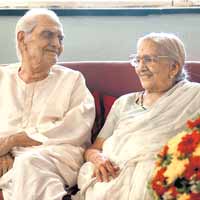
Recipe for a happy marriage
Namita Devidayal
In an era where every one seems to be someone’s ‘ex’ – (a Mumbai fashion designer has launched a label cockily called Sex With My Ex) – marriage has become something of a curio. The subject is eternally bewildering: What is the formula to make a marriage work? Is there one? Is it an outdated institution? Or is it a mistake every one should make?
In an attempt to decode the idea of matrimony, two South African film-makers have decided to make a film on long-marriages-couples who have stuck it out for more than 50 years. “We wanted to capture 50-year-old marriages before they become extinct,” explains Karen Slater, who earlier made films on wildlife.
So, what prompted her to drop the buzzard for the bedroom? It started four years ago, when she and her then friend, Steven Bartlo, got involved with each other. Slater was 36, Bartlo was close to 50. When the ‘M’ word came up, both recoiled. The subterranean ghosts popped up. She was terrified because her parents had divorced, and he was utterly cynical, because he had seen his folks bicker all his life long. (In case you’re wondering which is better – chronic bickering or divorce – wait till the end of the article).
To determine whether or not they should get married, and also get some tools on what makes marriages last, they started exploring the idea of making the film, which they titled ‘Fifty years! Should we do it’. They have since been all over the world interviewing sweet old couples, including a conservative Catholic Dutch couple, a polygamous Zulu chieftain and his six wives, a suburban American couple, Bartlo’s parents (who are Indian) and, most recently, the Breach Candy-based spiritual advocate, Ramesh Balsekar and his wife Sharda. Somewhere in the middle of that, they got married and also feature in the film.
Slater and Bartlo were in Mumbai recently to interview the Balsekars, who have been married 67 years. (They would have loved to interview their own guru, but realised that he would not be an appropriate candidate as he had slept with too many of his disciples.)
Bartlo interviews the man, Slater the woman. So what did Balsekar, whose disciples include the gloomy Canadian singer Leonard Cohen, have to say? “He explains every thing in terms of philosophy,” says Bartlo, “…so whatever is meant to happen, must happen. It’s the same in marriage.” What does he mean? People are programmed by their conditioning and their genetics. So that affects their marriage. But an important tip: “Always put your attention on the needs of the other. You have to rise above your own personal desires.”
Bartlo’s thoughts? It is important not to take things too seriously. So, if something happens in your marriage, you accept it, absorb and process it, let it have its due impact on you, and then let it go. Going back to a Balsekarism, he adds, “Remember, the past is dead, and the future is entirely uncertain, so just live in the moment.”
And what did the others have to say? Well, the Zulu healer, who once had 13 wives, had this gem on offer. “You should never stray outside your marriage.” He claimed to be happily married though, not surprisingly, the wives did not entirely reflect that sentiment.
Divorce is not a bad word in the film-makers’ view, only “something treated too easily and light-heartedly, without any long-term vision,” says Bartlo. It was when Bartlo interviewed his parents, who have now transformed into a calm, hand-holding couple, he was most intrigued. He realised that, “If you make it through the rapids and whirlpools of your marriage, you eventually do reach the ocean of serenity…If you have the strength of character to make it through the rough spots, you usually do reach the Golden Age” – (a nugget perhaps that all of us not-yet-married-for-50-years should stash away in a secret drawer).
“If we hadn’t made this film, I don’t think we’d have got married,” says Slater. “These couples have been an inspiration.”
 ClicksandWrites
You must be logged in to post a comment.