Sixty years of Pakistan
Sixty years of Pakistan
Friday,17 August 2007 10:00 hrs IST/MALAYALA MANORAMA English edition
– Alok Bansal As Pakistan completes 60 years of existence, it is passing through a critical phase. The state’s writ does not run over almost half its territory. Most people consider themselves as Sindhis, Baloch, Pakhtoons, Mohajirs and Punjabis first rather than as Pakistanis. Pakistan as a nation is kept together artificially by the only institution that functions – the army.
Despite belated attempts by the judiciary to assert its independence, the fact is that for most part of Pakistan’s existence the courts have been dysfunctional and came out with the bizarre ‘Doctrine of Necessity’ to justify military coups. Pakistan’s greatest tragedy has been that barring the armed forces or army to be specific, no other credible institution has emerged. The judiciary, legislature and bureaucracy-all have crumbled during Pakistan’s six decades’ journey.
However, it was not always the case when Pakistan came into being in 1947. It was a much stronger nation vis-a-vis India, which most Western scholars of that era believed would crumble under the weight of its own inner contradictions. However, Pakistan suffered from two major flaws right from the beginning-firstly the leadership of the Muslim League came from the provinces that remained part of India and hence the party had no mass support in the region that became Pakistan.
Secondly, the early death of Mohammed Ali Jinnah eliminated the only credible leader who could draw support across Pakistan. And when Liaquat Ali Khan was assassinated in October 1951, whatever little semblance of leadership remained disappeared.
Not that Jinnah and Liaqat were without flaws. Jinnah had centralised power in his hands and was the Governor General, the party chief and a cabinet minister simultaneously. Liaquat was guilty of not expediting the process of constitution making. But still they were leaders whose appeal was not confined to a part of Pakistan or any particular group.
Pakistan experimented with half a dozen constitutions within the first 25 years of its existence. Frequent coups and military rules ensured that neither the constitution nor the other institutions of governance were allowed to evolve.
The first decade was crucial to shaping Pakistan’s destiny and was marked by drift and chaos. Seven different prime ministers and eight different cabinets took oaths of office during this tumultuous period, resulting in the ascendancy of bureaucracy in the decision making, with the tacit support of the army.
When Ayub Khan took over the administration after the first military coup in 1958, the public, fed up with anarchy, supported him. In the initial years of the regime there was all-round improvement in the administration as well as economy. It was the time visitors from China and South Korea toured Pakistan to study its phenomenal success. But like any authoritarian regime, Ayub’s rule had long-term adverse impact on Pakistan.
Suppression of people’s democratic aspirations under a military regime and attempts to amalgamate ethnic identities by the creation of one unit impacted the Pakistani nation adversely. The 1965 war, often considered the high point of Pakistani nationalism, was the turning point as far as nationalism in the two South Asian countries was concerned.
From then on India consolidated as a nation but Pakistani nationalism began to wither. Bengali nationalism got a fillip during the 1965 war, when they were led to believe that their defence lay in West Pakistan. The reaction to ‘one unit’ created a strong sense of nationalism in Balochistan.
Ayub could not last the aftermath of 1965, when his own foreign minister, Zulfiqar Ali Bhutto, rebelled and convinced the masses that the gains of the battlefield had been frittered away at the negotiating table in Tashkent. However, Ayub’s belief in the superiority of the military leadership resulted in General Yahya Khan succeeding him rather than any other civilian dispensation.
Yahya undid the ‘one unit’ and was sincere about return to democracy. He conducted the first and possibly the only credible elections under a military regime in Pakistan. But long years of military rule had irreparably damaged the Pakistani nation. Yahya allowed himself to be hoodwinked by Bhutto, and the result was Pakistan’s break up and creation of Bangladesh.
The creation of Bangladesh removed whatever semblance of religious pluralism existed in Pakistan; and the absence of pluralism created fissures within Islam, which was supposed to bind Pakistan together. Bhutto, who succeeded Yahya Khan, moved Ahmediyas beyond the pale of Islam.
The fissures between various sects and schools within the same sect were accentuated under the Zia ul Haq regime, which brought religion on the centre stage of state policy.
Bhutto gave Pakistan its first workable constitution but his authoritarian streak led to the dismissal of opposition-led provincial governments, resulting in a violent uprising in Balochistan. Despite being the favourite to win the 1977 elections, Bhutto rigged them. Subsequent anti-government protests followed by government repression brought military once again on the centre stage.
Zia’s era was the darkest in Pakistan’s history. His Islamization drive, suppression of press and involvement in the Afghan conflict eroded the state structure considerably. Islamic militancy and sectarianism were the by-products of his policies, which finally led to the creation of Taliban.
Subsequent civilian interlude was not really a return to civilian rule. The army was not only looking from the sidelines, but decision making in certain key areas of state policy were kept beyond the ambit of civilian leadership. Marring this period was bickering between the two main political parties, led by Benazir Bhutto and Nawaz Sharif.
The period also saw the disenchantment of Mohajirs (the refugees from India) who were in the forefront of the Pakistan movement, leading to long bouts of violence in Karachi. The Pakistani economy slid and its foreign debt rose. An economic collapse of Pakistan looked likely.
Economic consolidation required a cut in bourgeoning military expenditure, which the army would not allow. In 1999, when Nawaz Sharif tried to break free from the army, the army decided to move in and remove the civilian façade. Like in all previous occasions, the military rule led to initial economic recovery, but it had long-term adverse impact on Pakistan.
Sub-nationalism emerged as a serious threat to the Pakistani state. Islamic fundamentalists challenge the writ of the government across the length and breadth of Pakistan. Islamabad’s frequent flip-flops on the foreign policy front and frequent incursions by American armed forces within Pakistani territory have compromised its sovereignty in the eyes of its citizens.
The author is a Research Fellow at New Delhi’s Institute of Defence Studies and Analysis.
Develop intuitive powers, tells top Tata executive
Develop intuitive powers, tells top Tata executive
Tuesday,21 August 2007 18:15 hrs IST /MALAYALA MANORAMA English edition
New Delhi: Intuition, along with traditional tools like logic and analyses, plays an equal role in the management of today’s corporations that are increasingly becoming global in outlook, a top Tata Sons executive said Tuesday.
“Logic and analysis are very important to leadership not making mistakes,” R. Gopalakrishnan, executive director of Tata Sons, who played a key role in the mega acquisitions of the group, said in a lecture here.
“But they have limitations. Intuition is a powerful outlay, after the powers of logic have been exhausted,” he said in the lecture on “The Manager’s Dilemma: Analysis vs Intuition” at the Federation of Indian Chambers of Commerce and Industry (Ficci).
Gopalakrishnan, who has also authored a book on corporate management titled “The Case of the Bonsai Manager”, also emphasised that it is intuition that will play a key role in the success of smaller firms in a world ruled by conglomerates.
Stating that his book deals with a key leadership issue – on what the balance between logic and intuition is – Gopalakrishnan said, “The world of business is a world of practicality.”
He said that in today’s world, sticking to only analysis before taking any strategic decision would not lessen chances of mistakes on the part of the leader.
“Continuous analysis can lead to paralysis. It is here that intuition plays an important part.”
He, however, added, “Intuition is not a substitute to analysis. It is a companion to analysis.”
Elaborating, he said, “Knowledge is ‘what you know you know’. Intuition is ‘what you don’t know you know’. A combination of both is wisdom.”
So, how can a person be intuitive?
“If we cannot hear beyond our hearing range, see beyond our visual range or feel beyond our immediate environment, we cannot be intuitive,” said Gopalakrishnan.
In a lighter vein, he said that analysis and intuition are as opposite to each other as corporate governance and sex.
“Everybody practises sex but does not talk about it. Everybody talks about corporate governance but nobody practises it.”
Stating that analysis can lead one into thinking only on a linear path, he said, “It is intuition, that sudden ‘aha’ moment of life, that will help a manager reduce mistakes.”
To emphasise his point, he referred to the examples of Archimedes and his bathtub moment and the apple falling on Isaac Newton’s head.
Giving a powerpoint presentation, he said that intuition can be developed by immersion and contemplation. This should be followed by filling what he called the ‘brain’s remote implicit memory’ or BRIM with emotion-rich stories.
“Your first day in school, your first job or the day your girlfriend rejected you. It can be anything – positive or negative. But it should be emotion-rich,” he said.
And then sensing at the edge of the spectrum is the final stage of the process of developing intuitive powers.
“Management schools teach you not to be emotional. I say, ‘Be emotional’,” the Tata Sons executive director said.
Earlier, welcoming the gathering, Ficci vice-president Rajeev Chandrasekhar said that Gopalakrishnan’s views are significant in today’s world of conglomerates.
“Big conglomerates are very risk averse. This throws up huge opportunities for new entrepreneurs. But these opportunities can be successfully exploited only when approached with a good gut feeling after being properly analysed,” he said.
UAE revises up 2006 GDP growth to 9.4pc
UAE revises up 2006 GDP growth to 9.4pc
(Reuters)/21 August 2007
DUBAI — The United Arab Emirates revised up its 2006 economic growth rate to 9.4 per cent on faster expansion in the oil and gas sector, the economy ministry said.
The second-largest Arab economy expanded to Dh391.16 billion ($106.5 billion) last year, from Dh357.59 billion in 2005, according to the latest data published on the Ministry of Economy web site.
The ministry said in March real gross domestic product grew 8.9 per cent last year.
The ministry revised the growth rate to account for higher growth in the oil and gas output, which accounts for 25.9 per cent of GDP.
The value of petroleum sector output grew 6.5 per cent to Dh101.31 billion, the ministry said, compared with the Dh99.9 billion figure released in March.
“You’re not going to see a growth rate that fast in the oil sector this year,” said Giyas Gokkent, head of economic research at the National Bank of Abu Dhabi.
The Organisation of Petroleum Exporting Countries (Opec) agreed at two meetings late last year to cut production by a total of 1.7 million barrels per day or roughly six per cent of group output, in response to a sharp drop in oil prices. The UAE’s production was rolled back to 2.5 million barrels a day from around 2.6 million barrels as part of the cuts, Gokkent said.
Economic growth in 2005 was 10.5 per cent, ministry data showed based on revised 2004 growth data. In 2003, the economy grew at 11.9 per cent.
Higher education strategy takes new turn
Higher education strategy takes new turn By Abdullah Al Shaiba, Staff Writer/GULF NEWS Published: August 19, 2007, 00:22
Needs of the labour market have to be included while devising higher education programmes, writes Abdullah Al Shaiba
It has become important for nations which seek prosperity and stability to establish, and maintain clear, transparent and achievable strategies for its development programmes.
The UAE has decided to follow that path under the new leadership of President His Highness Shaikh Khalifa Bin Zayed Al Nahyan.
Recently, the Ministry of Higher Education and Scientific Research (MHE) announced its strategic plan for higher education programmes and scientific research activities in the country.
The strategic plan is an essential part of the comprehensive national strategy announced a few months ago by His Highness Shaikh Mohammad Bin Rashid Al Maktoum, Vice-President and Prime Minister of the UAE and Ruler of Dubai.
The strategy was based upon the key roles the MHE performs which are:
The MHE is responsible for the general planning of higher education and scientific research in the country;
It will continue its mission as a coordinator between universities and colleges nationwide;
It supervises the issues and affairs of private universities and colleges;
It supervises international scholarships for UAE nationals;
The MHE organises the activities of scientific research.
Achieving a balance
The major goal of the strategic plan issued by the MHE is to establish, maintain, and broaden the prospective balance between the local labour market and the outcomes of higher education institutions.
The plan should complete the overall goals of the UAE strategy which has been established by the current cabinet and approved by Shaikh Khalifa.
Partnership with labour market
The strategy of the MHE focuses on improving the entire higher education system in the UAE to be one of the best systems worldwide according to international standards and practices adopted in accordance with the local identity and circumstances.
The MHE also aims to play an important role in creating the new knowledge-based economy in the UAE through establishing a new strategic partnership between higher education institutions and the labour market in order to participate in the comprehensive national development programmes.
Therefore, the participation of both the private market and business community is fundamental in the area of providing the necessary sponsorship for the students via internal or external scholarships programmes.
It is important to indicate that the MHE has already implemented some parts of its strategy with the Ministry of Education; particularly in the project of Future Schools, which aims to improve UAE national students’ educational levels during the general education stages in order to decrease the need for “foundation programmes or foundation years” in public higher education institutions.
The MHE will also develop the scientific research activities in the UAE in order to create a knowledge society.
The ministry will continue developing its system in both higher education and scientific research in order to support the decision-making process and to link the higher education and scientific research with the actual needs of the society.
The national strategy in general, and the strategy of the MHE in particular, no doubt, establishes a new era in the contemporary history of the UAE.
However, it is important to keep the strategy steady even when people who are responsible for its implementation have changed.
The strategy
The general aspects of the Ministry of Higher Education and Scientific Research (MHE) strategy are:
Develop the quality performance of the ministry with full coordination with the relevant federal and local institutions.
Offer the appropriate alternatives to replace the current academic programmes that aim to improve the students’ competencies in universities and colleges. This the MHE will coordinate with the Ministry of Education.
Develop the potential of private universities and colleges in coordination with the local education councils.
Coordinate with the Ministry of Education to face the challenge of the increase in the drop-out rates among male students in general education and to raise their participation in higher education institutions.
Coordinate with Ministry of Labour in the area of improving the mission of higher education in order to meet the requirements of the society.
Coordinate with the Ministry of Culture, Youth, and Society Development in spreading awareness of the national identity and heritage of the UAE.
Establish the appropriate initiatives to prepare and qualify UAE national manpower in order to increase their recruitment opportunities in the private market.
Develop and support the efforts of the Commission of Academic Accreditation (CAA) which supervises the private higher education institutions.
The writer is a UAE-based academic and thinker
Quality scheme to win shoppers’ confidence

Quality scheme to win shoppers’ confidence
By Binsal Abdul Kader, Staff Reporter/GULF NEWS Published: August 20, 2007, 23:37
Abu Dhabi: Shoppers can soon confidently pick up quality products from the market thanks to a standardisation scheme introduced by a federal agency.
Manufacturers or producers can attain an ‘Emirates Quality Mark’ for their products which ensures UAE or regional and international standards, said Muammar Mustafa, Director of the Conformity Assessment Department of Emirates Standardisation and Metrology Authority (ESMA) in Dubai.
The Emirates Conformity Mark Scheme to “mark” imported and locally produced products, has received a good response from the industry, he said.
ESMA is a national standards body and a legally authorised agency at the federal level entrusted with activities related to standards and quality in all the emirates.
It ensures safety, health, economical and environmental protection. The scheme which came into existence last month is not mandatory but voluntary and encourages the participation of manufacturers.
It is a comprehensive standardisation scheme which assesses not only the quality of products but also their safety.
To grant the “mark” coded “Al Alama” to a product, the standards of the manufacturing or producing units will also be assessed, apart from the quality of the products, said Mustafa.
If it so requires, the officials of the agency will visit a foreign country to assess the standard of the manufacturing unit and the process, said the director.
Applications
He said so far about 15 manufacturers have submitted applications to get the “mark” for their products since the scheme was introduced on July 19.
The applicants include three multinational companies and local manufacturers in the steel, food and lubricant industries. The evaluation may take about six weeks and the first quality mark from ESMA will be presented soon, said the director.
He said ESMA’s aim is to raise awareness among the consumers to insist on a high quality of products so that a self-regulatory mechanism will be put in place.
If consumers insist on the products with the “mark” sellers will be compelled to give preference to such products.
The director made it clear the system will work in accordance with WTO’s TBT guidelines (Technical Barriers to Trade) which insists that export and import of countries must not be hindered by regulations which are against international law.
Many consumers who had a bitter experience with substandard products in the market welcomed the new move.
Yazer Essam, an Egyptian said he was shocked to get a plastic piece in a soft drink bottle purchased from a shop. Such an experience may not be repeated if there is a ‘quality mark’ on products.
Retailers also welcomed the move. Kamal Vachani, director of Al Maya group said the standardisation will attract more customers to the UAE as an internationally reputed market.
“It is the biggest market in the Middle East so most of the products are launched here. Customers confidence in the mark will be improved with the new scheme.”
Nine categories to get certified
Although ESMA encourages manufacturers to get all types of products certified, it proactively takes up the following nine categories initially in the scope of the quality mark:
– Electrical household products
– Food products
– Toys
– Cosmetics
– Detergents
– Construction materials (cement)
– Lubricants
– Paints
– Wires and cables
Sharjah Port fire – Heroes of the inferno
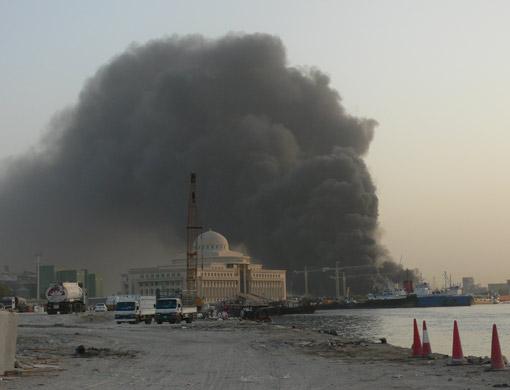
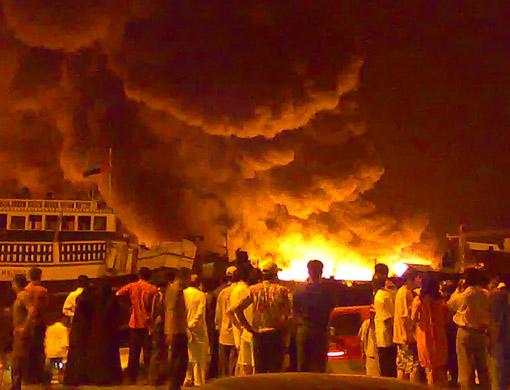
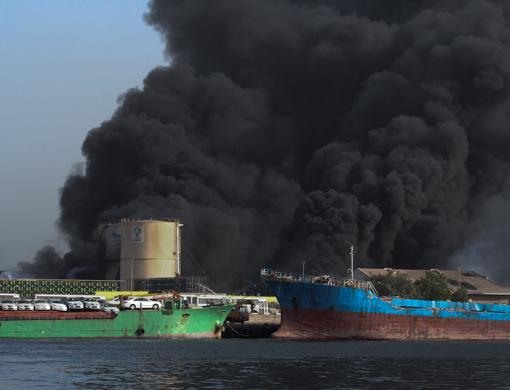
Heroes of the inferno 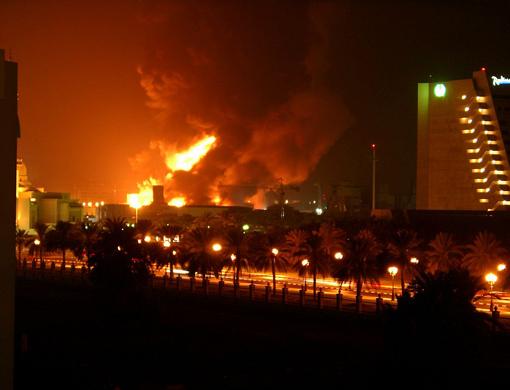



By Alia Al Theeb and Abbas Al Lawati, Staff Reporters/GULF NEWS Published: August 19, 2007, 23:05
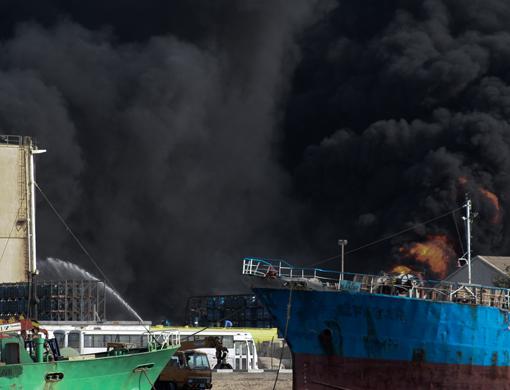
Dubai: As the thick smoke cleared, they could finally breathe easy – firefighters from across the country fought valiantly to combat the blaze that spread panic in Sharjah.
Gulf News spoke to two of the brave men who battled the inferno all night.
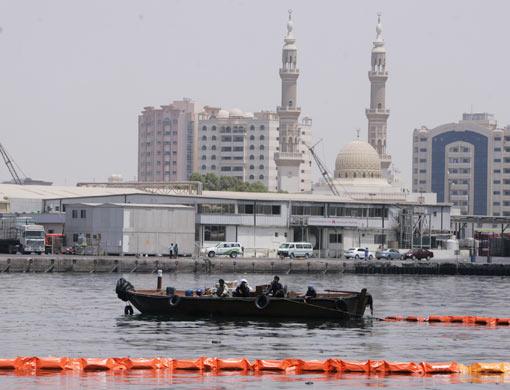
Two firefighters from Dubai Civil Defence said they spent 13 hours fighting the fire that started at oil products storage facilities of Emirates Lube Oil Company in Sharjah’s Port Khalid.
Lieutenant Colonel Ebrahim Al Sayegh, Coordinator of the Dubai firefighting teams on the site, told Gulf News he did not sleep for two days guiding his men. He said some firefighters were even called back from their vacations to help put out the fire.
He said Dubai teams supported Sharjah teams by providing them with water and in putting out the fire and getting into the site. He said around 30 firefighters and four fire officers went from Dubai, 15 on the first day and another 15 on the second day.
Break for a breath
Lieutenant Colonel Al Sayegh, who has been in the Civil Defence for 20 years, described the fire as a “developed fire”. He said there was thick black smoke which was suffocating.
“We needed a place to rest at the site, so a tent was put up. We took a breath every now and then. Some of us even went to rest in our cars,” he said.
Lieutenant Colonel Al Sayegh said he rested his men, changing them every day, but he remained on the scene. “I did not sleep for two days as I was responsible for updating the firefighting plans depending on the wind direction as well as coordinating the teams,” he said.
Lieutenant Majid Bin Hafez, a field officer and Director of Al Ghusais Civil Defence Centre, said he spent 13 continuous hours on the site.
“The team spirit on the site made the job easier because teams from various emirates worked next to each other to confine the fire,” he told Gulf News.
Lieutenant Bin Hafez, who has been working as a field officer for the past six years, said exhaustion is always a factor, especially during the heat, but most of the firefighters were in good physical shape. “The experience was exciting and added to my knowledge,” he said.
A firefighter from Sharjah Civil Defence who was on site, Mohammad Guloom, told Gulf News he had been trying to douse the fire and cool the area since Saturday.
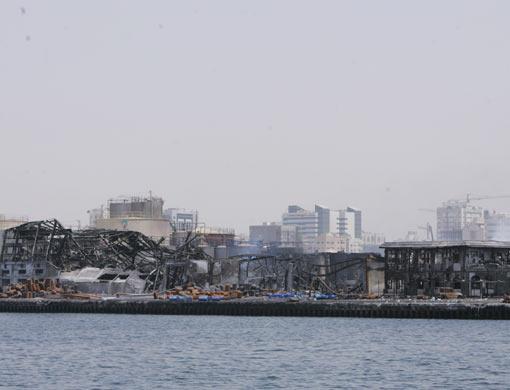
“We have been here all this time trying to put out the fire and prevent it from spreading. There seems to be a lot of damage but we managed to get it under control with cooperation from other emirates,” he said, adding that the fire was one of the biggest he had tried to fight. “This was probably the biggest on a national scale.”
The summer temperatures made the job more difficult, he said, but the water being sprayed played its part in keeping the firefighters cool too, he said as he filled his helmet with water and poured it over his head.
Firefighters stayed on site for seven hours before their colleagues took over.
The area Guloom was trying to cool is where containers of imported cigarettes once stood. “Hundreds of cartons of many different kinds of cigarettes were burnt,” he said.
An official from a marine services operator, which has an office at Port Khalid, said the company had lost two cars.
“Three thousand workers have been off work but hopefully they will be back soon.”
15 Tips to help you succeed at whatever you wish.

15 Tips to help you succeed at whatever you wish.
Tip 1 Ask for what you want.
How does the world know what to give you unless you put it out there? Ask for what you want and need. Let the world know what you want from it and look for it in return.
Tip 2 Be the person you want to be.
It’s call modeling. If you act like it, people will believe it. Assume the role you want others to see you in. Sell it from the inside out.
Tip 3 Believe in yourself.
If you don’t, no one will. People will follow; you just need to lead them. Forget worrying; concentrate on making things happen. Action and momentum are infectious.
Tip 4 Make a plan.
No one goes anywhere without a destination. Know your destination, and plot your journey. Take whatever pleasures you need on the way, but know that you are moving forward and will arrive at your destination.
Tip 5 Nervous = excited.
Realize that being nervous is the same as being excited. Instead of dreading it, welcome the surge of positive energy. Own it, and use it. It’s infectious in a good way!
Tip 6 Thinking about your failure brings your failure.
Concentrate on your success and watch it happen. Your mind will move in whatever direction you point it in. Make sure it’s pointed toward where you want to go and not where you don’t!
Tip 7 Feel whatever way you choose.
You control your feelings. You allow yourself to be upset, annoyed or frustrated. Only you control your feelings and no one else. Take back the power you give others and choose to feel strong, clear-minded and in control.
Tip 8 Communicate.
Listening and being understood are the keys to communication. People want to talk about themselves and they want to hear interesting things about you. No one wants to hear a sermon or hear a rant about your latest victory or great audition. Listen, observe and speak about mutually interesting subjects. Otherwise, you’re a bore.
Tip 9 Freak out.
Bad audition, interview or meeting? Take ten minutes to beat yourself up. Blame yourself, be annoyed and frustrated. Then, learn your lesson and move on. Now that all your anger is gone, put your energy into the lessons learned and move forward once again.
Tip 10 Speak your mind, NOW.
People swallow their feelings and anger, they postpone what they really want to say, thinking, “I’ll just wait till a good time.” DON’T! Handle the situation now, before the situation changes. Have a problem? Be a diplomat and talk about it. Handling a minor situation now will prevent it from becoming a festering chasm of misunderstanding and resentment later.
Tip 11 Dive in.
Someone make you feel inadequate? A situation makes you feel uneasy? In a room with a big shot and feeling small? Don’t overcompensate, navigate or fake your way through it, because you can’t. Dive in and address the problem. Address your feelings and say, “I’ve got to be honest, I’m a big fan and I’m feeling a little intimidated right now.” As soon as you own up to your feelings and the playing field is understood, you’re both able to move ahead. Everyone wants to deal with someone who’s truthful and honest, and not afraid to address their own insecurities.
Tip 12 Exploit yourself.
Find out what makes you different and exploit it. Each of you has a quality that makes you unique. Instead of trying to be what others are, exploit your uniqueness. It’s the one “ace” you have that no one else possesses.
Tip 13 Don’t accept the unacceptable.
Train people to treat you as you want to be treated. Being late is not acceptable, not returning calls is not acceptable and them not doing their job is not acceptable. Don’t accept these behaviors from people.
Tip 14 Walk a mile in someone else’s shoes.
Be someone else. Changing perspective is an amazing tip to see the world from another point of view. Assume a character and role and act it out for one day, then go out in the world as if it’s all new to you. You’ll be amazed at the new perspective you gain.
Tip 15 Say thank you.
Send an email from Hallmark, a card or a simple phone call. Don’t underestimate the value of someone feeling appreciated and recognized for their efforts. It leaves a lasting impression when someone thanks you for meeting or helping them.
A TRICK
A TRICK
A young man, a student in one of our universities, was one day taking a walk with a professor, who was commonly called the students’ friend, for his kindness to those who waited on his instructions.
As they went along, they saw lying in the path a pair of old shoes, which they supposed to belong to a poor man who was employed in a field close by, and who had nearly finished his day’s work.
The student turned to the professor, saying: “Let us play the man a trick: we will hide his shoes, and conceal ourselves behind those bushes, and wait to see his perplexity when he cannot find them.”
“My young friend,” answered the professor, “we should never amuse ourselves at the expense of the poor. But you are rich, and may give yourself a much greater pleasure by means of the poor man. Put a coin into each shoe, and then we will hide ourselves and watch how the discovery affects him.”
The student did so, and they both placed themselves behind the bushes close by.
The poor man soon finished his work, and came across the field to the path where he had left his coat and shoes. While putting on his coat he slipped his foot into one of his shoes; but feeling something hard, he stooped down to feel what it was, and found the coin.
Astonishment and wonder were seen upon his countenance. He gazed upon the coin, turned it round, and looked at it again and again. He then looked around him on all sides, but no person was to be seen. He now put the money into his pocket, and proceeded to put on the other shoe; but his surprise was doubled on finding the other coin.
His feelings overcame him; he fell upon his knees, looked up to heaven and uttered aloud a fervent thanksgiving, in which he spoke of his wife, sick and helpless, and his children without bread, whom the timely bounty, from some unknown hand, would save from perishing.
The student stood there deeply affected, and his eyes filled with tears. “Now,” said the professor, “are you not much better pleased than if you had played your intended trick?”
The youth replied, “You have taught me a lesson which I will never forget. I feel now the truth of those words, which I never understood before: ‘It is more blessed to give than to receive.'”
— Author Unknown
etisalat to offer ‘triple play’ service soon

etisalat to offer ‘triple play’ service soon
By Ivan Gale, Staff Reporter/GULF NEWS Published: August 19, 2007, 23:05
Dubai: etisalat expects to offer ‘triple play’ service to more than 100,000 customers this quarter once government regulators approve its pricing scheme, its chief executive said.
Triple play is a bundled service delivering fixed line and high-speed TV and internet over one cable into the home or office. It is often touted as producing cost savings to operators and customers.
“Customers will be able to receive state of the art technology at very high broadband speeds,” Mohammad Al Qamzi said. “This will be high-definition TV and internet will also be at very high speeds.”
Reduced costs
The etisalat CEO said an immediate benefit to the company would be reduced costs on maintenance and equipment.
“This is where the future of telecom is, where we can serve customers at a lower price and higher bandwidth.”
The product rollout will first be offered to subscribers of etisalat’s e-vision TV service because these customers already have installed the necessary cabling into their homes.
A pricing plan has already been submitted to the UAE Telecommunications Regulatory Authority.
The bundling will target higher sales of each of the three services offered, including the unprofitable e-vision division.
The initiative is the first step in a multi-year plan for the company, as it develops a next-generation network composed entirely of IP-based technology.
After completing its core network in Dubai and Abu Dhabi last year, the telecom provider will spend the next three years installing soft switches and fibre optic cabling throughout the country, Al Qamzi said. “We are now going for the ‘last mile’ – deploying fibre to the customer,” he said.
The first recipients of this high-bandwidth, all-IP network will be 27,000 residents in Abu Dhabi after etisalat successfully replaces the first of several hundred legacy switches. The new network should debut in Abu Dhabi in two months.
The project comes at a time when businesses and consumer are increasingly consuming higher data traffic, the CEO said.
“Internationally, voice [revenues] are declining, but data is increasing – that’s where the growth is.”
Gulf to Japan VLCC freight hits four-year low partly due to Opec cuts
Gulf to Japan VLCC freight hits four-year low partly due to Opec cuts Reuters Published: August 19, 2007, 23:05
London: The world’s main crude export route sank to a four-year low last Tuesday, hit by strong fleet supply, long-standing Opec cuts and refinery maintenance in Asia, according to brokers and analysts.
The Very Large Crude Carrier (VLCC) route from the Gulf to Japan struck W50 – its lowest level since October 2003, according to Reuters data.
The London Baltic Exchange confirmed the physical spot trade on the route at W49.97 – an average between single and double-hulled oil tankers on the long-haul voyage.
Japan is Asia’s biggest importer of crude oil, closely followed by China. More than two-thirds of the Gulf’s oil flows to Asia.
Brokers Simpson, Spence & Young cited a bout of refinery maintenance in Japan at the end of August and South Korea as a further reasons for the weakness.
Other core rates from the Gulf to the United States and out of the Atlantic Basin – West Africa and the North Sea – to the United States have already struck four-year lows.
Long-haul routes
Despite strong world crude demand and buoyant economic growth, major long-haul crude export routes – including those from top producers in the Gulf – have been hit hard by strong fleet growth and long-standing Opec cuts this year.
The Organisation of Petroleum Exporting Countries decided last year to lower output by 1.7 million barrels per day (bpd), equivalent to a VLCC’s worth a day from the market.
The group is meeting about 900,000 bpd of the promised reduction, according to a Reuters survey of July output.
High stocks in the United States and a backward dated Nymex crude futures market since mid-July have pressured export flows and correspondingly rates, as traders delay buying.
A heavy round of refinery maintenance in the world’s biggest consumer and unscheduled stoppages have also squeezed flows. “Oil tanker movements suggest oil in transit is well below seasonal norms, especially on westbound routes, and will remain so for several weeks,” the International Energy Agency said in a report last week. “In the Atlantic Basin, production outages and economic run cuts in Europe offer further downside to prospective crude vessel interest,” it said.
Sharp contrast
The slide on crude freight markets is in sharp contrast to ocean freight for dry commodities – a different sea freight sector – which continues to smash records. Some analysts said the new freight lows on crude were on a nominal basis only because the ‘real’ or dollar per tonne price was higher on a Time Charter Equivalent basis due to starkly higher ship fuel (bunker) costs this year.
 ClicksandWrites
You must be logged in to post a comment.