Upholding family values
Upholding family values
By Manal Alafrangi, Staff Writer GULF NEWS Published: October 03, 2007, 23:52
There is a certain universality when it comes to the term “family values” but because the concept itself is rooted in individual cultures, ideals and morals can come across as different. So then, what happens when people of different creeds and nationalities live in one society? Do they agree on what constitutes family values? Do they share the same ideals and principles?
According to our latest survey, there is a concern when it comes to cultural values being present in the UAE. That is, more than two thirds of our respondents feel family values are being eroded in the UAE. This opinion is particularly high amongst Arabs, excluding Emiratis (73 per cent). Moreover, 62 per cent of those surveyed feel people in the UAE are courteous and respectful to others but there is a difference of opinion amongst the various nationalities; 71 per cent of Emiratis compared to 39 per cent of Westerners.
Similarly, Arabs (excluding Emiratis) and Asians are also split on whether they think UAE residents have a community spirit. Emiratis and Westerners on the other hand are on opposite ends of the spectrum with the former saying they do and the latter saying they don’t.
That is one of the main conclusions from the latest Gulf News survey undertaken by YouGov-Siraj where by 1,191 people answered questions on family, growing old, and challenges to family time. (Of the total surveyed, 119 were Emiratis, 147 other Arabs, 168 Westerners, 669 Asians, and 88 others).
We asked our respondents who each of them considers to part of their own family. Across all nationalities, ‘parents’, ‘brothers and sisters’ and ‘spouse’ top the family member ladder. ‘Children’ and ‘grandparents’ are not far behind in the family members consideration set. Interestingly, despite no blood connection, 25 per cent believe friends are family and 16 per cent find employed household staff to also be part of family.
Who do they live with? More than half of our respondents say they currently live in the UAE with their spouse- this is clearly observed among Westerners and Asians (75 per cent and 63 per cent respectively) as compared to Arabs (42 per cent). Moreover, both Arabs and Asians seem to have more of their parents living with them in the UAE compared to Westerners. Arab scores are largely observed among Emiratis (6 in 10 Emiratis vs. nearly 3 in 10 other Arabs).
On the other hand, almost 1 in 10 lives alone in the UAE. This is primarily because their families live in different countries (numbers being highest amongst Western and Asian respondents). Some respondents simply say that they “prefer to live alone” (with 2 in 10 Emiratis saying so).
There is unanimity amongst our respondents when it comes to caring for their elderly parents. 95 percent said they would be supportive towards helping their parents as they grow older and become dependent upon others for help. What options would they seek in such a scenario? Nearly 6 out of 10 say they would nurse them at home themselves. But a closer look reveals that while 60 per cent of Arabs and 67 per cent of Asians feel this way, only 34 per cent of Westerners feel the same.
Instead, 40 per cent of Westerners say they would employ a nurse at home. Sending elderly parents to a nursing home proved the least popular option for our respondents.
Through this survey, we got an insight as to why respondents would consider helping their elderly parents. The overwhelming majority say they would do it out of love for their parents. 7 in 10 say it is because they feel a sense of gratitude to be repaid to parents and many feel it is expected of them to be with their family.
Our respondents are equally supportive of their spouse’s parents with 92 per cent saying they would care for them as the need arrives. Across all nationalities, Asians tend to be more supportive in assisting spouse’s elderly parents (95 per cent of Asians vs. 89 per cent for Arabs and 85 per cent for Westerners). Half of the respondents claimed they would be willing to nurse their spouse’s parents at home by themselves however, among Westerners, scores are directionally low.
As of now, over two thirds of our respondents prefer to live with their families than to live by themselves. This is especially the case with Asian respondents (82 per cent). What’s more, respondents aged 30-49 are more likely to want to live with family than younger respondents (aged below 30).
We asked UAE residents to peer into the future when they themselves become elderly; what then would they prefer their living arrangements to be? 48 per cent say they would like to with their own grown up children – assuming they had any. It should be noted that of the total, only 23 per cent of Westerners feel this way compared to 52 per cent of Arabs and 53 per cent of Asians..
Another option is to live in a nursing home or a retirement village. While it has proved unpopular amongst the Arab and Asian respondents, 27 per cent of Westerners choose it as their preferred option.
An extended family has its benefits. The majority of our respondents feel having them around is advantageous namely for emotional support. They also improve family bonding and help maintain a sense of belonging. But by the same token, having an extended family means a lack of privacy and lack of personal space for the majority of our respondents- irrelevant of their demographic profile.
Working life affecting private life
Our respondents are split on whether their or their partner’s working life has impacted their private life. 39 per cent said it has impacted their private life a lot, while 30 per cent say the impact has been small. A closer look at the survey shows that more females claim their partner’s working life has greatly impacted their private life. On the other hand, 16 per cent find there has been no impact whatsoever.
Fifty six per cent have at least 1 child in their household. They say that on average, they spend 3 hours and 50 minutes with their children on a typical work day. Emirati parents tend to spend fewer hours with their children as compared to other Arabs.
On average, it is likely that parents waste 5 hours and 4 minutes without being with their children due to work related issues outside of regular office hours or other commitments. Such work related issues include traffic congestion, which is by far, the most recalled factor that makes people stay away from being with their families (this is clearly observed among Asians). Shopping, socialising, and going to the gym are also reasons that feature lightly on the survey.
Importance of family values
UAE residents believe that family values are important in today’s world. Asians in particular have the highest scores when it comes to this conviction. We asked our respondents if they thought their family values are being eroded here in the UAE. Close to two thirds said yes. This opinion was particularly high amongst other Arabs (73 per cent). The three main reasons behind this are: lack of time for families to be together, economic pressure, and lack of parental guidance.
Other explanations including lack of proper role models and having too many temptations also feature prominently on the survey.
So then, how do our respondents generally feel about people in the UAE? Are they courteous and do they have a community spirit? Sixty-two per cent of those surveyed said yes but there is a difference of opinion amongst the various nationalities; 71 per cent of Emiratis compared to 39 per cent of Westerners.
Giving back to Society
Giving back to Society
By Robert Ditcham, Staff Reporter GULF NEWS Published: October 03, 2007, 23:52
Ask company employees about the importance of addressing global poverty, illiteracy, homelessness and environmental decay and most will say they care deeply.
Although they may do their bit, financial restraints and limited time may hinder their charitable efforts.
Their employer, on the other hand, has the financial muscle, brand status and human resources to tackle these issues head on. But is it actively engaging in corporate social responsibility (CSR) programmes?
In the UAE, the answer is more often than not a negative one. Brand analysts and companies say CSR in the UAE is in its infancy compared to North America, the Far East and Western Europe.
“Developed markets have been open for longer, commercial models and structures have been established, while consumers and pressure groups have grown in importance and in their ability to scrutinise and apply pressure to companies,” said Manal Shaheen, director, sales, marketing and customer service at real estate giant Nakheel.
However, she and many others say the UAE could be on the verge of embracing the global CSR phenomenon, with the recently-launched Dubai Cares campaign providing the much-needed catalyst.
At the time of going to press, nearly Dh700 million have been raised under the initiative, which will put one million children through primary education.
“Of course, there is still some way to go in this part of the world, but I believe that CSR will grow more rapidly than it did in those other regions because the momentum has built up, and lessons – both good and bad – have been learned,” Shaheen said.
As with any decision in the corporate world, there needs to be clear benefit to the firm itself. Why should companies invest in society at large when their primary concern should be their shareholders? After all, isn’t it the job of politicians to tackle society’s ills?
Obligation
According to CSR promoters, companies have a moral obligation to support society and the environment.
“We believe that CSR initiatives are a means for us to give something back to the society and the nation that has handed us everything to get us to where we are now,” said Princy Philip, manager for marketing and corporate communications at UAE property developer Memon Investments. “This fact makes it our moral responsibility to care for the unfortunate and provide for the unloved.”
Defining the business case for CSR is often more of a challenge. But, in a world where brand value and reputation are increasingly seen as a company’s most valuable assets, the pros are becoming more apparent to UAE chief executives.
According to an Ernst & Young survey in Europe, 94 per cent of company executives believe the development of a CSR strategy can deliver real business benefits.
“CSR is becoming more and more important in terms of building a strong corporate brand image, while companies are facing increasing pressure from their clients, customers and staff to be responsible corporate citizens,” said Hermann Behrens, the Dubai-based managing director of brand consultants Enterprise IG.
Behrens stressed that in the Gulf’s competitive job market, potential employees factor in a company’s CSR record when choosing their future job, selecting those that can make a positive impact on society.
According to the organisation CSR Europe, 78 per cent of employees would rather work for an ethical and reputable company than receive a higher salary.
CSR Europe argues that a “responsible attitude” towards society and the environment can make a business more competitive, more resilient to shocks, and more likely to attract and hold both consumers and the best employees.
Business sense
And in a world where socially responsible investment is growing, CSR can also attract investment and save businesses money in dealing with regulators, banks and insurers, the organisation adds. It says socially responsible investment accounts for nearly 13 per cent of the $16.3 trillion in investment assets under professional management in the US.
“The reason companies are taking the issue more seriously because it makes good business sense,” said Shaheen.
“Firstly, it has become clear recently that financial markets are factoring in some of the ‘sustainability’ issues into their valuations and decisions to invest or move their funds.
“Secondly, as customers get more savvy, it’s getting easier to compare the Good and the Bad. There is enormous value with your customers if they know you are one of the good guys and it’s no coincidence that people are prepared to pay a premium for this.”
But adopting CSR initiatives doesn’t always result in a rosy picture being painted of a company. Those that throw money at environmental causes and champion human rights, but also pollute the atmosphere and exploit their workers, will soon be found out, resulting in spectacular public relations disasters.
Behrens said good CSR is about a lot more than donating large sums to noble causes. A CSR campaign that engages the whole company in its ethos and gets its staff involved in charities or social work will have the best results, he said.
Shaheen said Nakheel is aware that CSR is much more than making “token gestures”.
“Although it’s quite normal for companies to make big statements, huge promises, or grand gestures, negative impressions can often be caused by what I’d call ‘tokenism’ – when companies obviously bolt-on campaigns or initiatives that are clearly superficial gestures and not integrated into the ethos of the company,” she said.
“I think that a lot of companies are on the journey from one to the other at the moment.”
The corporate sector’s swift response to the Dubai Cares campaign is among several examples of CSR being pursued in the UAE.
Memon Investments, a Dubai-based property developer and part of the international business conglomerate, the Memon Group of Companies, recently announced its participation in the ‘Safe & Sound’ campaign – BurJuman’s breast cancer awareness programme – as the official annual sponsor.
This will mark Memon Investments’ first CSR undertaking in the region.
Giant property developer Nakheel said it has established initiatives such as Bidaya, an educational and leadership programme aimed at discovering and nurturing the UAE’s next generation of leaders.
The programme offers university scholarships to outstanding male and female candidates from the country’s public high school system.
As one of its key CSR initiatives during 2007, Dubai Holding recently said it has pledged nearly Dh1.5 million to two organisations – the UAE Beit Al Khair and the Dubai Autism Centre.
Over the past two years, Dubai Holding has contributed more than Dh80 million in projects such as a facility for Zayed University and Dubai Education Council.
“Even as we rapidly drive our business to cross new milestones, we regard it as our duty to share the responsibility of the general welfare of the community,” said Mohammad Al Gergawi, executive chairman of Dubai Holding.
Meanwhile, a golf team from oil and gas major BP decided to use its $1,000 prize money won in a golf tournament recently to pay for a facility for autistic children at the Future Centre in Abu Dhabi.
Multinational corporation Halliburton has also made donations to The Future Centre, which provides schooling for children with special needs, through its Halliburton International Fund.
Savings potential for NRIs declines
Savings potential for NRIs declines
By Babu Das Augustine, Banking Editor GULF NEWS Published: October 03, 2007, 23:52
Dubai: Non-resident Indian (NRI) deposits, which account for a major share of India’s foreign exchange reserves, are declining fast due to the weakening dollar, lower interest rates and the Gulf’s rising cost of living.
The Gulf countries, a major source of NRI remittances to India, have been experiencing unprecedented growth in the cost of living on the one hand and the steep decline in exchange rates due to most Gulf currencies’ peg to the dollar.
According to the latest statistical bulletin from the Reserve Bank of India, the country’s central bank, NRI deposits declined by almost $500 million in the April-June quarter, and the current quarter is expected to post a further decline due to the continuing weakness of the dollar and falling interest rates.
“The saving potential of an average Indian working in the Gulf has come down by more than 30 per cent during the past two years. Although many of them are remitting the same amount or more in dollars, the reduced exchange rates of Gulf currencies are directly hitting their saving potential,” said Sudhir Shetty, General Manager of the UAE Exchange Centre.
At the state level Kerala- banks were hit the hardest. According to figures released by the State Level Bankers Committee meeting held in Thiruvananthapuram yesterday, non-resident deposits in Kerala banks amounted to Rs319.95 billion as of last June, which is 34.56 per cent of total deposits in these banks.
Diversification
“While falling rates and the interest rate cap on foreign currency deposits are the main reasons attributed to the decline in deposits, people have also started diverting funds to other investment options such as real estate and the stock market,” said a senior State Bank of India official.
Dollar denominated deposits are no longer attractive due to the decline in the dollar’s value against the rupee and falling interest rates. Currently, foreign currency deposits pay in the range of 3.8 per cent to five per cent. “NRIs were pumping money into India due to the high interest rate differential. Lower interest rates combined with four to six per cent domestic inflation could mean negative return on bank deposits,” said a senior banker.
Although NRI deposits are falling, exchange houses said remittances are not affected. “People with fixed commitments such as mortgages, loans, education costs and other family expenses cannot reduce their remittances. However, with falling exchange rates, people’s saving potential has come down. That is reflected in declining bank deposits, ” said Shetty.
NRIs in the UAE have lost about 12 per cent of their earnings due to exchange rate losses and about 10 per cent is lost in the increased cost of living. It means that in rupees, earnings have fallen by a minimum of 22 per cent, reducing the savings and investment potential of UAE-based NRIs.
Suite escape
Suite escape By Ameer Al Marzouqi GULF NEWS Published: October 03, 2007, 23:52
Celebrate Eid with your family in some of the world’s most exotic and luxurious destinations. Here are some of the best offers up for grabs.
VENICE
Experience the passion and romance of Italy in its sumptuous cuisine, celebrated arts and magnificent architectural treasures. Glide along Venice’s famous canals in a gondola, watching the light change softly on the glorious palaces.
Luna Hotel Baglioni
The Luna Hotel Baglioni is the oldest hotel in the city and is perfectly located to discover the city’s unique charms.
Duration: Three nights
Cost: Dh8,285 per person on Emirates airlines including airfare
Validity: October 12-15
Agency: Dnata
Contact: 8008118
ISTANBUL
Turkey is an exciting holiday destination that celebrates its roots in Asia and Europe, and welcomes visitors both traditional and modern. Famous for its mosques, castles and bazaars, Istanbul has a reputation for being a hospitable country.
Ciragan Palace Kempinski
The Ciragan Palace combines the architectural grandeur of an Ottoman palace with the modern comforts of a deluxe hotel.
Duration: Three nights in a sea-view room
Cost: Dh5,185 per person on Singapore Airlines including airfare
Validity: 12-15 October
Agency: Dnata
Contact: 8008118
LONDON
Explore London’s historic monuments, high fashion and vibrant theatre scene or journey to Shakespeare’s birthplace. London is home to some of the most famous sights in the world, such as Westminster Abbey and Buckingham Palace.
InterContinental Park Lane
It is located near the Houses of Parliament, Bond Street and the Buckingham Palace.
Duration: Three nights in an inner court room
Cost: Dh5,630 per person on Aer Lingus including airfare
Validity: October 12-15
Agency: Dnata
Contact: 8008118
KUALA LUMPUR
Malaysia is unmatched in the rich diversity of its culture and the contrast of its geography. Enjoy cool mountain highlands, relax on the peaceful, white-sand beaches, trek through ancient rainforest or shop in the heart of the city.
Mandarin Oriental
This hotel is adjacent to the world famous 88-storey Petronas Twin Towers.
Duration: Three nights in a deluxe city-view room
Cost: Dh4,110 per person on Emirates airline including airfare
Validity: October 12-15
Agency: Dnata
Contact: 8008118
BANGKOK
Thailand is famous for its temples and spectacular beaches. Thai culture blends with Chinese, Malay and Indian influences.
Four Seasons Hotel
The hotel is ideally located in Bangkok’s vibrant city centre and only 40 minutes from the airport.
Duration: Three nights in a deluxe room
Cost: Dh4,490 per person on Emirate Airline including airfare
Validity: October 12-15
Agency: Dnata
Contact: 8008118
Majestic Hotel
Duration: Three nights
Cost: Dh2980 per person including Dubai-Bangkok return airfare
Validity: 10-21 October
Contact: 8005252 or visit http://www.emirates-holidays.com
SINGAPORE
Singapore has several ethnic neighbourhoods, including Chinatown and Little India. Its cuisine is an example of its diversity with a fusion of Chinese, Indian, Malay and Tamil influences.
York Hotel
Duration: Three nights in a double room
Cost: Dh3,910 per person on Emirates Airlines including airport/hotel transfers.
Validity: October 11-17
Agency: Al Futtaim
Contact: 04 3410237
MALDIVES
A thousand islands offer dazzling beauty, both above and below the waters of the Indian Ocean. The vast coral island of the Maldives is full of peace and tranquility. Go diving, snorkelling and enjoy the sandy beaches .
Four Seasons Resort Maldives at Kuda Huraa
Thirty minutes by speedboat from the airport, the hotel is an island sanctuary with a traditional Maldivian village setting.
Duration: Four nights in a beach pavilion
Cost: Dh4,890 per person on Sri Lankan Airlines including airfare
Validity: October 11-16
Agency: Dnata
Contact: 8008118
SECHELLES ISLANDS
Experience the ultimate in natural beauty and tranquility in the Seychelles Islands archipelago, one of the world’s premiere tropical paradises. The 115 granite and coral islands are unique sanctuaries of flora and fauna, forests, beaches and lagoons.
Labriz Silhouette
Silhouette, the third largest island in the Seychelles, is an unspoiled natural wonder, covered in rainforest and white sandy beaches.
Duration: Four nights in a garden villa
Cost: Dh7,240 per person on Emirates Airlines including airfare
Validity: October 12-15
Agency: Dnata
Contact: 8008118
OMAN
Oman is a country of stunning natural beauty, blue-domed mosques and world-class hotels. Visit the Sultan Qaboos Grand Mosque and the traditional Muttrah Souk.
Shangri-La Barr Al Jissah Resort and Spa
This package gives guests at Al Bandar access to the resort’s private Turtle Beach.
Duration: Four nights in a pool view room
Cost: Dh2,600 per person
Validity: October 11-15
Agency: Dnata
Contact: 8008118
SRI LANKA
Although Sri Lanka is just 350 kilometres long, its dramatically varied landscape and ancient history ensure that visitors enjoy a holiday full of wildlife, culture and adventure, as well as some of the world’s most beautiful beaches.
Taj Exotica
This luxurious beach resort is located along the golden mile beach at Bentota, on Sri Lanka’s south-west coast.
Duration: Three nights in a standard room
Cost: On Emirates airlines at Dh3,070 per person.
Validity: October 1-31
Agency: Dnata
Contact: 8008118
MALTA
Walk through the narrow medieval streets of Madina, the silent city. The sound and light show in Valletta is a masterpiece of Renaissance designs with the Triton fountain.
Corinthia San Gorg Hotel
This 4-star hotel is located at the entrance to St. George’s Bay and designed around cascading pools.
Duration: Three nights in a double room
Cost: Dh3,060 per person on Emirates Airlines including airport/hotel transfers.
Validity: October 11-17
Agency: Al Futtaim
Contact: 04 3410237
ATHENS
Visit Athens to discover the roots of Western civilisation. It was here that democracy, drama, philosophy and scientific investigation were born. Athens is a mix of the modern and the ancient.
Titania Hotel
The Titania is a 3-star hotel in the heart of the historic and commercial centre of Athens between Syntagma and Omonia squares.
Duration: Three nights in a double room
Cost: Dh3,810 per person on Emirates airlines including airport/hotel transports.
Validity: October 11-17
Agency: Al Futtaim
Contact: 04 3410237
MAURITIUS
Apart from its beaches, Mauritius is known for its cuisine which is a blend of Indian, Creole, Chinese and European food.
Sugar Beach Resort
Duration: Three nights
Cost: Dh5,546 per person including Dubai-Mauritius return airfare
Validity: October 10-21
Contact: 8005252 or visit http://www.emirates-holidays.com
NAIROBI
Nairobi, the capital of Kenya, is famous for its zoos, snake parks, temples and exquisite parliament house.
Stanley Hotel
Duration: Three nights
Cost: Dh3,655 per person including Dubai-Nairobi return airfare
Validity: October 10-21
Agency: Emirates Holidays
Contact: 8005252 or visit http://www.emirates-holidays.com
ZURICH
Zurich’s churches, museums and parks are great examples of European architecture.
Swissotel Zurich
Duration: Three nights
Cost: Dh3,352 per person includes, Dubai-Zurich return airfare
Validity: October 10-21
Contact: 8005252 or visit http://www.emirates-holidays.com
GOA (Via Mumbai)
Goa is a major tourist destination. Its beaches, relaxed atmosphere and friendly people are the main draws.
Holiday Inn
Duration: Three nights in a double room
Cost: Dh3,540 per person on Emirates Airlines including airfare
Validity: October 11-17
Agency: Al Futtaim
Contact: 04 3410237
MUMBAI
The city is always bustling with activity and theres always somewhere to go to.
Taj President
Duration: Three nights in a double room
Cost: Dh3,560 per person on Emirates Airlines including airfare
Validity: 11-17 October
Agency: Al Futtaim
Contact: 04 3410237
Abu Dhabi Taxi shortage

Gulf News continues with their support to draw attention of the authorities to control and provide better solutions to Abu Dhabi public.
Luxury water bus service takes to the waves on Dubai Creek
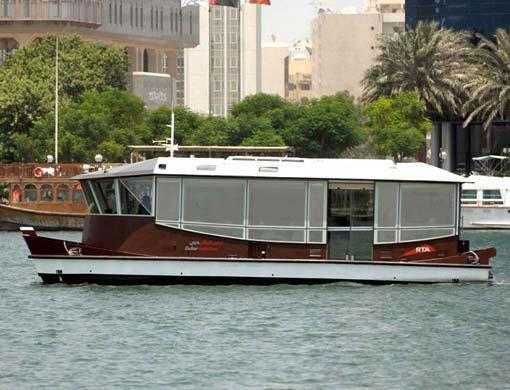
Luxury water bus service takes to the waves on Dubai Creek By Ashfaq Ahmed, Staff Reporter GULF NEWS Published: October 02, 2007, 23:09
Dubai: Residents can beat the traffic to reach shopping malls, offices, hotels and banks along Dubai Creek by using the new water bus service, said a top official.
“There is a massive concentration of government offices, banks, shopping areas, and tourist sites along Dubai Creek and the water bus is the answer to avoiding traffic congestion in the area,” Eisa Abdul Rahman Al Dossari, Chief Executive Officer of the Marine Agency at the Dubai Roads and Transport Authority (RTA) told Gulf News at the launch of the Dubai Creek water bus routes.
“People can beat traffic congestion, save time, money and hassle in finding parking by simply using the water bus to commute in the area,” he added.
Integrated plan
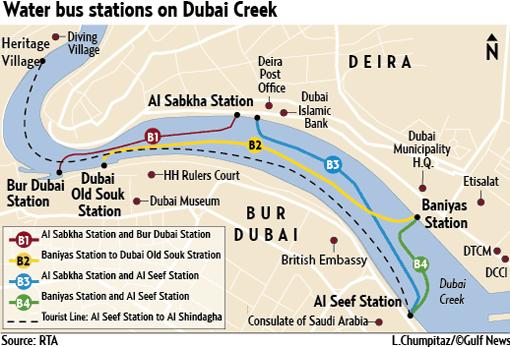
The new water transport is part of an integrated public transport plan to curb traffic congestion. It will serve the congested central business districts of Deira and Bur Dubai.
All five routes of the luxury water bus service are now operational as part of the first phase of a strategic plan for marine transport.
“By introducing air-conditioned water buses, we are targeting new types of commuters and encouraging them to park their cars and use water transport to commute along the creek,” said Al Dossari.
He said the water buses were not in competition with the abra service (traditional boats that traverse the Creek) but would complement it.
Around 20 million passengers use the abra service every year.
“We hope at least 2 million people will use the water bus every year,” he added.
Regarding the price difference between the abra fare (Dh1) and the new water bus fare (Dh4) he said passengers would be travelling in luxury on the water bus as it has proper seating, air-conditioning and facilities for the disabled.
The RTA has also introduced a smart card for the water bus service. Those, who use Dh40 worth will also get a 10 per cent discount. Passengers can also purchase tickets from the machine installed at abra stations.
Al Dossari said the water bus service is part of the first phase of the marine public transport project launched by the RTA’ s Marine Agency which has earmarked Dh1.5 billion to have integrated water transport services to implement its marine transport strategic plan 2020. Initially, eight out of a total of 10 water buses with the capacity to take 36 passengers each will be used while two water buses will be reserved for tourists. The operation will be seven days a week for 17 hours every day, from 6am to 11pm.
Abras: No new licences
With the launch of the service the RTA has stopped issuing licences for abras to cross the creek.
“No new abra licences will be issued because we understand the present 149 are more than enough to handle the current demands of passenger traffic,” Eisa Abdul Rahman Al Dossari, CEO, told Gulf News.
Dark chocolate helps fight fatigue
Dark chocolate helps fight fatigue
2 Oct 2007, 0032 hrs IST,Kounteya Sinha,TNN
They are delicious. And now, they also seem to be beneficial for your health. A daily dose of yummy dark chocolate may help patients suffering from the chronic fatigue syndrome (CFS).
According to scientists from Hull York Medical School, dark chocolates have been found to lower levels of serotonin, a brain chemical related to CFS. Serotonin is also believed to play an important role in the regulation of anger, aggression, body temperature, mood, sleep, vomiting and appetite.
The team said patients with CFS found that their symptoms were alleviated when they consumed dark chocolate, much more so than when they consumed milk chocolate that had brown dye added to it. The scientists, however, stressed that the quantity of dark chocolate consumed should be moderate.
Endocrinologist Steve Atkin said, “Although it was a small study, two patients went back to work after being off for six months. Dark chocolate is high in polyphenols, which have been associated with health benefits such as reduction in blood pressure. Also, high polyphenols appear to improve levels of serotonin in the brain, which has been linked with CFS.”
According to nutritionist Dr Shikha Sharma, consuming two cubes of dark chocolate is good enough. “Dark chocolates better preserve the benefits of cocoa as they have less sugar in it. Cocoa is rich in antioxidant properties. It’s even better when added with resins or nuts. But it has to be consumed in moderation. Consuming bars of dark chocolate can overstimulate the nervous system,” Sharma said.
Atkin and his team then carried out a trial on 10 patients to check whether dark chocolate benefited them also. As part of the experiment, the patients received a daily dose – 45g – of dark chocolate or white chocolate dyed to look like dark chocolate for two months.
This was followed by a month in which they were not given any chocolate, before being given the other type of chocolate for two months.
To their surprise, the researchers noted that patients taking dark chocolate reported significantly less fatigue when they started eating the sweet. They also reported more fatigue when they stopped eating it.
kounteya.sinha@timesgroup.com
Health benefits of watermelon
Health benefits of watermelon
4 Oct 2007, 0000 hrs IST,TNN
Watermelon is not only delicious, but extremely healthy, as well.
In fact, most melons are rich in potassium, a nutrient that may help control blood pressure, regulate heart beat, and possibly prevent strokes.
Another arm that’s well represented is beta-carotene. Researchers believe that beta-carotene and vitamin C are capable of preventing heart disease, cancer, and other chronic conditions. No matter which way you cut them, when it comes to nutrition, melons are number one.
Watermelon is a valuable source of lycopene, one of the carotenoids that have actually been studied in humans. Research indicates that lycopene is helpful in reducing the risk of prostate, breast, and endometrial cancers, as well as lung and colon cancer.
Whether you choose watermelons for their health benefits or simply for their good flavour, they can be an excellent snack, summer dish.
Shaikha Maitha bint Mohammed bin Rashid Al Maktoum sees hope for Sudanese children

Maitha sees hope for Sudanese children
By a staff reporter KHALEEJ TIMES 3 October 2007
DUBAI — The enormous challenges being faced by children in Sudan can be overcome only through humanitarian initiatives such as the ‘Dubai Cares’ campaign, according to Shaikha Maitha bint Mohammed bin Rashid Al Maktoum.
During her first-ever visit to Sudan as part of the Dubai Cares initiative, Shaikha Maitha toured the country to personally understand the children’s struggle to obtain basic education.
Senior government officials in Khartoum briefed her on the educational needs of the country, decimated by over 20 years of civil war. In Juba, Unicef officials Peter Crowley, Director, and Douglas Higgins, Deputy Representative, Southern Sudan, highlighted the country’s situation in the south.
Isa Abdullah Al Bashah Al Nu’aimi, UAE Ambassador to Sudan, was present during the briefings and Shaikha Maitha’s visits to the schools.
Shaikha Maitha said: “Dubai Cares believes in every child’s right to education and is committed to ensuring that no child is denied education. I wanted to tell the children we are here to help them and to, ultimately, help their country.”
Shaikha Maitha and her delegation visited Kuku-A Primary School and Juba 1 Girl’s Primary School, where the children welcomed her with songs and dances.
Recalling the experience of visiting the 4×3-metre classroom shared by nearly 60 students, she said: “I am touched by the warmth and strength of these children — a testament to their will to live and learn. We owe it to them to keep their hopes alive.”
In Khartoum, Shaikha Maitha visited the Mustapha Hamad School for Girls. She said: “Having seen the situation and the conditions children endure to obtain education, I am overwhelmed with their capacity to cope with the unbelievable. My heart goes out to them. Through campaigns such as Dubai Cares, we will empower them, their families and the community.”
Five burnt to death as speeding car overturns

Five burnt to death as speeding car overturns
By Alia Al Theeb, Staff Reporter GULF NEWS Published: October 02, 2007, 23:09
Dubai: Five people were burnt to death in a horrific traffic accident early on Tuesday, police said.
According to preliminary investigations, speeding was the cause of the accident that took place near the entrance of Al Karama tunnel connecting Shaikh Rashid Road to Shaikh Zayed Road. A police official said the bodies have not been identified yet.
This was the second major traffic accident in four days. Early Friday, seven people were killed on Emirates Road when the tyre of the minibus they were travelling in burst and the minibus turned over. Police also blamed speeding for the accident.
In yesterday’s accident, the driver of the car was speeding and as a result he hit the side pavement of the tunnel. The car turned over and caught fire. None of the passengers was able to escape from the car and were burnt to death.
In another incident, a fire broke out in the cabin of a ship loaded with cars in Al Hamriya Port. However, the fire did not reach the cars and no injuries were reported.
 ClicksandWrites
You must be logged in to post a comment.