Thousands of festive lights set Abu Dhabi aglow

Thousands of festive lights set Abu Dhabi aglow
By Rayeesa Absal, Staff Reporter GULF NEWS Published: October 09, 2007, 23:51
Abu Dhabi: The city’s exuberant mood is set during the Eid holiday by thousands of multicoloured lights that bring the capital aglow.
The garlands of lights draped across buildings add a real holiday atmosphere with the city’s well known skyscrapers twinkling for all to see.
Three Indian brothers Yousuf Karikkayil, Salam and Kabeer are behind the bright lights in the big city and work hard for days to design and create the look of buildings such as the Abu Dhabi Chamber of Commerce and Industries.
The Karikkayils’ business, the Light Tower, is also behind the buildings of the ADNOC group of companies such as the ADNOC headquarters and the Etisalat buildings, to name but a few.
In fact, the Light Tower has been contracted to do the lighting jobs for many of the capital’s landmark buildings over the past years. And not just for Eid, but also for all other festive days such as National Day.
“I have decorated the Chambers building for the last 15 years, ADNOC for the last 10 years and the National Drilling Company (NDC) for the last nine years,” said Yousuf, adding their job is not for novices.
“The foremost constraint is that during a festive season all the buildings have to be decorated at the same time. Also we have to mind the wind speed for safety reasons, two people are engaged at a time and as they work if the wind seems to get harder we have to stop. Well-trained workers are a must.”
Talking about a very special design, Yousuf said that last year to mark National Day celebrations the NDC building was lit up using more than 100,000 bulbs.
Blue LED bulbs were used for this expensive type of decoration. It usually takes 25 days to decorate a building but sometimes for bigger buildings we take up to 45 days, he added.
Abu Dhabi Awards deadline extended – 4 more days to nominate
Abu Dhabi Awards deadline extended
By M. A. Qudoos (Deputy Bureau Chief) KHALEEJ TIMES 7 October 2007
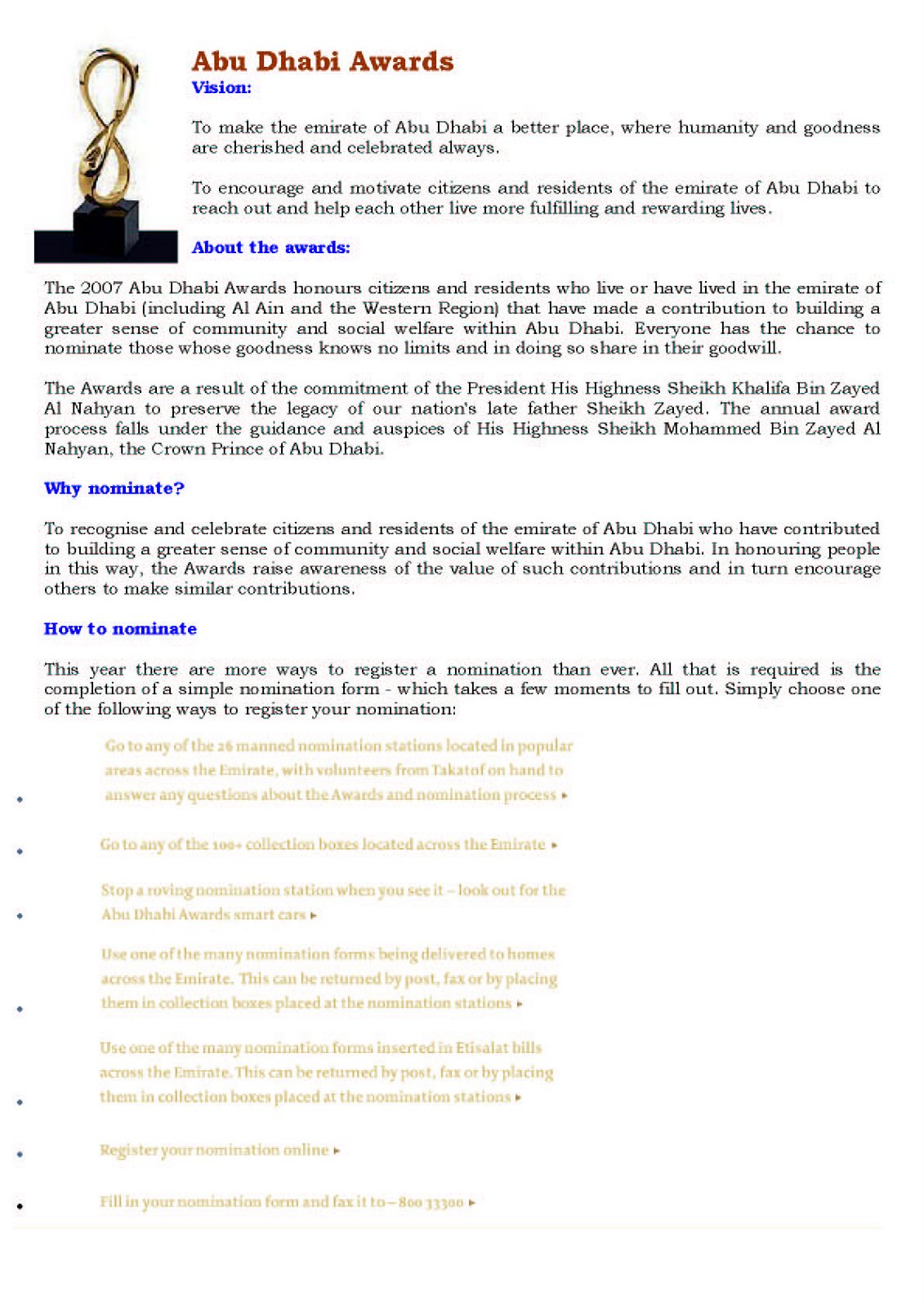
ABU DHABI — The deadline for nominations to the Abu Dhabi Awards has been extended to October 14 in order to ensure participation of citizens and residents of the emirate of Abu Dhabi, including Al Ain and the Western region. This has been done keeping in mind the upcoming Eid holidays.
Through the Abu Dhabi Awards, local residents are encouraged to take advantage of the Eid holidays to honour those who have carried out deeds of exemplary kindness and generosity for the good of the emirate of Abu Dhabi.
Commenting on the event, Abu Dhabi Awards 2006 recipient Sana’a Darwish Al Kitby, who was honoured for her leadership role in the Red Crescent Society, said: “It only takes a few minutes to fill out a nomination form, but the impact it could have may be life-changing for the individual you are recognising. This is encouragement for them and others in our community to keep making a contribution.”

Statistics and credit bureaus soon
Challenge will be to ensure sustained non-inflationary growth.
Statistics and credit bureaus soon
By Saifur Rahman, Business News Editor GULF NEWS Published: October 09, 2007, 23:50
Dubai: The UAE will establish a National Bureau of Statistics (NBS) and a Federal Credit Bureau by the end of this year, the International Monetary Fund (IMF) said yesterday in its latest country report.
The move will be followed by several statistical surveys, currently in the preparatory stage, including a study on household income and expenditure in line with UAE’s efforts to formulate a consumer price index (CPI) to measure real inflation – one of the major woes impacting the lives of its more than 4.5 million residents.
The report, Article IV Consultation 2007 with the UAE, “welcomed the prep-arations to introduce a Value Added Tax (VAT) system at the federal level.”
“Efforts to address the weaknesses of economic statistics at the national level have intensified. Work is under way to improve consumer price data and to establish the NBS by end-2007,” said the report, a copy of which is in possession of Gulf News.
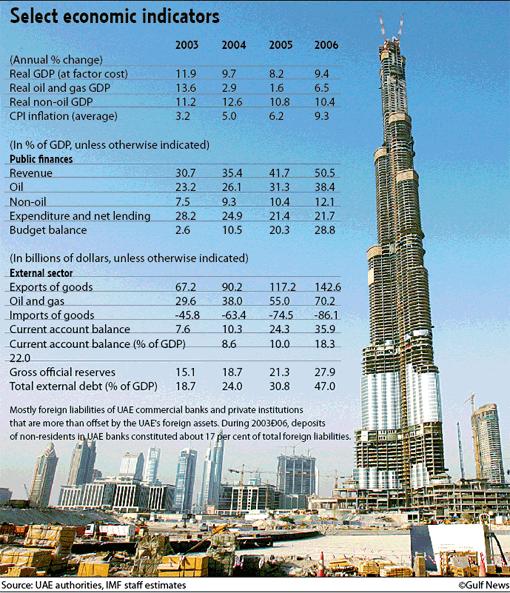
The UAE’s real GDP growth exceeded 9.4 per cent in 2006, with oil production rising by eight per cent and non-oil sectors growing at double-digit rates.
Dr Mohammad Al Asoomi, a UAE-based economist, said a high VAT could hurt the consumers.
“The authorities should introduce VAT from a low base and then gradually bring it up to the five per cent level,” he told Gulf News. “However, it should be a GCC-wide move and not an individual national move.”
Strong domestic demand and housing shortages have led to sharp rises in rents and contributed to upward pressure on other prices. As a result, the CPI inflation exceeded 9.3 per cent in 2006, the IMF said.
The IMF observed that although the assessment of inflation is complicated by data weaknesses, the rate of price increases, driven mainly by strong demand for housing, is too high.
“However, the anticipated reduction of capacity constraints – especially in the housing market – is likely to reduce inflation pressures over the medium term,” the report said.
“Fiscal policy could play a greater role in regulating domestic demand. In particular, expenditure increases – including by public and quasi-public entities – should be consistent with the country’s absorptive capacity. This, together with efforts to alleviate capacity constraints, would help subdue inflation and support a continued economic expansion with macroeconomic stability.”
Reflecting record oil prices, the overall fiscal and external current account surpluses remained large in 2006, and have allowed further accumulation of official foreign assets.
The medium-term outlook is very positive with real GDP growth projected to remain strong in 2007, and slightly decelerating thereafter due to temporary capacity constraints.
The fiscal and external accounts are projected to remain in large surplus. IMF agreed that “the key challenges will be to ensure sustained noninflationary growth and further diversification of the economy.”
Dollar peg
The IMF report agreed that the peg of the dirham to the US dollar has served the UAE well. “The exchange rate of the dirham is in line with fundamentals,” the report said, adding, “Further structural reforms would help to sustain the UAE’s competitiveness.”
The IMF appreciated the authorities’ commitment to work closely with other GCC member countries to a reach consensus on the appropriate future exchange rate regime to be adopted as part of the GCC currency union.
The IMF welcomed steps to enhance the supervision of capital markets and efforts to update the banking law and the company law.
“These steps would, inter alia, remove barriers to foreign participation in UAE markets and help protect shareholder rights,” the report said.
The IMF report called on the authorities to move ahead to enact the draft securities law, encourage the listing on the equity market of large quasi-public enterprises, and promote an increased role for institutional investors in the markets.
You Can Bank On Them
You can bank on UTI, Reliance Banking Fund
8 Oct, 2007, 0544 hrs IST,Bakul Chugan, TNN
The banking and financial services sector has been in the limelight of late, thanks to the sustained momentum in the domestic economy. The sector has gained the confidence of foreign institutional investors (FIIs) and fund managers alike. Even though the sector has been an important component of many equity diversified schemes, currently only two funds completely focus on this space.
This week, ET met up with Gautami Desai, fund manager, UTI Banking Sector Fund, and Sunil B Singhania, fund manager, Reliance Banking Fund, to gauge their views on the sector and the composition of stocks in their respective portfolios. It is interesting to note that while both these funds differ in their stock composition, the returns they have generated are more or less similar. Here are excerpts from the interview:
What is the ideal number of stocks you hold in your portfolio?
GD: On an average, we hold 15-20 stocks.
SS: The ideal number of stocks at any given time is 15-20 stocks.
How come the participation of finance companies appears to be low in your portfolio?
GD: We have non-banking finance companies (NBFCs) in our portfolio, but one may not find brokerage firms, since we feel the valuations are overstretched in that segment.
SS: We invest wherever we find opportunity. The banking sector itself is very huge and the percentage of NBFCs is very small. As such, we look for a proper mix of public and private sector banks, as well as NBFCs.
Reliance Capital has been doing pretty well on the bourses, but it does not appear in your portfolio.
GD: We are not very comfortable with the valuations of this scrip.
SS: Reliance Capital is the immediate parent of the fund holding group. So, we dissuade ourselves from investing in this stock. We believe we are sacrificing our returns by not investing in Reliance Capital, but we intend to maintain our stand on ethical grounds.
How come outperforming stocks like Axis Bank, HDFC and HDFC Bank are not part of the portfolio of Reliance Banking Fund?
SS: Not investing in these stocks was a big mistake on our part. We believe our returns would have been much higher if we had invested in these scrips.
UTI Banking Sector Fund appears to be bullish on Karnataka Bank. It has been in your portfolio since a very long time now.
GD: Karnataka Bank has good valuations and moreover, it is a part of the merger & acquisition story. We expect its merger in the near future.
What is the outlook for public sector banks?
GD: Private sector banks are doing better than PSUs. Hence, we are gradually reducing our exposure to PSU banks. However, State Bank of India (SBI) is an exception and we do intend to hold it since it has attracted a lot of FII interest.
SS: I think public sector banks are doing well. We have PSUs like Dena Bank, South India Bank, Bank of Maharashtra and Andhra Bank in our portfolio, which have generated good returns and SBI is doing exceptionally well too.
What are your expectations from September quarter results?
GD: The second quarter results are expected to be a slight disappointment, mainly on account of the slowdown in credit growth in the past six months. The margins looked good in the previous quarter, but this time round, we expect margins to be a little compressed as the deposits will be re-priced. However, there is a positive element in the market in the form of expectations of rate cuts and people are factoring this in. Thus, stock prices should not be adversely affected.
SS: We do not expect anything negative from the results. The banking sector has to keep pace with the growing economy. We expect at least 15-20% growth in this sector in the next 5-10 years.
What are your views on the current market volatility?
GD: We are a little cautious on the banking sector. Currently, we are holding on to the existing portfolio and gradually look forward to reducing our exposure in PSU banks, but we are not too keen on investing in brokerage firms.
SS: The market will always remain volatile. In fact, volatility is a good opportunity to buy good stocks.
Acting in haste versus vacillation
Acting in haste versus vacillation
8 Oct, 2007, 0110 hrs IST, TNN
A king of ancient India had hung from the ceiling of his palace (as was also the practice in many houses on those days), various manuscripts with selections of pithy quotes of great writers. One night, as the king entered his queen’s chamber, he found her on the cot, embracing a young man. Enraged, the king pulled out his sword, which, as it rose up to the ceiling happened to first hit one of the manuscripts, hanging on the ceiling.
Angry at the distraction, at the same time curious as to the matter written on that particular manuscript, which had thus fallen down, the king restrained himself to read the contents therein. The leaf bore these lines from the ancient Sanskrit work, Kiratarjuniya of poet Bharavi, which, when translated ran thus, “One should not do anything in haste because confused and impulsive behaviour could be most dangerous. Prosperity naturally attends on the virtuous and those who do things after due consideration.”
The king calmed down and demanded an explanation from the queen. Pointing to the youth at her bedside, she replied, “Don’t you recognise him? He is our dear son, who, while yet a boy, had after a tiff with you, run away. He has now returned!”
This was a case, where, thanks to a chance intervention, a major tragedy didn’t come to pass. In most cases, however, problems and often misfortunes follow impetuous actions, as also ill considered and stinging words. Valluvar in his Tamil work, Kural observes that even the wound caused by burns would heal but not the scars inflicted by a harsh tongue.
Though desisting from hasty actions would be ideal, at least expressing sincerely one’s regret or asking for forgiveness could be done as damage control exercises, instead of choosing to stand on prestige. Fortunate indeed is one, possessed of that healthy ego, which often is nourished by a willingness to admit one’s mistakes and shed vain pride!
UAE beat Vietnam in World Cup qualifiers
UAE beat Vietnam in World Cup qualifiers
October 09, 2007
United Arab Emirates earned a crucial one-nil away win over Vietnam in the first round of the Asian leg of the FIFA World Cup qualifiers in Hanoi. UAE came close to scoring in the 14th minute, when Ismail Matar fired in a free-kick but the hosts keeper Duong Son came up with a brilliant save. But the 79th minute of the match saw the solitary goal of the match that came off Saeed Basheer. The two will clash once again in the return leg.
Ten Steps To Make Sure Your Sales Training Works!
Ten Steps To Make Sure Your Sales Training Works!
How do you make sure your salespeople are trained effectively and make it a meaningful learning experience for all concerned?
Think of the following elements as building blocks, as the ten keys to sales training success. They should be kept in mind when planning and implementing any sales training program that you run:
1. Comprehensive
2. Customised
3. Relevant
4. Performance oriented
5. Motivational
6. Modular
7. Easy to test and measure
8. Interactive
9. Cost effective
10. Embraced by top management
Block 1. Sales training should be comprehensive
It should provide, to the greatest extent possible, a total solution encompassing not only specific product sales-related courses, but it should also provide:
* An overall plan, based on broad, fundamental and explicitly stated goals. Obviously, you must think about what you want your salespeople to actually learn. However, try to think what kind of salespeople you want them to become through the training.
* Here are two examples:
– “Our salespeople will create the sort of buying experience that will encourage loyalty from our existing customers and increased purchase intention from our prospects”
– “Our salespeople will assume a more professional behaviour when addressing customer needs, thus creating higher levels of customer trust and confidence. The impact of this effort will be measured and monitored through our customer viewpoint surveys.”
* An assessment tool to ensure that salespeople who are enrolled in the program are properly placed. While the your overall recruiting process is the first screening mechanism for bringing people into sales, closer and more accurate evaluation provided within the sales training system could reveal that an individual is better suited to another staff position.
* A tracking system to monitor progress and measure post- training increases.
* A follow-up agenda to provide reinforcement, as well as additional mentoring and coaching, as needed.
* An ongoing plan for continued development, to ensure that all relevant additional or revised information about your products, marketplace, competition, etc. is quickly assimilated into learning for your salespeople.
Block 2 – Sales training should be customised
It should develop logically out of the dynamics of the specific sales environment in which your salespeople work. To accomplish this, all training should be designed to meet the unique requirements of your company. It should be carefully matched to individual needs, limitations and prerequisites.
Ask what the training programme will cover before your salesperson attends. Discuss the subjects with the salesperson to determine which sections will be most relevant and what questions need to be answered. Ensure the salesperson knows what the objectives of the training are, so that they can customise some of the materials to their own needs.
Block 3 – Sales training should be relevant
It should introduce opportunities for your salespeople to acquire and practice skills in a protected and supportive atmosphere that parallels their real world job responsibilities.
This means that case studies (customer scenarios) should be used extensively. Case studies should, of course, reflect realistic customer environments and interactions, including both successes and failures. If it’s a retail course, ensure the activities will assist your salespeople to develop the retail skills they need for your franchise. If it’s a business oriented course, find out what the activities will enable your salespeople to accomplish.
Block 4 – Sales training should be performance oriented
It should build “bridges” and connect to the real world:
* Before training, discuss with the salesperson how it will fit in with their job-related performance objectives. This should dictate the appropriateness of sales training content, learning activities, and instructional methodology.
* During training, get the salesperson to make sure they use structured techniques for applying knowledge through the use of skill-based practice activities, such as group discussions, planning exercises and role playing.
* After training, make sure salespeople are put in touch with relevant information sources, given job aids, provided with structured coaching/mentoring, taken on joint sales calls with more experienced personnel, etc. This ensures the application and transfer of knowledge and skills to the job.
Block 5 – Sales training should be motivational
All training should inspire enthusiasm by focusing on need-to- know information, presented in sufficient depth to impart both confidence and competence to the salesperson.
When presented in a workshop format, sales training should be conducted by dynamic, experienced facilitators who possess a dependable knowledge of the products or services being sold, a realistic and up-to-date understanding of the selling environment, and expertise in moderating learning sessions for adults.
In other words, good sales training recognises that time spent in training is time away from direct sales activities; therefore, it makes efficient and best use of sales people’s time and energy.
Block 6 – Sales training should be modular
All sales training should fit together and should be composed of stand-alone (although related) modules.
These allow your salespeople to complete only those portions of sales training that are most closely connected to their own specific requirements.
To minimise the time that salespeople will have to spend away from sales, training should be designed to be as concise as realistically feasible.
Block 7 – Sales training should be easy to test and measure
It should allow salespeople to “test out” the parts of the training that target information or skills they already have mastered.
It should also require them to complete only those portions of sales training related to their most pressing areas of need.
You can do this by checking what they learned during your review sessions with them, and then applying the follow up methods discussed in Block 1.
Block 8 – Sales training should be interactive
It should consist of workshops, seminars, peer discussion groups, and similar types of interactive activities that allow for the maximum exchange of ideas and sharing of experiences among participants.
Block 9 – Sales training should be cost effective
It should be designed to maximise the organisation’s investment in training, achieving your company’s key goals with the lowest possible cost per participant.
When calculating costs of training, preview what the salesperson will be able to do in, say, six months.
Then determine the costs of manufacturer training courses, coaching, mentoring, distance learning and other forms of development over that time period and equate the overall investment against desired returns.
That way, you can convince your boss that the training budget will be well spent.
Block 10 – Sales training should be embraced by top management
It should have solid management backing, in order to ensure that all learning ideas and principles are adequately supported.
Remember, salespeople will immediately know the real culture of the company if they are told that they are to go on a training course simply to ‘tick a box’.
Get the Manager to discuss with the salesperson what they learned on the course and how their development is important to the company.
It will only take a few minutes but will show how important the role of training is in the company.
Without this, the salesperson will have the belief that their development is not really important to you, and they are not worth investing in.
** The final cement mix **
These keys hold true regardless of who is providing sales training. Here are some percentages from Training Magazine detailing who is providing sales training in organisations with more than 100 employees:
– 24 percent of training provided by in-house staff only
– 14 percent of training provided by outside suppliers only
– 62 percent of training provided by both
So consider how you can give yourself the best possible opportunities to help your sales people’s development have a firm foundation.
These blocks should help you build a great team spirit and create a positive learning culture within your department.
Like always if you would like help on any aspect of your business please feel free to drop us a line with what you need help on and then my team and I can let you know what we could do for you.
All the best.
By Sreeram CA for CiteHR
Creative sparks – Poem – The Criminal – by Master Suraj Menon

by Master Suraj Menon, Our Own English High School Abu Dhabi
Hyatt International to operate hotel at Abu Dhabi’s Capital Gate

Hyatt International to operate hotel at Abu Dhabi’s Capital Gate Staff Report GULF NEWS Published: October 08, 2007, 23:16
Dubai: Hyatt International will operate a 200 room, 5-star hotel in Abu Dhabi’s Capital Gate building, part of the Abu Dhabi National Exhibition Centre, a statement said yesterday.
The hotel will open in 2009 and will be the first Hyatt operated facility in the UAE capital city. In recognition of its significance and its stature, Hyatt International has named the hotel ‘Hyatt at Capital Centre’. It will be one of the most exclusive hotels in the world. Hyatt International already operates three luxury hotels in Dubai under the brands Park Hyatt, Grand Hyatt and Hyatt Regency.
“Capital Gate is a unique building which will become famous around the world. It was essential that the hotel was operated by an organisation which matched its status, I’m delighted that this operator is Hyatt International,” Shaikh Sultan Bin Tahnoon Al Nahyan, chairman of Capital Centre and Adnec said in a statement
Air Arabia set to land in Bangalore

Air Arabia set to land in Bangalore
Staff Report GULF NEWS Published: October 08, 2007, 23:16
Dubai: Air Arabia, the largest low-cost carrier in the Middle East and North Africa (Mena), will begin its service to the south Indian city of Bangalore on October 15, a company statement said yesterday.
The flights will initially operate four times per week between Bangalore and Air Arabia’s hub in Sharjah. From October 29, the frequency will be increased to daily.
Flights to Bangalore will leave Sharjah at 10:50pm local time and arrive in Bangalore at 4:20am local time. Return flights will leave Bangalore at 5:05am local time and arrive in Sharjah at 7:50am local time.
Kyle Haywood, commercial director, Air Arabia said: “Our rapidly expanding route destination network between India and the Middle East answers a growing need for passengers travelling between the two economically vibrant regions. We seek to give those who travel between these two regions low-cost fares along with the highest quality of service possible, whether they travel for business, holidays or to see family and friends.”
Expanding network
Bangalore is Air Arabia’s ninth destination in India, and increases Air Arabia’s total destinations to 37, a destination network that stretches from Eastern Europe, through the Middle East and North Africa, to South Asia.
Bangalore is India’s third most populous city and a major economic hub for the country. With its addition to Air Arabia’s 11 other destinations in South Asia, Air Arabia has become one of the leading low-cost carriers serving this growing region.
Bangalore is one of India’s most dynamic cities, and has been India’s leading centre for information technology, earning the nickname the ‘Silicon Valley of India’. In addition to being at the forefront of India’s technology revolution, Bangalore is also considered the ‘Garden City of India’ due to its lush climate, extensive vegetation and many public parks.
An ancient city, it was first mentioned in literature in the ninth century as part of the Ganga Kingdom. Then it was called ‘Bengaval-uru’ or the ‘City of Guards’.
“We are pleased to add Bangalore to our low-cost flight network within India. With the large Indian expatriate population living in the Gulf countries, this new flight route represents even more low-cost convenience for those who have family, friends and homes in both these regions,” Haywood said.
Air Arabia, established in February 2003 by an Amiri decree, began operations in October of the same year. Based in Sharjah and with a fleet of ten Airbus A320 aircraft, Air Arabia serves 36 destinations across the Middle East, North Africa, the Indian subcontinent and Central Asia.
 ClicksandWrites
You must be logged in to post a comment.