Team 1 Dubai 2008 Calendar
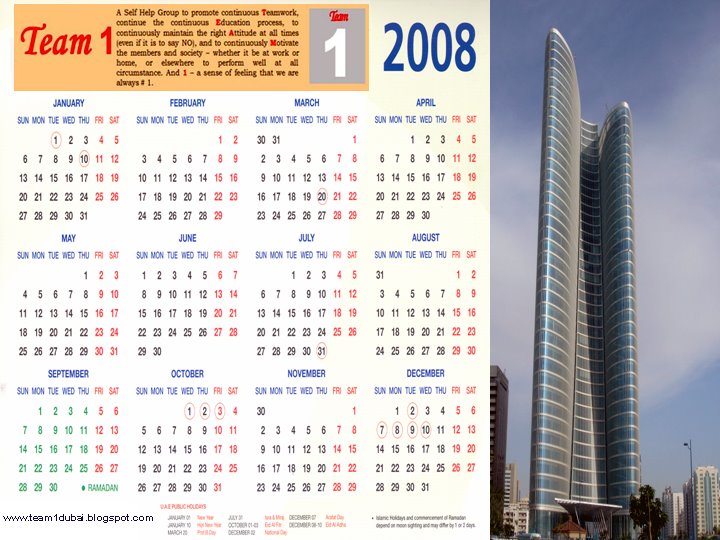
Dear all,
Wish you all a Quality Year 2008.
The calendar attached is with UAE Public Holidays.
God Bless,
Ramesh Menon
23122007

reddit_url='[URL]’reddit_title='[TITLE]’
Daily Exchange Rates – Saturday, 22 December 2007
Brought to you by
Al Rostamani International ExchangeAbu Dhabi
Tel : + 9712 6223003

Mind Speaks – Towards Building a Quality ’08
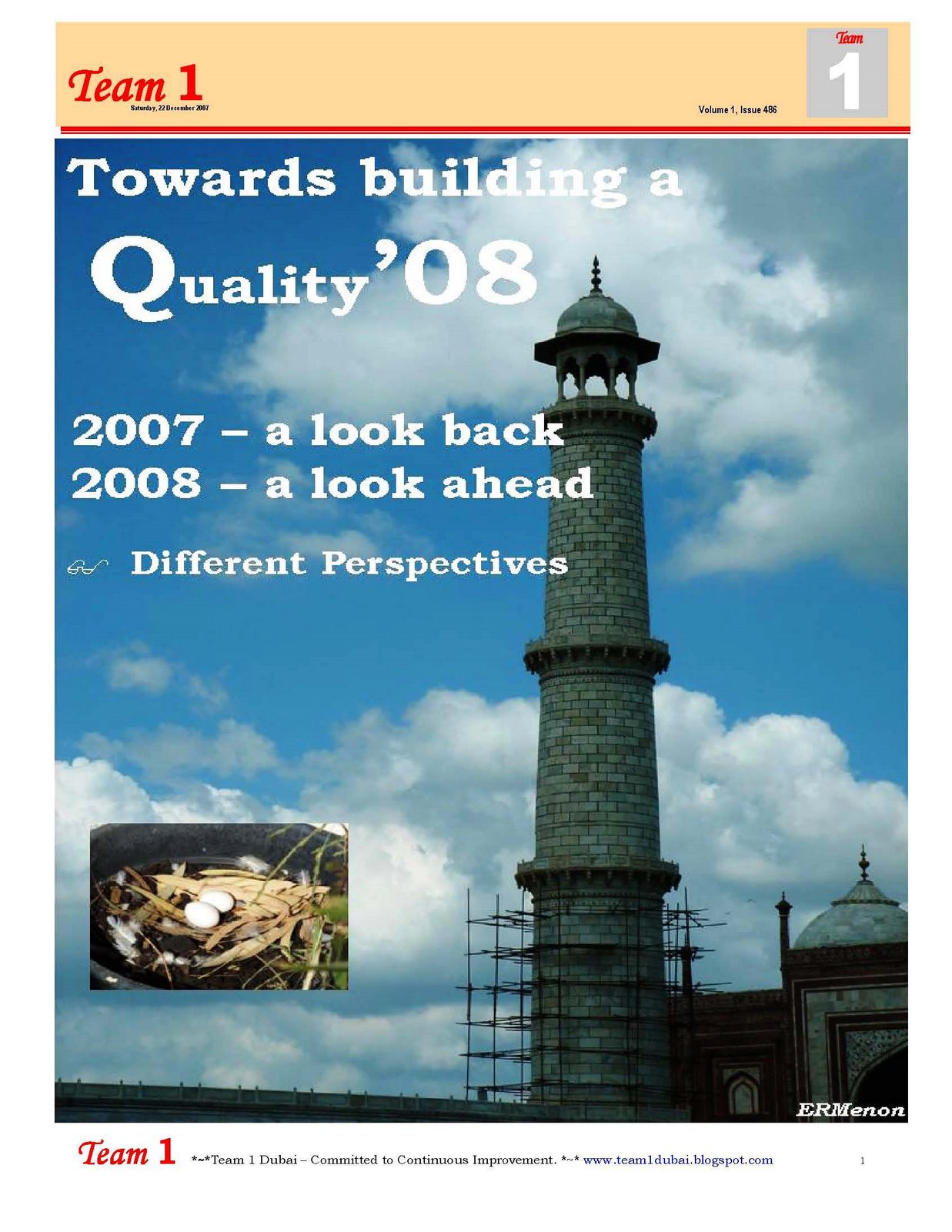
Hello friends,
Team 1 newsletter – Issue 486 – “Towards Building a Quality ’08” is ready and available. Those readers who wish to obtain a personal copy of the same in pdf version, please email us at team1dubai@gmail.com
digg_url = ‘WEBSITE_URL’;
digg_bgcolor = ‘#ff9900’;
digg_skin = ‘compact’;
digg_window = ‘new’;
"You Can Call It Gratitude"– by Sudha Murthy

“You Can Call It Gratitude”– by Sudha Murthy
There are two photographs that hang on my office wall. Everyday when I enter my office, I look at them before starting my day. They are pictures of two old people. One is of a gentleman in a blue suit and the other is a black and white image of a man with dreamy eyes and a white beard.
People have often asked me if the people in the photographs are related to me. Some have even asked me, “Is this black and white photo that of a Sufi saint or a religious Guru?” I smile and reply “No, nor are they related to me. These people made an impact on my life. I am grateful to them.” “Who are they?” “The man in the blue suit is Bharat Ratna JRD Tata and the black and white photo is of Jamsetji Tata.” “But why do you have them in your office?” “You can call it gratitude.”
Then, invariably, I have to tell the person the following story. It was a long time ago. I was young and bright, bold and idealistic. I was in the final year of my Master’s course in Computer Science at the Indian Institute of Science (IISc) in Bangalore, then known as the Tata Institute. Life was full of fun and joy. I did not know what helplessness or injustice meant.
It was probably the April of 1974. Bangalore was getting warm and gulmohars were blooming at the IISc campus. I was the only girl in my postgraduate department and was staying at the ladies’ hostel. Other girls were pursuing research in different departments of Science. I was looking forward to going abroad to complete a doctorate in computer science. I had been offered scholarships from Universities in the US. I had not thought of taking up a job in India.
One day, while on the way to my hostel from our lecture-hall complex, I saw an advertisement on the notice board. It was a standard job-requirement notice from the famous automobile company Telco (now Tata Motors). It stated that the company required young, bright engineers, hardworking and with an excellent academic background, etc.
At the bottom was a small line: “Lady Candidates need not apply.” I read it and was very upset. For the first time in my life, I was up against gender discrimination. Though I was not keen on taking up the job, I saw it as a challenge. I had done extremely well in academics, better than most of my male peers. Little did I know then that in real life academic excellence is not enough to be successful.
After reading the notice I went fuming to my room. I decided to inform the top most person in Telco’s management about the injustice the company was perpetrating. I got a postcard and started to write, but there was a problem: I did not know who headed Telco. I thought it must be one of the Tatas. I knew JRD Tata was the head of the Tata Group; I had seen his pictures in newspapers (actually, Sumant Moolgaokar was the company’s chairman then).
I took the card, addressed it to JRD and started writing. To this day I remember clearly what I wrote. “The great Tatas have always been pioneers. They are the people who started the basic infrastructure industries in India, such as iron and steel, chemicals, textiles and locomotives. They have cared for higher education in India since 1900 and they were responsible for the establishment of the Indian Institute of Science. Fortunately, I study there. But I am surprised how a company such as Telco is discriminating on the basis of gender.”
I posted the letter and forgot about it. Less than 10 days later, I received a telegram stating that I had to appear for an interview at Telco’s Pune facility at the company’s expense. I was taken aback by the telegram. My hostel mate told me I should use the opportunity to go to Pune free of cost and buy them the famous Pune saris for cheap! I collected Rs 30 each from everyone who wanted a sari. When I look back, I feel like laughing at the reasons for my going, but back then they seemed good enough to make the trip.
It was my first visit to Pune and I immediately fell in love with the city. To this day it remains dear to me. I feel as much at home in Pune as I do in Hubli, my hometown. The place changed my life in so many ways. As directed, I went to Telco’s Pimpri office for the interview. There were six people on the panel and I realized then that this was serious business.
“This is the girl who wrote to JRD,” I heard somebody whisper as soon as I entered the room. By then I knew for sure that I would not get the job. The realization abolished all fear from my mind, so I was rather cool while the interview was being conducted. Even before the interview started, I reckoned the panel was biased, so I told them, rather impolitely, “I hope this is only a technical interview.” They were taken aback by my rudeness, and even today I am ashamed about my attitude.
The panel asked me technical questions and I answered all of them. Then an elderly gentleman with an affectionate voice told me, “Do you know why we said lady candidates need not apply? The reason is that we have never employed any ladies on the shop floor. This is not a co-ed college; this is a factory. When it comes to academics, you are a first ranker throughout. We appreciate that, but people like you should work in research laboratories.” I was a young girl from small-town Hubli. My world had been a limited place. I did not know the ways of large corporate houses and their difficulties, so I answered, “But you must start somewhere, otherwise no woman will ever be able to work in your factories.”
Finally, after a long interview, I was told I had been successful. So this was what the future had in store for me. Never had I thought I would take up a job in Pune. I met a shy young man from Karnataka there, we became good friends and we got married.
It was only after joining Telco that I realized who JRD was: the uncrowned king of Indian industry. Now I was scared, but I did not get to meet him till I was transferred to Bombay. One day I had to show some reports to Mr. Moolgaokar, our chairman who we all knew as SM. I was in his office on the first floor of Bombay House (the Tata headquarters) when, suddenly JRD walked in. That was the first time I saw “appro JRD”. Appro means “our” in Gujarati. This was the affectionate term by which people at Bombay House called him.
I was feeling very nervous, remembering my postcard episode. SM introduced me nicely, “Jeh (that’s what his close associates called him), this young woman is an engineer and that too a postgraduate. She is the first woman to work on the Telco shop floor.” JRD looked at me. I was praying he would not ask me any questions about my interview (or the postcard that preceded it). Thankfully, he didn’t. Instead, he remarked. “It is nice that girls are getting into engineering in our country. By the way, what is your name?” I replied “I am Sudha” He smiled a kindly smile and started a discussion with SM. As for me, I almost ran out of the room.
After that I used to see JRD on and off. He was the Tata Group chairman and I was merely an engineer. There was nothing that we had in common. I was in awe of him. One day I was waiting for Murthy, my husband, to pick me up after office hours. To my surprise I saw JRD standing next to me. I did not know how to react. Yet again I started worrying about that postcard. Looking back, I realize JRD had forgotten about it. It must have been a small incident for him, but not so for me.
“Young lady, why are you here?” he asked. “Office time is over.” I said, “Sir, I’m waiting for my husband to come and pick me up.” JRD said, “It is getting dark and there’s no one in the corridor. I’ll wait with you till your husband comes.” I was quite used to waiting for Murthy, but having JRD waiting alongside made me extremely uncomfortable. I was nervous. Out of the corner of my eye I looked at him. He wore a simple white pant and shirt. He was old, yet his face was glowing. There wasn’t any air of superiority about him. I was thinking, “Look at this person. He is a chairman, a well-respected man in our country and he is waiting for the sake of an ordinary employee.” Then I saw Murthy and I rushed out. JRD called and said, “Young lady, tell your husband never to make his wife wait again.”
In 1982, I had to resign from my job at Telco. I was reluctant to go, but I really did not have a choice. I was coming down the steps of Bombay House after wrapping up my final settlement when I saw JRD coming up. He was absorbed in thought. I wanted to say goodbye to him, so I stopped. He saw me and paused. Gently, he said, “So what are you doing, Mrs. Kulkarni?” (That was the way he always addressed me.) “Sir, I am leaving Telco.” “Where are you going?” he asked. “Pune, Sir. My husband is starting a company called Infosys and I’m shifting to Pune.” “Oh! And what will you do when you are successful.” “Sir, I don’t know whether we will be successful.” “Never start with diffidence,” he advised me. “Always start with confidence. When you are successful you must give back to society. Society gives us so much; we must reciprocate. I wish you all the best.”
Then JRD continued walking up the stairs. I stood there for what seemed like a millennium. That was the last time I saw him alive. Many years later I met Ratan Tata in the same Bombay House, occupying the chair JRD once did. I told him of my many sweet memories of working with Telco. Later, he wrote to me, “It was nice hearing about Jeh from you. The sad part is that he’s not alive to see you today.”
I consider JRD a great man because, despite being an extremely busy person, he valued one postcard written by a young girl seeking justice. He must have received thousands of letters everyday. He could have thrown mine away, but he didn’t do that. He respected the intentions of that unknown girl, who had neither influence nor money, and gave her an opportunity in his company. He did not merely give her a job; he changed her life and mindset forever.
Close to 50 per cent of the students in today’s engineering colleges are girls. And there are women on the shop floor in many industry segments. I see these changes and I think of JRD. If at all time stops and asks me what I want from life, I would say I wish JRD were alive today to see how the company we started has grown. He would have enjoyed it wholeheartedly.
My love and respect for the House of Tata remains undiminished by the passage of time. I always looked up to JRD. I saw him as a role model for his simplicity, his generosity, his kindness and the care he took of his employees. Those blue eyes always reminded me of the sky; they had the same vastness and magnificence.
* Sudha Murthy is a widely published writer and chairperson of the Infosys Foundation involved in a number of social development initiatives. Infosys chairman Narayan Murthy is her husband.
Sourced from The Net.
Alternative therapies: Unlocking closed doors

Alternative therapies: Unlocking closed doors
Amrita Singh,TNN
Her mother thought she was speech impaired. For years the child had not spoken a word, and hearing her sing a rhyme was something they had long given up hope for. She was autistic, you see. But Margaret Lobo, a UK-based music therapist associated with Music Therapy Trust in Mumbai, knew she could be reached through music. Lobo sang nursery rhymes, prodding the child to sing after her. After just three sessions her student sang – loud and clear. Lobo had unbolted her isolated world, if only for a brief moment.
Lobo is one of the unlikely people working in the field of behavioural therapy. After all, music, dance, art or brain gym don’t seem to belong in psychiatry books. Yet, these creative forms may have solutions to psychological problems. Doctors are increasingly prescribing these therapies for attention deficit syndrome, dyslexia, autism, depression and even schizophrenia.
Broadly these therapies work on the premise that the basic brain structure is the same for everyone and if somebody cannot read, write or communicate it isn’t because there is something wrong with their brain but because we don’t have the right tools to communicate with them. These tools could well be found in various art forms.
Lobo, for instance, uses music therapy to deal with autism, ADHD and other disorders. “It works on anyone. You could be paralysed due to a stroke, but the ability to hear and comprehend music never goes,” she says. She encourages a child to experiment with many instruments, looking for cues about what might work in each case. The breakthrough may take weeks, sometimes even years and the effect may be fleeting. “There is a feeling of triumph each time a student manages to dance, sing or speak a sentence coherently.”
Dance therapy, meanwhile, uses body movements to increase emotional and physical coordination. It believes that the body’s shape can affect one’s attitude. Tripura Kashyap, a Hyderabad-based instructor with a degree in dance stroke movement therapy from Hancock Centre of Dance Therapy in US, says, “Dance can improve imitation skills and memory, as kids are motivated to make eye contact, focus for a long time and learn the sequence of steps.”
Another programme that’s gaining popularity is Neuro linguistic programming (NLP). Krish Srikanth, who has trained with American NLP practitioner Anthony Robbins, says kids with learning disorders store and comprehend information in a way that’s different from others. They can benefit from NLP spelling strategy, that attaches images and feelings to words to make learning and spelling easier.
But there are some roadblocks. Dr Vikas Mohan Sharma, a psychiatric at Vimhans, Delhi, says, “The therapies can be effective if used with medicine. But getting to the right person may be tough.” Parents must check the therapist’s qualification. For instance, a certificate in music therapy is given by Apollo Hospital, Chennai, and Music Therapy Trust of India.
Little geniuses need care too
Little geniuses need care too
Pallavi Srivastava,TNN
Academically and mentally challenged children are not the only ones that need much more support than is being provided in India. And while small moves are being made to nurture the differently abled, another group of kids continues to suffer silently.
Yes, most of us don’t even think that gifted children need special attention too. But the few people who are working in the field in India say that gifted children form yet another group that the society continues to treat unfairly.
“People think that gifted kids would do well anyway,” says Dr Devasena Desai, in-charge of the nurturing programme at the Pune chapter of Mensa, the largest, oldest and most well-known high-IQ society in the world. Dr Desai, however, emphasises that close to nothing is being done for the children who carry the greatest potential. We, in fact, do more harm to them if we just let them be. “They are more touchy and withdrawn, because their high ability hampers their interaction with other kids,” she says. “You have to give them challenging activities as well as help them in social and emotional development.”
That, unfortunately, is a thought almost non-existent in India. So our gifted kids risk ending up as under-achievers or distracted workers. The education system has no special place for them. Few schools make special provisions for their mental stimulation and parents don’t know whom to approach for guidance.
Not even a fraction of the money and attention given to providing special education for the mentally challenged children is given to these geniuses. “The need is doubled for these kids,” says M. Srinivasan, founder-chairman of GEAR (Gifted Education and Research) Foundation, which runs a school in Bangalore. “But as they say, the crying baby gets the milk. While parents and social workers are very active to get facilities for the disabled, people look down upon me for promoting gifted education.”
Efforts, however, are being made by individuals like him to make a difference at their own level. The Institute for Gifted Children, set up in Delhi by Dr Shakuntla S. Jaiman to develop a teaching methodology at her CSKM Public School, identifies gifted students from class 4 onwards. “The few schools that identify gifted children tend to group them in one section. That isolates them from the mainstream. But we develop them to become mentors to other children,” she says.
The scenario is made more complex because there are conflicting theories of judging giftedness, although most agree that gifted people are the top 1% of the population. Besides IQ testing, which has attracted wide criticism, new concepts like Multiple Intelligences and attitude, emotional and social quotients have emerged. This has left people to follow their own methods to identify and nurture children, and to train teachers.
For instance, Srinivasan, who holds a masters degree from the National Research Centre on the Gifted and Talented, University of Connecticut, USA, applies the Multiple Intelligences concept in his school. “We don’t ask, ‘How smart are you?’,” he says. “We ask, ‘How are you smart?’.” Jaiman, who has done her PhD. in the subject from IIT, Delhi, uses a wide range of psychological tests.
Srinivasan, in fact, discounts the IQ score beyond 120, saying it works more for mathematicians or scientists and not for the creative lot. Desai, however, says they need an IQ of at least 140. “There is a thin line between being talented and gifted,” she says. “While a talented person may be good at one or two-three things, a gifted person has a cognitive ability that’s far superior to the normal population.”
Mensa, for that matter, has its own standard international qualifying test that a person from any cultural background can take. And Mensa, Pune, has, over the past five years, identified over 60 tribal students from Maharashtra as ‘Mensan’. The organisation will help in their social, emotional and mental development through 18 modules over the next 18 months. Well, it’s high time the gifted got some gifts too.
Recipe for a happy marriage
Recipe for a happy marriage
Namita Devidayal
In an era where every one seems to be someone’s ‘ex’ – (a Mumbai fashion designer has launched a label cockily called Sex With My Ex) – marriage has become something of a curio. The subject is eternally bewildering: What is the formula to make a marriage work? Is there one? Is it an outdated institution? Or is it a mistake every one should make?
In an attempt to decode the idea of matrimony, two South African film-makers have decided to make a film on long-marriages-couples who have stuck it out for more than 50 years. “We wanted to capture 50-year-old marriages before they become extinct,” explains Karen Slater, who earlier made films on wildlife.
So, what prompted her to drop the buzzard for the bedroom? It started four years ago, when she and her then friend, Steven Bartlo, got involved with each other. Slater was 36, Bartlo was close to 50. When the ‘M’ word came up, both recoiled. The subterranean ghosts popped up. She was terrified because her parents had divorced, and he was utterly cynical, because he had seen his folks bicker all his life long. (In case you’re wondering which is better – chronic bickering or divorce – wait till the end of the article).
To determine whether or not they should get married, and also get some tools on what makes marriages last, they started exploring the idea of making the film, which they titled ‘Fifty years! Should we do it’. They have since been all over the world interviewing sweet old couples, including a conservative Catholic Dutch couple, a polygamous Zulu chieftain and his six wives, a suburban American couple, Bartlo’s parents (who are Indian) and, most recently, the Breach Candy-based spiritual advocate, Ramesh Balsekar and his wife Sharda. Somewhere in the middle of that, they got married and also feature in the film.
Slater and Bartlo were in Mumbai recently to interview the Balsekars, who have been married 67 years. (They would have loved to interview their own guru, but realised that he would not be an appropriate candidate as he had slept with too many of his disciples.)
Bartlo interviews the man, Slater the woman. So what did Balsekar, whose disciples include the gloomy Canadian singer Leonard Cohen, have to say? “He explains every thing in terms of philosophy,” says Bartlo, “…so whatever is meant to happen, must happen. It’s the same in marriage.” What does he mean? People are programmed by their conditioning and their genetics. So that affects their marriage. But an important tip: “Always put your attention on the needs of the other. You have to rise above your own personal desires.”
Bartlo’s thoughts? It is important not to take things too seriously. So, if something happens in your marriage, you accept it, absorb and process it, let it have its due impact on you, and then let it go. Going back to a Balsekarism, he adds, “Remember, the past is dead, and the future is entirely uncertain, so just live in the moment.”
And what did the others have to say? Well, the Zulu healer, who once had 13 wives, had this gem on offer. “You should never stray outside your marriage.” He claimed to be happily married though, not surprisingly, the wives did not entirely reflect that sentiment.
Divorce is not a bad word in the film-makers’ view, only “something treated too easily and light-heartedly, without any long-term vision,” says Bartlo. It was when Bartlo interviewed his parents, who have now transformed into a calm, hand-holding couple, he was most intrigued. He realised that, “If you make it through the rapids and whirlpools of your marriage, you eventually do reach the ocean of serenity…If you have the strength of character to make it through the rough spots, you usually do reach the Golden Age” – (a nugget perhaps that all of us not-yet-married-for-50-years should stash away in a secret drawer).
“If we hadn’t made this film, I don’t think we’d have got married,” says Slater. “These couples have been an inspiration.”
Why our kids run amok
Why our kids run amok
Rup Narayan Das
Depression is fast emerging like a silent killer without any warning unlike physical ailments.
People argue that it is because of depression that some of us commit suicide or are alcoholic. But the root cause of such manifest symptoms goes deeper.
Society is passing through a crisis. We have ceased to be traditional without becoming modern.
Urbanisation and modernisation coupled with the mindless pursuit of career are not only robbing us of the finer sensitivities and qualities but also spoiling our peace and tranquility, our societal and familial harmony.
The symptoms of depression are all-pervasive and manifest in road-rage, street brawls, ill temper, intemperate language, lack of civility and delinquent behaviour.
The cushioning effects of the joint family is no more and there is unbridled materialism and consumerism fueled by easy loan and credit cards, enticed by advertisement which drives one to the deadly debt trap.
There is a mismatch between aspiration and ability to achieve, leading to frustration and depression.
Loneliness of children, particularly in cities, has affected their mental growth and emotional nourishment.
The old world bonhomie of the neighbourhood and interpersonal interaction have also disappeared. Psychological and clinical therapy alone cannot address such ailments Mental depression needs to be addressed spiritually and socially.
We must address the basic reasons of depression which are the flipsides of urbanisation and modernisation. The very premise of development through material prosperity alone needs to be questioned.
No wonder then that a small country like Bhutan has questioned the paradigm of development and coined the term ‘gross domestic happiness’ in place of gross domestic product as an index of development, honoured by the UN. Isn’t it time we had a spiritual and ethical foundation to our material prosperity?
What’s short-selling of shares?
What’s short-selling of shares?
TNN
What is short-selling?
Short-selling, in the context of the stock market, is the practice where an investor sells shares that he does not own at the time of selling them. He sells them in the hope that the price of those shares will decline, and he will profit by buying back those shares at a lower price. In India, there is no prohibition on short-selling by retail investors. Institutional investors —domestic mutual funds and foreign institutional investors registered with the Securities and Exchange Board of India (Sebi), banks and insurance companies — are prohibited from short-selling and are mandatorily required to settle on the basis of deliveries of securities owned and held by them.
How is short-selling beneficial?
Short-selling is considered an essential feature of the securities market not just for providing liquidity, but also for helping price corrections in over valued stocks. Supporters of short-selling claim its absence distort efficient price discovery, gives promoters the unfettered freedom to manipulate prices and favours manipulators than rational investors. Securities market regulators in most countries, and in particular, all developed securities markets, recognise short-selling as a legitimate investment activity. The International Organisation of Securities Commissions (IOSCO) has also reviewed short-selling and securities lending practices across markets and has recommended transparency of short-selling, rather than prohibit it.
Are there any drawbacks of short-selling?
Critics of short-selling feel selling, directly or indirectly, poses potential risks and can easily destabilise the market. They believe that short-selling can exacerbate declining trend in share prices, increase share price volatility, and force the price of individual stocks down to levels that might not otherwise be reached. They also argue that declining trend in the share prices of a company can even impact its fund raising capability and undermine the commercial confidence of the company. In a bear market in particular, short-selling can contribute to disorderly trading, give rise to heightened short-term price volatility and could be used in manipulative trading strategies.
Will institutional investors in India be allowed to short-sell securities?
Sebi is working on a proposal to introduce a stock borrowing and lending mechanism. This will allow institutional investors to short-sell by borrowing shares. Under this arrangement, an investor A, who feels that a certain stock is overpriced, borrows those shares for a charge from investor B, who is willing to lend those shares. Investor A then sells those shares in the market, hoping that the price declines so that he can buy cheap and return them to investor B.
What is the difference between covered short sales and naked short sales?
Covered short sales are those in which the seller arranges for the delivery of shares he has sold by borrowing them. Naked short sales are those in which the seller does not intend to provide for the delivery of shares he has sold. Most international securities market regulators have prohibited naked short-selling and require the client to have documentary evidence of borrowing/tie-up with lenders before executing the sale transaction. This is because naked short sales in huge quantities can destabilise the market.
How does the stock lending and borrowing mechanism function in other markets?
World over, securities lending and borrowing transactions are, by and large, over-the-counter (OTC) contractual obligations executed between lenders and borrowers. International securities market regulators do not directly regulate the lending and borrowing transactions. In many international markets, entities like custodians and depositories run the lending and borrowing scheme and have their own screens for meeting the demand and supply of securities from their clients.
( With inputs from the Sebi discussion paper on short-selling and stock lending )
A temple must be in the heart
A temple must be in the heart
Mukul Sharma, TNN
As most of us well know, temples — and to more or less varying degrees churches, mosques, synagogues, etc — are not really places of worship, but social constructs. They were designed specifically for people of chosen faiths to congregate and continually reaffirm their bonds of that oneness that draws them together.
Which is why the heavy ceremonies, “Sunday best” dressing, body purifying processes and mannered interactivity. Praying, or any form of spiritual union with the divine is, at best, a solemn add-on initiative. However, it’s integral to the function of a temple to make at least a passing reference to God, otherwise its reason for existence crumbles.
Priests of all faiths realise this ironic fact only too well to properly disguise their intentions. They know, for instance, that the foundation on which their sanctuaries of veneration are built are on pretty shaky ground. On the one hand they goad us the godhead is inside ourselves, all around us and omnipresent, yet on the other, they need to demand our physical presence and time inside temples. Ultimately it turns out that it’s the only place where He can be appropriately addressed and that, too, after adhering to a series of ritualised practices.
Is it any wonder then that some people see through this masquerade from time to time? But that’s when astute templars who have the pulse of their flock right, up the devotional ante exponentially with historical crusades, mandatory pilgrimages and annual melas. Suddenly, for a small moment in time (which may actually last centuries in some cases), people get to focus clearly as the temple gets its act right.
But, like miracles, these sacred journeys of the mind have no real staying power, or if they do it’s only in a cyclical fashion. In the main, whole sections of society tire of that forced connect. In Japan which professes to be officially three-quarters Buddhist, monks have had to hit the catwalk recently in Tokyo to lure youths back to shrines. Buddhism is in a crisis in that country, they say.
Perhaps, the process of an inner devotion needs to be emphasised instead; one that recognises no iconic signposts leading the way to supposed salvation. Otherwise, young people in Japan — or for that matter anywhere in the world — will end up holding communion with whatever they believe in, only in their hearts. But come to think of it, how bad is that either?
 ClicksandWrites
You must be logged in to post a comment.