Turning waste to good use
Turning waste to good use
KHALEEJ TIMES 19 January 2008
USING body heat to power water heaters to heat buildings; trucks that run on chocolate and floors coated with cheese to say nothing of recycling human excrement. Bibi van der Zee looks at new ways of turning our waste to good use.
Body Heat
In Stockholm, they are going to capture the body heat generated by all the passengers at the central train station to heat water, which will be piped to the next-door office and used to heat the building.
It is an inspiration in terms of lateral thinking, but it was also done with such ease and lack of discussion and argument that it feels as if it should be contravening some obscure unitary development agreement, or some other typical obstacle to common sense. Karl Sundholm, of building managers Jernhusen AB, explains: “We were just sitting in a meeting, chatting and drinking coffee, and the idea popped up. Someone pointed out of the window to the railway station and said, ‘What about all that heat over there?’ We did a couple of drawings and that was it.”
They have finished the design stage, and are now finalising the details. Work is due to start in the autumn. The predicted cost is about GBP23,000, and they expect that it will reduce their heating bills by about 15%. “It’s not so complicated,” says Sundholm. “Just a couple of pipes and water pumps. Actually, I’m surprised no one thought of it before.”
Chocolate
Chocolate, of course, has always been one of the major forces for good in this world, so news that waste chocolate is being turned into a carbon-neutral fuel, thereby solving all our problems, should be no surprise to anyone.
Chocolate factories produce a lot of waste, equivalent to 5-10% of their total output, which usually goes into animal feed or straight to landfill. But now Ecotec, a UK bio-diesel firm, has worked out how to turn it into fuel. Biofuels from purpose-grown crops are looking increasingly problematic for the environment, whereas biofuels made from waste products are, quite simply, a good thing.
A little chocolate goes a long way, too, as Ecotec discovered when it recently powered a truck all the way across the Sahara. Alhough it took four tonnes of refined chocolate waste to power the trip, that is just a small percentage of annual chocolate waste.
Ecotec is also looking into other forms of food waste. As far as carbon neutral transport goes, nothing will ever beat your own feet, or a bicycle. But chocolate power has got to be better than any fossil fuel.
Human excrement
Fecophobia, an irrational fear of human excrement, is incredibly common in the modern world. In his cult 1995 book The Humanure Handbook, Joseph Jenkins (who gave the phobia its name) tried to get us to face up to this absurdity, pointing out that in the west we take for granted the idea that “you take your dump into a large bowl of drinking water, then flush it”. Why do we believe this to be the civilised thing to do, he asked. And what a waste. He went on. “Where does the flushed material go? What would happen if everyone in the world crapped in their drinking water supplies? Why doesn’t any other land mammal defecate deliberately in water? Why do we?”
Human excreta, or “night soil” as it is known is some cultures, is actually a potential goldmine, he said, calculating that if the entire world’s excreta had been turned into fertiliser for our crops in 2000, it would have been worth (using 1975 prices) $18.67bn. (It was reported this week that some farmers in Zimbabwe have started to use human excrement as fertiliser because of shortages of ammonium nitrate.) Moreover, when it is collected and sealed up so that it undergoes anaerobic digestion, it also produces biogas as a side product. Biogas can be used to fuel cooking stoves and heating systems. It can even be used to power cars.
The world is slowly coming round to Jenkins’ way of thinking. By 2010, China aims to have 50m households operating biogas systems, which harvest excreta and turn it into biogas and fertiliser. In Uganda, farmers are being taught how to make biogas using human excreta along with other organic waste, and in Sweden they already make an extra strong version, which includes biogas from rotting animal carcasses, and they even run trains on the stuff. There is no place for squeamishness in the brave new world.
Whey
You wouldn’t imagine that cheesemakers and floor contractors would have much in common, but some thoughtful food scientists have changed all that. A team at the University of Burlington in Vermont has developed a method of using whey, a waste product from cheese, as a floor covering. The whey protein is apparently a perfect binding agent, which means that it can replace the highly toxic solvents usually used in wood floor coverings.
Andrew Meyer, who runs Vermont Natural Coatings, the company that has been selling this floor covering for just under a year, has had good feedback from his customers. “I’ve had floor contractors, who have been using one particular product for many years, try this out, and they’ve said that when they finish the day now they don’t have the usual headache, or the usual agitation. There’s much less off- gassing with this product, you don’t have to move out if you want to varnish your floors.”
The farmers are happy, the environmental officers are happy, and the floors are gleaming. What more could you ask?
Road power
It is kind of a vicious circle, but at least Dutch company Road Energy Systems is deriving some benefit from heavy traffic. It has developed a road that has an asphalt layer (which is very effective at conducting heat) on top of a system of water-bearing pipes. The water absorbs heat generated by vehicles on the road surface and from the sun. It is then piped away and stored thermally until needed. It is then piped to buildings, where it is used to heat the air. There is already one system in operation that powers four office blocks in Scharwoude in the Netherlands, but whether it will be used more widely remains to be seen. –Guardian News Service
Ongoing / Upcoming events in Abu Dhabi
Ongoing / Upcoming events in Abu Dhabi
21 – 23 Jan 2008 World Future Energy Summit 2008
30 Jan – 2 Feb 2008 Abu Dhabi Real Estate and Investment show 2008
February
5 – 8 Feb 2008 The Bride Show 2008
12 – 14 Feb 2008 Abu Dhabi Recruitment Show 2008
March
2 – 5 Mar 2008 Homeland Security Conference
2 – 5 Mar 2008 ISNR 2008
11 – 16 Mar 2008 Abu Dhabi International Book Fair 2008
30 Mar – 2 Apr 2008 Interiors UAE 2008
April
8 – 10 Apr 2008 GIBTM 2008
8 – 10 Apr 2008 Incentive Business Travel Conference
20 – 23 Apr 2008 Building Futures Gulf by BATIMAT Conference
20 – 23 Apr 2008 Building Futures Gulf by BATIMAT 2008
20 – 23 Apr 2008 Envelope Gulf Exhibition 2008
20 – 23 Apr 2008 HVAC Gulf Exhibition 2008
20 – 23 Apr 2008 Intelligent Building Gulf Exhibition 2008
20 – 23 Apr 2008 Structure Gulf Exhibition 2008
28 – 30 Apr 2008 Middle East Workboats 2008
28 – 30 Apr 2008 Work Boats Conference
May
13 – 15 May 2008 Cityscape 2008
13 – 15 May 2008 Cityscape Conference
26 – 28 May 2008 Mecom 2008
September
9 Sep – 4 Oct 2008 Ramadan & Eid 2008
October
19 – 21 Oct 2008 Najah Conference on Education
19 – 21 Oct 2008 Najah Education Training Careers 2008
26 – 28 Oct 2008 Abu Dhabi Medical 2008
26 – 28 Oct 2008 Abu Dhabi Medical Congress 2008
26 – 28 Oct 2008 Abu Dhabi Patient Safety Congress 2008
26 – 28 Oct 2008 Emergency Congress 2008
26 – 28 Oct 2008 ME Power Generation and Water 2008
26 – 28 Oct 2008 Primary Healthcare Congress 2008
November
3 – 6 Nov 2008 ADIPEC 2008
3 – 6 Nov 2008 Petroleum Conference
11 – 13 Nov 2008 Halal World 2008
11 – 13 Nov 2008 LabME
23 – 25 Nov 2008 Int Freight Conference
23 – 25 Nov 2008 International Freight Week 2008
23 – 25 Nov 2008 Memex 2008
23 – 25 Nov 2008 Roadex Conference
23 – 25 Nov 2008 Roadex/Railex 2008
25 – 27 Nov 2008 SIM 2008
December
14 – 16 Dec 2008 Equip Hotel
17 – 21 Dec 2008 ADIMS 2008
Elephant’s bath
Elephant’s bath
How to make this forum lively? Good topics and good comments. Thought of adding a hot scene. Why not a bathing scene? Don’t panic.
Elephant’s bath – The temple elephant at the Ernakulam (Kerala) Shiva Temple, getting readied by giving a royal bath by its mahout, before the Araattu procession on the final day of the Ernakulam Shiva Temple festival.
Uploading it for our children to view. Look, how obedient he is with his mahout now.
When you view it, you will realise, how close I was, Just a trunk distance away from it. And imagine, his state of violence, if ever he is hurt or intimidated.
It shows that our provocative actions, are only and only responsible, for any violent reactions.
Enjoy viewing and show it to your children too.
A must read for every investor -Recent Indian Market Volatility
Dear All:
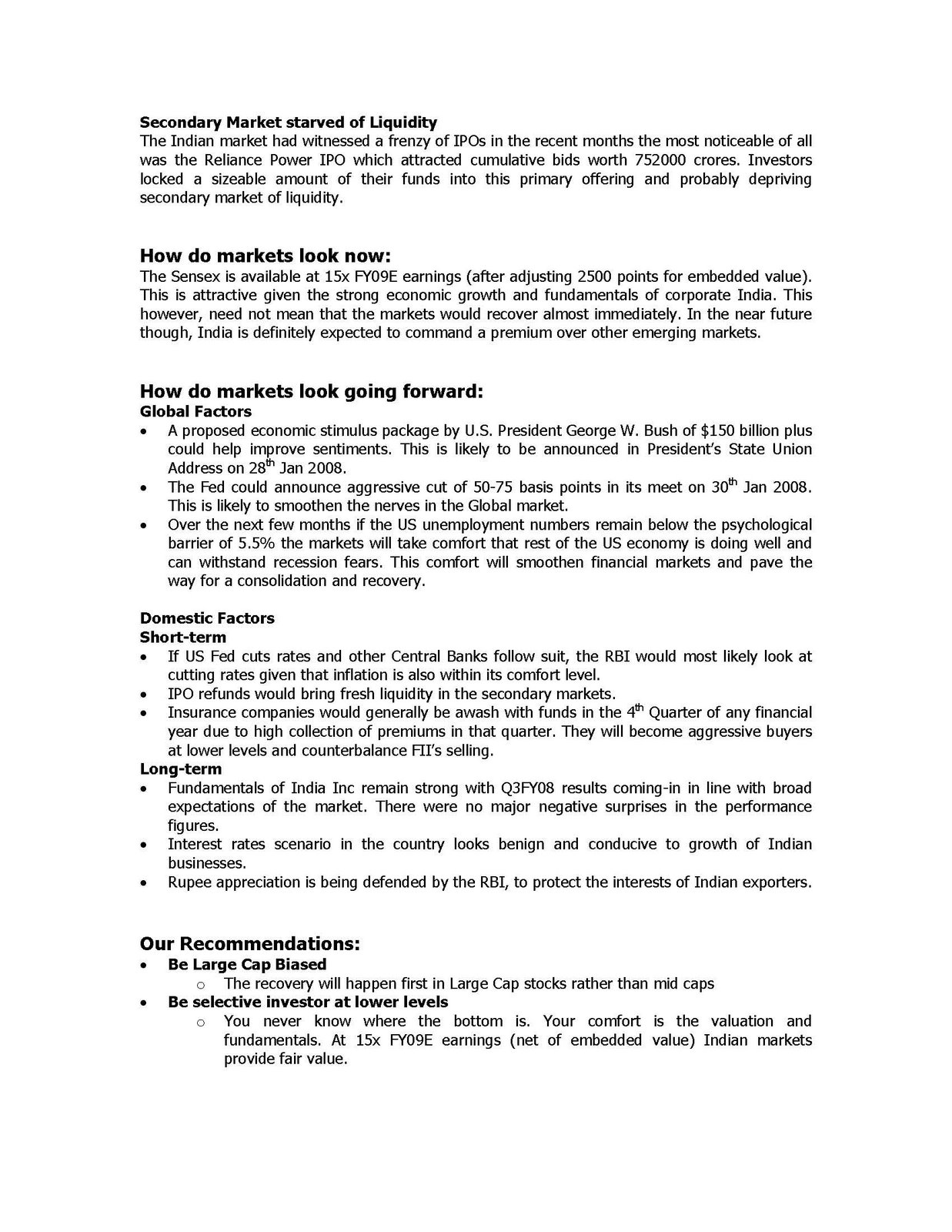
Attached please find a very good report from Prudential AMC which has not
only taken into consideration the domestic factors but also the
international factors that have resulted in the drastic fall in Indian as
well as all global markets.
It is a mail, which each and every investor should read.
One get only one or two such occasions in a year to make entry into the
equity market. This is one golden opportunity. Don’t miss it. The following
Indian as well as Offshore funds are strongly recommended. Please avoid
funds that have exposure to Pharma, IT and FMCG. Concentrate on funds that
are more domestically oriented like Infrastructure Funds, Capex
Opportunities Fund, UTI Infrastructure Fund, ING Domestic Opportunity Fund,
power sector fund and in the Midcap space Reliance Growth Fund.
It will be a great idea to get investors sign up for ING ZIP and choose ING
Domestic Opportunities Fund as it give an investor Daily Rupee Cost
averaging facility. Please don’t ignore this fund any more as responsible
Advisor.
On the offshore front our top recommendation is Prudential IOIF
Infrastructure Fund.
Stay away from SE Asian markets and European markets which may get badly hit
on account US economy slowdown. Our only recommendations beyond the
boundaries of India is Templeton BRIC Fund.
Apart from this recommend Birla Sunlife India Advantage Fund.
Finally, in view of the attractive valuation one of the biggest beneficiary
will be Reliance Natural Resources Fund NFO. The fund is having fresh funds
and it is getting deployed at very attractive valuations. I am sure this
will be on the top of the performance chart 1 year from now. Stocks which
the fund proposes to invest into have got battered and are available at
substantial discount.
With today’s fall the Indian Markets are trading at around 13.5 forward p/e;
which is something no investor can afford to ignore.
Anyone who is weak hearted make he/she may invest in ICICI Prudential FMP
(which is currently on) which can deliver a return of over 15% p.a. with
capital protection at the downside.
With warm regards,
Ramesh Krishnamurthy
Senior Vice President
Barjeel Geojit Securities LLC
Tel: +9714 3555900 Extn 202
Fax:+9714 3555903
Cell: +97150 6244740
Email: ramesh@barjeel.ae

Investors lose trillions; FM says don’t panic
Investors lose trillions;FM says don’t panic
January 22, 2008 11:32 IST
Last Updated: January 22, 2008 13:11 IST
Finance Minister P Chidambaram sought to calm investors panicked by a meltdown of over 2,000 points on Tuesday morning leading to suspension of trading, saying that enough liquidity would be provided to market players.
Investors lost over Rs 6 lakh crore (Rs 6 trillion) within minutes of the opening of the Bombay Stock Exchange on Tuesday.
“I am assured by the Reserve Bank of India [Get Quote] and all the banks that enough liquidity will be provided to brokers and market players. Liquidity will not be an issue,” Chidambaram said.
Ahead to his visit to Davos for participating in the World Economic Forum, Chidambaram exuded confidence that investors would return to market as fundamentals of the economy were strong.
“Worries of western world should not be allowed to overwhelm us… our economy is very different from some economies of developed countries. Our economy is a strong economy and corporate sector is very strong,” he said after the exchange authorities suspended trading within minutes after the bourses witnessed a sharp plunge.
Even after the market opened at 1100 hours, the sentiments were heavily toward sell and within an hour the BSE Sensex was reading down by over 2200 points.
To a query, Chidambaram said there is no ground for sentiments to be negative in the long run as fundamentals of Indian economy are strong.
“We will grow at nine per cent this year. Even Rangarajan Committee (Prime Minister’s Economic Advisory Council) has said we will grow at 8.5 per cent next year,” the finance minister said.
Banks have reported that investments in the economy are running very high as the demand for credit is strong, he said.
“RBI has stated that investment in pipeline is also strong. Fundamentals (of the economy) are very sound. Corporate profits are high and corporate income tax is at an all-time high,” he said.
When asked whether institutions would be advised to buy stocks at this moment, Chidambaram said: “We are not advising institutions to do this or that. Institutions are good judge of what are valuations today.”
However, he said analysts and advisers have advised investors to stay calm. “I am sure investors will take informed and matured decisions and not give any room to unwarranted apprehensions and market rumours,” he added.
In the morning, stock market suspended trading for an hour after the benchmark Sensex hit the lower circuit limit.
Investors lose Rs 6 trillion within minutes of opening
Investors on Tuesday lost over Rs 6 lakh crore (Rs 6 trillion) within minutes of opening of the Bombay Stock Exchange, which was immediately suspended for an hour after the 30-share barometer index, Sensex, hit the circuit limit of 10 per cent.
This loss of Rs 6,54,887.85 crore (Rs 6.548 trillion) comes on top of over Rs 11 trillion loss suffered by investors on the Dalal Street [Get Quote] [Get Quote] in the last six days.
“Small investors should stay away from the markets as of now. Let the market normalise and the volatility reduce,” domestic brokerage firm SMC Global Vice President Rajesh Jain told PTI.
“Better to out when in doubt” he said, adding that there is too much of panic in the markets and it is better to stay away from it.
The Sensex lost 5,251.15 points in last seven trading sessions including today’s early morning trade till suspension, while investors’ wealth — measured in terms of cumulative market capitalisation of all the listed companies — has declined by a whopping Rs 18,40,173.31 crore (Rs 18.401 trillion).
As per information available on the Bombay Stock Exchange Web site, the total market capitalisation stood at Rs 59,53,525.87 crore (Rs 59.535 trillion) at the end of on Monday’s trading against Rs 71,38,810 crore (Rs 71.388 trillion) before bourses began business last week on January 14.
The 30-share barometer tumbled 2,029.05 points to 15,576.30 within minutes of start of trading. The barometer index on Monday lost 1,408 to 17,605.35 points on concerns regarding the US economy going into recession.
The 10 biggest falls in Sensex history
The 10 biggest falls in Sensex history
rediff Business Bureau
January 21, 2008
It is a Terrible Tuesday for the bourses. The Sensex saw its biggest intra-day fall today. The Sensex fell further to a low of 15,332, down 2,273 points from the previous close. The Nifty has fallen further to 4,470, down 738 points.
Trading was suspended for one hour at the Bombay Stock Exchange after the benchmark Sensex crashed to a low of 15,576.30 within minutes of opening, crossing the circuit limit of 10 per cent.
At the time of suspension, the Sensex was quoted at 15,576.30 points, plunging 2029 points (11.53 per cent) from Monday’s close.
Investors on Tuesday lost over Rs 6 lakh crore (Rs 6 trillion) within minutes of opening of the Bombay Stock Exchange, which was immediately suspended for an hour after the 30-share barometer index, Sensex, hit the circuit limit of 10 per cent.
This loss of Rs 6,54,887.85 crore (Rs 6.548 trillion) comes on top of over Rs 11 trillion loss suffered by investors on the Dalal Street [Get Quote] in the last six days.
The Sensex and Nifty saw its second biggest loss on Monday. Relentless selling saw the index crash to a low of 16,951 – down 2,063 points (10.8%) from the previous close, the largest ever loss in a single day.
The index shed 1408.35 points (7.1%) to close at 17,605.40, the biggest-ever loss in absolute terms and also the first-ever four digit loss for the index at close.
The Nifty lost 496.50 points (8.70%) to close at 5,208.80 points.
The Sensex saw its third biggest intra-day loss on October 17, 2007, when it plunged by 1,743 points. The Sensex hit a low of 17,307.90 points within minutes of opening, following which trading was suspended in the market for an hour.
The markets had crashed on the wake of Securities and Exchange Board of India’s (Sebi) proposal to tighten the rules for purchase of shares and bonds in Indian companies through the participatory note (PN) route.
Here are the 10 biggest falls in the Indian stock market history:
Jan 21, 2008: The Sensex saw its highest ever loss of 1,408 points at the end of the session on Monday. The Sensex recovered to close at 17,605.40 after it tumbled to the day’s low of 16,963.96, on high volatility as investors panicked following weak global cues amid fears of the US recession.
May 18, 2006: The Sensex registered a fall of 826 points (6.76 per cent) to close at 11,391, following heavy selling by FIIs, retail investors and a weakness in global markets. The Nifty crashed by 496.50 points (8.70%) points to close at 5,208.80 points.
December 17, 2007: A heavy bout of selling in the late noon deals saw the index plunge to a low of 19,177 – down 856 points from the day’s open. The Sensex finally ended with a huge loss of 769 points (3.8%) at 19,261. The NSE Nifty ended at 5,777, down 271 points.
October 18, 2007: Profit-taking in noon trades saw the index pare gains and slip into negative zone. The intensity of selling increased towards the closing bell, and the index tumbled all the way to a low of 17,771 – down 1,428 points from the day’s high. The Sensex finally ended with a hefty loss of 717 points (3.8%) at 17,998. The Nifty lost 208 points to close at 5,351.
January 18, 2008: Unabated selling in the last one hour of trade saw the index tumble to a low of 18,930 – down 786 points from the day’s high. The Sensex finally ended with a hefty loss of 687 points (3.5%) at 19,014. The index thus shed 8.7% (1,813 points) during the week. The NSE Nifty plunged 3.5% (208 points) to 5,705.
November 21, 2007: Mirroring weakness in other Asian markets, the Sensex saw relentless selling. The index tumbled to a low of 18,515 – down 766 points from the previous close. The Sensex finally ended with a loss of 678 points at 18,603. The Nifty lost 220 points to close at 5,561.
August 16, 2007: The Sensex, after languishing over 500 points lower for most of the trading sesion, slipped again towards the close to a low of 14,345. The index finally ended with a hefty loss of 643 points at 14,358.
April 02, 2007: The Sensex opened with a huge negative gap of 260 points at 12,812 following the Reserve Bank of India [Get Quote] decision to hike the cash reserve ratio and repo rate. Unabated selling, mainly in auto and banking stocks, saw the index drift to lower levels as the day progressed. The index tumbled to a low of 12,426 before finally settling with a hefty loss of 617 points (4.7%) at 12,455.
August 01, 2007: The Sensex opened with a negative gap of 207 points at 15,344 amid weak trends in the global market and slipped deeper into the red. Unabated selling across-the-board saw the index tumble to a low of 14,911. The Sensex finally ended with a hefty loss of 615 points at 14,936. The NSE Nifty ended at 4,346, down 183 points. This is the third biggest loss in absolute terms for the index.
April 28, 1992: The Sensex registered a fall of 570 points (12.77 per cent) to close at 3,870, following the coming to light of the Harshad Mehta securities scam.
The dos and don’ts of buying stocks
The dos and don’ts of buying stocks
Rajesh Kumar, Outlook Money January 19, 2007
So you’ve made up your mind to invest in the stock market. Having overcome initial inhibitions, you’re now looking to become a millionaire overnight. After all, if your friend A or your cousin B could do it, why not you?
For investment-innocents, here’s a shocker: It is not where you invest your money, but how you invest it that decides the profits. That is to say, stocks are only as good as the investor; they respond to the individual’s abilities and acumen. In that sense, stocks are quite distinct from consumer durables. You can reasonably expect a washing machine to perform as well for you as for your neighbour, but that is not the case for stocks, which are a different breed altogether.
So, instead of investment tips, here are some attitude tips.
Don’t commit large amounts of money or short-term money. Even if you can afford to take risks, we suggest you don’t commit large sums of money – at least not in the initial stages. It would be wiser to start with small amounts and increase your investments as your confidence and grasp of the markets grows. It is not easy to pick up the right stocks or keep track of them when you are starting out.
Also, don’t break FDs to invest in rising markets. Always invest the surplus, money for which you have no immediate plans. Equity, as an investment, carries in-built risk and volatility and investing short-term money may force you to quit at the wrong time.
Do be sceptical of self-proclaimed experts. As an investment ing�nue, stay away from self-proclaimed experts or overzealous advisers. The so-called ‘hot tips’ they offer to investors are largely short-term trading tips, which are very risky for a retail investor. Because the reaction time is limited, chances are you will end up losing wealth.
Similarly, TV gurus and the like are forever ready with “buy” recommendations; few, if any, come out with “sell” advisories for your advantage.
Further, expert recommendations often have vested interests. Recently, market regulator Securities and Exchange Board of India fined an expert for acting exactly contrary to his own recommendations. To curtail such rogue elements, the market regulator is planning a law to govern experts, who comment on the markets in the mass media.
Don’t trade for short-term. Short-term trading or day trading is very risky and not recommended for retail and small investors for two reasons. First, it requires lot of time, which small investors can rarely spare since it is not their primary business. Second, retail investors may not have the necessary skills and tools required for short-term and day trading. Do not try to time the markets: it’s one of the most difficult things to do.
Invest long-term in fundamentally strong companies. Our advice to retail investors is to invest long-term in fundamentally strong companies. Give your portfolio adequate time to grow. Do not panic in technical corrections. If you are invested in fundamentally strong companies, you are safe. We saw two sharp corrections in 2006, first in May-June and again in December. On both occasions, the market bounced back and crossed previous highs because the fundamentals were intact.
Don’t ignore stock fundamentals. There is no set formula for fundamental analysis. You have to study various indicators like sectoral growth, company growth – both top and bottomlines – and various ratios like price to earning ratio, price earning to growth, dividend yield, book value, price to book value, price to sales ratio, debt-equity ratio, return on capital employed, to name just a few.
If number-crunching is not your cup of tea, you must still investigate the nature, business and size of the company and its growth in the last three years – sales, profit and earning per share – all of which are accessible on the websites of stock exchanges.
Do not be tempted to buy small caps and penny stocks. The risk involved in small companies is huge, but higher risk may not necessarily lead to higher gain. That is not to say that you should ignore small companies completely, but at the same time you must have solid reasons for buying into them. And when you do, make sure they are only a small portion of your portfolio.
Do be critical of media reports. It’s tempting, when you are just about beginning to follow the jargon, to buy into glowing media reports about corporates. But they could be misleading. For instance, you may read of a company setting up a new plant. Such announcements usually push up prices in anticipation of earning growth.
Before you join the queue for their stocks, you need to understand the cost benefit of the new plant. Ask yourself a few questions: where is the money coming from�equity or debt? If it’s equity, how will it impact the EPS in the near future? If the source is debt, is the company in a position to leverage the increased debt? What will be the gestation period? When will the earnings really start coming in? What will be the return on capital employed?
Don’t follow other investors blindly. People often talk about their success in the stockmarket, rarely of their failures. Your friend may have made money in the past, but there’s no guarantee he will continue to do so in future.
If, however, he offers to share his stocks research with you, welcome the opportunity. It will help you build your own research, but remember it is not a substitute for your own investigation.
Do stay away from a large number of stocks. Investors generally hold a large number of stocks in the name of diversification. But this may not always be the case.
Harry Markowitz, known as the Father of the Modern Portfolio, warned investors: “Holding securities that tend to move in concert with each other does not lower risk.” A truly diversified portfolio, he said, comprises non-correlated asset classes that could provide the highest returns with the least amount of volatility.
If you are still looking to diversify within equity, do not go in for stocks of more companies than you can track regularly. Seven to 10 would be ideal, though, of course, this is a highly individual call. The biggest disadvantage of holding a large number of stocks is failing to quit at the right time.
Capitalise on this crash: Sectors to eye right now
Capitalise on this crash: Sectors to eye right now
2008-01-21 13:16:01 Source : CNBC-TV18
India is the worst performing market today and Japan’s Nikkei declined 3.865% or 535.35 points, Hong Kong’s Hang Seng tumbled 4.425% or 1115.12 points Singapore’s Straits Times slipped 3.23 and South Korea’s Seoul Composite fell 2.95%.
It is proving to be an extremely scary session for the markets as fall has continued further. There is panic selling in markets and nearing to hit a down circuit which comes in at 10% down. Now the Sensex and Nifty are down nearly 7%. Margin call is seen building up.
It has broken all technical and psychological levels. Both Sensex and Nifty has fallen 16% from their highs. Breadth has worsened and the advance decline ratio is over 1:50. According to analyst the scenario is similar to the May 2006 fall. There is pressure due to triggering of margin call. Nifty Futures is trading at 100 points discount.
Shashank Khade, VP – Portfolio Management Services, Kotak Securities feels that the value that is right now emerging is clearly in technology, in auto and in FMCG. Valuations are really cheap right now in these three sectors, he feels.
He said, “My sense is that the markets may tend to go ahead and rotate the sectors itself. The underperformance that you had seen in the last six to eight months may actually start looking good, because not only did they not participate on the way up, they have also participated on the way down, which clearly means that the valuations of these stocks have got much more interesting. Sectors, in this sort of space would include FMCG, auto, technology, which may actually become extremely cheap in terms of valuations. So, while the infrastructure stocks may continue their consolidation and correction, it could be that monies may actually get rotated into the other stocks, which haven’t participated at all.”
He adds that, “The value that is right now emerging is clearly in technology, in auto and in FMCG. It is a call as to how much of the negatives in these sectors per se have been factored into these prices. That is the biggest call here. In FMCG and auto, the growth has not been as strong and that is the reason why these stocks have been really down and under. But valuations are really cheap right now in these three sectors.”
Vibhav Kapoor of IL&FS said, “We like banking a lot. There is definitely value in banking, capital goods; infrastructure has been beaten down. But there is good value in some of those sectors. In fact we are basically avoiding cement, technology sector and global commodities, which are metals. Apart from these three sectors, we think there is a lot of value in many other sectors.
Jaywalkers to be fined in Abu Dhabi
Jaywalkers to be fined in Abu Dhabi
By Rayeesa Absal, Staff Reporter GULF NEWS Published: January 18, 2008, 23:12
Abu Dhabi: People caught jaywalking will soon be fined Dh50 after Abu Dhabi recorded 91 pedestrian deaths last year, mostly involving people running across busy streets, police said.
Police will start a campaign against jaywalking in the capital on Monday to try to stop deaths on the roads. Last year, 647 pedestrians were involved in traffic accidents, said the police.
“Fatalities have increased by 20 per cent,” said Colonel Adel Hamad Al Shamsi, Director of the Traffic Department. He urged people to cross streets only at zebra crossings. “Lack of attention while driving is also a major cause of accidents,” he said.
The safety campaign’s motto is, “Pedestrian safety is everyone’s responsibility.”
According to statistics, 584 accidents involving pedestrians occurred last year. Besides the 91 pedestrians who died, 91 others were seriously injured.
The figures show that 140 pedestrians involved in accidents were younger than 18. Eight teenagers died and 36 others were seriously injured.
There have been a number of deaths due to jaywalking in Dubai and the Roads and Transport Authority (RTA) is planning to spend more than Dh70 million to construct pedestrian crossings.
In Dubai alone, 56 pedestrian deaths were recorded in the first six months of 2007.
An RTA executive said that 17 pedestrian crossings will be constructed. The main reason pedestrians were killed is because they crossed dangerous roads, he said.
Fence
A number of deaths have been recorded on Emirates Road near a labour accommodation.
Shaikh Zayed Road was also a major site of pedestrian deaths until the RTA constructed a fence along it. But there are no pedestrian bridges except one near Emirates Towers.
The other dangerous spot where a number of pedestrian deaths have occurred is in front of Ansar Mall at the entrance to Sharjah.
Residents have been complaining of a lack of a pedestrian bridges being constructed.
Apple unveils super-thin laptop




Apple unveils super-thin laptop
REUTERS[ WEDNESDAY, JANUARY 16, 2008 10:20:34 AM]
SAN FRANCISCO: Apple at the annual Macworld convention in San Francisco launched an aluminum-clad laptop, just three-quarters of an inch thick, seeking to bring a new computer to market with the same cachet as its iPod and iPhone devices.
Apple also said it would let people rent films over the Web with upgrades to its iTunes online media store, a technological challenge to a movie industry still largely focused on DVDs.
Shares of movie rental firms Netflix and Blockbuster fell sharply in response, and Apple’s own stock lost 5.5 per cent since the announcements were widely expected and Chief Executive Steve Jobs failed to conjure up any big surprises.
Jobs set a high bar last year by unveiling the iPhone. In addition, many times he ends presentations with by saying, “One more thing…” as a prelude to something unexpected. This year there was none.
Still, Jobs’ talents as a showman were on display when he took the stage at the event to cheers and applause from a few thousand software developers, customers and Apple employees.
He detailed a series of new products and services but saved the laptop, dubbed the MacBook Air, for last, drawing it out of a standard manila envelope to emphasise its slim dimensions.
Jobs said the new notebook was the thinnest available, measuring 0.76 inches at its thickest point and tapering to just 0.16 inches.
Priced from $1,800, the Air bridges the gap between Apple’s entry-level and high-end laptops, but analysts voiced concern that it could steal customers away from pricier products.
“It’s not really clear how many more incremental buyers you can drive, and there could be some cannibalisation,” said Shaw Wu, an analyst with American Technology Research.
MacBook laptops have been one of the company’s strongest products, with sales rising 37 per cent on the year in the fiscal fourth quarter ended last September.
New Apple users sought
Phil Schiller, Apple’s vice president of marketing, said the new laptop could appeal to a large swath of customers, including business travelers, those in education and people who wanted a more attractive computer at home.
“The goal overall is to continue to grow the business, so having another product in the line helps to do that. If the mix (of customers) changes a little bit, it doesn’t matter as long as we grow everything,” Schiller said.
Apple stock has nearly doubled since last year’s Macworld, and in late December topped $200 for the first time, driven by market-share gains by Mac computers, continued iPod strength, and enthusiasm over the iPhone, which Jobs said had sold more than four million units since its release last June.
Jobs showed off new iPhone features such as displaying a user’s location on a map and a way to customise the main screen with icons linking directly to specific parts of a website.
“The iPhone is not standing still. We keep making it better and better and better,” Jobs said.
But the company has struggled to find a big audience for Apple TV, a product originally designed as a Mac accessory for watching Internet video on a television and unveiled alongside the iPhone a year ago.
“It’s not what people wanted. We learned what people wanted was … movies, movies, movies,” Jobs said.
A new version of Apple TV will be able to connect to the Internet directly and download TV shows, movies and music through iTunes. Viewers will be able to choose movies directly from their TVs and Apple said viewers could start watching within seconds if they had a fast Internet connection.
Jobs announced deals with all six major movie studios and several smaller ones to offer movies for rental through iTunes, with new releases costing $3.99 and library titles $2.99. High-definition movies will also be available.
The revamp of Apple TV hardware combined with a broad selection of movies would give Apple an edge over competitors such as Amazon.com Inc, Netflix and Microsoft Corp, American Technology Research’s Wu said.
News Corp’s 20th Century Fox, Walt Disney Co, Time Warner Inc’s Warner Bros, Viacom Inc’s Paramount, General Electric Co’s Universal, Sony Corp’s Sony Pictures, Lionsgate, MGM and New Line have all signed on to Web rentals, Apple said.
“It’s too early to declare that this is going to be a big hit but this is arguably the best offering out there right now,” Wu said.
Apple shares fell to $169.04, while mail rental firm Netflix Inc shed 3.2 per cent, and top video rental chain Blockbuster Inc dropped nearly 17 per cent.
 ClicksandWrites
You must be logged in to post a comment.