Screen kidney, be safe
Screen kidney, be safe
13 Mar 2008, 1015 hrs IST,Risha Chitlangia,TNN
NEW DELHI: On World Kidney Day on Thursday, nephrologists want to raise awareness about Chronic Kidney Disease (CKD), incidents of which are increasing at an alarming rate.
If you have diabetes or high blood pressure, then you are at a risk of developing CKD. Unfortunately, by the time a person is diagnosed with CKD, nearly 50% of his kidneys are damaged. This happens because the blood creatinine levels, which are the indicators for kidney disease, don’t rise till 50% of the kidney functioning is affected.
During routine check-up, most doctors don’t study the creatinine levels of the patient if it is in the normal range. “But normal creatinine level doesn’t mean that the patient’s kidneys, especially those who have diabetes or high BP, are functioning properly. There is a need to study the creatinine levels seriously with respect to the patient’s weight, age, sex and history of diseases,” said Dr Vijay Kher, director, nephrology and kidney transplant unit, Fortis Healthcare.
Routine check-up doesn’t involve creatinine level assessment. “It is only in cases which have history of high BP or diabetes or any other ailment or they present with CKD symptoms, then we screen for CKD,” said Dr Mukesh Mehra, HoD, internal medicines, Max Healthcare.
Creatinine is freely filtered by the glomerular capillaries, inside the nephrons, and a small amount is also secreted in our body. But when these nephrons get damaged either due to high BP or diabetes, then the Glomerular Filtration Rate (GFR) also decreases. As a result of this, the creatinine level increases in a patient’s body.
“Unfortunately, the creatinine levels increase only after the GFR is affected nearly 50%. This means when the kidneys are nearly 50% damaged, it is then a patient is diagnosed with CKD. But by then it is too late,” said Dr Sanjeev Bagai, director and paediatric nephrologist, Rockland Hospital.
The prevalence of CKD is “one in 10 people in different stages of the disease. This varies from mild to severe form called, the End Stage Kidney Disease (ESKD),” said Dr S K Agarwal, additional professor, department of nephrology, AIIMS.
He added, “The reason for this in most cases is lifestyle related. High BP and diabetes are very common today. Most of the CKD patients have either of the two, especially in the urban population.
“If CKD is diagnosed in the early stages, it can be managed well and need for dialysis and a transplant in a patient can be delayed. A creatinine clearance test along with patient’s medical history can help a physician diagnose whether he/she is a case of CKD or not,” said Dr Kher.
CKD can happen in children too and can affect newborns as well. “A woman’s nutrition during pregnancy can affect the baby. It has been seen that newborns with low birth weight stand a chance of developing kidney diseases and also high BP when they grow up,” said Dr Agarwal. The common symptoms of CKD are: high HP, diabetes, low haamoglobin, difficulty in passing urine or blood in urine and swelling in body parts.
“If anybody has all these symptoms, then a routine ultrasound of the kidneys is a must. With this we can pick up kidney problems in the early stages,” said Dr Bagai.
Though there are no screening programme for CKD by the government, doctors say a screening test would not cost more than Rs 100 when compared with the cost of treatment of renal failure cases. So next time you go for a routine check-up, do ask the doctor for a CKD screening test, especially those who have above-mentioned symptoms and are BP or diabetes patients.
Morning sex can keep you healthy
Morning sex can keep you healthy
13 Mar 2008, 0046 hrs IST,ANI
LONDON: A steamy sex session in the morning can keep you in good health, say British researchers.
According to a research from Queen’s University in Belfast, a good morning session at least three times a week, decreases the risk of heart attack or stroke by half and a regular session improves circulation, thereby reducing blood pressure.
According to a study in New Scientist, a steamy session twice a week enhances IgA, an antibody that provides protection against microbes that multiply in body secretions, reports the ‘Sun’. Morning sex also helps in alleviating arthritis and migraine. It burns around 300 calories an hour that simultaneously diminishes the risk of developing diabetes.
Moreover, an American study involving 300 sexually active women whose partners did not use condoms revealed that they were less prone to depression.
Sex increases the production of testosterone that provides stronger bones and muscles thus helping to stave off osteoporosis.
A good morning session can make the hair shine and skin glow by raising the output of oestrogen and other hormones which are associated with it.
According to Yale School of Medicine researchers, having morning sex can aid in averting endometriosis, a condition where the tissue that normally lines the uterus, grows in other parts of the pelvis.
Prices of Selected Commodities – a selected review since 2006
As at 13 March 2008

As at 22 October 2007

As at 27 December 2006

As at 27 September 2006

Ant world is rife with royal corruption
Ant world is rife with royal corruption
12 Mar 2008, 1325 hrs IST,ANI
WASHINGTON: They may be held-up as the ideals of social co-operation but ants can be as sneaky as humans and their colonies are rife with cheating and corruption–with the royal line being the worst offenders, say scientists from the Universities of Leeds and Copenhagen.
Ants have always been thought to work together for the benefit of the colony rather than for individual gain, but Dr Bill Hughes from Leeds’ Faculty of Biological Sciences has found evidence to shatter this illusion.
With Professor Jacobus Boomsma from the University of Copenhagen, Hughes discovered that certain ants are able to cheat the system, ensuring their offspring become reproductive queens rather than sterile workers.
“The accepted theory was that queens were produced solely by nurture: certain larvae were fed certain foods to prompt their development into queens and all larvae could have that opportunity,” said Hughes.
“But we carried out DNA fingerprinting on five colonies of leaf-cutting ants and discovered that the offspring of some fathers are more likely to become queens than others. These ants have a ‘royal’ gene or genes, giving them an unfair advantage and enabling them to cheat many of their altruistic sisters out of their chance to become a queen themselves,” he added.
But what intrigued the scientists was that these ‘royal’ genetic lines were always rare in each colony.
Hughes said: “The most likely explanation has to be that the ants are deliberately taking steps to avoid detection. If there were too many of one genetic line developing into queens in a single colony, the other ants would notice and might take action against them. So we think the males with these royal genes have evolved to somehow spread their offspring around more colonies and so escape detection. The rarity of the royal lines is actually an evolutionary strategy by the cheats to escape suppression by the altruistic masses that they exploit.”
However, the scientists’ discovery does prove that, although social insect colonies are often cited as proof that societies can be based on egalitarianism and cooperation, they are not quite as utopian as they appear.
“When studying social insects like ants and bees, it’s often the cooperative aspect of their society that first stands out,” said Hughes.
“However, when you look more deeply, you can see there is conflict and cheating – and obviously human society is also a prime example of this. It was thought that ants were an exception, but our genetic analysis has shown that their society is also rife with corruption – and royal corruption at that!” added Hughes.
The study is published in the Proceedings of the National Academy of Sciences of the USA
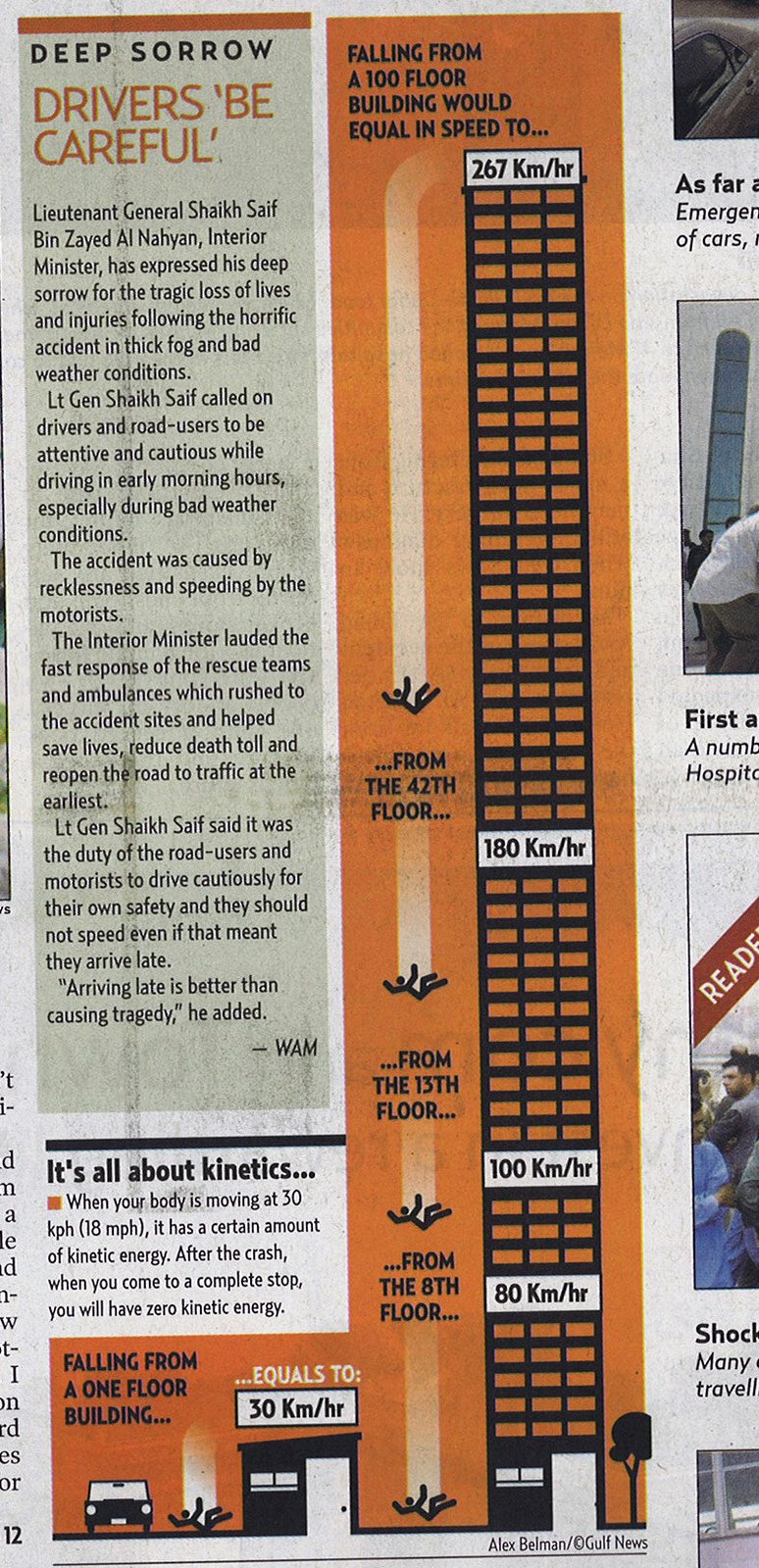
Speed indeed does kill!
Speed indeed does kill!
12 March 2008 (Editorial, Khaleej Times)
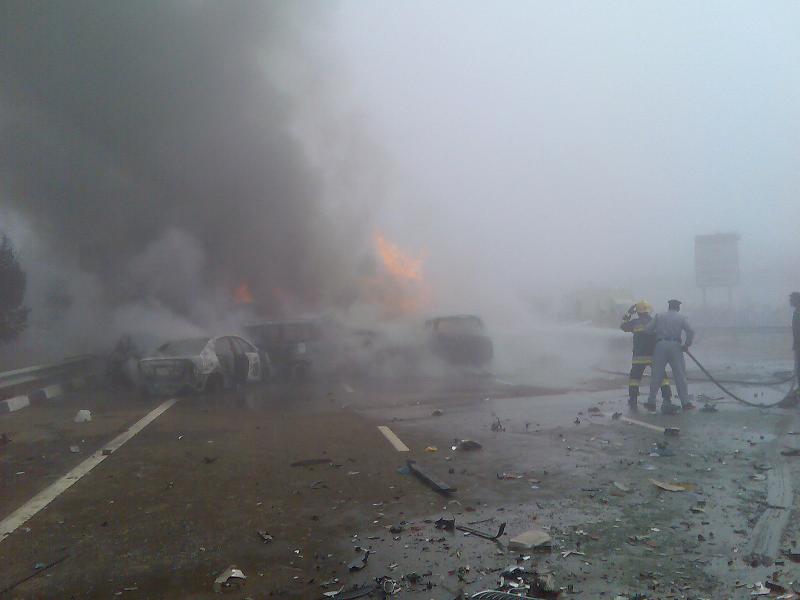
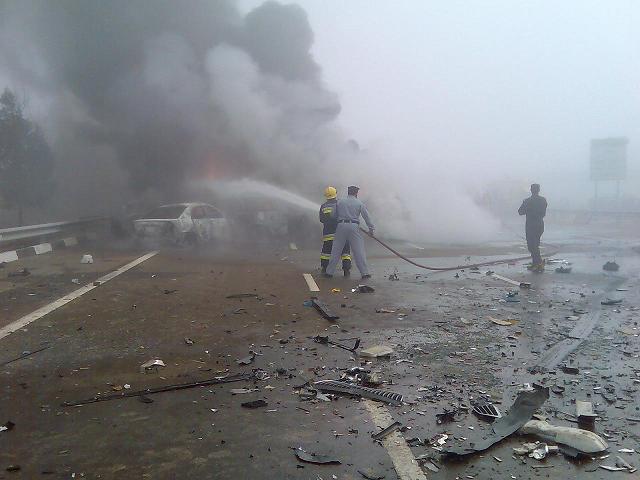
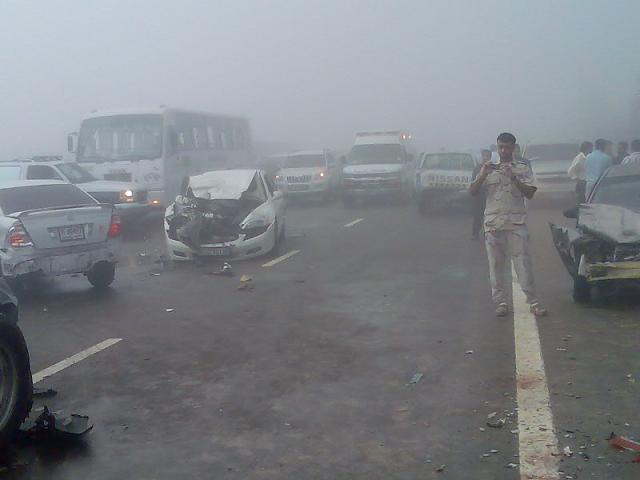
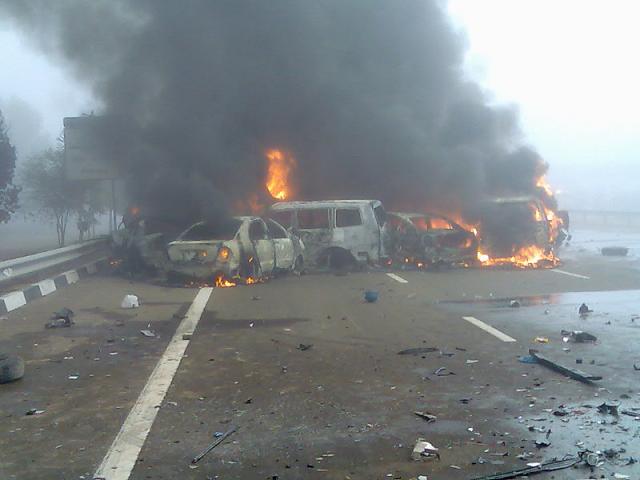
TUESDAY morning’s road tragedy was without doubt the worst ever witnessed in the United Arab Emirates, and with few parallels elsewhere in similar conditions. It appears early morning fog and a little faster driving than circumstances would have allowed made for the deadly mix that caused an unbelievable accident involving around 200 cars, leaving approximately a dozen dead and many, many injured.
Expectedly, the authorities were quick to attend to the injured, in some serious cases making the difference between life and death. Such was the magnitude of the accident that even those that were left physically unhurt could not escape the psychological trauma such scenes invariably carry.
The government has acted wisely in directing the ministry of the interior to mobilise all available resources to meet the emergency. Once the immediate needs of the injured are met, that would also entail investigating very seriously all possible reasons for the mishap.
While the investigation progresses, the authorities cannot really be faulted for failure to take adequate steps. Only at the start of the month the government exhibited its seriousness regarding road safety by introducing stricter rules to offset disturbing accident statistics.
Ultimately, the inquiries are likely to find that the prime responsibility rests with the people behind the wheel. It is unfortunate that some drivers in this part of the world at least have yet to betray appreciation for risks speeding is likely to carry. It is difficult to understand why traffic violations rise in numbers that sometime seem unbelievable for a place that hosts perhaps the most diverse mix of people anywhere in the world.
It seems most people just don’t realise that disobeying traffic rules puts not only their own lives in jeopardy, but also those of others, a lesson some people are bent upon learning the hard way.
From eyewitness reports, it is clear that speeding in less than ideal visibility was the main reason for yesterday’s tragedy, one that was clearly avoidable simply by sticking to the most basic driving rules. Considering how busy the Abu Dhabi highway is, it ultimately is quite understandable that what started as a couple of cars colliding quickly built into a massive pile-up, one with few similar examples.
There is an important lesson in this for the few than can become cause of untold miseries for many. If the government is forced to make traffic rules even more strict, it is for the people’s own good. A good start can be made by initiating a comprehensive campaign to educate expatriates who can sometimes take longer than others to adapt to trying driving requirements of the UAE.
Road horror in Abu Dhabi; casualties feared



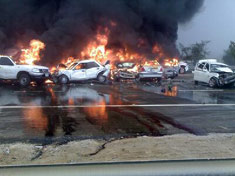
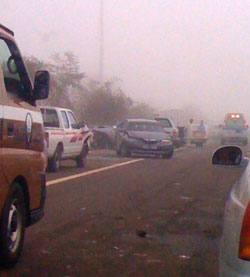
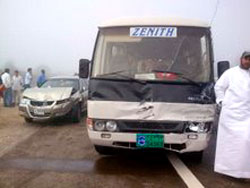


Road horror in Abu Dhabi; casualties feared
Staff Reporter KHALEEJ TIMES 11 March 2008
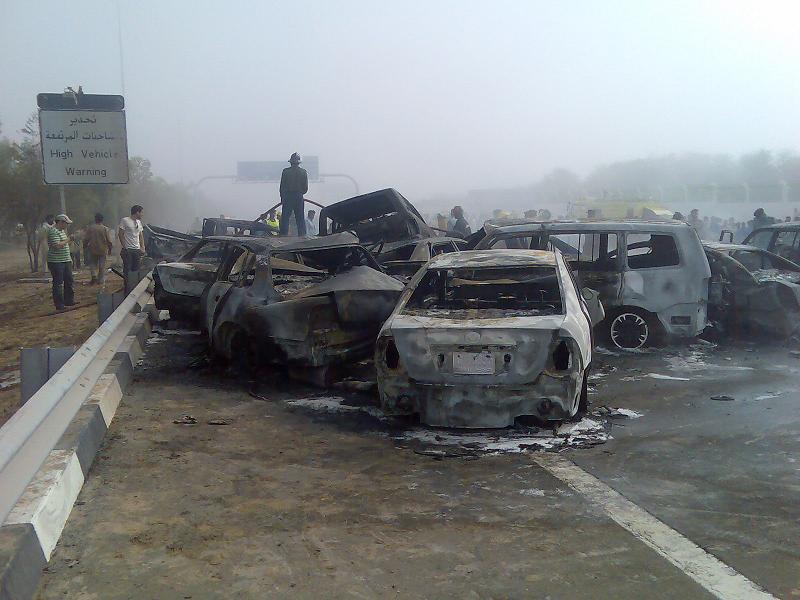
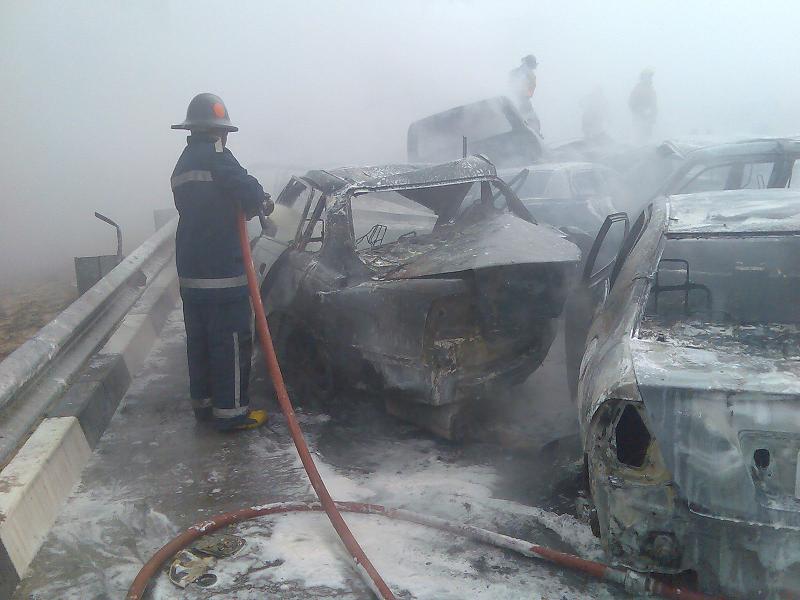
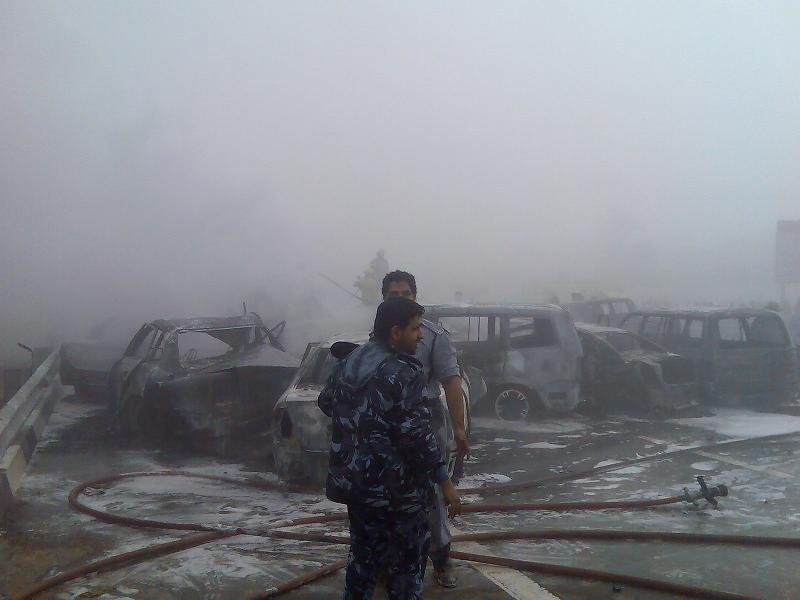
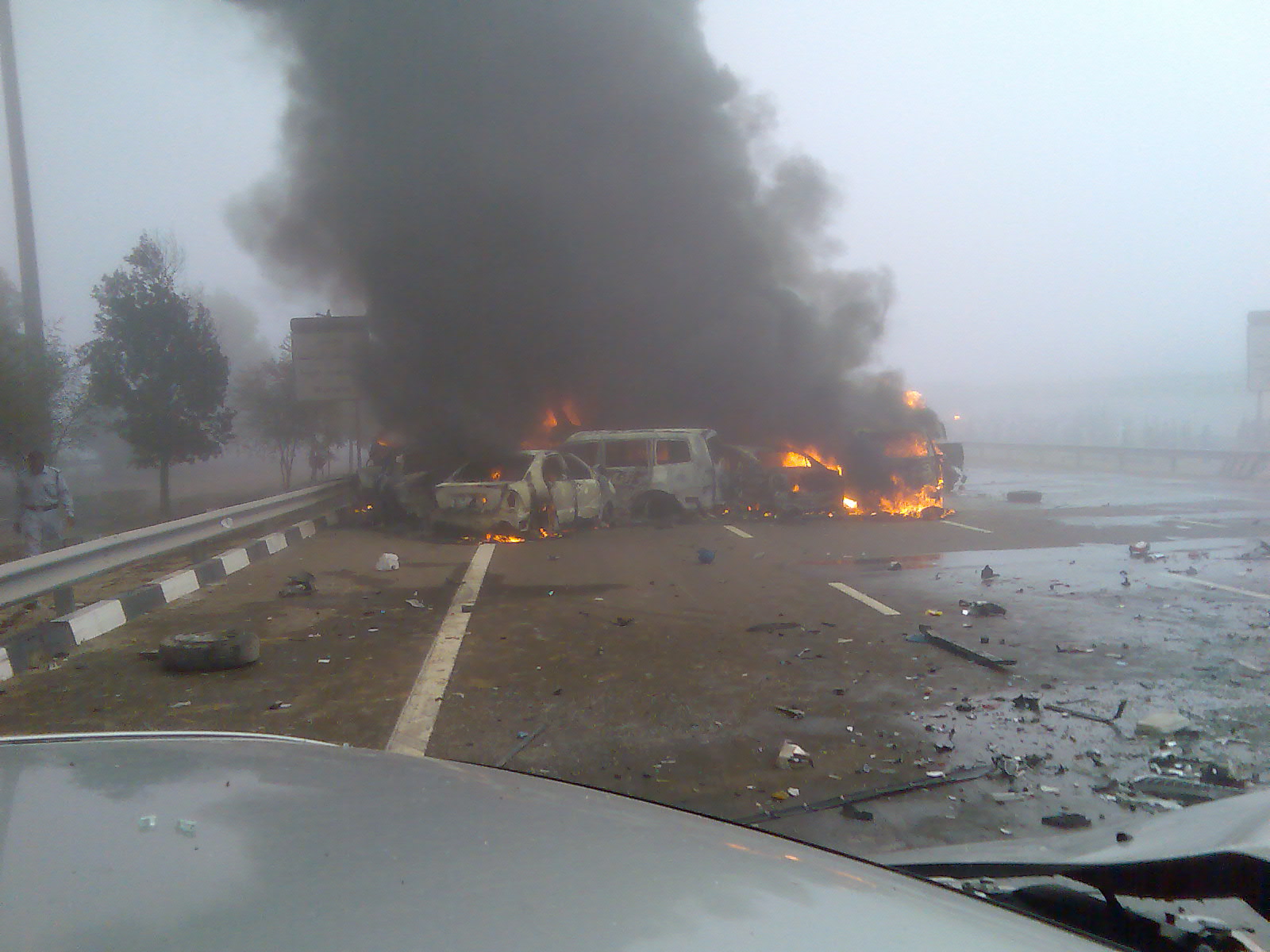
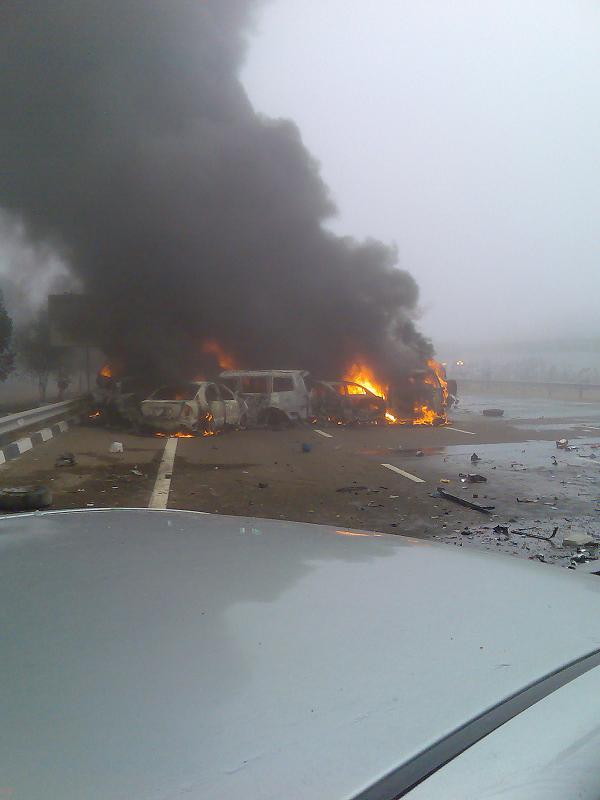
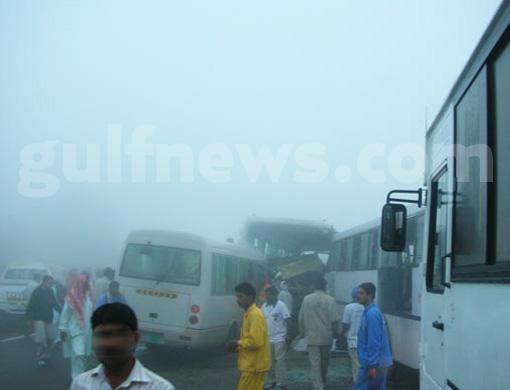
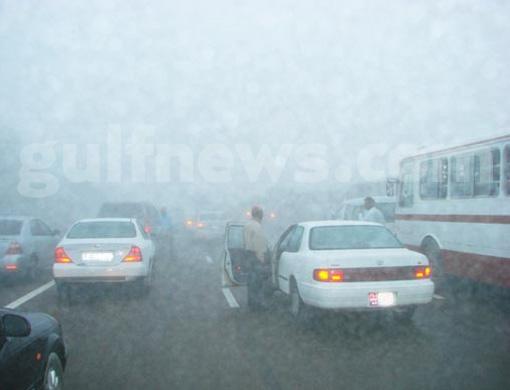
In what seems to be the worst accident to be ever recorded in the history of the United Arab Emirates, more than a 150 cars were involved in a massive pile-up on the Abu Dhabi-Dubai Road, that according to early estimates might have claimed more than ten people. About 40 were also reported injured.
The injured, some of them in critical condition have been rushed to the Khalifa Hospital. Rescue teams from Dubai and Abu Dhabi swung into action immediately as ambulances, helicopters and patrol cars were rushed to the scene.
Police sources have blamed poor visibility condition brought about by the fog for the crash.
Two eyewitnesses on the scene of the mishap recounted the tragedy as it unfolded before their eyes. Zeeshan Javed a regular commuter on the stretch says that he just escaped ‘by a whisker’ as the cars in front of smashed into each other. “It was a big pile up. I personally counted about eighty cars that had been wrecked beyond recognition. Even though emergency units were quick to respond the fact remains that there have been casualities. I have never seen an accident of this magnitude. Some cars that had caught fire were charred beyond recognition. This has to be the worst ever.”
Horrific accident on Abu Dhabi-Dubai highway near Ghantoot
Staff Report GULF NEWS Published: March 11, 2008, 10:35
Ghantoot: Many are feared dead after an horrific accident involving 31 cars blocked the Abu Dhabi to Dubai highway near Ghantoot.
Police have confirmed that there are fatalities and several injuries but have yet to say how many people were killed in the accident which happened on Tuesday morning.
Witnesses have said that three or four cars were on fire after the accident.
HSE Alert – Geyser – a home equipment to be handled with caution

HSE Alert – Geyser – a home equipment to be handled with caution
HSE Alert – Geyser – a home equipment to be handled with caution
A geyser provides a ready-to-use stock of hot water that can be set thermostatically to give a constant temperature, normally between 60-65°C, regardless of the outside temperature. Geysers are hard-working appliances – think of how much hot water you and your family use in a day. Geyser bursts can be dangerous and many times Geyser burst will be so powerful that all doors and windows along with door frames would be broken. It is also likely to cause cracks in the walls of the house.
The typical geyser installation is on the roof (preferably above the ceiling). In the event of a burst, water can pour down the ceilings, affecting light fittings, walls and furniture and furnishings in the room below.
In general, Geysers burst for a number of reasons – most often because of human error, that is, either due to:
– poor installation,
– the use of the incorrect valves,
– incorrect setting of thermostat
– wear and tear
– or the absence or plugging of safety and pressure-reducing valves
The burst usually happens because of an incorrect setting of the thermostat, which is an instrument used to control the heating temperature and the steaming pressure of the geyser. If the thermostat is badly regulated, it will incorrectly control the heating levels of hot water in the geyser, subsequently causing an explosion due to the amount of steam accumulated in the geyser.
Insurers all over the world has experienced many claims over the decades as a result of a burst geyser. Over the past few years, several people have been killed as a result of burst geysers and other accidents caused by poor plumbing installations.
In order to reduce these types of accidents due to lack of awareness, here are some handy tips to make sure your geyser won’t burst:
– Make sure you call a good plumber either to fix the old geyser, or to install a new one. The emphasis here is on the word ‘good’.
– It is always important to have a specialist to install your geyser to avoid a household disaster.
– Always take a proactive approach, if possible, by consulting a good plumber and instituting a preventative maintenance programme to protect the geyser and geyser valve. Timely anode replacement and a regular geyser-valve clean-up can save countless problems.
– If you use an unqualified plumber to install your geyser and it bursts, you are putting your life and the lives of others at risk.
– Have your geyser and pipes insulated, as well as the ceiling.
– Urgent action is needed if you hear a rumbling from the ceiling. This could be a signal that water in the geyser has begun to boil. Alternatively, steam may gush out when you open your hot-water taps.
– If these danger signals occur, switch off the geyser electrical isolator on the main distribution board.
– Now turn off the water at the main meter box. Most homes have a stopcock fitted to the inlet side of the geyser.
– If possible, look to see whether the geyser, the pressure-reducing valve or the pipes are leaking. This helps the plumber identify the problem.
– If a replacement geyser has to be fitted, it may also be advisable to fit a drip tray beneath the geyser. The tray’s outlet pipe will carry away a lot of the water in the event of a geyser burst at some stage in the future.
– If your geyser bursts, you should switch off the electricity mains immediately.
The reasons for this are twofold:
– Firstly, if the geyser element continues to heat up even if there is no water in the geyser, you could burn the house down. This is like switching on a huge, empty kettle.
– Secondly, water leaking from the geyser could get into electrical systems and cause a short circuit, and possible a fire.
– Find the water mains and switch it off. This will stop new water from running into the geyser and leaking all over your house. If you don’t know where your water mains are, make a point of finding it out today. You can phone the water department of the local municipality, but by the time they arrive, you might all be floating out the front door. So, do this check once you move in to a new apartment or house.
– If you are living in a flat, contact your neighbours, as water may be cascading into their flat. They don’t want to find that out when they step into three inches of water when they get up in the morning.
– If the area where the geyser burst is sopping wet, try and mop it all up with towels, mops or anything that is absorbent. You want to minimise damage to your floors and your furniture, or whatever else is close by.
– Buckets and plastic containers will also help to catch up some of the falling water.
– Although out of sight, the home’s plumbing system should never be out of mind, because when something goes wrong, the problem can take on nightmarish proportions. Consider the geyser, for example.
Can stocks rally back from 2008 low?
Can stocks rally back from 2008 low?
(USA Today)11 March 2008
NEW YORK – It’s test time on Wall Street
The question: Can the stock market right itself after falling below its January low — a level analysts say is a key level of support, or floor, that cannot be breached?
The outcome of the pass-or-fail test could provide a road map for where the struggling market is headed, says Richard Suttmeier, chief market strategist at RightSide.com. And that’s key, considering the Dow Jones industrial average, down 16% from its high, is flirting with a bear market, or a loss of 20%.
Last week, stocks continued their downward trajectory as the broad market declined nearly 3%. Another wave of bad economic news drove the selling. Headlines touting the biggest monthly job cuts in five years, more distress in the frozen credit markets and margin calls at a mortgage company and private-equity firm exacerbated fears of recession.
All three major U.S. stock indexes — the Dow, Nasdaq composite and Standard & Poor’s 500 — closed below their Jan. 22 lows, a level that, at the time, bargain-hunters viewed as a good buying point.
But the fact that stocks broke that 2008 low should serve as a “warning flag” to investors, Suttmeier says.
It is not uncommon during market downtrends for stocks to rally back from the dead only to relapse and head back down toward prior lows. This so-called retest of the lows is a way for traders who study stock charts to confirm whether stock prices have bottomed out for good or whether they need to fall more to attract buyers.
Despite the market’s recent descent to fresh lows, however, it is too early to tell whether it will ultimately pass or fail the test.
“We are still awaiting to confirm another leg down,” Suttmeier says.
Mark Arbeter, chief technical strategist at S&P Equity Research, also says it’s premature to say the market is headed decisively lower, even though the market is “sitting right at the edge” of more pain.
If the benchmark S&P 500 index, which closed Friday at 1293, continues to trend lower and dips, say, 1% below 1270, its intraday low hit in late January, and stays down there for two or three days, then the odds that the market is heading even lower would “increase dramatically,” Arbeter says. The S&P would have to decline nearly 2% from current levels to pierce the 1270 level.
The reason stocks tend to nose-dive after a key support level fails to hold is because all the buyers who came in at the prior lows are now “sitting on losses,” Arbeter says, and they sell to cut their losses.
Market bottoms don’t typically occur until panic surges and investors capitulate en masse. Only after everyone who wants to get out does can real buyers step in and push prices back up in a meaningful way.
“Panic? We haven’t seen it yet,” says Suttmeier, who is convinced that stocks are already in a bear market.
Special needs people must be made to feel they are part of community
Special needs people must be made to feel they are part of community
By Nada S. Mussallam (Our staff reporter)KHALEEJ TIMES 11 March 2008
ABU DHABI – The most important thing to rehabilitate people with special needs is to make them feel that they are part of the community, said Sir John Major, former British prime minister.
“It is very, very important that we should focus on making people with disabilities know that they are a part of the community and they are not different because they have a disability.
“They have the same instinct, the same souls like the rest of us and we should bring them into the society and not lock them out from the society,” said Sir John who is on a visit to the country to participate in a special needs conference.
The third Abu Dhabi International Conference for Special Needs will kick off today at the Armed Forces Club.
Speaking to Khaleej Times yesterday, he stressed: “People who have disabilities are exactly the same as the rest of us except that they have these disabilities. They are entitled to a good life as far as they could have one as anybody else.”
Sir John’s statement came shortly after ending a tour of Abu Dhabi Rehab Care Centre for Special Needs’s premises in the Mafraq region, which is an affiliate of Zayed Organisation for Humanitarian Care, Special Needs and Minor Affairs.
He praised the Centre by saying: “It is one of the most comprehensive centres I have ever seen and the facilities are of very high grade. It is wonderful to see such facilities brought together.
“This remarkable facility, I believe, would encourage disabled to become part of the community at large.”
What is wonderful about the Centre is that it has sports facilities, which are not available in most rehabilitation centres in the world, he said.
Sir John is well known for his contributions in the field of rehabilitation of people who are physically and mentally challenged in the UK.
About his opinion regarding the role of volunteers in rehabilitation of the disabled, he said: “In the UK the voluntary role is very important in supporting programmes dedicated to disabled. Volunteers can greatly help in this respect.”
 ClicksandWrites
You must be logged in to post a comment.