Can stocks rally back from 2008 low?
Can stocks rally back from 2008 low?
(USA Today)11 March 2008
NEW YORK – It’s test time on Wall Street
The question: Can the stock market right itself after falling below its January low — a level analysts say is a key level of support, or floor, that cannot be breached?
The outcome of the pass-or-fail test could provide a road map for where the struggling market is headed, says Richard Suttmeier, chief market strategist at RightSide.com. And that’s key, considering the Dow Jones industrial average, down 16% from its high, is flirting with a bear market, or a loss of 20%.
Last week, stocks continued their downward trajectory as the broad market declined nearly 3%. Another wave of bad economic news drove the selling. Headlines touting the biggest monthly job cuts in five years, more distress in the frozen credit markets and margin calls at a mortgage company and private-equity firm exacerbated fears of recession.
All three major U.S. stock indexes — the Dow, Nasdaq composite and Standard & Poor’s 500 — closed below their Jan. 22 lows, a level that, at the time, bargain-hunters viewed as a good buying point.
But the fact that stocks broke that 2008 low should serve as a “warning flag” to investors, Suttmeier says.
It is not uncommon during market downtrends for stocks to rally back from the dead only to relapse and head back down toward prior lows. This so-called retest of the lows is a way for traders who study stock charts to confirm whether stock prices have bottomed out for good or whether they need to fall more to attract buyers.
Despite the market’s recent descent to fresh lows, however, it is too early to tell whether it will ultimately pass or fail the test.
“We are still awaiting to confirm another leg down,” Suttmeier says.
Mark Arbeter, chief technical strategist at S&P Equity Research, also says it’s premature to say the market is headed decisively lower, even though the market is “sitting right at the edge” of more pain.
If the benchmark S&P 500 index, which closed Friday at 1293, continues to trend lower and dips, say, 1% below 1270, its intraday low hit in late January, and stays down there for two or three days, then the odds that the market is heading even lower would “increase dramatically,” Arbeter says. The S&P would have to decline nearly 2% from current levels to pierce the 1270 level.
The reason stocks tend to nose-dive after a key support level fails to hold is because all the buyers who came in at the prior lows are now “sitting on losses,” Arbeter says, and they sell to cut their losses.
Market bottoms don’t typically occur until panic surges and investors capitulate en masse. Only after everyone who wants to get out does can real buyers step in and push prices back up in a meaningful way.
“Panic? We haven’t seen it yet,” says Suttmeier, who is convinced that stocks are already in a bear market.
Special needs people must be made to feel they are part of community
Special needs people must be made to feel they are part of community
By Nada S. Mussallam (Our staff reporter)KHALEEJ TIMES 11 March 2008
ABU DHABI – The most important thing to rehabilitate people with special needs is to make them feel that they are part of the community, said Sir John Major, former British prime minister.
“It is very, very important that we should focus on making people with disabilities know that they are a part of the community and they are not different because they have a disability.
“They have the same instinct, the same souls like the rest of us and we should bring them into the society and not lock them out from the society,” said Sir John who is on a visit to the country to participate in a special needs conference.
The third Abu Dhabi International Conference for Special Needs will kick off today at the Armed Forces Club.
Speaking to Khaleej Times yesterday, he stressed: “People who have disabilities are exactly the same as the rest of us except that they have these disabilities. They are entitled to a good life as far as they could have one as anybody else.”
Sir John’s statement came shortly after ending a tour of Abu Dhabi Rehab Care Centre for Special Needs’s premises in the Mafraq region, which is an affiliate of Zayed Organisation for Humanitarian Care, Special Needs and Minor Affairs.
He praised the Centre by saying: “It is one of the most comprehensive centres I have ever seen and the facilities are of very high grade. It is wonderful to see such facilities brought together.
“This remarkable facility, I believe, would encourage disabled to become part of the community at large.”
What is wonderful about the Centre is that it has sports facilities, which are not available in most rehabilitation centres in the world, he said.
Sir John is well known for his contributions in the field of rehabilitation of people who are physically and mentally challenged in the UK.
About his opinion regarding the role of volunteers in rehabilitation of the disabled, he said: “In the UK the voluntary role is very important in supporting programmes dedicated to disabled. Volunteers can greatly help in this respect.”
UAE sets up task force to de-peg dirham
UAE sets up task force to de-peg dirham
By Issac John (Deputy Business Editor) Khaleej Times 11 March 2008
DUBAI – The Central Bank of UAE has set up a task force to help implement a possible de-pegging of the country’s currency from the US dollar.
The committee is studying the benefits of de-pegging or revaluing and will help coordinate any de-peg of the UAE dirham. It is expected to report its findings to the country’s Ruler at the end of the year, people familiar with the matter said.
The year-long timeframe for the group to report its findings will dash the hopes of many currency speculators that have increased bets on the UAE severing its ties with the dollar in the coming months. The World Bank officials said in a recent interview that the Middle East economies will be hit by an expected slowdown in global growth and the weakening greenback. Growth across the Middle East is expected to fall to as low as 5.6 per cent through 2008, down from about 6.3 per cent, senior World Bank officials said.
The shock of a workplace suicide
The shock of a workplace suicide
By Carole Spiers, Special to Gulf News Published: March 11, 2008, 00:41
A suicide in the workplace is fortunately a very rare occurrence. But when it does happen, it sets up uncomfortable guilt-feelings among the suicide’s colleagues, employers, friends and family, who all may wonder whether they could have done more, or anything, to prevent it.
This kind of agonising is a reaction that is very usual in such sad circumstances – but such guilty feelings are certainly inappropriate.
The ‘final straw’ that led to the irrevocable decision to take his or her own life, in most cases is never known. The suicide may have been triggered by events unconnected with work.
In all organisations, the most constructive course is to make a formal study of suicide intervention as part of routine stress-management training. Managers can be taught how to identify possible signs of a potential suicide; how to arrange counselling for any such vulnerable person; know what to say to the rest of the workforce in the event of such an incident; train your HR personnel to be aware and source specialist expertise from outside, when necessary.
An individual at risk of suicide may be depressed and withdrawn, unable to relate to those around them and increasingly liable to be absent from work. The risk is obviously greater in the wake of a traumatic event such as illness, bereavement, redundancy or when diagnosed as clinically depressed.
Unfortunately, a confusing factor is that a suicidal person can sometimes appear to be recovering from a desperate and depressed state of mind, when completely unexpectedly, they suddenly take their own life.
What, then, is the best kind of intervention? In principle, an acutely depressed and/or suicidal person, needs someone to be there for them, ready to listen patiently to what may or may not be a complex story, and to accept them as someone who is normal but who needs to be helped over what seems, to them, to be an unlivable-with position.
What they don’t need is a brisk pep-talk, a sermon, an appeal to ‘snap out of it’, or equally the too-easy reassurance that everything will be all right.
Sympathetic and attentive listening is essential – making the person feel they are being taken seriously. Experience shows that, in many instances, it is important to have access to the best professional back-up you can source.
The other day I was presented with the case of a van-driver who had tried to hang himself in his van – which, had he succeeded, would have involved his employers in a full inquest. By moving immediately into our emergency procedure, we were able to minimise the chance of another attempt. We provided immediate crisis intervention support, including access to a 24-hour counselling hotline. We also briefed his line-manager on how best to handle this particular situation, which had, in fact, been sparked by the recent suicide of the driver’s own son, for which he blamed himself.
Key points: Caring for lives
Identifying suicidal symptoms in advance can be formally taught.
Sympathetic and attentive listening is essential.
Expert professional backup should be ready to deploy, without delay, when necessary.
– The writer is a BBC broadcaster and motivational speaker, with 20 years’ experience as CEO of Carole Spiers Group, an international stress consultancy based in London.
Self-service pumps fuel controversy in Abu Dhabi
Self-service pumps fuel controversy in Abu Dhabi
By Binsal Abdul Kader, Staff Reporter GULF NEWS Published: March 10, 2008, 00:32
Abu Dhabi: Some say it is hazardous, while others feel it is a simple task.
Residents were reacting to Abu Dhabi National Oil Company’s (Adnoc) move to install self-service pumps that allow motorists to refuel their cars.
The service has started at Adnoc filling stations on a trial basis and is expected to be eventually introduced at all stations.
Latheef A.M, an Indian, said the climate here was not conducive to such an initiative.
“It will be unbearable in the summer to get out of the car and fill gas. People are very busy here, and this will just be wasting time.”
He said as it is the stations are congested and one has to wait in a queue to get petrol and the self-service move will only add to the problem.
There are a large number of vehicles on the roads and the number is growing. The queues at the petrol stations will only become longer, he said.
Jean-Marc Suter, a Swiss businessman, said almost all petrol stations in Europe had self-service terminals.
“In the UAE, it is a very convenient service having attendants. There is also the additional service – attendants clean the windscreen. I certainly would not want the stations here to become self-service,” he said.
Shahina Ajmal, a Pakistani, who has been driving in the UAE for the past 17 years, said: “I don’t think too many women would like to leave their cars to fill petrol when the stations are crowded. Children also may decide to get out of the car, and this is an additional problem.
“I don’t think self-service petrol stations are a good idea because many people may not know how to refuel their cars. This will raise the question of safety. Only trained staff should refuel because it can be a dangerous operation.”
Hussain Al Saeedi, an Emirati IT professional, however, welcomed the idea. “I have already seen the system while travelling in England.”
He has used the service in Abu Dhabi and finds it convenient.
“But too many people may not like this. Unlike in the West, people here are not very educated and hence they may find it difficult to accept such a self-service system. If the company gives handsome discounts for self-service, people may opt for it. Otherwise it may not work,” he said.
Lalan Purnama, an Indonesian, is in favour of the service.
“I have not used it yet, but I don’t think people will have any trouble filling their cars with petrol themselves. It may be a bit inconvenient, especially during the summer, but people will cope eventually,” he said.
Don’t fear the teen years
Don’t fear the teen years
Bharat Thakur, Columnist, GULF NEWS, Published: March 08, 2008, 01:10
This is the second part of yoga for children. It focuses on teenagers.
Teen years are a difficult time. During puberty and later teens, several hormonal and physiological changes take place in the body.
These changes often result in rebellion and mood swings.
Regular practise of yoga can help teens maintain balance in their lives. Asanas help build flexibility, strengthen muscles and keep internal organs healthy.
Trataka is a cleansing technique that helps the child to improve memory, develop concentration and a strong will power.
Bandhas help balance certain hormonal secretions.
Given below are some practices that can be made part of the teen lifestyle so that teenagers benefit all round and stay healthy.
Surya Namaskar is a combination of ten postures, which can be practised daily in rounds of 10 to 20.
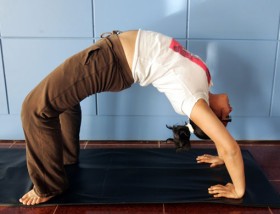
Chakrasana (The wheel pose)
Lie on the back with the knees bent and the heels touching the buttocks.
The feet and knees should be about 30cm apart.
Place the palms on the floor beside the head with the fingers pointing towards the shoulders.
Slowly, raise the body and arch the back, allowing the crown of the head to support the weight of the upper body.
Straighten the arms and legs as much as possible and lift the head and trunk from the floor.
Try to arch the back as high as possible in the final position.
Let the head hang between the straightened arms.
Hold this position for as long as is comfortable.
Slowly, lower the body so that the head rests on the floor and lower the rest of the body, too.
Practise three rounds.
Caution : Should be practised on a carpet to protect the head.
Shouldn’t be practised by teens with any illness, weak wrists or when they are feeling tired.
Sarvangasana (Shoulder stand)
Lie on the back on a mat. Make sure your body is straight.
With the support of your arms, slowly raise the legs to a vertical position, keeping them straight.
Bend the elbows and place the hands behind the rib cage, keeping them slightly away from the spine, to support the back.
Gently push the chest forward to bring it closer to the chin.
In the final position, the legs are vertical, together and in a straight line with the trunk.
Hold this position for as long as is comfortable.
To return to the starting position, bring the legs forward until the feet are above and behind the back of the head.
Slowly, release the position of the hands and bring the body down to the floor.
Relax on your back until the heart beat returns to normal.
Beginners should hold the position for a few seconds only.
Gradually increase the time to 3-5 minutes.
Should be performed once.
Caution: Shouldn’t be practised by teens suffering from enlarged thyroid, cervical spondylitis and slip disc.
Should be avoided during menstruation.
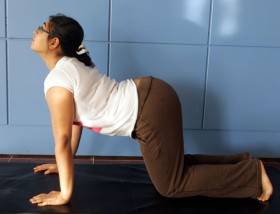
Marjariasana ( Cat-stretch pose)
Sit on your heels.
Raise the buttocks and stand on the knees.
Lean forward and place the hands flat on the floor beneath the shoulder, with the fingers facing forward.
Inhale and raise the head while depressing the spine, so that the back becomes concave.
Exhale while lowering the head and stretching the spine upwards.
At the end of each exhalation, contract the abdomen and pull in the buttocks and head between the arms and look towards the thighs.
This is one round; repeat 10 to 15 times.
Singhasana (Roaring-lion pose)
Sit on your heels with knees about 45cm apart.
Place the palms on the floor between the knees, with the fingers pointing towards the body.
Lean forward, resting the body on the straightened arms.
Arch the back and gently tilt the head back so that there is a comfortable tension in the neck.
Inhale slowly and deeply.
At the end of the inhalation, open the mouth and extend tongue as far as possible towards the chin.
While slowly exhaling, produce a clear steady “aaah” sound from the throat.
This is one round. Repeat five times.
Jalandhar bandha
Benefits: When we press the chin to the throat, the parathyroid and thyroid glands in the neck get activated and thyroxin is secreted.
This hormone helps reduce stress.
It also helps control numerous problems related to the thyroid gland.
Sit in a comfortable posture with the back straight.
Inhale deeply, fill your lungs with air, raise your chest and hold your breath.
Press your chin to the throat.
Hold your breath for 30 seconds to a minute.
When you can’t hold your breath anymore, raise your head and exhale.
Repeat three times.
Caution: People with cervical spondylosis shouldn’t attempt this bandha.
Teens with high thyroxin levels shouldn’t perform this bandha.
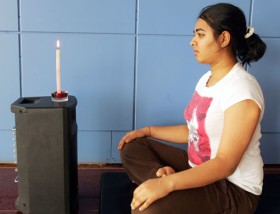
Trataka (Gazing with concentration)
Light a candle and place it on a small table. The flame should be exactly at the eye level when sitting.
Sit in a comfortable position with the head and spine erect. Be at arm’s length from the candle.
Close your eyes to relax them.
Open your eyes and gaze steadily at the end of the candlewick. The flame may flicker slightly but the end of the wick will always remain steady.
Try not to blink or move the eye balls in any way.
Don’t strain, as that will make you blink because of tension.
After a minute or two, when your eyes become tired or begin to water, close them gently.
With your eyes closed, focus mentally on the image of the flame.
If the image moves, try to stabilise it.
When the image of the flame begins to fade, try to bring it back.
When the image can no longer be retained, open your eyes and gaze at the end of the wick once more.
Repeat the practice.
Continue this way for two to three times.
After completing the final round, rub your palms and keep them on your eyes a couple of times.
Caution: Must be practised on a steady flame, so ensure that the room is not airy.
Avoid undue strain.
Bharat Thakur is the founder of Bharat Thakur’s Artistic Yoga. For questions on yoga, write to dubai.artisticyoga@gmail.com. For more information, log on to http://www.bharatthakur.com
UAE makes Arabic official language
UAE makes Arabic official language
By Duraid Al Baik, Foreign Editor GULF NEWS Published: March 10, 2008, 00:32
Dubai: The government on Sunday decided to use Arabic as the official language in all federal authorities and establishments.
The move was hailed by UAE intellectuals who called on local governments and private institutions to follow suit.
Dr Ebtisam Al Kitbi, Professor of Political Science at the UAE University in Al Ain, said the long overdue move was a step in the right direction in emphasising the national identity. He urged the government to follow up on its implementation.
Al Kitbi said the move will enhance the presence of Arab speaking people in labour market and restore the national identity,” she said.
She said the decision is in harmony with the UAE constitution, which states that the language of the land is Arabic without exception.
“To my knowledge, there is no nation that allows an invasion of foreign languages in government institutions the way we did in the UAE. The move will correct the imbalance,” she said.
“See countries like Germany, France and Japan. People there use foreign languages, but you will never see them in the work place other than their national languages. English is widely used in the government in the UAE and this is unacceptable,” she said.
Ali Abdul Kadir Al Khalaf, secretary-general of the Sharjah-based Arabic Language Protection Association (ALPA), said that he and his colleagues in ALPA have been working working for nearly 10 years to enhance the use of Arabic in the country.
“The government decision is just one step forward. We are looking to see similar commitments by governments in the various emirates and the business sector,” Al Khalaf said.
He said ALPA is waiting for stronger moves by the government to emphasise the national identity in 2008.
“The language decision was just an implementation of President His Highness Shaikh Khalifa Bin Zayed Al Nahyan’s initiative to endorse the current year as the year of national identity,” he said.
Chaired by Shaikh Mohammad Bin Rashid Al Maktoum, Vice-President, Prime Minister of the UAE and Ruler of Dubai, the Cabinet also approved an agreement between the UAE and France to develop nuclear energy for peaceful purposes.
Driving tips for foggy weather
Driving tips for foggy weather
By Alia Al Theeb, Staff Reporter, GULF NEWS Published: March 11, 2008, 16:35
Here are a few driving tips that everyone should follow to avoid accidents in this foggy weather:
* Ask yourself if your journey is really necessary before driving in thick fog.
* Avoid travelling in a car if you can.
* Make sure the headlights and the front windows of the car are clean before starting the journey.
* Reduce speed, leave enough space between vehicles and avoid overtaking.
* Do not change lanes unless necessary.
* Turn on headlights (but low beams only).
* Avoid turning on hazard lights, except in emergency cases. Using hazard lights all the time prevents a motorist from alerting other motorists to an emergency.
* Turn on the appropriate fog lights when driving.
* Make sure the window wipers work properly to constantly clean the window and have clear visibility.
* Be aware at all times for danger such as a vehicle suddenly braking in the front or another vehicle entering from a side entrance. This means not using mobile phones when driving, for example.
* Allow more time to complete a journey, especially during low visibility.
Story of fight between Sree Rama and Varuna
Story of fight between Sree Rama and Varuna
This is a story from Ramayana and a weekend challenge to attempt.
Faced with the dilemma of how to cross the ocean to Lanka, where his kidnapped wife Sita is held captive by the demon king Ravana, Rama (an Avatar of Vishnu) performs a penance (tapasya) to Varuna, the Lord of Oceans, fasting and meditating in perfect dhyana for three days and three nights. Varuna does not respond, and Rama arises on the fourth morning, enraged by the God’s arrogance. With his bow and arrow, he angrily begins attacking the oceans with celestial weapons – burning up the waters and killing its life and creatures. The Vanaras (Monkeys) are dazzled and fearful at witnessing the enraged Rama demolish the oceans, and his brother, Lakshmana, prays to calm Rama’s mind. Just as Rama invokes the brahmastra, considered the most powerful weapon capable of destroying all creation, Varuna arises out of the oceans. He bows to Rama, explaining that he himself was at a loss to answer Rama’s question. Begging him not to destroy the oceans with the missile, he suggests that Rama re-direct the weapon at a demonic race that lives in the heart of the ocean. Rama’s arrows destroys the demons, and establishes a purer, liberated environment there. Varuna promises that he would keep the oceans still for all of Rama’s army to pass, and Nala constructs a bridge (Rama’s Bridge) across to Lanka. Rama justifies his angry assault on the oceans as he followed the correct process of petitioning and worshipping Varuna, but obtaining the result by force for the greater good.
It is thus believed that when someone writes Sree Ramajayam on the sand at the seashore, the sea (i.e. Varuna) get intimidated and tries to clean it as soon as possible.
Try it wherever you are – write Sree Rama Jayam in any language, a little further than where you expect the waves normally come, and watch the fun of it being cleansed by the waves.


You must be logged in to post a comment.