Overseas Indian Centre to be opened in Dubai
Overseas Indian Centre to be opened in Dubai
By Riyasbabu (Our staff reporter) KHALEEJ TIMES 1 April 2008
DUBAI — India will soon open an Overseas Indian Centre in Dubai to facilitate legal, medical and financial counselling to its nationals based in the Gulf, said Minister of Overseas Indian Affairs Vayalar Ravi.
Speaking to Khaleej Times over the telephone from India, Ravi said, his ministry has begun to implement the proposal and a similar centre has already started functioning in Washington.
“Dubai centre will have a director and supporting staff and it will work under the Indian Embassy. The centre will coordinate with Indian doctors, solicitors and financial consultants living in the region and facilitate services to the Indian expatriates,” Ravi said.
“I cannot say when the centre will open. We are working on it at the moment and we will start operations as soon as possible. The Centre will coordinate its activities with the Indian diplomatic missions in the Gulf,” he added.
“India had plans to start a similar centre in Kuala Lumpur to cater to the Indians based in Malaysia, Singapore and Brunei but the plan has been stalled for now,” Ravi stated.
Elaborating the aim of the centre, the minister said, the centre will educate the Indians living in the region about their rights and obligations and ensure that they are not exploited.
He revealed that six posts have been created in Dubai under the Indian consulate to operate the centre and the staff will be professionals with legal, medical and financial expertise.
“The legal cell in the centre will run awareness campaigns among Indians about their rights and give advice to Indian citizens in case of disputes with employers.
“The medical cell will provide medical support, including psychiatric counselling, while the financial cell will provide financial advice on transfer of funds, savings and investments,” Ravi said.
The centre, Ravi said, will also focus on the issues of women and provide all the necessary assistance to them in times of need.
If you are illegal for less than three months, you can legalise your status
If you are illegal for less than three months, you can legalise your statusBy Ahmed Abdul Aziz (Our staff reporter)KHALEEJ TIMES 1 April 2008
ABU DHABI — If you are an illegal resident in the UAE or your driver or maid has an expired visa for less than three months you can go to the Naturalisation and Residency Department (NRD) and legalise the status without being penalised, according to Major Hilal Aida Al Mazrouei, Director of the Department of Illegals.
He told Khaleej Times that the work on following-up on illegal workers in the country will take a different shape as we seek the cooperation of all the sponsors in the society — nationals, expatriates and the illegals themselves – to weed out this problem.
The move will enable sponsors to legalise the status of their housemaids and domestic servants’ if their visas have expired. They can do this by going to the courts, which will waive the fines and legalise their status by renewing the visa or transferring the sponsorship.
In the past, one month was given as grace period to the sponsors to renew the visas of their workers, maids, domestic servants, relatives and dependants. However, the new decision now allows them up to three months.
Meanwhile, the NRDs countrywide have launched inspection campaigns to flush out illegals.
“We are on the move in the light of the directives of Minister of Interior Lt-Gen. Shaikh Saif bin Zayed Al Nahyan,” said Major Al Mazrouei.
He added that the inspection campaigns teams arrested about 80 illegals yesterday in the capital.
Al Ain bans smoking in malls, restaurants
Al Ain bans smoking in malls, restaurants
By Lana Mahdi (Our staff reporter)KHALEEJ TIMES 1 April 2008
AL AIN — The Al Ain Municipality has decided to regulate smoking in all enclosed public places, including shopping centres, malls and restaurants.
Awad bin Hasoum Al Darmaky, Director-General of the municipality, said yesterday that the ban would be enforced from April 15.
Al Darmaky said the move is in line with the national campaign against smoking which is the main cause of several diseases.
He highlighted that the Public Health Administration, which is part of the Al Ain Municipality, will organise inspection campaigns to ensure that the decision will be enforced.
Al Darmaky said all malls, shopping centres, restaurants and all enclosed public facilities will be no-smoking zones.
Violators of the ban would face stiff penalties, he added.
The regulation is aimed at assisting people who want to quit smoking by creating a helpful environment for them and the passive smokers who suffer due to the bad habit of others.
It may be mentioned that the Al Ain Municipality had already banned smoking in the offices of its departments. The ban came into effect on April 1, 2007.
Email-related stress in the workplace is a growing problem
Email-related stress in the workplace is a growing problem By Carole Spiers, Special to Gulf News Published: April 01, 2008, 00:41
A few months ago, I singled-out emails as a growing workplace stressor, especially in the way they set up a permanent air of emergency.
Now a study by two UK universities (Glasgow and Paisley) reports that 30 per cent of workers feel actively stressed by the need to monitor and respond to emails, and only about the same number feel unaffected by it.
This confirms the status of email-related stress management as a specific agenda of its own, which ought to be high in the priorities of both IT and HR personnel.
One example of a joint-response by these two departments is the Acceptable Use Policy (AUP). This is basically an internet Code of Conduct for employees, aimed at preventing activities that are either illegal, disruptive or a threat to security, and also takes in corporate rules of appropriate dialogue online, sometimes called ‘Netiquette’.
But this can be usefully dovetailed with IT by the blocking of Facebook, YouTube or those endless special offers that may distract people from their work, in addition to the main IT agenda of Content Filtering to block spam and restrict emails to work-related items only.
Like all sweeping regulations, this could be accused of penalising the responsible majority in order to control the mischievous few, and it may be claimed that the requirement to concentrate 100 per cent on work throughout the day is unnatural. Literally, you wouldn’t be able to send a short email to your wife at any time. Might this Big Brother intervention actually be causing more stress than it relieves?
Fortunately, the technology incorporates many features that can counteract email-related stress. That ‘air of emergency’ I referred to earlier, causing some people to check their messages up to 40 times an hour, is often rooted in anxiety that some important work emails may have been wrongly blocked.
Multiple-layer filtering enables ‘Whitelisting’ of trusted email senders’ addresses to ensure delivery. Also the technology is flexible enough to allow local rules at the discretion of management. You can allocate time and bandwidth quotas to each user, enabling access to leisure sites at particular hours. Another way round the problem is to block specific sites on the main network but provide free access on machines in the coffee area.
This reminds us that today’s workplace is a part-social arena, where most employees can and should be trusted to keep a sensible balance between working and socialising – a stress reduction factor in itself.
And if we can wean people away from checking the mail 40 times an hour (setting up a harmful syndrome called ‘false positive anxiety’), and seeing why a two-hourly check is usually quite adequate, we will have helped to encourage a more sensible and practical use of that unwieldy and imperfectly understood instrument, the Net.
Key points: Handling IT-related stress
Nearly a third of workers feel actively stressed by email demands
Content Filtering Technology can selectively block messages
Ideally, allow social emailing in the recreational zone of the office
– The writer is a BBC broadcaster and motivational speaker, with 20 years’ of experience as CEO of Carole Spiers Group, an international stress consultancy based in London.



Global remittances rise 7% to Dh1.17tr
Global remittances rise 7% to Dh1.17tr
By Saifur Rahman, Business Editor Published: March 31, 2008, 00:09
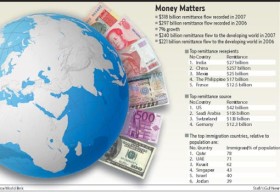
Dubai: Global remittances rose seven per cent last year to $318 billion (Dh1.17 trillion) up from the previous year’s $297 billion, according to the latest World Bank report.
India topped the global list of the remittance recipients with $27 billion (Dh99.1 billion), followed by China with $25.7 billion (Dh94.32 billion), Mexico having received $25 billion (Dh91.75 billion), the Philippines $17 billion (Dh62.39 billion) and France with $12.5 billion (Dh45.88 billion).
Rich countries are the main source of remittances led by the US with $42 billion in recorded outward flows in 2006. Saudi Arabia ranks as the second largest with $15.6 billion.
Of the $318 billion, about $240 billion (Dh880.8 billion) went to developing countries last year, which is eight per cent higher than the $221 billion (811.07 billion) recorded in 2006.
These flows do not include informal channels, which would significantly enlarge the volume of remittances if they were recorded.
“In many developing countries, remittances provide a lifeline for the poor,” said Dilip Ratha, World Bank’s senior economist, and author of the report.
“They are often an essential source of foreign exchange and a stabilising force for the economy in turbulent times.”
Despite a near stagnation in remittance flows to Mexico and a deceleration in other Latin American countries contributed to a slowdown in the rate of growth of remittances, its flow to developing countries remains robust because of strong growth in Europe and Asia.
As money transfers are being subjected to more intense scrutiny by regulators, the remittance industry has experienced a shift in remittances from informal to formal channels, the report says.
But the same regulations have also increased the documentation requirements for opening bank accounts. Large money transfer operators have therefore benefited from the shifting flows.
More recently, the remittance industry has also seen the introduction of cellphone-based remittances and several pilots involving remittance-linked financial products.
Mobile banking and partnerships with cellphone companies can potentially extend remittance services to millions of people in remote, rural areas. UAE’s largest telecom operator etisalat has started a pilot project to facilitate remittances through mobile phone.
These changes may imply a shift from cash-based remittances to account-based remittances in future.
“The remittance industry is experiencing some positive structural changes with the advent of cell phone and internet-based remittance instruments. The diffusion of these changes, however, is slowed by a lack of clarity on key regulations (including those relating to money laundering and other financial crimes),” the report said.
“Remittance costs have fallen, but not far enough, especially in the South-South corridors.”
Countries in South Asia and East Asia are experiencing robust growth in remittances. In the Philippines, remittances rose by 15 per cent year-on-year during the first nine months of 2007. Both Bangladesh and Pakistan reported over 20 per cent growth in remittances during the first nine months of 2007.
“High oil prices and strong economies in the oil-exporting Middle Eastern countries are contributing to strong demand for migrant labour. In India, the largest remittance-recipient developing country, private current transfers grew by 30 per cent in the first half of 2007,” he said.
While South-South migration nearly equals South-North migration, rich countries are still the main remittances source, led by the US, according to the World Bank’s new Mig-ration and Remittances Factbook 2008, released recently.
The US was also the top immigration country in 2005, with 38.4 million immigrants, followed by the Russian Federation 12.1 million.
Among low-income countries, India had the highest immigration volume with 5.7 million, followed by Pakistan with 3.3 million.
The top immigration countries, relative to population are Qatar with 78 per cent followed by the UAE with 71 per cent, Kuwait having 62 per cent, Singapore 43 per cent, Israel 40 per cent and Jordan 39 per cent.
In many developing countries, remittances provide a lifeline for the poor.”
Dilip Ratha
World Bank’s senior economist
UAE Opec governor says oil market well-supplied
UAE Opec governor says oil market well-supplied
Reuters Published: March 31, 2008, 00:09
Dubai: Oil markets are well-supplied with inventories of crude oil and refined products over their five-year average, the Organisation of Petroleum Exporting Countries (Opec) governor of the United Arab Emirates said on Sunday.
The weakness of the US dollar has amplified the rise in oil prices, which was partly due to speculation, Ali Al Yabhouni told an energy conference in Dubai.
“The market is sufficiently well-supplied and what proves my argument are inventories; they are over and above the five-year average for crude and refined products,” he said.
“It is not only fundamentals that are driving prices. It is very complex and there are many different players contributing to oil price movements.”
Al Yabhouni said producers decide their output policy based on oil market fundamentals, but cannot cater for the appetite of financial speculators. “We are looking at supply of oil, we see demand and try to match it. Financial demand is something else,” he said.
Opec left its output steady at a meeting earlier this month despite calls from consuming countries for more oil to halt the record rally. The weak dollar and rising cash flows from hedge funds helped send crude oil prices to a record high of $111.80 a barrel in mid-March. US crude closed at $105.62 on Friday.
Al Yabhouni said earlier this month Opec would not react to speculative oil price movements when market fundamentals were balanced. Opec officials have long insisted factors beyond their control are fuelling oil’s rally.
“One reason the price is high is the weakness of the dollar,” said Al Yabhouni. “If you look at it in other currencies such as the yen and the euro oil is very affordable. So, yes, the price looks high in dollars but not in other currencies.”
Passenger bus rams into the middle of bridge in Sharjah

Passenger bus rams into the middle of bridge in Sharjah
Staff Report GULF NEWS Published: March 30, 2008, 11:05
Sharjah: A passenger bus bound to Dubai from Sharjah rammed into the median of a bridge in Arouba Street near Al Khan Road, Sharjah, early on Sunday.
The cause of the accident is still being verified. Two passengers sustained minor injuries, said a passenger.
The accident sparked massive traffic jams, blocking motorists trying to get to work after the weekend.
 ClicksandWrites
You must be logged in to post a comment.