UAE
Join us in the Clean up campaign
Join us in the Clean up campaign

Abu Dhabi’s coastline is in dire need of your help. Waste from construction sites, boats and from the land have littered our coastline, not only causing an eye sore but also endangering precious marine life such as dugongs and sea turtles, our health and our fragile environment. Abu Dhabi Government is really very concerned about this issue.
There is still time to show your commitment.
Join us in the Clean up campaign as we move along the Abu Dhabi coast in our endeavour to keep our coast clean
How do we join in this time?
Join us in our Clean-Up Campaign on Saturday February 16th, 2008 at the Public beach at Mirfa in the western region
A tent will be set up at the site. Gloves, trash bags and refreshments will be available. The clean up will start at 8.30Am in the morning. The clean up will go on for about 2 hours.
Interested volunteers from Abu Dhabi will collect at 6.30am at Spinneys parking lot in Khalidiyah. The clean up site is at Mirfa public beach. The plan is for all volunteers to collect and move together from Spinneys Khalidiya in Abu Dhabi. Buses are being arranged for all those who don’t have cars to commute.It would take about one and half an hour to reach Mirfa coast in the western region. After the event, volunteers who traveled by bus will be dropped back at Spinneys supermarket. For those who want to travel by bus, please do contact and reserve your seats latest by 13th of February.
Who all can participate?
Social centers, general public, Private sector, Government organizations, youth etc
How do I/ we participate?
To volunteer in this important campaign, kindly complete the Registration form and submit it online to graghwa@ead.ae or moali@ead.ae or mhaneefa@ead.ae or ralmadfai@ead.ae
Please note spaces are limited so it is based on a first-come first-serve basis. Those companies / organization who can bring in their own buses or cars with their group, do inform us how many of you are coming
Did you know that we collected 6,720 kg of waste from the Mussafah Industrial area for the February 09 clean up campaign!
For more details, please visit: http://www.ead.ae/en/?T=4&ID=3554
Soaring prices of essential goods bite into consumers’ pockets

Soaring prices of essential goods bite into consumers’ pockets
By Irish Eden Belleza, Staff Reporter GULF NEWS Published: February 13, 2008, 00:20
Dubai: As 2008 began, UAE consumers have been crying over skyrocketing prices as basic commodities have become more expensive in many places in the past few months, posting increases as high as 25 per cent.

Increases in consumer prices are not unique to the UAE.
It is a worldwide phenomenon caused by soaring agricultural prices and the global economic slowdown, triggered by the lingering crisis in capital markets.
Solutions
Some retailers of fast-moving consumer goods (FMCG) are consequently coming up with innovative solutions to ease the burden on consumers.
“Most of the goods sold here are imported. But at LuLu Centre we are now producing our own range of goods such as frozen foods to give consumers an alternative and offer them more value for their money,” Ashraf Ali, executive director of the LuLu chain of hypermarkets, told Gulf News.
Due to pressure from suppliers to raise prices, some retail outlets are suffering severe shortages of basic commodities.
“We are experiencing a 40 to 50 per cent shortage or reduction of goods like rice, milk, dairy products, poultry and especially imported goods,” said Ashraf Ali.
“Suppliers are asking for price revisions but we are not implementing them since the suggested price increase has not yet been approved by the Ministry of Economy,” the official added.
Inflation
Inflation is expected to intensify over the next couple of months as, industry experts have revealed, consumers are confronted with more price hikes in basic commodities ranging from 20 to 40 per cent.
An industry insider also revealed that the UAE market is experiencing severe shortages of products produced by some multinationals.
However, some lucky consumers may have to take advantage of the current lull in price increases of many consumer goods that remained stable.
Choice
The latest consumer price index released by the Ministry of Economy indicates that consumers must be careful where they shop.
For instance, one kilo of cheese (Akkawi) from the Czech Republic has risen to Dh34.90 in some supermarkets, but is available for as little as Dh23.95 from others.
Butter from Denmark costs Dh7.95 for 400g in some stores while some others offer it for Dh7.75.
Most of the goods sold hereare imported. At LuLu Centre we are now producing our own range of goods such as frozen foods to give consumers an alternative and offer them more value for their money,” said Ashraf Ali, Executive director of LuLu chain of hypermarkets.
Truck drivers risk deportation if found violating safety rules
Truck drivers risk deportation if found violating safety rules
By Rayeesa Absal, Staff Reporter GULF NEWS Published: February 12, 2008, 19:12
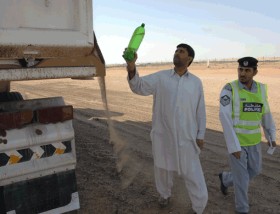
Abu Dhabi: Starting Thursday, truck drivers would risk deportation if they flout safety regulations while on the road, senior police officials said.
In order to tackle the issue of materials falling off from trucks on to the roads, threatening the safety of road users, a campaign has been launched by the Abu Dhabi Police. Not only would the trucks be confiscated for up to a month’s time, the errant drivers would face deportation.
Several traffic police patrol vehicles have been deployed across the capital city and its outskirts, including Al Ain and the Western region, to effectively track down drivers who fail to abide by the safety regulations.
Brigadier Nasser Al Nuaimi, Director General of the office of the Minister of Interior, said the entry and exit points of the city would be carefully monitored to nab violators. “Dust and other materials falling off from trucks could cause accidents. Truck drivers must ensure that these are adequately covered and secured.”
“The decision to impose stringent measures on drivers came after authorities spotted inconsiderate truck drivers who put public safety at risk,” he said.
A committee has been formed to coordinate with all the stake holders to curb this phenomenon, he added.
Speaking of the new measure, Colonel Hamad Adil Al Shamsi, the Director of the Department of Traffic and patrol police said that improper handling of materials carried in trucks threatens lives of motorists especially by reducing the visibility.
Police patrols are focussing on major construction sites besides the Al Raha beach area, Mussafah, Zayed Military area and Emirates road.
The police have already begun distributing leaflets in different languages to educate the drivers.
Fast track of Shaikh Zayed Road to be closed to traffic
Fast track of Shaikh Zayed Road to be closed to traffic
By Alia Al Theeb, Staff Reporter GULF NEWS Published: February 12, 2008, 17:35
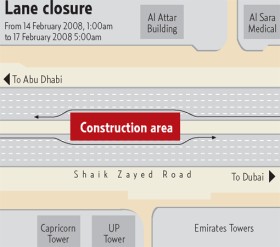
Dubai: Motorists are expected to face traffic jams due to the closure of the fast lane on both sides of Shaikh Zayed Road to allow for construction of a base for a pedestrian bridge.
The Roads and Transport Authority (RTA) said the closure of the fast lanes between the World Trade Centre Roundabout and the First Interchange on Shaikh Zayed Road will start from 1am on Thursday, February 14 until 5am on Sunday, February 17.
Maitha Obaid Bin Udai, Chief Executive Officer (CEO) RTA’s Traffic and Roads Agency, stated that the closure will only affect the fast track [extreme left lane] on both directions of Shaikh Zayed Road in the sector between the Defence Interchange and the World Trade Centre Roundabout, while traffic flow on other lanes will continue as usual.
Maitha called upon road users to exercise extreme caution while passing through the area. She explained that all required arrangements and procedures are in place to ensure smooth traffic flow on the road, as well as safe transit on other lanes. She called upon road users to abide by the speed limits, adhere to the guidelines displayed at traffic signs in the area, and use alternative roads to ease congestion during the lane closures.
“This lane closure is dictated by the need to construct an overhead pedestrian bridge in the median of this vital road so as to enhance the safety of pedestrians and save them from accidents.
“Such accidents, taking place at highways like Shaikh Zayed Road, are fatal in most cases since pedestrians tend to cross such roads from places other than those specified for this purpose,” she said.
Maitha said the RTA assigns paramount importance to the safety of pedestrians and road users and is making substantial efforts to take all actions required for their safety.
Next academic year for public schools begins on Aug 24
Next academic year for public schools begins on Aug 24
By Mohsen Rashid (Our staff reporter)KHALEEJ TIMES 13 February 2008
DUBAI — The Ministry of Education (MoE) has fixed the beginning of the 2008-09 academic year for the public schools on August 24, Khaleej Times has learnt.
While the teaching and administrative staff will report for duty on August 24, the students of all grades will report for classes on August 31, reliable sources in the ministry said yesterday.
The private (foreign) schools have been given the right to fix the date of commencement of their coming academic year.
The sources said the ministry had fixed the opening date of the academic year and the holidays for both the public and private schools last year, which sparked criticism from managements of several schools and parents. Therefore this time, the ministry has let it to the private schools to decide on the opening date.

VATAKARA MAHOTSAV INVITATION – 16 FEBRUARY 2008

VATAKARA MAHOTSAV INVITATION – 16 FEBRUARY 2008
Dear All:
All roads in the capital city on 16th February lead to VATAKARA MAHOTSAV 2008 at Abu Dhabi Cultural Foundation!
It is a pleasure to announce that Vatakara NRI Forum UAE is organizing VATAKARA MAHOTSAV 2008 filled with a variety of stage performances and an enthralling musical concert in Abu Dhabi.
Date: 16th February 2008, Saturday
Time: 7:00 p.m. (Doors open at 6:30 p.m.). You are encouraged to take up your seats by 6:30 p.m.
Venue: Abu Dhabi Cultural Foundation
Inauguration: Shri Benoy Viswam, Hon’ble Minister of Forests, Government of Kerala
The event will feature Shri Kaithapram Damodaran Namboothiri, a widely acclaimed Playback Singer, Actor and Music Composer, who will unleash his powerful and soothing musical concert to keep the audience spell-bound at the Cultural Foundation.
Crowd puller theme based traditional forms of stage performances are lined up to enthrall the audience – and that will include a variety of entertaining classical, fusion and folk dance forms of various States of India, traditional form of martial arts (kalari payattu), visualization of poem (kaaviyavishkaaram) and an ancient form of art (ottan thullal) depicting the cultural heritage of Kerala.
Entrance is free.
The VATAKARA MAHOTSAV 2008 event is sponsored by:
– General Medical Centre Hospital
– Al Fara’a Construction Group
– UAE Exchange Centre
– Good Bye Roaches – Maxicare
– Al Rostamani International Exchange
– Mazrui Supplies Contracts and Maint.
– Gemini Building Materials
You are cordially invited to grace the occasion of VATAKARA MAHOTSAV 2008 and enjoy the evening on 16th February 2008 Saturday, from 6:30 pm at the Abu Dhabi Cultural Foundation.
With regards
K. Sathianathan
Internet outage a boon to tech firms
Internet outage a boon to tech firms
BY LUCIA DORE (Assistant Editor, Business) KHALEEJ TIMES 11 February 2008
DUBAI — The recent internet outage across large parts of Middle East is proving a boon for technology companies providing business continuity planning and disaster recovery services.
“We have definitely seen an increase in interest in business continuity planning,” said Aruba Networks’ vice-president Middle East and Africa, Khalid Ishruq Laban, but added, “Disaster recovery has always been there, the new trend is secure mobility.”
Speaking to Khaleej Times, he said that following the Internet outage he has “definitely seen an increase in interest in his firm’s mobility solutions, which allow data to be accessed everywhere, at all times. Organisations in the region are seeking not only to upgrade their current solutions to cater for longer outages but are looking to find ways to increase their productivity as well, he said.
“Firms have increased their productivity with mobile phones and now they want to do with same with mobile data,” he said, adding that this strategy goes one step beyond business continuity planning for which most reputable companies already plan.
Without giving specific figures, he said the company aims to “at least double business every year” in the Middle East. Whereas three years ago a big deal was $10,000 to $20,000 it is now $1 million to $2 million, Laban said. “Mobility is a must have,” he added.
But if organisations adopt secure mobile solutions in an attempt to increase productivity it becomes even more important for them to have contingency planning in place to cover any lengthy internet outage. But, according to data from Gartner, a research consultancy firm, organisations have not been very good at planning for a business outage lasting longer than seven days. The recent regional wide Internet outage in the Middle East, as a result of damage to undersea cables, could take weeks to repair.
“The fact that most organisations plan for an outage that lasts up to seven days indicates a huge hole in those organisations’ ability to sustain business operations if a regional disaster strikes,” said research vice-president at Gartner, Roberta Witty. “The impact of a disaster that lasts more than one week can have enormous negative impact on revenue, reputation and brand. Regional incidents, service provider outages, terrorism, and pandemics can easily last longer than seven days. Therefore, organisations must be prepared. More mature business continuity management/disaster recovery programmes plan for outages of at least 30 days.”
Although the data is gathered from organisations in the US, Canada and the UK, the results are deemed indicative of trends in other regions as well. It shows that more organisations are planning for a pandemic for example.
When planning for specific types of disaster scenarios, 56 per cent of the companies surveyed also have plans for key service providers’ failure, IT outages, computer-virus attacks and terrorism. “With the growing use of third-party service providers to conduct mission-critical business functions, organisations that don’t plan for this type of business outage can find themselves in a tough position in the event that this scenario becomes a reality,” said Witty.
The importance of business continuity planning is vital. According to an IDC report commissioned by data storage company, Commvault, losing control of data has a two-fold impact on Middle East organisations: risk and cost. Organisations risk being unable to comply with international regulations and face the risk of failing audits, being fined, ruining their reputation and losing customers due to unresponsive service, the report says.
And CommVault’s marketing director, Fiona Moon, said: “Data growth in the Middle East is progressing faster than most emerging markets, and we believe that this trend will continue.
“IDC’s view that the region is on the verge of a data boom fully supports our existing position that regional organisations should be moving now to establish a clearly defined storage investment policy the places crucial importance on leading-edge back-up and recovery technologies.”
For the tourists
For the tourists
Gulf News Web Report Published: November 02, 2007, 01:20
Climate: Dubai has a year round sunny climate with rain a very rare occurance, happening only a few times a year.
The winter months (November to March) are the most suitable for tourists, with the weather averaging a pleasant 30C and humidity on the low side. The summer months can become very hot, with frequent low visibility caused by sandstorms – with average daytime temperatures rarely dipping below 40C (and often rising about 45C) and high humidity to accompany the high temperatures at night.
Local laws: Although you are allowed to drink in many of Dubai’s numerous bars, remember this is a Muslim country. If you wander around the streets drunk then there is a good chance you will be arrested.
There is also zero tolerence towards drinking and driving. That means the legal limit is zero and being caught will usually end in a prison sentence.
Certain prescripton drugs which are legal elsewhere in the world are banned in Dubai. If you need to take these then you must ensure that you take a doctors prescription with you.
A list of which drugs are illegal can be found at the: US consulate to Dubai’s website
Clothing: You will only need summer clothes when you’re here, however it is a good idea to bring a few light sweaters or cardigans as the air conditioning in some restaurants and malls can be chilly.
While there is no official ruling about exactly what you can and can’t wear, Westerners will be expected to dress with more modesty than you would at home in similar temperatures.
This doesn’t mean that women have to cover up completely or wear a veil but they should try to wear clothes that are not too revealing. Men should avoid short shorts and bare chests. Dubai is a liberal emirate, but it is also part of an Islamic country. You should also be respectful of Gulf culture.
Transport: The car is king in this city, and with wide, fast roads criss crossing the emirate, it’s the easiest way to get around.
A car can be hired from any of numerous car-rental companies operating in the city and with such a competitive market, rates are pretty reasonable. A renter needs to provide original passport, two photographs, and a valid international driving license or national license.
Compared to Europe and the United States, taxis are very cheap in Dubai. They are also plentiful and you won’t usually have to wait more than a minute before one races past. An average 10km journey will set you back around Dh15 (around $3.50)
The bus service in Dubai is cheap, clean and popular, but it is also limited. It tends to run mostly in Deira and Bur Dubai although there are services running along the Shaikh Zayed Road.
If catching the bus, male tourists should be wary of sitting next to women they don’t know as this is frowned upon in Muslim culture.
A monorail system is currently being built in Dubai. It is due to be completed in 2009 and will be one of the longest mass transit systems in the world – stretching some 40km from one end of the city to the other.
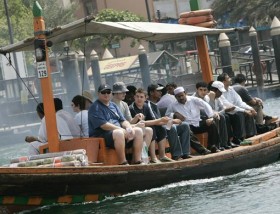
The final – and most traditional way to get around Dubai is by abra. The abra has been the best method of crossing the creek for decades now and despite the presence of bridges and tunnels, each trip from Deira to Bur Dubai and back is crammed full of businessmen, workers and tourists.
Shopping: Many people come to Dubai solely to shop. Tax free Dubai is known as a shopper’s paradise. Most of the major designer brands in the world are available in the enormous shopping malls which populate every corner of Dubai.
Malls get much busier at the weekends (which are officially Friday and Saturday).
Annual shopping events include the Dubai Shopping Festival which usually takes place in February (see last years time table ) and Dubai Summer Surprises which runs during the scorching summer months.
Dubai is famous for offering top international brands at sale prices during these festivals. Independent shops are generally open from 10am until 1pm and from 4.30pm until 10pm.
Opening hours at shopping malls throughout the day are roughly from 10am – 10pm although some stay open until midnight. On Fridays, they open from 2pm – 10pm.
Away from the air conditioned haven of the megamalls, there are bargains to be had in Dubai’s souks (the gold souk and the spice souk are in Deira) as well as the textile specialist areas of Karama and Satwa where you will find both the material, and the tailor, to have bespoke clothing made for very reasonable prices.
Sponsoring a relative to visit
Sponsoring a relative to visit
By Bassma Al Jandaly, Staff Reporter GULF NEWS Published: November 02, 2007, 01:20
Dubai: Expatriates who have valid residency papers can apply for a visit visa for relatives or friends, but must fulfil certain conditions.
According to the Naturalisation and Residency Department (NRD) law, if the sponsored relative is a female, she should not be less than 25 years of age.
If an expatriate wants to sponsor his wife and children on a visit visa, he should personally apply at the NRD at the emirate which issued him residency visa.
Papers needed
The papers needed are: passport copies of the applicant as well his wife and children, marriage contract attested by the Ministry of Foreign Affairs; attested work contract if working with a private company, or salary certificate if working in the public sector.
The salary of the expatriate should not be less than Dh3,000 per month with accommodation or Dh4,000 per month without accommodation. The applicant need not pay any deposit. He must get an e-gate card.
The e-form application will cost Dh100; another Dh100 if the visa is needed urgently, as well as Dh10 for delivery of the visa through Empost.
If an expatriate wishes to sponsor his parents on a visit visa, the application must be submitted personally at the NRD. The papers required are passport copies and an attested letter from the embassy proving the relationship.
Also needed are: an attested work contract if the person is working in a private company or a salary certificate if working in the government sector. The minimum salary requirements are the same: not less than Dh3,000 per month with accommodation or Dh4,000 per month without accommodation. No deposit is required, but the applicant must get an e-gate card.
If you are sponsoring a relative, a deposit of Dh2,000 is required and the salary must not be less than Dh5,000 per month with accommodation. But if you are sponsoring a brother or sister, the salary and accommodation allowance should be Dh6,000.
An expatriate can also sponsor two friends on visit at a time, but the salary requirements are higher – not less than Dh10,000 and Dh2,000 refundable deposit for each person which is returned after the friends leave the country. One should keep the receipt safely and present it for the refund.
Ceiling for categories
Some of the monthly salary requirements for sponsoring relatives or friends on a visit visa
* Wife or husband’s parents or grandparents. Salary must be Dh4,000 or Dh3,000 and accommodation facility.
* Wife or husband’s brothers and sisters and their sons and daughters who are less than 18 years. Salary should be Dh5,000 per month and Dh2,000 as deposit.
* Sister’s or brother’s sons and daughters. Salary must be Dh6,000 and Dh2,000 deposit for those above 18 years.
* Grandsons under 18 years of age. Salary must be Dh4,000 or Dh3,000 with accommodation facility. No deposit is required.
* Adult grandsons. Salary must be Dh6,000 as well as a deposit of Dh2,000.
Cousin. Salary of Dh8,000 and deposit Dh2,000.
* Wife’s minor sons and daughters. Salary of Dh4,000 or Dh3,000 with accommodation facility.
* Wife, sons and daughters. Salary of Dh4,000 or Dh3,000 with accommodation facility.
* A friend. Salary of Dh10,000. One can sponsor only two friends at a time. If there are more, one should justify the reason for the visit of so many friends.
 ClicksandWrites
You must be logged in to post a comment.