The National
New road will ease traffic – Letters to the editor – The National 15 September 2014
New road will ease traffic

I am sure commuters will be relieved when the road works are complete in the Al Wahda Mall area (Road works expected to ease access to Al Wahda Mall, September 14).
Apart from congestion, the bus stop dedicated to the shopping complex posed a visual obstruction for drivers exiting the mall. Another shortcoming was the lack of sunshades for bus passengers. These two issues, I hope, will be resolved.
Ramesh Menon, Abu Dhabi
Pedestrian bridge fails to lure capital jaywalkers
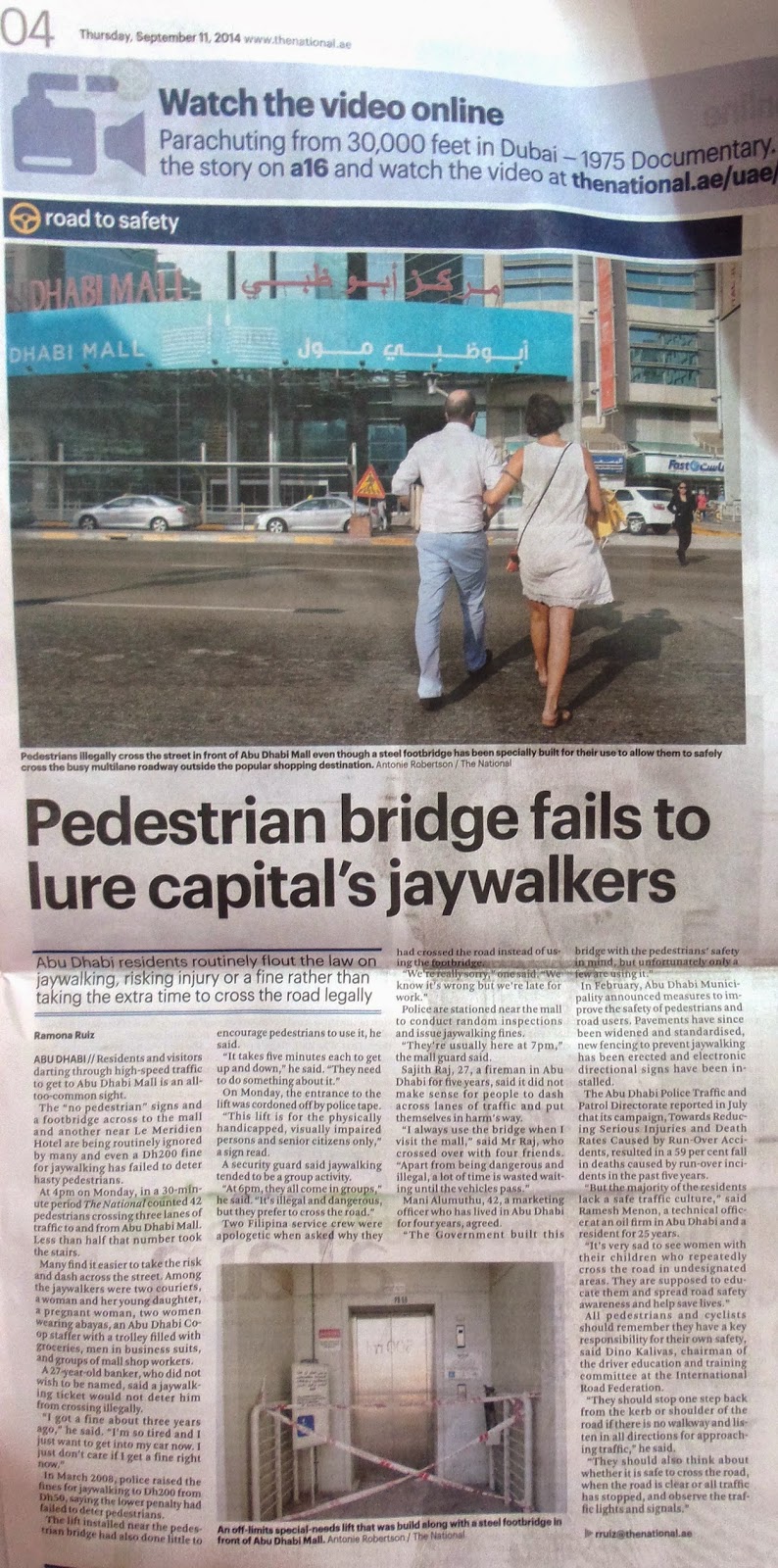
ABU DHABI // Residents and visitors darting through high-speed traffic to get to Abu Dhabi Mall is an all-too-common sight.
The “no pedestrian” signs, a footbridge across to the mall and another near Le Meridien Hotel are being routinely ignored by many and even a Dh200 fine for jaywalking has failed to deter hasty pedestrians.
At 4pm on Monday, in a 30-minute period The National counted 42 pedestrians crossing three lanes of traffic to and from Abu Dhabi Mall. Less than half that number took the stairs.
Many find it easier to take the risk and dash across the street. Among the jaywalkers were two couriers, a woman and her young daughter, a pregnant woman, two women wearing abayas, an Abu Dhabi Co-op staffer with a trolley filled with groceries, men in business suits, and groups of mall shop workers.
A 27-year-old banker, who did not wish to be named, said a jaywalking ticket would not deter him from crossing illegally.
“I got a fine about three years ago,” he said. “I’m so tired and I just want to get into my car now. I just don’t care if I get a fine right now.”
In March 2008, police raised the fines for jaywalking to Dh200 from Dh50, saying the lower penalty had failed to deter pedestrians.
The elevator installed near the pedestrian bridge had also done little to encourage pedestrians to use it, he said.
“It takes five minutes each to get up and down,” he said. “They need to do something about it.”
On Monday, the entrance to the elevator was cordoned off by police tape.
“This elevator is for the physically handicapped, visually impaired persons and senior citizens only,” a sign read.
A security guard said jaywalking tended to be a group activity.
“At 6pm, they all come in groups,” he said. “It’s illegal and dangerous, but they prefer to cross the road.”
Two Filipina service crew were apologetic when asked why they had crossed the road instead of using the footbridge.
“We’re really sorry,” one said. “We know it’s wrong but we’re late for work.”
Police are stationed near the mall to conduct random inspections and issue jaywalking fines.
“They’re usually here at 7pm,” the mall guard said.
Sajith Raj, 27, a fireman in Abu Dhabi for five years, said it did not make sense for people to dash across lanes of traffic and put themselves in harm’s way.
“I always use the bridge when I visit the mall,” said Mr Raj, who crossed over with four friends. “Apart from being dangerous and illegal, a lot of time is wasted waiting until the vehicles pass.”
Mani Alumuthu, 42, a marketing officer who has lived in Abu Dhabi for four years, agreed.
“The Government built this bridge with the pedestrians’ safety in mind, but unfortunately only a few are using it.”
In February, Abu Dhabi Municipality announced measures to improve the safety of pedestrians and road users. Pavements have since been widened and standardised, new fencing to prevent jaywalking has been erected and electronic directional signs have been installed.
The Abu Dhabi Police Traffic and Patrol Directorate reported in July that its campaign “Towards Reducing Serious Injuries and Death Rates Caused by Run-Over Accidents” resulted in a 59 per cent fall in deaths caused by run-over incidents in the past five years.
“But the majority of the residents lack a safe traffic culture,” said Ramesh Menon, a technical officer at an oil firm in Abu Dhabi and a resident for 25 years.
“It’s very sad to see women with their children who repeatedly cross the road in undesignated areas. They are supposed to educate them and spread road safety awareness and help save lives.”
All pedestrians and cyclists should remember they have a key responsibility for their own safety, said Dino Kalivas, chairman of the driver education and training committee at the International Road Federation.
“They should stop one step back from the kerb or shoulder of the road if there is no walkway and listen in all directions for approaching traffic,” he said.
“They should also think about whether it is safe to cross the road, when the road is clear or all traffic has stopped, and observe the traffic lights and signals.”
rruiz@thenational.ae
Safer roads require better monitoring – The National Dt 02 September 2014
Safer roads require better monitoring


In reference to your story, Heavy traffic but no major road issues as UAE goes back to school (September 1), it is indeed fortunate that no untoward incidents occurred on the first day of the school after summer break.
However, yesterday I witnessed examples of reckless driving.
One involved a bus carrying labourers on Sheikh Zayed Street along Abu Dhabi’s eastern corniche. It recklessly cut across lanes and sped off. It had no signs on it to indicate which company was providing the service.
This shows the importance of the police monitoring the roads from their control room so that when this kind of dangerous driving is detected, a patrol car can intervene before an accident follows.
I also believe this class of vehicles should be restricted to the slow lanes.
Ramesh Menon, Abu Dhabi
The National Dt. 02 September 2014
To read it in original, please visit The National online
A significant chapter in the UAE’s history – The National Dt 1 September 2014
A significant chapter in the UAE’s history
With regards to your coverage of the new national service programme (A proud moment for the country and its citizens, August 31), it is indeed a proud moment for all of the country and especially those who are lucky enough to be in the first batch of recruits.
I am sure the programme will mould a generation into citizens who are patriotic and proud to work for the good of the country, keeping it on a path of peace and harmony.
It will not be easy for many of these young recruits as the environment will be different from the one they are used to.
However, as true citizens of this country, they will, I am sure, get up to speed with the tough requirements of the programme. I am also sure they will emerge as a generation who are always ready and willing to serve their country.
Ramesh Menon, Abu Dhabi
The National Dt. 1 September 2014
Sheikh Hamdan’s endurance win – Letters to the editor – The National Dt 31 August 2014
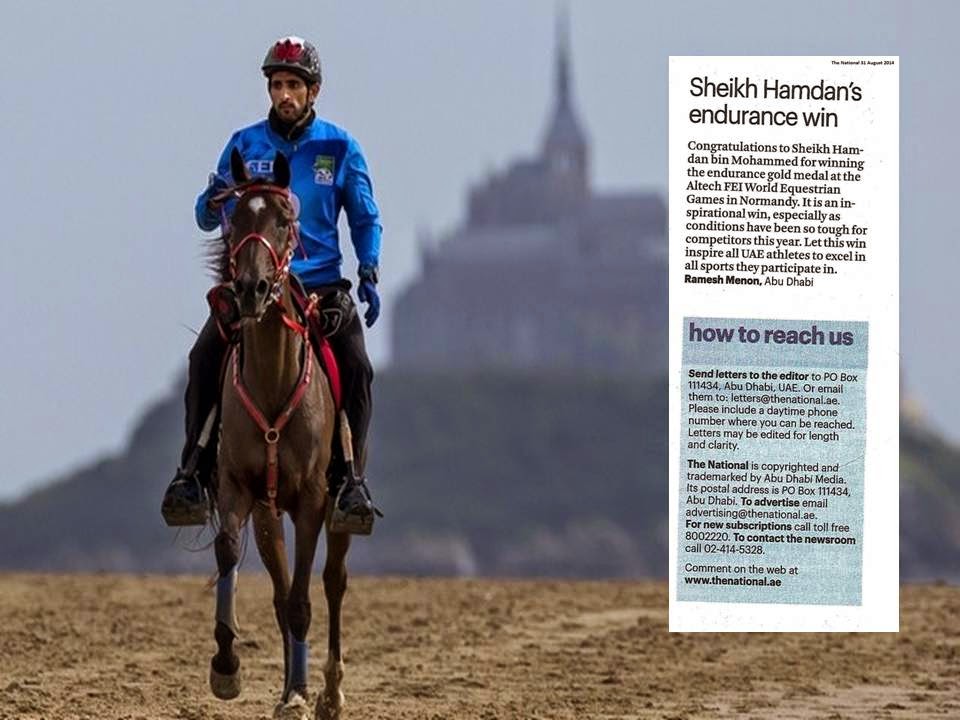
Sheikh Hamdan’s endurance win
Congratulations to Sheikh Hamdan bin Mohammed for winning the endurance gold medal at the Altech FEI World Equestrian Games in Normandy. It is an inspirational win, especially as conditions have been so tough for competitors this year. Let this win inspire all UAE athletes to excel in all sports they participate in.
Ramesh Menon, Abu Dhabi
Petrol station employees need shaded areas – The National Dt. 20 August 2014
Petrol station employees need shaded areas

Driving between Abu Dhabi and Dubai regularly, I have noticed that many petrol stations lack shade in the areas where diesel and special fuels are served. This is a cause for concern as the staff have to work all day under the open sky. I am sure their problems do not end at night, or even during the winter.
I request the fuel company to consider installing shades over all serving points at every fuel station.
Ramesh Menon, Abu Dhabi
The National, Dt. 20 August 2014
Strict rules and training needed – Letters to the editor – The National
Strict rules and training needed
It is very sad to read that an accident of the kind described in your article (38 workers injured in Sharjah bus crash, July 22) has happened on our roads once again.
Looking at the efforts by the authorities to prevent such accidents and the results achieved thus far, it is promising to note that they have become less frequent.
However, in order to get even better results, there is one option that ought to be implemented. The law should be amended to give no leeway above the stated speed limit for drivers of commercial or public transport vehicles. This would include 15-seater vans and minibuses, as well as full-size buses and trucks.
If enforced correctly and with strict punishment for drivers who breach it, this law ought to result in fewer accidents due to speeding and negligence.
In conjunction with this, all transport companies should be required to give their drivers training and to update their road-safety awareness skills.
Ramesh Menon, Abu Dhabi
To read it in original please visit The National online
Safe-driving signs on lorries are not what they seem – Letters to the editor – Dt. The National 21 July 2014
Safe-driving signs on lorries are not what they seem
Letters to the Editor
July 20, 2014 Updated: July 20, 2014 03:36 PM
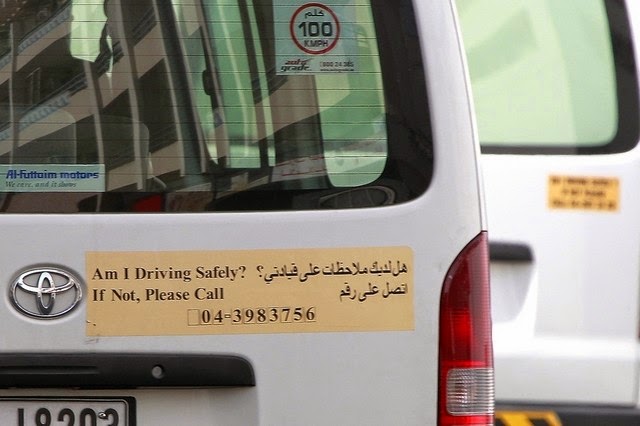
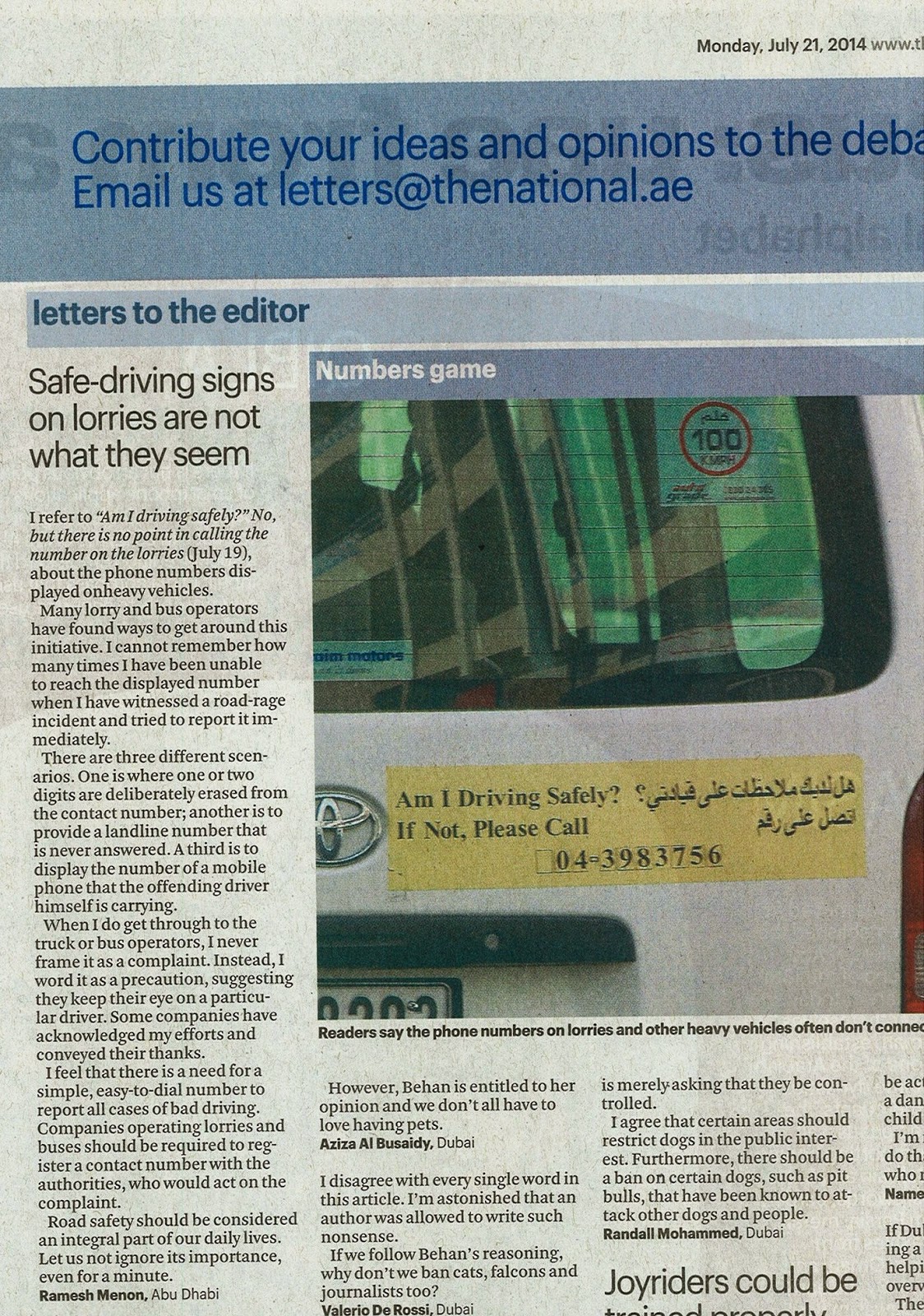
I refer to “Am I driving safely?” No, but there is no point in calling the number on the lorries (July 19), about the phone numbers displayed on heavy vehicles.
Many lorry and bus operators have found ways to get around this initiative. I cannot remember how many times I have been unable to reach the displayed number when I have witnessed a road-rage incident and tried to report it immediately.
There are three different scenarios. One is where one or two digits are deliberately erased from the contact number; another is to provide a landline number that is never answered. A third is to display the number of a mobile phone that the offending driver himself is carrying.
When I do get through to the truck or bus operators, I never frame it as a complaint. Instead, I word it as a precaution, suggesting they keep their eye on a particular driver. Some companies have acknowledged my efforts and conveyed their thanks.
I feel that there is a need for a simple, easy-to-dial number to report all cases of bad driving. Companies operating lorries and buses should be required to register a contact number with the authorities, who would act on the complaint.
Road safety should be considered an integral part of our daily lives. Let us not ignore its importance, even for a minute.
Ramesh Menon, Abu Dhabi
Highway code is necessary – Letters to the editor – The National Dt. 1 July 2014
Highway code is necessary
I refer to the article Safety expert advocates UAE federal highway code (June 30). The code is particularly necessary to keep heavy vehicles under control. They should never be given the extra 10 or 20kph speed allowance.
The moment you give that opportunity to these drivers, they tend to break the rules. In other words, if the maximum speed limit is 100kph for heavy vehicles, they should stay below it.
Many times, I have been in situations where buses and lorries came flashing their headlights from behind. The RTA buses are no exception. They should also be made to stay within the last two lanes, so as to keep the rest of the lanes free for lighter vehicles.
There is a rule that public and commercial vehicles should display specific phone numbers on which complaints can be made in case of dangerous driving. But proper monitoring is needed to make this system effective. A dedicated centralised contact number will be more helpful. I am sure consistent efforts will help make our roads safer and better. Let us all work together towards this objective.
Ramesh Menon, Abu Dhabi
To read it in original, please visit The National online.
No tolerance for drunks on planes – Letters to the editor – The National – 26 June 2014
No tolerance for drunks on planes
A friend of mine recently flew in to Abu Dhabi from Mumbai on a non-UAE airline.
On-board the plane were many workers who had been drinking before the flight took off.
Despite seeing them in that condition, the airline staff served alcohol to them during the flight. This resulted in them becoming totally intoxicated, spilling their food and causing inconvenience to other passengers.
I was very sad to hear of this scenario. Airlines flying to the UAE should have guidelines that ensure that people who have consumed a high level of alcohol before a flight are not allowed to board.
Ramesh Menon, Abu Dhabi
To read it in original, please visit The National online.
 ClicksandWrites
You must be logged in to post a comment.