Opinion 2012

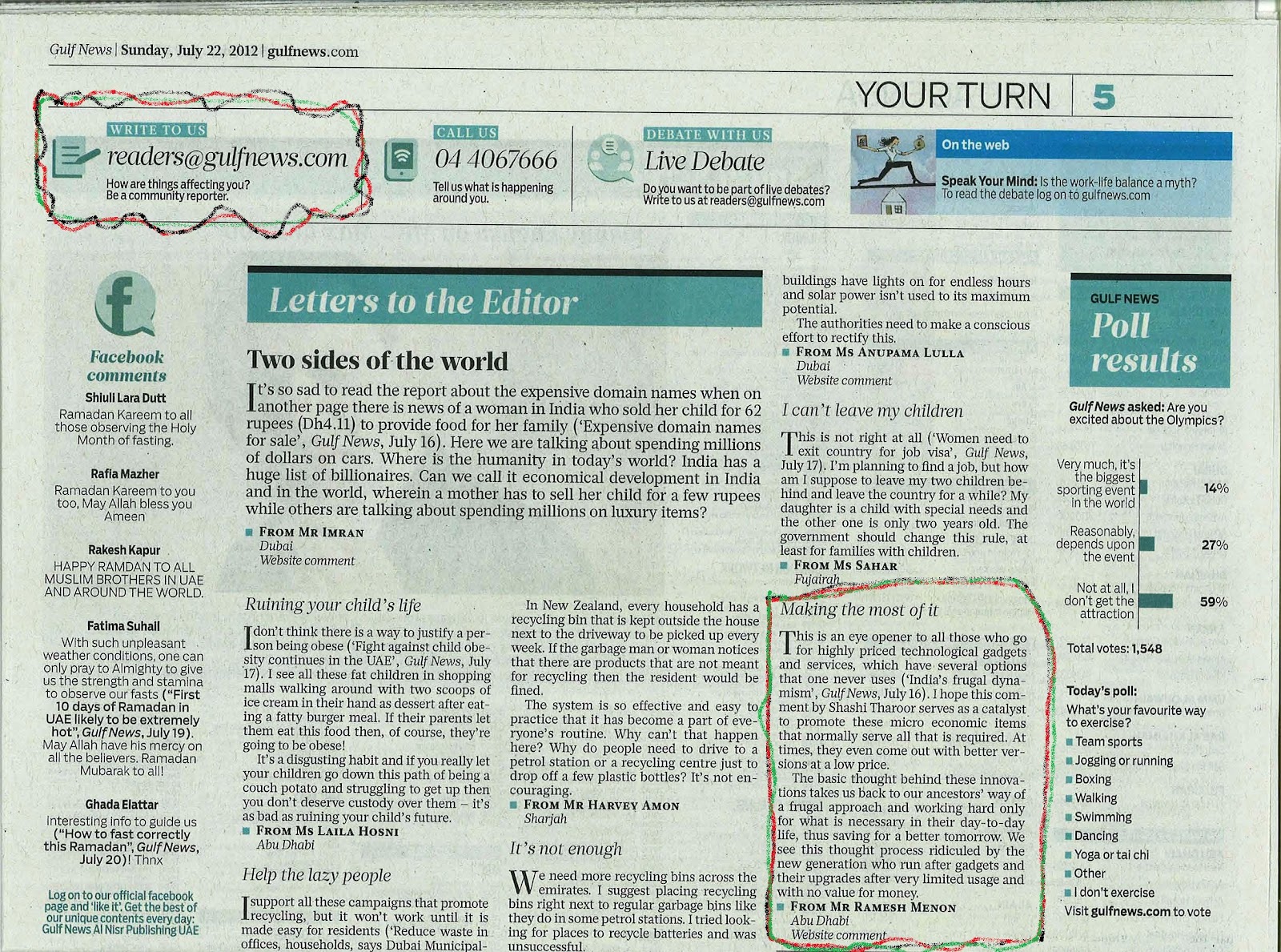
Making the most of it

Posted on Updated on

To read the article by Mr. Shashi Tharoo and read the letter in original, please visit GULF NEWS online

Sale and distribution of Mawaqif parking cards

Posted on Updated on

It would be a good idea if Mawaqif could organise the distribution and sale of parking cards of various denominations through petrol stations and other handy outlets.

Currently, there are only one or two outlets selling these cards and it is inconvenient for the public to obtain them. Also, it is not easy to locate the parking meters in many places.

It would be helpful if the authorities put up some special signage pointing to the parking meters.

Ramesh Menon, Abu Dhabi

To read it in original, please visit The National online.

India’s frugal dynamism

Posted on

Indians are natural leaders in innovation, imbued as they are with the ‘jugaad’ system of developing makeshift but workable solutions from limited resources
  • By Shashi Tharoor | Special to Gulf News
  • Published: July 16, 2012


India’s sliding economy has inspired gloom and doom far and wide, but increasingly bearish sentiment is misplaced. India still offers hope, but, to understand why, you have to leave macroeconomic indicators aside and go micro. To take one example: Google the phrase “frugal innovation,” and the first 20 search results all relate to India.

Indian companies have long recognised the opportunities in meeting previously overlooked demand at the “bottom of the pyramid.” Shampoo sachets originated in India more than two decades ago, creating a market for a product that the poor had never before been able to afford. Indians without the space or money to buy a whole bottle of shampoo for Rs100 (Dh6.66) could spend five for a sachet that they would use once or twice.

But India’s leadership in “frugal innovation” goes beyond downsizing: It involves starting with the needs of poor consumers — itself a novel term (who knew the poor could be consumers?) — and working backwards. Instead of complicating or refining their products, Indian innovators strip them down to their bare essentials, making them affordable, accessible, durable and effective.

Indians are natural leaders in frugal innovation, imbued as they are with the ‘jugaad’ system of developing makeshift but workable solutions from limited resources. ‘Jugaad’ essentially conveys a way of life, a world view that embodies the quality of making do with what you have to meet your needs.

But ‘jugaad’ is not about pirating products or making cheap imitations of global brands. It is about innovation — finding inexpensive solutions, often improvised on the fly, within the constraints of a resource-starved developing country full of poor people. An Indian villager constructs a makeshift vehicle to transport his livestock and goods by rigging a wooden cart with an irrigation hand pump that serves as an engine. That’s ‘jugaad’.

Common machines and household objects are reincarnated in ways that their original manufacturers never intended. Everything is reusable or reimaginable. If you cannot afford your mobile phone bills, you invent the concept of the “missed call” — a brief ring that is not answered, but that signals your need to speak to the recipient.

Indian ingenuity has produced a startling number of world-beating innovations, none more impressive than the Tata Nano, which, at $2,000 (Dh7,356), costs roughly the same as a high-end DVD player in a western luxury car. Of course, there’s no DVD player in the Nano (and no radio, either, in the basic model); but its innovations (which have garnered 34 patents) are not merely the result of doing away with frills (including power brakes, air conditioning and side-view mirrors). Reducing the use of steel by inventing an aluminium engine; increasing space by moving the wheels to the edge of the chassis and relying on a modular design that enables the car to be assembled from kits proved conclusively that you could do more with less.

Then there’s the GE MAC 400, a hand-held electrocardiogram (ECG) device that costs $800 (the cheapest alternative costs more than $2,000), and the Tata Swachh, a $24 water purifier (ten times cheaper than its nearest competitor). The GE MAC 400 uses just four buttons, rather than the usual dozen, and a tiny portable printer, making it small enough to fit into a satchel and even run on batteries; it has reduced the cost of an ECG to just $1 per patient. The Swachh uses rice husks (one of India’s most common waste products) to purify water. Given that some five million Indians die of cardiovascular diseases every year, more than a quarter of them under 65, and that about two million die from drinking contaminated water, the value of these innovations is apparent.

Many other examples of frugal innovation are already in the market, including a low-cost fuel-efficient mini-truck, an inexpensive mini-tractor being sold profitably in the US, a battery-powered refrigerator, a $100 electricity inverter and a $12 solar lamp.

Moreover, medical innovations are widespread. An Indian company has invented a cheaper Hepatitis B vaccine, bringing down the price from $15 per injection to less than $0.10. Insulin’s price has fallen by 40 per cent, thanks to India’s leading biotech firm. A Bangalore company’s diagnostic tool to test for tuberculosis and infectious diseases costs $200, compared to $10,000 for comparable equipment in the West.

Late last year, India’s government unveiled a hand-held computer that costs only Rs2,250 (about $40). Aakash has a resistive seven-inch touch screen, like Apple’s iPad. It comes in a rugged plastic casing, has two gigabytes of flash memory, two USB ports, headphone and video output jacks and Wi-Fi capability.
Aakash uses the Android 2.2 operating system and consumes a meagre two watts of power, which is supplied by an internal lithium-ion battery that can be charged using a solar-powered charger. And the government will subsidise 50 per cent of the cost to students, so a young Indian just has to pay $20 to have his own tablet. The initial reviews are good.

Even the financial sector has seen innovation. Just three years ago, there were only 15 million bank accounts in a country of 1.2 billion people. Indians concluded that if people won’t come to the banks, the banks should go to the people. The result has been the creation of brigades of travelling tellers with hand-held devices, who have converted the living rooms of village homes into makeshift branches, taking deposits as low as a dollar. More than 50 million new bank accounts have been established, bringing India’s rural poor into the modern financial system.

Frugal innovation pervades the Indian economy. It is one of the reasons why there is more dynamism in the Indian economy than those who look only at the macroeconomic data believe. Sometimes it is important to stop looking at the forest and focus on the trees.

Project Syndicate

Shashi Tharoor, a former Indian minister of state for external affairs and former UN under-secretary general, is a member of India’s parliament and the author of a dozen books, including India from Midnight to the Millennium and Nehru: the Invention of India.

My comments as follows:
An eye opener to all those who go for highly priced technological gadgets and  services, with several options one never uses. Hope this article by Mr. Tharoor serves as a catalyst to promote these micro economic items which normally serves all the required purpose of such knowhow. At times, they even come out with better versions at a limited budget as detailed extensively by him. The basic thought behind these innovation and invention takes us back to our ancestors way of frugal approach and burning their fingers only for what is necessary in their day to day life and future, thus saving for a better tomorrow. As we see this thought process is ridiculed by the new generation who run after gadgets and their upgrades after a very limited usage and with no value for money.
Ramesh Menon, Abu Dhabi, United Arab Emirates

To read this in original, please visit GULF NEWS online

Dh258 credit card fee that led to debt of Dh60,000

Posted on Updated on

Dh258 credit card fee that led to debt of Dh60,000

/The National


ABU DHABI // When KB Muralee was offered his credit card, he was told it would be free for life.

Seven years after using it once, he had an accumulated debt of Dh60,000.
“I used the Standard Chartered credit card for some purchases in India amounting to Dh12,000. Of that, I paid back Dh10,000 on time and later deposited the remaining Dh2,000. My card’s credit limit was Dh15,000.”
A Dh288 late fee for the outstanding amount of Dh2,000 was combined with annual fees, insurance and interest charges to create the mammoth debt.
“I didn’t even want the card, but they insisted that it was free and then said I had to purchase insurance on it,” said Mr Muralee, who is the honorary president of Kerala Social Centre in Abu Dhabi.
After The National approached the bank for comment, Mr Muralee said he was contacted almost immediately with a settlement deal.
“They called and said, ‘OK, pay Dh2,000 and end the matter’.”
In another call, he was asked to pay just Dh500.
In an official statement, Standard Chartered explained: “Upon receiving the complaint, Standard Chartered’s customer care unit contacted the customer and launched an investigation.
“Apparently, the customer had made a purchase on his card in 2005 and has not settled his outstanding balance since then.
“Despite the bank sending him his statement on a regular basis, the customer has ignored settling his credit card which has led to the automatic compilation of late-payment fees and interest on his outstanding balance.
“The bank has contacted the customer and has settled the issue with him.”
Mr Muralee said he refused to pay a single fils on either his credit-card charges or on the settlement, because he believed the charges are baseless.
“I knew it could land me behind bars but I was not afraid of it because it’s entirely the bank’s fault,” he said.
“It’s been mental torture to me, as the bank kept sending me statements throughout these years that I couldn’t get them to resolve.
“It’s very hard for a layman to understand their schemes, paybacks, late fees and hidden charges that they add on without explanation. These banks play like hunters and they wait and watch when you are going to get trapped.”
Other consumers could find themselves in the same situation as Mr Muralee if they don’t read the fine print.
The websites of several local banks use the term “free for life” to refer to credit card products, including Abu Dhabi Commercial Bank, Mashreq Bank, RAK Bank and Lloyd’s TSB.
Standard Chartered is more cautious in its use of the term, but the bank does refer to a “free for life” credit card that is available with certain products, including their Home Suite Package.
“There is absolutely no such thing as a ‘free’ credit card,” said an independent financial adviser from Dubai who did not wished to be identified.
“The banks might say they’re giving you six months free, but that’s as long as you pay back what you owe them before the due date every month.
“The thing is, they do cover themselves: there’s that little asterisk next to ‘free’, which means you should be checking the fine print,” he said.
“But let’s get real: in today’s financial climate? Nothing is for free.
“That’s just a catch-phrase.”
For more in our Consumer Watch series click here.


Whom to call for help


The Central Bank of the UAE regulates banks, exchange houses, and finance and investment companies. You can contact the consumer protection unit of the Central Bank to report problems on  02 691 5290/5453, or email your complaint to complaint@cbuae.gov.ae or log it online at http://www.centralbank.ae


* Anwar Ahmad

My comments as follows:
Showing 3 of 3 comments

  1. RameshMenonAbuDhabi

    It requires lot of boldness and courage for a highly social and community oriented person like KB Muralee to come out in open and openly discuss his harrowing financial experiences as a credit card holder with payment discrepancies. We can easily imagine the plight of those who cannot communicate or do not have any source to cry out. It easily open our eyes to many who affected silently suffering with no clue what so ever to come out the trap they are in. It may also give us answers to absconding of several and deaths here and back in their own home country due these type of debts. UAE Central Bank should conduct a comprehensive check of the credit allocation policy, basis of interest and interest on interest levied to customers and several hidden charges allocated. Banking regulatory authorities should also come out with appropriate rules to restrict the mandatory and explanatory clauses from smaller prints to bigger and bolder ones in all the banking application forms, and have a controlling officer to guide the applicant before approving any credit line to customers about various charges and consequences of payment anomalies. In this case, as they say, a child who cry only will get the milk and Muralee was bold enough to cry and he got his milk and waiver on excessive charges. There are thousands of unlucky others out there who are not so lucky or educated or have contacts.

    To read my comments in original, please visit THE NATIONAL online

Historic landmarks need to be maintained

Posted on Updated on

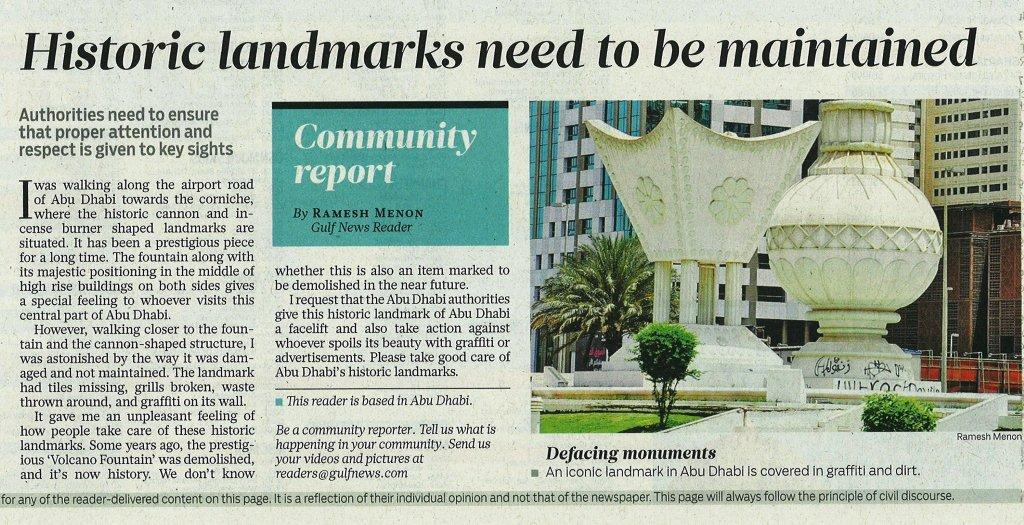
Historic Abu Dhabi landmarks not maintained

Authorities need to ensure that proper attention and respect is given to key sights
By Ramesh Menon, Gulf News Reader
Published: July 6, 2012
  • Image Credit: Ramesh Menon/Gulf News Reader
  • An iconic landmark in Abu Dhabi is covered in graffiti and dirt.

I was walking along the airport road of Abu Dhabi towards the corniche, where the historic canon and incense burner shaped landmarks are situated. It has been a prestigious piece for a long time.
The fountain along with its majestic positioning in the middle of high rise buildings on both sides gives a special feeling to whoever visits this central part of Abu Dhabi.
However, walking closer to the fountain and the canon shaped structure, I was astonished with the way it has been damaged and ignored for maintenance. The landmark had tiles missing, grills broken, waste thrown around, and graffiti on its wall.
  • Image Credit: Ramesh Menon/Gulf News Reader
  • The canon shaped structure appears to have been ignored for maintenance.

It gave me an unpleasant feeling of how people take care of these historic landmarks. Some years ago, the prestigious ‘Volcano Fountain’ was demolished, and it’s now history. We don’t know whether this is also an item marked to be demolished in the near future.
I request that the Abu Dhabi authorities give this historic landmark of Abu Dhabi a facelift and also take action against whoever spoils its beauty with graffiti or advertisements. Please take good care of Abu Dhabi’s historic landmarks.
This reader is based in Abu Dhabi
Be a community reporter. Tell us what is happening in your community. Send us your videos and pictures at readers@gulfnews.com


To read it in original, please visit GULF NEWS online

Mall shoppers left unprotected under the sun

Posted on Updated on

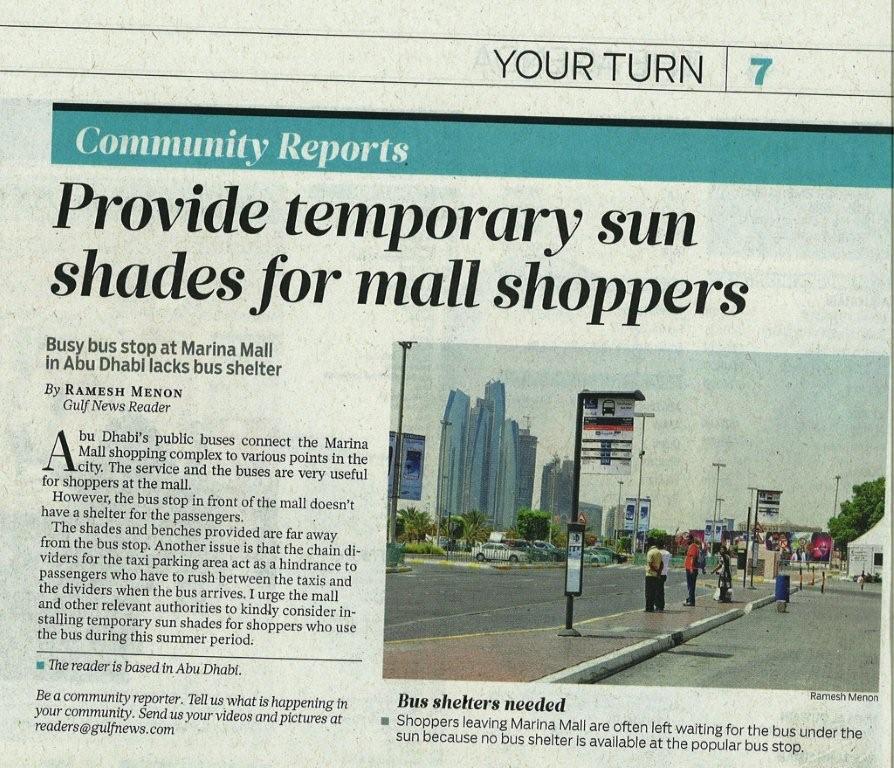
Mall shoppers left unprotected under the sun

Busy bus stop at Marina Mall in Abu Dhabi lacks bus shelter By Ramesh Menon, Gulf News Reader Published: June 29, 2012

Image Credit: Ramesh Menon

Shoppers leaving Marina Mall are often left waiting for the bus under the sun because no bus shelter is available at the popular bus stop.

Abu Dhabi’s public buses connect the Marina Mall shopping complex to various points in the city. The service and the buses are very useful for shoppers at the mall.

However, the bus stop in front of the mall doesn’t have a shelter for the passengers. The shades and benches provided are far away from the bus stop. Another issue is that the chain dividers for the taxi parking area act as a hindrance to passengers who have to rush between the taxis and the dividers when the bus arrives.

I urge the mall and other relevant authorities to kindly consider installing temporary sun shades for shoppers who use the bus during this summer period.

The reader is based in Abu Dhabi.

Be a community reporter. Tell us what is happening in your community. Send us your videos and pictures at readers@gulfnews.com

To read it in original, please visit GULF NEWS online.

Indians in UAE can’t fly home

Posted on Updated on

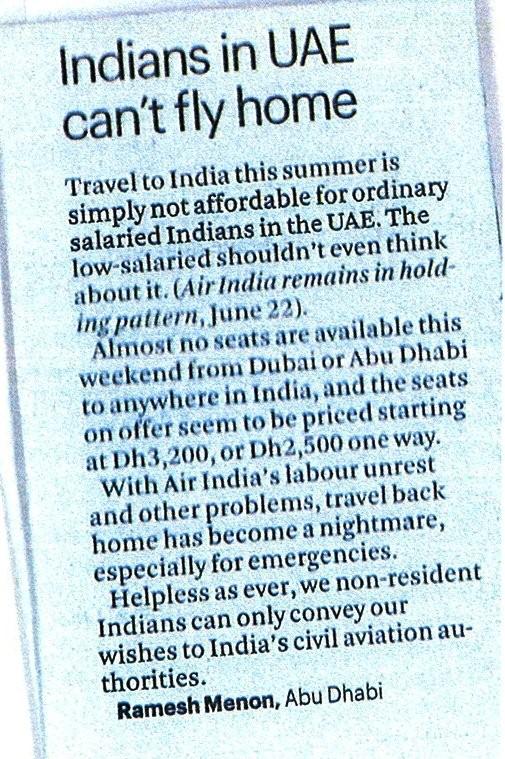
Indians in UAE can’t fly home

Travel to India this summer is simply not affordable for ordinary salaried Indians in the UAE. The low-salaried shouldn’t even think about it. (Air India remains in holding pattern, June 22).

Almost no seats are available this weekend from Dubai or Abu Dhabi to anywhere in India, and the seats on offer seem to be priced starting at Dh3,200, or Dh2,500 one way.

With Air India’s labour unrest and other problems, travel back home has become a nightmare, especially for emergencies.

Helpless as ever, we non-resident Indians can only convey our wishes to India’s civil aviation authorities.

Ramesh Menon, Abu Dhabi

To read it in original, please visit The National online

Uncomfortable seating causes public bus users discomfort

Posted on

Uncomfortable seating causes public bus users discomfort 
No air conditioning a turn-off for bus users during cross-emirate trips

By Ramesh Menon, Gulf News reader, Published: June 24, 2012

Image Credit: Ramesh Menon/Gulf News Reader
While traveling from Abu Dhabi to Dubai, Ramesh Menon found his journey enjoyable as the newer bus was comfortable and offered a smooth ride.
In order to go to Dubai from Abu Dhabi one Friday morning, I decided to use the bus instead of driving, as I thought – why drive unnecessarily when there is an efficient bus system in place?
I went to the main bus station and was told by the security personnel to go inside the station to collect a ticket.
Inside, I approached a staff member to purchase a ticket and handed him a Dh100 note. He told me he had no change, but after waiting there for a few minutes and after a few other passengers had purchased tickets, I was able to get mine.
I walked back to the bus, which was one of the latest models and was ready and waiting. After a 10-minute wait, the journey started.
The bus was comfortable, the air-conditioner worked properly and the journey was smooth. I dozed off automatically, as I relaxed.
For the price of Dh15, I had the safest and most comfortable journey I could ever take to reach Dubai from Abu Dhabi.


>Image Credit: Gulf News archive
Menon’s trip back to Abu Dhabi was a lot less comfortable as the older bus’ air conditioning and seating were not up to par.


However, on my return trip, upon reaching the Bur Dubai bus station, I found the queue for the bus comparatively large. I found the ticket station and collected my ticket, but realised it was neither the same type of bus nor the same ticket price.

The bus was older and the charge from Dubai to Abu Dhabi was Dh25.
It was relatively noisy all the way to Abu Dhabi and the air conditioner was not at all proper. Rather, it was not there at all.
Added to all that, the seats were not at all comfortable and the two-hour journey back was really cumbersome.
By the time I reached Abu Dhabi, I was really tired, sweaty and exhausted.
While I commend this service provided to the general public and praise its efficiency, I humbly request the authorities check that the air conditioning system in each bus is in good condition.
Also, all buses should be fitted with comfortable seats, especially those taking passengers on a two-hour journey or longer. They could also set one price of Dh15 for the trip from Abu Dhabi to Dubai and back.
I am sure if these changes are implemented, more of the general public will show interest in using the bus services to travel between the emirates.

The reader is a technical officer based in Abu Dhabi.

Be a community reporter. Tell us what is happening in your community. Send us your videos and pictures at readers@gulfnews.com

To read it in original, please visit GULF NEWS online.

Midday break rule needs bolstering

Posted on

Midday break rule needs bolstering
Talking to a group of labourers working outside one recent afternoon, I learnt that there are some side effects of the strict implementation of the midday break (Building sites stick to midday break rule, June 16). These side effects may even spoil the positive effects of the midday work stoppage.
For example, some workers are transported back to their individual labour camps, where they are forced to relax without air-condition or water facilities, as they are either switched off or cut to avoid usage during noon hours.
There are companies that take care of their workers, but not all of them do. And as I learnt, midday break rule violations are just the tip of the iceberg.
Take health care. If a worker from an irresponsible company becomes sick, he has to continue going to work or risks cuts to his salary. Medical assistance is also not always available in case of injury.
Authorities should put parallel survey and compliance procedures in place at labour camps during noontime breaks, to monitor how breaks are being given and to ensure workers are afforded comfortable rest, with air conditioning and water.
Checks should also be made with increasing frequency within the city to make sure workers are not toiling in the sun during noon hours.
Ramesh Menon, Abu Dhabi
To read it in original, please visit THE NATIONAL online