Letters to the editor
Historic landmarks need to be maintained
Posted on Updated on

Historic Abu Dhabi landmarks not maintained

Authorities need to ensure that proper attention and respect is given to key sights
By Ramesh Menon, Gulf News Reader
Published: July 6, 2012
  • Image Credit: Ramesh Menon/Gulf News Reader
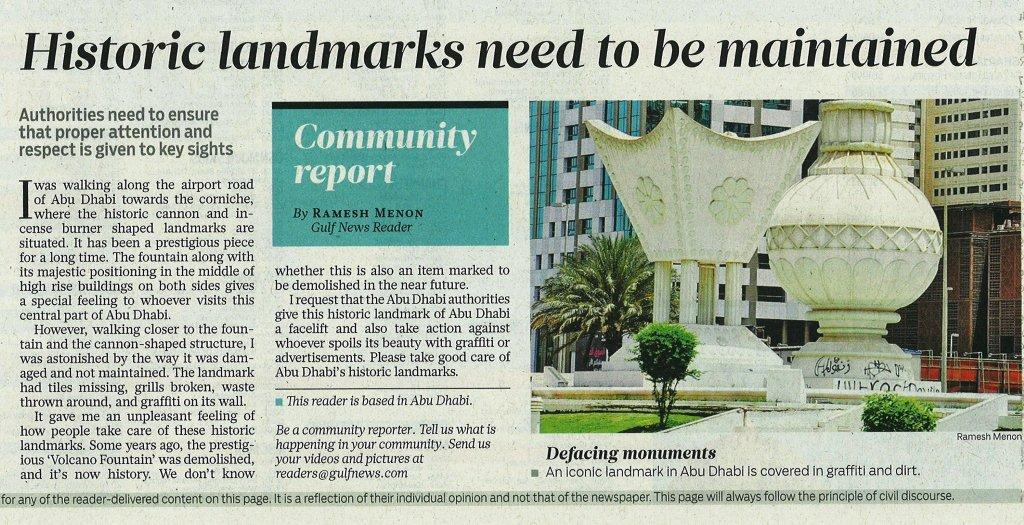
  • An iconic landmark in Abu Dhabi is covered in graffiti and dirt.

I was walking along the airport road of Abu Dhabi towards the corniche, where the historic canon and incense burner shaped landmarks are situated. It has been a prestigious piece for a long time.
The fountain along with its majestic positioning in the middle of high rise buildings on both sides gives a special feeling to whoever visits this central part of Abu Dhabi.
However, walking closer to the fountain and the canon shaped structure, I was astonished with the way it has been damaged and ignored for maintenance. The landmark had tiles missing, grills broken, waste thrown around, and graffiti on its wall.
  • Image Credit: Ramesh Menon/Gulf News Reader
  • The canon shaped structure appears to have been ignored for maintenance.

It gave me an unpleasant feeling of how people take care of these historic landmarks. Some years ago, the prestigious ‘Volcano Fountain’ was demolished, and it’s now history. We don’t know whether this is also an item marked to be demolished in the near future.
I request that the Abu Dhabi authorities give this historic landmark of Abu Dhabi a facelift and also take action against whoever spoils its beauty with graffiti or advertisements. Please take good care of Abu Dhabi’s historic landmarks.
This reader is based in Abu Dhabi
Be a community reporter. Tell us what is happening in your community. Send us your videos and pictures at readers@gulfnews.com


To read it in original, please visit GULF NEWS online

Mall shoppers left unprotected under the sun

Posted on Updated on

Mall shoppers left unprotected under the sun

Busy bus stop at Marina Mall in Abu Dhabi lacks bus shelter By Ramesh Menon, Gulf News Reader Published: June 29, 2012
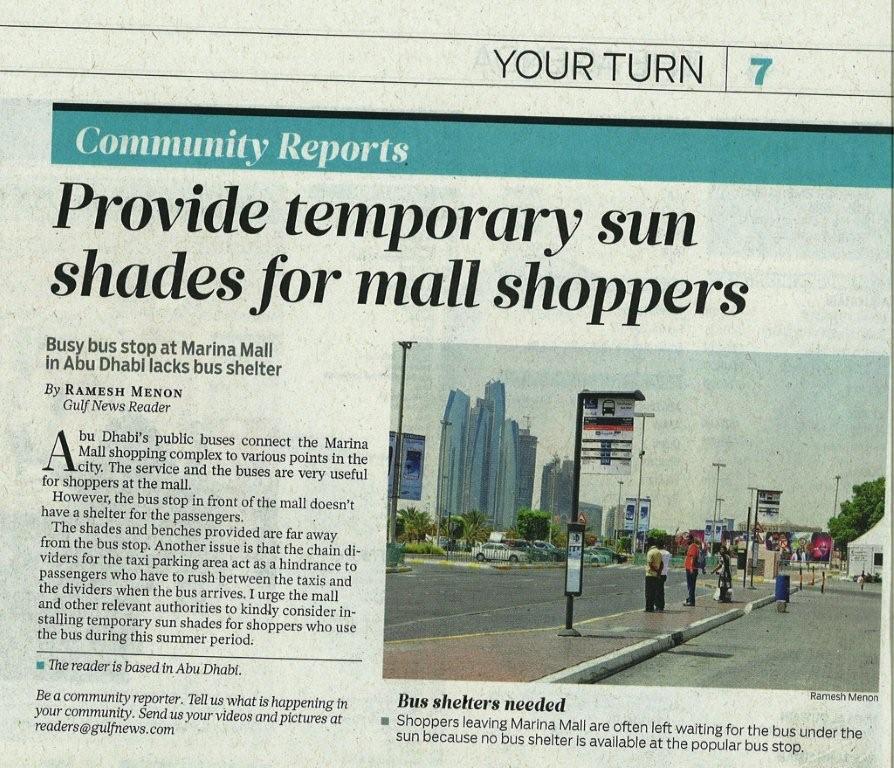
Image Credit: Ramesh Menon

Shoppers leaving Marina Mall are often left waiting for the bus under the sun because no bus shelter is available at the popular bus stop.

Abu Dhabi’s public buses connect the Marina Mall shopping complex to various points in the city. The service and the buses are very useful for shoppers at the mall.

However, the bus stop in front of the mall doesn’t have a shelter for the passengers. The shades and benches provided are far away from the bus stop. Another issue is that the chain dividers for the taxi parking area act as a hindrance to passengers who have to rush between the taxis and the dividers when the bus arrives.

I urge the mall and other relevant authorities to kindly consider installing temporary sun shades for shoppers who use the bus during this summer period.

The reader is based in Abu Dhabi.

Be a community reporter. Tell us what is happening in your community. Send us your videos and pictures at readers@gulfnews.com

To read it in original, please visit GULF NEWS online.

Indians in UAE can’t fly home

Posted on Updated on

Indians in UAE can’t fly home

Travel to India this summer is simply not affordable for ordinary salaried Indians in the UAE. The low-salaried shouldn’t even think about it. (Air India remains in holding pattern, June 22).

Almost no seats are available this weekend from Dubai or Abu Dhabi to anywhere in India, and the seats on offer seem to be priced starting at Dh3,200, or Dh2,500 one way.

With Air India’s labour unrest and other problems, travel back home has become a nightmare, especially for emergencies.

Helpless as ever, we non-resident Indians can only convey our wishes to India’s civil aviation authorities.

Ramesh Menon, Abu Dhabi

To read it in original, please visit The National online

Uncomfortable seating causes public bus users discomfort

Posted on

Uncomfortable seating causes public bus users discomfort 
No air conditioning a turn-off for bus users during cross-emirate trips

By Ramesh Menon, Gulf News reader, Published: June 24, 2012

Image Credit: Ramesh Menon/Gulf News Reader
While traveling from Abu Dhabi to Dubai, Ramesh Menon found his journey enjoyable as the newer bus was comfortable and offered a smooth ride.
In order to go to Dubai from Abu Dhabi one Friday morning, I decided to use the bus instead of driving, as I thought – why drive unnecessarily when there is an efficient bus system in place?
I went to the main bus station and was told by the security personnel to go inside the station to collect a ticket.
Inside, I approached a staff member to purchase a ticket and handed him a Dh100 note. He told me he had no change, but after waiting there for a few minutes and after a few other passengers had purchased tickets, I was able to get mine.
I walked back to the bus, which was one of the latest models and was ready and waiting. After a 10-minute wait, the journey started.
The bus was comfortable, the air-conditioner worked properly and the journey was smooth. I dozed off automatically, as I relaxed.
For the price of Dh15, I had the safest and most comfortable journey I could ever take to reach Dubai from Abu Dhabi.


>Image Credit: Gulf News archive
Menon’s trip back to Abu Dhabi was a lot less comfortable as the older bus’ air conditioning and seating were not up to par.


However, on my return trip, upon reaching the Bur Dubai bus station, I found the queue for the bus comparatively large. I found the ticket station and collected my ticket, but realised it was neither the same type of bus nor the same ticket price.

The bus was older and the charge from Dubai to Abu Dhabi was Dh25.
It was relatively noisy all the way to Abu Dhabi and the air conditioner was not at all proper. Rather, it was not there at all.
Added to all that, the seats were not at all comfortable and the two-hour journey back was really cumbersome.
By the time I reached Abu Dhabi, I was really tired, sweaty and exhausted.
While I commend this service provided to the general public and praise its efficiency, I humbly request the authorities check that the air conditioning system in each bus is in good condition.
Also, all buses should be fitted with comfortable seats, especially those taking passengers on a two-hour journey or longer. They could also set one price of Dh15 for the trip from Abu Dhabi to Dubai and back.
I am sure if these changes are implemented, more of the general public will show interest in using the bus services to travel between the emirates.

The reader is a technical officer based in Abu Dhabi.

Be a community reporter. Tell us what is happening in your community. Send us your videos and pictures at readers@gulfnews.com

To read it in original, please visit GULF NEWS online.

Midday break rule needs bolstering

Posted on

Midday break rule needs bolstering
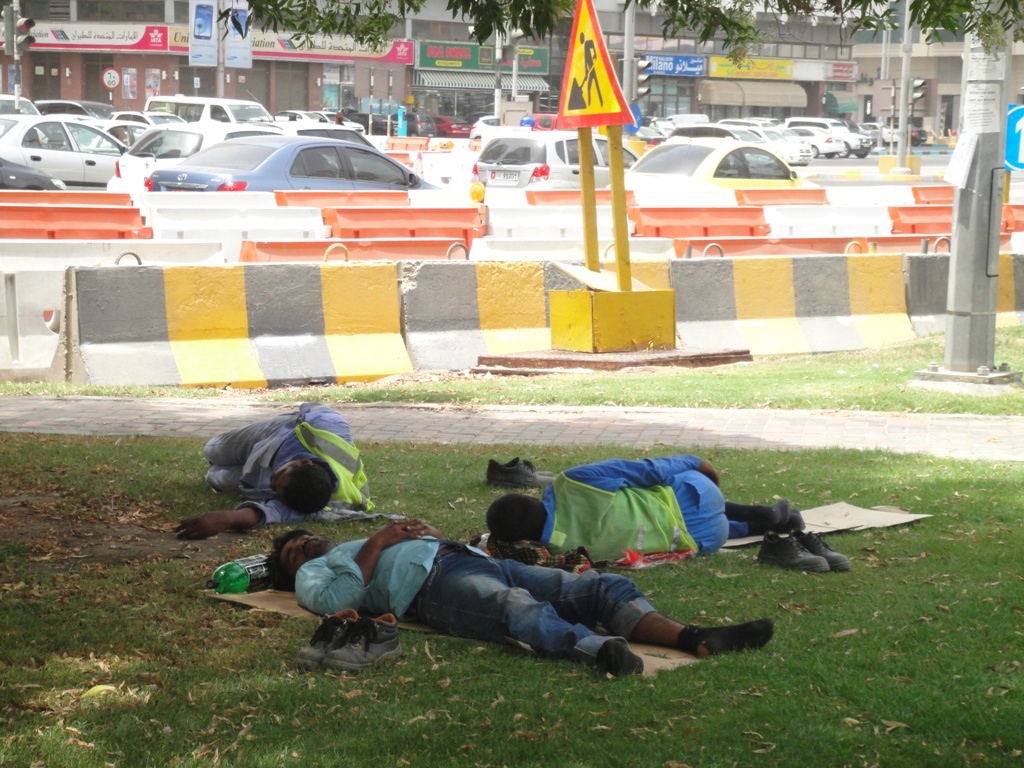
Talking to a group of labourers working outside one recent afternoon, I learnt that there are some side effects of the strict implementation of the midday break (Building sites stick to midday break rule, June 16). These side effects may even spoil the positive effects of the midday work stoppage.
For example, some workers are transported back to their individual labour camps, where they are forced to relax without air-condition or water facilities, as they are either switched off or cut to avoid usage during noon hours.
There are companies that take care of their workers, but not all of them do. And as I learnt, midday break rule violations are just the tip of the iceberg.
Take health care. If a worker from an irresponsible company becomes sick, he has to continue going to work or risks cuts to his salary. Medical assistance is also not always available in case of injury.
Authorities should put parallel survey and compliance procedures in place at labour camps during noontime breaks, to monitor how breaks are being given and to ensure workers are afforded comfortable rest, with air conditioning and water.
Checks should also be made with increasing frequency within the city to make sure workers are not toiling in the sun during noon hours.
Ramesh Menon, Abu Dhabi
To read it in original, please visit THE NATIONAL online

Cars running idle for a long period during hot summer
Posted on Updated on

I think we should fine drivers who keep their cars running idle for a long period (A midday break to benefit everyone, June 19).
Very often we get to see expensive cars with their engines on, without a driver inside and probably locked from the outside using a spare key.
The sight is common in front of major offices and shopping areas. This is a waste of valuable energy and may present a danger during the hot summer.
People ignore advice on this issue, just to avoid a few minutes of sitting inside a hot car – something they could easily overcome by driving for a few minutes with open windows.
I think the authorities should ensure that Mawaqif inspectors fine drivers those who do this.
Ramesh Menon, Abu Dhabi
To read it in original, please visit THE NATIONAL online.

A midday break to benefit everyone

Posted on Updated on

A midday break to benefit everyone

Enforcement of the law protecting workers who are out in the sun this summer period is commendable.

But perhaps the rule should be applied to others working outside. Mawaqif inspectors, for instance, are out all day. Why not give them a respite? While we’re at it, how about a summer free of Mawaqif parking fees? That would be a true win-win.
Ramesh Menon, Abu Dhabi
To read it in original, please visit THE NATIONAL online.

Cotton Clothing

Posted on Updated on

A clear and enlarged version of the photo can be seen below.

 
Cotton clothing

The Fujairah Municipality’s instruction to employers to provide appropriate light cotton clothing to those who work outside during the summer period, is praiseworthy.

I hope this and more worker-friendly actions will be followed by the other emirates, too, to safeguard those who work outside.

In addition, mandatory safety checks should be made on the tyres used on the heavy-duty trucks and public buses.

Let the progressive actions by the authorities reduce the summer stress for these silent heroes.

To read it in original, please visit Khaleej Times online.

Tenancy contract and utility bill mandatory for UAE residence visa

Posted on

Tenancy contract and utility bill mandatory for UAE residence visa

Rule will be implemented after summer break and people will be informed about it: top official
By Iman Sherif, Staff Reporter/GULF NEWS
Abu Dhabi: The authorities’ new requirement of a tenancy contract and copies of utility bills to get a residence visa has not been reverted but only postponed, a top official has confirmed to Gulf News.
“The implementation of the decree is not immediate, as the authorities are allowing a grace period for people to return from the summer holidays, and people will be informed of the dates when this becomes mandatory,” the official said.
“ The decision is not targeting any party or property group but it will serve those departments seeking accurate data about foreigners’ residences ”
Major General Nasser Al Awadi Al Menhali Earlier, the rule was to be implemented from June 1
According to Major General Nasser Al Awadi Al Menhali, the Assistant Undersecretary of the Ministry of Interior for Naturalisation, Residency and Ports Affair, requesting a copy of the housing contract or electricity and water invoice to issue a residency visa, is an administrative decision aimed at maintaining accurate records of people’s places of residence.
“Many residents change their addresses, and it has become difficult for the authorities to reach them. Labourers, whose companies provide them with group housing, have to provide a document that states their address along with a letter from the company, or any contract document, that proves where they live,” Al Menhali said.
Gulf News broke the story last week that tenancy contracts and electricity bills would be mandatory to renew a residence visa or to apply for a new one from June 1.
Security purposes
“The decree aims primarily to provide addresses of all residents for security purposes. The decree does not target a specific category of people, but rather provides the residency sector with accurate, updated and correctly documented database,” Al Menhali said.
“The procedure will be unified across the UAE. It is a procedure that is applied worldwide and not only in the UAE,” he added.
A residency official told Gulf News that the new decision is aimed at improving living conditions, as well as maintaining an accurate census of families living in the UAE and the number of members in each family.
“This procedure is to prevent more than one family from living together as currently four or five families share the same housing,” he said.
“Families will not be allowed to share housing,” he added.
Responding to queries Al Menhali said those sharing accommodation must also present proof of their residence by submitting a tenancy contract or utility bill in their names.
“Those working with companies which provide them with collective accommodation must present proof of their residence, an address and a letter from the employer showing where he resides,” he added.
Al Menhali underlined that the new rule is primarily aimed at verifying the residence of all expatriates living in the UAE for security and procedural reasons.
“It is a security, administrative and service decision taken by the immigration and foreign affairs departments in the country”.
“The decision is not targeting any party or property group but it will serve those departments seeking accurate data about foreigners’ residences,” he added.
My comments as follows:
Thank you for the clarifications on the tenancy contract requirements. This is not a new requirement for visa processing. However, the implementation of attestation process and procedures for residency proof documents, like direct tenancy contract with owners, rental agreement with agencies, and attestation of electricity and telephone bills, if mandatory should be done through an appropriate attestation desk controlled by the authorities. These attestation offices should be set up either at the immigration offices or at specific public points and should function throughout after office hours. This will help residents avoid running around from one office to another and can reduce waste of professional man hours for processing residency permits. Linking important facility ownership details with UAE ID cards will help assist this process of verification. Currently, car ownership is done in a similar manner and can incorporate the ones like tenancy details, etisalat and dewa account details etc. 

Ramesh Menon, Abu Dhabi, United Arab Emirates

To read it in original, please visit GULF NEWS online.