Month: April 2008
All gas cylinders to have improved safety valves
All gas cylinders to have improved safety valves
By Alia Al Theeb, Staff Reporter GULF NEWS Published: April 08, 2008, 23:39
Dubai: All domestic gas users will have new cylinder valves with improved safety features, a senior official announced on Tuesday.
The changeover will be executed with immediate effect in Dubai by Emirates Gas in partnership with Emarat. The valves and regulators are available from all authorised LPG (liquefied petroleum gas) cylinder distributors for a one-off payment of Dh40.
The move comes following a decision by the undersecretary of the Ministry of Interior in conjunction with Dubai Civil Defence. Major General Rashid Thani Al Matroushi, Director of Dubai Civil Defence and head of the committee that put in place a structure to enforce the decision, stressed the importance of all bottling and distribution companies’ commitment to the clauses under the Ministry’s decision.
Colonel Ahmad Al Sayegh, Deputy Director of Dubai Civil Defence, said faulty gas cylinder valves were time bombs and there had been many fires at houses, labour accommodation and Portakabins and this had led to a study on the reasons behind the fires.
“Experts said gas leaks or errors in the valves were the main reasons behind those fires,” he said.
The civil defence will implement the mechanism to ensure the use of the new attachments and initiate an awareness programme for residents. It will also perform checks on restaurants and other public places to ensure the new regulators and valves are being used.
Ali Mustafa, General Manager, Emirates Gas, said considering Dubai alone has 300,000 to 400,00 domestic gas cylinders in use, the environmental and safety advantages of the new valves will be tremendous.
Several advanced safety features
Dubai: The new valve has several advanced safety features and is being introduced after extensive research and trials.
It has a short one-piece body with high impact strength. It also has a protective gasket preventing the entry of dust and water and a self-closing valve preventing accidental leaks.
The regulator is equipped with an automatic cut-off mechanism to stop the flow of gas in case of a leak or cut in the rubber hose. The cylinder valve will close in case of a fire. The current cylinders when empty will be exchanged for a cylinder with a new valve by the distributor. Cylinders with this new valve can be operated only by a regulator supplied by Emirates Gas or Emarat. It is estimated that about 1,000 cylinders with new valves will be changed per day.
– Staff Report
Timeline: Blast history
March 29, 2008: Gas cylinder blast injures three workers in Ras Al Khaimah.
February 20, 2008: Seven hurt in villa gas cylinder explosion in Deira, Dubai.
May 19, 2005: Ten hurt and 22 shops and 70 vehicles damaged after a gas pipe leak caused a massive explosion in a restaurant on Al Wahda Street, Sharjah.
February 28, 2005: Massive gas cylinder blast wrecks Sharjah cafeteria.
December 19, 2004: Three injured in cylinder blast in the Al Wathba district, Abu Dhabi.
December 7, 2003: Gas cylinder blast destroys restaurant and shop in Ras Al Khaimah.
September 30, 2001: Gas cylinder explodes in apartment in Al Rifaa, Dubai.

Burj Dubai is world’s tallest man-made structure
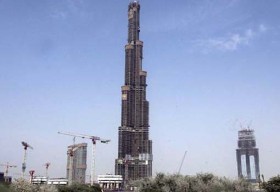
Burj Dubai is world’s tallest man-made structure
Agencies Published: April 07, 2008, 15:57
Dubai: Burj Dubai has surpassed the United States’ KVLY-TV mast in North Dakota to become the world’s tallest man-made structure.
Burj Dubai is now 629 metres high while KVLY-TV, which held the record for the world’s tallest supported structure since 1963, has a height of 628.8 metres.
Burj Dubai is already the world’s tallest building, and at 160 storeys, is taller than Taipei 101 (508 metres) in Taiwan and CN Tower (553.33 metres) in Canada.
Burj Dubai is billed to meet all four criteria listed by the Council on Tall Buildings and Urban Habitat (CTBUH), which classifies the world’s tallest structures.
CTBUH measures the height of buildings to the structural top, the highest occupied floor, the top of the roof and the tip of the spire, pinnacle, antenna, mast or flagpole.
The KVLY-TV mast in Blanchard, North Dakota, is a television transmitting mast, which was completed in 1963.
It’s a trophy life

It’s a trophy life
Enid Parker (Staff Reporter)KHALEEJ TIMES
7 April 2008
Pooja Vinod, who has been awarded the prestigious Shaikh Hamdan bin Rashid Al Maktoum Award for the Distinguished Student in the Basic Education Category, gets candid with City Times
WHAT FIRST caught my eye as I walked into Pooja’s home was the glass-fronted cabinet with dozens of gleaming trophies.
“She has over 40 trophies and 85 certificates to her credit,” smiled her parents. I gulped, a little overwhelmed already as I sat down with this poised young lady who studies at the Our Own English High School in Dubai, and has been awarded the prestigious Shaikh Hamdan bin Rashid Al Maktoum Award for the Distinguished Student in the Basic Education Category (Grades 1-5) for the year 2007-2008. The award will be presented on April 8.
“The criterion for the award was academic performance, co-curricular activities and overall excellence,” says Pooja.
At this I ask her if she always comes first in class. ‘Yes,’ she answers with a smile. Her mother Praseena, a Mathematics teacher, adds, “Right from Kindergarten she took an active interest in studies. She does her homework by herself; we never had to remind her to study.” Her father, Vinod Kumar, a Telecommunication Engineer, adds, “She’s always been number one in academics.”
Intrigued by a child who’s actually interested in studying, and recalling my own distracted primary school existence, I was curious to find out what her other interests were. “I like singing, dancing, drawing, coin and stamp collecting, travelling, swimming and making projects from waste materials,” she says in her clear voice brimming with confidence, adding that she likes drawing most. “I like doing sceneries and also cartoons, like the ones in colouring books.”
Music
Pooja’s accomplishments in music are noteworthy; she has won prizes in many music contests and has participated in classical music concerts as well. She receives training in classical music and light music from a tutor and says she likes to sing ‘all kinds of songs.’
“She sings everything from classical and light to popular music – in Hindi, English and Malayalam,” adds her mother.
She is a fan of Celine Dion, particularly the popular ‘My Heart Will Go On’ from the soundtrack of the movie Titanic. At the Heart Song competition held at Ski Dubai for the release of the movie ‘Happy Feet’, she won the best singer in the sub-junior category for her rendition of ‘My Heart Will Go On.’ She also performed the song live on Valentine’s Day at the Indian Pavilion at this year’s Global Village.
On the radio
She’s enthusiastic about her radio performances. “I like being on the air, people get to hear my voice… and its fun doing radio advertisements; I have recorded one for Indomi Fried Noodles in Hindi as well as Malayalam.”
A little princess
Pooja played the role of Princess Ariel in The Little Mermaid as part of a cultural programme conducted by her school last year. “It was a musical drama and I had to both act and sing.” I didn’t have to ask her if she liked it, her expression said it all.
Hobbies
So with all this on her plate – so many extra-curricular pursuits and being number one in academics, does she have any time for normal kids’ stuff like games and dolls and toys?
“I like playing with dolls, but now I love kitchen sets more,” she says, and at this point I can’t help talking about my favourite brown ceramic tea set that I had as a child. She laughs and says she has one like it too. She talks about a game called ‘Stuck in The Mud,’ which she loves to play and according to her is ‘very funny.’
And what about books? “Enid Blyton is my favourite author, especially the story ‘The Little Lost Hen.'” I almost begin to reminisce about my own Enid Blyton favourites, then realise with a twinge of regret that its time to leave; I’ve really enjoyed chatting with her.
So does she ever get camera shy or have stage fright? Her smile tells me the answer to that one. “I’m all set for the big day,” concludes this charming and articulate young lady who no doubt leaves a big impression on whoever she meets.
Pooja has won accolades for singing, dancing, public speaking, elocution, story-telling and art. Some of her accomplishments include:
* Sub-junior ‘Kalathilakam’ (overall champion) in the Open Youth Festival 2006-2007 conducted by ADMS
* First prize in the Karaoke Malayalam Film Song competition held at the Indian Consulate in May 2006
* First prize in film song competition at the ADMS UAE Open Youth Festival conducted in January 2008
* Her song was broadcast by Asianet Radio 94.7 fm during the ‘Voice of the Year’ programme
* At the prestigious inter-school KGS music festival, she secured first prize in the group event during the year 2006-2007
Road accidents claim 21 lives in 72 hours
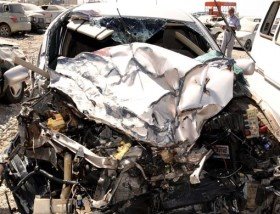
Road accidents claim 21 lives in 72 hours
By Alia Al Theeb, Mariam Al Serkal and Rayeesa Absal, Staff Reporters GULF NEWS
Published: April 07, 2008, 00:35
Dubai/Sharjah/Abu Dhabi: A driver was killed in a horrific accident near National Paints bridge in Sharjah on Sunday, taking the death toll in road accidents nationwide to at least 21 in just 72 hours.
In Sunday’s accident the driver rammed into a cement mixer, police said.
The weekend also saw a spate of accidents. A young Emirati was killed in Al Ain on Saturday when he was driving without a licence. An Asian woman died on Saturday when she was run over by a car while crossing the road on Shaikh Zayed Road.
A father and his two-year-old daughter were killed early Saturday when their car plunged into a pedestrian underpass in Abu Dhabi.
Three people were killed in a gruesome accident on Friday on Dubai’s Al Khail Road when a sewage tanker first hit a minibus, which was then hit by a bus. A six-year-old Emirati boy died on Friday in Ras Al Khaimah when a heavy vehicle rammed into the car his father was driving.
But the worst accident occurred on Al Wagan Road in Al Ain on Thursday night in which 12 people were killed.
President His Highness Shaikh Khalifa Bin Zayed Al Nahyan yesterday offered his condolences to the families of the victims.
An official from the Dubai Police Traffic Department said speeding, failure to maintain proper distance between vehicles, driving under the influence of alcohol, reckless driving and lack of consideration for other drivers are the main reasons behind most road accidents.
Some 1,056 people were killed in traffic accidents in the UAE in 2007. According to Yahoo, more than 1 million people are killed worldwide, and more than 50 million are injured in traffic accidents each year.
Statistics: Too many offences
According to statistics, Dubai police’s traffic department reported 33,886 traffic offences in Bur Dubai in March. The traffic control teams also confiscated 232 vehicles for violating traffic rules.
Major Ahmad Bin Delan, Director of Bur Dubai Traffic Department, said blocking traffic topped the list of offences with 8,033. He said this offence adds to traffic congestions.
Other traffic offences included lane line violation by light vehicles, reckless driving, parking on pavements, driving on the hard shoulder and jumping red signals.
Statistics from Abu Dhabi revealed 1,312 offences were committed from March 1 to 15.
These offences included speeding, jumping a red signal, reckless driving and entering a road dangerously.
Adnoc to sell cooking gas at reduced prices
Adnoc to sell cooking gas at reduced prices
By Sebugawaawo Ismail (Our staff reporter)KHALEEJ TIMES 7 April 2008
RAS AL KHAIMAH — Residents of Ras Al Khaimah will soon get a chance to buying cooking gas at reduced prices as Adnoc will soon start selling LPG at its fuel stations in the emirate.
Senior officials from Adnoc have confirmed that the company has made the necessary arrangements and have got approvals from the Ras Al Khaimah Department of Economic Development (DED) to open up cooking gas outlets at seven Adnoc stations in Ras Al Khaimah.
The official said that the move comes following several requests from officials of the DED and RAK residents to start selling cooking gas in the emirate as the existing cooking gas companies and distributors in the emirate were arbitrarily increasing the prices on the pretext of having paid more for procuring gas from their suppliers.
Hassan Hamad Al Shamsi, Deputy Director-General, Department of Economic Development, said that after several complaints from the residents about the arbitrary price hikes by gas suppliers, they had decided to hold monthly meeting with them and set the prices to protect the consumers.
He stressed that in their last meeting, which was held in March, the price of a standard 22kg cylinder was fixed at Dh86, the 11kg cylinder at Dh43 and 44kg cylinder at Dh172.
“We have been trying to fix these prices fairly to see that no party is cheated but still the prices of cooking gas in Ras Al Khaimah are very high compared to other emirates,” said Al Shamsi.
He noted that Adnoc will soon start selling cooking gas in the emirate and the gas prices are expected to come down as this was agreed upon by both the Ministry of Economy, DED and Adnoc officials in the emirate, to fix prices according to the company policies.
He explained that Adnoc price in Abu Dhabi is Dh35 for a standard cooking gas cylinder and Dh22 for the smaller one, which is far lower than the current rates charged by gas companies and distributors in Ras Al Khaimah.
Texting while driving is risky, say UAE residents
Texting while driving is risky, say UAE residents
Staff Reporters, Mariam M. Al Serkal, Dina El Shammaa, Fuad Ali GULF NEWS Published: April 06, 2008, 00:31
Dubai/Abu Dhabi/Fujairah: Free dinners, free concert tickets, or free health spas – what kinds of competitions distract you from driving?
The majority of motorists have dedicated themselves to listening to their favourite radio station while commuting, and cannot help but hear the alluring offers that demand them to send a text message via their cell phones.
Can motorists continue to focus their senses completely on the task of driving despite the airwaves alluring them into attractive promotions?
City Talk took to the streets and asked residents whether they have ever sent text messages to radio competitions while driving, if they think it is a hazard to do so, and should sending text messages while driving become an offence?
Investigator Barbara Radwan-Wiehe, from the United States, said: “I am technologically inept so texting through my cell phone is something I rarely do, I am old school. However I definitely think using your phone while driving affects your concentration span and ability to watch the road. I try not to use my phone while driving because even if you are careful, other drivers next to you may not be.
“There should be strict regulations to prohibit cell [phone] usage during driving.”
Hadeel Mohammad, a 23-year-old student from Iraq, said: “Even though I don’t participate in radio competitions I usually send text messages while driving because once I receive a message I don’t want to keep the other person waiting. I’ve never been involved in an accident while sending text messages, but I know that it’s dangerous to do so.
“I think a rule should be implemented so that motorists will be fined when caught using their mobile phone.”
Ali Khalil Qasim, 26, Egyptian airline staff, said: “I have noticed there are often listeners of radio shows who send text messages and call the shows while they are on the road and I often ask myself how safe is that?
“A lot of concentration is required on the road and it is highly irresponsible to engage in texting while driving. “Sometimes if the car is stuck in traffic and you’re stationary then maybe it is safe to use the phone, but still, it will take your mind off the road and other drivers around you.”
Ebrahim Mohammad Quwayes, 26, car rental agent from Egypt, said: “I have never considered texting while driving because I know how dangerous it is. It’s hard enough to drive and talk on the phone because your concentration on the road is compromised, but texting actually takes your eyes off the road, which is seriously dangerous to all road users.
“I think it’s highly irresponsible for radio presenters to invite and read out comments from drivers without pointing out basic safety reminders as a reminder to all road users.”
Fadi Ganem, a manager from Lebanon, 32, said: “I used to send text messages and [narrowly] escaped many accidents. That’s why I have stopped. Now when I see others driving and playing with their [cell phones] I get really mad because they do silly mistakes on the road.
“There used to be a strong campaign against motorists using their [cell phones] but now it’s not as important anymore, and police are not doing anything. The campaign against mobile phones should be re-introduced.”
Eyad Nasim, a Jordanian manager, 40, said: “It is inconsiderate to send text messages while driving, but when you’re stuck in traffic for 45 minutes to an hour then you can afford to do it.
“I don’t reply to competitions, and the only time I send messages is when they are work related or if someone wants to know where I am.
“I don’t think there should be a heavy fine against motorists using their cell phones, but it should be implemented on an accelerating basis. So every time you get caught, you will have to pay a higher fine.”
Hamdan Mohammad Al Mulla, an Emirati executive manager, 22, said: “I think radio stations should take some responsibilities in this matter.
“After all, it is they who encourage listeners to call or text them. Using the phone in any capacity while driving is very dangerous for both the driver and other motorists, and young drivers in particular need reminding of that.
“Radio stations should always remind listeners on the road not to communicate with them while they are driving.
“With every invite to participate in a programme, a warning about safe road practice should be made out advising drivers to pull-over if they want to take part.”
Abdul Kader, 45, an Indian supervisor in an automobile workshop, said: “I have never used my phone while driving, it’s very dangerous.
“How can you possibly concentrate while using your cell phone or sending a text message?
“I believe people should be advised on an individual basis. I personally advise people not to use their phones at all while driving. It’s just too risky and keeps you unfocused on the road.”
Electrical engineer Enas Khalid, Egypt, 33, said: “I am all about safety while driving. I have two children, a one-year-old and the other is four, and I make sure they sit in the back seat of the car every time.
“It is impossible to use a [cell phone] or text while driving. I believe day dreaming in general while driving is dangerous and think strict laws to prohibit cell phones while driving in general should be implemented.”
A million dollar company built on a failure
A million dollar company built on a failure
Prasanna D Zore | October 23, 2007 | 16:57 IST
He started his first Internet Company, Radio FM, a streaming online radio portal, when he was a mere 17-year-old.
His father was not happy that his teenaged son was wasting most of his time online, rather than preparing for his exams. His stand was vindicated when his son’s maiden venture failed to produce any profits.
But Vishal Sampat, now Ceo of Convonix.com, wasn’t about to give up. He maintained his faith in the Internet, and transformed Radio FM into Khopcha.com which, in turn, became the genesis for Convonix.com, a search engine optimisation company.
Today, Convonix is a one million dollar company and by March 2008, Vishal is confident of doubling his company’s turnover.
As somebody who has gone through the trials and tribulations of starting an Internet business and learning from his failures, here’s what the 25 year old CEO of Convonix?has to tell budding entrepreneurs: “The world will never believe in you till you achieve something. But if you believe in yourself and what you are doing is right and has a future, then you should persevere and work honestly towards your goal. If you do this you will surely be successful one day.”
Can you tell us about your early days in school, college and the time you started your first online streaming radio venture, Radio.com?
I was born and brought up in Mumbai. I studied St Xavier’s?School and completed my SSC in 1997. After that I did my engineering.
I started my first online radio streaming business in 1999-2000. Those were the early days of the Internet in India, when it took half an hour for someone to get connected online. The reason we started this venture was we believed that there was a huge audience abroad who would be interested in Indian music and, for that matter, in knowing?what’s happening back in their own country.
A cousin of mine who was into radio got for me some audio capsules which I could play in between the 20-30 minute programme. We used to have songs as well as the RJ capsules in the middle.
Basically, none of us knew what we were doing and I had no money. So what we did was we got free space from various free web hosting companies that operated at teh time, like Geocities. We managed to get the load balanced with these servers and got our online music channel going.
How much money did you put into in this venture?
I invested Rs 3,000-4,000, with my father footing the Internet bills (laughs), which at that time was very expensive compared to what it is now. He wasn’t very happy about that though (laughs).
Did you make any profit out of this venture?
No, we didn’t. We did succeed in getting?around six and a half million visitors, but it was too expensive to carry out this business online. Of course, being in college and having no sense of economy helped us make no profits (laughs). Finally, this website transitioned into another website named khopcha.com, a portal for teenagers.
Though the portal is still online, we don’t maintain or update it regularly now. It was this experience that helped me start Convonix.com. The first venture, however, still has sentimental values.???????
What inspired you to start this streaming online music portal then?
It was something that just struck us. It was this huge market that was waiting to be tapped. The late 1990s and the early 2000s was an era of the dot com boom and everybody wanted to be online then. This venture was something that we thought we might try and make a lot of money out of, which actually didn’t happen.
What did you learn or gain from this failure?
You can’t call it a failure as such.?It was lot of fun. When Radio FM and khopcha were both online, we did not have money to market the product and services we offered online. This was the genesis of my current venture.
I used search engines to market both the services; I used online portals; I learned about banner exchanges; all kinds of online marketing tools. This experience helped me a lot in offering various products under the Convonix name now.?
Can you explain Convonix’s business model? Who are your competitors globally?
Let me first explain the main business of Convonix, that is, search engine optimisation or SEO.
Suppose you are a bank who wants to sell credit cards. When people search for such services online, they get a list of links on which they click to avail the service. What we do is we consult the banks that want to do business online and get maximum traffic directed to their portal.
SEO helps such institutions to maximise the use of Internet as an active marketing tool to sell their services and products. What we do is we identify who is searching for their products and services, estimate the number of searches, what are the key words they are using for their search and where they are looking out for their requirements.
Convonix helps these businesses to get their portals on top of such a search list. This is SEO and its benefits to the potential customers.
Well, that’s our primary service but we are also into Internet marketing like social media optimisation, which includes crawling the blogs (which are very huge nowadays) to find out who wants what. We are also into paid advertising business.
Our competitors would be ad agencies who are getting into online marketing business. Apart from that there are a couple of big players as our competitors. However, we have the first mover advantage and there is lot of work going around.
Also, SEO is a niche field and it will be very difficult for a traditional ad firm to compete with us and build the core competency needed for this business.
What are the fundamental principles that guide Convonix?
One of our biggest principles is Under Promise and Over Deliver. You will never find one of my guys coming to you promising the world and then failing her/his word.
We’d rather play it conservatively than go over board and fail to deliver. We promise only what we believe can be done, and?then we?do a lot more?than that.
Secondly, we follow a very consultative approach. My team members would first ask you about your business, your goals and then say what we can do about it. Very frankly, we have gone ahead and told many of our customers that a certain thing cannot be done. Of course, we have lost business because of this discipline of ours (laughs).
It really makes no difference if we lose some business because of this, but we don’t want to cheat on our clients.
How would you define your role and responsibilities at Convonix, you being the founder of this company?
My basic responsibility towards my company is to see that it grows as planned and all my employees are happy working with the company. Get talented and skilled people on board, strategising on novel ideas to expand my business. I no more look after the day-to-day operations, which I used to do just a couple of years ago.
How many employees do you have?
We have around 50 employees spread across our two offices in Mumbai. We have just purchased a new 10,000 sq ft office in Navi Mumbai that will help us to triple our headcount.?
What kind of turnover and profit margins are you looking out at in 2008?
Our turnover last year was around a million dollars, and we are looking at double that figure in 2008. Our profit margin is very healthy, as we use a lot of consultative approach, but it is difficult for me to give you a number on that. It could be safely assumed to be 30-40 per cent of our annual turnover on a conservative basis.
80 per cent of our revenues are generated from businesses based out of India. We started the partnership model when we started this business, as it was the best way to get some foot holding in the markets abroad then. We tied up with overseas marketing companies and web solution providers. We handle the sales there and manage all the campaigns from here.
A few of our clients in India are Just Dial, Apnaloan; we have also worked with Indian Hotels, Eitihad Airways and currently we are running a campaign for Sun Pharmaceuticals.
Our clients overseas include the best names in the hotels, airlines and travel portal business. We also do business with ClearWire, which is a listed company on the US stock exchange.
Are you the only owner of this company and do you have any plans of taking Convonix public in the near future?
Yes, I am the sole owner of Convonix. About the other question, we have a strong revenue model and cash is coming internally to fund our expansion plans. In the near future we don’t have any plans of going public. Even the money to fund the 10,000 sq ft facility that we bought came out of internal accruals. What’s more, ours is a debt-free company.
Can you tell us about your interesting journey from an online radio streaming business to a one million dollar company Convonix?
It was indeed an exciting and interesting journey to begin with. Every day we learn something new, and adapt it to improve our businesses. Initially, when I started Radio FM, people didn’t know what I was doing. To add to it I wasn’t making any money from the business. And I was wasting a lot of time online, according to my dad, instead of studying (laughs). That was difficult, but from 2002-2003 when I started explaining to people about my first business the germ of Convonix started taking roots.
It was me and two of my colleagues from school, Pallav Jain and Sarfraz Khimani — the former passed out from IIM-A and the latter will pass out from IIM-C in March 2008. I had pulled these guys midway from their engineering courses, and they were firm on completing their academics. We are still very close friends; we used to work out of my bedroom. That’s when the revenues started flowing, and that’s when my parents started believing in my business. After that everyone started supporting me.
The reason why I am here today is because I got the best team that I could have ever got and great support from my family and friends. ????????????
What would be your advice to budding entrepreneurs?
First thing would be, if you believe in yourself and that what you are doing is right and has a future, then you should persevere and work honestly towards your goal. If you do this, you will surely be successful one day. You will get a million people who will laugh it off and discourage you from doing what you are doing, but you have to persevere. The world will never believe in you till you achieve something. That perhaps is the most difficult aspect for the people who are starting on their own.

 ClicksandWrites
You must be logged in to post a comment.