Month: April 2008
Email id can reveal your personality
Email id can reveal your personality
28 Apr 2008, 0412 hrs IST,PTI
LONDON: Think twice before you pick an email address — it can reveal your personality.
Researchers at the University of Leipzig in Germany have found that an email address may speak volumes about the character of the person who created the unique online identification.
According to lead researcher Mitja Back, even the thinnest slice of communication via the world wide web — the mere email address — contains valid information about the personality of its owner.
In their study, the researchers asked a panel of 100 students to guess the personalities of 600 young adults simply by looking at their email addresses.
The panel’s guesses agreed mostly with a personality survey the teenagers had completed when it came to qualities like openness, conscientiousness and narcissism, and diverged most on the trait of extroversion.
Addresses that gave away personality often contained full stops, numbers or a name that was obviously not genuine, the researchers found.
Level of accuracy was explained using lens model analyses — the students made broad use of perceivable email address features in their personality judgements, features were slightly valid and the observers were sensitive to subtle differences in validity between cues.
The study has been published in the latest edition of the Journal of Research in Personality.
Hydrocarbon sector’s share in Abu Dhabi GDP diminishing
Hydrocarbon sector’s share in Abu Dhabi GDP diminishing
By Haseeb Haider KHALEEJ TIMES 27 April 2008
ABU DHABI — With the diversification of Abu Dhabi’s economy, the dominant role of oil and gas sector is being diminished as in 2007 it contributed 65 per cent to the GDP from 66.3 per cent in 2006 and 66 per cent in 2005.
According to an Abu Dhabi Planning and Economy Department weekly status report on the emirate’s economy, share of the government sector to the GDP was estimated at 18.5, 16.7 and 16.1 per cent in 2005, 2006 and 2007 respectively.
Restructuring: The government is currently undertaking a wide-ranging restructuring programme to arrive at the best formula of governance which envisages sustainable constructive public-private partnership.
The restructuring programme has produced new public entities like the Abu Dhabi Tourism Authority and Abu Dhabi Council for Economic Development that have specific and clear-cut targets and in which the private sector has a major role to play.
Other entities like Abu Dhabi Education Council and Abu Dhabi Health Authority were also created to upgrade health and educational services.
Private sector: The private sector’s contribution to GDP rose from 15.5 per cent in 2005 to 17 per cent in 2006 and 18.2 per cent in 2007.
The situation needs restructuring of the sector and creating a favourable working environment and removing obstacles hindering its progress and the development of its potential.
The public and private sectors should come together to adopt private-sector oriented economic policies given the strategic operational options under the economic openness adopted by the government.
Other goals include optimum utilisation of competitive edges of the private sector and forging strategic alliances based on mutual interests.
The future of economic development in Abu Dhabi hangs to a large extent on the nature of partnership between the public and private sectors.
Broadening the scope of this partnership and boosting its ability to act as the key driver in the emirate’s economy is the only option to address and tackle the economic challenge ahead, the report said.
However, the private sector is still suffering from drastic deficiencies and defects which invite formulation of proactive, effective restructuring policies from its foundation and motivate it to develop its own capabilities so as to compete in regional and international markets.
Policies seeking to enhance the efficiency of the private sector should based on the following factors :
* Giving the private sector a greater role in carrying out development projects and achieve socio-economic development which is based on diversification of income and economic base.
* Outsourcing more public utilities
* Stimulating research and development of competitive national products
Motivating economic cooperation to merge and create major private sector firms that focus on high value added capital-oriented sectors.
* Providing favourable business and regulatory environment conducive to increasing of productivity.
* Building more modern infrastructure and introducing incentive regimes.
* Offering financial and moral support and incentives to spur national plans to recruit Emiratis and transfer technology to the emirate.
* Facilitating adoption of modern efficient administrative systems at bar with those adopted in advanced economic nations.
* Streamlining issuance of commercial, industrial and professional licences as per economic feasibility studies and actual needs,
* Drawing industrial investment plan to encourage the private sector to play its role in industrial development.
Residents of Sharjah flock to Adnoc for low-price petrol
Residents of Sharjah flock to Adnoc for low-price petrol By Sunita Menon, Staff Reporter GULF NEWS Published: April 28, 2008, 00:05
Dubai: Residents of Sharjah and the northern emirates are making a beeline for Adnoc fuel stations because they can still pay by credit card, and their petrol is cheaper as well.
Adnoc has over 180 fuel stations in Abu Dhabi and the northern emirates.
It is the only company to sell E+ (octane 91) petrol, at Dh5.75 per gallon, a dirham less than Super petrol.
“Work at the fuel station has doubled with Sharjah residents coming to fill up their cars at Adnoc stations. They can pay by credit card and the petrol is cheaper,” said an Adnoc attendant at the fuel station on Al Ittihad Road in Sharjah.
“Motorists who own ordinary cars choose E+, but those who have luxury cars choose Super quality,” he said.
Emarat, Eppco and Enoc petrol stations stopped accepting credit cards last October, citing high bank charges. Since then motorists have to pay either in cash or with smart cards.
Adnoc said motorists can look forward to more savings once self service is introduced at their fuel stations.
Motorists in the northern emirates, especially those who own saloon cars, said they saved money by using E+ petrol.
Majid Abdullah, an Indian resident, said he has not visited a fuel station in Dubai since Adnoc opened their outlets in Sharjah.
“The best thing is paying by credit card and the E+ petrol. I hope they do not stop accepting credit cards.”
Mahmoud Ali, an Iraqi from Sharjah, said: “I used to fill my car with Special [octane 95], but with prices going up all the time I switched to E+. Now I pay much less.”
Ashraf Siddique, a Pakistani resident from Ajman, said he shifted to E+ only a couple of weeks ago when fuel stations in the emirate ran out of Special.
“It was an Eppco gas station attendant who told me to go to Adnoc and get E+ because they only had Super on that particular day. Now I plan to use this type of petrol regularly as it suits my wallet,” he said.
E+ petrol is sold only at Adnoc fuel stations. It costs Dh5.75 per gallon. Diesel costs Dh8.50 per gallon at Adnoc. Diesel costs Dh15.30 per gallon at other stations.
The price of other types of petrol is the same at Adnoc, Emarat and Eppco stations. Special (octane 95) costs Dh6.25 per gallon, and Super (octane 98) Dh6.75 per gallon.
BP hopes to sign oil deal with Iraq
BP hopes to sign oil deal with Iraq
Simon Webb for The National
Contract terms could set the pace of development. Bloomberg
DOHA // BP hopes to sign a service contract designed to boost output in Iraq by 100,000 barrels per day (bpd), a senior executive said.
The deal is one of five that Iraq is negotiating with major oil companies to boost output by 500,000 bpd, or nearly a quarter, from its largest oil fields.
“I’d say we might sign around the middle of the year,” said Steve Peacock, the president of BP’s Middle East and South Asia exploration and production unit. “These are active discussions with serious intent, there is no sense that they’ve stalled or reconsidered, it’s just taking longer than anticipated.”
Payment terms for the service contracts were yet to be concluded, he said. Iraq has indicated each contract could be worth up to $500 million.
Iraq wants to sign two-year technical service contracts with major firms as part of stopgap measures to boost oil production in the absence of a vital oil law. Legislation to set the terms and extent of foreign investment in the country has been stalled in parliament for more than a year.
“In this politically sensitive and difficult situation, service contacts are a pragmatic step forward for Iraq,” Mr Peacock said.
Oil firms would prefer contracts that offer long-term involvement in Iraq and were looking for a link in the service contracts to future development of Iraq’s giant oilfields.
“Whether it gets linked into the contract or not – it’s a natural question that’s on the table. These contracts are valid for a couple of years; how does that link with what comes afterwards?” Mr Peacock said.
The longer-term link would help ensure that work undertaken under the two-year contracts would be in line with future field development plans, he added.
Mr Peacock said he was confident that the companies concerned and Iraqi negotiators would come up with a contract that gave an incentive for firms to use all their skills and expertise, while at the same time respecting political opposition to deals that gave companies a share in production.
The terms of the contracts could set the pace of oil field development for years to come, he said.
“I think it’s important acknowledging the political sensitivity of using barrels as a form of reward,” Mr Peacock said.
“That shouldn’t be confused with giving up national sovereignty over the ownership – that’s never in question. The question is, do you want to use barrels or cash as a form of reward? Whichever it is, I think, is going to be key for the long term. It will determine how fast production can be realised and how fast new developments can be brought on stream.”
The service contract Iraq is negotiating centres on the giant Rumaila oil field in the south of the country.
The target to boost output by 100,000 bpd from the field was possible, although to do so in two years would require an aggressive development plan, Mr Peacock said.
The contracts call for larger project management roles in the fields. Aside from boosting production and long-term planning, the oil firms would be required to bring in supplies to Iraq.
Companies will supervise the work from outside the country as security concerns will prevent them from sending in ground staff, at least initially.
The companies have studied the same fields and have provided training and technical assistance for years as they look to position themselves for any future contracts.
“We’ve studied the whole of the rest of the country, so we’re waiting for what comes next after the service agreements. And we have an opinion on which bits we’d be more interested in,” Mr Peacock said.
BP was in similar discussions in Kuwait, he said.
Kuwait aims to include a performance-related clause in its service contracts that would increase the attraction for signing up for international oil companies.
Discussions currently revolved around the details of that clause. Mr Peacock said: “If Kuwait were to pay more for that expertise, how could that be justified? One way to justify it is to link it for achievement of output. The devil is in the details – how aggressive are the targets and how much do you get paid if targets are met?”
The contracts would likely be concluded over a period of months, he added. In Oman, drilling would start on BP’s project to develop tight gas reserves by the end of the fourth quarter.
The company is evaluating different ways of commercialising gas output from early appraisal wells. BP won a contract to develop tight gas reserves in Oman in early 2007. The reserves are in complex formations from which it is difficult to extract the gas.
* Reuters
Can Dubai sustain more mega malls?
Can Dubai sustain more mega malls?
Last Updated: April 24. 2008
Since Singapore was labelled the world’s leading retail destination in 2005, Dubai has set out to outpace, outdo and out-shop the Asian city and any other competition in its bid to build the emirate as a shopper’s paradise and attract more tourists to the “shopping hub” of the Middle East.
In fact, Dubai has already achieved this goal, as it was recently ranked eighth among the top 15 international retail markets, while Singapore fell to 13th place, according to the global emerging markets survey released two weeks ago by CB Richard Ellis.
Retailing has changed dramatically in the past five years, with high-profile developments bringing in high-end labels to Dubai. Today, 40 per cent of retail sales are generated by tourists, so continued success depends heavily on an increase in travelling shoppers.
Dubai already has the region’s largest shopping centre, Mall of the Emirates, complete with its own ski slope. Dubai Mall, near the world’s tallest building, Burj Dubai, will become the world’s largest mall, according to the developer, when it opens at the end of August, while the giant Mall of Arabia is in the making and is due to open in 2010. Three of the world’s five biggest malls will be in Dubai – but can Dubai really sustain more mega malls?
Currently, the emirate has 4.2 billion square metres of retail space and, with Nakheel’s recent announcement that it plans to develop five new mega malls, a few hundred million more square metres will be added by 2012.
However, if you look at the numbers, Dubai is already heading towards overcapacity by 2010. Based on current shopper numbers, per capita retail spending would have to increase by 280 per cent to support the planned retail space growth – without taking Nakheel’s expansion into consideration.
Newly developed communities will need retail space to reach a wider consumer base and offer shopping in the direct vicinity of residents, and this is the niche that Nakheel intends to cover. Although faced with no other choice than to offer more retail space, will Nakheel compete in a sector where market share can only be gained by taking it from others?
The success of a mega mall does not solely depend on community traffic; it also relies heavily on shoppers from further afield. In an environment where size is not the only differentiator, success is also dependent on the entertainment factor and attractions produced to lure shoppers away from the competition.
Size has been known to hinder sales, as is the case with Ibn Battuta Mall on the outskirts of Dubai, which is widely known as having suffered from its complex layout. The same happens when malls become too large. Customer traffic density declines and “dead corners” develop, leading the mall to opt for more expensive entertainment and attractions to tempt consumers back.
For Nakheel to succeed, it needs to diversify in terms of licensed brands. Currently, all malls carry, more or less, the same labels and product offerings. If malls do not differentiate through brands and clear market segmentation, they become a commodity, no matter how high-class the interior may be. Malls run the risk of becoming “out of fashion” quickly, once the next mega mall becomes operational. These factors, paired with declining occupancy rates, quickly cause a mall’s demise, requiring another circus to revive it.
Robert Ziegler is the vice president of AT Kearney Middle East
What to do when you receive spam
What to do when you receive spam
By Scott Shuey, Chief Business Reporter GULF NEWS Published: April 26, 2008, 00:35
Q: Last month I received some messages from a Yahoo mail saying you are the winner of “YAHOO MSN DONATION AWARD 2008 One Million Great Britain Pound Sterling”. But when I contacted them, they advised me that I have to pay $1,000 for service and transaction charges. Again they are sending messages. Can I believe them?
A: To put it simply, you cannot believe them. This is spam, and the person who sent it would like nothing more than to steal your money. No company gives money at random. There are no free lunches.
1The people who send these mails are thieves, and often of the organised variety. It’s estimated that spammers and cyber thieves, as an industry, make more money than the illegal drug trade.
2If you receive such an email again, delete it immediately. These thieves have developed many strategies over the years to take your money. Even clicking on a link within the email could cause problems. You will likely be directed to a site that will employ software devised to steal personal information in the hope that it will unlock your bank account.
3Don’t let greed or misplaced hope override your common sense. Despite what resent emails have promised, no one ever received an unsolicited corporate donation, no one has even won a lottery they didn’t enter, and the odds of you having a rich and recently deceased relative giving you the cash is zero. I was going to say slim and none, but I don’t want anyone to mistakenly get a glimmer of hope.
– Send your questions to : advice@gulfnews.com
KG pupil left behind in school van dies
KG pupil left behind in school van dies
By Binsal Abdul Kader, Staff Reporter GULF NEWS Published: April 26, 2008, 00:36
Abu Dhabi: A four-year-old pupil died after he was allegedly left locked in his kindergarten van on Thursday.
Aathish, a KG grade 1 pupil of Merry Land kindergarten on Muroor Road in Abu Dhabi, boarded the van on Thursday morning and a phone call from the school at 12.50pm said he had met with an accident, his father told Gulf News.
“When my wife, father and friends reached Shaikh Khalifa Medical City, the doctors said the child was dead,” said Shebin Sreedher who works at Jebel Ali in Dubai and hails from the southern Indian state of Kerala.
“He was my only son,” he said. Dhanya, the boy’s mother, works for Etihad Airways.
“A hospital report said the cause of the death was unknown, but we came to know from officials that he suffocated,” said Shebin.
“We came to know that he did not alight from the van at the kindergarten. He was put in the van at 7.35 am by my father. It is suspected that no staff checked whether the boy alighted from the bus and reached the class.
“The driver and attendant might have taken the bus to the parking space and found the boy inside the bus in the afternoon,” said Shebin.
He said police officials told him the matter is under investigation. Police were not available for comment.
A spokesman for the school said that the child had taken ill and was absent from classes for three days.
He said that they were not aware the child had boarded the bus that morning.
The driver himself rushed the child to hospital after he found him in the vehicle, the spokesman said.
The school is cooperating in the police investigations.

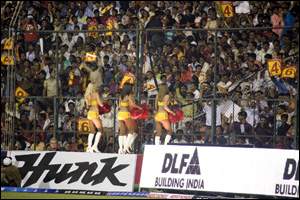
Cheerleaders ‘a distraction’
Cheerleaders ‘a distraction’
David Clough Last Updated: April 25. 2008 3:00AM UAE / April 24. 2008 11:00PM GMT
Cheerleaders have certainly done their part to add entertainment for spectators attending Indian Premier League games. Washington Post
HYDERABAD // Cheerleaders may have added a dash of glamour to the billion-dollar Indian Premier League, but Shahid Afridi sees them as a distraction.
The Pakistan all-rounder, who is signed up to the Deccan Chargers, rejects the idea they add to the entertainment value of the game.
“The girls in skimpy dresses should be removed from the ground as this is distracting the batsmen,” he said.
“Cricket itself is an entertainment. It does not require such cheerleaders to entertain.”
Afridi, a veteran of 258 one-day matches, made an inauspicious IPL debut on Tuesday. He scored just two runs in seven balls, while 17 runs were scored off his two overs as the Chargers lost to the Delhi Daredevils by nine wickets.
Afridi, who was bought by his team for $675,000 (Dh2.5m), also feels Pakistani players have been undervalued in the IPL.
“Bids on Pakistan players have not been as high when compared to the bids on other players,” he said.
“Players like Misbah-ul-Haq, Umar Gul and Shoaib Malik, who performed exceptionally well in the Twenty20 World Cup last year, did not get their due.
“I feel some Pakistan players should have received much higher bids.”
* PA Sport
20-25% chances of Sensex stooping to 11K
20-25% chances of Sensex stooping to 11K
Ridham Desai for Money Control.com
Ridham Desai, MD and Co-Head-Equity, Morgan Stanley feels that one is likely to see more downside before market bottoms out and there’s 20-25% probability of the Sensex going down to 11,000. The market may take some more time to form a bottom, Desai said. He alsosaid that, the price correction shows that India may be in a bear market. Desai said that, most indicators show that the market is in a ‘fear zone’. On a more positive note, he affirms that the market may see an end to the pain by the third quarter of this year
Desai is skeptical about whether companies will disclose their losses this quarter. He feels that the valuation gap between sectors needs to narrow down. He further added that if India falls another 10-15% as against other emerging markets, it will create a buying opportunity.
“It has not satisfied the time requirement because bear markets usually are longer. It has definitely satisfied the price correction requirement. We have been through a couple such corrections in this bull market. If this is not a bear market then it could turnout to be like May 2004 or 2006 when we went through a similar type of price corrections. This time around, the fundamentals are under the scanner and that’s what makes me feel that this is a bear market. We may have a little bit more time to go before we get to that so-called bottom,” he added.
Excerpts from CNBC-TV18’s exclusive interview with Ridham Desai:
Q: Are we in a bear market?
A: It looks like one. It has not satisfied the time requirement because bear markets usually are longer. It has definitely satisfied the price correction requirement. We have been through a couple such corrections in this bull market. If this is not a bear market then it could turnout to be like May 2004 or 2006 when we went through a similar type of price corrections.
This looks more like a bear market because the fundamentals in 2004 and 2006 were different. In May 2004 and 2006, the macro was pretty much intact and we got some global surprise which has caused markets to correct in terms of valuations. We found a bottom very quickly and the markets rallied all over again. This time around, the fundamentals are under the scanner and that’s what makes me feel that this is a bear market. We may have a little bit more time to go before we get to that so-called bottom.
Q: What’s your definition of a bear market? There are many definitions, some say a 20% fall is enough for a bear market, but obviously you define it differently?
A: 20% is one criteria, another criteria would be the 200-DMA. From 2003 till now, we have had only one penetration of the 200-DMA and that too for a very brief time in 2004.
Q: This time we are consistently below it.
A: Yes, we are consistently below it. One should look at is falling intermediate tops and bottoms. That’s another thing that was not met in the previous two corrections of 2004 and 2006. In that there were one or two falls and then the market actually did not establish lower bottoms. This time we are getting consistently lower bottoms and tops. So, that feels like a bear market if you look at the long-term trend lines.
I am not a big believer in trend lines because you can draw many lines through two points and justify a lot of things on trend lines. But these are the three things that I look at. The percentage of fall, are successive tops and bottoms lower or higher, and how long we stay below that 200-DMA? The percentage of fall at 20-25% is a good number. We have at least three bottoms which have been lower than the 200-DMA and have been staying below that for a while.
Q: Is history a good guide to how long bear markets typically last or have things changed because one contention has been now-a- days that the bear markets are much shorter, so we don’t need to worry about 4-6 quarters it will all get over in two quarters?
A: There were three bear markets since the early 90’s. We had the Harshad Mehta scam-related bear market that lasted approximately 50-weeks and the fall was about 50%. Then, we had the mid-90’s emerging market sell-off, which produced 55% fall and lasted about 86-weeks. Last, we had the tech bubble where the price fall was approximately 50%, but it lasted longer. It took 110-weeks for the markets to bottom out.
This is what distinguishes this time from the previous and this is debated quite hotly because this is intuition rather than based on any facts or data. India has moved on structurally, we are not the same economy that we used to be in the 90’s. Therefore, to argue for a100-week prolonged bear market like we had gone into during the tech bubble days or in the mid-90’s will be a little bit too aggressive.
We will probably get a 50% fall if this turns out to be a bear market. In terms of depth, you will still get that 50% fall and several parts of the markets are already down 50%, so we are getting there. In terms of length, we will not get the type of the 90’s bear market that we got, so this will be shorter. May be it will last for another 15-weeks but it won’t establish the 70-80-90 week period that we have seen in the past.
Q: What would convince you that it is a bear market? You are saying it could be a bear market, which you think is likely. But it could also be a deep correction in a bull market. What would utterly convince you that this is a bear market that we have entered?
A: From a fundamental perspective, it is earnings because bear markets never come with earnings rising and that too at a base of 20-25%, which is what we have all got used to. Even in the early and late 90s, we got earning declines. So, maybe we don’t get earnings declines but get a slowdown in earnings. So, that is one thing we need to watch out for. When earnings start declining, we know that it is a bear market. So, that is fundamental.
Technically, I am kind of more or less convinced. There is not much room left because the market breadth has collapsed, midcap index has collapsed, several sectors with fluff have gone away, and the momentum stocks have gone away. We have discussed this 200-DMA, the tops and bottoms have fallen. So, I cannot imagine that there is much of a debate there.
The debate will be on the earnings and fundamentals. Have they peaked or is this just a mild correction and we are going to recover pretty quickly? So, if that is going to now fall then this is a bear market.
Q: The scary bit is the 50% number that you are working with. In past bear markets, we have fallen 50% from the top.
A: Yes, we have fallen 50% or slightly more.
Q: Is it likely then that we will go back from that 21,000 peak to something like 10,500-11,000?
A: We need two conditions to get there. First, we need some extensive turmoil in global financial markets beyond what we have already had. We need some more things to happen, maybe Europe will get into trouble, or may be non-financials in America will get into trouble. We need that because without that I do think India on its own is going to slip into a 50% correction. Second, we need a policy mistake at home.
It is a challenging time right now. Growth is slowing down, inflation is rising, and it is an election year. These conditions are similar to 1996 when growth had peaked out, inflation was rising, and we were in election year. If there is a rate hike, or there is a response from the policy side which accentuates the growth slowdown, then we could argue for a 50% correction. Otherwise, we may miss that precise 50% point and may bottom out before that.
Q: What kind of a probability would you attach to it happening?
A: A 20-25% probability of the Sensex going to 11,000. We will probably bottom out before that.
Global financial market conditions may not worsen dramatically from here. It may spread a bit in the US. In the US, the pain in the financial sector is probably behind us. We may get some pain in non-financials, industrials, and materials notably. In Europe, we may see a bit more pain because they have not really seen that pain. But it may not be a catastrophe. It may not be like what we saw in the US, it may not be like a Bear Stearns effect. We have seen some pain come out in the last one week and the markets have responded well to that. So, we may get a bit more pain, but nothing of the nature that we need to take the markets down another 20-30%.
At home we look okay. We are getting some response from the government, which is the right response in the circumstances. So, we don’t want the central bank to come around and say okay, inflation is high so let me hike rates because our own view is that rates are already prohibitively high. They are already in restrictive zone, and they need to be lower. If you hike them further, then growth will probably fall even harder and that will create a problem for the markets here. It will be hard to recover from those lower levels later on. So far, as we don’t do that, I feel confident that we may not do that. I think we should be okay.
So, we may not get to 11,000, but it is still a one in a four chance. We may bottom out before that.
Q: It is a general feeling in many quarters that we may have in some sense established a near-term bottom. We won’t violate that because we have been just hovering around those 15,000 levels. Do you think that is a bottom or you would be surprised if that turns out to be a bottom?
A: We need a confirmation from companies on how much they have lost on their balance sheet and off- balance sheet trades. Until, companies come and tell us that the markets will speculate and will be nervous. That’s what the condition we are in right now.
Q: Can that end at the end of this quarter, if all disclosures are made?
A: I am actually skeptical that we will get all disclosures this quarter. I hope they come.
Q: Despite ICAI?
A: Yes, despite ICAI. We may not get it because ICAI does leave a room for you to disclose it in your notes. The notes will not be revealed until the balance sheets come out and that will happen only in August-September or June. It may actually go beyond this quarter. I hope that companies disclose it because if they disclose it the pain will be behind us and we will establish a bottom.
Second, we need commodity prices to come off and some dollar strength because of our inflation problem is not our problem. This time around it is actually the world’s problem and we are just importing that problem. It is going to be very hard to generate a response to that. So, we just plainly need commodity prices to come off. We need oil, wheat, and metal prices to come off.
Third, we need a little bit of despondency among retail investors. We have not seen that as yet. Retail investors are holding fort. It is quite remarkable that the market has come off as much as it has and mutual fund flows are still positive. If I get a month or two of negative mutual fund flows, I will feel a lot more comfortable that we have hit a market bottom.
Q: Do you think that the final capitulation hasn’t happened yet?
A: I don’t think so. That’s why I don’t think that the bottom that we have seen in the last couple of weeks cannot be violated. It can be violated and we could see some more downside before we bottom out. It has to be combined with these three things. I would add one more factor to this which is not an event related thing, but it is an adjustment process in the market and that’s valuation dispersion. If you look at the market even after what has happened, there are three or four sectors that are trading way above historical averages in terms of valuations and way below the gap which was much wider in January.
The three sectors on the higher side are financials, industrials, and utilities, while those that are trading at a discount are notably consumer staples, technology, and healthcare. The gap has narrowed because financials, industrials and utilities have sold off whereas staples, technology, and healthcare are relatively better but it is still there. If that gap narrows further — so if financials, utilities and industrials compress, and staples like technology and healthcare stay put — then we may also get that adjustment process required to establish a bottom.
Q: What about emerging markets overall because our rally was in sync with emerging markets and we have all underperformed the US big time this year? Do you see that continuing for the rest of the year? The US actually does not fall too much but emerging markets correct even more?
A: On the emerging market front, India and China were behaving a bit more differently from the rest of the emerging world in terms of valuations and performance. By early January, we were outperforming emerging markets by 30% from our August 2007 lows. So, we were significantly better off. Since then we have given up all the gains. Now, we are trading flat from August 2007, so that’s good news actually. That performance gap was a worry for me. We have given that up, at least relative to emerging markets. Now, we look better. Valuations were at a 100% premium on the January 9-10 peak, and are now down to 50%. I feel very comfortable with that
Q: Will that unwind more you think?
A: It could unwind more because we have domestic risk factors to deal with. So, may be it unwinds to 35%. If it goes to 35%, India becomes a very good buy relative to emerging markets.
Right now, it is neutral. It was a sell relative to emerging markets in January. It is now neutral. If it falls a bit more now — another 10-15% relative to emerging markets — we become a buy. From an emerging market standpoint, commodity prices falling, which is good for us, is actually bad for emerging markets because a lot of emerging markets are anchored around commodities. So, Brazil, Russia, West Asia, and even parts of Eastern Europe will suffer. India actually stands to gain, so if commodity prices fall and if that becomes a trigger, the country will actually outperform. That could be a major differentiating factor going forward.
Q: If we just take out the off balance sheet items like derivatives etc, do you see chances of negative surprises in core earnings over the next three quarters?
A: There is risk because EBITDA margins are actually at an all-time high. They are sitting at five-year high levels and revenue growth will slowdown because GDP growth is slowing down. I don’t think we can runaway from the fact that the economy is slowing down, which is the right response or which was the response that we should have expected when the RBI tightened last year.
This is just a reflection of what has happened last year in terms of tightening and a reflection of the slowdown in capital flows. The economy is slowing down, revenue growth therefore has to slowdown, and so earnings will slowdown. The consensus is a tad too optimistic about earnings right now. We may actually end up getting lesser earnings growth that what is being forecasted by the street which is around the 20% mark. Earnings could probably slip into the low teens or even the high single-digits. It is quite possible that if things turn really bad and some of those worst-case scenarios turn up, you get actually a quarter or two of negative earnings growth which is definitely not out there.
Q: We could de-rate further then?
A: It is possible. We are trading at about 15 times on an absolute basis, and 50% premium to the emerging market multiple. Historically, we have traded at close to the emerging market multiples, so if things turn bad one could get a bit of de-rating for a short time. If such things happen, then you would have sold your house and buy equities. Then, you satisfy the condition to really buy equities in a big way.
Q: Just one more point on sentiment. You spoke about retail not having had that capitulation yet but when you measure global and local sentiment, do you think there is more downside or do you think we are pretty much at the lowest ebb of sentiment?
A: We have a proprietary sentiment indicator where we combine 15 market matrix. A lot of them are suggesting that we are in fear zone. That’s good news. I like that because fear is essential ingredient to market bottoming out.
So, I am not getting granular about this. Normally, I don’t because I just take the composite reading and say okay, this is fear, euphoria. Now, I am getting more granular because we want to get more accurate about this. Then, there are a few indicators that are still not sold off enough or still not fallen enough. If they would fall more then we would have entrenched ourselves into a fear zone. So, from a sentiment perspective we would have probably kissed a market bottom.
Q: What’s your best case in terms of the turnaround timing? If I put a gun to your head and say by when you think the turnaround will happen, given the three factors that you mentioned where would it be — third quarter, fourth quarter, or next year? What is the highest probability of the inflation point?
A: May be by third quarter, we should have a lot of these things behind us. We will know by the third quarter whether commodity prices are going to fall or not and by that time the adjustment processes should have happened in the commodity markets. By then, we will know the losses that are there on balance sheets and the earnings slowdown that’s coming and consensus would have revised earnings lower. I am quite certain that by then retail would have given up as well, if the markets don’t go anywhere.
So, we would have satisfied a lot of these things. By the third quarter of this year, we should be okay. Therefore, long-term investors, and there are very few left these days in this market, who have a 1-2 years timeframe should actually start looking for stocks. This is a good time for them to start bargain hunting and there are a lot of places in the marketplace where things have turned attractive.
Q: Has it come as a bit of a surprise that in the last one-month, despite a fall of 30% on the index, a lot of the supposedly long-term money did not buy this dip, because at 21,000 there were a lot of India bulls? Some things have changed fundamentally but a 30% fall did not induce a whole lot of long-term money coming in?
A: It is also surprised me that institutional money has not sold heavily either and the markets have fallen 30%. We have not seen that type of selling, which if I go back to January and somebody had asked me what is going to trigger a market fall, and I would say that would be basically institutional selling. That never really came in a big way. May be we should be surprised because a lot of long-term investors were very bullish on India in 2007 and suddenly that bullishness has been threatened by a few events.
There isn’t that many really long-term investors left out there who have the luxury of taking a one-two year call. Most investors are by the mandates, which they have, forced to look at a one-three month scenario. The one-three month scenario still doesn’t look that comfortable for them to actually pull the trigger. Even the investors who are buying in this market are buying in very small quantities because they don’t want to commit their capital up front. They are saying let us put 5-10% today, and we will wait for another two-three weeks, see where prices go and put another 10%. Even the buying is happening in a very spaced out fashion. So, that doesn’t allow the market to actually bottom out.
Q: What is your base-case scenario because third quarter is the end of the pain and downside is what 10-15% from here at best?
A: I would be comfortable with 13,500 or so on the index which is the August 2007 low. We will test that. If one looks technically, the market has very strong support at 12,500. So, I am not thinking about that being broken at this stage. For that to be broken, we need really terrible news. Probably, we won’t break that but from current levels to 13,700 or 14,600 could get violated.
Q: Somewhere around July-August you think is the end of the pain?
A: Yes, third quarter is a reasonable timeframe.
- ← Previous
- 1
- 2
- 3
- …
- 12
- Next →
 ClicksandWrites
You must be logged in to post a comment.