Month: December 2007
Quilling and punch art

Quilling and punch art
Sujata Shethia, from India
The first art form Shethia learnt in 2004 was Warli, a specialised Indian tribal art, which depicts scenes of human figures engaged in everyday activities like hunting and harvesting.
She also learnt Indian Madhubani painting, an art characterised by tribal motifs and mineral pigments.
But it wasn’t till 2006 that a new art form intrigued her. It was daedal composition of quilling art used on a greeting card. “The intricacy of the designs was exquisite,” she says. So impressed was she that she asked the person who created the art to teach her. “But she wasn’t interested [in teaching]. I then spotted a brochure that listed quilling teachers,” she says.
Quilling, also known as paper filigree, is the art of rolling narrow strips of paper and then shaping them. Projects can range from simple gift tags and cards to elaborate pictures and 3-D models.
Quilling isn’t difficult to learn, but requires an eye for detail, time, patience and practice. “Quilling started with metal filigree, but scarcity of material popularised paper filigree,” says Shethia. After learning the art of quilling, which took Shethia a year, she decided to amalgamate her varied artistic knowledge to create unique artworks.

“I began to integrate painting with quilling. It doesn’t matter if it is a simple project like a card, gift box, photo frame or pencil decoration, or a large-scale project like an aquarium [pictured here]. Each creation conveys my personalised artistic message,” she says.
During one of her recent exhibitions at ARTE Soukh, a mother of two boys asked Shethia to create an aquarium for her boys. Impulsively she suggested an alien ship. “I used mixed media and quilling to create an alien world. I made use of different supplies like glitter, sequins, beads and colourful stones. I have even made earrings using the quilling technique!” she says.
Shethia, who first participated at ARTE Soukh last December, exhibits and conducts workshops for children and adults. “There is a sense of belonging, a sense of solidarity among this family of artists. The best part of the Soukh is the exclusive art pieces on offer. You will not be able to find them in regular shops or malls!” she says.
Quilling designs are made of rolled coils. Shethia says the technique needs only a few basic shapes like teardrop, rectangle, square, crescent, arrow, half circle, holly leaf, and triangle. “Once these are perfected, you can combine individual shapes to form anything.”
Interestingly, quilling can also be made to resemble other art forms like painting. “For instance, instead of a painting for a goldfinch bird, you can create the same figure by using quilling. It will give a stunning 3-D, full-bodied effect,” she says.
She enjoys the technique of combing in quilling. “It creates uniform cascading loops to make fluttering creatures or beautiful petals,” she says.
As an extension to this art form, she also learnt punch craft, and now uses both art forms. “For example, when I am making a Christmas card, I punch the Christmas tree and embellish it with beads, colourful stones and glitter. The gift boxes placed under the tree are quilled. This gives the card 3-D effect. Handmade cards express that rare sentiment not found in commercially printed ones,” she says.
– For further details contact Shethia, on sujatashethia@hotmail.com
Scrapbooking

Scrapbooking
Annais Benetua Bin Haider, from United Arab Emirates
When Haider’s youngest son, Abdullah (now 10), went to grade one in 2004, she spent her mornings attending arts and crafts workshops. “I learnt decorative matting and framing of photographs. I also picked DIY craft books,” she recalls.
Her artistic potential, fuelled by an extremely creative imagination, led her to take these workshops seriously.
It also led to the online search of the use of acid-free paper in decorative matting. “I discovered its use in scrapbooking. I was hooked,” says the mother of 3 boys, Rashid, 13, and Omair, 11 and Abdullah, 10.
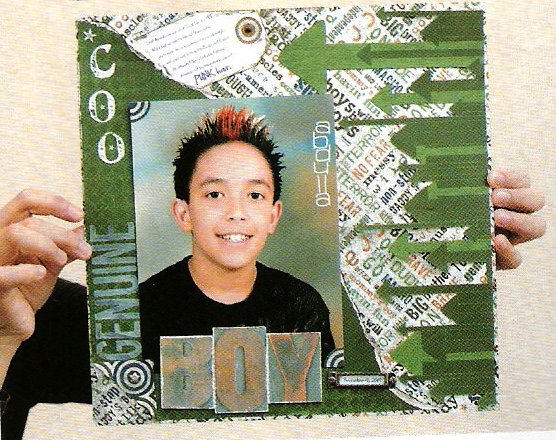
Scrapbooking is a work of art and an illustrated form of storytelling. For Haider, it is both, and an artistic expression of familial love. “A scrapbook is an interpretation of my life and my personality through art. Most importantly, it is a way to express love for my family. There is nothing more precious than the gift of a scrapbook,” she says.
Scrapbooking is often accused of being assemblage or bricolage art by artists who believe the truest form of art is creating not assembling.
“When a scrapbook artist develops his style by experimenting with different decorative techniques and a wide variety of mediums, his work becomes original. A scrapbook is an illustrated story of your life. How can somebody else have the same story or memories as you do?” reasons Haider, who has been exhibiting at ARTE Soukh since July this year, where locally made scrapbooking paper packs and Memories of UAE scrapbooking album were launched.
“All my scrapbooks are heirlooms. I use acid-free or archival quality supplies to ensure the art will not fade, yellow or turn brittle and disintegrate,” she says.
Scrapbooks can represent random, chronological or themed family life. Haider finds the entire process enjoyable. “The only tough part is choosing what to include. There are so many photographic moments I would like to record,” she says. Every stage is important, especially the layout. “The process includes the positioning of photographs, adding embellishments to support the story, and completion with written details like what, where, when, why and who. Together, these elements create the layout,” she says.
Cropping is also an important step. “It is like zooming in on your subject after the photo is taken. Through this, you can focus the viewer’s eye on a particular element of the photo or trim away the unappealing portions.”
Her fascination for scrapbooking inspired her to open her home-based scrapbook store, Creative Hands, and to offer classes tailored to support the art. “My store also deals with scrapbooking supplies because when I started out, I realised of the obvious paucity of supplies,” she says.
– For further details, log onto http://www.dubaiscrapbookingshop.com
Mind Speaks – Team 1 newsletter – Issue 485 – Born Fighters

Hello friends,
Team 1 newsletter – Issue 485 – “Born Fighters” is ready and available. Those readers who wish to obtain a personal copy of the same in pdf version, please email us at team1dubai@gmail.com.
Photo Speaks – Abu Dhabi Corniche
I have been away from this section for some time. Here I am back with some of my favorite photos taken during different time showcasing Abu Dhabi Corniche. Enjoy them and I would love to read your comments.
Fishing – a Friday morning pass time activity for some expats

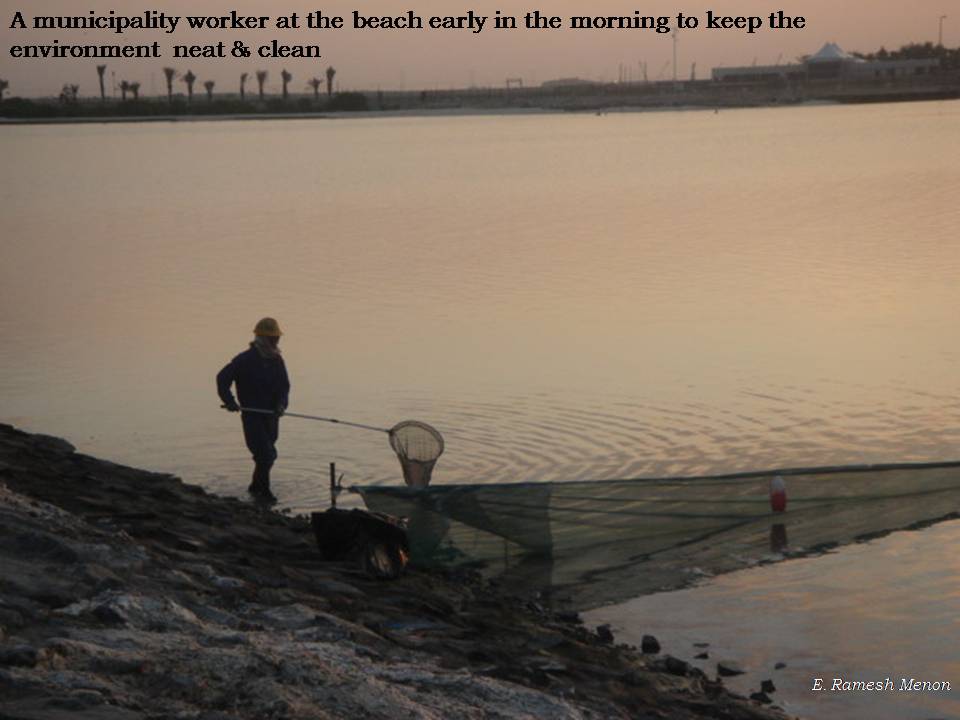
A municipality worker cleaning the beach front early in the morning.
The mangroves at the Eastern Corniche – keeping ecological balance and preserving nature

The mangroves at the Eastern Corniche – another view

Eastern Corniche

Eastern Corniche – try going for a walk soon, this area is getting renovated and may be you may not get to walk here at all.

Migratory Birds at the Mina Port area

Dhows waiting to load and offload goods at the Mina Port

Cruise ships at the Mina Port

The Ethical Side of Leadership
The Ethical Side of Leadership
Dr Thomas Donaldson is the Mark O. Winkelman Professor at the Wharton School, University of Pennsylvania, where he is also Director of the Wharton PhD Program in Ethics and Law. He has written broadly in the area of business ethics, values and leadership. He is president-elect of the Social Issues in Management Division of the Academy of Management, and is a founding member and past president of the Society for Business Ethics. At Wharton, he has received many teaching awards, including the Outstanding Teacher of the Year Award, twice, in 1998 and in 2005. He has consulted at many organisations, including Goldman Sachs, Walt Disney and Microsoft.
Is leadership different from management?
‘Leadership’ is a broader and deeper concept than ‘management’. Albert Einstein (the scientist) and V. S. Naipaul (the writer) were intellectual leaders, but not managers. Good management entails good leadership. Leadership is not just the frosting on the cake of good management; it is more like the flour in the cake.
What is the need of the hour for leaders?
Leaders must carry moral authority. Without moral authority, leadership is blind. Surveys of business people around the world show that they rank characteristics such as integrity at the top of the list of essential elements for leadership.
You research extensively on business ethics. Is the concept of ethics different across societies?
The most important truths about ethics are shared among cultures and religions. The underlying truths of the Bhagavad Gita are not so different from those of the Christian Sermon-on-the-Mount or many Islamic verses in the Koran. But developing countries sometimes have trouble adapting their traditional moral practices to the requirements of modern market capitalism. In successful capitalism, friendship must take a somewhat lower priority in the rationale for business transactions than price and quality. This is why good countries like India often struggle with issues of corruption.
How important is ethics to a leader?
Again, leaders must carry moral authority. Consider leaders outside of business. Sometimes, leaders must provoke principled resistance, as did Winston
Churchill in World War II; sometimes, they must restore dignity as Abraham Lincoln did in the struggle against slavery in the US; and, sometimes, they must take a situation that seems impossible but use moral authority to turn it around, as Gandhiji did in his fight against the British occupation of India.
Is ethics different for different sectors — government, business and non-profit sectors?
Non-profit firms and government organisations are not exempt from ethical challenges; indeed, I think they face problems more severe than for-profit organisations. For-profit organisations are at least subject to the rigours of the marketplace. If they cheat customers, they will pay for it in the long run. But governments and non-profits are insulated from this discipline. The current government corruption scandal in the US involving lobbyist Jack Abramoff and the Congress is a case in point.
You have been recognised as an outstanding teacher several times. How can teachers be leaders?
Teachers lead when they care for truth and the education of their students above everything else. They must care for it even above their own desire for academic recognition. This is very difficult.
What is the burning issue that every leader should be thinking about right now?
Business leaders today should be thinking about how to balance the demands of markets, analysts and owners, with the interests of employees, customers and members of the wider community. Our legal institutions everywhere are still reeling from the introduction of market capitalism — and this is true even in developed economies where the market system is almost 200 years old. We continue to struggle with reconciling market systems with our underlying societal values. I am convinced that enlightened business leadership and enlightened consumers, more so than government control, are the long-run solution to this problem.
How can we develop socially-responsible leaders, especially in the developing nations?
Leaders in developing countries should not be Xerox copies of leaders in developed ones. Indeed, leaders in any country should not be Xerox copies of leaders in others. Leadership in India means embodying characteristics that inspire and motivate Indians. In Switzerland, it means embodying characteristics that inspire and motivate the Swiss.
Can leadership be taught?
I know that even some academics who study leadership are pessimistic. They deny that leadership can be taught. But this is wrong. Consider the flip side of the question: “Can leadership be taught?” The flip side is “Can leadership be learned?” Of course leadership can be learned. All great leaders speak eloquently about their process of learning. So, if leadership can be learned, shall we suppose that it only can be learned by the individual himself — alone — without the help of others? This is nonsense. Learning about leadership, and especially about leadership, is like learning everywhere: it is easier through the help of others. But the “others” we learn from may soon be our colleagues at work, our spouse, our children or a teacher in a university.
Have An Idea, Attend Manfest
Have An Idea, Attend Manfest
IIM-Lucknow has come up with a unique opportunity for entrepreneurs to secure funding for their venture, reports Chetna Mehra
Entrepreneurs in India will now have one more opportunity to make it big. In an endeavour to encourage entrepreneurs in India, IIM Lucknow has come up with a platform ‘Start-up Showcase’ that allows entrepreneurs to showcase their business plans before IIM-L partners and angel investors. These panelists, in turn, will judge whether the ideas are credible enough. The winners will secure funding of up to $200,000 or about Rs 80 lakh. The contest will be organised in IIM Lucknow during Manfest 2008, IIM-L’s annual fest, to be held from 11 to 13 January.
Startup-Showcase is an initiative started by Abhiyan, the entrepreneurship club of IIM Lucknow. The club, in its seventh year of inception, aims to promote an entrepreneurship culture in India. In course of time, Abhiyan has developed a network of valuable mentors across the globe, including successful entrepreneurs and venture capitalists.
“The Start-Up Showcase is open to all and this is the first time we are taking such an initiative,” says Vaibhav Agarwal a team member of Abhiyaan. Till now, Abhiyan’s ‘Business Plan’ contest was open only to students. “In fact, we have received three business plans so far,” says Aggarwal. Interested participants are expected to send in an executive summary outlining their business idea. Broadly, the feasibility and innovativeness of the idea and opportunities for growth through market expansion would be tested. The last date for submitting the executive summary is 20 December 2007.
Abhiyan is organising the event in association with Seedfund, NEA-IndoUS Ventures, GEN, The Indus Entrepreneurs and Baring Private Equity Partners, which is also a part of Nirvaan 2008, IIM-L’s entrepreneurship summit. The judging plan will include personalities such as Sanjeev Bikhchandani, CEO, Naukri.com; Anand Lunia, CFO, Seedfund and Rohit Agarwal, CEO, Techtribe, Nirvaan is an excellent opportunity for students and budding entrepreneurs to also secure mentoring on their business plans from India’s best entrepreneurs. Seedfund, the leading associate of Nirvaan 2008 is a venture capitalist fund that has evolved according to the Indian business climate.
Winner of Nirvaan 2005, Prakash Mundhra founded a successful company ‘Sacred Moments’. The company that produces a puja kit ‘ Blessingz’, with the funding provided by IIML saw sales to the tune of 34 lakhs in less than six months.
Shaikh Khalifa reviews new building project by Adnoc

Shaikh Khalifa reviews new building project by Adnoc
(Wam)11 December 2007
ABU DHABI — The President, His Highness Shaikh Khalifa bin Zayed Al Nahyan, yesterday reviewed a model of the Abu Dhabi National Oil Company’s new headquarter project in the presence of General Shaikh Mohammed bin Zayed Al Nahyan, Crown Prince of Abu Dhabi and Deputy Supreme Commander of the UAE Armed Forces.
The project, designed by an international consultancy house, envisages construction of a 39 to 49-storey building which can accommodate over 2,000 staff and customers.
The project’s first phase involves construction of the main offices. Work on the first phase will commence in 2009. It is scheduled to be completed by 2011. The project’s second phase will be completed in early 2014. The state-of-the-art building is designed to be energy efficient. It will be located in an area adjacent to the Emirates Palace hotel and Adnoc’s old building.
The company’s old building was opened in 1979 by the late Shaikh Zayed bin Sultan Al Nahyan.
The reviewing session was attended by Shaikh Mansour bin Zayed Al Nahyan, Minister of Presidential Affairs, Shaikh Hamed bin Zayed Al Nahyan, Chief of Abu Dhabi Crown Prince’s Court, Chairman of Higher Corporation for Specialised Economic Zones (Zonecorp), Shaikh Omar bin Zayed Al Nahyan, the President’s aide de camp, Dr Shaikh Sultan bin Khalifa Al Nahyan, other Shaikhs, members of the Supreme Petroleum Council and senior officials.
Unique story: Japanese bank running on Indian IT
Unique story: Japanese bank running on Indian IT
Dibeyendu Ganguly, TNN
There was a time when Shinsei Bank had so many Indian software engineers working at its headquarters in Tokyo that the company canteen introduced a range of curries on its menu. The software engineers were from TCS, Wipro, Infosys, iFlex, Polaris, Nucleus and their numbers were in thousands. Led by Jay Dvivedi , Shinsei’s legendary Indian-born CIO, they transformed Shensei from the stodgy old institution it was five years ago to the sleek new retail bank it now is.
The story eventually became a Harvard Business School case study, titled Information Technology and Innovation at Shensei Bank, and CEO Thierry Porté attests to the debt the Japanese bank owes the Indian engineers. “The IT initiative totally changed Shinsei,” he says. “Even today, we are a Japanese bank that runs on Indian IT.”
Formerly the head of Morgan Stanley Japan, Porté joined Shinsei in 2003, two years after its IT rejig began, but as a long time resident of Tokyo, he was well acquainted with the problems of the country’s banking system. When Indian engineers first began their work at Shinsei, Japanese banks charged ATM users a fee for every transaction — and the service was available only during banking hours, till three o’clock in the afternoon. “Japan’s banks started sooner with IT, but they didn’t change as technology developed,” says Porté . “Shinsei was one of the earliest to completely shut down legacy systems and start afresh.”
Shinsei’s IT project was completed in one year rather the three years originally estimated and it cost only $60 million — 10% of what other Japanese banks spent on similar projects. The Harvard case study gives the credit to Dvivedi’s relationship with India’s IT companies: “With each company , Shinsei worked to establish a relationship characterised as a partnership rather than one of a supplier.
The bank worked with its partners without requiring competitive bids, avoiding traditional requirement documents such as Request For Proposal or Request For Information. Dvivedi believed these were superfluous process steps that added unnecessary time and overhead. Further, Shinsei did not enter into fixed-price contracts; on the contrary, engagements were quantified on a time-and-material basis.”
An interesting aspect of Shensei’s new IT system is that it uses no mainframe computers. In fact, Shinsei is Bill Gates’ favourite company — featuring in every other speech he makes — for its systems are based entirely on PCs using the Microsoft Windows platform. Further, it uses the public internet rather than leased lines, which allows it to move work to any location, the most important of which is India. Shinsei still has a close relationship with its Indian IT partners, who are called in whenever its system needs to be expanded and upgraded , such as when it acquired APLUS, a consumer finance company , whose systems needed to be integrated with the bank. “We have virtual work rooms in India,” says Porté . “We video-conference with our IT partners for new projects all the time.”
The thousands of Indian software engineers who created the bank’s IT system, and continue to work with it, have never needed to learn Japanese — Shinsei has provided them with translators all through. As an American private-equity owned Japanese bank, Shinsei is exceptionally global in its outlook. A graduate of Harvard Business School, Porté is American (his parents immigrated to New York from France after World War II), while his wife is Japanese. And there are several other Indians at the top in Shinsei besides Dvivedi, such as its CFO and head of retail banking.
Last year, Shinsei expanded its India connection with a small office in Mumbai, offering corporate advisory services. This was followed by a deal with UTI Mutual Fund, through which Shinsei distributed UTI’s products to investors in Japan (the asset management venture manages $500 million). The tie-up is now being expanded to other South East Asian countries, starting with Singapore.
First lap: The early days in a new firm
First lap: The early days in a new firm
Priyanka Sangani, TNN
When Rajeev Karwal joined Reliance Retail last year, it was after a string of successful stints at companies like LG, Philips and Electrolux. Having earned his spurs as a startup and turnaround specialist , he was expected to be among the high flyers as the head of the consumer durables business. But one week into his job, he came to a realisation. “My heart lay elsewhere,” he says. Karwal quit eight months later and set up Milagrow Business & Knowledge Solutions, a venture catalyst firm that works with SMEs.
For Ajay Kaul, CEO, Domino’s India, who came to India after a stint at TNT Express in Indonesia, the first few months were a blur as he came to grips with an alien industry.
His predecessor had already left the country so there was no formal handover, which Kaul feels could have made his early days a little smoother. “You are relying on direct reports and every verbal and non-verbal cue to adjust to the new environment,” says Kaul. The first three months were hectic, but they the pace for the rest of his tenure and Kaul is now a well ensconced pizza CEO.
The 100 day period has long been used as the first stage of judging how effective a person’s performance has been, whether it is the President of the USA or a fledgling enterprise.
Why 100 days? Apart from the obsession with measuring performance on a quarterly basis, it’s also a nice round number. “It’s a long enough time to see if the immediate objectives of the move have been met,” says Shalini Pillay, director , KPMG Advisory Services.
While the exact specifications of what needs to be achieved during this period vary, there is a general consensus that 100 days are indication enough of whether it is a successful move or not.
And it applies not just to CEOs, but to fresh entrepeneurs as well. After all, there are many who have been known to chuck it and return to the corporate fold. Karwal, for one, says ” You get a clear idea within the first 100 days of whether or not the venture will work. Entrepreneurs tend to go wrong because they don’t set down the rules clearly for themselves.”
Deepak Shahdadpuri, managing director , Beacon India Advisors says that within the first 100 days, one would have a very good feel about the likelihood of the venture succeeding. For Shahdadpuri, it’s been a mixed experience going on as a board member at the companies his fund has invested in. “Since we invest in fledgling companies, my role on the board is also that of an advisor,” he says.
In such a situation, if the older board members and the newcomer are unable to establish a professional relationship, it has an impact on how the board functions. Normally, the first few months are enough to build the trust that is required, says Shahdadpuri , but there have been cases when it hasn’t quite worked out. If you don’t establish a strong relationship in the early days, there is an increased likelihood of things going wrong.
For a new CEO coming in to head a company, it is a far more complex situation . Not only does he have to get accustomed to a new workplace and culture, but he also needs to start proving to the board that they were right in hiring him. During the first few months, the issues that crop up have less to do with the actual performance, and more with the softer side of the business.
Anindita Banerjee, principal consultant, Stanton Chase International says that the first month is enough for the CEO to create an impression and then position himself within the organisational structure. “During this time, how others perceive and react to him is important to him,” she says.
Potential threat factors generally come to the forefront during the initial months. A new CEO could be faced with an alternative power centre, perhaps the COO who has been in the company longer, often leading to frustration, and at times the CEO walking out. While most CEO’s tend to give themselves more time to settle down, one common reason for them quitting is miscommunication or a misunderstanding about their role or what is expected of them, says Egon Zehnder’s Govind Iyer.
Rangu Salgame, who is barely a month into his new job as the President of Tejas Networks, has spent most of this time on the road, meeting with key clients and stakeholders. “Before shaping my strategy for the business, it is important to listen to, and get feedback from the clients and employees about their view and vision for the company,” he says.
His first 100 days at Cisco, his former employer, weren’t too different from what he is currently experiencing at Tejas, he says. Irrespective of the company, you need to first get a clear idea of what is expected of you and where the company is headed before working on your strategy, which should be ready by the end of the three month period, says Salgame.
When you join a new company, you need to be cognisant of the ground reality that the culture will be different from what you are used to. Here, it is essential to go in with an open mind and not get frustrated if things are not what you expect them to be.
The scale of the adaptation changes completely when you shift focus to an acquisition . Marico, which has made seven acquisitions in a little under three years, sees the first 100 days as both a showcase as well as a honeymoon period. “During this period, everyone is avidly observing the deal and most would be fishing for negatives.
An adverse observation would set the deal up for bad publicity and eventually , disaster,” says Milind Sarwate, chief HR & strategy, Marico. At such times, it becomes critical to track the early demonstrable wins to all the stakeholders to set the right tone for the future.
“After a merger, there is a significant amount of value and knowledge loss in the first 100 days, through attrition,” says Ganesh Shermon, head – human capital practice, KPMG. “It’s always the good employees who leave first.”
Sarwate says that companies tend to be more inward looking during this period and take their eye off the market, enabling competitors to take advantage of the situation. People are the most important part of managing the post merger integration and it is essential that the roles for the senior management are clearly defined. If employees feel that there is uncertainty about their future in the company, they may start looking for opportunities elsewhere.
The biggest derailment in these cases happens if postacquisition the head of the acquired company quits.
Even if there are contractual stipulations, he may stay on for as long as required without adding any significant value. There is also the possibility then, of the core team following him out. If this happens, the momentum cannot be sustained and it becomes tough to meet the pre-deal objectives.
Another important aspect is finding a fit between the two company cultures. In cross-border acquisitions, of which India has seen many in the recent past, the acquirer must adapt to the cultural nuances in the foreign country, rather than impose cultural changes. When Tata Tea acquired Tetley, it was an unusual case where the acquirer was a far smaller company, and an Indian one at that. John Nicholas, MD- business development & developed markets,
The Tetley Group says that from the very beginning, the Tatas made it clear that they would not come in and change things. “While the management and strategy was kept in place, the early days were all about shared learning and evolving a joint venture strategy,” he says.
“A merger is also a good time to change things for the better,” says KPMG’s Pillay. Post acquisition by Man Financial (now MF Global), Refco India was exposed to a more transparent and less hierarchical system of communication , which was welcomed by the employees . “There was a lot more multilevel and multi-regional communication across the different functions, which has resulted in faster integration and better information flow,” says Vineet Bhatnagar , MD, MF Global.
Intelenet Global Services was recently involved in a management buyout and CEO Susir Kumar says it is essential is to have clarity in vision even before a new structure is formed.
To ensure that the MBO did not impact the functioning of the company, the key changes were communicated to all the stakeholders. “Our focus for all our stakeholders was maintaining continuity for our clients and employees,” says Kumar.
The first 100 days play an important role in defining the vision and long term strategy of the business, irrespective of what the case may be. The key to seeing them off smoothly is to keep all channels of communication open rather than let the grapevine do the talking.
Tips for Driving Under Adverse Conditions
Tips for Driving Under Adverse Conditions
Driving on Snowy or Icy Roads
• Set the selector knob to 4H position. Gently release the clutch and apply the accelerator for a smooth start and to avoid wheel spin.
• Use of snow tyres and / or tyre chain is recommended. Maintain a safe distance between vehicles to avoid sudden braking and slow down by shifting down the gears. Avoid sudden acceleration, braking or turning. Such sharp manoeuvers can cause loss of traction and thereby loss of vehicle control.
Driving on Sandy or Muddy Roads
In case the traction on the wheels is sufficient, you may be able to proceed in 4H mode. However in case change in road conditions are anticipated, it is better to select the 4L mode. Shift the selector knob to 4L position by following the correct procedure and proceed in the normal manner. Your vehicle will move at a slower pace with higher engine RPM in the same gear because of the 4L mode. To match your power and speed requirements, you can shift up in any of the 5 forward gears or the reverse gear.
You may choose to reduce the tyre pressure marginally for additional grip on loose surfaces, though with a slight loss of ground clearance.
Try to maintain a constant engine speed and avoid sudden acceleration which can cause wheel spin and loss of traction, possibly leading to bogging down of the vehicle.
If the vehicle gets stuck in loose sand, do not keep on accelerating as the wheel spin will only result in the wheels sinking deeper.
The extent of muddy / sandy, conditions and the traction available is difficult to judge and the vehicle can get bogged down deeply. Operation should be done at slow speed only. If possible, get down and check the path conditions before proceeding.
Driving Through Water
Never venture to drive through water when it flows over guard stones. Engine may get seriously damaged if attempted to cross over through deep water.
If at all the situation demands that you have to drive through water then;
– Keep engine in fast idling and crawl the vehicle in low gear.
– After driving through water apply brakes several times to dry liners and to regain original braking.
Do not attempt to start the engine if vehicle gets flooded due to water.
Driving on a Rainy Day
• Check brakes, steering and windows.
• Check tyres for wear and tyre pressure.
• Check wiper blades for proper functioning.
• Avoid harsh braking and sharp turns. It may cause loss of control and lead to a skid.
• For slowing down, shift to lower gears and brake gently.
• Keep lights ON if visibility is poor.
Night Driving
• Dip the head lamp for oncoming traffic during night driving.
• Maintain a speed such that you can stop within illuminated distance of head lamps.
• Use head lamp main/dip beam to alert other road users on turns/cross roads etc.
• Use side indicators for lane change or turning.
• Put on hazard warning switch in case of hazardous parking or if your vehicle is disabled to warn the passing traffic.
Climbing Sharp Gradients on Loose Surfaces
• Select the 4L mode, start off smoothly in any suitable gear. Apply power smoothly so that there is no loss of traction by over-revving of the engine.
• Choose as smooth a slope as possible and select the appropriate gear so that gear changing in the middle of the climb is not required. Changing gears in the middle of the climb can cause loss of momentum and engine stalling. Shifting to lower gear has to be done cautiously to avoid loss of traction.
• Under no conditions should the vehicle be moved diagonally across a hill. The danger is in loss of traction and sideways slippage, possibly resulting in tipping over. If unavoidable, choose as mild an angle as possible and keep the vehicle moving.
• If the wheels start to slip within few feet of the end of the climb, motion can be maintained by swinging the steered wheels left and right, thereby providing increased grip.
• If the vehicle stalls or losses headway while climbing a steep hill, make a quick shift to reverse and allow the vehicle to move back with the control of engine compression.
Descending Sharp Gradients
• Select the 4L mode and depending on the severity of the gradient, shift into appropriate gear. Use engine braking judiciously without over-revving the engine.
• Brake application under such situations should be done very smoothly to avoid loss of control. Select appropriate gear so that gear changing or clutch disengagement is not involved while descending the gradient.
Towing the Vehicle
• For towing the vehicle, the best way is to use a recovery van.
• Alternatively use a rigid tow bar.
• Avoid using flexible cable or rope as your vehicle may crash into towing vehicle when it stops suddenly.
• Switch ‘ON’ Hazard warning switch to warn the other road users.
• Keep the engine in idling so that power steering assistance is available. This will also built the vacuum for the brakes.
• In case of brake failure, use parking brake
 ClicksandWrites
You must be logged in to post a comment.