Month: September 2007
Another fire in Jebel Ali






Another fire in Jebel Ali
By Alia Al Theeb, Staff Reporter / GULF NEWS Published: September 10, 2007, 15:15
Dubai: A plastic packaging factory was gutted in a massive fire that broke out in its premises in Jebel Ali Industrial Area 3 early yesterday morning.
No one was injured in the incident.
The fire was brought under control by civil defence and fire fighting teams from Al Quoz, Jebel Ali Jumeirah and Al Karama more than three hours after the blaze started.
The cause of the fire at the United Flexible Packaging Co. Ltd. in Jebel Ali Free Zone (South Zone) was unknown.
Preliminary investigations revealed that the fire started in the middle of a hall where a machine and plastic materials were stored. The fire spread to the offices located at the entrance of the factory.
Dubai Civil Defence’s operations room said it received a report from Dubai Police’s Operations Room at 3.17am regarding the fire. Firefighting teams from Al Quoz stations arrived to the scene at 3.43am. The factory for plastic and packaging contained tonnes of flammable materials.
Brigadier Rashid Thani Al Matroushi, Director of Dubai Civil Defence, supervised the firefighting operation which lasted two hours and 48 minutes.
The fire was brought under control at 6.39am. The fire gutted machines, plastic materials as well as a container loaded with plastic materials. The company manufactures and exporters flexible laminates, laminated rolls, pre-formed pouches and pre-punched lids.
Ramadan – Understanding the true spirit of the fasting month

Understanding true spirit of the fasting month
By Samir Salama, Bureau Chief GULF NEWS Published: September 10, 2007, 00:16
Abu Dhabi: Feasting their eyes on cuisine on dinner tables during Ramadan shows how far removed Muslims are from the true spirit of this holy month.
The month of fasting is in fact a time of giving, patience and tolerance for Muslims.
For more than a billion Muslims around the world, it should be the time for devotion to God and self-restraint, when communal nightly prayers are conducted and the basic teachings of Islam are emphasised and Ummah (Islamic nation) consciousness is heightened.
As the ninth month of the lunar Islamic calendar, Ramadan comes 11 days earlier each year on the Gregorian calendar and the duration of the fast changes depending on which season the holy month falls in.
The start of Ramadan, as that of all Islamic months, is based on the sighting of the new moon, the hilal, which is why the crescent is often used as an unofficial symbol of the month. The moon sighting is also the reason that the start of Ramadan differs from one country to another, but many opt to follow Saudi Arabian sightings to be able to mark the holy days together.
Five pillars
As one of the five pillars of Islam, fasting during Ramadan, which is considered one of the highest forms of worship, is obligatory for those Muslims past the age of puberty who are mentally and physically fit and not travelling, as long as it does not cause them physical or mental harm.
Those who cannot fast during Ramadan, owing to health or other reasons, may fast in other months, or feed the poor.
But a Ramadan fast is not a simple abstention from food, drink and sex during daylight hours.
A fast consists of a true and verbal intention that must be recited, as well as a package of dos and don’ts which are specifically emphasised during the month.
Fasting, or sawm (literally refrain), which did not become obligatory until 624 AD, offers an opportunity for Muslims to cleanse the body and mind.
It promotes the principle of sincerity by keeping the individual away from arrogance.
Among the greatest benefits is the lesson in self-restraint and discipline that could be carried forward to other aspects of a person’s life, such as work and education.
The lengthy nightly prayer called Taraweeh is an important element of rituals during the month.
Since it is a time of piety and high religious consciousness, it would be considerate for non-Muslims to dress and behave modestly, avoiding animated behaviour that could cause offence.
Those who want to understand the holy month better could consider involving themselves in the spirit of the month, which would be welcomed by most Muslims. Saying ‘Ramadan Kareem’ to Muslims and attending a fast-breaking feast, or iftar, would be appreciated by most.
Work hours in the private sector are shortened by two hours for Muslims and non-Muslims. The public sector will function from 9am to 3pm.
Live music is banned through the month.
Shopping malls and supermarkets are expected to be open late at night.
A typical day
A typical day of fasting begins with waking up before dawn to have a meal called the suhoor before the start of the fasting day. At sunset, Muslims usually break their fast upon the call for Maghreb (sunset) prayers with another meal called iftar. Prayers are conducted five times through the day, as they are on all days, and an extra set of prayers called Taraweeh is conducted after Isha or night prayers.
Tips for non-Muslims
Since it is a time of piety and high religious consciousness, it would be considerate to dress and behave modestly, avoiding animated behaviour that could cause offence.
Those who want to understand the holy month better could consider involving themselves in the spirit of the month, which would be welcomed by most Muslims. Saying ‘Ramadan Kareem’ to Muslims and attending a fast-breaking feast, or iftar, would be appreciated by most.
Since cultural consciousness is also high during the month, Ramadan can be a good time to connect with the local and Muslim cultural scene by attending the various musical and social events, as well as trying local and regional cuisine that is popular during the month of fasting.
Arabic speaking non-Muslims wishing to learn more about the region and its people will notice that Arabic television channels change their programming to a new schedule dedicated for Ramadan, when some of the most popular celebrities in the Arab world feature in some of the most-watched soap operas, historic series, as well as religious, cultural and musical shows. 

We’re authors of our own bewilderment
We’re authors of our own bewilderment
6 Sep, 2007, 0510 hrs IST,Vithal C Nadkarni, ECONOMIC TIMES
Pope Benedict has described Mother Teresa’s decades-long crisis of faith as “the silence of God”, a phenomenon the Pontiff says is “known to all believers”.
Referring to the book of letters detailing the tormented state of Mother Teresa’s faith, the Pope says this isn’t unusual. All Catholics have to contend with the silence of God, which so sorely tested even the saintly Mother despite all her charity and force of faith, he has added.
By the Pope’s own admission, the cat is finally out of the bag: hereafter it would be extremely disingenuous to claim special access to the Big Boss who allegedly lives beyond the Pearly Gates.
Nor should you believe those who claim to have a hotline to heaven. This also rules out such prospects as barters with God, or bribing Him into benevolence with your little acts of piety. Does this sound pitiless? But that’s exactly how the universal cookie crumbles, even according to Bhagwad Gita.
That’s precisely the revolutionary message of the fourteenth verse from fifth chapter of the Lord’s Song: “Of course there is no God,” Krishna says to Arjuna, at least not in the sense that countless generations of priests and shamans have led you up to believe.
If at all there’s something, it’s what the Gita is willing to concede as “embodied consciousness”, which Swami Prabhupada, founder of the Hare Krishna movement, translates as “the master of the city of your body”. “He does not create activities, nor does he induce people to act. He also does not create the fruits of action,” the verse goes on to elaborate. All that pops out from the tendencies inherent in material nature.
The verse that follows makes even more revolutionary assertions: The Supreme Spirit lies indifferent beyond all epithets and categories; it does not care for your sinful activities nor is it pleased by your pious acts. “(Thus) the Lord neither hates nor likes anyone, though He may appear to,” says Swami Prabhupada. Our poor embodied souls often fail to get this message.
Enslaved by our own desire to escape from supreme consciousness, we become authors of our own bewilderment and grow forgetful of our own essential nature. This can only heighten the so-called darkness of the soul suffered by embodied beings, for ignorance has knowledge enthralled (ajnanavruttam jnanam tena mhuyanti jantavah) in its coils.
The way out of the impasse is through faith and enlightenment.
The god of smallest things
The god of smallest things
7 Sep, 2007, 0214 hrs IST, By Mukul Sharma /ECONOMIC TIMES
I write this as I lie almost totally incapacitated in bed with a virus infection that’s turned out to be so virulent that I have no choice but to marvel at the miracle of the infinitesimally small.
I’m continuously thinking of my own suffering here when actually millions of these creatures are either being created every second somewhere inside my body, or dying there without a trace of ambition. I don’t know these creatures.
They don’t know me either. The “me” that resides as my personality and is sometimes supposed to be unique in the grand scheme of things, makes absolutely no difference to them whatsoever. For some reason, apparently they have a job to do — just like a plumber, politician or rock drummer does.
Nor do I know my immune system. My white blood cells have a job to do too which they go about doing without a “by your leave” or permission granted by me — exactly as if I didn’t exist at all for all they cared. You sometimes think: are they concerned only about their own existence or what — a la the selfish gene? But then, luckily, I’m comforted by the thought that they don’t have the capacity to think along those lines.
In other words, I also have my work cut out for me. When I’m infected, I suffer and wait impatiently, and often unfairly, for parts of me to get rid of parts that were never intended to be me. Ultimately, I’m glad all three of us manage this exquisite ménage remarkably well.
Does this mean that at some deeper level our dependency and symbiotic relationship with one another has to be more than just an amazing feat of coincidence? Or is it perhaps merely evolutionary mechanics which has no “goal” as such but only thrives on each doing the best for itself?
So I’m thinking now, what if a virus could indeed think. In order to make some sense of a human body it incarnates in from time to time, it might well say to itself: “I came into this body-world to procreate and multiply, only to find forces of hostility and evil committed towards my destruction.
All odds are stacked against me. Yet what am I doing wrong here? Is there no fairness, or is this world only a mindless creation of chance encounters between atoms which have no regard for the fact that I exist as a thinking being who can question its impetus and inspiration? If there’s a God it definitely doesn’t reside in this little universe. Why would there be so much evil around otherwise? Maybe when I die, I go to a far, far better place than I’ve ever been before.”
Enoc appoints new chief executive to oversee future growth strategy

Enoc appoints new chief executive to oversee future growth strategy
Staff Report GULF NEWS Published: September 10, 2007, 00:16
Dubai: Emirates National Oil Company (Enoc) yesterday announced the appointment of Saeed Khoury as group chief executive designate.
Hussain M. Sultan, Enoc group chief executive, said, “Saeed Khoury is a proven expert in the oil and gas industry with 28 years of solid experience in the UAE. I am delighted to welcome him to a new strategic role that will drive Enoc’s future growth and help us maintain our leadership position.”
Khoury joins Enoc from Abu Dhabi National Oil Company (Adnoc) where he was assistant general manager, technical. He has also served as a board member in a number of oil and gas service companies.
Established in 1993 as a wholly-owned company of the government of Dubai, Enoc aims to promote the interests of its shareholders through the development of further downstream and upstream activities in the oil and gas sector and beyond and to encourage the economic diversification of Dubai and the rest of the UAE.
Enoc’s joint ventures with major international companies allow partners to pool their technology, know-how and expertise along with resources to further commercial success.
When you converse at a personal level
When you converse at a personal level
B.S. WARRIER for HINDU
Personal conversation accounts for a substantial part of our daily communication. Here are ways of making it effective and result-oriented.
“Unless one is a genius, it is best to aim at being intelligible.” – Anthony Hope (1863-1933), British novelist
In personal conversation you have to take care of many things. An expert in interpersonal communication advises that you should be TACTFUL in conversation. What he suggests is the following;
T – Think before you speak
A – Apologise quickly when you commit a blunder
C – Converse, don’t compete
T – Time your comments
F – Focus on behaviour,not personality
U – Uncover hidden feelings
L – Listen for feedback
In strange company, it is good manners to introduce yourself to others, since that would not leave them guessing who you are. So also, you may greet others first; this shows that you are not plagued by ego feelings. It is most likely that you do get a favourable response.
There is no harm in asking a person’s name if you do not know it. After knowing the name, repeat it during the conversation. The sweetest word for anyone is his/her name. Try to remember the names of people whom you would meet again. Be liberal in showering praise, if you feel someone deserves it.
Intellectual curiosity
When ideas are discussed, you should not give an impression that you are too conventional to accept a new idea. Intellectual curiosity will be appreciated in cultured groups. Conversation would sour if you enter into arguments on trifles.
Never try to offer unsolicited advice. Though it is not advisable to bore others by narrating dull events in your life, you need not feel shy in sharing your interesting experiences if the occasion demands. Keep your general awareness up to date, if you want to partake actively in an interesting conversation. You would be able to switch to new subjects when a subject has run out of steam.
Maintain a balanced outlook. Extreme positions may lead to controversial remarks that may mar smooth dialogue among the members of a normal group. Do not go after any contentious issue, unless it is unavoidable. Be tolerant to differing views. Never be dogmatic. Be a good listener. In personal conversation humour has a place, though it should not jar, given a situation. If you are not gifted with the fine art of making humorous conversation, do not attempt it.
Body language
You may encourage others to speak by paraphrasing their statements for confirmation and through pleasing body language, including facial expression. Never try to be another person through your language or gestures. People who speak in a natural way are liked by others. Do not try to put on airs. You cannot wear a mask for a long time; you are likely to be exposed. Eye contact and a pleasant smile would add spice to your words. Find areas of common interest during conversation. You can ask questions on subjects that are of interest to the other person, when you are in a one-to-one mode. Everyone likes to speak on areas in which he is well versed. Enjoy the conversation, and show that you are enjoying it. Be enthusiastic.
You should never adopt a stance of arrogance, since none would like to communicate with such a person. Never be rude. Never assume a patronising attitude. But you should not surrender your self-esteem. Avoid insinuation. Show patience; never try to be unduly smart before others. You have to display empathy by entering into the other person’s world of thought, and trying to think the way he thinks.
You can ask leading questions to confirm your interest in his conversation. Questions seeking clarification are generally welcomed by people. Confessing your own weakness would generate sympathy and keenness in the other person and prompt him to listen to you further.
Key to success
Any communication succeeds only when it has been received, understood, accepted, and the intended action has been effected. If such a success has to be achieved, there are several measures we should follow in the process of communication. Ideas and the words that carry them are certainly important. But you should realise that your voice, tone, appearance, and body language are also equally important in oral communication.
Making a presentation
If you intend to make a presentation, not only the structure but the content, logic, and main phrases have to be planned. The right strategies for effective presentation have to be followed. These include:
•Getting over nervousness
•Wearing proper dress
•Proper body language
•Speaking with clarity
•Not reading from a prepared text
•Stating your objective in the beginning
•Following a logical order in presenting ideas
•Choosing the right mode for each item (for example, statistical trends to be displayed through graphs, histograms, pie diagrams, etc.)
•Using charts or computer software such as the PowerPoint or Flash
•Avoiding cluttered display on the screen
•Ensuring that your voice can be heard and the projection seen well
•Synchronising spoken words with gestures
•Not keeping a projected slide on the screen for too long a duration
•Avoiding mannerisms
•Ensuring voice modulation
•Keeping eye contact
•Adopting the language to suit the comprehension level of the audience
•Maintaining appropriate speed of delivery
•Keeping consistency in logic
•Using controlled humour
•Avoiding frequent corrections during speech
•Emphasising significant points
•Interacting effectively with the audience
•Watching the body language of the listeners and making changes in style, if necessary
•Listening carefully to questions from the audience
•Handling of tricky questions wisely
•Not talking beyond the permitted duration
•Giving a summary at the end
It is easily said that you should look at the type of your listeners before choosing your language. But the characteristics of a group are not susceptible to generalisation. Suppose you are addressing a group of rural farmers. All of them may not be the same, in the matter of information or perception. There would be individuals who are much more informed than many others in the group. There may be persons who are far below the general level of awareness. Perhaps in such situations, one strategy that can be adopted is to address the average among the group. This is the style that is followed by good teachers in a classroom comprising a heterogeneous group of pupils, so that the very bright do not get bored and the underachievers do not feel left out.
Persuasion
You are often faced with the problem of convincing others of your standpoints. You might have observed that most of the time, politicians are engaged in this exercise. Marketing professionals and businessmen have to be good in this kind of communication. What are the aspects to be kept in mind when you attempt to convince others on some point or other?
First and foremost you should find out what type of person is your target – on the bases of educational background, culture, language comprehension, age, sex, attitude, and so on. You should ensure that the person listens to you when you speak. If the mood is not proper, you have to generate an appropriate atmosphere congenial to effective listening. The person should be in a listening mood throughout.
What you say should have the qualities or clarity and accuracy. You should plan beforehand your strategy of presentation. You have to be enthusiastic. You have to be confident. You should continuously watch the listener’s expression and body language, and make sure that the person is not emotional when you try to apply logic through your words.
In any persuasive talk, you will have to emphasise the significant points of interest to the listener. Your logic has to be convincing. Use illustrations. Be consistent. If the listener wants to raise a question, make him fell free to do so, thereby making way for smooth exchange of ideas. Make him feel important. If there is a problem to be settled through negotiation, split it into parts and identify portions of agreement, and try to tackle the other portions in stages. Try to build trust at every stage. Never make the listener hostile, lest he should block further communication.
Who is a good teacher?
Who is a good teacher?
Here is a systematic look at the capabilities, skills and traits that will help one attain the goal of being an ideal teacher. It follows last week’s responses from various campuses in the State on this topic, highlighted in a lead story.
A friend and guide: Good teachers are excellent facilitators.
The lead story on the ideal teacher (Educationplus, August 27) had thrown up interesting insights into the perceptions of several students and teachers on the topic. Let us go on to examine this topic in a systematic manner.
The ‘ideal teacher’ is a concept. It is a goal that teachers should aspire to attain.
There is no ideal teacher as there is no perfect musician. Let us look at an eastern concept. Seekers of knowledge are sometimes compared to the musk deer. The deluded deer that does not know that the scent emanates from one of its own glands runs hither and thither in search of the source.
The eastern scriptures tell that all knowledge is within us. But there is a thin film of ignorance covering the knowledge. The teacher does not teach, but removes the thin layer and brings out the knowledge for our benefit. True teachers are not knowledge shopkeepers, but are those who help us to remove the cover of ignorance. Perhaps this is what is meant by guidance from the teacher. “Discover” or “unveil” are good synonyms for “teach.” Good teachers are excellent facilitators.
The teacher in the eastern scheme of things stands on a very high pedestal. He is called the Guru and the disciple the Sishya. The process of teaching and learning is treated as a sacred course of action, and not commercial activity. Knowledge stands head and shoulders above every other kind of wealth. Scholars are respected much more than those who are rich in money, or great in power. Now, let us come down to the ground and look at the essential attributes of a good teacher in our colleges and institutions of higher learning.
Personal characteristics
The significant personal characteristics of a good teacher are: appreciates students’ problems; articulate; accessible to students; avoids mannerisms in the classroom; believes in the potential of each student; caring; clarity in speech; committed to the teaching profession; communicates effectively; concern for student learning; conducts practical experiments wherever necessary; creates good learning environment for students; creative; dedicated; desire to teach; develops student-centred classroom; displays exceptional people skills; does more than just teach; does not belittle students before others, or otherwise; dynamic model of contagious enthusiasm; effective interaction with all students; effective techniques; employs different teaching methods to suit the subject and the pupils; encourages interdisciplinary approach; ensures interaction of pupils, and not keep them as passive listeners; ensures pupil participation in lecture classes through questioning techniques; evaluates student assignments in time, points out errors, and offers corrections; excellent communication skills; gets feedback from students on classroom performance in order to improve; gives practical examples for illustrating concepts; gives the details of the syllabus in the beginning of the academic year; good academic qualifications; innovative; instils mutual respect among teacher and pupil; interacts with parents; joy and pride in teaching; knowledge of different learning styles; knows his subject thoroughly; lifelong learner; links the lesson with the pupils’ everyday experience and kindles their interest; maintains a spirit of research; maintains punctuality and discipline through his own example; passionate in teaching; has a positive relationship with students; prepares well before each class; presents himself / herself as part of “real people”; promotes hands-on student learning; provides clear expectations for assignments; provides frequent feedback to students on their performance; provides the relevance of information to be learned; respects individuality of students; responsible; role model to students; seen and heard well in the classroom; sense of humour; sensitive to cultural differences; speaks in a lucid style; employs special methods to handle difficult subject areas; spends extra time with students; states lesson objective and lesson summary; strong work ethics; student-centred approach; suggests good textbooks, reference books, and websites; takes constructive criticism; tries to know students; uses appropriate teaching aids; wide knowledge and experience in teaching techniques and willingness to learn from students and other teachers.
One may doubt whether one individual can have all these attributes. This indeed is possible. Many trained teachers have acquired all these through deliberate effort.
Lecture method
Although the lecture method of teaching has several disadvantages, it would continue to be an important component of our classroom teaching, because of many points of convenience. Teachers adopting this style should invariably ensure student participation in the classroom. One of the important methods for achieving such participation is the use of the “questioning” technique. Teachers who use the questioning technique may keep the following points in mind – Precise, simple wording; prepare in advance; pose, pause, point; don’t use YES / NO type; not with several good answers; avoid vagueness; use elliptical questions for slow learners; avoid tricky/very hard questions; never make sudden jumps; don’t rephrase in a hurry; avoid saying “Can anyone tell me?,” “What rubbish ?,” “Do you work hard ?,” etc; repeat right answers; don’t accept unsolicited answers; give due credit for right answers; comment, “Aha, that’s a fine idea,” “Could you improve the answer?,’ etc and encourage reverse questions.
Questioning in the classroom has other applications as well such as eliciting information (prior learning / depth of assimilation); revision; consolidation; logical development of the lesson; probing into difficulties of the pupils; forcing the class to think; rousing curiosity and interest; feedback to measure success of teaching; evaluation of pupils etc
This write-up has the limited objective of highlighting the desirable attributes of a good teacher in the environment of our temples of higher education.
B.S. WARRIER
for HINDU
Carnatic Flute thru online lessons
My name is k.t.dasarathy,an online carnaric flute teacher from chennai.i teach carnatic flute thru cds,mail attachment lesons,sound files,voice chat lessons etc to around 400 plus students all over the world.most of my students started from zero level only.
in case you need reference for verifaction about me and my method of teaching,i shall give you the contact nos of my students.
please mail me in case any of your friends is interested.
immediately on enrolment to my online coaching programme,i will record around 40 months lessons in cds and send them by speedpost to the contact address of my students.if they want flutes that also i will arrange to send with cds.
i have now built up a student strength of around 459 students now so far.
i have also recorded aroung 18 popular rags alongwith notationss for them manually in a note book.that will be useful for any one learning any carnatic instruement.they will have to simply listen to the instructions the cds alongwith the notations in the note book and they can learn the rags comfortably within a short time.for details about me,see the flwg:
http://dasarathy-onlinefluteteacher.blogspot.com
all the best
KT Dasarathy [ktdasarat99@yahoo.com]
Mind speaks – Lack of agression = Indian Cricket & Chak De Indian Hockey
We dream of several things, plan and work on them and at times unknown hands come and play unexpected things, which turn the life upside down. We get bogged down by the event, and then never comes out of it and continues with the empathy and trauma associated with it for the rest of the life.
Lack of aggression = Indian cricket
Welcome to read through the Mind Speaking column from Team 1 news. This is what happened for the Indian Cricket Team at the Lord’s cricket ground yesterday. If you have read through my previous posting before the match, I had cautioned about 12 pairs of safe hands for the Indian team. Strangely, when all the 11 pairs of hands of the Indian team members worked safely in favour of the team, the most crucial pair – of the Umpire, worked against the team. Not once, but twice. It was more than enough for the team, and they never came out of it. One over of the match where Yuvraj Singh was playing was enough to project the mentality of the team, there was no power in his shots, no ambition and no aggressiveness. From nowhere, they created a cricketing icon of Dimitri Masceranhas, who walked away with 3 wickets and minimum runs against him. It’s a shame that we didn’t play aggressive cricket. I didn’t sit to see the match in full. I am sure many others. No wonder, Shasi Tharoor wrote in his weekly write up with the Times news column that he wasted five valuable days of his life watching the final test India played against England.
Callous journalism and Teaching Profession
It was really shocking to read the news report about a teacher Mrs. Uma Khurana arrested in Delhi for molesting girl students is all cooked up and fabricated in order to get a break through for an upcoming journalism student. This is hugely deplorable for all from the journalist community and also from the teaching. Teaching is a noble profession, and those who take up teaching does it with due diligence and respect for the profession. Except for some, who takes undue advantage by prompting students to join for tuition or take extra money from them for the same. These are all one off cases. But, when we compare the actual scenario happening in the Teaching profession, we will realise the bigger gap between Teaching and other profession. If we take up the Professional educational colleges and the remunerations earned by Teaching staff there and that of the start up salary offered to a student passing out by them from Industry leaders who come for campus recruitment, we will realise the financial disparity that is being followed these days. If we get a little deeper, we will then realise what is offered to the Professors and Teachers who are supposed to bring out the future generation. This situation happens not only in India but here in the Middle East as well, where a teacher’s salary is almost the same as that of a house maid. No wonder, children now show scant respect towards their teachers who are at mercy and think many times to raise their fingers against those mischievous ones.
The above story also raises a question or two about the speed with which the communication media operates these days. There is no time for a second level authenticity checking or many ignores it in the rush to spread hot news.
As usual, I know we all like to not respond and close our eyes to realities as long as it doesn’t affect us.
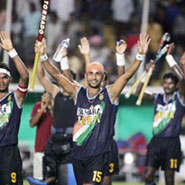
Chak De Indian Hockey
Whether it is Chak De effect or not, Indian Hockey is doing extremely well. I congratulate the Indian Hockey Team on their victory in Asia Cup Hockey tournament. I wish Indian Cricket team members also get to play 15 minutes of hockey during their training session, they will realise what it means to be staying fit in sports. Here is the latest from the Hockey field:
Chennai: Goals rained as hosts India on Sunday thrashed Asian Games champions Korea 7-2 to win the Asia Cup final here. Defending champions India on Sunday retained the BSNL Asia Cup, defeating Asian Games hockey champions 7-2 in the final in Chennai.
India led 3-1 at the lemon break. India’s scorers were Prabhjot Singh (3), Rajpal Singh, Shivendra Singh, SV Sunil and Roshan Minz. Oh Dae Keun and Jang Jong Hyun pulled back one each for the losers.
God bless and have a great week ahead.
Ramesh Menon
09092007
 ClicksandWrites
You must be logged in to post a comment.