
The real Judge’s judgement
The real Judge’s judgement
lNNER VOICE/Nadia Ahmed/Hindustan Times September 10, 2007
Once upon a time there was this learned man named Ali Haji who was very religious. He used to offer Salat (namaz) five times a day and was also very regular in reciting the holy Qur’an daily.
His neighbour, man named Rehan, was his good friend but the only thing Ali Haji disliked about Rehan was that he was not regular in offering the Salat or reciting the holy Qur’an. Rehan used to offer Salat whenever he felt in need, and as soon as his wish was fulfilled he used to stop offering the Salat or reciting the holy Qur’an!
One day Ali Haji, who was very irritated, scolded Rehan thus: “Rehan, vou never offer Salat regularly and always say that since the Almighty fulfils your wishes whenever you ask Him, there’s no problem!”
Ali Haji then cursed him, “Take my word for it, you are not true to your religion and you will certainly go to Hell for this!”
That very night the Almighty appeared in Ali Haji’s dream and said “Ali Haji, who are you to judge who is true to Me and who is not? So what if Rehan offers Salat only when in need? For he calls Me from the bottom of his heart with true faith in Me. Now you will be placed in Hell and Rehan in Heaven.”
So now this simply shows that we are nobody to judge or object to anyone because of their faith or devotion towards their idea of God, be it a Hindu, Muslim, Christian, Sikh or anyone. What really matters is not the quantity of our worship of the Almighty but the quality. It may be good to make people offer regular prayers but we must not judge them by their ‘inabilities’ or ‘abilities.’
Especially when it comes to matters of faith, it’s not our business to judge the sincerity of a person’s relationship with God, who is One. After all it is not us but the Almighty who is the ultimate power who decides everything, especially who loves Him and how.
Parents can now control kids’ mobiles

Parents can now control kids’ mobiles
AGENCIES
SYDNEY: An Australian company claims to have developed the world’s first software suite that enables parents to completely control their children’s mobile phone usage.
The programme lets users filter inappropriate websites, control all SMS and MMS messaging and block expensive premium SMS numbers.
Meg Dennis, co-founder of Leopard Labs, which developed most of the suite, said, the software would help parents keep their children’s phone bills in check, besides ensuring that the kids were not exposed to adult content.
The software would also prevent cyber bullying, Dennis said.
“You can say I only want people in my address book who know my kid to access them [and] anyone outside that address book will get rejected,” Dennis said.
“It’s not about stopping access; it’s about facilitating it and making it a great user experience for kids and parents as well,” she said.
She said the software also had the provision to filter out specific words from SMS messages, but she did not expect that particular feature to be widely used, as it was easy to bypass using abbreviations.
According to a Sydney Morning Herald report, the software also contains an anti-virus programme from Kaspersky Lab to protect against mobile malware and spam, which security companies say is on the rise as mobile phones become more like computers.
“What we see happening is mobiles becoming the device of choice to access the Internet … and the mobile world is very similar to the PC world in that it needs those types of controls available,” Dennis said.
Dennis said the complete software package, called mozone, which Leopard Labs had been working on since 2005, would be available to buy from the company’s website in November.
Though the price has not yet been decided upon, it would be “completely affordable”, she said.
She further said Mozone will presently support only the Symbian platform, used by Nokia, Motorola, Samsung and Panasonic, which represent 72 per cent of the world’s smartphone market, adding that support for other platforms would be added early next year.
Understanding central bank autonomy
Understanding central bank autonomy
10 Sep, 2007, 0442 hrs IST,Mythili Bhusnurmath, TNN
NEW DELHI: Research has already established that there are significant benefits for macroeconomic performance from central bank autonomy (CBA). CBA helps countries achieve lower average inflation, cushions the impact of political cycles on economic cycles, enhances financial system stability, and boosts fiscal discipline without any real additional costs or sacrifices in terms of output volatility or reduced economic growth.
Now an IMF paper that looks at trends over time in CBA of 163 central banks representing 181 countries (India is not included in the sample) delves deeper into the issue, more specifically into two aspects of such autonomy: political and economic autonomy.
Political autonomy is defined as the ability of central banks to select the final objectives of monetary policy, based on eight criteria: (1) governor is appointed without government involvement; (2) governor is appointed for more than five years; (3) board of directors is appointed without government involvement; (4) board is appointed for more than five years; (5) there is no mandatory participation of government representative(s) in the board; (6) no government approval is required for formulation of monetary policy; (7) central bank is legally obliged to pursue monetary stability as one of its primary objectives; and (8) there are legal provisions that strengthen the central bank’s position in the event of a conflict with the government.
Economic autonomy assesses the central bank’s operational autonomy on the basis of seven criteria: (1) there is no automatic procedure for the government to obtain direct credit from the central bank; (2) when available, direct credit facilities are extended to the government at market interest rates; (3) this credit is temporary; (4) and for a limited amount; (5) the central bank does not participate in the primary market for public debt; (6) the central bank is responsible for setting the policy rate; and (7) the central bank has no responsibility for overseeing the banking sector or shares responsibility.
Assessing the performance of the sample group of central banks against these two yardsticks, the paper concludes: Average CBA scores have increased significantly over the last couple of decades: overall CBA (political and economic autonomy) has about doubled, but the economic element of autonomy is significantly ahead of the political component.
Advanced economies started off from relatively high levels of autonomy in the late 1980s but continued to strengthen their CBA in the subsequent years. Since their economic autonomy was already quite high, most progress has been towards boosting the political autonomy. However, the political component of autonomy still lags behind the scores for economic autonomy.
Among emerging markets, overall CBA has more than doubled over time and has surpassed CBA, typical in the advanced countries in the late 1980s. Measures of economic and political autonomy show similar levels of improvement, with economic autonomy remaining higher than political autonomy.
In developing countries, political autonomy of central banks has improved only marginally and remains low. The good thing, however, is that economic CBA has increased significantly over the past couple of decades.
According to the authors, political autonomy is much harder to win than economic autonomy. In developing countries, governments often continue to be involved in the selection of central bank boards and tenures tend to be short; the government is generally represented on the board and central banks have a limited legal protection in the event of a conflict with the government.
The four main principles of any legal framework for CBA include:
Setting price stability as the primary objective of monetary policy
Governments may have several competing economic objectives, particularly in the short term. Accordingly, they may tend to ignore the medium-term inflationary effects of an expansionary monetary policy. This time-inconsistency causes a credibility problem. Entrusting price stability to an autonomous agency ( i.e., the central bank) helps strengthen credibility.
Curtailing direct lending to governments
Most central banks have provisions in place that limit their ability to provide unrestricted credit to the government. Today, almost all central bank laws stipulate that lending to the government, if allowed at all, cannot be automatic, and must be temporary, subject to quantitative limits and at market-related interest rates.
Ensuring full autonomy for setting the policy rate
Most central banks have been granted full autonomy for setting their policy rate. At the most basic level, this condition is necessary for the central bank to pursue its goals. A corollary to that consensus view is the desire to ensure that the central bank has full autonomy for the design of its monetary policy instruments, i.e., the tools to achieve the operational target of monetary policy.
Ensuring no government involvement in policy formulation
No government approval should be required for the formulation of monetary policy. A corollary to that principle is the existence of procedures to resolve conflicts between the central bank and the government.
With the exception of the second — curtailing direct lending to government — we do not make the grade on any of the remaining counts. No wonder that differences between the government and the RBI will increasingly see the central bank on its back foot, with unhappy long-term consequences for the economy?


Another fire in Jebel Ali






Another fire in Jebel Ali
By Alia Al Theeb, Staff Reporter / GULF NEWS Published: September 10, 2007, 15:15
Dubai: A plastic packaging factory was gutted in a massive fire that broke out in its premises in Jebel Ali Industrial Area 3 early yesterday morning.
No one was injured in the incident.
The fire was brought under control by civil defence and fire fighting teams from Al Quoz, Jebel Ali Jumeirah and Al Karama more than three hours after the blaze started.
The cause of the fire at the United Flexible Packaging Co. Ltd. in Jebel Ali Free Zone (South Zone) was unknown.
Preliminary investigations revealed that the fire started in the middle of a hall where a machine and plastic materials were stored. The fire spread to the offices located at the entrance of the factory.
Dubai Civil Defence’s operations room said it received a report from Dubai Police’s Operations Room at 3.17am regarding the fire. Firefighting teams from Al Quoz stations arrived to the scene at 3.43am. The factory for plastic and packaging contained tonnes of flammable materials.
Brigadier Rashid Thani Al Matroushi, Director of Dubai Civil Defence, supervised the firefighting operation which lasted two hours and 48 minutes.
The fire was brought under control at 6.39am. The fire gutted machines, plastic materials as well as a container loaded with plastic materials. The company manufactures and exporters flexible laminates, laminated rolls, pre-formed pouches and pre-punched lids.
Ramadan – Understanding the true spirit of the fasting month

Understanding true spirit of the fasting month
By Samir Salama, Bureau Chief GULF NEWS Published: September 10, 2007, 00:16
Abu Dhabi: Feasting their eyes on cuisine on dinner tables during Ramadan shows how far removed Muslims are from the true spirit of this holy month.
The month of fasting is in fact a time of giving, patience and tolerance for Muslims.
For more than a billion Muslims around the world, it should be the time for devotion to God and self-restraint, when communal nightly prayers are conducted and the basic teachings of Islam are emphasised and Ummah (Islamic nation) consciousness is heightened.
As the ninth month of the lunar Islamic calendar, Ramadan comes 11 days earlier each year on the Gregorian calendar and the duration of the fast changes depending on which season the holy month falls in.
The start of Ramadan, as that of all Islamic months, is based on the sighting of the new moon, the hilal, which is why the crescent is often used as an unofficial symbol of the month. The moon sighting is also the reason that the start of Ramadan differs from one country to another, but many opt to follow Saudi Arabian sightings to be able to mark the holy days together.
Five pillars
As one of the five pillars of Islam, fasting during Ramadan, which is considered one of the highest forms of worship, is obligatory for those Muslims past the age of puberty who are mentally and physically fit and not travelling, as long as it does not cause them physical or mental harm.
Those who cannot fast during Ramadan, owing to health or other reasons, may fast in other months, or feed the poor.
But a Ramadan fast is not a simple abstention from food, drink and sex during daylight hours.
A fast consists of a true and verbal intention that must be recited, as well as a package of dos and don’ts which are specifically emphasised during the month.
Fasting, or sawm (literally refrain), which did not become obligatory until 624 AD, offers an opportunity for Muslims to cleanse the body and mind.
It promotes the principle of sincerity by keeping the individual away from arrogance.
Among the greatest benefits is the lesson in self-restraint and discipline that could be carried forward to other aspects of a person’s life, such as work and education.
The lengthy nightly prayer called Taraweeh is an important element of rituals during the month.
Since it is a time of piety and high religious consciousness, it would be considerate for non-Muslims to dress and behave modestly, avoiding animated behaviour that could cause offence.
Those who want to understand the holy month better could consider involving themselves in the spirit of the month, which would be welcomed by most Muslims. Saying ‘Ramadan Kareem’ to Muslims and attending a fast-breaking feast, or iftar, would be appreciated by most.
Work hours in the private sector are shortened by two hours for Muslims and non-Muslims. The public sector will function from 9am to 3pm.
Live music is banned through the month.
Shopping malls and supermarkets are expected to be open late at night.
A typical day
A typical day of fasting begins with waking up before dawn to have a meal called the suhoor before the start of the fasting day. At sunset, Muslims usually break their fast upon the call for Maghreb (sunset) prayers with another meal called iftar. Prayers are conducted five times through the day, as they are on all days, and an extra set of prayers called Taraweeh is conducted after Isha or night prayers.
Tips for non-Muslims
Since it is a time of piety and high religious consciousness, it would be considerate to dress and behave modestly, avoiding animated behaviour that could cause offence.
Those who want to understand the holy month better could consider involving themselves in the spirit of the month, which would be welcomed by most Muslims. Saying ‘Ramadan Kareem’ to Muslims and attending a fast-breaking feast, or iftar, would be appreciated by most.
Since cultural consciousness is also high during the month, Ramadan can be a good time to connect with the local and Muslim cultural scene by attending the various musical and social events, as well as trying local and regional cuisine that is popular during the month of fasting.
Arabic speaking non-Muslims wishing to learn more about the region and its people will notice that Arabic television channels change their programming to a new schedule dedicated for Ramadan, when some of the most popular celebrities in the Arab world feature in some of the most-watched soap operas, historic series, as well as religious, cultural and musical shows. 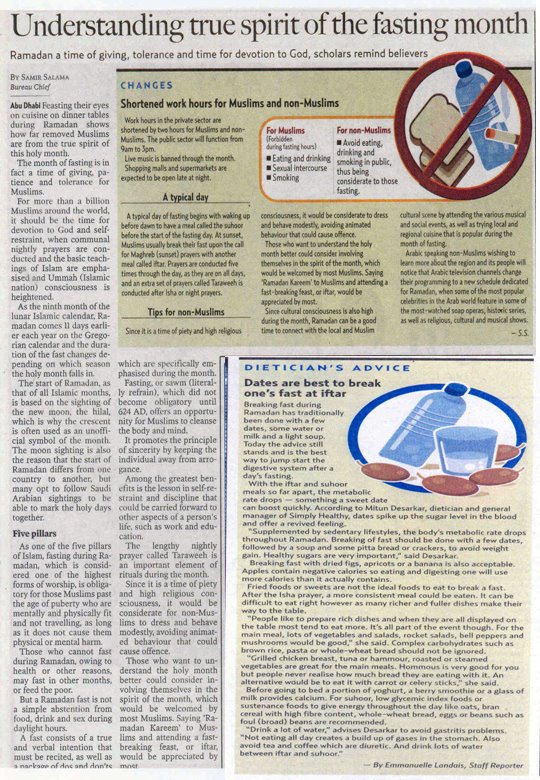

We’re authors of our own bewilderment
We’re authors of our own bewilderment
6 Sep, 2007, 0510 hrs IST,Vithal C Nadkarni, ECONOMIC TIMES
Pope Benedict has described Mother Teresa’s decades-long crisis of faith as “the silence of God”, a phenomenon the Pontiff says is “known to all believers”.
Referring to the book of letters detailing the tormented state of Mother Teresa’s faith, the Pope says this isn’t unusual. All Catholics have to contend with the silence of God, which so sorely tested even the saintly Mother despite all her charity and force of faith, he has added.
By the Pope’s own admission, the cat is finally out of the bag: hereafter it would be extremely disingenuous to claim special access to the Big Boss who allegedly lives beyond the Pearly Gates.
Nor should you believe those who claim to have a hotline to heaven. This also rules out such prospects as barters with God, or bribing Him into benevolence with your little acts of piety. Does this sound pitiless? But that’s exactly how the universal cookie crumbles, even according to Bhagwad Gita.
That’s precisely the revolutionary message of the fourteenth verse from fifth chapter of the Lord’s Song: “Of course there is no God,” Krishna says to Arjuna, at least not in the sense that countless generations of priests and shamans have led you up to believe.
If at all there’s something, it’s what the Gita is willing to concede as “embodied consciousness”, which Swami Prabhupada, founder of the Hare Krishna movement, translates as “the master of the city of your body”. “He does not create activities, nor does he induce people to act. He also does not create the fruits of action,” the verse goes on to elaborate. All that pops out from the tendencies inherent in material nature.
The verse that follows makes even more revolutionary assertions: The Supreme Spirit lies indifferent beyond all epithets and categories; it does not care for your sinful activities nor is it pleased by your pious acts. “(Thus) the Lord neither hates nor likes anyone, though He may appear to,” says Swami Prabhupada. Our poor embodied souls often fail to get this message.
Enslaved by our own desire to escape from supreme consciousness, we become authors of our own bewilderment and grow forgetful of our own essential nature. This can only heighten the so-called darkness of the soul suffered by embodied beings, for ignorance has knowledge enthralled (ajnanavruttam jnanam tena mhuyanti jantavah) in its coils.
The way out of the impasse is through faith and enlightenment.
 ClicksandWrites
You must be logged in to post a comment.