Abu Dhabi unveils 2030 growth plan
Abu Dhabi unveils 2030 growth plan
(Wam) 13 September 2007
ABU DHABI — The President, His Highness Shaikh Khalifa bin Zayed Al Nahyan, was briefed on the Abu Dhabi development plan until 2030 at his Bateen Palace here yesterday.
General Shaikh Mohammed bin Zayed Al Nahyan, Crown Prince of Abu Dhabi and Deputy Supreme Commander of the UAE Armed Forces, attended the briefing.
Shaikh Khalifa expressed his satisfaction about the development plan of the capital city, Abu Dhabi, and implementation of work projects to develop the country at par with the developed countries of the world. He listened to the detailed briefing about the plans and objectives and how to execute them by Khaldoun Khalifa Mubarak, Chairman of the Abu Dhabi Executive Authority.
The move is in response to the need for a well-studied, accurate planning amid huge development and growing population of the Abu Dhabi emirate.
Mubarak said the “plan is based on sustainable development that reflects economic and environmental situation and preservation of the natural environment of coasts and deserts. It also covers transport and communication networks as per international standards and in line with the values and traditions of the UAE”.
He said that the plan has been set for a city that will be inhabited by three million people by year 2030 and with infrastructre that meets such a growth, adding that the plan includes construction of metro and internal train network.
“The interior part of the city will be expanded through road network paralell to the islands to create a new commercial area on Al Sowah and Al Reem Islands,” Mubarak said.
After the briefing, Khalifa issued instructions on provision of all means of comfort, including more parks, convenient transport, preservation of the UAE environment and making the UAE an attractive cultural, commercial and tourist hub.
For smart investors, STP’s the next step
For smart investors, STP’s the next step
10 Sep, 2007, 0443 hrs IST,Barun Chakraborty, TNN
Over the past one month, equity investors across the globe have seen their fortune swing back and forth. Concerns over subprime lending, yen-carry trade and the looming spectre of a US slowdown not only battered global equity markets, but also raised doubts among several retail investors on the course of the markets in the short- to- medium-term.
In India too, investors have had a tough time given the kind of gyrations the markets have been witnessing.
The Sensex has seen several major corrections since it touched its life-high of 15,868 on July 24 this year, and after dropping to 14,000-levels it bounced back to 15,600-levels.
A retail investor is likely to remain confused as to whether it is the right time to enter the markets? Should one expect some more corrections? Unfortunately, no one can predict the course of the market. For a retail investor, timing the entry or exit is a difficult act to follow. The best way to survive a volatile market is to keep investing in equities and stay put with a long-term horizon.
SIP (Systematic Investment Plan)
For mutual fund investors, the systematic investment plans (SIPs) are the best method to stay invested without bothering too much about the market ups and downs. Through regular investing, one gets to invest in the highs as well as the lows. This helps in averaging out the market volatility. The investor keeps investing a certain amount (as small as Rs 50) at regular intervals. As the market soars, even the value of the investment scales new highs. And when the market tanks, the value of the mutual fund units —the net asset value (NAV) — too comes down. This means more units for the same SIP amount.
Apart from inculcating the discipline to invest regularly, the fact that the investor has to stay invested for at least two years in a fund to free his/her investment in one-year SIP from capital gains tax, gives enough time for the money to stay put in the market and appreciate.
STP (Systematic Transfer Plan) Edge
The SIP is the best route to invest with regular cash flows. But what if someone has a huge corpus and plans to invest in equities and at the same time is worried about the prevailing uncertainty in the market? Still, the systematic investment route remains the best vehicle to move ahead.
The gains could be enhanced by opting for a systematic transfer plan (STP) along with the SIP. STP allows one to make periodic transfers from one fund into another.
In an SIP, an investor typically parks the money in a bank savings account and a certain amount is transferred at a regular interval from the savings account to the fund house for buying into a specified equity fund.
In the case of an STP, the lumpsum is invested in a liquid or a floating short-term plan and is transferred at regular interval to a specified equity fund. For example, one has Rs 60,000 to invest in equities, he can put the entire amount in a liquid plan and go for a monthly SIP of Rs 5,000 in an equity plan through a systematic transfer.
However, the limitation of this investment process is its inability to invest in different fund houses. So, if you have an equity fund to invest through the SIP mode, you would have to choose the liquid fund of the same fund house. But with little difference in returns among different liquid funds and its almost risk-free status, STP is still a better bet.
While an investor earns only around 3.5% pa interest on the amount parked in the savings account, a liquid fund gives a higher return of 5-7% pa on the corpus with the same level of liquidity. As these funds invest in safe and liquid debt instruments, the level of risk remains very low.
Positive action for dealing with change
Positive action for dealing with change
10 Sep, 2007, 0019 hrs IST,Nandan M Nilekani,
As Global business leaders, we operate at a time when the need to address larger issues such as climate change and poverty is becoming more urgent. Questions are being asked about the role that large companies play in addressing these challenges. This is why the inquiry into Tomorrow’s Global Company, initiated by the Tomorrow’s Company think-tank, has proved so timely and relevant.
This writer co-chaired the inquiry that brought together representatives from businesses based in Asia, North America and Europe as well as people from non-governmental organisations (NGOs) and not-for-profit groups. They came from ABB, Alcan, Amnesty International Business Group, BP, Dr Reddy’s, Ford, The International Institute for Sustainable Development, KPMG, Leaders’ Quest, McKinsey, Standard Chartered etc.
Given this diversity of backgrounds, it was interesting to find a remarkable degree of consensus in our views. We agreed that the market economy has proved a powerful force for innovation, growth, employment and development. Today, the market’s power is most dramatically seen in the process of globalisation, which is driving up productivity and creating prosperity.
However, we also agreed that the world is undergoing unprecedented change, characterised not only by economic growth but by increasing pressure on the environment and continuing social, political and cultural divisions. The positive power of globalisation is not touching many lives.
Global companies — with their scale, power, capabilities and experience — are uniquely placed to deliver practical solutions to resolve these issues. They can develop new technologies, create jobs, raise skill levels, set benchmarks in working conditions and provide goods and services to improve living standards for the world’s poor. In other words, companies can make a positive difference.
Going beyond our current efforts, we need to envision a world in which companies make profits and create shareholder value while tackling large global problems. There is no simple answer. But we have agreed on specific priorities — actions we believe companies should take to realise our shared vision.
Our three priorities were: redefining success, living by strong values, and deeper engagement with governments, etc., to create stronger market frameworks. We saw these as critical factors for changing businesses from wealth creators to agents of social change.
First, we agreed that global companies must redefine ‘success’. It isn’t only about delivering short-term returns to investors but about creating lasting positive impact for society and the environment. If companies can make such contributions, the profits will follow.
Investors are increasingly judging companies on their prospects for sustainable success — looking hard at performance against environmental, social and governance indicators. They want companies to be clear about their goals for building value and prove that they are achieving them. The onus is on us to define specific measures of long-term success and demonstrate that we are on track to meet them.
Our second priority was for companies to articulate and live by strong values. Global businesses are diverse in many respects — geographically, culturally and linguistically — but they cannot afford to be so in regard to ethics and behaviour.
Strong values — put in practice through codes of conduct or charters — bind a multinational together, providing motivation internally and building trust externally. For example, if a company says it believes in education and backs that belief with investment, people will make the connection that wherever that company operates it will support education. This association becomes integral to the company’s brand. While helping people develop skills, the company also attracts customers who value its reputation for encouraging learning.
Our third priority related specifically to directing the power of the market for social and environmental ends. In many areas there are no international rules laid down by governments, which means that there are serious failures in the frameworks that should constrain the market. Over the past two decades, NGOs have highlighted these areas — from the environmental damage caused by construction projects to corruption that prevents the proceeds of global companies’ work from benefiting citizens of developing countries.
Progressive businesses have evinced interest in tackling such problems both to avoid negative outcomes and being undercut by less scrupulous competitors. Such issues can only be resolved by strong national regulation and international agreements. However, one cannot simply shift the responsibility onto governments.
That is why companies must continue to implement voluntary agreements. Examples include the Kimberley Process, which seeks to prevent the sale of ‘conflict diamonds’; the Equator Principles, which make banks’ funding for major projects contingent on social and environmental responsibility; and the Extractive Industries Transparency Initiative, which combats corruption by encouraging greater openness about the use of revenues from oil, gas and mining operations.
While they are a good start, these initiatives must be followed up by stronger frameworks of agreements, laws and regulations to ensure that the power of the market is unlocked to address the problems of our time. And companies must work with governments to create such frameworks.
In the last decade there has been emphasis on doing business in a ‘responsible’ way, i.e., avoiding negative impact on society and the environment. We must now focus on doing business in a ‘sustainable’ way — delivering positive impact to society and the environment. This also means doing so in a way that assures our own sustainability, without which we can do nothing.
Global businesses have huge resources, deep capabilities and extensive reach. They also have front-line experience of key problems such as poverty, environmental issues and human rights dilemmas. We have shown that we understand the problems. We must now be part of the solution.
(The author is co-chairman, Infosys Technologies)
Creativity from being oneself
Creativity from being oneself
10 Sep, 2007, 0548 hrs IST,K VIJAYARAGHAVAN, TNN
In a song sung by Mohammed Rafi for the film Izzat, released in 1968 (Lyrics: Sahir Ludhianvi), the message of authenticity is brought out in the lines, Kya miliye aise logon se, jinki fithrath chupi rahe; nakli chehera samne aaye, asli surath chupi rahe (what can be obtained from such people whose nature lies hidden, where only the false face is in view and the real face stays hidden?). This song further expatiates powerfully on the ways of such pretentious persons in this world of make believe and sham.
Many indeed are far removed from their normal selves, influenced as they are by feelings of insecurity and anxieties or in consequence of their greed for money, power and fame. While some openly and brazenly cast off all scruples and goodness in their feverish pursuits, some continue to talk of and preach honesty and integrity, though unable to bring themselves to lead a life of clarity and real substance.
They thus display a dichotomy in character, which also finally manifests, to an intelligent observer, in their conflicting words and acts. While many are helpless tools of situations, some also can cause serious harm through their glib talk and convincing exterior. Such wolves in sheep’s clothing are verily walking examples of split personalities, whose cliché laden and sugar-coated words would extend to swearing and making promises, adroitly stage managed to bowl many over.
In an incisive article, “The Awesome Power to be Ourselves”, (Reader’s Digest, July 1983) Ardis Whitman rightly terms the power to be oneself as the greatest power — the power which could touch the destiny and trends of situations and peoples. Citing specific examples of great personalities, who possessed this power of integrity and authenticity, Whitman also points out how, on the contrary, the “loss of power” on the part of the soul, could also result in unexplained fatigue and various psychosomatic diseases.
While specific mental and spiritual exercises could help one to obtain authenticity and clarity within, being in solitude once in a while, reflecting on things within and without is also a powerful tool in this journey. This verily is the application of the exhortation, ‘Know Thyself’, the concept of Sage Patanjali (Yoga Sutra: 1,3) of being established in one’s true self (swarupa) and the injunctions in the Bhagawad Gita (2,45; 5,3 and 5,25) to become freed of conflicts and dualities within.
Time for Chak De, India – Narayana Murthy
Time for Chak De, India
11 Sep, 2007, 0000 hrs IST,Narayana Murthy, for ECONOMICS TIMES
NEW DELHI: The other day, my wife and I were perhaps among the very few post-fifty people in the mostly-twentyish crowd watching the film Chak De in Bangalore. You had to be there to believe the shouts of joy that accompanied every goal India scored in the imaginary tournament in the movie.
The mood at the end was as if India had actually won the women’s world cup in hockey. I can appreciate this mood since I too felt similar joy and pride when hundreds of cameras clicked at me holding our national flag, on India and my being declared the winners of the E and Y world entrepreneur award among the forty-odd competing nations at Monaco in 2003. As I exited the theatre after watching Chak De that day, several youngsters asked me for my reaction to the movie. My answer was simple. I said I wanted to see the movie become a reality not just in hockey but in every sphere.
The recipe for such a success was most wonderfully conveyed by Shah Rukh Khan and those wonderful women hockey players in the movie. Let me recount them here. We have to identify as Indians first and rise above our affiliations with our states, religions and castes.
We must accept meritocracy and enthusiastically play the role we are best suited to. We must embrace discipline to strictly follow every step required for success. We have to put the interest of our nation ahead of our personal interests, subordinating our egos and biases. Finally, we have to put in tremendous hard work and make short term sacrifices for long term glory.
I have immense faith and optimism in the youth of this country. But, will we get our leaders to set examples for hundreds of millions of Indian youth? I wish more and more of our leaders see Chak De and learn these precious lessons. (The author is Chief Mentor and Chairman of the Board, Infosys)
World’s fastest bowler is an Indian
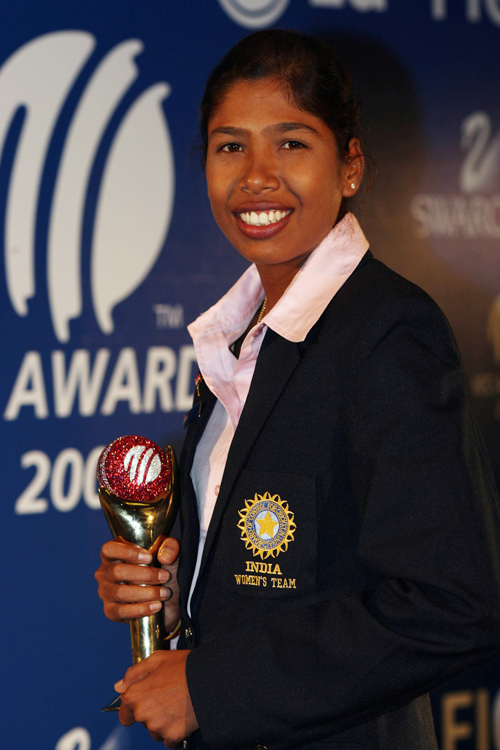
World’s fastest woman bowler is an Indian
TNN / Partha Bhaduri & Sumit Mukherjee
JOHANNESBURG/KOLKATA, September 11: When the jet-lagged Indian men’s cricket team landed in Jo’burg and realised they had to attend the ICC awards function, a groan went up. They’d have preferred to rest, especially since not one of them was in the running for any of the awards.
Then the big night came around. Skipper MS Dhoni was called to present a trophy, and suddenly he was applauding. The other members of Team India were up on their feet too, putting their hands together for a player who played a key role in India’s historic Test series win in England – Jhulan Goswami.
Jhulan who? Never heard the name? Few have. In a country that’s cricket-mad, the world’s fastest bowler in women’s cricket has gone largely unrecognised. Till Monday night, when the strapping 24-year-old from the backwaters of Chakdah (in West Bengal’s Nadia district) was declared ICC’s Woman Player of the Year.
“Everyone thinks women should not play cricket. I just hope this award which I got when no cricketer from the men’s team was nominated makes news,” she told TOI after her acceptance speech.
Clear shades of Chak De. While the men’s team was feted for its Test series triumph in England, a similar feat by the women last year went unnoticed. That series had presented the rare sight of opposing batsmen backing away as an Indian pacer charged in. 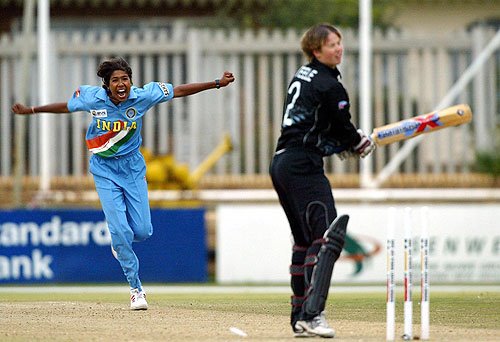
In fact, England captain Charlotte Edwards, who had become Jhulan’s bunny, dropped herself down the order so she wouldn’t have to face her nemesis straightaway.
Edwards’s woes can be traced back to the boys in Jhulan’s neighbourhood when she was growing up. They wouldn’t let her bowl in their matches, because she was too slow. Edwards paid the price years later.
Ramadan begins tomorrow

Ramadan begins tomorrow
By a staff reporter / KHALEEJ TIMES 12 September 2007
ABU DHABI — The holy month of Ramadan begins tomorrow and Thursday, September 13, will be the first day of the month of fasting, the moon sighting committee announced yesterday.
The committee said in a statement following its meeting held under the chairmanship of Mohammed bin Nakhira Al Dhahiri, Minister of Justice, that Wednesday, September 12, will be the 30th day of Shaaban.
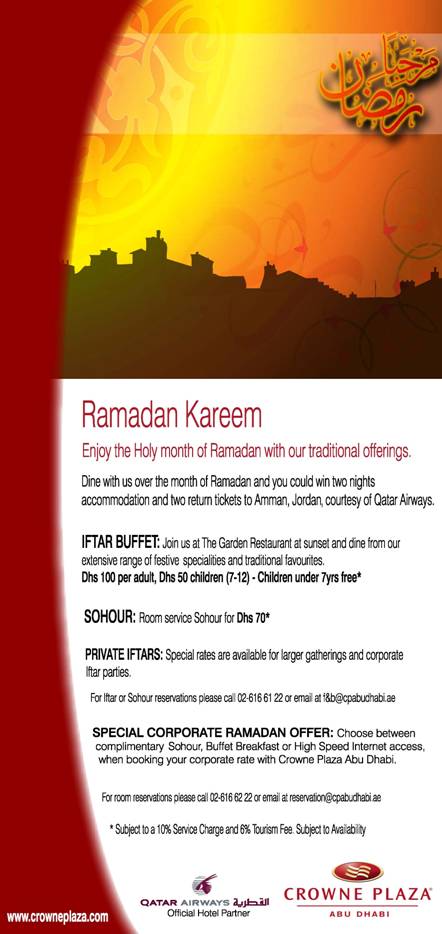
Ramadan Special offers

30% of women in UAE have osteoporosis
30% of women in UAE have osteoporosis
By Dina El Shammaa/GULF NEWS 05 September 2007
Abu Dhabi: Around 30 per cent of women in the UAE suffer from the common bone disease osteoporosis, said Dr Shivanand Shetty, an orthopedic surgeon at the New Medical Centre.
The age of onset is around 50-years-old. Osteoporosis is a major risk factor for fracture. Dr Shetty spoke to Gulf News regarding reasons behind developing osteoporosis. Risk factors that enhance osteoporosis include smoking, excessive alcohol consumption, lack of calcium in one’s diet and lack of exercise.
However, osteoporosis can be avoided at an earlier stage, said Dr Shetty. Until the age of 30 there is constant turnover of the bone in the skeletal system. Bone formation and resorption takes place at an equal rate.
Diet
Peak bone mass (adequate deposit of calcium in the bone) is reached by the age of 30. To achieve peak bone mass one needs a diet adequate in calcium, vitamin D and good exercise during the early phases of life. Osteoporosis runs in families; having a parent or sibling with osteoporosis puts a person at greater risk.
“I advise patients to drink a lot of milk and consume dairy products as well as green vegetables. One whose diet is not adequate in calcium requires calcium supplements and regular exercise,” said Dr Shetty.
One of Dr Shetty’s patients, Shahnaz Ihsan, a housewife, aged 56, spoke to us regarding her experience with osteoporosis.
“Exactly three years ago I started to feel immense pain in my back, my bones were cracking and I visited the doctor who prescribed medicine .. and now feel so much better,” she said.
Ihsan advised other woman to seek medical help if they start to suffer menopausal
symptoms.
Do you wish to know more about Osteoporosis? Read on:
Osteoporosis
Normal bone is dense and strong. Bones with osteoporosis become porous because of deterioration of the bone tissue, which leads to bone fragility and increase in fracture risk.
Bone undergoes a process of constant remodeling consisting of the breakdown of old bone and re-building of new bone. This resorption (by osteoclasts) and formation (by osteoblasts) occurs at an approximately equal rate thereby maintaining strength of the entire skeleton.
Around the ages 30-35, peak bone mass is attained and the process of bone loss begins. The greater the bone mass accrued prior to this time, the less chance exists for complications from bone loss later.
Osteoporosis is the most type of bone disease and affects both men and women. The condition is characterized by low bone mass, loss of bone architecture, and reduced bone strength. Because people with osteoporosis have brittle bones, they are at increased risk for developing fractures. The most common types of fractures in people with osteoporosis include spinal vertebral fractures, hip fractures, and wrist fractures.
There are two types of osteoporosis:
Primary osteoporosis – bone loss that occurs as a consequence of the normal aging process and most often affects postmenopausal women.
Secondary osteoporosis – bone loss that occurs as a consequence of other factors such as a chronic medical condition, nutritional deficiency, or certain types of medications.
There is currently no cure for osteoporosis. The best treatment available for osteoporosis is prevention. The goals of treatment of patients with osteoporosis include:
To slow the progression of the disease once it has started.
To minimize the risks of complications that may cause pain and reduction in function.
Exercise and attention to safety issues help to maximize mobility and reduce the risk of falls and fractures.
Currently, in the United States, several medications are approved by the U.S. Food and Drug Administration (FDA) for the prevention and treatment of osteoporosis and are considered as first-line medications. These medications include:
* Biphosphonates
* Raloxifene
* Nasal calcitonin
* Teriparatide
Opec extraordinary meeting to be held in Abu Dhabi on Dec 5

Abu Dhabi: The 146th extraordinary meeting of the Organisation of Petroleum Exporting Countries will be held in Abu Dhabi on December 5, the organisation said in its schedule of forthcoming events.
The third Opec summit will be held in Riyadh, Saudi Arabia, on November 17 and 18.
International media reports on Monday said Opec will probably maintain its oil production targets, resisting calls for more supply because of concerns that demand may falter as US economic growth slows.
Representatives from member states, including Libya and Iran, have maintained over the past fortnight that there is no need to boost output from those targets set last year.
Ministers from Iran and Kuwait also said over the weekend that the organisation’s production limit of 25.8 million barrels a day should not be changed, echoing comments from top officials in Venezuela, Algeria and Qatar.
UAE’s Minister of Energy and Opec president Mohammad Bin Dha’en Al Hamili said yesterday that “supplies to the oil market are sufficient,” state news agency WAM reported.
Oil prices have risen 24 per cent this year and touched a record $78.77 a barrel in New York on August 1 after members of the organisation curbed exports to drain inventories.
Contribution
Opec countries have made significant contributions to their reserves in recent years by adopting the best practices in the industry.
As a result, the proven reserves of the organisation currently stand well above 900 billion barrels.
Output: Group produced 30.37m bpd in August
Opec produced 30.37 million barrels per day in August, or over a third of the world’s 85 million bpd supply.
Opec countries hold more than three-quarters of the world’s oil reserves. The bulk of Opec oil reserves is located in the Middle East, with Saudi Arabia, Iran and Iraq contributing 56 per cent to the organisation’s total.

 ClicksandWrites
You must be logged in to post a comment.