Help Wanted – to sort out Taxi problem
And support from unknown sources…. As long as the objective is for the betterment of the society, we don’t mind who or from where the Help come.

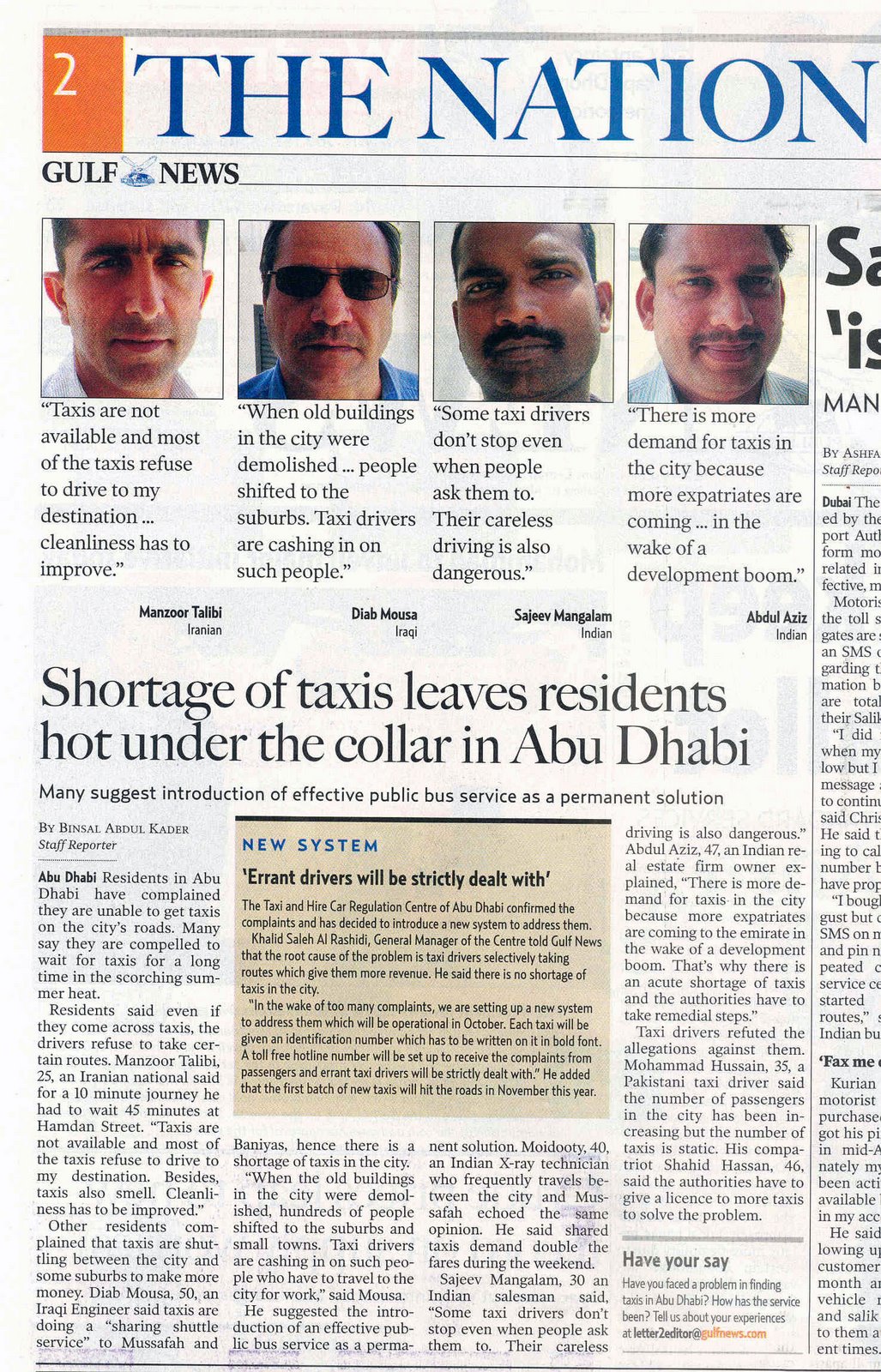
Appreciate to see more suggestions and solutions to resolve the shortage of taxis in Abu Dhabi which is making the life of people to go to work and come back home. We need solutions and we have to give solutions to the administrative authorities rather than filling them with problems.
You may write your thoughts to letter2editor@gulfnews.com.
Abu Dhabi reveals long term urban plan
Abu Dhabi reveals long term urban plan
By Samir Salama Bureau Chief and Ahmed A. ElewaStaff Reporter Published: September 19, 2007, 15:28
Abu Dhabi: A Dh600 billion master development plan for Abu Dhabi for the next quarter of a century was announced by the emirate’s Urban Development Council yesterday.
The Plan Abu Dhabi 2030: Urban Structure Framework Plan sets out a strategic approach to develop the emirate’s most dynamic economic sectors and envisages a growth of the UAE capital’s populations to over three million by that year.
General Shaikh Mohammad Bin Zayed Al Nahyan, Abu Dhabi Crown Prince and Deputy Supreme Commander of the UAE Armed Forces, said the plan provides a strong and comprehensive foundation for the development of Abu Dhabi, in a strategic and coordinated way. 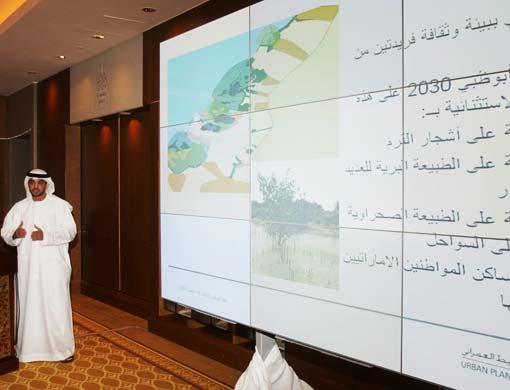
“It will ensure that future generations will continue to enjoy and be inspired by ongoing access to the desert, sea and natural assets that are integral to our national identity, while building a global capital with its own rich cultural heritage,” Shaikh Mohammad said following the release of the plan. 
“The execution of the plan has begun already eight months ago, and it started with the detailed study aiming at developing Abu Dhabi as one of the best international cities,” commented Falah Al Ahbabi, who has been appointed general manager for UPC. The plan projects a population of three million people residing in Abu Dhabi by 2030, and sets the framework of the necessary infrastructure, housing, recreational, and business sectors to cater for such population.
The plan includes inter-city train network and metro lines, specifies land uses, building heights and transportation plans for Abu Dhabi, said Falah Al Ahbabi, director-general of the Abu Dhabi Urban Planning Council, authorised to oversee implementation of the plan.
Urban Planning Council set up
President His Highness Shaikh Khalifa Bin Zayed Al Nahyan has issued in his capacity as Ruler of Abu Dhabi, a new law setting up the Abu Dhabi Urban Planning Council (UPC). As per law No. 23 for 2007, the UPC shall be an independent corporate entity enjoying financial and administrative independence and full legal status to operate. 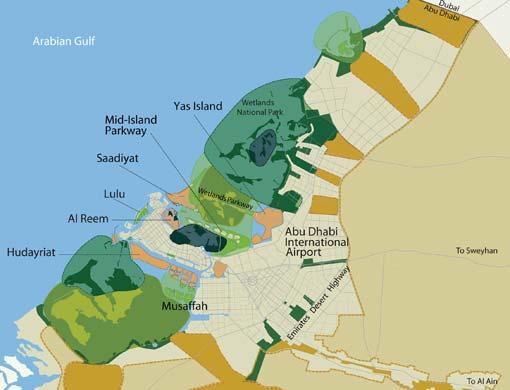
The council is to be chaired by General Shaikh Mohammad Bin Zayed Al Nahyan, Abu Dhabi Crown Prince and Deputy Supreme Commander of the UAE Armed Forces. Shaikh Khalifa also issued Decree No. 22 for 2007, setting up the Abu Dhabi Future Energy Company, a joint-stock company, and the Masdar Science and Technology Institute. The company’s shares will be completely owned by Mubadala Development, WAM reported.
Energy for sustainable growth
Energy for sustainable growth
By Francis Matthew, Editor at Large Published: September 19, 2007, 23:21
The Gulf states’ profligate use of energy will have to stop if plans for larger populations and expanded economies are going to work.
Their energy reserves are some of the largest in the world, but they are not infinite, and they will certainly not support the planned growth for ever. Even if growth eventually slows to a more stable total population, the region will be much larger than at present and will finish its reserves rapidly.
The planned scale of growth is awe inspiring. The population of the Arabian Peninsula is set to double from the present 59 million in 2007 to reach 124 million by 2050, according to the Population Reference Bureau’s June 2007 Bulletin.
This will be a combination of natural growth from the national populations, as well as continuing immigration from expatriates into the region.
This massive increase will have to be matched by very careful planning of water and power resources. Till now most Gulf Cooperation Council (GCC) states have not done well at this since growth so far has not seriously challenged their capacity to produce energy for domestic and industrial use.
All the governments have had to do is turn the taps on a bit more and they have kept pace. This cannot continue.
It is true that water has been a topic of government concern for the last decade, mainly due to the warnings sounded by the failure of traditional artesian wells which forced governments to plan alternatives and thus raised the whole question of actively planning how to allocate water resources to meet demand across the whole economy.
But this planning has remained at government level, with most solutions revolving around increased use of recycled water, and increasing desalination capacity. But wider awareness of the importance of water conservation has not happened and the population at large remains uncaring.
This is dangerous since the supply of new water depends on desalination, which uses a lot of gas to boil the sea water. All electricity in the GCC comes from generating stations which also use gas.
Both the supply of water and electricity ultimately depend on the same resource, which is gas, and as with all hydrocarbons, gas supplies are ultimately limited. They may be around for some decades or even centuries in a few areas, but they will eventually be used up.
It is startling how much the region’s future plans are linked to continued and plentiful gas supplies. There is a major long term crisis in the making unless steps are taken today to address how to conserve this large but ultimately limited resource, and the answers lie in both supply and demand.
On the demand side, it lies with all authorities to enforce more rigorous standards in all spheres of life. For example it should be mandatory that new buildings meet tough energy standards.
For example, all the glass walls we see around us require large air conditioning units on the roofs of buildings, chewing up vast amounts of energy.
On the supply side, it is important that all GCC states develop effective national power grids, and link them in a future GCC grid. This involves commitment from all governments, and it also means developing a pricing mechanism within the grid so that the power hungry parts of the GCC are able to buy power from the resource rich countries.
Any pricing mechanism will have to take into account the subsidies that most GCC governments continue to offer their populations, since very few individuals or companies are able to bear the true commercial cost of a unit a power.
Power grid
Unfortunately the GCC has not been able to implement its plans for a GCC power grid, but it is exactly the kind of project that the GCC should be able to manage. It is largely technical in nature, focusing on infrastructure, and the benefits are overwhelming. All that is required is some political commitment to achieve a solution to the pricing issue.
But there another important supply of power which the GCC states have to take more seriously. It is ridiculous that in an area which has so much sun, there is so little solar energy.
For example, all buildings should have solar panels on their flat roofs, all new projects should have their solar farms, and solar energy should become part of every planner and government official’s thinking.
The absence of solar energy in the GCC cannot remain a matter of concern to a few environmentalist lobbies. It has to become part of mainstream government thinking, otherwise the 54 million people due to be living in the region in 40 years time will not have enough power or water to keep going.
The continued success of the GCC states depends on getting this right.
Khalifa issues decree setting up energy firm
Khalifa issues decree setting up energy firm
WAM Last updated: September 19, 2007, 23:24
Abu Dhabi: President His Highness Shaikh Khalifa Bin Zayed Al Nahyan, in his capacity as Ruler of Abu Dhabi, issued a law setting up the Abu Dhabi Future Energy Company with a capital of Dh10 million.
Law No. 22 of 2007 sets up the Abu Dhabi Future Energy company as a private joint stock company specialised in the commercialisation of alternative energies through emissions reduction, and clean development mechanism solutions as provided by the UN agreement on climate change as explained in the Kyoto Protocol.
Research
It also sets up the Masdar Science and Technology Institute with the aim of developing and supporting scientific research and technology in the emirate.
According to the law, the company will be a corporate body that enjoys full financial and administrative independence to practice its activities and achieve its targets.
The institute, a corporate body, will also enjoy complete financial and administrative with legal capacity to practice its activities.
It will be offering specialised educational programs in renewable energy and sustainability. Based in Abu Dhabi, the energy company will have a capital of Dh10 million distributed as equity shares at a value of Dh1 per share.
Shares
The new company’s shares are wholly owned by the Mubadala Development, which has the right to restructure the capital. Mubadala is also permitted to sell its shares in the newly established company.
The company may set up, invest in or enter into partnerships with others in the areas of agriculture, industry, water and electricity abiding by the principles of sustainable energy.
It will also have wide ranging business activities in Abu Dhabi and outside the emirate.
Effectively executing restructuring plans

Effectively executing restructuring plans
By Sanjiv Anand, Special to Gulf News Published: September 18, 2007, 23:50
This is the kind of stuff that can grey your hair quickly. It doesn’t win you popularity contest. The benefits are not immediate. The rumour mills can often beat you. Bottomline, it’s not for the faint-hearted. I have been fortunate to have led a number of them over the years, and am still living to tell the story.
There are a number of ways to execute this. My style is to do it quickly and surgically.
Firstly structure follows strategy, and any transformation needs to be driven by the way forward strategy approved by the Board and the CEO.
Furthermore since new structures result in role changes, to get the management team to approve them is inappropriate – remember they are conflicted. It’s all very well to say that they will take a corporate/impartial view of it – that’s all theory. They tend to very much look at it from their own perspective, and also tend to think of the structure in context of the existing strategy and processes. The closest you will get to an impartial reviewer of new structure is the board, and potentially the CEO.
The CEO often also has to be reminded to wear the corporate hat, and not be swayed by his close colleagues within the management team. HR should also be involved at the appropriate point.
There is always pressure to announce it to the larger audience. The CEO is bombarded, people indicate they are nervous. My view is you only communicate when you are clear what you want to communicate and to whom.
Those who are performing well, are never nervous. The ones that are nervous tend to be ones who are unsure of their performance, and they need to be nervous. The first presentation should be a summary of the strategy to the overall senior management team. This gives them context to the organisational change that is about to come. I have never opened out a new structure to a management forum – all hell tends to break lose, and people immediately start jockeying.
Then a set of one-on-one meetings needs to happen with those to be reassigned. HR gives them a letter confirming their new position. Also have their new job description ready, and a presentation outlining the role and strategy of the unit/role they are about to take over.
Handover
These meetings need to be back-to-back and finished over a couple of days, and as much as possible the cutover date to the new position should be within four-seven days of being handed the letter. Also preferably, as many are done on the same day the better. People will also say that they need more time to handover.
My view is core handover should happen, the rest can happen when the person is in the new role, after all he/she hasn’t left the organisation. On the day of the cut-over, make sure you set up a help desk, so that the employees can walk over and ask questions/clarifications once in the new position. Without delay targets need to be provided for the new position, and potential an incentive should be announced for those who will facilitate effectively the organisational change.
The above works well where you are not cutting headcount. Restructuring with a headcount reduction – well, that’s another story. Get your helmets on, it’ a story for another day !
– The writer is managing directorof Cedar Management Consulting International.
Easy Maths
Please try it
something really exciting Multiply 777 with ur age
& then
multiply it with 13 the answer will surprise u…
TAX STRUCTURE IN INDIA…
TAX STRUCTURE IN INDIA…
1) Qus. : What are you doing?
Ans.: Business.
Tax: PAY PROFESSIONAL TAX!
2) Qus. : What are you doing in Business?
Ans.: Selling the Goods.
Tax: PAY SALES TAX!!
3) Qus. : From where are you getting Goods?
Ans.: From other State/Abroad
Tax: PAY CENTRAL SALES TAX, CUSTOM DUTY & OCTROI!
4) Qus. : What are you getting in Selling Goods?
Ans.: Profit.
Tax: PAY INCOME TAX!
5) Qus. : Where you Manufacturing the Goods?
Ans.: Factory.
Tax: PAY EXCISE DUTY!
6) Qus. : Do you have Office / Warehouse/ Factory?
Ans.: Yes
Tax: PAY MUNICIPAL & FIRE TAX!
7) Qus. : Do you have Staff?
Ans.: Yes
Tax: PAY STAFF PROFESSIONAL TAX!
8) Qus. : Doing business in Millions?
Ans.: Yes
Tax: PAY TURNOVER TAX!
9) Qus. : Are you taking out over 25,000 Cash from Bank?
Ans.: Yes, for Salary.
Tax: PAY CASH HANDLING TAX!
10) Qus. : Where are you taking your client for Lunch & Dinner?
Ans.: Hotel
Tax: PAY FOOD & ENTERTAINMENT TAX!
11) Qus. : Are you going Out of Station for Business?
Ans.: Yes
Tax: PAY FRINGE BENEFIT TAX!
12) Qus. : Have you taken or given any Service/s?
Ans.: Yes
Tax : PAY SERVICE TAX!
13) Qus. : How come you got such a Big Amount?
Ans.: Gift on birthday.
Tax: PAY GIFT TAX!
14) Qus. : Do you have any Wealth?
Ans.: Yes
Tax: PAY WEALTH TAX!
15) Qus. : To reduce Tension, for entertainment, where are you going?
Ans.: Cinema or Resort.
Tax: PAY ENTERTAINMENT TAX!
16) Qus. : Have you purchased House?
Ans.: Yes
Tax : PAY STAMP DUTY & REGISTRATION FEE !
17) Qus. : How you Travel?
Ans.: Bus
Tax: PAY SURCHARGE!
18) Qus. : Any Additional Tax?
Ans.: Yes
Tax: PAY EDUCATIONAL, ADDITIONAL EDUCATIONAL & SURCHARGE ON ALL THE CENTRAL GOVT.’s TAX !!!
19) Qus. : Delayed any time Paying Any Tax?
Ans.: Yes
Tax: PAY INTEREST & PENALTY!
ALTERNATIVE ENERGY – ‘Wind Stands Out As Most Competitive’
ALTERNATIVE ENERGY – ‘Wind Stands Out As Most Competitive’
Distant peak or near peak. That is one big bone energy optimists and pessimists around the world scuffle about, especially when oil prices are rising. Some say the ‘peak’ of production is not yet in sight. Others believe the terminal decline in energy resources is nearing. Daniel Yergin, one of the world’s most respected authorities on energy and its economics, dislikes the word ‘peak’ when he talks about energy.
But that does not stop the Pulitzer Prize winning author of The Prize: The Epic Quest for Oil, Money and Power from assessing the potential of renewable forms of energy. Yergin is the chairman of Cambridge Energy Research Associates (CERA), one of the world’s leading energy consulting firms. In an e-mail interview with BW’s Vatsala Kamat, Yergin talks about the gains and gambles in alternative energy. Excerpts:
How does the current state of energy technology appear to you?
I call it ‘the great bubbling’. We have never seen so much growth in research and innovation as now across the energy spectrum — covering both the conventional and the renewable forms. That is stimulating a good amount of growth in the latter area. But remember, as nations prosper, the consumption of conventional energy will shoot up.
Of the two, how big do you think has the sector of alternative energy grown?
Take a look at wind energy. You will see it has already become a big business across the world. The growth rate for renewable forms is high and will continue to be so. But let’s also consider the wider perspective. In terms of the overall energy mix, renewable forms are still small. CERA’s base long-term scenario, which we call the ‘Asian Phoenix’, shows the demand in world energy will grow about 50 per cent over the next 25 years. Much of that will be met with conventional energy or increased efficiency. But renewable forms will become more prevalent. Breakthroughs in renewable energy could significantly increase their market share.
Indeed, the interest and investments in renewable energy are going up. What could be the reasons?
One reason is the strong growth in energy demand, which the renewable forms can help meet. A strong global economic performance requires energy supplies to fuel it. Another reason is a drive for diversification as part of energy security. Of course, price too is a big factor. Concerns on climate changes and environmental damages loom larger every day. And the public wants renewable forms as part of the energy mix. All these are shaping policies intended to encourage renewable development. Renewable forms have particular importance in a country like India, where demand keeps growing, where supplies are inadequate and where millions are poorly served with commercial energy, or not at all.
How critical are government subsidies to renewable energy? What other kinds of government support will be required?
Call them subsidies or incentives, they have been crucial to the development of alternatives. No less important are mandates and regulations that you see in Europe and North America and elsewhere, which stipulate that a certain percentage of electric power or motor fuel or total energy be ‘renewable’ in nature. You also need infrastructure to support renewable forms. In short, development of renewable forms depends on government policies. Of course, in countries where power prices are high or where there is a shortage, renewable energy can be much more competitive.
Do you think this segment could some day become an economically viable option without subsidies?
A lot of efforts have been made to make renewable energy more competitive. Last year, $2 billion (Rs 8,000 crore) worth of venture capital in North America was invested in ‘clean energy’, which is four times what it was just two years earlier. Investors are looking for alternatives that are economically competitive. Standalone economic viability depends on factors such as the pace of technical advance, competitive economics and the pricing or shadow pricing of carbon. Remember, after 30 years of hard work, Brazilian ethanol has become competitive without subsidies.
Will alternative forms of energy become more viable if oil and coal prices increase?
In the analysis for ‘Crossing the Divide’, our study on clean energy, we found that for the most part, alternative energy is priced above conventional energy. In other words, its growth still depends upon supportive government policies. That will continue to be the case for a long time. However, costs are being reduced and competitive economics will be changed when the price of energy includes a price tag for carbon.
Which renewable energy segments would you say have the highest economic viability when adopted on a larger, commercial scale?
We looked at that question very closely in ‘Crossing the Divide’ and found that wind stands out as the most competitive. There has been a lot of advance in wind technology over the past two decades and in some locations, wind, along with biomass and geothermal, are competitive without subsidies.
Are biofuels carbon-neutral? Or can they too become worse than fossil fuels?
There is no single answer to that. Ethanol produced from sugarcane in Brazil can have a very positive energy balance. That is because the bagasse, the waste from the sugar plant, is used to generate the energy necessary for ethanol production and even to generate surplus electricity. On the other hand, the corn-based ethanol in the United States has only a modest positive energy balance.
What could be done to make biofuels environmentally acceptable?
As biofuel usage increases, it faces trade-off with food, water, fertiliser, land use as well as with logistical issues. Europeans were surprised when they learned that their biodiesel demand was causing in South-east Asia, the opening up of more land to cultivation, burning of forests, and consequently an increased production of CO2. Also, conventional biofuels are much leveraged to the costs of the agricultural products from which they are made.
Emerging nations such as India and China have to straddle between renewable energy and food security…
As I said, the advance of biofuels poses a trade-off between food and fuel. Biofuels can raise rural incomes, which is one reason for their political popularity. But over the past six months, the fuel-versus-food issue has come to the fore due to the impact of ethanol production on food availability and prices. That trade-off will put a definite limit on the market share of conventional ethanol, and that is why there is so much interest in what are called ‘second-generation’ biofuels such as cellulosic ethanol made from agricultural waste or specially-grown energy crop. But the debate is quite fierce as to when cellulosic ethanol could be made available on a commercial scale.
Is there any sector within renewable energy that India could leap ahead?
India has competitive strengths in wind energy, solar energy, and biofuels. It has advantage in terms of human capital and scientific and engineering capabilities. India also has an advantage because it has urgent needs. Need generates urgency, which generates demand, which, in turn, generates innovation. These factors create conditions for India to move ahead both at home and abroad.
And what are the bottlenecks?
Like in the rest of the energy sectors, renewable forms too face the bottlenecks arising from growth. Silicon is in short supply for solar photovoltaics. In many parts of the world, there is shortage of equipment for wind farms. Shortage of human capital also affects the whole energy industry worldwide. I think India can make a great contribution to the human capital needs of the energy industry globally. In our ‘Asian Phoenix’ scenario, we even posit that an Indian will become the CEO of one of the super major international oil companies in a decade or two!



Zero customs duty on digicams
Zero customs duty on digicams
New Delhi, Sept. 18 In a major relief to the industry, the Finance Ministry has clarified that flat panel monitors and digital cameras will be treated as IT products with nil customs duty, although this will not mean any change in product prices for the end consumers.
The Customs authorities were earlier assessing the two products at 10 per cent Customs duty, and the clarification assumes importance as it puts an end to several disputes on interpretation of the applicable rate on these items.
“The clarification has a far-reaching consequence as several developed countries including the EU and other Asian countries such as China have been unable to resolve the classification issue and continue to classify them as non-IT products,” Mr Vinnie Mehta, Executive Director of MAIT, said.
The Government has clarified that flat panel monitors were computer monitors (IT product) and not LCD TVs. Similarly, owing to the video clip recording facility, digital cameras were earlier being classified in the same category as ‘camcorders’ with 10 per cent customs duty.
No change in prices
However, there would not be any change in the cost of the products because leading vendors were furnishing bank guarantees and clearing the products at a nil customs duty subject to clarification from the Government.
According to Mr Alok Bhardwaj, Vice-President, Canon India, most of the leading vendors had already dropped prices for these products and hence the price tag will remain unchanged.
“Prices were already factored at the lower level. However, the clarification puts things in black and white,” Mr Ravi Swaminathan, President – Personal Systems Group, HP India, said.
 ClicksandWrites
You must be logged in to post a comment.