14-year-old boy gets admission to MCA
14-year-old boy gets admission to MCA
(PTI) 1 October 2007
NEW DELHI — In perhaps a first of its kind achievement, a 14-year-old boy, the son of a labourer, has secured admission to the Master’s in Computer Application course.
Despite living in abject poverty, Shailendra Kumar Verma, whose parents are illiterate, has proved to be a genius, completing his Bachelor in Computer Application this year from Lucknow University with 66 per cent marks.
The child prodigy is now pursuing MCA at the Indira Gandhi National Open University (IGNOU). The varsity has exempted the entire course fee for the boy, IGNOU’s Registrar (SRE) Srikant Mohapatra told PTI. “He is now the youngest student in IGNOU. The academic council of the university has taken his case as a special one and allowed waiver of fee during the three-year programme amounting to over Rs40,000,” Mohapatra said. Shailendra had passed Class XII examination from National Open School at the age of 11. Astonishingly, prior to that, he had never entered any formal education system. He has also cleared the Scholarship Aptitude Test (SAT). Shailendra later took admission in the Bachelor of Computer Science course in an American university, but could not pursue it due to financial constraints.
He has taken admission into the MCA programme at the Lucknow centre of IGNOU. In view of his poor financial condition, the regional head of the centre had sought waiver of fee for the student. “Whatever support the university can provide will be given to the student. We wish him all the best for the future,” Mohapatra said.
IGNOU will set up university for NRIs
IGNOU will set up university for NRIs
(IANS) 1 October 2007
WASHINGTON — India plans to set up a ‘knowledge bank’ to share the expertise of NRI doctors, engineers and other professionals to provide world-class education back home, Overseas Indian Affairs Minister Vayalar Ravi said here.
To this end, the Indira Gandhi National Open University (IGNOU) is preparing a project to set up an NRI university, Ravi said during an interaction with the Indian American community at the Indian embassy here Saturday.
An independent trust was also being set up in collaboration with the Confederation of Indian Industry (CII) to help Indians abroad do what they want back home.
A legislation has been introduced in the Indian parliament to encourage more collaboration with credible foreign universities to bring about the needed changes in the Indian system of education, Ravi said.
The proposal he said had run into political problems with some supporting parties having certain objections to it. But he personally felt that collaboration with foreign institutions would be good.
Ravi agreed that India’s healthcare system needed an overhaul, but in order to provide access to basic healthcare down to the district level, government and the private sector needed to work together.
There was, he said, great demand for Indian manpower abroad, particularly in the Gulf region. To facilitate and regulate this, memoranda of understanding (MOUs) have been signed with Kuwait and the UAE. Similar MOUs were in the offing with Oman, Qatar and Bahrain, Ravi said.

Count your exchange rate losses
Count your exchange rate losses
By Babu Das Augustine, Banking Editor Published: October 01, 2007, 00:41
Dubai: Did your employer recently give you a 10-15 per cent salary raise and a bit of motivational talk on your performance?
You might be surprised to find that your increment doesn’t mean much. And if your employer didn’t consider you for a raise in the last 18 months, you have a serious problem as your earnings have depreciated in the range of 23 to 31 per cent, depending on the currency in which you are saving and spending your money.
UAE residents already reeling under the rising cost of living are also losing heavily due to exchange rate losses.
Last year, the UAE’s inflation hit a 19-year high of 9.3 per cent and the inflation this year is estimated around the same level by Standard Chartered Bank.
The exchange rate data for the last 19 months suggest that various groups of expatriates living in the UAE lost in the range of 12 to 21 per cent in exchange rate losses along (see table).
In simple terms it means, your earnings in purchasing power in your home currency is down about 12 per cent if you are earning in rupee, 15 per cent down in the peso and 20 per cent and 18.7 per cent in the euro and the sterling, respectively.
With the exchange rates of dirham falling against their home currencies, expatriate salary earners who have fixed commitments such as mortgages, bank loans and college fees are forced to dip into their savings or borrow to send money home.
Savings remain nil despite better pay
Savings remain nil despite better pay
By Robert Ditcham, Staff Reporter Published: October 01, 2007, 00:41
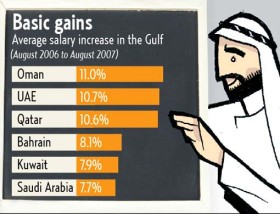
Dubai: Private sector salaries in the UAE rose by 10.7 per cent on average over the last year, just beating the nine per cent GCC average, according to figures released yesterday by online recruitment firm GulfTalent.com.
Oman registered the biggest jump, from 5.6 per cent last year to 11 per cent this year, while wages in Saudi Arabia climbed just 7.7 per cent – the lowest of the countries surveyed.
Analysts say employers have been forced to raise wages to contend with intense competition for talented workers, healthy pay rises in the public sector, the depreciating US dollar and rising salaries in India, traditionally the main supplier of expatriate workforce to Gulf countries.
But better pay is unlikely to leave more money in the bank for workers due to spiraling inflation and depreciation of dollar-pegged currencies.
The UAE’s official inflation reached 9.3 per cent in 2006, driven by soaring food prices and rent hikes, while Qatar’s inflation increased to 14.8 per cent year-on-year in the first quarter before declining to 12.8 per cent in the second quarter.
Shortage of skills
Of the UAE-based expatriates surveyed by GulfTalent.com, 41 per cent reported making no savings on their income, the highest figure in the Gulf. And nine per cent of UAE-based expats reported that their salaries did not even cover their living costs, forcing them to borrow or live off their existing savings.
For employers the trend translates into difficulty recruiting and retaining staff, which has already had serious implications for the region’s economy.
“While market demand was extremely healthy, skills shortages were limiting their companies’ ability to grow, forcing them to turn down new business or, in some cases, causing them to miss targets on their existing projects,” said Yasser Hatami, managing director of GulfTalent.com.
Abid Junaid, CEO of Dubai-based property developer ETA Star, said developers are becoming more realistic in the number of projects they launch and their delivery targets due to a lack of skilled labour among contractors, but he did not anticipate a major slowdown in the construction sector.
“It’s a very concerning situation as it impacts our ability to attract expatriate workers, especially from Europe and the Indian sub-continent,” he said.
Junaid said developers can reduce residents’ expenditure on rent by building more low-cost housing.
According to the GulfTalent survey, the GCC construction sectors enjoying the highest pay rise, along with banking and energy. Healthcare and education registered the lowest increases.
Among job categories, engineers and finance staff received the biggest pay rises, followed by human resource professionals in third place, the survey revealed.
“Historically under-represented in the region, the HR function has recently been catapulted to the front line as Gulf-based employers grapple with the challenge of attracting, developing and retaining staff,” the report stated.
In response to declining net disposable income, companies are now changing the structure of worker’s pay packages to boost staff retention, said Hatami. Pensions, stock options, training initiatives, and a reduction in working hours are all being considered, he said. 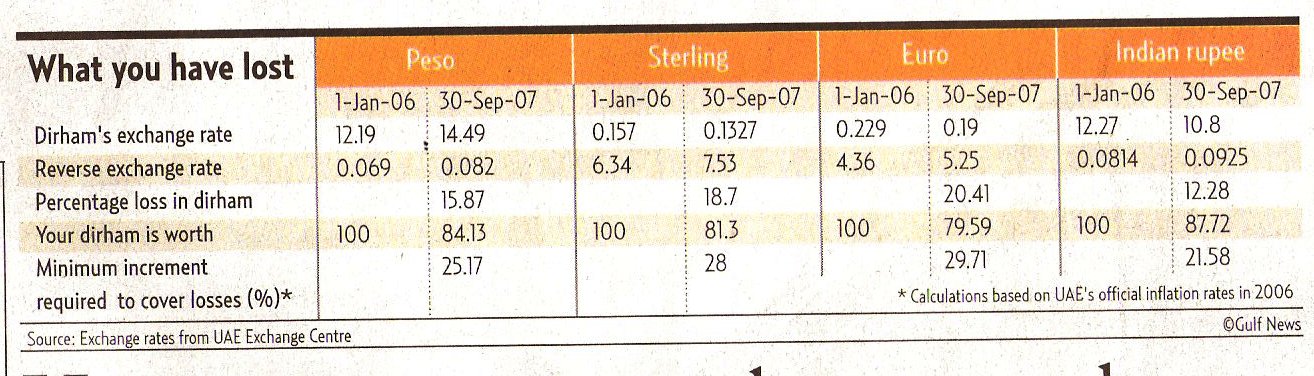
The quality of life within a country is another important factor, the survey suggested. It revealed that the UAE, and Dubai in particular, still benefit from the relative popularity of the country with expatriates, thanks to attractive career opportunities, modern infrastructure and facilities, and a relatively liberal society.
“This is allowing UAE-based employers to continue to attract and retain professionals with below-inflation pay rises, albeit with greater difficulty than previously,” the report said.
Indo-French nuclear business meets from Oct 15
Indo-French nuclear business meets from Oct 15
28 Sep, 2007, 1630 hrs IST, PTI
MUMBAI: In the backdrop of Nuclear Power Corporation of India Limited (NPCIL) planning to buy six nuclear power reactors from France, an Indo-French nuclear business meet will begin here from October 15.
The meeting is organised by the French embassy in collaboration with NPCIL, a top scientist said.
“The two-day meet is to strengthen the bilateral cooperation in the nuclear power sector and also to improve the relationship between the industries of both India and France,” S K Agrawal, Director, Projects of NPCIL told media today.
“We are expecting the participation of over 20 French nuclear companies including AREVA and an equal number from India,” he said.
NPCIL plans to buy six nuclear power reactors from France, Agrawal said.
AREVA could be one of the biggest suppliers for its Jaitapur site in the Ratnagiri district of Maharashtra which is one of the four coastal sites selected by NPCIL for imported reactors, he said.
Also, NPCIL can enter into business with the French only after the completion of the Indo-US deal, he said.
On that front, US has a timeframe for the entire process including India’s discussion with the International Atomic Energy Agency on safeguards and US’ negotiations with the NSG countries.
Asked whether other members of Nuclear Suppliers Group were also in touch with NPCIL officials, Agrawal said, the Japanese were interested and Mitsuibishi had held talks with the NPCIL officials.
Oil industry safety awards presented
Oil industry safety awards presented
30 Sep, 2007, 1500 hrs IST, PTI
MUMBAI: Recognising the efforts of oil and gas industry in enhancing safety performance, the ‘Oil Industry Safety Awards 2006-07’ were presented to five oil companies here.
The awards were given to the companies by the Secretary, Petroleum & Natural Gas, M S Srinivasan, at a function held in the city, a release said here today.
Indian Oil, ONGC and GAIL, won two awards each while Hindustan Petroleum and Bharat Petroleum won one award each.
Indian Oil’s Mathura refinery won the award for the best safety performance among refineries and ONGC’s Ahmedabad operation was adjudged the best managed oil and gas asset, the release said.
Bharat Petroleum won the award for its lube oil blending plant while GAIL won accolades for managing its Hazira-Vijaipur-Jagdishpur pipeline and the processing plant at Vijaipur.
Hindustan Petroleum won the safety award in the petroleum products marketing category and Indian Oil in the LPG marketing category.
The criteria for selection of winners was based on various parameters like complexity of facility, volumes handled, safety management system with minimum fires, accidents and losses.
The Oil Industry Safety awards were instituted in 1986-87 by the Government to promote safety performance in the industry.
They are administered by the Oil Industry Safety Director, New Delhi, which co-ordinates a series of self-regulatory measures relating to safety in the oil and gas industry in the country.
Nifty seen on course for fresh high
Nifty seen on course for fresh high
24 Sep, 2007, 0257 hrs IST,
We saw a ‘bullish engulfing candle’ for the Nifty on Tuesday, which was a strong candlestick pattern for an upward move for the market. This was mainly due to the surge in major indices on Wednesday and robust gains on Friday. The Nifty ended the week at 4,837, its highest-ever closing, and a gain of 7% over the previous week.
It has been gaining for the past five consecutive weeks. Market breadth was negative on Friday, but it was positive for most part of the week. BSE Realty, BSE Oil & Gas and BSE Bankex indices were among the prominent gainers during the week.
Market ahead
Last week’s upmove was backed by strong volumes, and we expect the market to build on these gains in the coming days. This week, the Nifty is expected to consolidate in the 4,850-4,900 band. We also expect a major up-move for the market beyond 4,950 and touch 5,000 levels in the short term.
Sectoral Indices
BSE Oil & Gas (9,340): The BSE Oil & Gas index had broken past the crucial resistance level of 8,200 about three weeks ago, and has been on the uptrend ever since. On a weekly closing basis, the index has been on an uptrend for six weeks in a row. It was also helped by the buoyant trend in the international oil market. We expect this index to touch 9,750 levels in the short term. Petronet LNG and Gail are our favourite stocks.
BSE Bankex (8,740)
The BSE Bankex has closed at 8,740 level last week, and is now quoting at an all-time high. We expect this index to touch 9,000 levels in the short term. Kotak Bank and Oriental Bank of Commerce are our favourite stocks in this sector.
SBI: After being restricted in the Rs 1,400 to Rs 1,750 range for the past three months, we saw SBI breaking out of that range on Friday. The stock ended the week at Rs 1,808. We recommend a ‘buy’ on SBI in the Rs 1,800 to Rs 1,820 band, with a target of Rs 1,935. Investors should fix their stop loss in this stock at Rs 1,760.
BSE Realty (9,183)
The BSE Realty Sector closed at 9,183 levels last week, and is now quoting at an all-time high. This sector rose above its key resistance level of 8,500 supported by strong volumes. We expect this index to touch 9,500 levels in the short term. Indiabulls Real Estate and Purvankara are the best bets in this sector.
Akruti Nirman: The stock has broken above its key resistance level of Rs 705, supported by strong volumes. We recommend a ‘buy’ in the Rs 745-750 range with a price target of Rs 835 and keeping a stop loss at Rs 720.
DS Kulkarni Developers: The stock has broken above its key resistance level of Rs 260, supported by strong volumes. We recommend ‘buy’ in the Rs 272-275 range, with a price target of Rs 302 and keeping a stop loss at Rs 258.
(This is the weekly technical outlook of Reliance Money technical desk)
Investing in a bull market
Investing in a bull market
30 Sep, 2007, 0901 hrs IST,Kavita Sriram , TNN
The stock markets are brimming with optimism. Money is pouring into the market like never before. The index has embraced unimaginably new highs. For now, it appears that the bull-run is at the horizon. For a true bull market, at least 20-25 per cent of the stocks must be on an increase and that too for a sustained period say two years. An upswing market is considered a good time for the investor.
What sort of a strategy must investors adopt to make it rich in a bull run? It is not unusual to find some stocks faring poorly in a bull market and some doing exceptionally well in a bear market. A bull run implies a booming economy, low unemployment rate, high production of goods, and low inflation.
The market ups and downs follow cyclic patterns.
For now, it is the time of rising index and increasing volatility. In a bull run, investors follow the formula ‘buy low and sell high’. It is now time for investors to sell their stocks and book profits. Investors need to make well-educated and investigated investments in the markets.
Mere speculation can prove costly. Suppose in a bear market one stock fares poorly. An investor who has done enough research will know the reason for its fall. There may be something fundamentally wrong with the stock and the company policies.
Or the slide in the stock’s price will be a reflection of general pessimism pervading a bear market. If an investor knows that it is the latter, he will stay calm and may be even add more stocks of the company to his portfolio. On the other hand, if he believes that something is fundamentally wrong with the stock, he may decide to sell it and stop further loss.
The scenario holds much the same in a bull market. Some stocks may become highly overpriced. An overpriced stock in a heated market is sure to burst when the bull run ends. Some investors prefer to sell all their shares and make profits. Another strategy is to sell some of the shares and buy back the stock when the price falls back to reasonably low levels.
The value of equities tends to rise fast in a bull run. Predictably, the equity investments in your portfolio will become disproportionately higher. Depending upon your age, objectives and financial obligations, you would have arrived at an asset allocation plan.
In order to stick to the asset allocation, make a judicious down-sizing of the equity component. This will provide ample cushion in case the bubble bursts and markets fall. In a bull run, investigate the real value or worth of the stocks. Do not invest in overpriced stocks. It is advisable to sell overvalued stocks. Exit immediately if you feel the prices have gone up adequately.
Invest regularly. The power of compounding and systematic investment plans goes a long way in wealth accumulation. Finally, bear in mind that there are no permanent bull and bear markets. Disciplined investing and avoiding speculation will help investors.
 ClicksandWrites
You must be logged in to post a comment.