Need to stop waffling between flip & flop
Need to stop waffling between flip & flop
Vithal C Nadkarni
In his new movie, I Am Legend, Will Smith plays the last human survivor in virus-ridden New York. Real life is different: with four of his most recent movies — The Pursuit of Happiness, Hitch, Shark Tale and I, Robot — each grossing more than $300 million, the actor has already become a legend in a notoriously fickle industry.
What’s more, his trademark artlessness on screen is said to be the result of “one of Hollywood’s most meticulously planned and executed careers”. But it wasn’t always so. When he was 16, his first girlfriend walked out on him. That turned out to be a defining moment, he recalls, “In my mind, she cheated because I wasn’t good enough. I remember making the decision that I will never not be good enough again.”
His very first album as a rapper went on to win the first Grammy for a hip-hop act. At 21, when a friend suggested that they should probably have a goal now that they were going to LA, Smith replied without batting an eyelid: “I want to be the biggest movie star in the world.” He also backed his resolve with the notion that education was “the elixir for all problems”.
For all that initial success, “in the first five years in Los Angeles, Smith couldn’t get a meeting with a director or studio,” reports Time. They just didn’t seem to care. Here he was, a rapper who had gotten a most lucky break on the charts and a luckier run in a successful TV sitcom; if that was all he was supposed to be good at, wasn’t it time he resigned himself to a graceful exit euphemistically termed ‘Plan B’? “I don’t want to get too metaphysical,” Smith replies, “but by even contemplating a Plan B, you almost create the necessity for a Plan B.” Which is another way of stating his original resolve: take no survivors; don’t ever admit second-best options or the so-called parachute clause. Paradoxically, only when you deliberately cut off your exit thus do you stop waffling between flip and flop.
That’s when you hit upon that wonderful clarity of mind former US secretary of state Henry Kissinger extolled, which he said was born out of an absence of alternatives (or excuses). The Bhagvad Gita calls it atma-vinigraha the mental resolve necessary for attaining even satvic goals. But resolution backed by persistent present action is absolutely not to be confused with living in the future or hankering after the results. As a student of ‘universal patterns’, Smith knows this better than most.
Photo Speaks – Mother Care
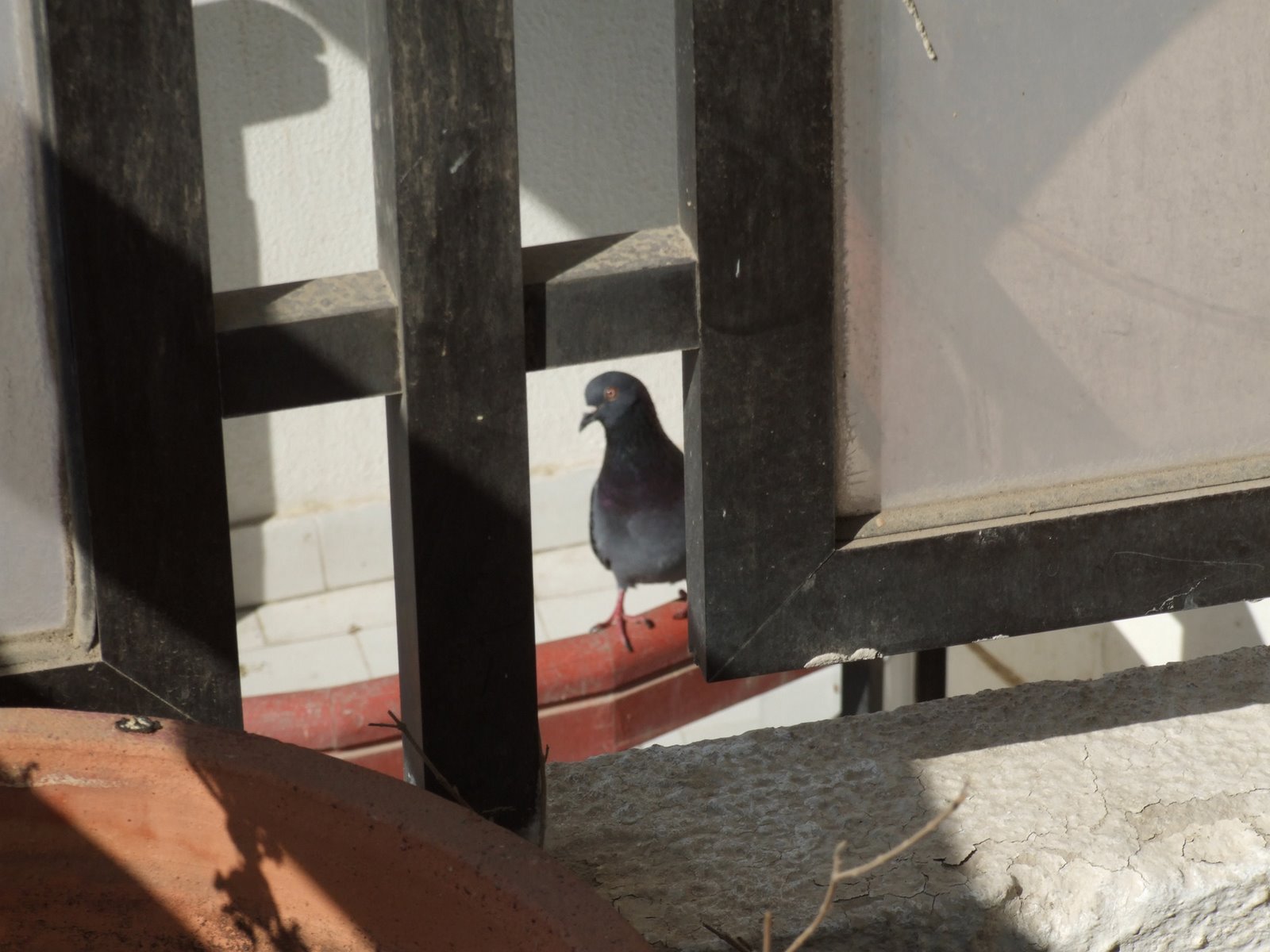
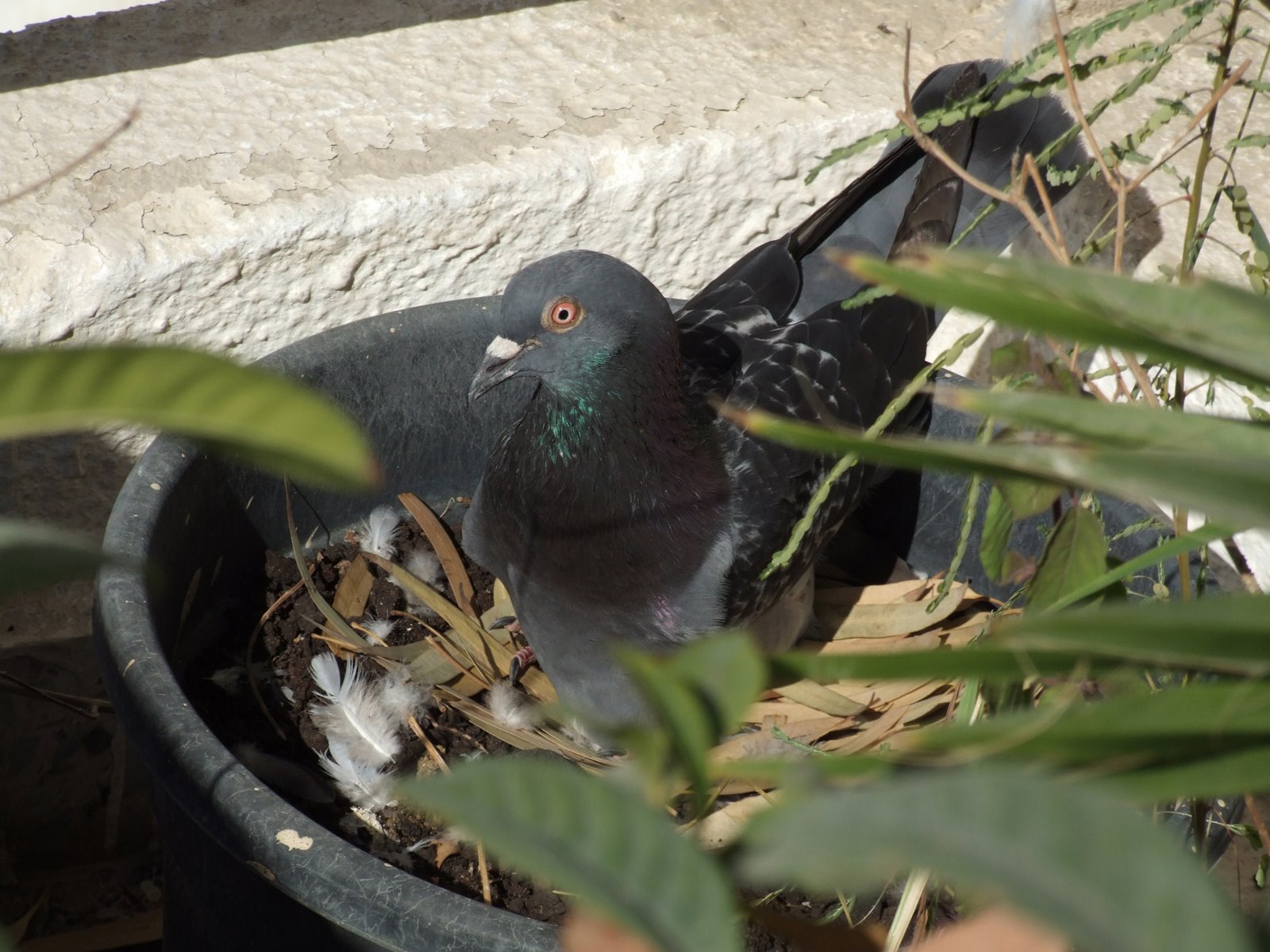
Many of us might have seen this scene back home during our childhood days. But for the new generation, this is something quite unusual and out of the moon. A mother bird laying eggs and hatching it. And another member from the family does the surveillance protecting it from the predators. All happening at my balcony – hopefully in a few days time Team 1 members will have their Christmas/New year Gift – two new members to this world of TQM and Positive Thinking.


Opec to raise quotas in Feb
Opec to raise quotas in Feb
(Bloomberg)17 December 2007
NEW YORK — Opec, producer of more than 40 per cent of the world’s crude oil, may increase output quotas when it meets on February 1 because stronger demand is expected during the winter season, Algerian Oil Minister Chakib Khelil said.
“The forecasts now point toward a cold winter, and the economy seems to be improving. That means stronger demand” for oil, Khelil said yesterday in an interview in Limassol, Cyprus.
“The chances that we could decide to increase output are greater than reducing output.”
The Algerian oil official will become the Organisation of Petroleum Exporting Countries president on the first of the year for a 12-month term. Venezuela’s Oil Minister Rafael Ramirez said earlier this month that the oil exporters group may decide to reduce output when it meets in February to discuss output policy at its headquarters in Vienna.
Oil prices in New York closed in New York on December 14 at $91.27 a barrel, up more than 4 per cent since Opec decided to keep production quotas unchanged at its December 5 meeting.
Opec’s production ceiling now stands at 29.673 million barrels a day for 12 of its members.
War-torn Iraq is the only member without a quota.
Khelil is in Cyprus this week to attend a conference of European and Mediterranean energy ministers which starts tomorrow.
Residents book eggs ahead to beat shortage

Residents book eggs ahead to beat shortage
By Binsal Abdul Kader, Staff Reporter GULF NEWS Last updated: December 16, 2007, 23:13
Abu Dhabi: Residents have now turned to bookings eggs to purchase the food item.
Supermarkets and groceries must keep one more record in addition to their day to day accounts now that they are listing customers who book the eggs in advance.
The acute shortage of eggs has led to a new system of ‘sale on booking’, especially by small supermarkets and groceries, said market sources.
Those wanting eggs can reserve them by leaving their names and contact numbers with the grocer or supermarket. They will deliver a maximum of one tray when the stock arrives.
Some outlets took the opportunity to show loyalty to their regular customers. A grocery on Salam Street in Abu Dhabi, which displayed only one tray of eggs, told Gulf News it was kept for a regular customer who had reserved it.
Gulf News has learned that there is no uniformity of prices for local produce in the various emirates. The chaos has created a 50 to 100 per cent price rise in the past three weeks, said the sources.
A tray of 30 medium sized local eggs, which cost Dh12 to Dh13 earlier, now costs Dh18 to Dh22.
Wholesale dealers said medium sized eggs are scarce, but the larger ones are available for Dh24 to Dh28 per tray of 30, up from Dh15 to Dh17. Most of the groceries sell medium sized eggs for Dh1 each and the large ones for Dh1.25, said customers.
Some unscrupulous suppliers are trying to cash in on the shortage, some customers claim. “My grocer is selling a tray of medium sized eggs for Dh25 which is about 60 per cent more,” said Abdul Majeed, a resident of Al Muteena in Deira.
Warning effect
The Ministry of Economy’s warning has prompted some outlets to stop selling eggs at all to avoid penal action for price hike. “I have not been selling eggs for the past three days as I did not buy the stock at higher prices,” said a grocer in Ras Al Khaimah.
71 reckless motorists made to clean streets and schools
71 reckless motorists made to clean streets and schools By Rayeesa Absal, Staff Reporter GULF NEWS Last updated: December 16, 2007, 22:53
Abu Dhabi: More than 70 motorists were booked for reckless driving and made to do community service as part of the new traffic rule implemented last Sunday.
According to the rule, any driver caught driving recklessly will have to spend two days doing community service and five days in prison with the confiscation of the vehicle for a month.
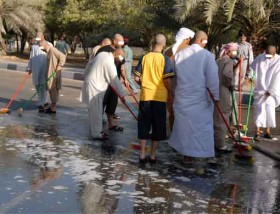
The driver will be made to clean the streets of the city for a day and clean a school for another, as per the rule implemented under the instructions of Lieutenant General Shaikh Saif Bin Zayed Al Nahyan, Minister of Interior.
“Some 39 motorists have been caught driving dangerously in Abu Dhabi and 32 were caught in Al Ain over the last week. These motorists will remain in custody for a week. This includes two days of community service,” said Colonel Hamad Adil Al Shamsi, Director of the Abdu Dhabi Department of Traffic and Patrol Police, during a press conference yesterday.
“The rule will curb the menace of reckless driving and will make people think twice before performing dangerous stunts on the roads,” he said, adding that the rule will be implemented regardless of whether the motorists are male or female. Female drivers may be exempted from cleaning the streets and may be asked to clean schools for two days, he said. No female driver has been arrested so far.
The new rule has already brought in changes, the official said: “There is a marked decline in the number of violations with almost a 50 per cent reduction.”
Youngsters
“Most of the drivers who were arrested were youngsters. Twenty students were also arrested but they have been released temporarily to complete their college exams. Once their exams finish, they will be made go through the same punishment like other drivers,” he said.
The rule came in the wake of violations committed during National Day celebrations.
Offence: in the fast lane
Major Engineer Hussain Al Harthy, head of the Road Engineering and Traffic Management section of the Abu Dhabi Police Traffic Department, said the speed limit from Sas Al Nakhl to Shahama has been reduced to 100km/hr from 160km/hr.
He said if a motorist speeds up to 160km/hr a fine is issued. If the speed is between 160km/hr to 200km/hr the licence of the driver is taken away and he is asked to come to the traffic department. “In case the speed is above 200km/hr, the vehicle is confiscated,” said Al Harthy.
Free car parking in Dubai during Eid
Free car parking in Dubai during Eid
Staff Report GULF NEWS Published: December 16, 2007, 23:12
Dubai: Car parking will be free in Dubai during Eid Al Adha holidays from December 18 to 20, said an official at the Dubai Roads and Transport Authority.
Engineer Maitha Obaid Bin Udai, Chief Executive Officer (CEO) of Traffic and Road Agency at the RTA, said that parking would be free during Eid holidays but parking fines would be issued for motorists for violating parking regulations.
“Any motorist parking illegally blocking the traffic, double parking or parking on the pavement, would be given fines,” she said.
Mohammad: Ministers told to be proactive
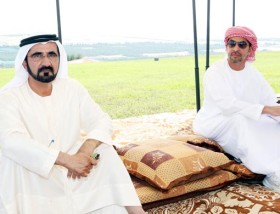
Shaikh Mohammad with Shaikh Hamdan Bin Zayed Al Nahyan, Deputy Prime Minister, during the final special Cabinet session in the garden of President His Highness Shaikh Khalifa Bin Zayed Al Nahyan’s palace in Liwa.
Mohammad: Ministers told to be proactive
Gulf News Report Last updated: December 17, 2007, 00:03
Dubai: The federal government strategy, ushering a new era of efficiency and transparency, has been completed and is ready for implementation as of January next year, it was announced on Sunday.
“This historic national accomplishment ushers in a new dawn” of progress, His Highness Shaikh Mohammad Bin Rashid Al Maktoum, Vice-President and Prime Minister of the UAE and Ruler of Dubai, was quoted as saying by WAM.
He was referring to the federal government strategy, which has been completed by the various government bodies in six months. It was ordered by Shaikh Mohammad in April.
“It is a great achievement and could not have been done without your efforts, your teamwork and your new ideas,” he told members of the Cabinet, which held its third and final special session in the garden of President His Highness Shaikh Khalifa Bin Zayed Al Nahyan’s palace in Liwa, 220km west of Abu Dhabi.
Right to housing
Shaikh Mohammad told the ministers it was time for them to get out of their offices and become acquainted with the problems of citizens, offer “the best services” to them and eliminate red tape and bureaucracy.
“Our people expect more of us in education, health, housing and job opportunities, which should be available to every citizen across the country,” he added, stressing the right of widows and divorcees to have suitable housing.
“At the end of this three-day historic meeting… I would like to also thank Shaikh Mansour Bin Zayed Al Nahyan [Minister of Presidential Affairs] on his efforts to lead the meeting of the ministerial council for services which has saved us a lot of time and effort,” he said.
Eid Al Adha: 377 prisoners pardoned
His Highness Shaikh Mohammad Bin Rashid Al Maktoum, Vice-President and Prime Minister of the UAE and Ruler of Dubai, has pardoned 377 Emirati and expatriate prisoners to mark Eid Al Adha.
The amnesty is to help those who have served part of their sentences, and enable them to share the occasion with their families.
– WAM
A glass of wine a day delays dementia
A glass of wine a day delays dementia
16 Dec 2007, 1238 hrs IST,PTI
NEW YORK: Wine can be food for health as long as you are smart about how you drink – one goblet daily may help in preserving your memory for long.
A study has found that a glass of wine everyday delays dementia in those who are at risk from Alzheimer’s disease as they are already having memory problems.
“While many studies have assessed alcohol consumption and cognitive function in the elderly, this is the first study to look at how alcohol consumption affects rate of progression of mild cognitive impairment to dementia,” according to lead researcher Vincenzo Solfrizzi of University of Bari in Italy.
Mild cognitive impairment is a transitional stage between normal ageing and dementia used to classify people with mild memory problems and no significant disability.
The researchers came to the conclusion after they evaluated alcohol consumption and the incidence of mild cognitive impairment in a group of 1,445 people aged between 65 and 84 years.
The team then followed 121 people with mild cognitive impairment and their progression to dementia.
The researchers found that those with mild cognitive impairment who had up to one drink of alcohol a day, mostly wine, developed dementia at an 85 per cent slower rate than people with mild cognitive impairment who never drank alcohol.
“The mechanism responsible for why low alcohol consumption appears to protect against the progression to dementia isn’t known. However, it is possible that the arrangement of blood vessels in the brain may play a role in why alcohol consumption appears to protect against dementia.
“This would support other observations that drinking moderate amounts of alcohol may protect the brain from stroke and vascular dementia,” Solfrizzi said.
Success storeys – Mr. Rizwan Sajan, Chairman DANUBE Group, Dubai

Success storeys – Mr. Rizwan Sajan, Chairman DANUBE Group, Dubai
By Sandhya Rajayer GULF NEWS Published: December 13, 2007, 23:17
In 15 years, Rizwan Sajan has risen from a Dh1,500 per month job to spearhead a business that is worth $200,000. Sandhya Rajayer speaks to the chairman of Danube Group to learn of his definition of success.
A lot has changed about Dubai in the last 30 years. The vast sandy stretches have morphed into a Manhattan-like skyline, the corner grocery stores have turned into air-conditioned multi-brand format supermarkets, the city roads that once saw Cadillacs and camels crossing paths are now set to welcome the metro. But the one thing that remains unchanged is the power of this city to breathe life into dreams, to reveal to the human mind the shape and size of things to come even if at that time there is no evidence that
the dream will take shape in the way you want.
Rizwan Sajan was 28 when he came to Dubai in 1992 to take up a job in a hardware store on a salary of Dh1,500 per month. Barely 15 years from then he has propelled himself on the path to success with a speed and determination that is astonishing to record. Today he is Chairman, Danube Group, a $200,000 building material company that distributes over 10,000 products, has retail outlets in the UAE, Bahrain, Muscat and India, and three sourcing centres in China and employs 400 people. But all of this was not like a walk in the park. A part of it has been like a roller coaster ride, another stretch like a trial by fire. But through it all remained intact Rizwan’s sheer grit.
This is his story:
Rizwan’s father passed away in 1980 when he was 16 years old. As the eldest son he realised it was up to him to find ways to support his family. So he wrote to his uncle in Kuwait, who ran a building material business, saying he was looking for work and was there anything his uncle could offer him? The response was in the affirmative – but, wrote his uncle, he would have to wait for two years in order to reach the legal age to work. Rizwan interpreted the answer to be a tactic in polite evasion. So he squashed all hopes of going to Kuwait. Instead, he continued his studies and attended morning college for his commerce graduate degree at Somaiyya College in Vidyavihar (an eastern suburb of Mumbai, India) and worked part-time at Nathani Steel, a company also based in the same suburb, in the evenings.
And so it was that two years later, Rizwan was pleasantly surprised to receive a letter from his uncle in Kuwait enquiring if he was still interested in the job. Within a month, the job visa formalities were completed and he was on his way to a job in Kuwait. As he worked closely with his uncle, Rizwan began to understand the workings of the building material business inside out.
He was also sharp to build his personal assets, buy a car and over a span of 10 years, his reputation in the field turned rock solid.
He got married in 1987 and continued to work in Kuwait. But when the country was invaded by Saddam Hussain in August 1991, like several thousand other expats, Rizwan had to leave Kuwait overnight, and all that he had worked for and built up came to nought. He landed in Mumbai with about Rs150,000 in his pocket and felt as if he was back at the starting line.
Grasping at the tiniest straws of opportunity, Rizwan met up with a friend who owned a hardware business venture in Dubai. “I can still recall our meeting at the poolside restaurant (at Searock Hotel in Juhu, Mumbai) in vivid detail,” he says. “My friend asked me what kind of money I had been earning in Kuwait. About Dh15,000, inclusive of salary and commissions, I replied. ‘I can’t even think of paying you that much,’ he said. I wasn’t even dreaming of asking for that much, I responded. He offered me a job with a salary of Dh3,000 plus a 25 per cent commission on the sales. What did I have to lose? I didn’t have a job in hand anyway. I accepted the offer on the spot and he promised to send me the visa as soon as possible.”
A month later, there was no sign of the offer turning into reality. So he called his friend in Dubai only to be told that his business was lax and he could not afford to pay the salary promised earlier. “How much can you pay me?” Rizwan asked him point blank. ‘Dh1,500 plus 25 per cent commission,’ came the reply. Perhaps, Rizwan thought, it was the kind of offer that was very easy to refuse, which was why it was being offered to him. But Rizwan was desperate. He accepted the offer immediately. His only request was that he be provided accommodation and food. Fortunately for Rizwan, by the time he landed in Dubai in March 1992, the situation in Kuwait was back to normal and people had started returning to work. This meant that Rizwan’s business contacts were back in town as well and when word got round that he was in Dubai, they started placing orders with him for building material. Truckloads of cement, sanitary fittings, furniture .. all made their way from Rizwan’s new workplace to Kuwait. The friend who had offered him Dh1,500 quickly hiked his pay to the original sum of Dh3,000. With additional commissions, Rizwan began to earn about Dh8-10,000 per month.
But the whims of Lady Luck are known to none. So it was that just as he was beginning to taste success once more, his contacts in Kuwait went back to doing direct imports. Rizwan’s income stream started to dry up.
By this time Rizwan had fallen in love with Dubai. From the moment he had stepped off the plane, he had begun to feel at home. So he stood his ground in Dubai, convinced that it was worthwhile to hang in and keep trying. Eventually, it would all fall into place.
With exports to Kuwait having dried up, Rizwan was back to trading in small hardware. He realised that he had arrived at a crossroads as far as his career was concerned. He also realised that this was the moment to start thinking big. “So I suggested to my friend and employer that with my experience and contacts, we could expand the building material business and, say, trade in wood. This called for an investment of about a million dirhams. Not convinced about the returns on this risk, he refused.
“And thus it was that I parted ways with him,” Rizwan recalls.
This was barely 10 months after Rizwan had started working in Dubai and he had in his account a sum of Dh88,000 or so. His wife, Samira, was in India waiting to join him as soon as his business stabilised. “I told myself that there were two ways of looking at my situation. I could join one of the big companies that could use my expertise in the building material business or I could put my savings to good use and start my own business. Hopefully it would work, but if it didn’t, I would not have a problem getting a Dh5,000 job with a bigger company. Age was on my side, I was not even 30 at the time.”
After some hard thinking, Rizwan decided to start his own company – an indenting company – buying from a supplier, selling to a buyer and earning a commission on the transaction. However he had not reckoned with the strong resistance of big buyers. “I had a hard time for the first six months. My savings of Dh88,000 went into setting up initial capital, an office, a car and the expenses of day-to-day living even as there was no income.”
As luck would have it, Rizwan soon won the contract for supplying galvanised corrugated sheets to a company. His product was so good that it began to attract the attention of big traders who now agreed to buy from him. Things began to move slowly but steadily. To add momentum, Rizwan contacted some of his old supplier friends in Singapore and Romania. “I was frank with them. I told them that I did not have the money to pay for goods just yet but since they knew me, I hoped they would send me material on credit. I promised to pay as soon as the sale was concluded.” His good reputation was his greatest alibi. And so his business began to expand. Soon it was on a roll.
Today Danube runs the gamut of interior and exterior building material – scaffolding, steel and cement, ceramic flooring, bathroom and sanitary fittings, paints, wallpapers, glass, door fittings … He has partnered with some of the best names in the industry such as Kingplex, Halspan, Spano, Astroflame, Dorma, Nobili and many more.
Danube is now a wholesale and retail building material company with about 10 outlets within the UAE, two each in Bahrain and Muscat and in India. It has three branches also in China which act as their sourcing office. Rizwan opted for China as he found that “the (Chinese) government encourages investment and pulls out all the stops to create a conducive climate for economic development.”
(The reason for naming his company Danube Rizwan attributes to his many business trips to Romania. “I fell in love with the river Danube flowing through the country.”)
Obviously, on a journey in search of success as long as this, there are many milestones. Rizwan recalls one particular incident with a person who is now his biggest competitor. “In the initial days (of setting up my business), I had been chasing this person for an appointment, requesting for just a few minutes of his time. Finally one day he agreed to see me at 3 pm. Those days I used to work a split shift from 8 am to 2pm and 4 pm to midnight. I would go home have my lunch and take a nap before getting back to work at four.
“So the 3 o’clock appointment was a bit difficult for me and obviously I couldn’t request for a change in the time considering how difficult it had been to get an appointment in the first place! But I had dozed off in the afternoon for a bit and reached his office 10 minutes late. He just looked at his watch and said to me, ‘You are late for the appointment, you’ll have to take another one.’ I had no choice but to begin chasing him all over again for an appointment and this time I made sure I reached on time. I learned a lot of things from him but I also learnt the importance of punctuality,” Rizwan says.
Having enjoyed a ringside view of the building industry in Dubai for a long time, what does he have to say about the exponential growth of the industry? “I believe Dubai knows where it is headed. The growth is not temporary, it is here to stay.”
Obviously the building industry means more than bricks and mortar. They need to offer solutions for beautiful interiors. Danube’s House of Laminates in JAFZA, launched recently has plugged this gap. Customers usually walk in with the idea that laminates are old-fashioned and when they see the innovative designs and finishes on offer they are surprised into buying them.
“The challenge in the building industry today is to come up with innovations every day. The variety of wood, ebony, walnut, ash, for example, in place of the old staples of rose and teak are all customer driven.
“The average man does not settle for the ordinary, he wants something different even on a modest budget,” says Rizwan. “Even bathroom fittings have been subject to this demand for innovation and if earlier we talked of only a bathtub, we now have shower cubicles in different designs. The same goes for modular kitchens and different finishes for doors. The variety is truly amazing.”
The interiors of Rizwan and Samira’s home in the Dubai Marina have been totally designed by Samira. “I haven’t hammered in a single nail in my house,’ Rizwan says. Is there a glimmer of pride? Looks like it in his smiling eyes.
“Samira has always given me the freedom to focus a 100 per cent on my business. She has tackled all domestic issues with utmost ease throughout our married life of 19 years. Even when I was travelling almost six months a year in the initial stages of setting up the business, she didn’t mind it.”
Then he amends his statement. “I think I should say, there was a bit of cribbing, but not much,” he laughs.
Like all entrepreneurs who begin young did Rizwan too make a promise to himself that he would work hard and retire early? “I tell my wife this every morning,” he laughs again. “In fact I would often say to her that I would retire at 40. That was four years ago. Now I think I should change that to 50!”
Danube has been a part of almost all reputed projects in Dubai beginning with the Burj Al Arab, Media City and Knowledge Village. Among the current mega projects are the Burj Dubai, Down Town Dubai, Jumeirah Islands, International City, The Palm …
Rizwan’s definition of success in life is measured not by the savings in the bank account but the qualities that fill up an individual’s heart. A good human being is a successful human being, according to him.
“A lot of people have a lot of money but not all of them have the respect of their fellow human beings. That I think is the true mark of success. I live by the creed of live and let live – give every person the freedom to reach his goal. And this applies to my sales staff too as they don’t have to report on their daily sales calls. They have the freedom to chart their own course of action. Of course, if there is a shortfall in performance, we have to sit across the table and discuss how to change that.” Ultimately, what matters in life, he says, is whether you made a difference or not.
Total Energy and Education Seminar
Total Energy and Education Seminar
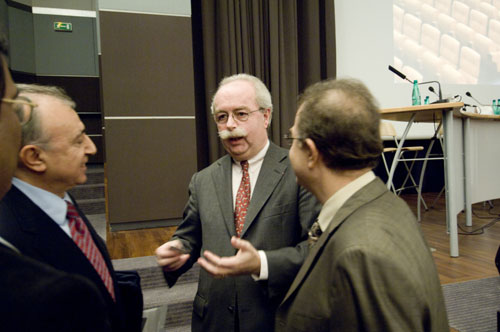
52 university professors from around the world came to Paris for the Total Energy & Education Seminar
From November 25 to 30, Université Total was welcoming for the first time in Paris 52 professors from 44 universities in 21 countries for a week of conferences and discussions on energy and education.
The attendees, most of whom specialize in scientific fields related to energy, or in economics or management, shared their views with some 20 Total senior executives and outside experts.
List of the universities
ALGERIA
University M’Hamed Bougara of Boumerdes
ANGOLA
Agostinho Neto University
ARGENTINA
Instituto Tecnológico de Buenos Aires
Universidad de Buenos Aires
Universidad Austral
CANADA
Keyano College
University of Calgary
University of Alberta
CHINA
China University of Petroleum-Beijing
Shanghai Jiao Tong University
FRANCE
Ecole Centrale Lyon
Polytech’Lille
Institut d’Etudes Politiques de Paris (cycle de Menton)
Ecoles des Mines de Nancy
GERMANY
Hochschule Merseburg (FH) University of Applied Science
Aachen University of Applied Sciences
INDIA
Indian Institute of Technology-Delhi
Indian Institute of Technology-Kharagpur
Indian Institute of Technology-Bombay
INDONESIA
Institut Teknologi Bandung
University of Indonesia
IRAN
Petroleum University of Technology
Sharif University
IRAQ
Baghdad University
University of Sulaimani
ITALY
SDA Bocconi (School of Management)
Catholic University of Milan and Insubria University
LIBYA
El Fateh University
NIGERIA
University of Port Harcourt
Rivers State University of Science and Technology
NORWAY
Institutt for kjemisk prosessteknologi/NTNU
University of Stavanger
RUSSIA
Saint-Petersburg State Mining Institute
Bauman Moscow State Technical University
SOUTH AFRICA
University of the Witwatersrand
University of Cape Town
SPAIN
Universidad Pontificia Comillas
TURKEY
Middle East Technical University
Koç University
UK
Loughborough University
University of Manchester
VENEZUELA
Instituto de Estudios Superiores de Administración
Universidad Simón Bolivar
Universidad Central de Venezuela
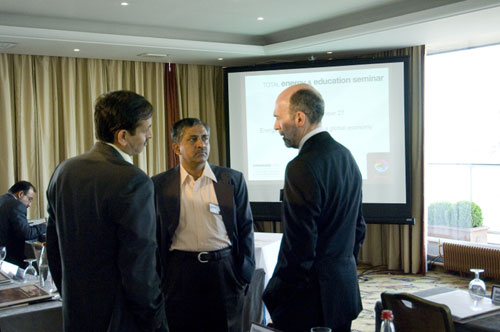


Questions for Nathalie Fokart
Director, Université Total
What’s the common thread between the Total Summer School, the MIT senior executive seminar and the climate change conference?
Each of those programs is inspired by a commitment to thinking about and discussing issues that are not only of great interest to Total, but are increasingly a matter of public debate. Our operations involve all sorts of human, geopolitical, technological and environmental aspects that are often closely interwoven and can’t be managed by executives all on their own.
Université Total’s multidisciplinary approach and mix of both in-house and public speakers and participants make it an ideal place to study and gain perspective on these often complex issues.
How do you make this commitment to outreach work?
Whatever the topic, we favor an approach that combines different angles and a variety of scientific, economic and sociological disciplines. We try to tailor our teaching methods—courses, lectures, internships—to the subject and target audience. This can lead to some pretty unusual situations: the Total Summer School invites students into our facilities, while the MIT seminar sends Total executives off to spend a week on a university campus. In both cases, it expands their point of view. The Climate Change Conference was another attempt to break down the walls between specialties, by asking the leading stakeholders—climatologists, companies and government representatives—to come and present their insights. Incidentally, the conference inspired additional meetings on climate change across our operations. The fact that we can repeat and tailor some Université Total events at the request of the business units helps ground our projects in the day-to-day realities of the Group.
And how do you incorporate this open approach to headline issues like ethics or the environment into your internal training programs?
The Université offers a full range of courses about our ethics, environmental, community relations and industrial safety policies. Some are general and interdisciplinary, while others, like business ethics, security and human rights, industrial safety and environmental management, delve into a specific topic in more detail. Several are held in our subsidiaries to promote local presence and dialogue. The same topics are also discussed extensively in the management training and integration programs deployed by the corporate or business training departments and are part of the Université curriculum.
Université Total deals with topics that are rich, diverse and very international. How will you be able to maintain the momentum?
Our initiatives are meant to be constantly updated, since they only make sense if they are pursued over the long term. The Total Summer School will become a regular event and the success of our first session has led us to invite more students. We will continue sponsoring conferences to encourage discussion and debate on social and community issues, such as diversity, and on environmental and technological issues. For geopolitical topics, we’re working on a two-day seminar dedicated to Africa, which will alternate between country analyses and discussions on regional or social trends.
Moreover, a number of projects are giving rise to others, that build on the original. A seminar scheduled for late 2007 on energy and education is expected to draw 50 teachers from around the world.
Curiosity and the thirst for knowledge will be powerful incentives to inspire future programs.
 ClicksandWrites
You must be logged in to post a comment.