Damaged sea cable hits internet services
Damaged sea cable hits internet services
By Mariam M. Al Serkal, Staff Reporter GULF NEWS Published: January 30, 2008, 18:17
Dubai: Both the UAE’s telecom providers suffered yesterday from a break down of internet connections and international calls after a cable was cut in the Mediterranean Sea.
Officials from both network providers were unable to disclose when the issue will be resolved as the submarine cable system operators (FLAG Telecom and SEA-ME-WE 4) were responsible for repairing the damage.
In its statement, etisalat said it was able to re-route the traffic through its network partners in Asia, Europe and UAE to ensure that services remained operational in the UAE.
——————————————————————————–
——————————————————————————–
etisalat said it was working closely with the administration, partners, and concerned operators, for urgent repair work to ensure that the links with major global internet hubs are restored at the earliest. The links deployed by etisalat has meant that normal internet browsing and essential traffic will continue to work at reasonable speeds for the company’s customers.
According to a source at du, the cable is located in Egypt, 12km from the shore. The fault occurred yesterday morning and affected telecom operators globally. du confirmed that its customers were also affected by the broken cable and were likely to experience interruption in internet services and international voice calls.
Emergency: Who’s doing what
– du has transferred internet and international voice traffic through other cable systems that were not affected, although congestion is expected to occur at peak times.
– etisalat is working to ensure that links with major global internet hubs are restored at the earliest. Essential traffic continues to work at reasonable speed.
Photo Speaks – Might is right
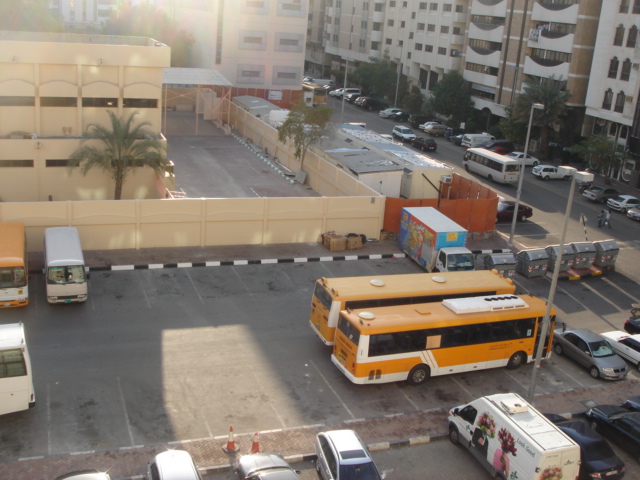
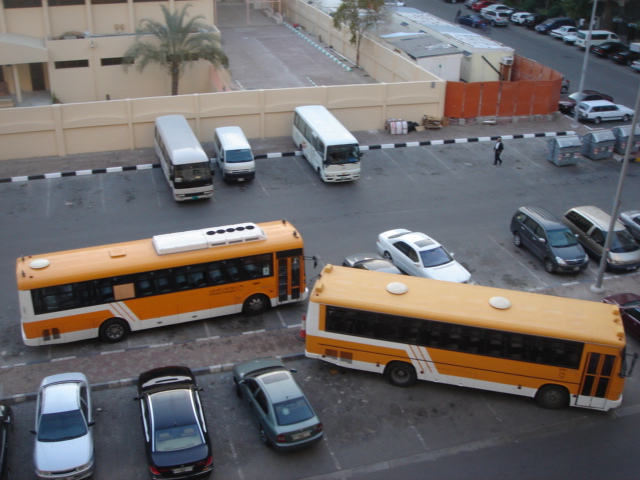
With the increase in number of vehicles and buildings, parking is difficult to find. However, there is a saying “Might is Right”. And these bus drivers knew it very well.
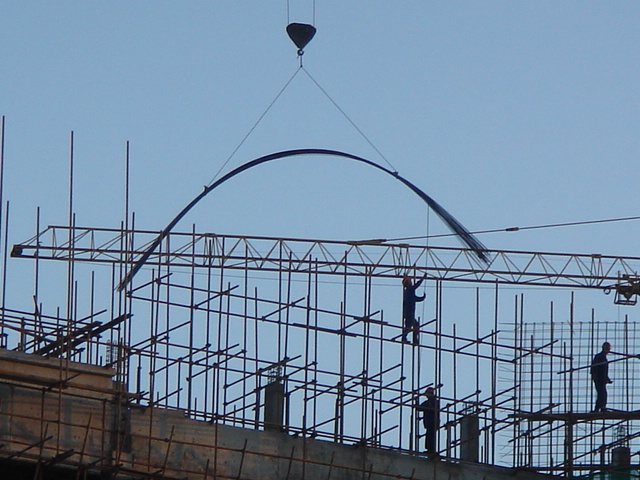
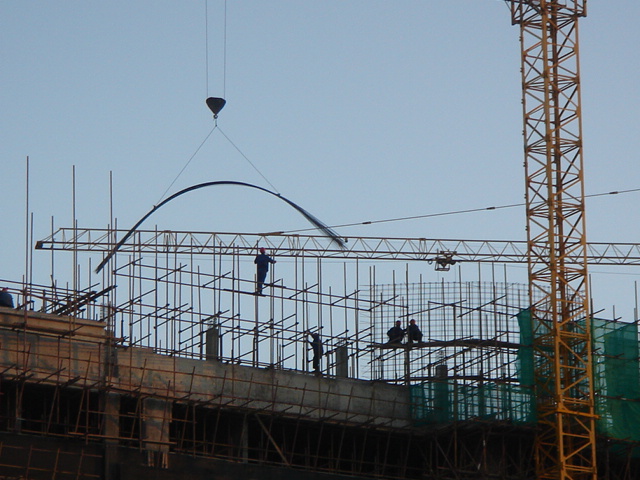
Photo Speaks – Balancing Act
It’s a tough world to live these days. Especially with the cost of living increasing by day. We know very well how difficult is it to do the balancing act even when we are fairly compensated. And we know how difficult and costly it can be for us with momentary lapse of concentrtion. Ever imagined how these poor workers manage thier needs under these growing economic situation?


Dubai to build world’s longest arched bridge

Dubai to build world’s longest arched bridge
By Joy Sengupta (Our staff reporter)KHALEEJ TIMES 30 January 2008
DUBAI — Construction of the world’s longest arched bridge in Dubai will begin in March and the project would be completed in four years, the Roads and Transport Authority (RTA) announced yesterday.
The project, the sixth crossing over the Dubai Creek, is estimated to cost Dh3 billion.
The bridge, 1600 metres long and 64 metres wide, will comprise 12 lanes, 6 in each direction. In addition, the Green Line of Dubai Metro will run through the centre of the bridge (the dividing area between the two bridges). The giant arch will be 205 metres high and 667 metres long.
The bridge will link Al Jaddaf in Bur Dubai with the road separating The Lagoons and Dubai Festival City. The crossing would also provide entry and exit points for the Creek Island, on which Opera Building, a project of Sama Dubai, will be constructed. The Chairman of the Board and Executive Director of the RTA, Mattar Al Tayer, said the project, developed by a United States-based company, would be completed in six phases.
“The construction of the first phase would begin in March this year,” he pointed out.
The crossing would facilitate free traffic flow at all intersections and allow free navigation throughout the day as it would be15 metres above the water surface.
The 50-metre-wide navigation corridor would enable movement of large yachts.


Abu Dhabi to withdraw 500 old taxis from service
Abu Dhabi to withdraw 500 old taxis from service
By Binsal Abdul Kader, Staff Reporter GULF NEWS Published: January 29, 2008, 23:39
Abu Dhabi: About 500 taxis from the old fleet will be withdrawn from the capital’s streets this month, Trans AD, the taxi regulatory authority, told Gulf News.
“We are withdrawing the gold and white taxis [old taxis] in accordance with the increasing number of new taxis,” said Huda Al Ka’abi, Communication Officer at Trans AD.
“About 800 new taxis are on the streets now and the number is increasing day by day.”
She said more than 900 drivers have received their registration so far and some of them are undergoing training.
“About 7,600 old taxis operate in the emirate and 500 will be phased out every two months,” said Sultan Mohammad Al Shamsi, Director of Customer Services and Compliance Division at Trans AD.
“Although about 8,000 registered old taxis are in the emirate, about 400 were non-operational for a long time.” He said the compensation for old taxi owners will be distributed by next month.
The first batch of new taxis commenced operations on November 4, 2007 with 300 taxis [which gradually increased to about 800] and the phasing out of old taxis has started this month. Trans AD authorised seven national companies to operate in the emirate and over 7,000 new taxis are expected to be on the roads in the near future; over a thousand by each franchisee.
One of the franchisees said they are planning to introduce their quota of 1,021 taxis within six months.
Complaint: Knowledge
Complaints about language skills and local knowledge of drivers are also strictly dealt with, said Huda Al Ka’abi, Communication Manager.
“People have to call up the hotline number 600535353 with the taxi number and we test the language skills of the driver.” If he is unable to speak, he will be sent back for a month of training.
Metro man is Indian of the Year

Metro man is Indian of the Year
HT Correspondent, Hindustan Times
And here is the Indian of the Year for 2007. He is the man who gave the country such rail marvels as the Konkan Railway and Delhi Metro. He also taught Delhiites, without ever asking for it, how to respect public property.
He is the Delhi Metro chief E Sreedharan.
Sreedharan was presented the award — instituted by CNN-IBN in partnership with the Hindustan Times — at a glittering function in the capital on Tuesday. The chief guest was Vice-President Hamid Ansari and the guest of honour former President APJ Abdul Kalam.
Accepting the award, Sreedharan said the honour bestowed on him showed that some values still count — the integrity of individuals; professional competence; and the fact that time is money, hence, the need to finish work on time. And, he said, he held these values in high esteem.
The metro chief was competing with Finance Minister P Chidambaram (from the category of politics), SBI chairman OP Bhatt (business), Vishwanathan Anand (sports), Chak De director Shimit Amin and scriptwriter Jaideep Sahni (entertainment) and Vodafone CEO Arun Sarin (NRIs). Sreedharan was the winner in the public service category.
The lifetime achievement award went to cartoonist RK Lakshman.
The format of the awards was as follows: the competition was divided into six categories, each with six nominees — politics, business, sports, entertainment, public service and NRIs. Each category would have a winner. The six winners would then compete for the top award.
They were to be picked by a mix of voting by people — SMS and online — and selection by a jury of Padma awardees — lawyer Soli Sorabjee (chairman), HDFC chairman Deepak Parekh, actor Mohanlal Viswanathan Nair, Hindustan Times Media Ltd vice-chairman and editorial director Shobhana Bhartia, Infosys co-chairman Nandan Nilekani, billiards champion Geet Sethi and former police officer Kiran Bedi.
The Indian of the year for 2006 was Prime Minister Manmohan Singh.
Hospital puts anti-abduction system in maternity ward
Hospital puts anti-abduction system in maternity wardBy Mariam M. Al Serkal, Staff Reporter GULF NEWS Published: January 29, 2008, 23:39
Dubai: Dubai’s only public maternity hospital implemented a system to prevent baby theft after some babies were abducted from their bassinet, Gulf News has learnt.
A security bracelet is attached to the babies’ ankles that have a sensory barcode which is linked to all nursery stations and security offices at Al Wasl Hospital, which implemented it last year.
Diaa Hassan, Consultant, Quality and International Accreditation, Al Wasl Hospital, told delegates at the Hospital Design and Upgrade Conference at Arab Health that the anti-abduction system is a standard procedure required by the Joint Committee International.
“The baby anti-abduction system has been implemented for the past year, and there were two to three cases of abduction in the country,” she said, but refused to elaborate.
The most publicised baby snatching case in the UAE was in December 2005, when an Indian doctor abducted a new-born Iraqi boy at Al Qasimi Hospital in Sharjah. A nurse spotted the doctor walking away with the baby and alerted the authorities. The gynaecologist served six months in jail followed by deportation.
With regard to preventing hospital-acquired infections, Hassan said that it was difficult to prevent because the maternity ward is always receiving many family members. “It is difficult to control the number of visitors at the hospital because of the culture in the region. When someone delivers all the family comes in,” she said.
She noted that it was highly unlikely for patients to receive hospital acquired infections because all infectious cases are transferred to Rashid Hospital.
Abu Dhabi to keep March contract volumes steady
Abu Dhabi to keep March contract volumes steady
Reuters Published: January 29, 2008, 23:39
Singapore: Abu Dhabi National Oil Co (Adnoc) has notified at least four Asian lifters that it will supply crude oil at full contracted volumes for March, as it did for February, lifters said yesterday.
Abu Dhabi, the main oil producer the UAE, would also supply limited extra volumes, on top of fully contracted volumes, with three refiners saying they did not request additional volumes for March.
Additional cargo
One lifter said they would receive an additional 500,000-barrel cargo of Murban crude for March, while another declined to comment on whether he had sought additional volumes.
Demand for March Abu Dhabi crude has weakened from February as refiners in North Asia have started cutting runs.
The steady March volumes come as the Organisation of Petroleum Exporting Countries (Opec) is scheduled to meet this week, with members repeatedly saying they are pumping enough oil, signalling that it would maintain output levels despite calls by the United States for more supplies to help ease high prices.
International crude prices have come down from their historic high of over $100 a barrel on worries of a US slowdown.
Spot Abu Dhabi crude fell to its deepest discounts in three months last week, with flasgship Murban crude sold at down to a discount of 25 cents a barrel to Adnoc.
But demand has not collapsed and spot cargoes for March loading have largely cleared by now, traders said, suggesting that refiners saw value in the light sour grades, though at discounts to their official selling prices (OSPs).
Japanese refiners, who are the largest buyers of Abu Dhabi crude, have cut runs for January and February from their initial plans on sluggish domestic demand and falling margins.
Japan’s top refinering company, Nippon Oil Corp, has also said that it will extend and deepen a 30,000 barrels per day (bpd) production curb this month to a 41,000-bpd cut in February.
Four out of five South Korean refiners have also decided to cut crude runs for February, pressured by poor margins and seasonally weak demand, processing at the lowest rate in four months, a Reuters poll of industry sources show-ed.
 ClicksandWrites
You must be logged in to post a comment.