OPEC freezes oil output amid cooler prices
OPEC freezes oil output amid cooler prices
(AFP) 1 February 2008
VIENNA – OPEC left unchanged its oil production ceiling on Friday, snubbing US demands for an increase as the cartel focuses on supporting prices which have fallen 10 percent since the start of the year.
‘We all agreed to keep things as they are,’ Nigeria’s Minister of State for Energy, Odein Ajumogobia, told reporters following conclusion of OPEC’s meeting in the Austrian capital.
Saudi Arabia, the oil cartel’s most influential member and the world’s biggest producer of crude, said on going into the meeting that it saw no need to change official output of the Organisation of Petroleum Exporting Countries.
‘Had there been a need to take any measures concerning supply and demand, we would have taken them. But the current situation shows that the market fundamentals are sound,’ Saudi Arabian Oil Minister Ali Al Nuaimi told the pan-Arab daily Al Hayat in an interview published on Friday.
OPEC, which pumps 40 percent of world oil, decided to keep official daily output at 29.67 million oil barrels.
A freeze is be a snub to the United States after President George W. Bush recently urged OPEC to increase output to help bring down high oil prices that stunt economic growth and fuel inflation.
However, lower oil prices are not welcomed by crude producers as their export income drops.
Since striking a high above 100 dollars at the start of the year, the price of oil has slid owing to fears of a US recession and a global economic slowdown. But crude futures are still almost double the level of a year ago.
A US recession would dent demand for crude in the world’s biggest energy market and send oil prices sliding further, OPEC fears.
Kuwait’s acting oil minister, Mohammed Al Aleem, had said Thursday that the 13-member OPEC was ‘a little worried about the impact of a slowdown or a recession in the United States’ on oil prices.
‘The price, for the time being, has been going a little bit down,’ he said.
‘Within three weeks, it’s been about 10 dollars. We have to see why, what the problem is, and whether it’s going to continue at the same pace.’
New York’s main oil futures contract, light sweet crude for delivery in March, was 41 cents lower at 91.34 dollars per barrel following OPEC’s output decision.
This compared with a record high of 100.09 dollars reached on January 3.
‘We have no option now’ but to hold output, Qatar’s Minister of Energy and Industry Abdullah bin Hamad Al Attiyah had said on his arrival in Vienna on Thursday.
‘We are very concerned about the world economy … The American economy will (influence) oil prices,’ he told reporters.
OPEC’s meeting on Friday was an extraordinary get-together that was scheduled at the group’s last official gathering on December 5 in Abu Dhabi.
There, OPEC decided against increasing production, insisting the market was well supplied and that high prices were caused by speculative activity, not a reaction to the demand and supply situation.
The next OPEC meeting is due next month in Vienna.
OPEC comprises Algeria, Angola, Ecuador, Indonesia, Iran, Iraq, Kuwait, Libya, Nigeria, Qatar, Saudi Arabia, the United Arab Emirates and Venezuela.
Iraq is the only member without an output quota owing to unrest in the country, while analysts say OPEC is in fact producing above its official ceiling by about 180,000 barrels of oil each day.
Sarkozy: Low on dignity, high on humanity
Sarkozy: Low on dignity, high on humanity
27 Jan 2008, 0047 hrs IST,Shashi Tharoor for TIMES OF INDIA
It is curious that even in the Indian media, the build-up to the visit this week of France’s president Nicolas Sarkozy focused quite so obsessively on his personal life. Had he secretly married the Franco-Italian model-singer Carla Bruni? Was he going to bring her to New Delhi as First Lady?
Such were the questions that dominated press articles about the impending arrival in India of a major political figure – and that was odd, not merely because there were more important things worth analysing on Franco-Indian relations, but because the Indian press has traditionally drawn a discreet veil over the private lives of our politicians.
Indeed the disconnect between what our journalists and editors claim to know about politicians and what they are willing to write about is rather striking. Members of the media talk quite openly (at least in living-room gossip) about things that in other countries would be the basis for investigative exposes.
I remember a very senior editor telling me, many years ago, about the alleged habit of a certain distinguished Scheduled Caste cabinet minister, while on tour around the country, of having Brahmin girls procured in each location for his nocturnal pleasure. When I asked why, if this was common knowledge, the editor’s own paper had never reported it, he looked quite startled and said, “We don’t do that sort of thing, my boy.”
So, journalists will tell you quite cheerfully that a certain former prime minister had lived most of his adult life in a menage-a-trois with his lady love and her complaisant husband, while continuing with a straight face to describe him as a bachelor. A senior minister lives openly with a political colleague, but she is described only as his party’s president, never as his companion. This is the Indian way: the private lives of public figures are deemed to be their business, not the public’s. And perhaps that is how it should be.
After all, that was how it used to be in the West; the sexual peccadilloes of assorted American presidents were simply not discussed until the Lewinsky scandal blew the veil off the Clinton White House.
In France, too, presidents were understood to be discreetly pursuing their extra-marital interests, but the press never discussed such stories; it was only upon the death of president Francois Mitterrand, for instance, that it was revealed he had maintained a long-time mistress and had had a daughter by her, whose appearance at his funeral was the first public acknowledgement of her existence. President Sarkozy’s own relationship with a well-known journalist – who even lived with him when his wife briefly left him – was never reported. So, what has happened to change all that?
Very simply, the president himself has opened his private life to public scrutiny. He has not merely conducted a romance with a media figure; he has flaunted it, taking his lady love (a model and singer) on overseas visits and being photographed with her, visiting tourist sites, holding hands, embracing. The media, invited to indulge its prurience, has lapped it all up.
But what our press seems to have missed in reproducing foreign news agency copy about the president’s indiscretion (and its negative effect on his standing) is the simple possibility that Sarkozy’s actions fit perfectly with a deliberate strategy to transform his office. What Nicolas Sarkozy has systematically done since his election is to take the French presidency, long known for its grandeur and its distance from the people – a presidency occupied by older men who rarely deigned to give press conferences and who would never have been praised for their accessibility – and to reboot it.
And what a reboot this has been. Superficial commentary has called Sarkozy “President bling-bling” and “the People magazine President”, but what he has done is to harness the power of popular imagery to the popularisation of his office. He has personalised the presidency, hyperactively launching and announcing his own initiatives in a dizzying array of fields, but if the presidency is a person, that person must transcend the presidency, or at least its familiar rituals and trappings.
Sarkozy has humanised his office by televising his presidential and personal life; instead of adapting himself to the presidency, he has adapted the presidency to himself, individualising his political power in an increasingly individualist society. The proliferation of media in the 21st century has made voyeurs out of every citizen. Sarkozy is the first major office-holder to realise this, and to cater to it for his political purposes.
To get on the front page with Carla Bruni is as relevant as making headlines with a State visit; the presidency is no longer a symbol, it is a flesh-and-blood man. Sarkozy gives the media just enough to make them more interested than they ever were in any of his predecessors, but not so much as to devalue his office (hence the secrecy about his marriage itself). It is almost as if Princess Diana was holding Tony Blair’s job.
This has, paradoxically, strengthened the presidency in France; in the Information Age, the French president is omnipresent in the information media. In speeches, press conferences, restless trips at home and abroad, interviews and meetings, he sets the agenda, announces policies, and takes initiatives that challenge established orthodoxies; the French now talk of “hyperpresidentialisation”. Sarkozy’s self-exposure fits into the plan; by revealing so much of himself, he reduces the distance between the presidency and the people.
Democracies increasingly like citizens to believe they have control of their own destinies by placing them in the hands of leaders they can relate to. Sarkozy is no remote seigneur; he is “one of us,” with his own passions, disappointments, needs. Conducting a public romance may have reduced the dignity of the presidency, but Sarkozy is president for an era in which dignity is less important than humanity. And few presidents have shown themselves to be as human, in every sense of the term, as Nicolas Sarkozy.
Police rescue two window cleaners stuck outside building’s 13th floor
Police rescue two window cleaners stuck outside building’s 13th floor
By Marten Youssef, Staff Reporter GULF NEWS Published: January 31, 2008, 17:20
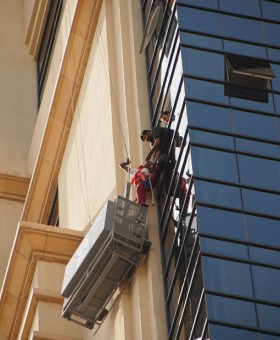
Abu Dhabi: The Abu Dhabi police team undertook an unconventional and daring rescue on Thursday of two men who were stuck outside the 13th floor while washing the building’s windows.
The authorities blamed a power failure on the two men being stuck.
“We had four options. We could try to put electricity back to the building. We could try to reach them with our ladders, through the roof or pull them through the window,” Fabian Dyck, a member of the rescue team said.
Hundreds of people watched the rescue attempts outside the Union Bank building on Electra Street. After three failed attempts to reach the two stranded workers using the ladders of fire brigades, the rescue team decided to pull the men through the nearest window.
Third attempt
“This is the third time we tried to reach them but our ladders are just too short,” Dyck said.
Just eight metres shy of reaching the two stranded men, the rescue team changed their strategy and handed harnesses to the workers as they pulled them through the window of one of the residents.
The two men were rescued and taken by ambulance to a nearby hospital. Police said there were no physical injuries to the men.
Dubai gets new crown prince – His Highness Shaikh Hamdan Bin Mohammad Bin Rashid Al Maktoum
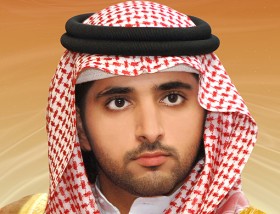
Dubai gets new crown prince – His Highness Shaikh Hamdan Bin Mohammad Bin Rashid Al Maktoum
DUBAI: Sheikh Hamdan bin Mohammed bin Rashid Al Maktoum, the brother of Dubai’s ruler Sheikh Mohammed bin Rashid Al Maktoum, has been appointed as Crown Prince, an official decree said in Dubai on Friday.
Vice President and Prime Minister of UAE Sheikh Mohammed bin Rashid Al Maktoum issued a decree in his capacity as the Ruler of Dubai, appointing Sheikh Hamdan bin Mohammed bin Rashid Al Maktoum as the Crown Prince of Dubai, the official Emirates news agency said.
Sheikh Mohammed also named Sheikh Maktoum bin Mohammed bin Rashid Al Maktoum and Sheikh Hamdan bin Rashid Al Maktoum as Deputy Rulers of Dubai with effect from Friday.
The new crown prince is presently Chairman of the Dubai Executive Council, which oversees Dubai Government entities.
Born on 14 November, 1982, Sheikh Hamdan studied at the Rashid Private School, Dubai. After graduation, he went to UK’s Sandhurst Royal Military Academy.
He has attended specialized courses at the London School of Economics and the Dubai School of Government.
Sheikh Hamdan is also the president of Dubai Sports Council, Dubai Autism Centre and the Sheikh Mohammed bin Rashid Establishment for Young Business Leaders.
Gasco wins the Shaikh Khalifa Excellence Award for 2007

Gasco wins the Shaikh Khalifa Excellence Award for 2007
Gasco was awarded the Shaikh Khalifa Excellence Award from H. H. General Sheikh Mohammed Bin Zayed Al-Nahyan, Crown Prince of Abu Dhabi and Deputy Supreme Commander of the UAE Armed Forces, in the presence of H.E. Yousef Omair Bin Yousef, Secretary General of the Supreme Petroleum Council and ADNOC’s Chief Executive Officer and H.E. Abdulla Al Suwaidi, Deputy CEO & Director, E&P. The award was recieved by Mohammed Sahoo AlSuwaidi, General Manager of Gasco.
‘Excellence’ is one of the values we actively promote across all areas of our organization- and hence this award conferred on us fills us with a profound sense of professional achievement.
The Award, instituted by the Abu Dhabi Chamber of Commerce under the patronage of Shaikh Khalifa Bin Zayed Al Nahyan is given each year to an organization that qualifies on the basis of a set of standards and stringent evaluation criteria. The Award Criteria, that form the basis for evaluation by an expert team of Assessors, covers our results in the areas of People Management, Business Performance, Customer Processes and Societal Contributions. Our approaches to producing these results are also evaluated.
This is the first year of our entry into the Award cycle, and to be rated high in an excellence scale is testimony to the high levels of efficiency, effectiveness and professionalism all of us are able to bring on to our work
Opec to pump more oil if necessary, says Al Hamili
Opec to pump more oil if necessary, says Al Hamili
(Wam)31 January 2008
ABU DHABI – In a bid to strike a balance in the world oil market, Opec will take every measure deemed necessary to keep market stability, including pumping more oil, UAE Minister of Energy Mohammed bin Dha’en Al Hamili said.
Speaking to the news agency shortly before travelling to Vienna for the extraordinary Opec meeting which will open tomorrow, Al Hamili expressed concerns that world oil prices might remain volatile due to the current state of global economy which, he said, is exacerbated by the mortgage crisis in the US. The UAE official, however, observed that demands for crude oil “usually recedes during the second quarter of the year due to seasonal factors”.
Al Hamili remained non-committal on whether or not Opec would increase output in view of the of the current market volatility.
“Any decision to maintain or increase the current production ceiling will be based on informed opinions, studies and analyses that will be presented to the ministers,” he said.
Al Hamili further said that market and economic conditions indicate that world economy is heading towards recession. “Nevertheless, it is predicted that global economy will continue to grow by 4.8 per cent during 2008, a growth rate that is closer to last year’s level.”
While underling Opec commitment to strike a balance between supply and demand, Al Hamili cited weakening US dollar, speculators, US housing sector crisis, among others, as the main factors responsible for oil prices volatility.
Opec oil accounts for about 40 per cent of the world’s needs.
Get ready for the big chill in UAE
Get ready for the big chill in UAE
By Adel Arafah (Our staff reporter)KHALEEJ TIMES 31 January 2008
ABU DHABI — A polar cold air mass passing by the Arabian Gulf is going to stream over the country today afternoon, the National Centre for Meteorology and Seismology predicted yesterday. The air mass would come with a moderate northwest wind.
The cold air mass would affect the Western region in the afternoon and would gradually extend to the other regions in the night.
The temperature would plummet during the night. A sharp fall in temperature would be felt tomorrow (on Friday) as well, especially in the coastal and mountainous areas.
The northwest wind would continue lashing the country tomorrow, and the sky would be hazy in the Northern and Eastern regions accompanied by rain.
The National Centre for Meteorology and Seismology advised the people to be extra careful when venturing into the sea for the next three days from today (Thursday). Waves are likely to be 3-5 feet high near the coast and 8-10 feet high in the high seas. Besides, the centre advised the people to wear warm clothes.
An expert at the centre said the country was affected yesterday by a depression forming in the south and centre of Saudi Arabia which caused the dusty winds, especially in the western region.
Winter storms and snow caused schools and shops to shut across the Middle East yesterday.
Meanwhile, many Israelis and Palestinians stayed home from work as snow piled up in Jerusalem and highland areas of the West Bank. Cars crawled through sleety streets and children, excused from school, flocked to parks to have snowball fights.
The storms also closed government ministries and universities in Jordan’s capital Amman, as many residents took the day off rather than try to negotiate the clogged roads.
In Lebanon, heavy snow disrupted traffic on the main highway to the Syrian capital, Damascus, and left villages above 600 metres (2,000 feet) largely cut off. (With agency inputs)
Qatar says Opec could cut supply as inventories grow
Qatar says Opec could cut supply as inventories grow Bloomberg Published: January 31, 2008, 01:28
Doha: The Organisation of Petroleum Exporting Countries (Opec) won’t raise output quotas at a meeting this week and will consider a supply reduction in the future because world econ-omic growth is slowing and oil inventories are ample, Qatar’s energy minister said.
“The world has sufficient supply, even oversupplied in some places,” Qatar’s Abdullah Bin Hamad Al Attiyah said yesterday. “So to increase, I don’t think this is on the agenda.”
He said the 13-member producer group, the supplier of more than 40 per cent of the world’s oil, would consider a production cutback “if the world economy moves toward a recession.” Weaker economies may lead to reduced demand for energy, he said.
The Opec is expected to keep its output target unchanged at 29.67 million barrels a day when it meets in Vienna on February 1, according to 29 of 32 analysts surveyed by Bloom-berg News.
UAE Energy Minister Mohammad Bin Dha’en Al Hamili said yesterday he was concerned about the possible knock-on effects of the US mortgage crisis on the world economy and oil markets.
Al Hamili said Opec was monitoring the impact on crude oil demand of a possible slowdown in the global economy and would discuss the matter.
A senior Iranian oil official also made clear yesterday he did not expect Opec to decide to change output levels at the meeting. “Because no special conditions have been created in oil markets, it is unlikely that Opec will make a special decision in its meeting on Friday,” Javad Yarjani, head of Opec affairs at Iran’s oil ministry, said. “Market conditions do not need a new Opec decision.”
Oil prices have tumbled from a record $100.09 a barrel set on January 3 amid signs of an economic slowdown in the US, the world’s biggest energy consumer.
Crude oil for March delivery was up 45 cents at $92.09 a barrel in electronic trading on the New York Mercantile Exchange ay 9.28am London time.
Customers lose up to 4% when wiring money abroad
Customers lose up to 4% when wiring money abroad
By Suzanne Fenton, Staff Reporter GULF NEWS Published: January 31, 2008, 01:28
Dubai: Expatriates in Dubai lose up to four per cent per transaction when they send or receive money from other countries, according to a recent market entrant.
As an expat magnet, the UAE sees millions of dirhams being wired to and from the country every day. And banks charge a wide variety of exchange rates and commissions, which fluctuate daily.
But, according to Lisa O’Brien, director of First Rate FX, a London-based currency specialist firm with offices in Dubai, by doing some basic research, expats can save a lot of cash when transferring money.
“Often people want to transfer money quickly, and so they get in the habit of calling their own bank,” she says.
“But we’re currency specialists. We buy large volumes of all major currencies every day. And because of this we can make a huge saving and pass this benefit on to the client.”
O’Brien says this is with no commission or any other additional charges.
Lucrative business
Mohammad Ishaq, Head of Treasury at Sharjah Islamic Bank, says: “They benefit from the customer in two ways: When a customer deposits the money, it takes a few days to arrive at the destination. In this time the money is lying in transit and the company makes the interest on that.
“Also, the company buys big amounts of money at wholesale rates, but offers it to the customer at the retail rate – about half a per cent or one per cent, depending on the transaction. This half or one per cent makes a big difference. It’s very lucrative for them.”
To highlight O’Brien’s point, using a High Street bank such as HSBC to transfer £1,000 from the UK to Dubai would convert to Dh7,175 with no extra charges or fees at an exchange rate of 7.17.
Naturally, this is only “an indication for today as prices vary from day to day”, according to a bank employee. To send £1,000 from Dubai to the UK, however, would cost Dh7,408 at an exchange rate of 7.41 with an additional charge of Dh80 for sending, amounting to a total of Dh7,488.
Sending £1,000 from the UK to Dubai with a money transfer agency like Western Union would amount to Dh7,220, with the sender paying an additional charge of Dh331 (£47). Sending £1,000 from Dubai to the UK however, would cost Dh7,510, with an additional charge of Dh400, amounting to a total of Dh7,910. Western Union also has a maximum amount of $7,500, with a $310 fee.
Using a specialist company like First Rate FX to transfer £1,000 from the UK to Dubai at a rate of 7.23 would amount to Dh7,230. To send 1,000 GBP to the UK from Dubai would be Dh7,307, at a rate of 7.31.
As foreign exchange is volume-driven, larger amounts would achieve better rates. For example, sending £25,000 from the UK to Dubai with First rate FX would amount to Dh180,957.5 at today’s exchange rate of 7.24 with no commission or extra costs. It would take Dh182,272.5 at a rate of 7.29 to get £25,000 from Dubai to the UK.
According to O’Brien, it’s a case of taking the time to research the market. “In the UK press, there’s been a lot of talk about banks charging too much. So people are becoming more educated to go to specialists instead.”
 ClicksandWrites
You must be logged in to post a comment.