


Dubai’s landmark goes up in smoke
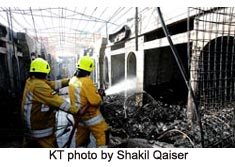
Dubai’s landmark goes up in smoke
By Amira Agarib and Riyasbabu (Our staff reporters)KHALEEJ TIMES 3 April 2008
DUBAI — More than 180 shops in the three-decade-old Naif Souq in Deira, popularly known as ‘cabin market’, were reduced to ashes, following a massive blaze in the early hours of yesterday. No casualty or injury was reported, officials said.
The fire gutted 184 shops of the 190 shops in the souq, Salim Zayed, Head of Market Control Section of Dubai Municipality, said.
The losses, according to market sources, are expected to run into millions of dirhams.
Fire experts are investigating the cause of the fire. Naif Souq, a popular shopping centre for traditional goods, mainly clothes, readymade garments, toys, bags and fashion accessories, went up in flames around 1.50am.
The police and Civil Defence officials reached the site immediately and struggled for hours to contain the fire. They managed to do so before it could spread to shops and the buildings in the densely populated area.
A large number of shop owners watched helplessly as the fire raged on.
Anwar, 35-year-old Afghan owner of shop No. 334 in the souq, collapsed at the site of the blaze. He is said to have lost goods worth Dh100,000.
Firefighters from Al Ras Civil Defence reached the scene at 1.58am. Firefighters from other civil defence stations, including Al Hamriya, Karama, Ghusais and Jebel Ali joined them later.
The blaze caused panic in the densely populated Naif area as thick smoke billowed as flames spread.
Eyewitnesses said hundreds of shops, mainly housed in wooden portakabins stocked with garments, toys and perfumes, went up in flames in a matter of minutes.
A Civil Defence officer said the fire might have started due to a short circuit in the electricity control panel located near gate No. 5 of the souq.
Major-General Khamis Mattar Al Mazina, Deputy Commander-in-Chief of Dubai Police who was present at the site, said the forensic experts are investigating.
Officers of Naif police station are in talks with shop owners to assess the material losses. The police have ordered the owners of unaffected shops in the souq to remain closed till the investigations are completed.
A Dubai Municipality market inspector revealed the market was in good condition and that the municipality carried out periodical inspections and routine checks on the safety measures.
He said they carried out maintenance works regularly at the cabin market building. “The only problem faced by the souq building was its narrow passages and lack of air-conditioning system.’
He said the municipality had insured the building and it might build a modern market soon.
Major Khalid Obaid Kanoon, Director of Firefighting and Rescue Operations of Diera district, and Major Juma Salem, Director of Firefighting and Rescue Operations of Bur Dubai, and a number of officers from various stations joined the firefighting operation.
The entire operation which lasted till morning was supervised by Colonel Ahmed Obaid Al Sayegh, Acting Director of the Dubai Civil Defence.
We will have to change eating habits, say residents
We will have to change eating habits, say residents
By Binsal Abdul Kader, Staff Reporter GULF NEWS Published: April 03, 2008, 00:05
Abu Dhabi: Residents are annoyed by the expected rise in prices of rice and pulses due to an export ban by India and Pakistan.
South Indians are especially unhappy as they cannot do without their staple food, non-basmati rice. “Although I am a diabetic, I cannot avoid eating a small amount of rice, even if it is against my doctor’s advice, said Ansar Chirayinkizh, an Abu Dhabi resident from Kerala.
“I think most South Indians are in the same position. A price rise will affect their monthly budget badly,” he said
Lakshmi Ashok, a Keralite housewife who has been living in Sharjah for the past 12 years, said her family will miss their favourite “Palakkdan Matta”, a non-basmati rice from Kerala. “We may try alternatives like Thai rice or switch to other dishes using wheat flour, but that too will get more expensive,” said Ashok.
Dr Shemeema Abdul Nazer, a Dubai resident from India, said eating rice may become less frequent among her compatriots due to the price rise. “Bachelors are already changing their food habits.”
Some Indians have also begun to avoid rice for medical reasons such as diabetes, as rice contains a high amount of carbohydrates, said the doctor.
A Sri Lankan family in Dubai said they might also try alternatives to non-basmati rice.
“Nowadays we have rice for both lunch and dinner, but we might be compelled to switch to other alternatives,” said Nishantha Perera, a human resources manager in Dubai.
Abdul Rahman Fatahulla Al Marzouqi, an Emirati in Abu Dhabi, said he could not do away with rice, even if the price goes up.
Sabahath, a Pakistani teacher in Abu Dhabi, said she reduced the frequency of eating rice to once a week due to the price rise. “Now people like me might further reduce it to twice in a month,” she said.
Camels take to catwalk in desert fashion show

Camels take to catwalk in desert fashion show
By Marten Youssef, Staff Reporter GULF NEWS Published: April 03, 2008, 00:05
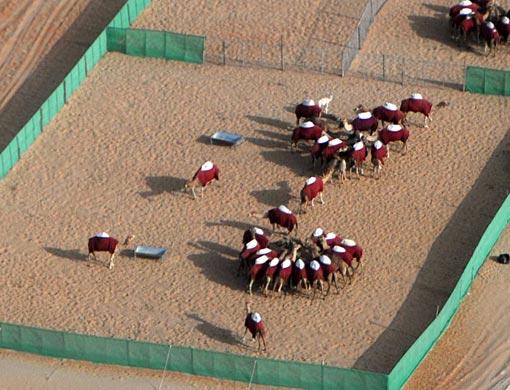
Abu Dhabi: More than 10,000 pure-bred camels “took to the catwalk” in Zayed City on Wednesday as a part of the 2008 Mazayin Dhafra Camel Festival.
At the event in the Western region, the desert became a fashion show for camel owners to showcase their animals.
With more than Dh35 million and 100 cars as prizes, the Abu Dhabi Authority for Culture and Heritage, the organisers of the event, are promising this will be the biggest and most comprehensive camel festival the Arab world has ever seen.
The nine-day festival will end on April 10 and is being held under the patronage of General Shaikh Mohammad Bin Zayed Al Nahyan, Crown Prince of Abu Dhabi and Deputy Supreme Commander of the UAE Armed Forces.
Competitors who come from across the Gulf are restricted to a set of rules and guidelines in entering the competition.
competitions with different categories that depend on age, gender and type. There are two different types of pure-bred camels: the Asayel and the Majahim. The Asayel are the lighter skin-coloured camels and the Majahim are the darker camels, which are very common in the Gulf region.
Part of our lives
Rashed Gaber Al Manhali is the president of the judging panel and arguably one of the finest camel experts in the UAE. Raised as a Bedouin, Al Manhali developed a passion for camels at the age of 10 and owns more than 80 camels himself.
Sitting cross-legged under a Bedouin style tent to shade him from the blistering 39 degree heat of the desert, Al Manhali shared his criteria for judging camels.
“There are five judges for today’s session and we are looking for specific things in a camel. The beauty of the face, the length of the neck, the size of the chest, the hump, the purity of colour, the silkiness of the hair and the size of the muscles,” the 55-year old Abu Dhabi native said.
“Camels are the most magnificent animals. For centuries, our people have used them to make pilgrimages to Makkah and to travel long distances. So this event is not just about showing off our camels but to pay homage as playing a significant part in our life and in our ancestors’ lives,” he adds.
The first winner of the festival was announced early yesterday afternoon. Police officer Mohammad Ali Al Docery, from Qatar walked away on the first day having won first and sixth place for his two camels.
“I won two cars with both of my camels,” says the 40 year-old police officer who entered more than 10 of his camels in the competition.
The event is truly a festival that is about much more than camels.
The economic impact of the festival is being felt throughout the region. For Umm Nasser, who came all the way from Qatar to sell camel accessories and beautification items, this is a great moment.
“I am a Bedouin,” she proudly says lifting up her head to show her pride.

Celebration
“This is a celebration of my people…My husband is here to compete with his camels so I came along,” she said sitting under tent number 29 and inviting all passers-by to experience Bedouin hospitality.
Umm Nasser is hopeful she will make a lot of money over the next nine days. The festival is also expected to increase the price of camels.
New roadworks to start at Al Diyafah intersection
New roadworks to start at Al Diyafah intersection
Staff Report GULF NEWS Published: April 02, 2008, 15:18
Dubai: A new diversion on the Al Diyafah Road intersection with Al Wasl and Al Mina Roads will start on Friday as part of the Jumeira Roads Improvement Project, said a senior official.
Motorists driving from Al Wasl Road, Jumeira Road and Al Mina Road towards Al Diyafah Road will face diversions which will be in place at least until the end of May.
“Motorists will not face a delay because we have kept the same number of lanes on the diverted roads,” said Nabeel Mohammad Saleh, Director of Roads Department at the Traffic and Roads Agency at the Dubai Roads and Transport Authority (RTA).
He said the traffic diversions were necessary to improve the intersection for smooth and safe traffic flow and to improve facilities for pedestrians.
Traffic signals and temporary directional signs have already been installed to streamline the traffic flow.
Saleh called on motorists using the diverted routes to abide by the prescribed speed limits, follow the directional signs on site and use alternative roads so as to ease traffic congestion during the period of construction.
“The RTA is keen to maintain smooth and safe traffic flow and provide temporary alternatives during the project implementation phase so as to ease congestion.”
He said the RTA is carrying out road improvement projects all over the city as part of its plan to widen and improve roads in view of the expanding city and subsequent increasing traffic.
Rice traders warn of empty shelves
Rice traders warn of empty shelves
By Saifur Rahman, Business Editor GULF NEWS Published: April 03, 2008, 00:05
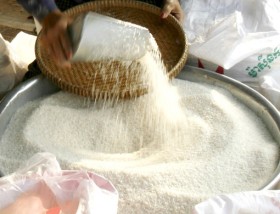
Dubai: Rice shelves in the UAE’s supermarkets might become empty within six weeks, if the government fails to intervene soon, traders said on Wednesday.
“The market price of the top quality super cornell rice is Dh200-210, however, the government has fixed it at Dh140, which makes it uneconomic for us to import,” said a member of Foodstuff Trading Group which represents the trade, requesting anonymity.
“We want the UAE government to match the market price or subsidise. Otherwise, importers will stop buying it. As it is, the flow of import has reduced significantly and the current stock could last six weeks at best.”
Food price inflation has already replaced the list of other public worries, including house rents and traffic earlier this year. Traders warned, if the current situation is bad, then the worst is yet to come.
Pakistan has already stopped exporting basmati rice to the UAE due to the price control. Indian government is planning to top up the ban on non-basmati rice with cheaper version of the staple food, which will adversely impact the Gulf consumers, most of whom depend on these varieties of rice.


 ClicksandWrites
You must be logged in to post a comment.