UAE
Web survey to gauge schools in Abu Dhabi
Web survey to gauge schools in Abu Dhabi
Jen Gerson, THE NATIONAL Last Updated: May 20. 2009
Education officials announced an online questionnaire yesterday allowing parents to comment on their children’s schools.
“This is the first step towards the instillation of the culture of transparency between the school, the home and Abu Dhabi Education Council,” said Mughair Khamees al Khabeeli, the general director of Adec, which is conducting the survey.
“The questionnaire covers all the aspects of the education paradigm in Abu Dhabi schools.”
The site asks parents whether the questionnaire should be offered permanently and what makes them satisfied with their school’s performance.
“Based on optional answers, the questionnaire covers such aspects as the school environment, curricula, administrative and teaching staff performance, communication between parents and schools, equipment and amenities,” Mr al Khabeeli said. The results of a similar survey were released this month.
Adec said 70 per cent of parents were satisfied with the schools. That survey queried almost 5,000 parents, who were asked to grade a variety of factors.
The results of a similar survey of Dubai parents were recently released by the Knowledge and Human Development Authority.
The questionnaire can be found at http://www.adec.ac.ae, according to the state news agency WAM.
http://www.thenational.ae/article/20090521/NATIONAL/705209803/1010
To participate in the survey, visit: http://www.adec.ac.ae/en/default/survey.html
Comments: The survey is very detailed and there are options to include the name of school and your own telephone number and email to get the result of this survey. It is therefore advisable to participate in this TQM opportunity provided by Abu Dhabi Education Council.
Nominations for UAE Appreciation Award for Science, Arts and Literature Begin
Nominations for UAE Appreciation Award for Science, Arts and Literature Begin
DUBAI — The Ministry of Culture, Youth and Community Development on Wednesday announced the launch of the fourth session of the UAE Appreciation Award for Science, Arts
and Literature.
Bilal Al Budur, Executive Director for Culture and the Arts at the ministry, said the award’s objective is to stimulate the intellectual, cultural and creative people in the UAE, to highlight and honour them and motivate the younger generations to improve knowledge of science.
In its fourth session, the award this year consists of five key areas: science (Electronic Engineering), literature (Al Faseeh poetry), field studies and research (Management Studies), field of plastic arts (Spatial Configuration), and field of performing arts (Directing). August 31 will be the deadline for accepting nominations, and the names of the winners will be announced in December to coincide with the UAE National Day celebrations
Safety in the Heat Plan Launched
‘Safety in the Heat’ Plan Launched
Olivia Olarte 21 May 2009 KHALEEJ TIMES
ABU DHABI — A comprehensive safety regime programme aimed at creating awareness and enhancing health and safety of workers who are exposed to high temperatures and humidity during the summer months was launched in Abu Dhabi on Wednesday.
The ‘Safety in the Heat’ programme, launched by the Heath Authority-Abu Dhabi (HAAD) in cooperation with the Ministry of Labour (MoL) for the first time in the UAE, targets those who work in the construction, transportation, agriculture, manufacturing and heavy industry sectors.
“HAAD and MoL are strongly supporting this programme and want to see this rollout and implemented to as many companies in Abu Dhabi as possible. Companies and organisations from other emirates and countries in the region are welcome to participate in the programme,” Dr Jens Thomsen, Section Head, Occupational and Environmental Health at HAAD, told company representatives at the launch.
The programme will support employers through offering a comprehensive package of educational and awareness materials in English, Arabic, Hindi, Urdu and Malayalam. It focuses on the prevention of heat-related illnesses such as rash, cramps, exhaustion and heat stroke caused by exposure to the hot environment.
The ‘Safety in the Heat’ recommendations are validated by HAAD and are applicable to workers in Abu Dhabi and the GCC region.
The programme has been developed following a two-year scientific research by the UAE University and Curtin University of Technology in Australia, sponsored by HAAD and participated by select companies in Abu Dhabi and Dubai.
A few hundred workers were engaged in these studies which include monitoring the workers’ heart rate for three continuous days, measuring their hydration status, recording of workers’ core temperature throughout the work shift and documenting environmental conditions.
“We found that the hydration status of the workers when they come to work is generally poor, and they tend to stay that way during the day… there is a lack of general awareness among employers and workers on how to prevent heat illness,” said Dr Graham Bates, Medical Physiologist from Curtin University of Technology.
The heat management programme also introduces a new heat stress index called Thermal Work Limit (TWL), which was developed by Dr Bates. TWL monitors all environmental factors such as the dry bulb, radiant heat, wind speed and humidity to assess working conditions and determine the thermal risk to the employee.
In addition to the protection of workers, the programme is also aimed at improving productivity of companies and reduce the time loss due to injuries by workers, said Dr Bates.
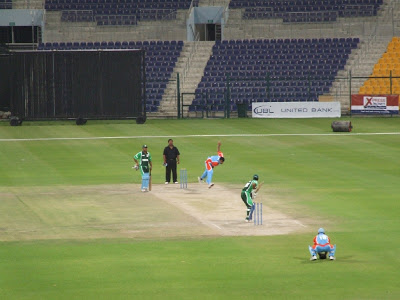
SAARC UAE Exchange Xpress Money Cup 2009 at Sheikh Zayed Stadium Abu Dhabi
Lifts to carry pedestrians to safety
May 14. 2009 THE NATIONAL
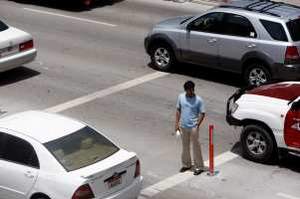
Traffic passing the mall is heavy because lorries and cars have been diverted to the road by construction on Salam Street. Sammy Dallal / The National
ABU DHABI // Lifts will be installed on the footbridge in front of Abu Dhabi Mall, and the traffic signal removed, in an attempt to stop pedestrians making dangerous crossings at the spot, a city official said yesterday.
Khaled al Junaibi, project manager for the Salam Street underpass project, said the lifts had been ordered and should be installed by the end of the summer at the bridge on the street that runs in front of the mall.
Pedestrians going to or from the mall often walk and run across five lanes of one-way traffic at a signal crossing designated for “handicapped only” rather than use the footbridge just steps away. Many of them cross the street against the light during breaks in traffic rather than wait for a “walk” signal.
Mr al Junaibi said city planners did not want people to cross at street level in front of the mall.
“When they cross the road we are forced to give less time for the traffic. If we give less time for this traffic, it will be backed up.”
The one-way traffic has been divided by bollards, leaving three lanes for vehicles going towards Al Meena Road and the Corniche and two lanes for local traffic, going to sites such as the mall or the Beach Rotana hotel.
Traffic passing the mall is particularly heavy at present because lorries and cars have been diverted on to the road by construction on Salam Street.
Some pedestrians make it only as far as the bollards and then wait as vehicles drive by within touching distance on either side of the pedestrians.
“We know about this issue,” Mr al Junaibi said. “We have ordered some elevators, and by the end of the summer they are supposed to be fixed.”
The crossing and signal were meant to be used by the disabled and the elderly who could not use the bridge, Mr al Junaibi said.
At about 5pm on one recent weekday, large groups of pedestrians crossed at street level with just a few opting to climb the flights of stairs to the bridge.
The traffic showed red against traffic for about 50 seconds to allow pedestrians to cross. Some impatient people crossed illegally, and many were forced to run. Motorists could be seen slowing down. The driver of a silver taxi slammed on his brakes and screeched to a halt to avoid hitting a young boy.
Kailash Tiwari, a road safety specialist with 30 years of experience as a traffic engineer, said the municipality was right to encourage people to use the footbridges. But he said a pedestrian-controlled signal should be installed at the crossing to give priority to the disabled and elderly who need to use it.
Mr al Junaibi said planners try to have pedestrian crossings at street level where possible. “It’s an equation we have to manage between the traffic and the pedestrian. It is OK for them to cross at certain locations, but we don’t want them to affect the quality of the traffic.”
He said staff at the traffic centre at Abu Dhabi Municipality were able to monitor the timing of the signal and adjust it if necessary. He added that lifts might be installed at other temporary footbridges.
Last month Col Gaith al Zaabi, the director of the Ministry of Interior’s traffic department, called on municipalities to install lifts at footbridges. He also said municipalities should add control systems for pedestrians in front of crossings with traffic lights and do more to deter jaywalkers, such as ensuring broken construction barriers are fixed promptly.
Twenty-six people were killed crossing roads in Abu Dhabi in the first 71 days of this year.
With few mid-block crossings in the capital, pedestrians have a choice of walking sometimes a kilometre between traffic signals or dashing across the road during breaks in traffic. Motorists rarely slow down for them.
Several pedestrians yesterday said they chose to cross at street level near the mall because it was easier than climbing the footbridge.
Hamed Ali Ahmed, 22, who works at the mall, said he sometimes used the bridge, but that when he was in a hurry to get to work he would cross at street level.
Leigh Bracken, 36, from Australia, who works for Abu Dhabi Commercial Bank, said he found it quicker to cross on the street but he would do so only if he felt there was enough time to get across all the lanes. He worried that someone would be struck while waiting to cross in the middle of the road.
http://www.thenational.ae/article/20090514/NATIONAL/705149956/1021
Report by Matthew Chung, Photo by Sammy Dalal THE NATIONAL
***********
I sincerely thank THE NATIONAL for listening and highlighting the safety issue and following it up with the concerned authorities. Look forward with excitement to the new state-of-the-art facility to carry pedestrian across the road in the city centre. At the same time, I keep my fingers crossed that no untoward incidents happen and no life is lost till the time this is implemented.
Dubai taxis hail plan to limit speed
Dubai taxis hail plan to limit speed
Eugene Harnan for THE NATIONAL
Last Updated: May 15. 2009 2:56PM UAE / May 15. 2009 10:56AM GMT DUBAI // Taxis roaring along the city’s roads at high speeds may soon be a thing of the past as devices that prevent them from going faster than 100kph have been installed in 200 of the vehicles.
By the beginning of next month, the Roads and Transport Authority (RTA) will assess the results and consider placing the speed limiters in every taxi in Dubai.
The move follows a similar initiative in Abu Dhabi, where devices limit the capital’s silver taxis to 120kph.
“We need drivers to change their attitude to speed and reduce it,” said Ahmed Mohammed al Hammadi, director of resources and support at the RTA’s Dubai Taxi Corporation.
The initiative is expected to cut emissions and fuel consumption as well as speed.
“We need to save our environment and this machine can measure the carbon dioxide emissions output of the engine,” Mr al Hammadi said.
The Dubai Taxi Corporation has 3,500 cars in its fleet and if the trial goes well, they will all get the speed limiters.
Taxis belonging to other franchises will also be fitted with the new device, bringing the number of vehicles with it to more than 6,000.
Currently, there is a system that notifies head office if a driver is speeding and a penalty is automatically issued. But under the new system, they will be restricted to speeds below the national limit. Some parts of Dubai have speed limits of 120kph, but the engines will be fixed not to break the 100kph barrier, irrespective of the restrictions on the road.
“We have done the studies on where our fleet is going and at what time of the day, either at peak or off-peak times and found we don’t need to open the limit more than 100kph,” said Mr al Hammadi.
Only cars that leave the emirate regularly, for example airport taxis that travel to Al Ain or Abu Dhabi, will be permitted to go at a higher speed.
Taxi drivers backed the limiters yesterday. “It’s a good idea. There are no more worries for speed cameras if I am tempted to break the speed limit,” said Yaal Shah, from Pakistan.
“The only problem is when I drive a customer to Jebel Ali or the airport along Sheikh Zayed Road and they are late, they ask why I am only doing 100kph,” he added.
Mr Yaal said he had been given only two speeding fines in his 12 years as a taxi driver in Dubai.
“It’s not a problem in the city as you don’t go any faster than that, but when I’m out on Emirates Road, I can see it as a nuisance.” Govendam Sanana from India said he very rarely broke the limit so the new move did not affect him.
“When I am on my own in the car, it is OK to go a bit faster but if I have a family with children or even tourists, I do not want to frighten them,” he said. “There are enough crazy drivers on the road and I try to keep them calm when I drive by going at a safe speed. A normal speed is better for everybody’s health, but there are a lot of crazy drivers out there.”
Adil Sadak, from India, said the power of his car, a Toyota Camry 2L, was sometimes too tempting.
“I know when I am on my own on a big, open, empty road I would like to get to the other end of it quicker. We have a problem with speed cameras so if we do not know the road, we will not do it,” he said.
In Abu Dhabi, all seven firms operating the newer silver taxis have had to fit their cars with speed limiters that restrict cars from exceeding 120kph. Gold and white taxis, which are being slowly phased out, are exempt.
The limiter is a small device attached to the engine and controlled through a monitor inside the car. It works by limiting the flow of fuel to the engine when 116kph is reached, causing the car to level out at 120kph.
Drivers can override the system for 10 seconds by pressing a button near the car radio controls or on the gear shift, allowing them to accelerate when they need to.
Drivers could in theory hit the button continuously, but the companies can track the number of times it is pressed and could reprimand those who overuse it.
http://www.thenational.ae/article/20090515/NATIONAL/705149827/1040
*****************
I sincerely thank the DUBAI RTA authorities for listening to this quality suggestion of mine to introduce speed limiters on vehicles. They were willing to listen and also kind enough to call and inform back about the test phase which is on currently. I hope this will be a success and will gradually implemented on to medium vehicles, mini vans, heavy vehicles, espcially buses carrying school children and workers and even government public transport buses.
Salama – HSE initiative – 10 golden rules for your safety on the road
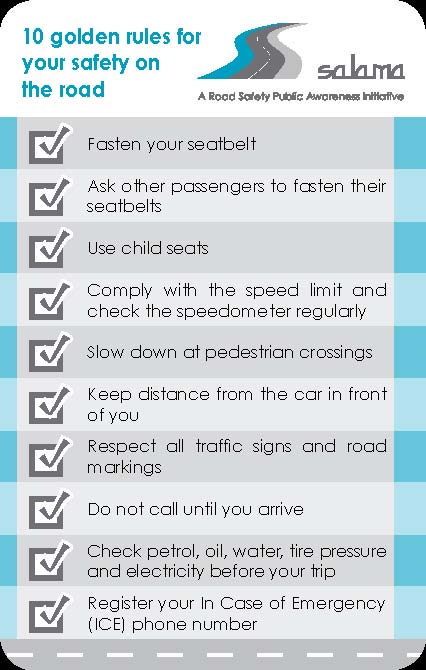 Visit: http://www.uaesalama.ae/ for more information.
Visit also : http://team1dubai.blogspot.com/search/label/HSE%20+
Salama – HSE initiatives – on Speeding

Salama – HSE initiatives – on Seat Belts for children
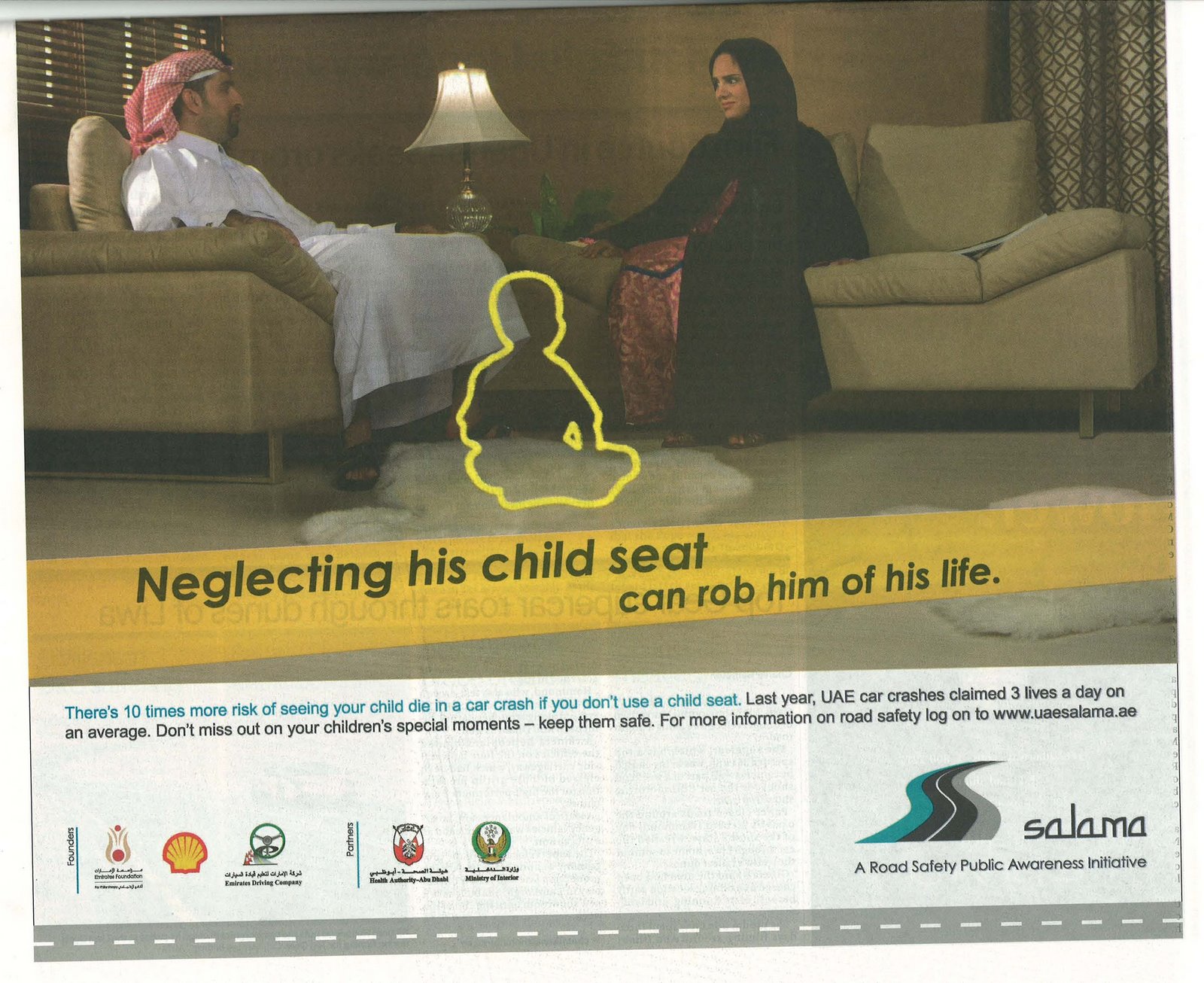
Visit: www.uaesalama.ae for more information.
Visit also : http://team1dubai.blogspot.com/search/label/HSE%20%2B
 ClicksandWrites
You must be logged in to post a comment.