TQM
Remove the fear of failure

Remove the fear of failure
Mr Amitava Roy, President, Symphony Services
One teacher I remember, and why: Prof. Bhola Nath Roy, my grandfather, for the values he instils in me.
One most valuable work lesson thus far: I am humbled by the intelligence of my colleagues and juniors.
My role is to unleash the untapped potential in people around me.
One thing I look for the most in a new recruit: Attitude.
A book that I am currently reading: How to manage in a flat world, by Susan Bloch & Philip Whiteley.
One tip for time management: Prioritisation.
One key thing in my fitness routine: Walk.
One signal that tells me there is a problem: Slowdown in communication.
One technique for handling anger: Deep breath.
One essential ingredient in my investment portfolio: Common sense.
One good thing about a new generation: Passion.
One worrying thing about the young: Affluence affecting their survival instincts.
One thing that clinches a deal: Trust.
One definition of values: Truth.
One way that I use for resolving conflicts: Listening.
One favourite activity when travelling: Photography.
One indicator of performance: Success.
One macroeconomic variable I keenly watch: India’s GDP growth.
One dream I’d like to chase, later in life: Travel — sightseeing.
One good way to foster innovation: Removing the fear of failure.
One clue that tells me I’m the leader: When others listen.
Trust those you depend on

Trust those you depend on
Ms Ranjini Manian, Founder and CEO, Global Adjustments.
One teacher I remember, and why: Robin Sharma’s List of Heroes. I made my wish-list and it has resulted in my actually meeting them!
One most valuable work lesson, thus far: Trust those you depend on.
One thing I look for the most in a new recruit: Multi-tasking ability.
One thought from a book that I am currently reading: “One pointed attention is key to success,” from Eknath Easwaran’s Book on Meditation.
One tip for time management: Cut through the knot of the most pressing thing that seems to weigh in your very stomach!
One key thing in my fitness routine: Pranayama.
One signal that tells me there is a problem: When I can’t think of a new idea.
One technique for handling anger: Postpone speech.
One essential ingredient in my investment portfolio: Land.
One good thing about the new generation: Superbly gadget savvy.
One worrying thing about the young: Do they know their roots?
One thing that clinches a deal: Asking sincerely.
One definition of values: Do what you want others to do to you.
One way that I use for resolving conflicts: Mediate.
One favourite activity when travelling: Listening to talks on the Bhagwad Gita on my iPod.
One indicator of performance: Societal admiration.
One macroeconomic variable I keenly watch: Dollar-rupee exchange.
One dream I’d like to chase, later in life: Teach Indian philosophy.
One good way to foster innovation: Adapt learning to your field.
One clue that tells me I’m the leader: There is actually someone following.
10 tips to get noticed in your GD
10 tips to get noticed in your GD
Kshipra Singh | March 25, 2008 | 11:19 IST
In the last article, we discussed eight things that you should not do in a group discussion (GD). This week we look at tips that can help you in succeeding in the GD. Your soft skills definitely come into picture here. Here are some of the things that you can do to make a winning impression in your GD.
~ Read voraciously: Make a habit of reading voraciously on every subject. This will keep you ready for any topic for a discussion in GD. Your knowledge is your most important weapon in a discussion.
~ Initiate the discussion: Most of us have a misconception that initiating the discussion would give you an advantage over others. It does give you an advantage but only if you know the subject well and have something relevant to start the discussion otherwise it is a disadvantage.
For instance, when a group was given the subject “Is capital punishment right?” some members of the group heard the word punishment and jumped at starting the discussion with out understanding the meaning of capital punishment. The evaluators kept listening for two minutes after which they intervened and asked the group if they knew the meaning of capital punishment. The members who initiated were quiet, looking at each other’s faces. That is when a silent member of the group got up and explained the meaning of the topic. From this, you can easily tell who must have succeeded in the GD, the ones who initiated the discussion or the one who explained the topic and gave it a right direction.??
They say, “Speaking just for the sake of speaking is noise”. So, don’t create noise in the GD, instead make some useful and resourceful contributions to get noticed in the discussion.
~ Speak politely and pleasantly: As you speak make sure that you do not talk at the top of your voice. You should be audible and clear. Remember?that you are participating in a discussion which is different from a speech given out by the leaders in their rallies. Even if you disagree with the other’s point of view, disagree politely. Use phrases like, ‘I would like to disagree a bit here’ or?’I am sorry, but I think I have a slightly different point of view’.
~ Be precise: Abstain from using irrelevant information and data from your talks during a GD. Speak precisely so that others also get a chance to put across their point of view.??
~ Acquire and apply knowledge: Stay attentive to the ideas put forward by other group members and keep writing the important points discussed during the GD. As you get a chance to speak, put forward your views about the topic. You can also agree or disagree with other’s ideas, based on your knowledge about the subject.?
~ Agree with the right: Don’t take a stand on either extreme when the discussion begins. It might happen that you get convinced by other’s argument and want to change your stand. Respect another’s opinion as well and agree with what is right, even if you initially had a different opinion.
~ Speak confidently: Maintain your confidence as you speak. Establish eye contact with other members of the group and do not let your voice tremble.
~ Moderate: Try to moderate the discussion if any arguments arise. This is necessary to ensure that the group doesn’t wander from the goal of the GD.?
~ Use positive body language: Your body language should not demonstrate dominance or low self confidence. Show your interest in the discussion through your gestures like bending forward a bit, nodding your head.
~ Be a team player: Last but not the least, be a team player as this is a group activity. Be comfortable with the group members and vice versa.
The author is a contributor to http://www.CareerRide.com, a website that addresses technical and personal aspects of an IT interview. CareerRide also provides sample CVs and answers to questions asked in a personal and technical interview.
‘To be successful, you need a compelling vision’
‘To be successful, you need a compelling vision’
March 24, 2008 | 17:30 IST
Shirish Nadkarni has led an interesting life. He studied at some of the world’s most illustrious schools — IIT and Harvard. He was the tenth Indian to join IT behemoth Microsoft back in 1987, contributing to its incredible growth?and played a pivotal role?in the overall online strategy for the MSN portal.
He then went on to set up his own?company TeamOn Systems, which he sold and is now heading portal Livemocha.com, a portal that helps people learn a number of different languages.
In an e-mail interview with rediff.com’s Shifra Menezes, he shares his experiences and lessons young entrepreneurs can learn from them.
Source: rediff.com
Give us a brief sketch of your career in the industry and the agencies you worked with before Livemocha.
I started my career at Microsoft in 1987 in product management. In fact, I was the No 10 Indian to join Microsoft at that time. It was a great time to join Microsoft and was able to contribute to the huge growth that Microsoft enjoyed in the PC software business.
Towards the end of my career at Microsoft, I was responsible for driving the overall online strategy for the MSN portal. In that context, I was responsible for Microsoft’s entry into the two largest application categories on the internet — email and search.
On the e-mail front, I led the acquisition of Hotmail and, on the search front, I led the partnership with Inktomi, a leading search provider. I left Microsoft in 1999 and started my first company, TeamOn Systems.
At TeamOn, we developed a unique wireless e-mail technology for mobile handsets. TeamOn was acquired by RIM (Research in Motion) in 2002 and the technology we had developed became BlackBerry Internet E-mail which now has several million users.
I stayed on at RIM in an executive capacity and helped RIM grow their consumer business. In 2006, I left RIM to start working on my next venture which became Livemocha.
You have studied at some of the illustrious colleges in the world. Tell us a little bit about what it was like at an IIT and Harvard.
It was truly an incredible experience going to both IIT and Harvard. You get to interact with some of the best students and professors in the world and the competition is very tough.
However, the experiences were different in some respects. With IIT, the focus was very much on very rigorous theoretical learning — as you know, the IIT entrance exam is legendary for asking very tough problems.
With Harvard, the focus was much more practical in nature. Instead of just learning theory, it was an all case study based approach with theory being taught in the context of the case studies being taught.
Both approaches have their place in the learning process and one is more effective than the other depending on the discipline that you are in.
How did Livemocha come about? Tell us a bit about what the portal does and its growth.
Livemocha emerged out a personal need to teach my own kids a foreign language. I was disappointed with the existing solutions in the market and felt that the internet provided a perfect platform to connect people so that they could each leverage their native language expertise to help each other.
Livemocha combines in-depth instructional content for six different languages with? a worldwide community of language learners. The site has experienced growth.
We launched the site in Sept 2007 and have already grown to over 300,000 users from 200 different countries in a matter of 5 months. India is one of the biggest source of users on our site.
What kind of assignments did you handle in the early days of your career?
My first assignment at Microsoft was a Product Manager for Microsoft Mail. It was an amazing experience since e-mail (which we take for granted today) was hardly commonplace. It was an opportunity to establish this whole new category of application on the PC platform.
My work schedule was quite hectic in the early days since Microsoft was a fairly small company in those days and one didn’t have access to many resources. It was not uncommon for people to work 60 to 80 hours a week. But we didn’t mind since it was great to be at the forefront of new technology adoption
Tell us a bit about how you went about setting it up TeamOn Systems.
I started TeamOn Systems in 1999. To fund the company, I went to a number of prominent angel investors who I had known. These included people like Sabeer Bhatia, the founder of Hotmail, Pete Higgins, Executive VP at Microsoft, Mike Slade, CEO of Starwave etc.
This was very valuable not just for the funding that they provided but more importantly for the tremendous amount of advice and experience they were able to provide.?
The acquisition by RIM happened in 2002 and was prompted by RIM’s desire to enter the “prosumer” (mobile professional or individual business user) in addition to their traditional enterprise business.
At TeamOn, we had built a unique consumer wireless e-mail technology which was a perfect fit for RIM’s requirements. The acquisition was very successful for RIM — the technology that was built by TeamOn became BlackBerry internet e-mail which is now being used by several million BlackBerry users.
What kind of challenges have you faced in the course of your career, and how have you learned to deal with it?
The biggest challenge I faced was with my first company, TeamOn Systems. We originally started TeamOn Systems with the idea of creating a small business e-mail solution (sort of a super charged Hotmail for business users).
However, the dot com bust happened right after we got venture funding for the company and many of the partners who would distribute our application went out of business. So we had to retrench and look for new opportunities for the technology we had built.
Given the advent of data applications on mobile handsets, we decided to redirect our technology to the mobile space. It turned out to be a fortuitous move and a successful one at the end through the acquisition of the company by RIM.
Do you believe in the ‘lucky break’ factor, or do you believe that an innovative, new idea is all you need to guarantee career success?
I believe in both innovation and luck. You can be very innovative but sometimes you are ahead of your time.
So it is important to have some luck as well to be at the right place at the right time. But luck by itself is not sufficient — you have to be prepared to take advantage of the “lucky” opportunities that present themselves.
What do you think is the most common mistake newcomers make? What advice do you have to give them in this regard?
The most common mistake that newcomers make is to not focus on what exactly is the value proposition that would get people excited about using your offering. Sometimes you get carried away with some interesting idea or technology but if its not something that really solves a real need, it is not going to be adopted. As most venture capitalists would say “You need to sell Aspirin not vitamins!”
Having come such a long way in your career, what do you think remains to be achieved? Which dreams are yet to be realised career-wise?
Right now my immediate priority is to make Livemocha into a global company that is teaching at least 50 different languages to millions of users all over the world and creating a better understanding between people from different countries.
However, beyond Livemocha, I want to dedicate my time to help upcoming entrepreneurs achieve their dreams as well as make a major contribution in the education field (Livemocha is the first effort in this regard).
My dream is to eventually start a series of volunteer schools that provide free math and science tutoring to kids.
Did you have a mentor, and if so, how did he/she inspire you to steer your career in the right direction?
I have not had a specific mentor but have relied on a number of senior executives for advice and guidance. People who have had big influence on my career are people like Pete Higgins, former Executive VP at Microsoft and Jim Balsillie and Mike Laziridis, co-CEOs of Research in Motion.
Has your career impacted your personal life? Do you feel like you’ve had to sacrifice a few personal pleasures in favour of your job, or are you a workaholic, thriving under pressure?
I have been happily married for the last 20 years. My wife Mona is also Indian. I have 2 kids — Rohit and Priyanka who are both in high school in the US. My career certainly has had an impact on my personal life though my family, especially my wife, has been very supportive.
I do, however, take time to spend with my family and also contribute time to the community.
Currently, I am volunteering my time as the President of the Seattle chapter of TiE. I am also on the Board of Trustees of a new school in the Seattle area.
How do you spend your free time?
I love to play tennis and watch sports. In fact, my dream is one day to watch Roger Federer play at Wimbledon before he retires.
What is the last book you read or are currently reading?
I love reading books?– currently I am reading the Age of Turbulence by Alan Greenspan.
What would you say is compulsory reading for young entrepreneurs?
One of all time favourite?business books is called Positioning: The Battle for the Mind by Al Ries and Jack Trout. It describes in very simple terms how to build a compelling and a unique positioning for the product that you are trying to market. Without clear “positioning” that differentiates one’s product from others, an entrepreneur has no real chance of success.
What tips do you have for today’s youngsters looking to set up their own company? Other than a good idea, what is required from them?
To be successful, you need to have a compelling vision that you are willing to go all out to achieve. It can’t just be a product idea. It has to be a vision about how you are going to change the world with this idea. And you need to complement your vision with an incredible amount of drive because undoubtedly, you will experience many challenges and disappointments.
Without the vision and the drive, it will be very hard to get to the pot of gold at the end of the rainbow.
Knot Just a Tie
Knot Just a Tie
By Nitin Nair, Features Editor GULF NEWS Published: March 03, 2008, 00:47
Want to look spiffing for the big interview? Learn how to tie a Windsor knot
And you thought this was just a thick, fat knot. Somewhere in that knot is a story about love and the abdication of the British throne.
Though he denies having invented it, the Windsor knot is widely attributed to the Duke of Windsor. The Duke was King Edward VIII before he gave up the title of the king of the British Empire to marry American divorcee Wallis Simpson.
Something of a style icon in his times, the Duke patronised Hawes and Curtis, a London-based clothing company that made bespoke lounge suits, blazers and shirts for him.
Now that he was doing so much for its brand in British aristocratic circles, the company created a bespoke tie that had a thicker inner lining in the part of the tie that formed the knot.
The result was a thicker, broader tie knot, a style that pleased the Duke. In his honour, the knot was christened the Windsor knot – the most formal of all tie-knots.
REMEMBER: The Windsor knot needs space, so forget the button-down shirts; this works best with spread collar shirts.
“Any tie can create the knot, but of course a thicker tie creates the best knot as this is the whole point of it. Although it is the way that it is knotted and not the tie that makes it definitive as the Windsor knot,” says Damien Paul, menswear buyer, Harvey Nichols Dubai.
WHEN TO WEAR IT: Ideal for men with long necks since the wide form shortens the perceived height of the neck. The Windsor is best suited for presentations and job interviews because it supposedly projects confidence. “Since it is thought of as a sign of high society, it is best suited for formal events, interviews, weddings etc,” says Paul.
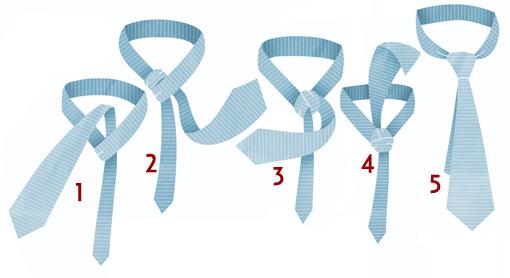
The Windsor in Five steps
Hang the tie around your neck with your right hand holding the narrow end. Transfer the narrow end to your left hand and with your right, cross the wide end of the tie over the narrow end. Bring the wide end up through the inside of the loop.
Bring the wide end down to your right, around and behind the narrow end, on your left. Now, bring the wide end over and down through the neck loop and pull it out to your left side.
Next, cross the wide side in front of the tie and to the right.
Now go up through the neck loop and down the loop made by the previous cross at the front of the tie.
Tighten the knot, draw up to the collar and straighten.
8 things you should NOT do in a GD
8 things you should NOT do in a GD
Kshipra Singh | March 18, 2008 | 09:46 IST
A group discussion or GD, is a form of many-on-many discussion. It has become an inseparable part of admissions to management institutes and your selection in campus interviews.
A GD is held to identify certain traits that companies and institutes like to see in their employees or students. Let’s take a look at the traits which the evaluators look out for in a candidate during the GD. ?
~ Knowledge: Whatever you do in a GD, your knowledge about the subject can’t be replaced by anything else. You are required to talk in a GD but inputs that don’t contain any substantial value will not help in any way. Be a voracious reader to increase your knowledge on various subjects. Newspapers, TV, magazines, news portals etc are great sources of knowledge.
~ Alertness and presence of mind: In a GD you are required to carefully listen to the other person’s thoughts and keep an argument, example or a supportive statement, fact, example ready to participate in the discussion. Here comes into picture your alertness and ability to think and act immediately. As you participate in a GD, make sure that you sit with an attentive mind and keep taking down the relevant points put forward by others.
~ Communication: You may have a lot of good points to put across but if you can’t communicate them clearly, you won’t stand a chance when it comes to impressing the evaluators. Practice communicating in a clear and effective way with your friends, family or study group.
~ Confidence: Your self confidence adds a lot of value to your candidature. Look at every group member as you speak, avoid too much hand movement and looking at evaluators.
~ Leadership and team skills: Your participation in a GD clearly establishes not only your leadership skills but also your capability to work in a team. To meet the objectives, a good leader has to be a team player.
~ Goal orientation: Since so many people participate in a GD, the chances of the discussion moving away from the subject are high. Your focus on the goal can get you some extra points.
Now, as you are being evaluated for the above discussed traits, you must avoid things that can work to your disadvantage and might cost you the selection. Here are some things that you must avoid doing as a GD participant:
~ Initiating the discussion without proper subject knowledge
Although initiating the discussion helps you get the immediate attention of the evaluators, sharing irrelevant details just for teh sake of talking can work to your disadvantage. Start first only if you know the subject well otherwise wait for others to start and get a feel of the subject before entering into the discussion.
~ Snatching another’s chance to speak
Give your group members a chance to speak. Talking more won’t get you through the GD. In fact it will give the evaluators a feeling that you are not a team player. Making short and relevant contributions of 20-30 seconds 3-4 times in the discussion is enough.
~ Interrupting others
Let the other person finish his comment before you speak. Interrupting someone is counted as a negative trait. Remember, it is a discussion not a debate. Don’t jump at the conclusions. Listen carefully to the other person before putting your point across.??
~ Dialogue
In a GD you are expected to communicate with all the members of the group. Do not keep looking at one person while talking. Establish eye contact with all the members of the group. It is a many-on-many discussion not one-on-one.
~ Shouting or dominating
Keep you emotions in check. Do not try to dominate the others or let your emotions rule you. Sometimes it might happen that a group member might say something that hurts your feelings such as a comment on your race or religion, make sure that you do not get into an argument. Your focus should be to effectively meet the goals of GD topic.
‘I nailed my IIM group discussion & interview!’
~ Showing offYou have to put across your knowledge on the subject during the GD but you have to be very careful about the thin demarcation between showing off and knowledge sharing. For eg, using statistics and facts during the GD is a good thing to do but you must not overdo it enough to nauseate the group members.
~ Low self confidence or insecurities
As we have seen earlier, one of the traits evaluated during a GD is your self confidence. Do not hesitate to speak confidently, even if you might be short of ideas or knowledge on the subject. Listen to others and put across your thoughts in a clear and audible voice. Make sure that you make eye contact with all the group members.
~ Slang and negative gestures
GD is a formal discussion. Avoid informal words and negative gestures. For eg avoid words like gonna, wanna, ya etc. Similarly avoid gestures like pointing fingers, tapping the desk with the pen.
If you ensure that you do not commit these mistakes during the GD, you will not have to worry too much about the negative marks and your chances of getting through it also become much brighter.
Kshipra Singh is a contributor to http://www.CareerRide.com, a website that addresses technical and personal aspects of an IT interview. CareerRide also provides sample CVs and answers to questions asked in a personal and technical interview.
Here’s how you can live a happy retired life with pension plans
Here’s how you can live a happy retired life with pension plans
Vidyalaxmi, TNN
A chief executive officer of a leading insurance company had an interesting thing to say on pension plans: “The pension plan of Indians until two years ago was to give birth to a maximum number of sons. The hope was at least one would take care of the aged parents in their golden years.” This school of thought has been challenged with the breakdown of the joint family system.
Indians rarely think they need to bear their retirement costs, nor do they expect the government to play a role. Most Indians feel that their children will bear their retirement costs. But falling fertility rates are resulting in smaller families. The growing stress of mobility in work force is impacting the joint family system and informal support systems are crumbling,” says Aviva India managing director Bert Paterson.
According to an all-India survey done by the Invest India Economic Foundation, less than a sixth of those about to retire, around 113 million by 2016, are covered by some form of pension. Pension plans are one such investment-cum-saving option offered by most insurers for your golden years. In such plans, you pay a fixed premium over a certain tenure, which is the term of the policy. Then the net premium, after all the deductions, is invested by the insurer in various instruments, depending on the type of plan.
Pension plans available
There are two kinds of plans — endowment and unit-linked. Endowment plans invest your money in fixed income products. So you may find the returns low, although safe, after discounting the inflation. The other variant is ULIPs, which invests the corpus in stock markets, balanced funds, etc. Then comes the ‘with cover’ and ‘without cover’ plans. The ‘with cover’ pension plans, as the name suggests, comes with a life cover that takes care of any untimely demise. The most commonly available plan today is the ‘deferred annuity’ plans.
In these plans, the pension does not begin immediately. You can defer it up to a period of your choice. Let us assume you buy a pension plan with a tenure of 25 years. Then your annuity/pension will begin after 25 years from the effective date of your policy. Apart from that, you also have the option of deferring your vesting age. Suppose you have opted for a pension plan, in which the annuity would start from the time you turn 45. But if you plan to work for another five years, then you can defer your vesting age to 50, says Pranav Mishra, senior vice-president & head of products, ICICI Prudential Life Insurance.
Start Early
It is also advisable to start investing early. That will help you save a significant corpus for future. There is certain cost attached to your postponement of investment.
If one delays buying a life insurance policy even by five years, the premium goes up.
Flex it
Another point check is to ensure that the plan offers flexibility so that it fits the customer’s needs as they change. The trend is to opt for a ULIP pension plan with a fixed allocation strategy.
Know the charges
Every pension policy comes at a cost. Briefly, you have a fund management charge, policy administration charge, premium allocation charge and switching charge. A switching charge, however, is applicable only after you cross the switching limit available in every policy. According to industry estimates, the policy administration charge is anywhere between 0.20% and 0.50% of the premium. It depends upon the frequency of the premium and the premium amount.
Premium can be paid annually, semi-annually, quarterly or every month. Fund management charge falls anywhere between 0.75% and 2.5% per annum and the switching charge, if any, is usually Rs 100.
Death of the policyholder
This clause may vary from policy to policy. If the policy holder dies during the tenure of the plan, then the nominee gets the sum assured or fund value, whichever is higher in case of sum assured plans. If the nominee is the policyholder’s spouse, then he/she has an option of either an annuity or a lump sum amount. In case of zero sum assured policy, the beneficiaries get the fund value.
Other options
Should you lock yourself into an annuity plan? Most neutral financial advisors say no. One reason is the annuities are taxable. Secondly the returns are also low.
You earn anywhere around 6-7% on your annuities. Today, a five-year bank deposit, which also offers a tax break on investment under Section 80C offers 8.5-10%. Other monthly income options are the Senior Citizens’ Savings Scheme (SCSS), which offer 9% and the post office monthly income scheme (POMIS) that offers 8%. But again the tenure for these instruments is six years and eight years, respectively.
“I like the concept of annuity. It covers the life risk as an investor gets payouts till his/her life ends. But the rates are even lower than bank FDs. You get around 8-9.5% interest rate on your FDs. Similarly you park your money with the insurer but you earn only 6-7%,” says Swapnil Pawar, a certified financial planner with Park Financial Advisors.
If you have saved a higher corpus for retirement, then you can look at fixed maturity plans or even debt funds as they are more tax efficient than FDs.
Rishi Nathany, another certified financial planner, says annuities are low worldwide. At least in the US, social security benefits are available for senior citizens. But in India, the senior citizens have no such option.
The fact is that annuities ensure regular cash flow in retirement years. In other cases you have to customise your plan, be it a FD or FMP for a regular stream of income.
Friday sermon to be telecast live in sign language
Friday sermon to be telecast live in sign language
By Adel Arafah (Our staff reporter) KHALEEJ TIMES 26 February 2008
ABU DHABI — The Juma (Friday) sermon at Shaikh Zayed Mosque in Abu Dhabi will be telecast live in sign language from the first Friday of March, Dr Mattar Al Ka’abi, Director-General of the General Authority for Islamic Affairs and Auqaf (Endowments), said recently.
Emirates TV channel would telecast the sermon in sign language every Friday, he said.
The move was part of the authority’s commitment to the people with hearing and speech difficulties, who number more than 200 in Abu Dhabi alone as per the statistics issued by the Zayed Higher Foundation for Humanitarian Care, he said.
The authority had signed contracts with two specialists in sign language to convey, in detail, the Juma sermon, he noted. These people with special needs are an integral part of the society, and the authority was planning to introduce sermons in sign language in more mosques in all emirates, he added.
How to achieve your financial goals
How to achieve your financial goals
Sheetal Mehta | February 25, 2008 for rediff.com
Saurabh Awasthi, 26, a media professional from Hyderabad was trying to figure out his financial goals. His wife Seeta, 25, too, was helping him in the exercise. At the end of the day both Saurabh and Seeta had exhausted themselves. They could not figure out as to what their priorities were: Planning for their 2 year old son’s higher education, buying a home for themselves which they desperately needed or spend Saurabh’s bonus on a world tour.
This, often, is the dilemma faced by many people planning their future finances. The most common question in such cases is how you should plan your finances. In the fast-growing Indian economy everyone is so keen on concentrating on their career and earning as much money as possible that they forget that the surplus money has to be invested for the future.
Or even if you do remember a bandwagon concept is adopted ?invest where everyone else is investing. But in the world of financial planning you must remember that one size does not fit all.
In my interaction with the people who I come across and further discussions with them I have noticed that they lack a clear picture of the purpose of their investments. Everyone just wants to invest and become rich. I wish if that were so easy.
Do not invest just for the sake of investing. As Ralph Seger rightly said, “An investor without an investment objective is like a traveller without destination.” Although this quote has been used n number of times I would still like to use it here as planning without a definite goal is akin to a traveller without destination.
First and foremost you must remember the most important aspect of financial planning, and that is, what you want to achieve? Try doing this: jot down 5 important financial goals that you want to achieve in the next 10-15 years. I am sure not many will be able to do this.
But there is a simple way that may help you to develop a fundamentally sound financial plan and achieve goals for which you are working so hard. The first and foremost step is to note down your goals as this is the starting point of your planning.
Don’t get foxed by returns on your investments
Goals give you an idea as to what you want to achieve. They can vary from just plain savings to your retirement, to your child’s education, buying a house, buying a car, funding your or your son’s/daughter’s marriage etc. The job does not end here though. Even after listing them, you must have a clear vision about their priorities. The best, way to make this daunting task easy is to divide your goals into the following three categories:
~ Responsibilities: Like providing for your parents, providing education to your children, funding their marriage, meeting any unforeseen events etc.
~ Needs: This includes requirements that you have like providing for retirement, buying a house, providing for day-to-day life and also saving for the near future, etc.
~ Dreams: Or aspirations. It can be anything like buying a luxury car to buying a solitaire for your wife or a world tour. Your dreams may be out of reach but there is no harm in listing them as this can act as a constant reminder for you to work hard.
Based on the above three criteria you categorise your goals. You need to prioritise the above listed goals in an order of importance in your life and their requirements.? There needs to be a fair balance drawn between needs and responsibilities as at a certain point in time both could be equally desired by you.
Time frame
Once you have set your goals then the second important step is to decide the time frame in which you would like to achieve them. This factor is very important when you are planning to invest. The time period for investment is based on the time in which you wish to achieve your set of goals.
Let’s take an example to understand it better.
Say you are planning to buy a car but are not sure when you can do it. You invest a part of your money in Public Provident fund, National Saving Certificate, Infrastructure bonds and some close-ended funds. After say 4 years a new car is introduced in the market which suits your requirements and you decide to buy it. But your entire sum is blocked as all of them have been invested in products which have a lock-in period.
Let me take one more example. Say your child’s admission to higher education is just a year away. You are planning to invest money to meet this requirement. Carried away with the stock market boom you invest all your money in the market. Just a few days before paying the fees the stock market crashes and your capital is reduced to half.
Remember that stock market is a good avenue to invest but only if you are a long term investor and your goal is at least 8 to 10 years away and not when it just a year away. You need the capacity to hold and stay invested. Also, to enter the stock market with the intention to be a trader and not an investor is a risky affair and such foolishness is better avoided.
However, it is not necessary to fix an exact time frame. A rough estimate of when you will need money can also give you a picture as to how to plan your financial goals. However, if you do not give a set time to achieve your goals then you may not only digress from the right path of planning but also end up depleting your hard earned money.
Charting
After you have done the above two exercises you need to put a financial figure as to how much money you will require when you reach that stage. That is, you must know the future value of your requirements in today’s cost. For instance, a two year MBA today may cost you say Rs 4 lakhs but eight years down the line you will surely need a higher amount for the same course.
To overcome this, the best way is to prepare a chart as given below:

(The above table is hypothetical)
You need to factor in the inflation cost and find out what will be the future value of financial goals. This can be calculated using a simple formula:
FV = Present Value * (1+ Inflation rate) ^ number of years left to achieve your goal
FV = 4,00,000 * (1+6%) ^ 8
FV = Rs. 6.37 lakhs (approximately). So this is the figure for which you need to plan for.?
I hope the above will help you lay a path for your investment planning. Planning varies depending upon your needs but the factors that help lay a path to your plan remain same for everyone. The above process gives you a clear picture as to the path you need to follow to achieve your goals. It also helps you to decide on the most suitable investment that will help you and not your friend or neighbour.
The author is a financial consultant and can be reached at dhanplanner@rediffmail.com.
Use of seatbelts in back seats may be made compulsory
Use of seatbelts in back seats may be made compulsory
By Alia Al Theeb, Staff Reporter GULF NEWS Published: February 24, 2008, 23:29
Dubai: Police are working with the Interior Ministry to issue a law that considers making not wearing seatbelts in the back of a car an offence, a senior police official announced on Sunday.
Brigadier Mohammad Saif Al Zafein, Director of Dubai Police’s Traffic Department, did not elaborate on the issue, but stressed the importance of wearing seatbelts at all times. Currently, only front seat passengers need to wear seatbelts by law.
Police issued around 25,520 offences for not wearing seatbelts in 2007 with an average of 2,126 offences monthly. Brigadier Al Zafein announced the launch of a two-week awareness campaign on wearing seatbelts which began yesterday.
Awareness
He said awareness regarding wearing seatbelts had started going down and the number of motorists who now wore seatbelts was only 50 per cent. Brigadier Al Zafein revealed that 332 people were killed in traffic accidents last year and it is estimated that 40 per cent of those victims in collisions were not wearing seatbelts.
He pointed out that 16 per cent of people who were killed in accidents where cars flipped over in 2007 were not wearing seatbelts. The fine for not wearing seatbelts is Dh100 and three black points. The law fines the motorist and the passenger sitting next to the motorist.
“We are coordinating with the Interior Ministry to issue a law that considers not wearing seatbelts in the back seat a punishable offence,” Brigadier Al Zafein said.
He said the first week of the campaign would focus on spreading awareness on the importance of wearing seatbelts and the importance of using child car safety seats.
The second week will focus on road control and issuing fines to offenders.
“Seatbelts do not prevent accidents but they do reduce the damage to the lowest levels,” Brigadier Al Zafein said.
He pointed out that traffic police issued 14 fines to motorists who allowed children under 10 to sit in the front of cars.
Lieutenant Colonel Dr Jasim Mirza, Director of Dubai Police’s Security Awareness Department, said the focus of the campaign would be on educating schoolchildren.
Dubai Police’s Traffic Department launched the campaign in coordination with the Santis HSE Group, a Global Health, Safety and Environment Consultancy and Gargash Enterprises.
Santis HSE Group and Gargash Enterprises officials will take the campaign to schools, streets and shopping malls in Dubai to promote safety and give out complimentary child car seats and car safety packages.
 ClicksandWrites
You must be logged in to post a comment.