The National

Time for Etisalat to improve its airport presence

Posted on Updated on

Although it is the major telecommunications service provider in the UAE, Etisalat still falls short when it comes to providing good customer service.

At Abu Dhabi Airport, the location of the only Etisalat payment machine is unknown even to many of the airport staff. The plight of a visitor can be imagined.

When I tried to deposit money in the machine recently, it would not accept any notes. When I called the Etisalat contact centre to report this error, I failed to convince the operator about the importance of this issue.

He wanted to have the machine’s ID number, which was not displayed. I told him the machine’s location – it is just in front of the Etihad and NBAD offices on the mezzanine floor – but he was adamant about getting this number so he could log the complaint.

I wonder whether the machine was finally repaired. Considering the value of Etisalat’s reach and its prominence in this country, I think it should have a customer support and sales counter at the airport arrivals terminal.

This is especially significant as the airport will be the gateway for all the visitors arriving for the new season of international events, including the Formula One race.

Ramesh Menon, Abu Dhabi
To read it in original, please visit THE NATIONAL online

Abandoned cars send a message

Posted on Updated on

Abandoned cars send a message

I recently visited Abu Dhabi International Airport’s short-term car park and was shocked to see many cars there completely covered in dust.
Some of them had punctured tyres and the dust was inscribed with graffiti, so I guessed that they had been there for a long time. This was confirmed when I visited 10 days later and the same vehicles were still there.
I am not sure whether these are cars parked in the wrong place by travellers who are on long holidays or they have been abandoned by people who have left the country for good.
Graffiti on one of them saying “Gone fishing” made me think the latter might be the case.
I hope the relevant authorities at the airport can remove these vehicles, as they provide an unpleasant sight for visitors.
With several key events scheduled to happen immediately after Ramadan, this is one thing the authorities should take into consideration in their efforts to continue to keep the city neat and clean.
Ramesh Menon, Abu Dhabi
To read it in original, please visit THE NATIONAL online.

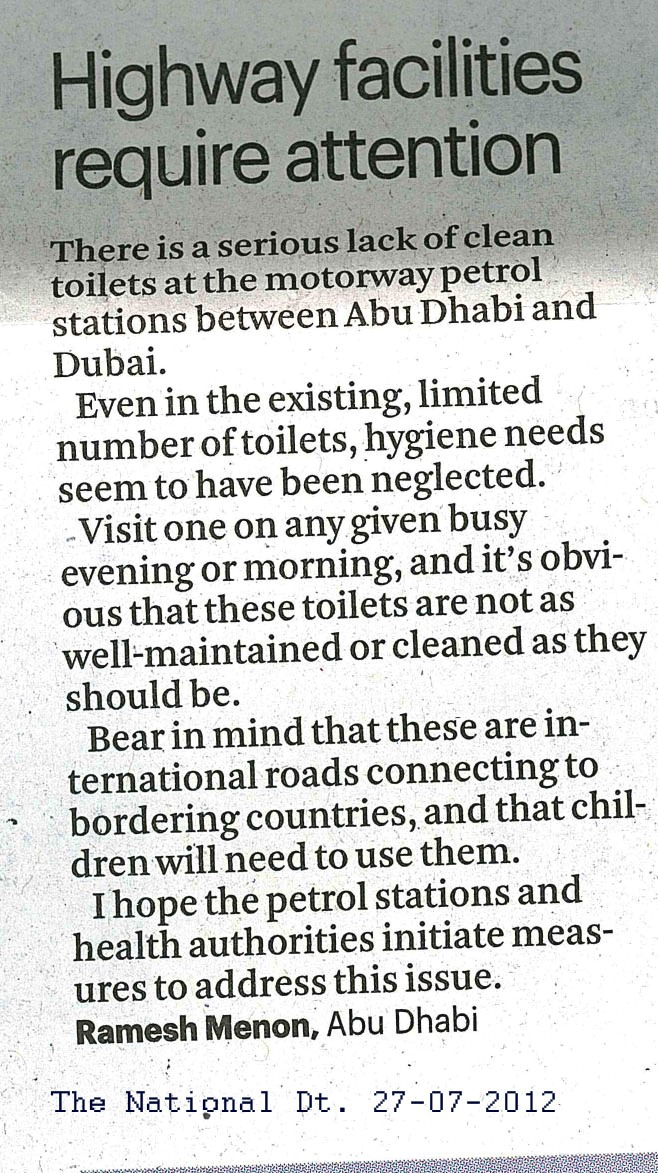
Highway facilities require attention

Posted on Updated on

Highway facilities require attention
There is a serious lack of clean toilets at the highway petrol stations between Abu Dhabi and Dubai.
Even in the existing, limited number of toilets, hygiene needs seem to have been neglected.
Visit one on any given busy evening or morning, and it’s obvious that these toilets are not as well-maintained or cleaned as they should be.
Bear in mind that these are international roads connecting to bordering countries, and that children will need to use them.
I hope the petrol stations and health authorities initiate measures to address this issue.
Ramesh Menon, Abu Dhabi
To read it in original, please visit The National online.

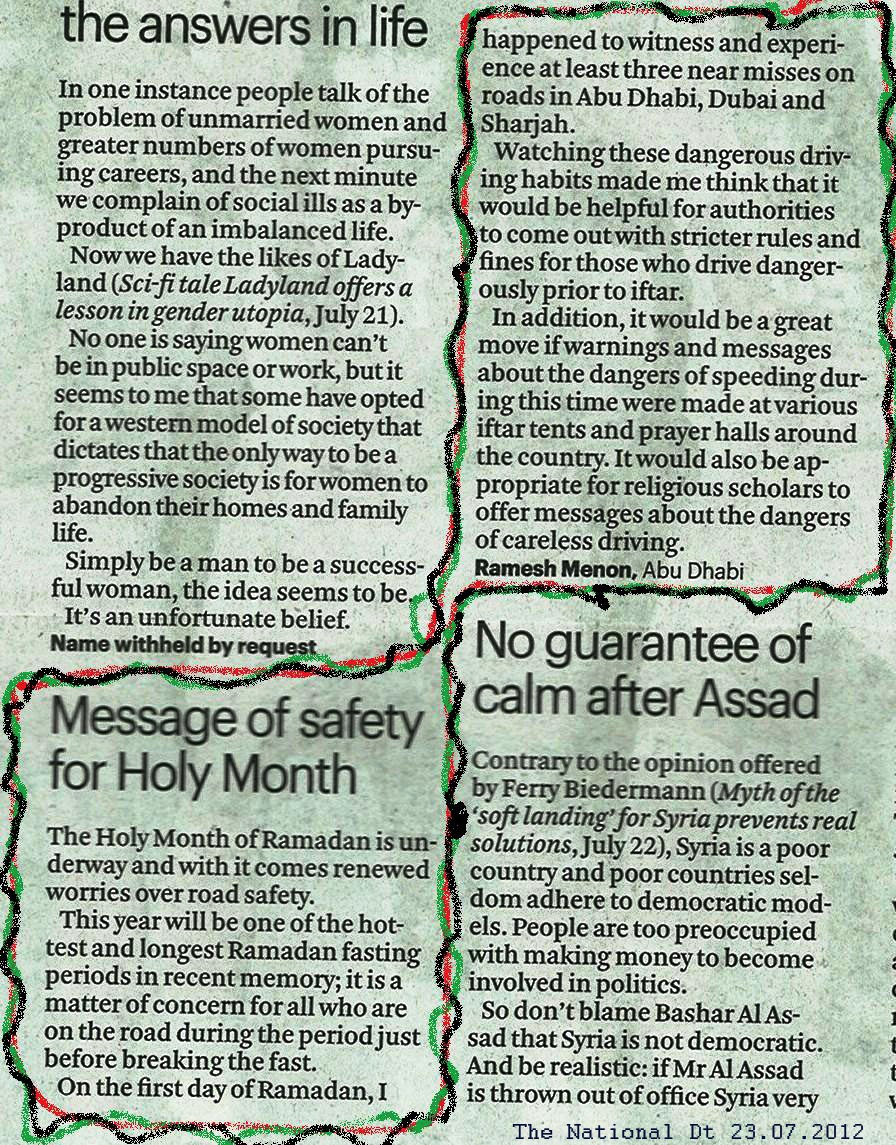
Message of safety for Holy Month

Posted on Updated on

Message of safety for Holy Month
The Holy Month of Ramadan is underway and with it comes renewed worries over road safety.
This year will be one of the hottest and longest Ramadan fasting periods in recent memory; it is a matter of concern for all who are on the road during the period just before breaking the fast.
On the first day of Ramadan, I happened to witness and experience at least three near misses on roads in Abu Dhabi, Dubai and Sharjah.
Watching these dangerous driving habits made me think that it would be helpful for authorities to come out with stricter rules and fines for those who drive dangerously prior to iftar.
In addition, it would be a great move if warnings and messages about the dangers of speeding during this time were made at various iftar tents and prayer halls around the country. It would also be appropriate for religious scholars to offer messages about the dangers of careless driving.
Ramesh Menon, Abu Dhabi
To read it in original, please visit The National Online.

You may also read the below article and actions which followed the above article:

Dubai police report 3,605 traffic accidents since start of Ramadan

Sale and distribution of Mawaqif parking cards

Posted on Updated on

It would be a good idea if Mawaqif could organise the distribution and sale of parking cards of various denominations through petrol stations and other handy outlets.

Currently, there are only one or two outlets selling these cards and it is inconvenient for the public to obtain them. Also, it is not easy to locate the parking meters in many places.

It would be helpful if the authorities put up some special signage pointing to the parking meters.

Ramesh Menon, Abu Dhabi

To read it in original, please visit The National online.

Dh258 credit card fee that led to debt of Dh60,000

Posted on Updated on

Dh258 credit card fee that led to debt of Dh60,000

/The National


ABU DHABI // When KB Muralee was offered his credit card, he was told it would be free for life.

Seven years after using it once, he had an accumulated debt of Dh60,000.
“I used the Standard Chartered credit card for some purchases in India amounting to Dh12,000. Of that, I paid back Dh10,000 on time and later deposited the remaining Dh2,000. My card’s credit limit was Dh15,000.”
A Dh288 late fee for the outstanding amount of Dh2,000 was combined with annual fees, insurance and interest charges to create the mammoth debt.
“I didn’t even want the card, but they insisted that it was free and then said I had to purchase insurance on it,” said Mr Muralee, who is the honorary president of Kerala Social Centre in Abu Dhabi.
After The National approached the bank for comment, Mr Muralee said he was contacted almost immediately with a settlement deal.
“They called and said, ‘OK, pay Dh2,000 and end the matter’.”
In another call, he was asked to pay just Dh500.
In an official statement, Standard Chartered explained: “Upon receiving the complaint, Standard Chartered’s customer care unit contacted the customer and launched an investigation.
“Apparently, the customer had made a purchase on his card in 2005 and has not settled his outstanding balance since then.
“Despite the bank sending him his statement on a regular basis, the customer has ignored settling his credit card which has led to the automatic compilation of late-payment fees and interest on his outstanding balance.
“The bank has contacted the customer and has settled the issue with him.”
Mr Muralee said he refused to pay a single fils on either his credit-card charges or on the settlement, because he believed the charges are baseless.
“I knew it could land me behind bars but I was not afraid of it because it’s entirely the bank’s fault,” he said.
“It’s been mental torture to me, as the bank kept sending me statements throughout these years that I couldn’t get them to resolve.
“It’s very hard for a layman to understand their schemes, paybacks, late fees and hidden charges that they add on without explanation. These banks play like hunters and they wait and watch when you are going to get trapped.”
Other consumers could find themselves in the same situation as Mr Muralee if they don’t read the fine print.
The websites of several local banks use the term “free for life” to refer to credit card products, including Abu Dhabi Commercial Bank, Mashreq Bank, RAK Bank and Lloyd’s TSB.
Standard Chartered is more cautious in its use of the term, but the bank does refer to a “free for life” credit card that is available with certain products, including their Home Suite Package.
“There is absolutely no such thing as a ‘free’ credit card,” said an independent financial adviser from Dubai who did not wished to be identified.
“The banks might say they’re giving you six months free, but that’s as long as you pay back what you owe them before the due date every month.
“The thing is, they do cover themselves: there’s that little asterisk next to ‘free’, which means you should be checking the fine print,” he said.
“But let’s get real: in today’s financial climate? Nothing is for free.
“That’s just a catch-phrase.”
For more in our Consumer Watch series click here.


Whom to call for help


The Central Bank of the UAE regulates banks, exchange houses, and finance and investment companies. You can contact the consumer protection unit of the Central Bank to report problems on  02 691 5290/5453, or email your complaint to complaint@cbuae.gov.ae or log it online at http://www.centralbank.ae


* Anwar Ahmad

My comments as follows:
Showing 3 of 3 comments

  1. RameshMenonAbuDhabi

    It requires lot of boldness and courage for a highly social and community oriented person like KB Muralee to come out in open and openly discuss his harrowing financial experiences as a credit card holder with payment discrepancies. We can easily imagine the plight of those who cannot communicate or do not have any source to cry out. It easily open our eyes to many who affected silently suffering with no clue what so ever to come out the trap they are in. It may also give us answers to absconding of several and deaths here and back in their own home country due these type of debts. UAE Central Bank should conduct a comprehensive check of the credit allocation policy, basis of interest and interest on interest levied to customers and several hidden charges allocated. Banking regulatory authorities should also come out with appropriate rules to restrict the mandatory and explanatory clauses from smaller prints to bigger and bolder ones in all the banking application forms, and have a controlling officer to guide the applicant before approving any credit line to customers about various charges and consequences of payment anomalies. In this case, as they say, a child who cry only will get the milk and Muralee was bold enough to cry and he got his milk and waiver on excessive charges. There are thousands of unlucky others out there who are not so lucky or educated or have contacts.

    To read my comments in original, please visit THE NATIONAL online

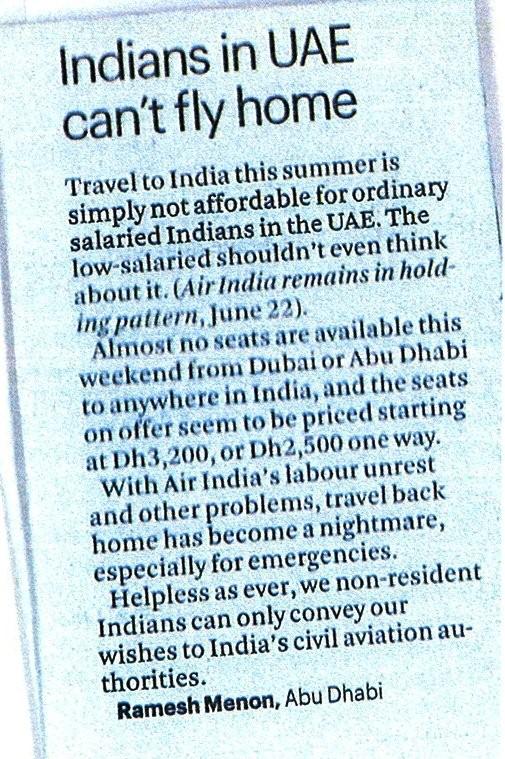
Indians in UAE can’t fly home

Posted on Updated on

Indians in UAE can’t fly home

Travel to India this summer is simply not affordable for ordinary salaried Indians in the UAE. The low-salaried shouldn’t even think about it. (Air India remains in holding pattern, June 22).

Almost no seats are available this weekend from Dubai or Abu Dhabi to anywhere in India, and the seats on offer seem to be priced starting at Dh3,200, or Dh2,500 one way.

With Air India’s labour unrest and other problems, travel back home has become a nightmare, especially for emergencies.

Helpless as ever, we non-resident Indians can only convey our wishes to India’s civil aviation authorities.

Ramesh Menon, Abu Dhabi

To read it in original, please visit The National online

Midday break rule needs bolstering

Posted on

Midday break rule needs bolstering
Talking to a group of labourers working outside one recent afternoon, I learnt that there are some side effects of the strict implementation of the midday break (Building sites stick to midday break rule, June 16). These side effects may even spoil the positive effects of the midday work stoppage.
For example, some workers are transported back to their individual labour camps, where they are forced to relax without air-condition or water facilities, as they are either switched off or cut to avoid usage during noon hours.
There are companies that take care of their workers, but not all of them do. And as I learnt, midday break rule violations are just the tip of the iceberg.
Take health care. If a worker from an irresponsible company becomes sick, he has to continue going to work or risks cuts to his salary. Medical assistance is also not always available in case of injury.
Authorities should put parallel survey and compliance procedures in place at labour camps during noontime breaks, to monitor how breaks are being given and to ensure workers are afforded comfortable rest, with air conditioning and water.
Checks should also be made with increasing frequency within the city to make sure workers are not toiling in the sun during noon hours.
Ramesh Menon, Abu Dhabi
To read it in original, please visit THE NATIONAL online

Cars running idle for a long period during hot summer

Posted on Updated on

I think we should fine drivers who keep their cars running idle for a long period (A midday break to benefit everyone, June 19).
Very often we get to see expensive cars with their engines on, without a driver inside and probably locked from the outside using a spare key.
The sight is common in front of major offices and shopping areas. This is a waste of valuable energy and may present a danger during the hot summer.
People ignore advice on this issue, just to avoid a few minutes of sitting inside a hot car – something they could easily overcome by driving for a few minutes with open windows.
I think the authorities should ensure that Mawaqif inspectors fine drivers those who do this.
Ramesh Menon, Abu Dhabi
To read it in original, please visit THE NATIONAL online.

A midday break to benefit everyone

Posted on Updated on

A midday break to benefit everyone

Enforcement of the law protecting workers who are out in the sun this summer period is commendable.

But perhaps the rule should be applied to others working outside. Mawaqif inspectors, for instance, are out all day. Why not give them a respite? While we’re at it, how about a summer free of Mawaqif parking fees? That would be a true win-win.
Ramesh Menon, Abu Dhabi
To read it in original, please visit THE NATIONAL online.