No News
Ant Kingdom
Ant Kingdom
We think our life is the most busiest. Have a look at what’s happening here. There is totally a much more busier world out there.
Al Wathba – Camel Market
Al Wathba – Camel Market
On the Abu Dhabi – Al Ain road, Al Wathba is famous for the Camel Racing track. It has also a famous Camel market adjacent to it. And not to forget about the Al Wathba Prison.
Story of fight between Sree Rama and Varuna
Story of fight between Sree Rama and Varuna
This is a story from Ramayana and a weekend challenge to attempt.
Faced with the dilemma of how to cross the ocean to Lanka, where his kidnapped wife Sita is held captive by the demon king Ravana, Rama (an Avatar of Vishnu) performs a penance (tapasya) to Varuna, the Lord of Oceans, fasting and meditating in perfect dhyana for three days and three nights. Varuna does not respond, and Rama arises on the fourth morning, enraged by the God’s arrogance. With his bow and arrow, he angrily begins attacking the oceans with celestial weapons – burning up the waters and killing its life and creatures. The Vanaras (Monkeys) are dazzled and fearful at witnessing the enraged Rama demolish the oceans, and his brother, Lakshmana, prays to calm Rama’s mind. Just as Rama invokes the brahmastra, considered the most powerful weapon capable of destroying all creation, Varuna arises out of the oceans. He bows to Rama, explaining that he himself was at a loss to answer Rama’s question. Begging him not to destroy the oceans with the missile, he suggests that Rama re-direct the weapon at a demonic race that lives in the heart of the ocean. Rama’s arrows destroys the demons, and establishes a purer, liberated environment there. Varuna promises that he would keep the oceans still for all of Rama’s army to pass, and Nala constructs a bridge (Rama’s Bridge) across to Lanka. Rama justifies his angry assault on the oceans as he followed the correct process of petitioning and worshipping Varuna, but obtaining the result by force for the greater good.
It is thus believed that when someone writes Sree Ramajayam on the sand at the seashore, the sea (i.e. Varuna) get intimidated and tries to clean it as soon as possible.
Try it wherever you are – write Sree Rama Jayam in any language, a little further than where you expect the waves normally come, and watch the fun of it being cleansed by the waves.
Maha Shivarathri – the universal Pati-patni day
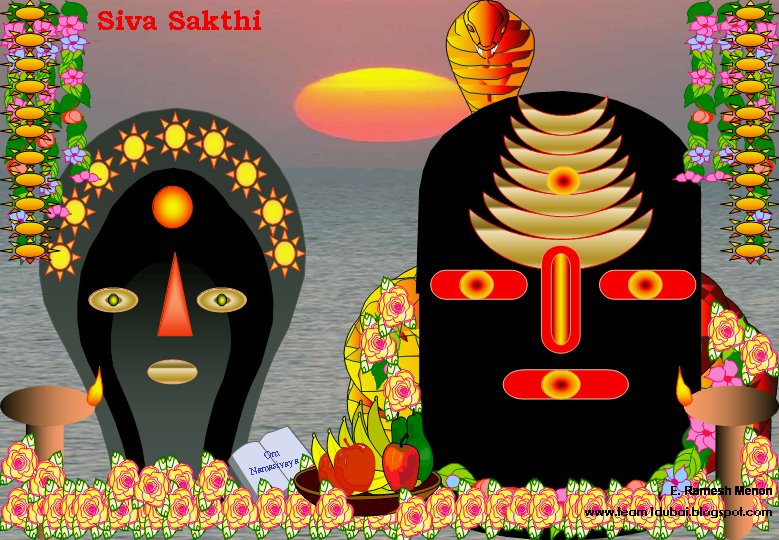
Today is Maha Shivratri.
These days, we blindly follow several different types of days, for eg: Valentines day, mothers day, fathers day, friendship day, no-smoking day and the list goes on and on. When we look at it Shivarathri is the truly traditional family day or pati-patni day, as I term it. Because, from the ancient times, devoted wife’s pray and observe fast on this day for the well being of their husband and children and vice-versa, husband’s observe religious rituals and prayers like chanting Rudram and chamakam to give grace and prosperity to the well being of own family and the society.
There are many stories associated with Shivaratri and its origins.
One is about lord shiva drinking a poison and he held it in his throat by binding it with a snake. The throat became blue due to the poison (Thus Lord Shiva is also known as Neelakantha) and Shiva remained unharmed. In another story, it is said that the whole world was once facing destruction and the Goddess Parvati worshiped her husband Shiva to save it. Parvati named the night for the worship of Iswara by mortals Maha-Sivaratri, or the great night of Siva. After creation was complete, Parvati asked Shiva of which rituals pleased him the most. The Lord replied that the 14th night of the new moon, during the month of Maagha, is my most favourite day. It is known as Shivaratri. Parvati repeated these words to her friends, from whom the word spread over all creation. Another story is about a hunter. Lubdhaka, a poor tribal man and a devotee of Shiva, once went into the deep forests to collect firewood. At nightfall, he became lost and could not find his way home. In the darkness, Lubdhaka climbed a bel tree, and sought safety and shelter in its branches until dawn. All night, he could hear the growls of tigers and wild animals, and was too frightened to leave the tree. In order to keep himself awake, he plucked one leaf at a time from the tree and then dropped it, while chanting the name of Shiva. By sunrise, he had dropped thousands of leaves on to a Shiva lingam, which he had not seen in the darkness. Lubdhaka’s all-night worship pleased Shiva. By the grace of Shiva the tigers and wild animals went away, and Lubdhaka not only survived but was rewarded with ‘divine bliss’.
While most Hindu festivals are celebrated during the day, Mahashivratri is celebrated during the night and day that come just before the new moon. Each new moon is dedicated to Shiva, but Mahashivratri is especially important because it is the night when he danced the ‘Tandav’, his cosmic dance. It also celebrates the wedding of Shiva and Sati, the mother divine. Night represents evil, injustice, ignorance, sin, violence, and misfortune. Tradition says that Shiva, like his symbol the new moon, appeared in order to save the world from darkness and ignorance, before the world entered complete darkness. Those who observe the Mahashivratri fast only break their fast the next morning, and eat the prasad offered to Shiva. Young girls observe the fast and worship Shiva so that he may bless them with good husbands. They sing devotional songs in praise of the lord, and holy texts are chanted throughout the night. The pandits in the temples perform the puja according to the scriptures. This is done four times during the night.
Dedication:
On this auspicious day, I would like to dedicate to AMMA and to our global forum a painting named Shivasakthi. It is also a dedication to all the loving mother’s, wife’s and sisters and also to all our fellow brothers for keeping our tradition and values always high, wherever we are.
I would like to also add a few words about this painting. This is created purely using powerpoint tools and it was done as a result of a few minutes of quite time at a small temple near REC Chathamangalam, Calicut. On that particular monsoon evening (somewhere in 1995), it happened to be that there was no power in that area, and the darshan of the deity at the time during deeparadhana created an everlasting memory in my mind. The decoration of the Devi idol, simple and small, by the melshanti (priest) was simply superb. I added to it a similar devotion at another temple, which is Avittathur Mahadeva temple. And the result is this creation – Shivasakthi.
At both these places, the time available by the melshanthis to decorate the idols during the time the sanctum sanctorum closed for pooja, is barely 10 minutes or so. And imagine yourself the result when the doors are opened. It is the epitomisation of the ultimate sraddha, the dedication and devotion to provide us a blissful presence. Can you imagine them practising this art somewhere else? Or re-doing it, if a little more of water has been added to the chandan and kunkum or bhasmam they mix in order to create these decorations.!!
There are many unsung heroes and these are a few among them. And it is also my way of tribute to the many who remain within the four walls of our own religious boundaries, who do not get to watch or listen to any of the niceties which we are blessed with.
No one has the patience these days, and to add ease to it, we have a wonderful creation called remote control. It makes things easy for our wandering minds to switch from one programme to another and to refrain from keeping focussed on one. We undergo severe rituals and follow procedures for many days and ultimately visit our favourite temples and the moment we are in front of the deity, we close our eyes and fall into deep prayers. At this moment, we go back to the old thoughts, photos etc, forgetting about the opportunity to meet the real lord who is in front of us in full – paadadi kesham. And we are pushed away for someone else to do his minutes or seconds of closed eye prayers. The moment you close your eyes, you forget your objectives. So, open your eyes, look at the realities, and react to it. As the prayer song “Geet nahi, Sur nahi, phir bhi mem gavoom”, in this spiritual sphere of mental peace and inner joy, the responsibility for success or failure is entirely one’s own.
Offering two special namams to AMMA, who has reached Lalitha Sahasra namam to all and every one, irrespective of caste, creed, religion, nationality:
Om sree sadacharapravarthikayai nama (She who makes things happen through good conduct)
Om Sree Shivasakthyaikya roopinyai nama (She who is unification of Shiva and Shakthi)
God bless and have a great time blogging.
FXLabs, Zapak, Sify Launch "Agni"
FXLabs, Zapak, Sify Launch “Agni”
Techtree News Staff
Game company, FXLabs, has launched its first PC adventure game, “Agni” starring Malaika Arora Khan as the lead character. For which, the company has partnered with Zapak and Sify.
FXLabs claims “Agni” is the first PC game developed in India. “Agni” is designed as a third person shooter-role playing game or TPS-RPG that features more than 10 original scenic stages, and four different characters named Tara, Ghayab, Adhira, and of course, Agni.
Speaking at the launch, Sashi Reddi, founder and chairman of FXLabs, said, “Agni will provide Indian gamers with international quality, and content with local flavor at Indian prices. We have followed international ‘AAA’ production standard that rivals the best PC games in quality.”
Zapak will be the Buzz Marketing Partner (360 degrees) for “Agni” and will promote the game both online and offline via Gameplexes. While Sify will market the game online and through their GameDromes.
Also present at the occasion, Arun Mehra, chief marketing officer of Zapak Digital Entertainment, said, “We would get our users to sample the game through a 60 minutes trial version, which we will launch on Zapak.com soon. We will be promoting the game offline through our Gameplexes in 11 cities and host a tournament around it, to be flagged off by Malaika Arora Khan in Delhi next week.”
Meanwhile, those who want to try their hand at “Agni”, can download the game from the FXLabs Web site.
French connection
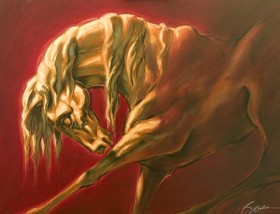
French connection
By Shiva Kumar Thekkepat, Staff Writer GULF NEWS Published: February 15, 2008, 00:30
The UAE is fast becoming a major player on the international art scene. Next month, the first French Art Festival – featuring the works of 35 artists, including five from the UAE – is scheduled to take place in Dubai and Abu Dhabi.
Think art and one of the first images that springs to mind is of France. This nation was home to some of the most prolific artists in the world.
After the Second World War, many in the field argued that the US had taken over from France to become the centre of the art world. However, in the past decade or so, Europe, primarily Britain and France, has been edging ahead of the US. Now, if the French interest in the Middle East, as shown by the high profile French Art Festival set to take off in Dubai and Abu Dhabi next month, is anything to go by, a fourth market is likely to emerge on the international art scene – the UAE.
The First French Art Festival will see the exhibition and sale of 400 works of art produced by 30 French artists. Also taking pride of place in this festival will be five artists from the UAE who are to be the guests of honour at the festival. Hosted by the Abu Dhabi Cultural Foundation, the event will showcase some of the finest works of art including paintings, sculptures and photographs.
“It all started with Francoise Malafosse’s passion for art, contemporary art in particular, and creation,” says Odile Duron, French Art Festival project manager.
“Through the French design and communication company she started with her husband, Michel, Francoise (who is the French Art Festival manager and a passionate art lover). met a large number of artists, most of whom became her friends over the past 15 years. Francoise always had the desire to bring their talents together through a major art exhibition. Out of 120 she chose 30, and she wanted to showcase their talents and that is how the festival came about. The French Art Festival in the UAE offered her just that opportunity.”
Francoise is all set to realise her dream thanks to Odile Duron who, along with her team, has been working for over a year enlisting the support of the concerned authorities in the UAE.
“It is about promoting art, French contemporary art and French artists helping them to export their works of art which is usually difficult to do especially if they are independent and don’t work with established galleries. The French Art Festival is a great opportunity (for them),” says Odile.
Patrice Paoli, French Ambassador to the UAE, and Dominique Baudis, president of the Arab World Institute in Paris, are expected to attend the opening of the event.
During the opening night, one of the French painters, Robert
Di Credico, will paint live on stage and his painting will then be auctioned with the proceeds going to the Emirates Foundation. Around 5,000 people have been invited and 2,000 more visitors are expected over the three days, according to Odile. A special evening will be reserved for women.
Based on the initial selection made by Francoise, over 700 works of art by the 30 select French artists have been put together to form a panel that is representative of the best of contemporary art in France.
“Many French artists don’t work with galleries as they want to be independent and we too prefer it that way as we want to preserve their identity and not impose anything on (their creativity),” explains Odile. “Francoise and the artists chose the works of art that are to be exhibited together, and nothing was imposed on them in terms of technique or anything.”
The main idea behind the selection was to make sure that they would not compete with each other. Also the organisers wanted to provide a wide range of what contemporary French art is. Francoise did not choose one trend in particular. On the contrary, she wanted to be as objective as possible, to give as broad a spectrum as possible to meet the expectations of the public, says Odile.
According to her, the talent that will be on exhibit is incontrovertible. “There is Robert Di Credico who is going to paint live on stage at the opening ceremony and that work will be auctioned, with the proceeds going to the Emirates Foundation,” she says. “He’s done that before, he’s very good at it. There’s also Christine Barres. She uses very bright colours. It reflects her personality. She’s very enthusiastic, very optimistic. She’s going to conduct workshops at the Cultural Foundation and wants to share her passion for art with all art lovers.
“There is also Pascal Magis, he’s already quite famous in France. Then there’s Jean-Louis Toutain, a sculptor, whose works can be seen in many public places in France. All of them are quite unique in their own way.”
Apart from the French talent, five local contemporary artists – Manal Bin Amro, Nuha Hassan Asad, Mohammad Kanoo, Mohammad Mandi and Wasel Safwan Antepli – will provide local input with their works complementing those of their French colleagues.
Though French art has dominated the art scene globally for centuries spawning many influential schools, it has not been setting any discernible trends in recent times.
Francoise, a serious student of French contemporary art, says: “I don’t think there is a particular trend, or maybe it’s too early to say.
“I would refer instead to a new momentum in various fields: there are interesting creations in ‘classic’ fine arts (painting, sculpture, music, couture, etc.) as well as in more innovative areas: photography, design, cuisine, video art, etc. There is a profusion of talent and inventiveness. For French artists, the challenge is to take on board – and release themselves from – extremely strong traditions. For years, France has reigned supreme as the country of the arts: both an opportunity and a responsibility.”
Does this mean that French art is in a good state of health at present?
“You have to distinguish between the creation and the market,” says Francoise.
“In terms of creation, I would emphasise that the talent is out there. And the people we are introducing with the French Art Festival prove my point. Through the 30 artists selected, we present a sort of representative shot of what is being done in France today.
“In terms of the market, or rather of market share, it cannot be denied that France follows the United States, Great Britain and, now, China. But artistic quality is not measured just by millions of dollars … at least I hope not,” she says.
The French government had announced a Euro 100-million project to support French artists and increase the contemporary art market some time back. Has this succeeded in reviving the art market in France?
“I don’t know the details of this project,” says Francoise. “But I do know that in March, Martin Béthenod, general commissioner of the International Contemporary Art Fair, is to submit his report to ease the administrative burdens facing professionals and to encourage collectors. That will involve relaxation of regulations in France and harmonisation on a European level. Last autumn, Christine Albanel, Minister for Culture, promised to launch a revival plan to boost the art market. And at the end of January, the Council of Ministers adopted a bill to make art and cultural education generally available from the earliest age. Finally, a new structure, linked to the Pompidou Centre, will be created in the vacant premises of the Palais de Tokyo in Paris.”
While it appears that the French government has many mechanisms for supporting contemporary art and artists, there has been some criticism of this sort of State sponsorship. Francoise, however, feels this move is justified.
“Most countries promote their art and support their artists by placing orders, allocating grants, providing premises, facilitating exports, etc,” she says. “France has a tradition and knowledge in this field, whether at a national level or at a regional level through DRACs – the regional offices for the arts. Local councils are also playing an increasingly important part in the distribution of the arts and culture.
“There are always critics on either side: some believe that public authorities do not do enough, others believe that they are getting involved in a field which is not their own. You have to find the right balance between public and private, while keeping in mind that, in the end, it is always the public who decides.”
And then she delivers the coup de grace: ” I have two things to say about the effectiveness of this policy: first, the share of living artists in the art market is continuing to rise; second, 83 per cent of works changing hands around the world in 2005 were worth less than $10,000. So it is not only past geniuses who are finding buyers!”
Francoise does not entirely agree that after ten centuries of hegemony, there was a certain decline in the influence of French art following the Second World War. “I would not call it a decline in French art but increased strength in other countries, which is perfectly normal,” she says.
“It was natural that the dominant power of the United States since 1945 should also manifest itself in the arts. Similarly, it is natural that China, which represents nearly a quarter of humanity, should take its own prominent place.
“Countries such as France, England and Italy, for example, have made similar journeys. But I do recall that, in 2005, of the 10 bestselling artists in the world, four were French – Claude Monet, Marc Chagall (originally from Belarus), Fernand Léger and Jean-Michel Basquiat. [Also], the number one, Pablo Picasso, spent a large part of his life in France!”
But according to experts, during the past decade Europe appears to have caught up somewhat with the United States. Does this denote a resumption of contemporary art in France?
“Following the explosion of the speculative bull market in 1990, the art market experienced several years of recession, followed by an upturn in recent years, linked primarily with an increase in the number of buyers,” explains Francoise. “This can be explained by the emergence of new markets (such as China, India and Russia) and by increased accessibility to works, thanks to all the tools in place especially on the internet.
“France continues to be an inexhaustible crucible for works of art: the country’s museums contain unrivalled riches, its collectors are innumerable and the institutions, such as the Drouot auction house, the house of François Pinault and Fondation Cartier, play a major role in artistic exchange today. And, again, we are not just talking about classic works: the 20th century was exceptionally rich [in modern works of art] in France, and there is no reason for that to stop in the 21st century.”
There are three essential markets for art: France, Great Britain and the United States. Does this exhibition represent a high level of interest in French art in the Middle East?
“Yes, I believe these new ‘stages’ are important,” says Francoise. “Not just because these are markets, but also because these are places where art has always been present. What motivates me more than anything is artistic exchange, the meeting of people and works from different traditions. Nothing is more interesting.”
Perhaps the reason why both Francoise and Odile are looking beyond the festival already. “The spin-offs of such an event are innumerable and not all of them are quantifiable,” say Odile. How can one measure the pleasure provided, the desires aroused, the relationships it leads to …, she asks.
“There will, of course, be economic spin-offs, for the artists who open up to new markets, and for the companies taking part in this festival in different ways,” she continues.
“But there will also be spin-offs in terms of knowledge and recognition: what an opportunity for an artist to be able to present his or her work on such a prestigious scene and to an audience as cosmopolitan as that of the UAE! It offers tremendous encouragement to these new talents to continue and make further progress in their artistic expression!
“There will also be other benefits in terms of openness of mind, the discovery of new forms of expression and respect for cultures. The festival’s noble ambition is to bring individuals together through their shared interest in contemporary art.”
According to the organisers of the festival, the art event will be “renewed and amplified every year because contemporary art is by definition constantly evolving and because, alongside the visual arts, other arts such as literature, theatre, cinema, music and even gastronomy can find their place and their audience.”
Ultimately, Francoise feels the Middle East, and the East in general, will be significant markets for international art.
“The UAE considers culture to be a factor of development. That is wonderful and we were lucky that our proposal was consistent with this outlook,” she says.
Simply natural!
Simply natural!
By Abigail Mathias, Staff Writer GULF NEWS
The appeal of black and white photographs never fades.
Life is like a good black and white photograph, there’s black, there’s white, and lots of shades in between. – Karl Heiner
Want to create an impression? Photograph your subject in black and white. Ever since the first film was shot and developed, black and white photos have been popular with photographers around the world because they have a classic and elegant look.
In many instances black and white photographs characterise the genre of social documentary photography, creating images that are seemingly natural, simply caught in an instant of life and, therefore, real, but stark and compelling in their absence of colour.
In spite of the invasion of sophisticated digital photography, black and white photography remains a popular choice for weddings as it portrays romance and lends a sense of timelessness to images. Its simplicity gives the subject a polished appearance. Without the distractions of colour, the picture commands the viewer to appreciate the individuality of the subject. This is why headshots of dignitaries and company presidents are often shot in black and white.
Unfortunately not many realise the true potential of black and white photography. Sue Johnston, who specialises in lifestyle photography, and has worked with the Dubai International Art Centre, is disappointed that black and white photography is under developed in the region. “Most of my friends are unhappy with the quality of black and white printing. I have worked with black and white films and developed my own photographs, but the results were never as expected. Newspaper photographs are often in colour these days and that’s a huge change. Earlier newspapers had just one or two colour pages. Similarly, only a few art publications focus on black and white photography these days,” says Johnston.
When learning photography, the simplicity of black and white helps students focus on the important aspects without getting distracted by colour. Black and white simplifies the scene and centres attention on form, shades, pattern, and other graphic concepts, to give them an unusual quality with tone and hue.
Mamoun Khalifa, Operations Manager, United Colour Films (UCF), says, “Black and white photography marks the birth of photography. It adds historic value to people’s photographs.”
Though the number of clients developing black and white photographs is comparatively few, Khalifa says, wedding photographers and corporate houses still prefer such prints.
“Black and white allows photographers more control in taking the picture and producing the print. One can more easily use shape, line, texture, form and tone to manipulate the picture and the viewer without the often-contradictory message of colour.
The graphic concepts are easier to see when shot in black and white. One can find interest in everyday objects and scenes, making them more dramatic. Black and white also works very nicely for portrait photography. Skin tones in black and white are mellowed; blotches, blemishes, and uneven shading is less noticeable than it is in colour photos. “I still get a lot of requests for black and white portraits,” says Johnston. “The shadows and lighting make the images appear kinder to people of all ages. People take time to look at the photograph and notice details,” says Johnston.
Sultan Roam, Laboratory Supervisor at UCF, says, “Black and white prints last longer than coloured ones. The lack of colour allows the photograph to withstand more wear and tear, whereas a colour photograph tends to fade after a while if it’s exposed to direct sunlight. The intensity of a black and white photograph remains the same even after 20 years.”

Photo Speaks – Bike rider
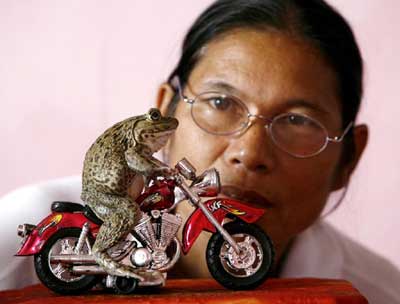
Tongsai Bumroongtai, 52, looks on her pet black spotted female frog ‘Nong Oui’ as it sits astride a toy motorbike in the resort city of Pattaya, Chonburi province, Thailand, on February 10, 2008. Tongsai found the amphibian eleven months ago and trained her pet frog, ‘Nong Oui’ to sits on toy motorbike, a battery-operated dumper truck and lies on a plastic bottle in various positions for show and claiming she could speak to the frog.
 ClicksandWrites
You must be logged in to post a comment.