Mind Speaks
World this week – my perceptions and similar views
I haven’t had enough time during the last couple of days to complete the newsletter. As usual, an interesting topic is getting ready this time too. Meanwhile, I did manage to read through many topics during my reading time. Surprisingly I found a few among them worthy to pass on here. They were carrying similar messages to what I wrote in the recent special editions of our Team 1 newsletter.
Indian Cricket and state of mind
One such article was a write up by Mr. Shashi Tharoor in the Times of India. Cricket has a big fan following in the sub-continent with almost about 60% of TV viewers watching cricket (the nearest contender in other sports activities is soccer with 15% and Hockey and Tennis in the range of 14% viewership). So no wonder he decided to write something on it.
It was written just after the defeat of India in the ongoing Cricket Series with England. His temptation to see, in Indian cricket, metaphors for larger issues in our national life (secularism and diversity, for instance) is often irresistible. He warns us that this is one to which he has succumbed in the past — even while being conscious that one should always be wary of making too much of anything that transpires on that theatre of the fleeting, the sports field.
Here again, Indian pace bowler Sreesanth is coming into picture. In January, in one of his write up’s Mr. Tharoor wrote about Sreesanth’s reaction to the South African paceman’s attempt to intimidate him — encapsulated, He hopefully argued then, all that is different about the new India: courage, assertiveness, a refusal to be cowed, a willingness to take risks and ultimately the confidence to stand up to the best that the outside world can flung at us — well beyond the cricket field.
He now realises that he spoke too soon. He adds on that he has just spent the better part of five days watching India’s cricketing leaders sell themselves, and the country, short at the Oval. After piling up a lead of 319 in the first innings, Rahul Dravid declined to enforce the follow-on against a demoralised and all-but-beaten England team. Dravid, a man he used to respect, sought to justify this pusillanimous decision by claiming his bowlers were tired.
This, despite the pace bowlers having had a good night’s rest before the end of the England first innings, and having bowled barely 20 overs each in the previous day. He has infor from reliable sources that our bowlers were in fact raring to go: the disgraceful decision was not theirs but was sought to be pinned on them. There is only word for that, and it is not a pretty one.
The logic of the decision, according to its defenders, was simple: one-up in the series, India wanted to eliminate the slightest chance of losing. But there were barely two days left, and a gigantic lead: while nothing is impossible in cricket, a defeat was next to inconceivable. England had their backs to the wall: they had shown no capacity to bat through two days. They would have had to make 500 in record time to set us a target, and then bowl us out in two sessions, to win.
This would have called for such an abject performance by India with both bat and ball, against the run of play in the entire series, as to be improbable: even in a fantasy scenario for England, the best likely outcome for them would have been a draw.
But by batting again, India completely undermined itself. The drooping shoulders of the English team received a perceptible lift: then, when Indian wickets clattered, the formerly demoralised Englishmen were energised. Instead of having to bat through two days to save the Test, their batsmen only needed to survive a bit over one day. The decision also signalled to the opposition that the Indian team leadership did not have enough faith in its own bowlers to bowl the English out a second time, and in its own batsmen to chase a possible 100-run target in the fourth innings.
When you have so little faith in yourself, why should your opponents fear you? Dravid’s decision emboldened his opponents; they played in their second innings like men who had just learned that they did not need to respect their adversaries.
If this self-inflicted belittling was shameful enough, even sadder than all this was the complete lack of the will to win. The Indian captain knew, of course, that not enforcing the follow-on made a draw the most likely outcome, and he didn’t mind. As long as we can win the series 1-0, Dravid and his ilk must have told themselves, what is the need to try to win 2-0? This was exactly the sort of thinking that had abased India in the bad old days, when India routinely played out meaningless draws out of fear of defeat. By being afraid of losing, we helped our opponents not to lose.
The gutlessness of the decision was sought to be defended as one that could only be appreciated on the field of battle. “If I was sitting in an armchair,” Dravid said, “I too might have disagreed with the decision.” (By that logic every actor can reject every theatre critic’s view of his performance.) But many experienced cricketers I spoke to at the time saw it for what it was. Dravid’s own embarrassing innings of 12 off 96 balls, the slowest dozen runs ever made in the history of Test cricket, was emblematic of the problem.
The cricketer Steve James described it as a “pedestrian innings” which “portrayed a man full of fret and fear”. England, he added, “can thank the Indian captain’s timidity”.
When he wrote about what Sreesanth’s attitude betokened, I stressed that it didn’t matter that India lost that Test series, because my point was not about cricket. It was about a state of mind — a state of mind that will also change the Indian state.
What Sreesanth demonstrated in Johannesburg was an attitude that has transformed the younger generation into a breed apart from its parents’. It is the attitude of an India that can hold its nerve and flex its sinews, an India whose self-confidence is rooted in the sober certitude of self-knowledge, an India that says to the future, “come on; I am not afraid of you.”
Dravid demonstrated, haplessly, that the dead hand of the older India still clings on — an India that is afraid to take risks for fear of failure, an India without the courage of self-belief, an India that is all too willing to settle for 1-0 than go for 2-0. This is the India that did a deal with the Kandahar hijackers rather than the India that threw out the intruders of Kargil. We have the capacity to be, in any field of national endeavour, both kinds of country. But I have no doubt that the attitude I saw on the fourth day of the Oval Test is unworthy of what the real India is shaping up to be.
Mr. Tharoor ends up his note with the above feelings.
I take it up from there a little more, with my favorite character on the cricket field – Sreesanth. Although I did stop watching cricket in full because of the excellent performance record of our team, I did watch a few overs during the 3rd Test. I was delighted to see Sreesanth back in action, and he was a completely changed bowler this time around. The Sreesanth Syndrome (of doing all his routine prayers/rituals before he takes his run up or even while doing the running) was not there. He was a man of concentration and focus. Yes, and the results showed too. Eventhough he was unlucky with the wickets, he came out with excellent match figures. Many times, he was coming out with superb and unplayable balls.
This shows determination, dedication and preparation and the hardwork associated with all these three. You can never come out as a winner, if you don’t do any of these. One needs to be continuosly updated and prepared with his own skills and also aware of his own weaknesses and take appropriate remedial measures at the right time. Then only he can utilise the golden opportunity he has or when suddenly he is given a chance. That time, it is only he and his capabilities and the way he handles things matters. Of course, God’s grace and blessings are important all the time to achieve success. I wish we have many gutsy players like him, who has the guts to stand up and walk against opposition players with guts in mind and fury on eyes. Then only we will win. It is just the same way, you throw a stone at a stray dog, if it mourns and runs away, you know it is him at the receiving end, and the same time, if it barks, turn around and come running at you, you know it is your turn.
Cruise tourism set to make waves
Another interesting news item which came across was about the new policy which the Indian Government likely to introduce, which proposes service tax waiver and easier visa norms for cruise travellers (visa on arrival facilities). This is really a great news to bring in more tourists and revenue to the country.
Change your thinking to change your life
Albert Ellis, who recently passed away at 93, was one of the best known and most influential psychotherapists of the post-Freudian era. He could outperform the zaniest of Zen monks with his colourful use of expletive and sing-along ditties involving audiences packed into $10-a-ticket seminars. Like Eastern Masters whacking their lazy or stupid acolytes, Ellis too had a confrontational style: “Neurosis,” he was fond of saying, “is just a high-class word for whining.” Stop moaning, he urged his patients: get off your backside and deal with it.
In the ’fifties, Ellis’s rational emotive method of behaviour therapy challenged the far more ponderous psychoanalytical technique of Sigmund Freud, just as the Zen school of sudden enlightenment defied the older, slower mirror-polishing techniques of meditation. While Freud insisted on excavating childhood experience to go to roots of neurosis, Ellis believed that the key to happiness lay in “forgetting your Godawful past”.
His basic message — everyone has capacity for “crooked thinking” or skewed assumptions that lead to neuroses — is remarkably similar to the psycho-dynamic insights of Patanjali’s Yoga Sutra. What, for example, Patanjali calls vikalpa, viparya and mithya-jnana, would be equivalent to the destructive semantics of the self that Ellis uncovered with his ‘correct-your-thinking’ approach to mental health.
Following the Greek Stoic philosopher Epictetus, whom he liked to quote, Ellis believed that in order to change your life, you have to change your thinking. And like Marcus Aurelius, the student of Epictetus, Ellis thought that our suffering is due not so much to the events in our lives, but to the way we interpret them. This echoes one of the great axioms of yoga — manah eva manushyana karana bandha mokshayo — mind alone is responsible for human bondage as well as liberation.
He also taught unconditional self acceptance (USA), which translates into “you always accept you no matter what you do.”
The same courtesy is extended to ‘unconditional other acceptance’, that is, “Nobody is evil, even if they do evil things” and ‘unconditional life acceptance’: “You always accept things, no matter how they are”.
These accord well with the samatvam (same in pain or gain) philosophy of enlightenment of the Bhagwad Gita: Don’t get stuck in the mud of the past, rise above it like a lotus.








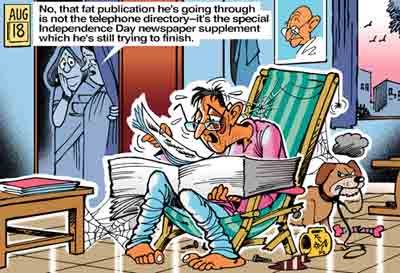
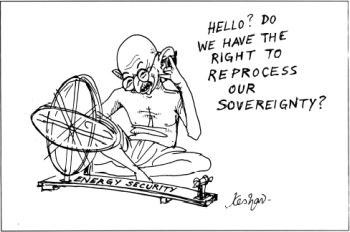

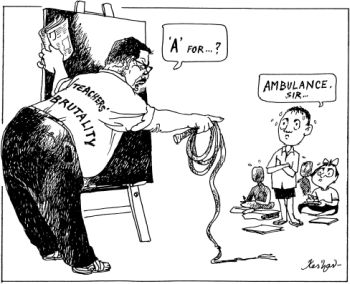
‘India of today’
‘India of today’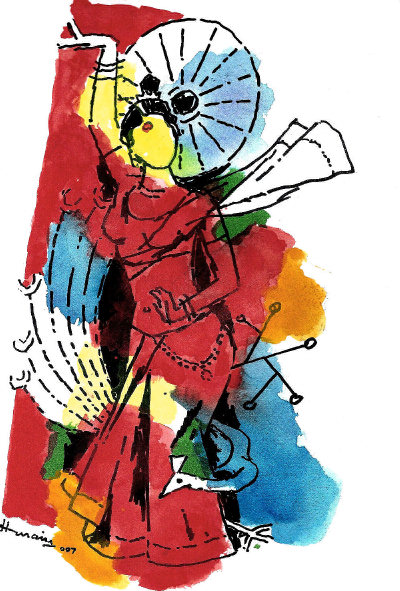
Watercolour by M.F.Husain, done specially for The Hindu on the occasion of 60 years of Independence
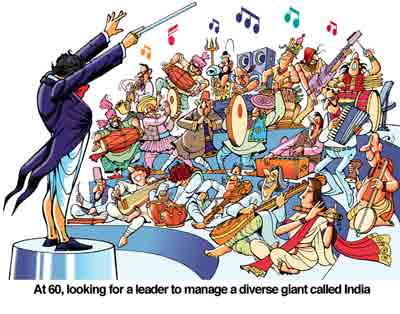
Sixty years of Pakistan
Sixty years of Pakistan
Friday,17 August 2007 10:00 hrs IST/MALAYALA MANORAMA English edition
– Alok Bansal As Pakistan completes 60 years of existence, it is passing through a critical phase. The state’s writ does not run over almost half its territory. Most people consider themselves as Sindhis, Baloch, Pakhtoons, Mohajirs and Punjabis first rather than as Pakistanis. Pakistan as a nation is kept together artificially by the only institution that functions – the army.
Despite belated attempts by the judiciary to assert its independence, the fact is that for most part of Pakistan’s existence the courts have been dysfunctional and came out with the bizarre ‘Doctrine of Necessity’ to justify military coups. Pakistan’s greatest tragedy has been that barring the armed forces or army to be specific, no other credible institution has emerged. The judiciary, legislature and bureaucracy-all have crumbled during Pakistan’s six decades’ journey.
However, it was not always the case when Pakistan came into being in 1947. It was a much stronger nation vis-a-vis India, which most Western scholars of that era believed would crumble under the weight of its own inner contradictions. However, Pakistan suffered from two major flaws right from the beginning-firstly the leadership of the Muslim League came from the provinces that remained part of India and hence the party had no mass support in the region that became Pakistan.
Secondly, the early death of Mohammed Ali Jinnah eliminated the only credible leader who could draw support across Pakistan. And when Liaquat Ali Khan was assassinated in October 1951, whatever little semblance of leadership remained disappeared.
Not that Jinnah and Liaqat were without flaws. Jinnah had centralised power in his hands and was the Governor General, the party chief and a cabinet minister simultaneously. Liaquat was guilty of not expediting the process of constitution making. But still they were leaders whose appeal was not confined to a part of Pakistan or any particular group.
Pakistan experimented with half a dozen constitutions within the first 25 years of its existence. Frequent coups and military rules ensured that neither the constitution nor the other institutions of governance were allowed to evolve.
The first decade was crucial to shaping Pakistan’s destiny and was marked by drift and chaos. Seven different prime ministers and eight different cabinets took oaths of office during this tumultuous period, resulting in the ascendancy of bureaucracy in the decision making, with the tacit support of the army.
When Ayub Khan took over the administration after the first military coup in 1958, the public, fed up with anarchy, supported him. In the initial years of the regime there was all-round improvement in the administration as well as economy. It was the time visitors from China and South Korea toured Pakistan to study its phenomenal success. But like any authoritarian regime, Ayub’s rule had long-term adverse impact on Pakistan.
Suppression of people’s democratic aspirations under a military regime and attempts to amalgamate ethnic identities by the creation of one unit impacted the Pakistani nation adversely. The 1965 war, often considered the high point of Pakistani nationalism, was the turning point as far as nationalism in the two South Asian countries was concerned.
From then on India consolidated as a nation but Pakistani nationalism began to wither. Bengali nationalism got a fillip during the 1965 war, when they were led to believe that their defence lay in West Pakistan. The reaction to ‘one unit’ created a strong sense of nationalism in Balochistan.
Ayub could not last the aftermath of 1965, when his own foreign minister, Zulfiqar Ali Bhutto, rebelled and convinced the masses that the gains of the battlefield had been frittered away at the negotiating table in Tashkent. However, Ayub’s belief in the superiority of the military leadership resulted in General Yahya Khan succeeding him rather than any other civilian dispensation.
Yahya undid the ‘one unit’ and was sincere about return to democracy. He conducted the first and possibly the only credible elections under a military regime in Pakistan. But long years of military rule had irreparably damaged the Pakistani nation. Yahya allowed himself to be hoodwinked by Bhutto, and the result was Pakistan’s break up and creation of Bangladesh.
The creation of Bangladesh removed whatever semblance of religious pluralism existed in Pakistan; and the absence of pluralism created fissures within Islam, which was supposed to bind Pakistan together. Bhutto, who succeeded Yahya Khan, moved Ahmediyas beyond the pale of Islam.
The fissures between various sects and schools within the same sect were accentuated under the Zia ul Haq regime, which brought religion on the centre stage of state policy.
Bhutto gave Pakistan its first workable constitution but his authoritarian streak led to the dismissal of opposition-led provincial governments, resulting in a violent uprising in Balochistan. Despite being the favourite to win the 1977 elections, Bhutto rigged them. Subsequent anti-government protests followed by government repression brought military once again on the centre stage.
Zia’s era was the darkest in Pakistan’s history. His Islamization drive, suppression of press and involvement in the Afghan conflict eroded the state structure considerably. Islamic militancy and sectarianism were the by-products of his policies, which finally led to the creation of Taliban.
Subsequent civilian interlude was not really a return to civilian rule. The army was not only looking from the sidelines, but decision making in certain key areas of state policy were kept beyond the ambit of civilian leadership. Marring this period was bickering between the two main political parties, led by Benazir Bhutto and Nawaz Sharif.
The period also saw the disenchantment of Mohajirs (the refugees from India) who were in the forefront of the Pakistan movement, leading to long bouts of violence in Karachi. The Pakistani economy slid and its foreign debt rose. An economic collapse of Pakistan looked likely.
Economic consolidation required a cut in bourgeoning military expenditure, which the army would not allow. In 1999, when Nawaz Sharif tried to break free from the army, the army decided to move in and remove the civilian façade. Like in all previous occasions, the military rule led to initial economic recovery, but it had long-term adverse impact on Pakistan.
Sub-nationalism emerged as a serious threat to the Pakistani state. Islamic fundamentalists challenge the writ of the government across the length and breadth of Pakistan. Islamabad’s frequent flip-flops on the foreign policy front and frequent incursions by American armed forces within Pakistani territory have compromised its sovereignty in the eyes of its citizens.
The author is a Research Fellow at New Delhi’s Institute of Defence Studies and Analysis.
Team 1 news – 479 dt 15082007 – 60th Independence Day Special

Dear members,
A warm welcome to all of you to sit, relax and read through the 60th Independence Day Special edition of Team 1 news.
India is a land of tradition and 60th Birthday is one which all family members take pride and care to celebrate in the best way and pay tribute to those whom we love and lived with. On such occasions we all tend to give a gift of our choice. As a truly patriotic Indian, it is my simple and humble gift to my mother country and fellow Indians. If I am able to generate a Positive and Quality feeling in you to contribute and build our nation to a greater height, I will be more than satisfied. Making an effort is something which is always better than doing nothing. I believe totally in it.
Do not hold on to your thoughts and ideas. If you would like to contribute to Team 1 with your own articles, photos or any thing which is of Quality Value to our readers, please email them at team1dubai@gmail.com .
For a pdf version of the newsletter in full, please email your request to team1dubai@gmail.com.
God Bless,
Ramesh Menon
15082007
Coming back with more NIP (News, Information and Pictures)
Hello friends, I have been away for a few days of rest & recreation. I am back here in Abu Dhabi and invite you again to my e-Home with plenty of NIP (News, Information and Pictures)and of course the regular Team 1 newsletter. As usual a new topic is getting ready in the background of my mind while moving around and I hope you will enjoy reading it. Not to forget our little friends, Jajoo Jajoo stories will have an interesting story for them. Enjoy a few feeler photos while you get set to enjoy your coffee break at http://www.team1dubai.blogspot.com.
Petronas Twin Towers Malaysia
Go-carting – Genting Highlands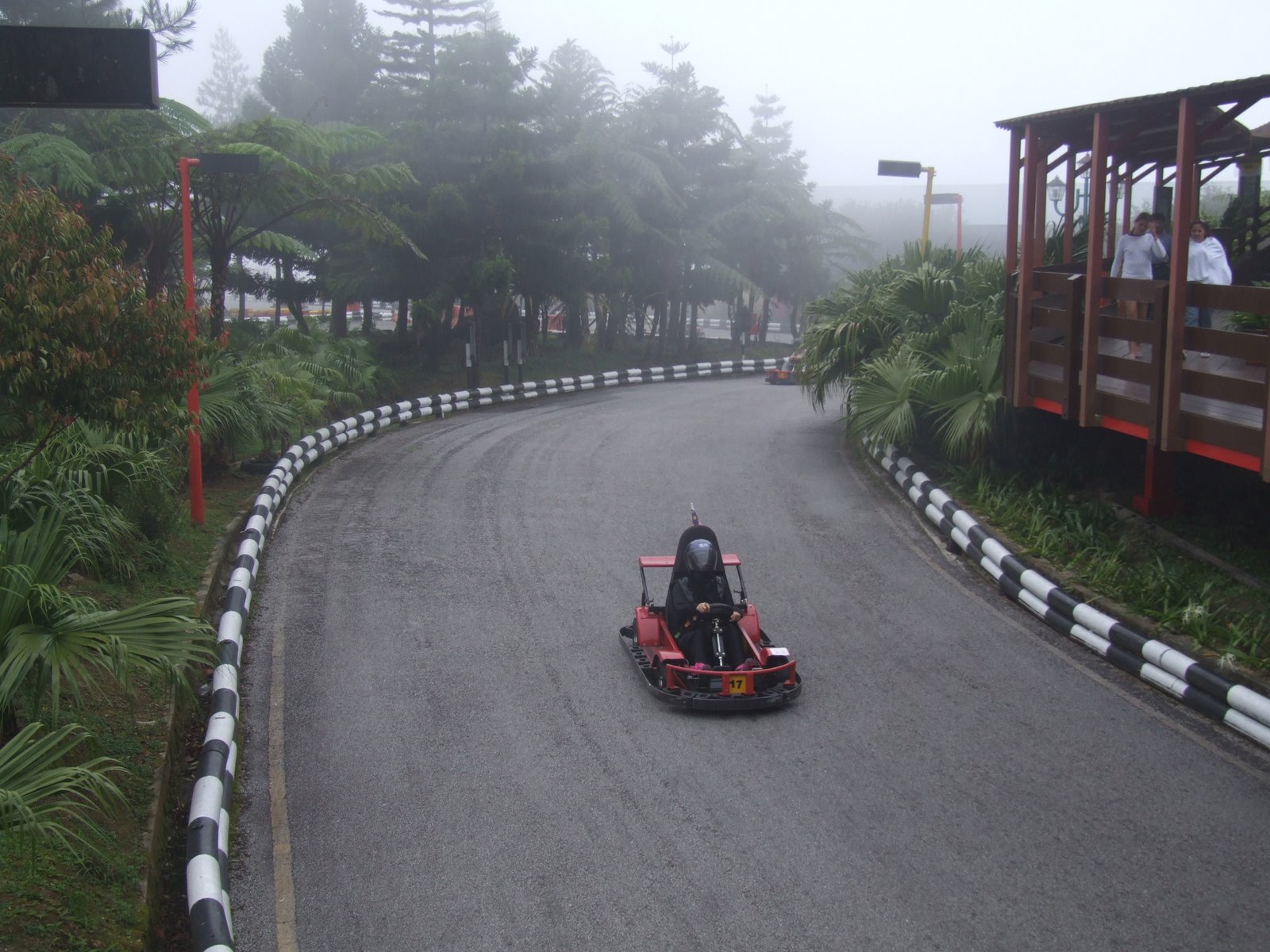
View from Batuk Caves – It was time to sit, relax & have a drink after a tough, fast and productive year. It was time for planning ahead too.

“Awareness”
It is not unusual for us to get so caught up in meeting our needs, desires, and goals that we lose sight of what is happening around us. From time to time, we may be stopped in our tracks by some unusual event that will cause us to pay attention to what is important. Those lessons can cause “dents” as happened in the following story.
A young and successful executive was traveling down a neighborhood street going a bit too fast in his new Jaguar. He was watching as kids darted out from between parked cars and slowed down when he thought he saw something.
As his car passed, no children appeared. Instead, a rock smashed into the Jag’s side door! He slammed on the brakes and spun the Jag back to the spot where the rock had been thrown. He jumped out of the car, grabbed the kid who was standing there and pushed him against a parked car shouting, “What do you think you are doing?”
Building up a head of steam he went on, “That is a new car and the dent from the rock you threw is going to cost a lot of money to repair. Why did you do it?”
“Please sir, please. I’m sorry, I didn’t know what else to do,” pleaded the youngster. “I threw the rock because no one else would stop…”
Tears were dripping down the boy’s chin as he pointed around the parked car. “It’s my brother, sir,” he said. “He rolled off the curb and fell out of his wheelchair and I can’t lift him.”
Sobbing, the boy asked the executive, “Would you please help me get him back into his wheelchair, sir? He’s hurt and he’s too heavy for me.”
Moved beyond words, the driver tried to swallow the rapidly swelling lump in his throat. He lifted the young man back into the wheelchair and took out his handkerchief and wiped the scrapes and cuts, checking to see that everything was going to be okay.
“Thank you and may God bless you, sir,” the grateful child said to him. The man then watched the little boy push his brother toward their home. It was a long walk back to his Jaguar… a long, slow walk. He never did repair the car door. He kept the dent to remind him not to go through life so fast that someone has to throw a rock at you to get your attention.
Author Unknown
Everyday, we have the opportunity to be aware of what is going on around us and to notice who might need our assistance or attention. When we are so focused on ourselves or getting where we are going, it may take a rock to get our attention.
Let’s slow down and truly “see” what is around us. How many “dents” do we need before we make it a habit to “stop, look, listen, feel and care?”
Affirmation for the Week:
“I maintain awareness and vigilance in my life. I need only a feather to tickle me, not a rock to dent me, to bring my awareness back to the moment when my attention and focus strays.”
Have an observant week!
"I Want Patience And I Want It Now!"
“I Want Patience And I Want It Now!”
Patience has never been one of my virtues, although I have become more so as I grow older. I recently experienced a surge of impatience as I waited for an event to occur. I kept repeating my usual affirmative statement, but I found myself in a battle to let things go and allow them to unfold as they should. Another opportunity to practice patience.
Stimulated by my irritation stemming from impatience, I began to think about how impatience affects our sense of well-being and peace. In my archive of information,
I found the following thought on patience.
——————–
The Greek word for patience, makrothymia, suggests having a large capacity for absorbing irritants without letting them paralyze you. Here’s one way to think about it: Patience is like good motor oil, which doesn’t remove all of the contaminants. It just puts them into suspension so they don’t get into your works and seize them up. Patient people have, so to speak, a large crankcase. They can put a lot of irritants into suspension.
Suppose the person behind you keeps cracking his knuckles. You put your annoyance into suspension. Suppose you can’t find your keys and you feel a little scuffed up. Put it into suspension. Suppose somebody is late for your meeting and you feel your anger start to rise. Into the crankcase it goes. Patient people have makrothymia. They’ve got a big capacity for absorbing irritants without seizing up. They get annoyed, but they have a place to put their annoyance.
Author: Cornelius Plantinga, Jr.
——————–
It is not just situations that can result in our impatience; it is also our impatience with others at home and at work that can arouse the sleeping giant of irritability. We may find ourselves becoming irritated over small, insignificant behaviors or habits of others that have the same effect upon us as the sound of fingernails raking down a chalkboard.
C. S. Lewis says, “When two humans live together for a while, it usually happens that each has facial expressions and tones of voice that are almost unendurable to the other.” With all due respect to C.S. Lewis, I would suggest that people with whom we work could have the same effect upon us when we are under stress on the job.
Patience with ourselves, with others and with our situations is an important component of our happiness. It is through our patience that grander things can come to and through us. As an old Chinese proverb reminds us, “Patience is power; with time and patience the mulberry leaf becomes silk.”
Affirmation for your coming days:
“I am growing patience in my garden of life. I can’t wait to see what fruit it bears.”
Have patience-filled days ahead!
Every Day is an Opportunity
Every Day is an opportunity to find something new in our life and also attempt for and achieve old or new objectives which come across our way as it progress. Utilise it to the best way so that when you finish, you are able to pat yourself with a “Well Done – You have done a great job” remark and a small and short thanks to God for giving an opportunity to do so.
I am posting some of the things that came in this morning and thought they deserve to be here.

We saw the retirement of two major infrastructures from the lifeline of Abu Dhabi this week. The first one was the closure of India Social Centre – ISC – which was etablished in 1967 in this building. It has temporarily closed down its old facilities, after 40 years of service to the Indian Community. A totally new facility is getting ready and will be ready for its members very soon.

Once up on a time!!! The second one was the demolition of the Gray Mackenzie – now ADMMI – building situated in Khalifa street after serving almost 40+ years.
Many old Abu Dhabi’ites will have golden memories connected to both these places.
Considering the pace of demolition and development that is happening here, these two longstanding achievers really showed their prominence and value to remain there to serve the community.
Enhancing Facilities:


Dubai – the City that Cares
Dubai Government promotes itself as a City that Cares… What more you need to suffice it’s claims…

The Magic of 07/07/07 and Great offers……

BREAKING NEWS!!
Residents from the 7 Emirates of UAE only can book one of the 7 Grand Deluxe Rooms at the 7 stars Emirates Palace Hotel on the 07/07/07 for only aed.777 with early check in at 7 am and late check out at 7 pm”
For details and conditions, call: +971 26908882/3/4/5
Don’t Miss it !
Regards
—
Myriam Naud (Ms.)
Sales Manager
Emirates Palace – Abu Dhabi
Managed by Kempinski
P.O. Box 39999, West Corniche, Abu Dhabi, UAE
Tel: + 971 2 690 9000 ext.7909 Fax: + 971 2 690 7879
Mobile: +971 50 818 22 98
myriam.naud@Kempinski.com http://www.emiratespalace.com
Kempinski – Hoteliers since 1897
Leaders in Luxury for 110 Years
Hotel of the Month June 2007: Kempinski Hotel Emirates Palace Abu Dhabi – U.A.E. http://www.Kempinski.com
Sreesanth syndrome – the continuation

I don’t know why, he is one player, who comes into my column very often. A few weeks ago I had mentioned about this player of our Indian Cricket team and his style of taking God and rituals into the playing field when he is required to perform. I bring this point again looking at the news space he is getting once again – somehow or other. When Indian Cricket Team has been selected for playing in Ireland, it should have had made a simple logic – that any normal person would have taken – to take precautions about the Irish Weather and playing conditions and keep the players fit enough to go out and play while in Ireland. 6 or 7 players out of the 15 member squad is out of action for the 2nd One day international shows the amount of preparation our Team Management and Cricket Board does with these high profile players. I know it is easy to criticise than make things happen. But how many times we see this situation when teams like Australia, England or West Indies come out to play in India during extreme summer? Coming back again and continuing what I wrote about Sreesanth last time – one more country stamp in his passport, without playing in full. BRAVO. I know he will get to read this column and hence it’s an open challenge to perform and prove otherwise.
- ← Previous
- 1
- …
- 57
- 58
- 59
- Next →
 ClicksandWrites
You must be logged in to post a comment.