Hungry drivers
Letters to the editor
‘Abandoned’ Cars gather dust at Abu Dhabi airport
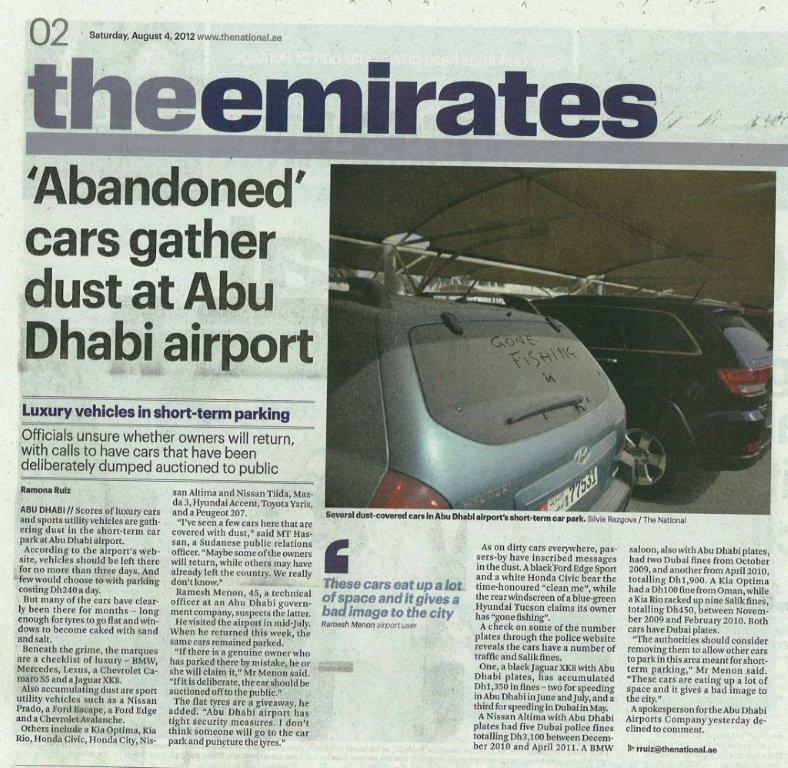
ABU DHABI // Scores of luxury cars and sports utility vehicles are gathering dust in the short-term car park at Abu Dhabi airport.
According to the airport’s website, vehicles should be left there for no more than three days. And few would choose to with parking costing Dh240 a day.
But many of the cars have clearly been there for months – long enough for tyres to go flat and windows to become caked with sand and salt.
Beneath the grime, the marques are a checklist of luxury – BMW, Mercedes, Lexus, a Chevrolet Camaro S5 and a Jaguar XK8.
Also accumulating dust are sport utility vehicles such as a Nissan Prado, a Ford Escape, a Ford Edge and a Chevrolet Avalanche.
Others include a Kia Optima, Kia Rio, Honda Civic, Honda City, Nissan Altima and Nissan Tiida, Mazda 3, Hyundai Accent, Toyota Yaris, and a Peugeot 207.
“I’ve seen a few cars here that are covered with dust,” said MT Hassan, a Sudanese public relations officer.
“Maybe some of the owners will return, while others may have already left the country. We really don’t know.”
Ramesh Menon, 45, a technical officer at an Abu Dhabi government company, suspects the latter.
He visited the airport in mid-July. When he returned this week, the same cars remained parked.
“If there is a genuine owner who has parked there by mistake, he or she will claim it,” Mr Menon said. “If it is deliberate, the car should be auctioned off to the public.”
The flat tyres are a giveaway, he added. “Abu Dhabi airport has tight security measures. I don’t think someone will go to the car park and puncture the tyres.”
As on dirty cars everywhere, passers-by have inscribed messages in the dust. Some, including a black Ford Edge Sport and a white Honda Civic, bear the time-honoured “clean me”, while the rear windscreen of a blue-green Hyundai Tucson claims its owner has “gone fishing”.
A check on some of the number plates through the police website reveals the cars have a number of traffic and Salik fines.
One, a black Jaguar XK8 with Abu Dhabi plates, has accumulated Dh1,350 in fines – two for speeding in Abu Dhabi in June and July, and another for speeding in Dubai in May.
A grey Nissan Altima with Abu Dhabi plates had five Dubai police fines totalling Dh3,100 between December 2010 and April 2011.
A green BMW saloon, also with Abu Dhabi plates, had two Dubai fines from October 2009, and another from April 2010, totalling Dh1,900. A Kia Optima had a Dh100 fine from Oman, while a Kia Rio racked up nine Salik fines, totalling Dh450, between November 2009 and February 2010. Both cars have Dubai plates.
“The authorities should now consider removing them to allow other cars to park in this area meant for short-term parking,” Mr Menon said. “These cars are eating up a lot of space and it gives a bad image to the city.”
A spokesperson for the Abu Dhabi Airports Company yesterday declined to comment.

Several cars sit covered in dust, seemingly abandoned at the Abu Dhabi Airport short-term parking lot as seen on Wednesday afternoon, August 1, 2012. Silvia Razgova / The National
To read it in original, please visit THE NATIONAL online
Time for Etisalat to improve its airport presence
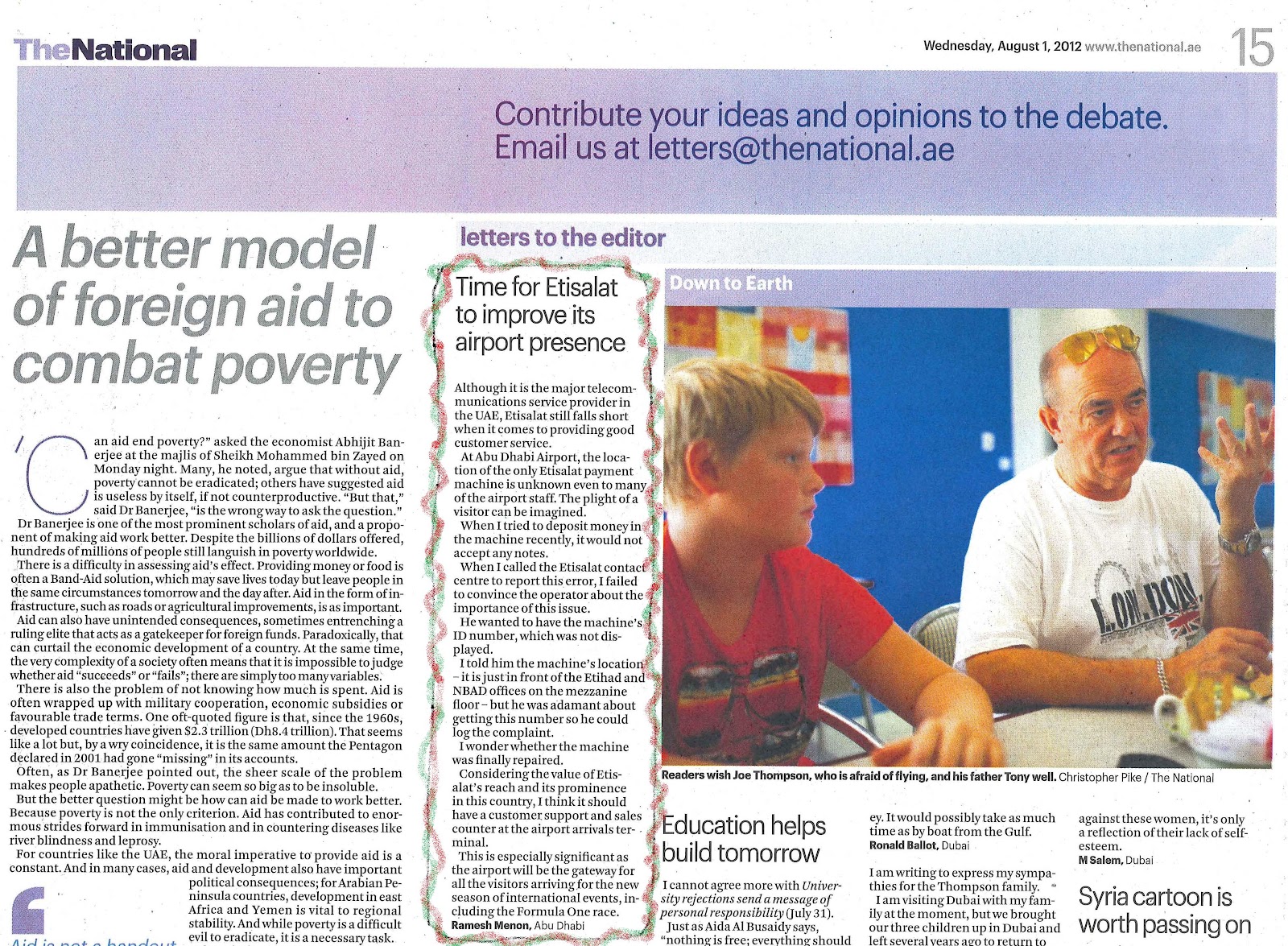
Although it is the major telecommunications service provider in the UAE, Etisalat still falls short when it comes to providing good customer service.
At Abu Dhabi Airport, the location of the only Etisalat payment machine is unknown even to many of the airport staff. The plight of a visitor can be imagined.
When I tried to deposit money in the machine recently, it would not accept any notes. When I called the Etisalat contact centre to report this error, I failed to convince the operator about the importance of this issue.
He wanted to have the machine’s ID number, which was not displayed. I told him the machine’s location – it is just in front of the Etihad and NBAD offices on the mezzanine floor – but he was adamant about getting this number so he could log the complaint.
I wonder whether the machine was finally repaired. Considering the value of Etisalat’s reach and its prominence in this country, I think it should have a customer support and sales counter at the airport arrivals terminal.
This is especially significant as the airport will be the gateway for all the visitors arriving for the new season of international events, including the Formula One race.
Ramesh Menon, Abu Dhabi
To read it in original, please visit THE NATIONAL online
Abandoned cars send a message
Abandoned cars send a message
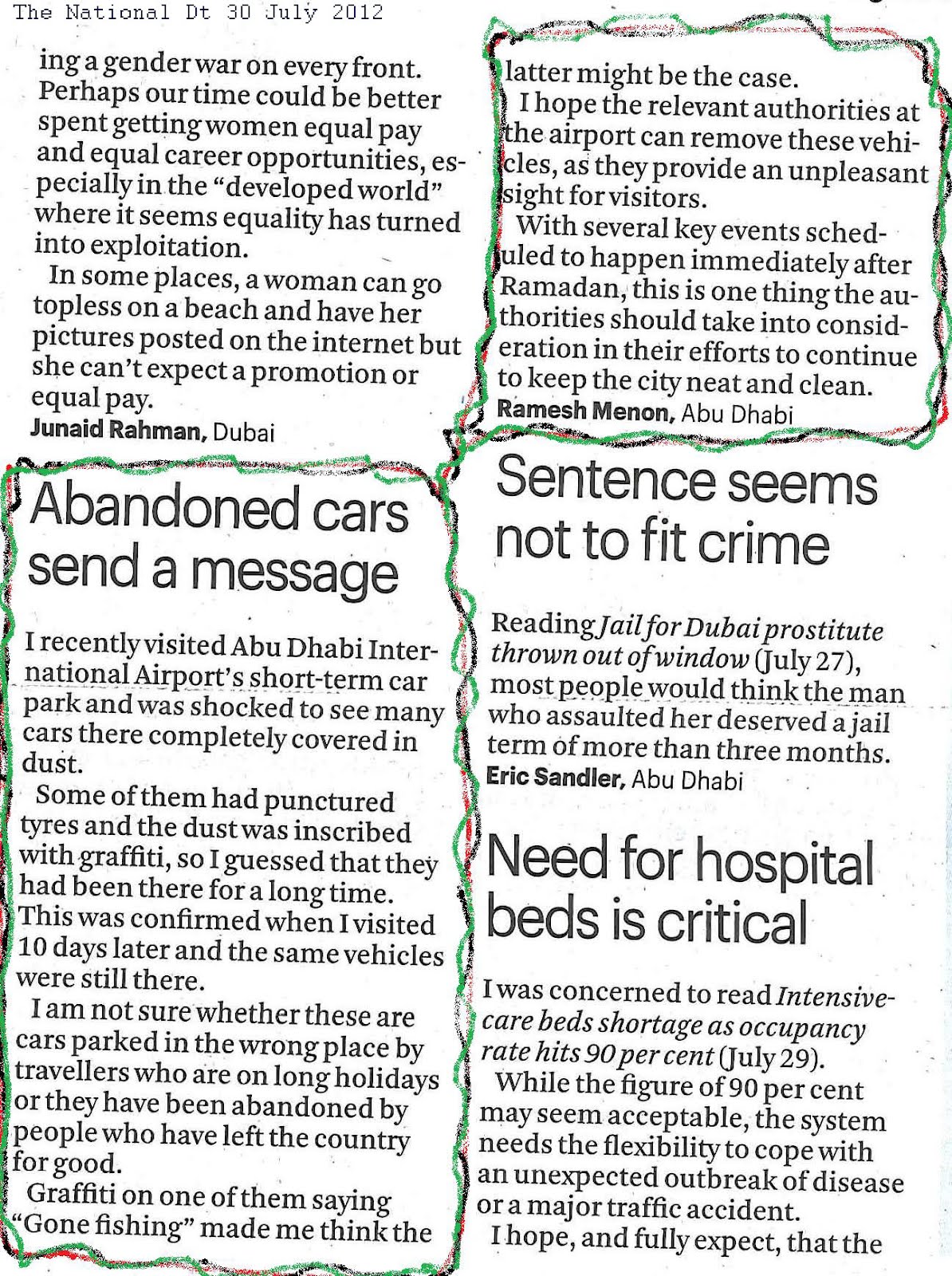
I recently visited Abu Dhabi International Airport’s short-term car park and was shocked to see many cars there completely covered in dust.
Some of them had punctured tyres and the dust was inscribed with graffiti, so I guessed that they had been there for a long time. This was confirmed when I visited 10 days later and the same vehicles were still there.
I am not sure whether these are cars parked in the wrong place by travellers who are on long holidays or they have been abandoned by people who have left the country for good.
Graffiti on one of them saying “Gone fishing” made me think the latter might be the case.
I hope the relevant authorities at the airport can remove these vehicles, as they provide an unpleasant sight for visitors.
With several key events scheduled to happen immediately after Ramadan, this is one thing the authorities should take into consideration in their efforts to continue to keep the city neat and clean.
Ramesh Menon, Abu Dhabi
To read it in original, please visit THE NATIONAL online.
Highway facilities require attention
Highway facilities require attention
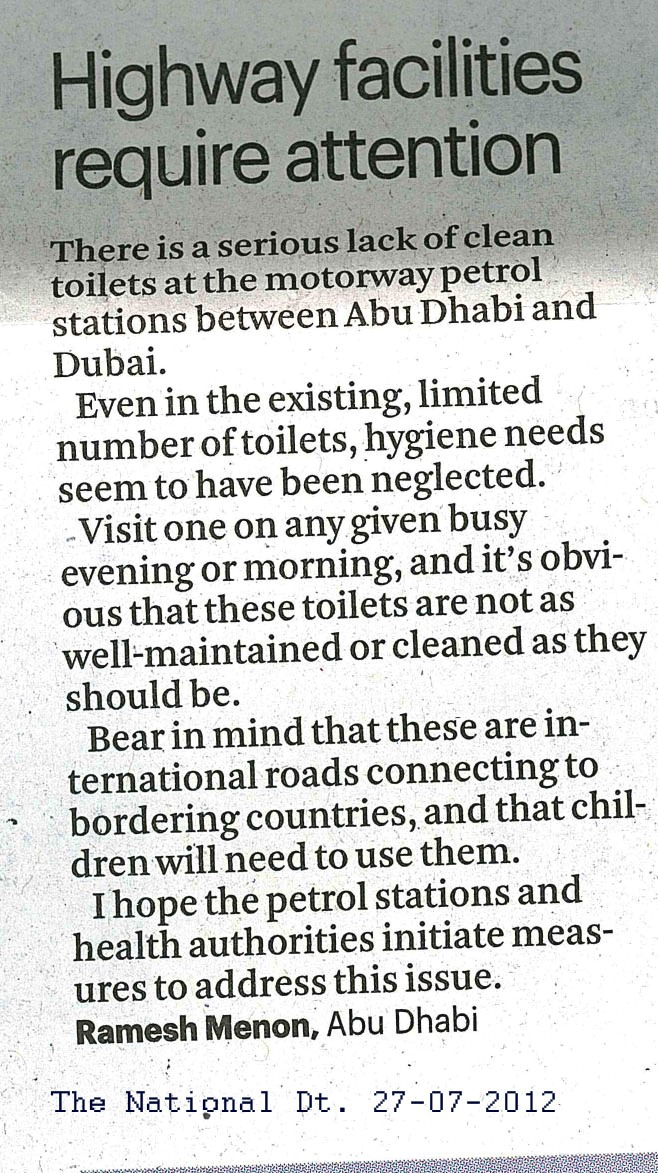
There is a serious lack of clean toilets at the highway petrol stations between Abu Dhabi and Dubai.
Even in the existing, limited number of toilets, hygiene needs seem to have been neglected.
Visit one on any given busy evening or morning, and it’s obvious that these toilets are not as well-maintained or cleaned as they should be.
Bear in mind that these are international roads connecting to bordering countries, and that children will need to use them.
I hope the petrol stations and health authorities initiate measures to address this issue.
Ramesh Menon, Abu Dhabi
To read it in original, please visit The National online.
Hungry Drivers
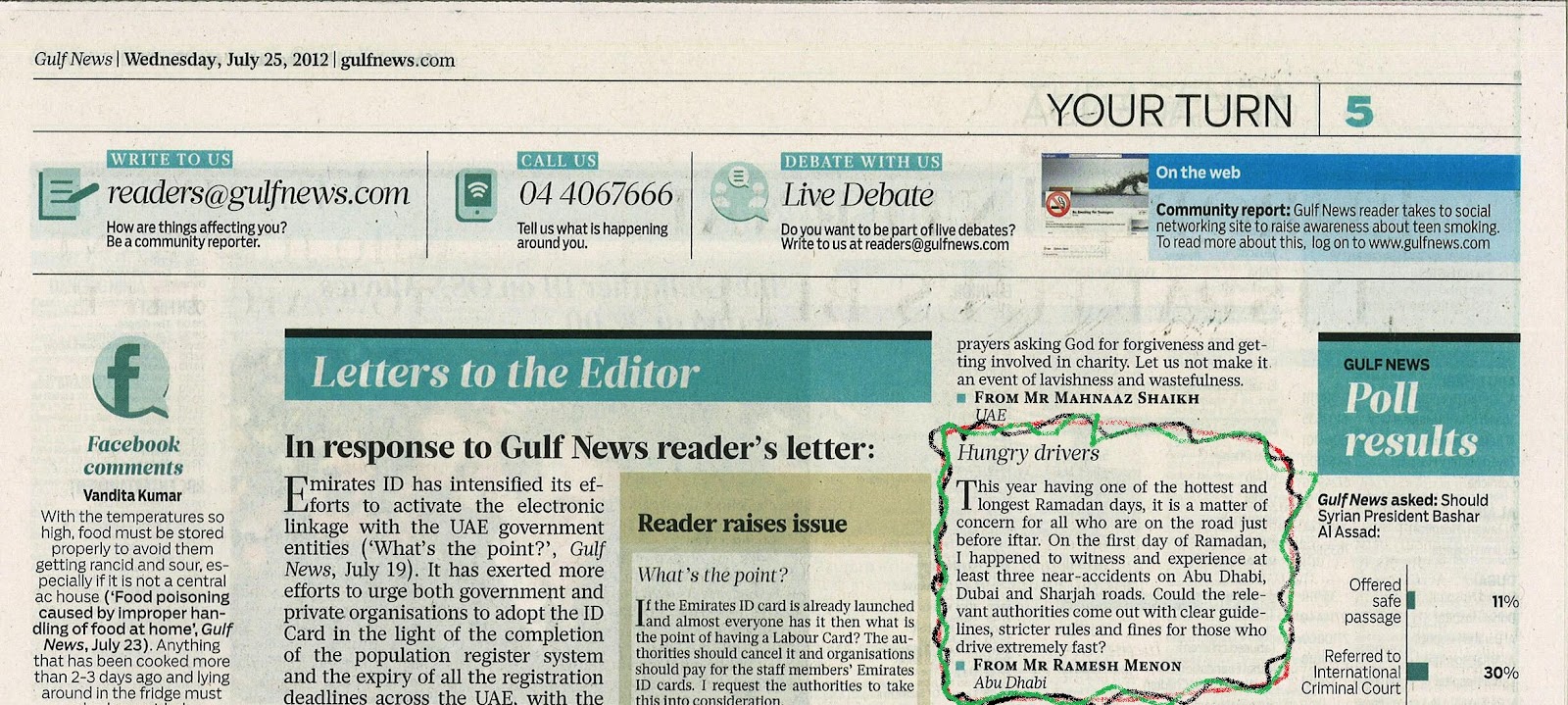
This year being one of the hottest and longest Ramadan days, it is a matter of concern for all who are on the road right before iftar. On the first day of Ramadan, I happened to witness and experience at least three near-accidents in Abu Dhabi, Dubai and Sharjah roads. This is really dangerous and I hope that no one gets hurt. Could the relevant authorities come out with clear guidelines, stricter rules and fines to those who drive extremely fast?
From Mr Ramesh Menon
You may please read the below article and actions which followed the above report:
Police warn motorists to drive safely — especially before iftar
Message of safety for Holy Month
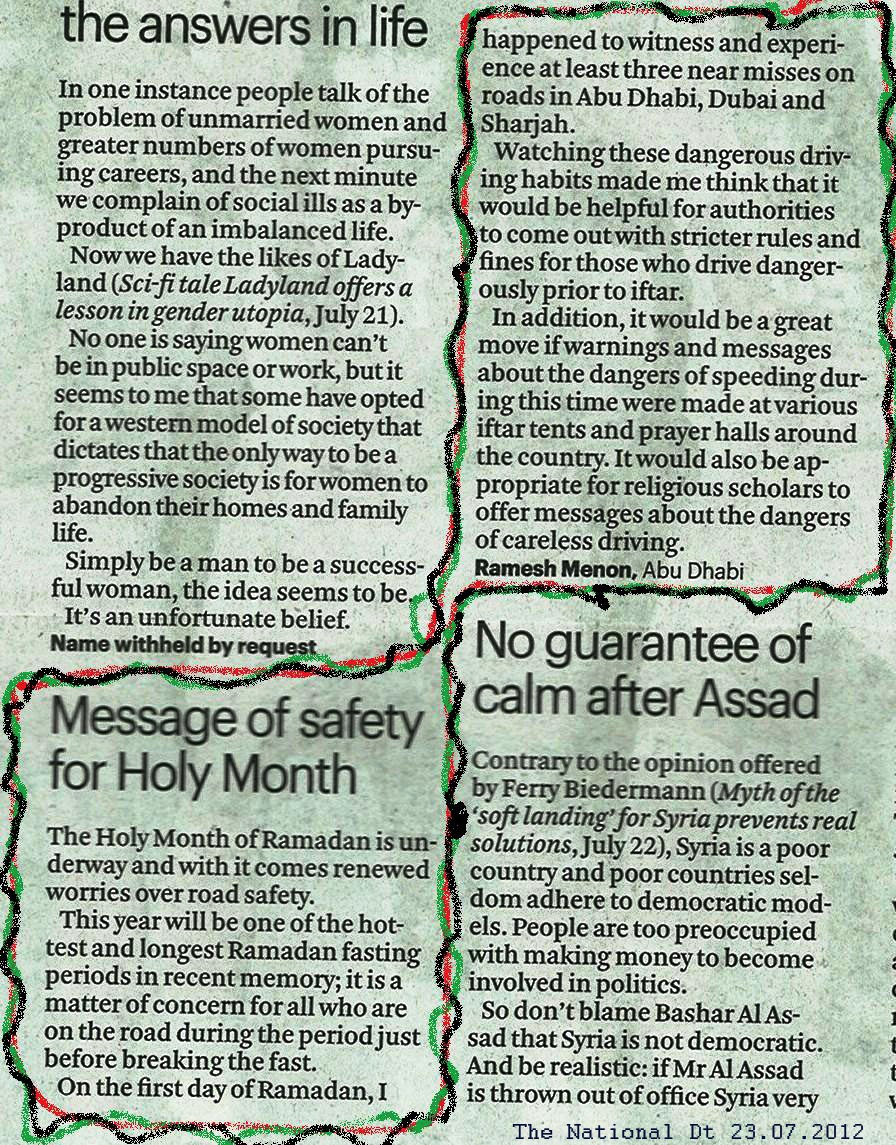
Message of safety for Holy Month
The Holy Month of Ramadan is underway and with it comes renewed worries over road safety.
This year will be one of the hottest and longest Ramadan fasting periods in recent memory; it is a matter of concern for all who are on the road during the period just before breaking the fast.
On the first day of Ramadan, I happened to witness and experience at least three near misses on roads in Abu Dhabi, Dubai and Sharjah.
Watching these dangerous driving habits made me think that it would be helpful for authorities to come out with stricter rules and fines for those who drive dangerously prior to iftar.
In addition, it would be a great move if warnings and messages about the dangers of speeding during this time were made at various iftar tents and prayer halls around the country. It would also be appropriate for religious scholars to offer messages about the dangers of careless driving.
Ramesh Menon, Abu Dhabi
To read it in original, please visit The National Online.
You may also read the below article and actions which followed the above article:
Dubai police report 3,605 traffic accidents since start of Ramadan
Making the most of it
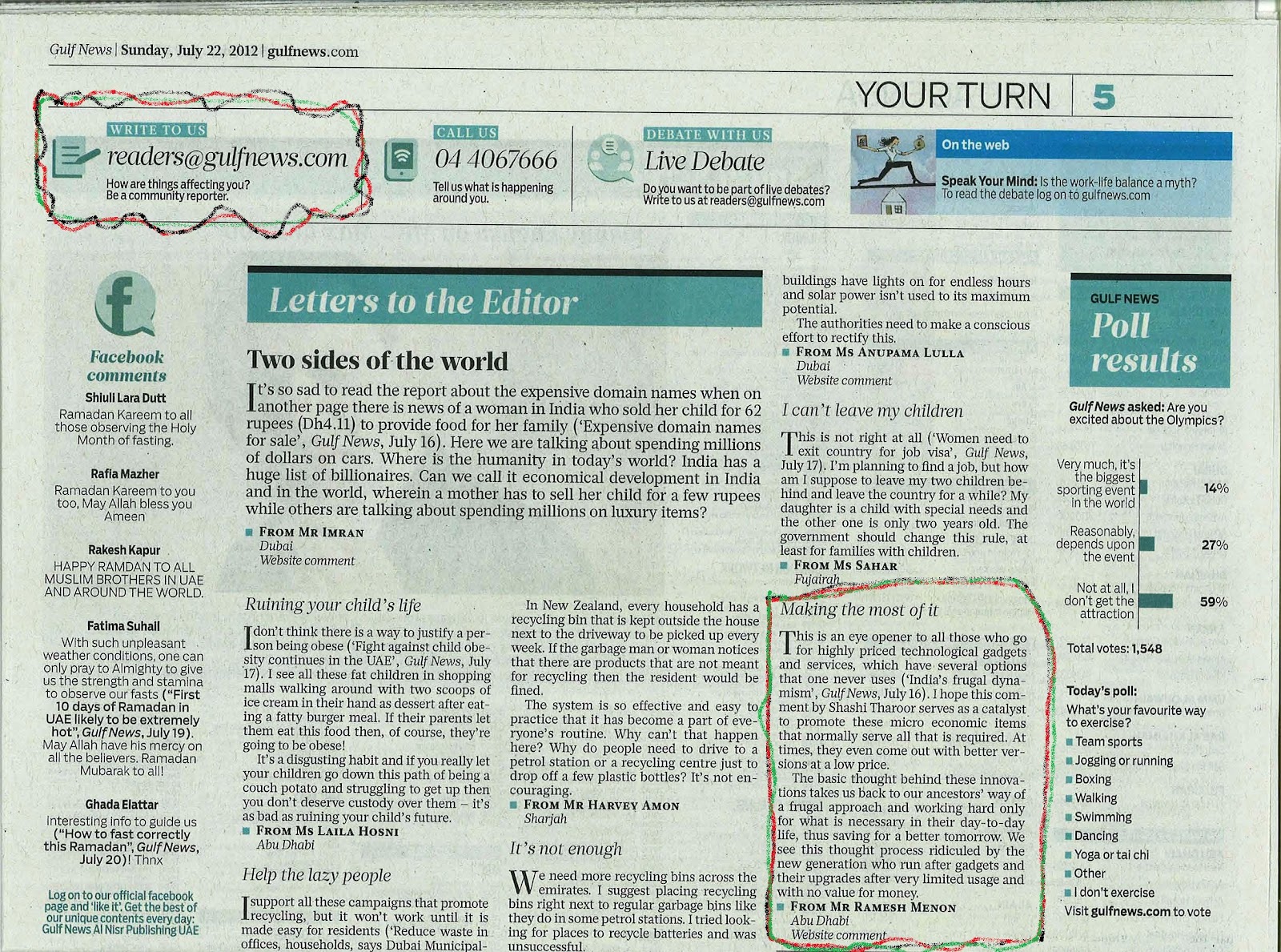
To read the article by Mr. Shashi Tharoo and read the letter in original, please visit GULF NEWS online
Sale and distribution of Mawaqif parking cards

It would be a good idea if Mawaqif could organise the distribution and sale of parking cards of various denominations through petrol stations and other handy outlets.
Currently, there are only one or two outlets selling these cards and it is inconvenient for the public to obtain them. Also, it is not easy to locate the parking meters in many places.
It would be helpful if the authorities put up some special signage pointing to the parking meters.
Ramesh Menon, Abu Dhabi
To read it in original, please visit The National online.
India’s frugal dynamism
Indians are natural leaders in innovation, imbued as they are with the ‘jugaad’ system of developing makeshift but workable solutions from limited resources
 By Shashi Tharoor | Special to Gulf News
- Published: July 16, 2012

India’s sliding economy has inspired gloom and doom far and wide, but increasingly bearish sentiment is misplaced. India still offers hope, but, to understand why, you have to leave macroeconomic indicators aside and go micro. To take one example: Google the phrase “frugal innovation,” and the first 20 search results all relate to India.
Indian companies have long recognised the opportunities in meeting previously overlooked demand at the “bottom of the pyramid.” Shampoo sachets originated in India more than two decades ago, creating a market for a product that the poor had never before been able to afford. Indians without the space or money to buy a whole bottle of shampoo for Rs100 (Dh6.66) could spend five for a sachet that they would use once or twice.
But India’s leadership in “frugal innovation” goes beyond downsizing: It involves starting with the needs of poor consumers — itself a novel term (who knew the poor could be consumers?) — and working backwards. Instead of complicating or refining their products, Indian innovators strip them down to their bare essentials, making them affordable, accessible, durable and effective.
Indians are natural leaders in frugal innovation, imbued as they are with the ‘jugaad’ system of developing makeshift but workable solutions from limited resources. ‘Jugaad’ essentially conveys a way of life, a world view that embodies the quality of making do with what you have to meet your needs.
But ‘jugaad’ is not about pirating products or making cheap imitations of global brands. It is about innovation — finding inexpensive solutions, often improvised on the fly, within the constraints of a resource-starved developing country full of poor people. An Indian villager constructs a makeshift vehicle to transport his livestock and goods by rigging a wooden cart with an irrigation hand pump that serves as an engine. That’s ‘jugaad’.
Common machines and household objects are reincarnated in ways that their original manufacturers never intended. Everything is reusable or reimaginable. If you cannot afford your mobile phone bills, you invent the concept of the “missed call” — a brief ring that is not answered, but that signals your need to speak to the recipient.
Indian ingenuity has produced a startling number of world-beating innovations, none more impressive than the Tata Nano, which, at $2,000 (Dh7,356), costs roughly the same as a high-end DVD player in a western luxury car. Of course, there’s no DVD player in the Nano (and no radio, either, in the basic model); but its innovations (which have garnered 34 patents) are not merely the result of doing away with frills (including power brakes, air conditioning and side-view mirrors). Reducing the use of steel by inventing an aluminium engine; increasing space by moving the wheels to the edge of the chassis and relying on a modular design that enables the car to be assembled from kits proved conclusively that you could do more with less.
Then there’s the GE MAC 400, a hand-held electrocardiogram (ECG) device that costs $800 (the cheapest alternative costs more than $2,000), and the Tata Swachh, a $24 water purifier (ten times cheaper than its nearest competitor). The GE MAC 400 uses just four buttons, rather than the usual dozen, and a tiny portable printer, making it small enough to fit into a satchel and even run on batteries; it has reduced the cost of an ECG to just $1 per patient. The Swachh uses rice husks (one of India’s most common waste products) to purify water. Given that some five million Indians die of cardiovascular diseases every year, more than a quarter of them under 65, and that about two million die from drinking contaminated water, the value of these innovations is apparent.
Many other examples of frugal innovation are already in the market, including a low-cost fuel-efficient mini-truck, an inexpensive mini-tractor being sold profitably in the US, a battery-powered refrigerator, a $100 electricity inverter and a $12 solar lamp.
Moreover, medical innovations are widespread. An Indian company has invented a cheaper Hepatitis B vaccine, bringing down the price from $15 per injection to less than $0.10. Insulin’s price has fallen by 40 per cent, thanks to India’s leading biotech firm. A Bangalore company’s diagnostic tool to test for tuberculosis and infectious diseases costs $200, compared to $10,000 for comparable equipment in the West.
Late last year, India’s government unveiled a hand-held computer that costs only Rs2,250 (about $40). Aakash has a resistive seven-inch touch screen, like Apple’s iPad. It comes in a rugged plastic casing, has two gigabytes of flash memory, two USB ports, headphone and video output jacks and Wi-Fi capability.
Aakash uses the Android 2.2 operating system and consumes a meagre two watts of power, which is supplied by an internal lithium-ion battery that can be charged using a solar-powered charger. And the government will subsidise 50 per cent of the cost to students, so a young Indian just has to pay $20 to have his own tablet. The initial reviews are good.
Even the financial sector has seen innovation. Just three years ago, there were only 15 million bank accounts in a country of 1.2 billion people. Indians concluded that if people won’t come to the banks, the banks should go to the people. The result has been the creation of brigades of travelling tellers with hand-held devices, who have converted the living rooms of village homes into makeshift branches, taking deposits as low as a dollar. More than 50 million new bank accounts have been established, bringing India’s rural poor into the modern financial system.
Frugal innovation pervades the Indian economy. It is one of the reasons why there is more dynamism in the Indian economy than those who look only at the macroeconomic data believe. Sometimes it is important to stop looking at the forest and focus on the trees.
Project Syndicate
Shashi Tharoor, a former Indian minister of state for external affairs and former UN under-secretary general, is a member of India’s parliament and the author of a dozen books, including India from Midnight to the Millennium and Nehru: the Invention of India.
My comments as follows:
An eye opener to all those who go for highly priced technological gadgets and services, with several options one never uses. Hope this article by Mr. Tharoor serves as a catalyst to promote these micro economic items which normally serves all the required purpose of such knowhow. At times, they even come out with better versions at a limited budget as detailed extensively by him. The basic thought behind these innovation and invention takes us back to our ancestors way of frugal approach and burning their fingers only for what is necessary in their day to day life and future, thus saving for a better tomorrow. As we see this thought process is ridiculed by the new generation who run after gadgets and their upgrades after a very limited usage and with no value for money.
Ramesh Menon, Abu Dhabi, United Arab Emirates
To read this in original, please visit GULF NEWS online
Dh258 credit card fee that led to debt of Dh60,000
Dh258 credit card fee that led to debt of Dh60,000

Anwar Ahmad/The National

ABU DHABI // When KB Muralee was offered his credit card, he was told it would be free for life.
 ClicksandWrites
RameshMenonAbuDhabi