Information – Positive Thinking
The Holy month of Ramadan and it’s significance
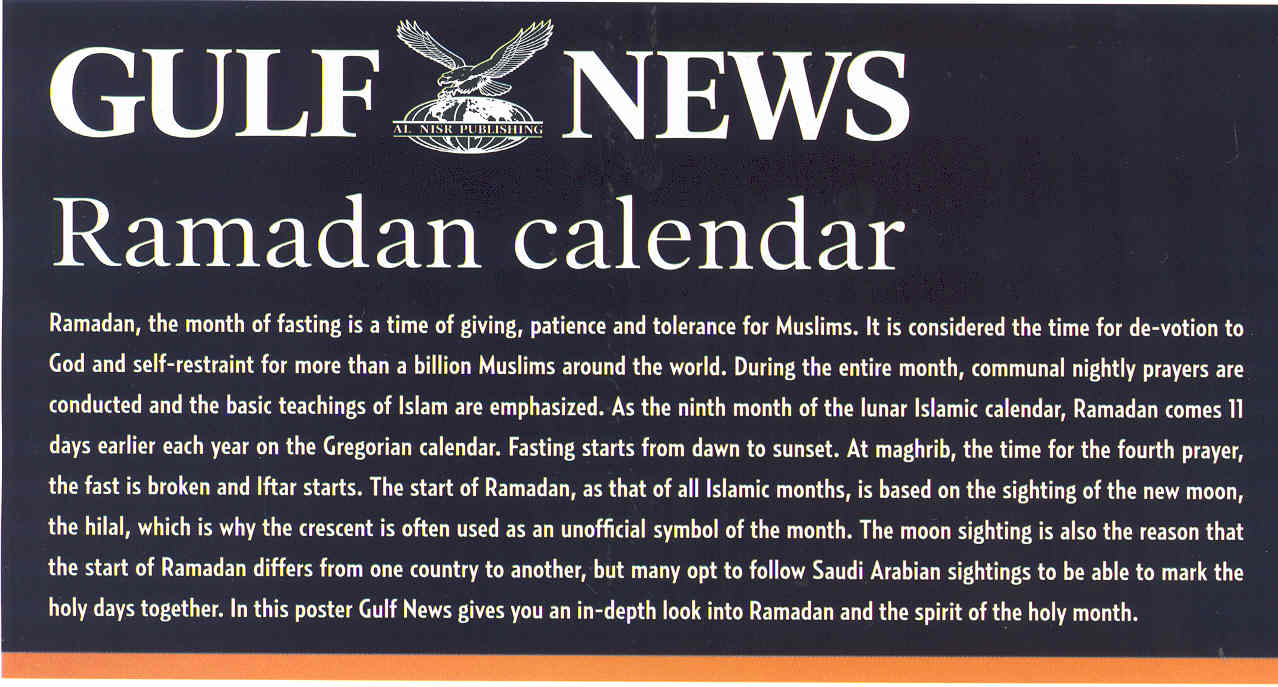
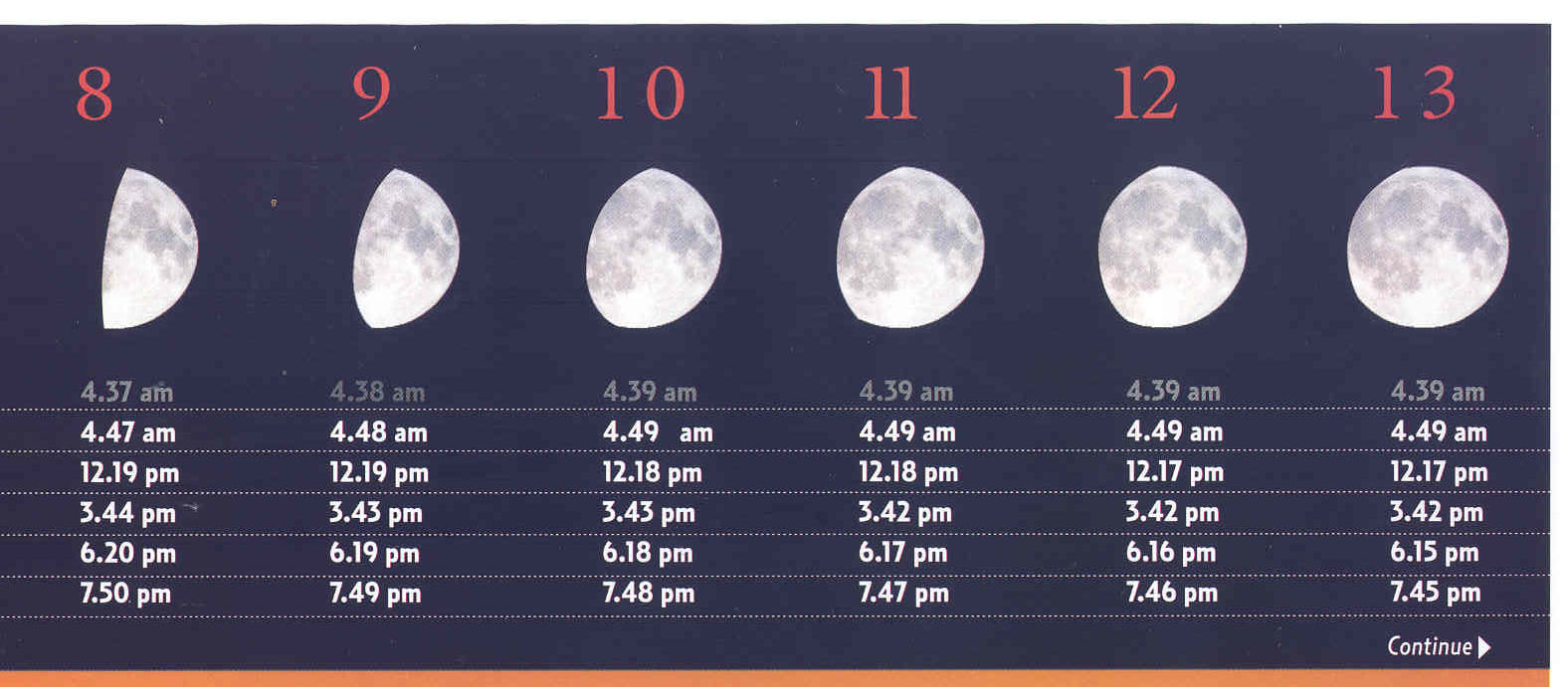
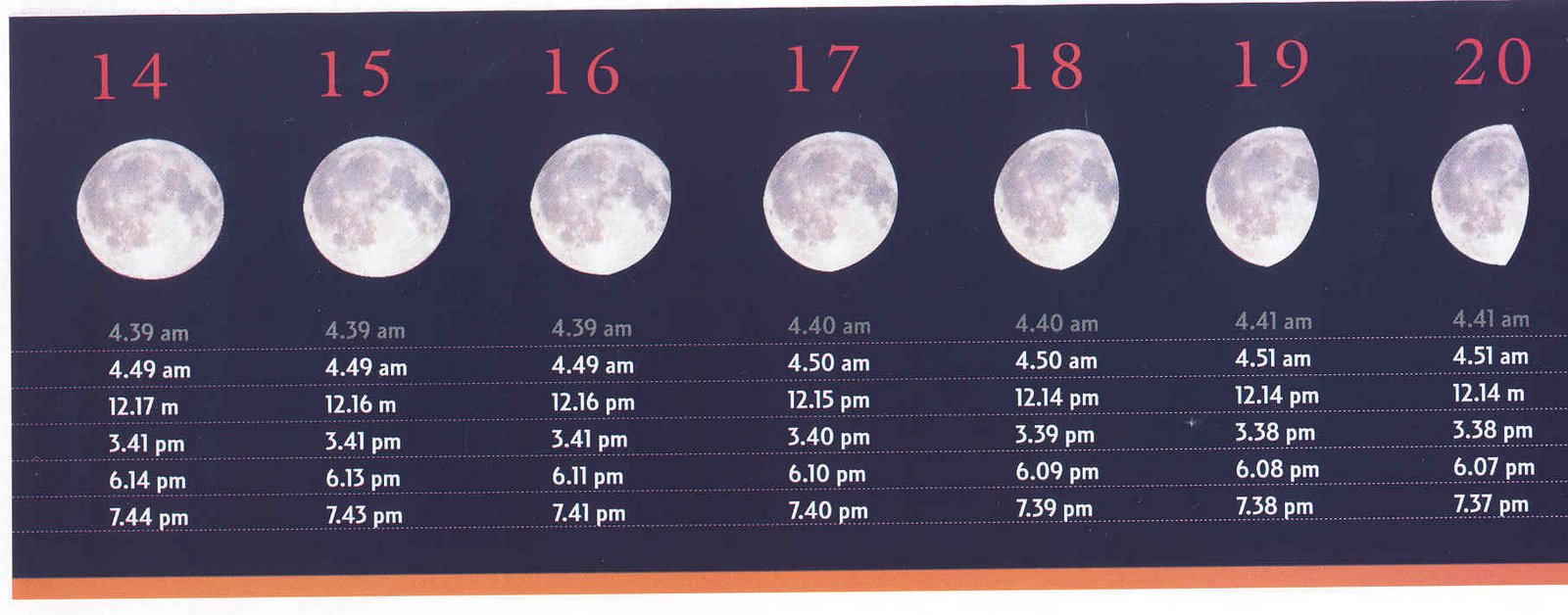
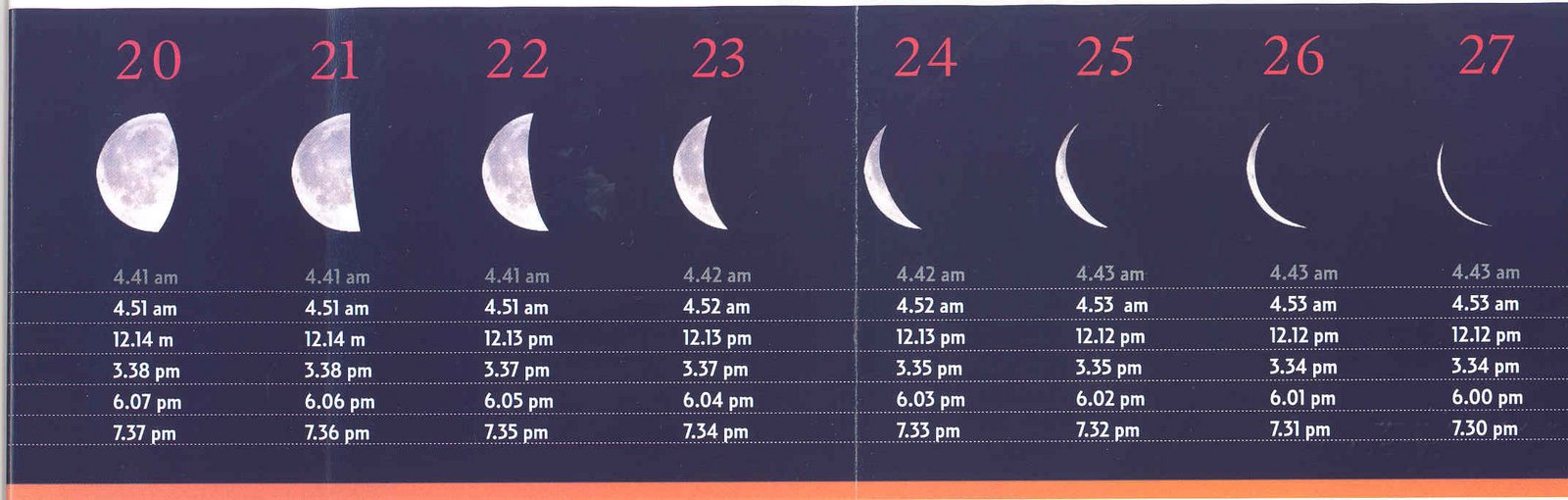
Ramadan Prayer Timings

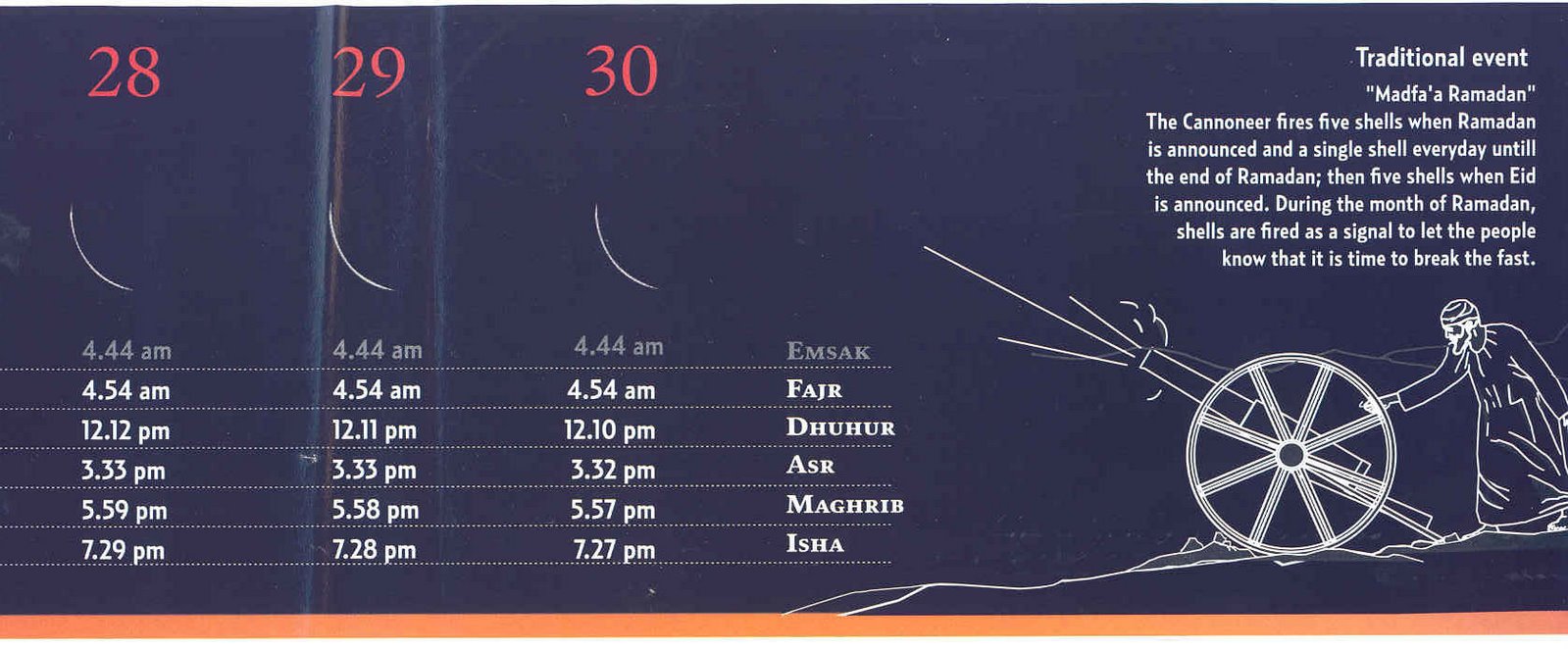
Five Pillars of Islam
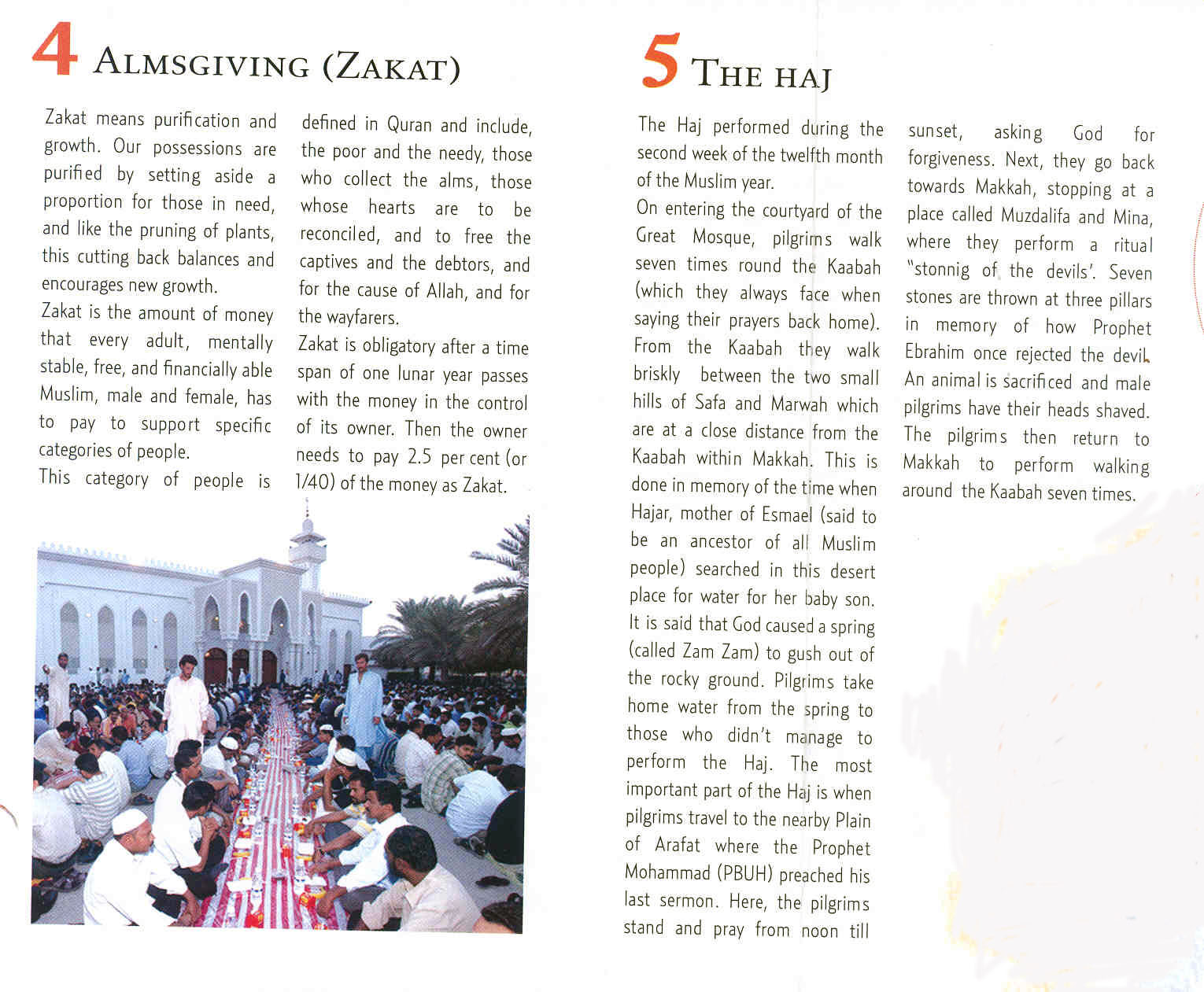
There are five formal acts of worship which help strengthen a Muslim’s faith and obedience, which are call the “Five Pillars of Islam.” They are, testimony of faith (Shahada), prayer (salah), fasting (sawm), almsgiving (zakat) and pilgrimage (Haj). Testimony of faith is to delcare there is no god but Allah, and Mohammad is the messenger of Allah. Prayer, as a Muslim prays five times a day. Fasting is one month of daytime fasting every year. Almsgiving is when Muslims give a small percentage of their annual savings as charity. Pilgrimage is when worshippers make their way to Makkah.


Why we fast in Islam

Why we fast in Islam
By Najla Al Awadhi, Special to Gulf News Published: September 12, 2007, 23:38
You mean you can’t even drink water?” a friend asked me this question with a bewildered look on her face, she couldn’t believe that fasting during the month of Ramadan meant I would not drink or eat from sunrise to sunset for an entire month.
As my friend stood there looking bewildered, I thought, is it really that hard to believe that Muslims refrain from food and drink during the fast? We fast the whole day knowing that we will be ending our fast with the setting of the sun, and in the context of a world where many live in poverty, where hunger and thirst for many become a way of life, our fasting really is a simple duty. This is the spirit of Ramadan, it is about understanding the feeling of hunger, it is about building empathy, self-restraint and piousness.
For myself, and for all devout Muslims, Ramadan holds such deep teachings; it is not a month about food, or about socialising in the evenings in Ramadan tents, or watching Ramadan shows on TV, Ramadan is about learning compassion, it’s about “cultivating our piety”.
What is Ramadan?
Ramadan is the ninth month of the Islamic lunar calendar (hijri calendar), we consider it to be the most holy and spiritually-beneficial month of the Islamic year. Ramadan is the month when the first verses of the holy Quran were revealed.
Fasting in the month of Ramadan is one of the five pillars of Islam, and all Muslims who are mentally and physically able and that have reached puberty are required to fast during this month.
Those who are sick, travelling, pregnant, menstruating or nursing women, are not required to fast, however, those who are unable to fast for these reasons must make up the days they missed fasting upon recovery or return, or after weaning.
In the month of Ramadan, we begin the fast with the sunrise and end the fast with the sunset, or with the fourth Muslim prayer of the day (maghrib prayer). The fast is ended each evening with a meal called iftar and the last meal we have is in the morning right before dawn which is called suhur.
Spiritual experience
The fast of Ramadan is not about physical deprivation, it is meant to be deeply spiritual experience. In the holy Quran it is stated that the purpose of the fast is to develop a quality which in Arabic we call taqwa.
Taqwa can be defined as, “worshipping God as if you see Him, because if you don’t, He sees you”. Taqwa is about cultivating an awareness that God is always watching. For example, when I fast nobody but God knows if I actually have observed the entire fast or if I secretly cheated. So in order to resist the temptation to cheat during the fast, I must remember that God is always watching and will see any lapse.
This sense of taqwa is carried over into other areas of our lives, hence by fasting we foster a habit of piousness, self-restraint, and an inner-balance. For devout Muslims Ramadan is a month of worship; prayer and recitation of the Quran during this month are pivotal, and it is common practice during this month to provide food/iftar to others especially the poor on a daily basis.
Today is the first day of Ramadan and over a billion people will be observing the fast during this holy month.
Whether you will be fasting or not, I hope that the lessons that Ramadan teaches of taqwa, compassion, piousness and charity will remain with you, and not just during this holy month, but I hope that you will carry these lessons with you every day of your life.
Najla Al Awadhi is a member of the UAE parliament (the Federal National Council), Deputy CEO Dubai Media Incorporated, and General Manager of Dubai One TV.
Positive action for dealing with change
Positive action for dealing with change
10 Sep, 2007, 0019 hrs IST,Nandan M Nilekani,
As Global business leaders, we operate at a time when the need to address larger issues such as climate change and poverty is becoming more urgent. Questions are being asked about the role that large companies play in addressing these challenges. This is why the inquiry into Tomorrow’s Global Company, initiated by the Tomorrow’s Company think-tank, has proved so timely and relevant.
This writer co-chaired the inquiry that brought together representatives from businesses based in Asia, North America and Europe as well as people from non-governmental organisations (NGOs) and not-for-profit groups. They came from ABB, Alcan, Amnesty International Business Group, BP, Dr Reddy’s, Ford, The International Institute for Sustainable Development, KPMG, Leaders’ Quest, McKinsey, Standard Chartered etc.
Given this diversity of backgrounds, it was interesting to find a remarkable degree of consensus in our views. We agreed that the market economy has proved a powerful force for innovation, growth, employment and development. Today, the market’s power is most dramatically seen in the process of globalisation, which is driving up productivity and creating prosperity.
However, we also agreed that the world is undergoing unprecedented change, characterised not only by economic growth but by increasing pressure on the environment and continuing social, political and cultural divisions. The positive power of globalisation is not touching many lives.
Global companies — with their scale, power, capabilities and experience — are uniquely placed to deliver practical solutions to resolve these issues. They can develop new technologies, create jobs, raise skill levels, set benchmarks in working conditions and provide goods and services to improve living standards for the world’s poor. In other words, companies can make a positive difference.
Going beyond our current efforts, we need to envision a world in which companies make profits and create shareholder value while tackling large global problems. There is no simple answer. But we have agreed on specific priorities — actions we believe companies should take to realise our shared vision.
Our three priorities were: redefining success, living by strong values, and deeper engagement with governments, etc., to create stronger market frameworks. We saw these as critical factors for changing businesses from wealth creators to agents of social change.
First, we agreed that global companies must redefine ‘success’. It isn’t only about delivering short-term returns to investors but about creating lasting positive impact for society and the environment. If companies can make such contributions, the profits will follow.
Investors are increasingly judging companies on their prospects for sustainable success — looking hard at performance against environmental, social and governance indicators. They want companies to be clear about their goals for building value and prove that they are achieving them. The onus is on us to define specific measures of long-term success and demonstrate that we are on track to meet them.
Our second priority was for companies to articulate and live by strong values. Global businesses are diverse in many respects — geographically, culturally and linguistically — but they cannot afford to be so in regard to ethics and behaviour.
Strong values — put in practice through codes of conduct or charters — bind a multinational together, providing motivation internally and building trust externally. For example, if a company says it believes in education and backs that belief with investment, people will make the connection that wherever that company operates it will support education. This association becomes integral to the company’s brand. While helping people develop skills, the company also attracts customers who value its reputation for encouraging learning.
Our third priority related specifically to directing the power of the market for social and environmental ends. In many areas there are no international rules laid down by governments, which means that there are serious failures in the frameworks that should constrain the market. Over the past two decades, NGOs have highlighted these areas — from the environmental damage caused by construction projects to corruption that prevents the proceeds of global companies’ work from benefiting citizens of developing countries.
Progressive businesses have evinced interest in tackling such problems both to avoid negative outcomes and being undercut by less scrupulous competitors. Such issues can only be resolved by strong national regulation and international agreements. However, one cannot simply shift the responsibility onto governments.
That is why companies must continue to implement voluntary agreements. Examples include the Kimberley Process, which seeks to prevent the sale of ‘conflict diamonds’; the Equator Principles, which make banks’ funding for major projects contingent on social and environmental responsibility; and the Extractive Industries Transparency Initiative, which combats corruption by encouraging greater openness about the use of revenues from oil, gas and mining operations.
While they are a good start, these initiatives must be followed up by stronger frameworks of agreements, laws and regulations to ensure that the power of the market is unlocked to address the problems of our time. And companies must work with governments to create such frameworks.
In the last decade there has been emphasis on doing business in a ‘responsible’ way, i.e., avoiding negative impact on society and the environment. We must now focus on doing business in a ‘sustainable’ way — delivering positive impact to society and the environment. This also means doing so in a way that assures our own sustainability, without which we can do nothing.
Global businesses have huge resources, deep capabilities and extensive reach. They also have front-line experience of key problems such as poverty, environmental issues and human rights dilemmas. We have shown that we understand the problems. We must now be part of the solution.
(The author is co-chairman, Infosys Technologies)
Creativity from being oneself
Creativity from being oneself
10 Sep, 2007, 0548 hrs IST,K VIJAYARAGHAVAN, TNN
In a song sung by Mohammed Rafi for the film Izzat, released in 1968 (Lyrics: Sahir Ludhianvi), the message of authenticity is brought out in the lines, Kya miliye aise logon se, jinki fithrath chupi rahe; nakli chehera samne aaye, asli surath chupi rahe (what can be obtained from such people whose nature lies hidden, where only the false face is in view and the real face stays hidden?). This song further expatiates powerfully on the ways of such pretentious persons in this world of make believe and sham.
Many indeed are far removed from their normal selves, influenced as they are by feelings of insecurity and anxieties or in consequence of their greed for money, power and fame. While some openly and brazenly cast off all scruples and goodness in their feverish pursuits, some continue to talk of and preach honesty and integrity, though unable to bring themselves to lead a life of clarity and real substance.
They thus display a dichotomy in character, which also finally manifests, to an intelligent observer, in their conflicting words and acts. While many are helpless tools of situations, some also can cause serious harm through their glib talk and convincing exterior. Such wolves in sheep’s clothing are verily walking examples of split personalities, whose cliché laden and sugar-coated words would extend to swearing and making promises, adroitly stage managed to bowl many over.
In an incisive article, “The Awesome Power to be Ourselves”, (Reader’s Digest, July 1983) Ardis Whitman rightly terms the power to be oneself as the greatest power — the power which could touch the destiny and trends of situations and peoples. Citing specific examples of great personalities, who possessed this power of integrity and authenticity, Whitman also points out how, on the contrary, the “loss of power” on the part of the soul, could also result in unexplained fatigue and various psychosomatic diseases.
While specific mental and spiritual exercises could help one to obtain authenticity and clarity within, being in solitude once in a while, reflecting on things within and without is also a powerful tool in this journey. This verily is the application of the exhortation, ‘Know Thyself’, the concept of Sage Patanjali (Yoga Sutra: 1,3) of being established in one’s true self (swarupa) and the injunctions in the Bhagawad Gita (2,45; 5,3 and 5,25) to become freed of conflicts and dualities within.
Time for Chak De, India – Narayana Murthy
Time for Chak De, India
11 Sep, 2007, 0000 hrs IST,Narayana Murthy, for ECONOMICS TIMES
NEW DELHI: The other day, my wife and I were perhaps among the very few post-fifty people in the mostly-twentyish crowd watching the film Chak De in Bangalore. You had to be there to believe the shouts of joy that accompanied every goal India scored in the imaginary tournament in the movie.
The mood at the end was as if India had actually won the women’s world cup in hockey. I can appreciate this mood since I too felt similar joy and pride when hundreds of cameras clicked at me holding our national flag, on India and my being declared the winners of the E and Y world entrepreneur award among the forty-odd competing nations at Monaco in 2003. As I exited the theatre after watching Chak De that day, several youngsters asked me for my reaction to the movie. My answer was simple. I said I wanted to see the movie become a reality not just in hockey but in every sphere.
The recipe for such a success was most wonderfully conveyed by Shah Rukh Khan and those wonderful women hockey players in the movie. Let me recount them here. We have to identify as Indians first and rise above our affiliations with our states, religions and castes.
We must accept meritocracy and enthusiastically play the role we are best suited to. We must embrace discipline to strictly follow every step required for success. We have to put the interest of our nation ahead of our personal interests, subordinating our egos and biases. Finally, we have to put in tremendous hard work and make short term sacrifices for long term glory.
I have immense faith and optimism in the youth of this country. But, will we get our leaders to set examples for hundreds of millions of Indian youth? I wish more and more of our leaders see Chak De and learn these precious lessons. (The author is Chief Mentor and Chairman of the Board, Infosys)
The real Judge’s judgement
The real Judge’s judgement
lNNER VOICE/Nadia Ahmed/Hindustan Times September 10, 2007
Once upon a time there was this learned man named Ali Haji who was very religious. He used to offer Salat (namaz) five times a day and was also very regular in reciting the holy Qur’an daily.
His neighbour, man named Rehan, was his good friend but the only thing Ali Haji disliked about Rehan was that he was not regular in offering the Salat or reciting the holy Qur’an. Rehan used to offer Salat whenever he felt in need, and as soon as his wish was fulfilled he used to stop offering the Salat or reciting the holy Qur’an!
One day Ali Haji, who was very irritated, scolded Rehan thus: “Rehan, vou never offer Salat regularly and always say that since the Almighty fulfils your wishes whenever you ask Him, there’s no problem!”
Ali Haji then cursed him, “Take my word for it, you are not true to your religion and you will certainly go to Hell for this!”
That very night the Almighty appeared in Ali Haji’s dream and said “Ali Haji, who are you to judge who is true to Me and who is not? So what if Rehan offers Salat only when in need? For he calls Me from the bottom of his heart with true faith in Me. Now you will be placed in Hell and Rehan in Heaven.”
So now this simply shows that we are nobody to judge or object to anyone because of their faith or devotion towards their idea of God, be it a Hindu, Muslim, Christian, Sikh or anyone. What really matters is not the quantity of our worship of the Almighty but the quality. It may be good to make people offer regular prayers but we must not judge them by their ‘inabilities’ or ‘abilities.’
Especially when it comes to matters of faith, it’s not our business to judge the sincerity of a person’s relationship with God, who is One. After all it is not us but the Almighty who is the ultimate power who decides everything, especially who loves Him and how.
Parents can now control kids’ mobiles

Parents can now control kids’ mobiles
AGENCIES
SYDNEY: An Australian company claims to have developed the world’s first software suite that enables parents to completely control their children’s mobile phone usage.
The programme lets users filter inappropriate websites, control all SMS and MMS messaging and block expensive premium SMS numbers.
Meg Dennis, co-founder of Leopard Labs, which developed most of the suite, said, the software would help parents keep their children’s phone bills in check, besides ensuring that the kids were not exposed to adult content.
The software would also prevent cyber bullying, Dennis said.
“You can say I only want people in my address book who know my kid to access them [and] anyone outside that address book will get rejected,” Dennis said.
“It’s not about stopping access; it’s about facilitating it and making it a great user experience for kids and parents as well,” she said.
She said the software also had the provision to filter out specific words from SMS messages, but she did not expect that particular feature to be widely used, as it was easy to bypass using abbreviations.
According to a Sydney Morning Herald report, the software also contains an anti-virus programme from Kaspersky Lab to protect against mobile malware and spam, which security companies say is on the rise as mobile phones become more like computers.
“What we see happening is mobiles becoming the device of choice to access the Internet … and the mobile world is very similar to the PC world in that it needs those types of controls available,” Dennis said.
Dennis said the complete software package, called mozone, which Leopard Labs had been working on since 2005, would be available to buy from the company’s website in November.
Though the price has not yet been decided upon, it would be “completely affordable”, she said.
She further said Mozone will presently support only the Symbian platform, used by Nokia, Motorola, Samsung and Panasonic, which represent 72 per cent of the world’s smartphone market, adding that support for other platforms would be added early next year.
Ramadan – Understanding the true spirit of the fasting month

Understanding true spirit of the fasting month
By Samir Salama, Bureau Chief GULF NEWS Published: September 10, 2007, 00:16
Abu Dhabi: Feasting their eyes on cuisine on dinner tables during Ramadan shows how far removed Muslims are from the true spirit of this holy month.
The month of fasting is in fact a time of giving, patience and tolerance for Muslims.
For more than a billion Muslims around the world, it should be the time for devotion to God and self-restraint, when communal nightly prayers are conducted and the basic teachings of Islam are emphasised and Ummah (Islamic nation) consciousness is heightened.
As the ninth month of the lunar Islamic calendar, Ramadan comes 11 days earlier each year on the Gregorian calendar and the duration of the fast changes depending on which season the holy month falls in.
The start of Ramadan, as that of all Islamic months, is based on the sighting of the new moon, the hilal, which is why the crescent is often used as an unofficial symbol of the month. The moon sighting is also the reason that the start of Ramadan differs from one country to another, but many opt to follow Saudi Arabian sightings to be able to mark the holy days together.
Five pillars
As one of the five pillars of Islam, fasting during Ramadan, which is considered one of the highest forms of worship, is obligatory for those Muslims past the age of puberty who are mentally and physically fit and not travelling, as long as it does not cause them physical or mental harm.
Those who cannot fast during Ramadan, owing to health or other reasons, may fast in other months, or feed the poor.
But a Ramadan fast is not a simple abstention from food, drink and sex during daylight hours.
A fast consists of a true and verbal intention that must be recited, as well as a package of dos and don’ts which are specifically emphasised during the month.
Fasting, or sawm (literally refrain), which did not become obligatory until 624 AD, offers an opportunity for Muslims to cleanse the body and mind.
It promotes the principle of sincerity by keeping the individual away from arrogance.
Among the greatest benefits is the lesson in self-restraint and discipline that could be carried forward to other aspects of a person’s life, such as work and education.
The lengthy nightly prayer called Taraweeh is an important element of rituals during the month.
Since it is a time of piety and high religious consciousness, it would be considerate for non-Muslims to dress and behave modestly, avoiding animated behaviour that could cause offence.
Those who want to understand the holy month better could consider involving themselves in the spirit of the month, which would be welcomed by most Muslims. Saying ‘Ramadan Kareem’ to Muslims and attending a fast-breaking feast, or iftar, would be appreciated by most.
Work hours in the private sector are shortened by two hours for Muslims and non-Muslims. The public sector will function from 9am to 3pm.
Live music is banned through the month.
Shopping malls and supermarkets are expected to be open late at night.
A typical day
A typical day of fasting begins with waking up before dawn to have a meal called the suhoor before the start of the fasting day. At sunset, Muslims usually break their fast upon the call for Maghreb (sunset) prayers with another meal called iftar. Prayers are conducted five times through the day, as they are on all days, and an extra set of prayers called Taraweeh is conducted after Isha or night prayers.
Tips for non-Muslims
Since it is a time of piety and high religious consciousness, it would be considerate to dress and behave modestly, avoiding animated behaviour that could cause offence.
Those who want to understand the holy month better could consider involving themselves in the spirit of the month, which would be welcomed by most Muslims. Saying ‘Ramadan Kareem’ to Muslims and attending a fast-breaking feast, or iftar, would be appreciated by most.
Since cultural consciousness is also high during the month, Ramadan can be a good time to connect with the local and Muslim cultural scene by attending the various musical and social events, as well as trying local and regional cuisine that is popular during the month of fasting.
Arabic speaking non-Muslims wishing to learn more about the region and its people will notice that Arabic television channels change their programming to a new schedule dedicated for Ramadan, when some of the most popular celebrities in the Arab world feature in some of the most-watched soap operas, historic series, as well as religious, cultural and musical shows. 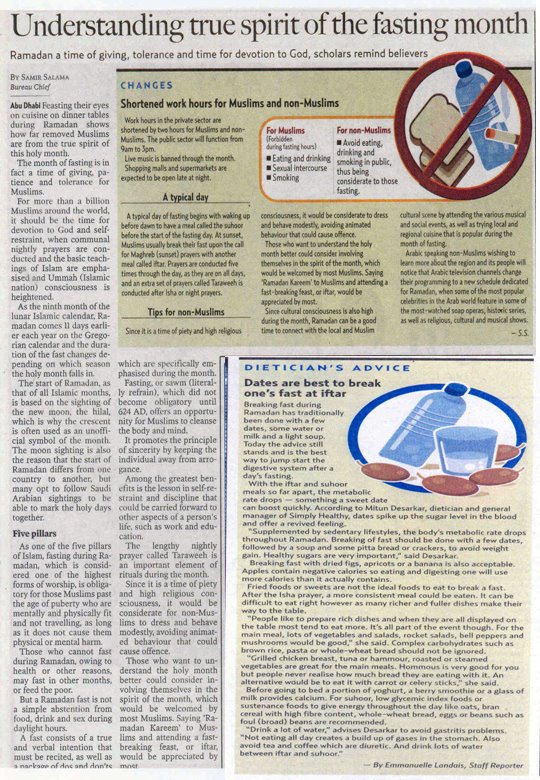
We’re authors of our own bewilderment
We’re authors of our own bewilderment
6 Sep, 2007, 0510 hrs IST,Vithal C Nadkarni, ECONOMIC TIMES
Pope Benedict has described Mother Teresa’s decades-long crisis of faith as “the silence of God”, a phenomenon the Pontiff says is “known to all believers”.
Referring to the book of letters detailing the tormented state of Mother Teresa’s faith, the Pope says this isn’t unusual. All Catholics have to contend with the silence of God, which so sorely tested even the saintly Mother despite all her charity and force of faith, he has added.
By the Pope’s own admission, the cat is finally out of the bag: hereafter it would be extremely disingenuous to claim special access to the Big Boss who allegedly lives beyond the Pearly Gates.
Nor should you believe those who claim to have a hotline to heaven. This also rules out such prospects as barters with God, or bribing Him into benevolence with your little acts of piety. Does this sound pitiless? But that’s exactly how the universal cookie crumbles, even according to Bhagwad Gita.
That’s precisely the revolutionary message of the fourteenth verse from fifth chapter of the Lord’s Song: “Of course there is no God,” Krishna says to Arjuna, at least not in the sense that countless generations of priests and shamans have led you up to believe.
If at all there’s something, it’s what the Gita is willing to concede as “embodied consciousness”, which Swami Prabhupada, founder of the Hare Krishna movement, translates as “the master of the city of your body”. “He does not create activities, nor does he induce people to act. He also does not create the fruits of action,” the verse goes on to elaborate. All that pops out from the tendencies inherent in material nature.
The verse that follows makes even more revolutionary assertions: The Supreme Spirit lies indifferent beyond all epithets and categories; it does not care for your sinful activities nor is it pleased by your pious acts. “(Thus) the Lord neither hates nor likes anyone, though He may appear to,” says Swami Prabhupada. Our poor embodied souls often fail to get this message.
Enslaved by our own desire to escape from supreme consciousness, we become authors of our own bewilderment and grow forgetful of our own essential nature. This can only heighten the so-called darkness of the soul suffered by embodied beings, for ignorance has knowledge enthralled (ajnanavruttam jnanam tena mhuyanti jantavah) in its coils.
The way out of the impasse is through faith and enlightenment.
The god of smallest things
The god of smallest things
7 Sep, 2007, 0214 hrs IST, By Mukul Sharma /ECONOMIC TIMES
I write this as I lie almost totally incapacitated in bed with a virus infection that’s turned out to be so virulent that I have no choice but to marvel at the miracle of the infinitesimally small.
I’m continuously thinking of my own suffering here when actually millions of these creatures are either being created every second somewhere inside my body, or dying there without a trace of ambition. I don’t know these creatures.
They don’t know me either. The “me” that resides as my personality and is sometimes supposed to be unique in the grand scheme of things, makes absolutely no difference to them whatsoever. For some reason, apparently they have a job to do — just like a plumber, politician or rock drummer does.
Nor do I know my immune system. My white blood cells have a job to do too which they go about doing without a “by your leave” or permission granted by me — exactly as if I didn’t exist at all for all they cared. You sometimes think: are they concerned only about their own existence or what — a la the selfish gene? But then, luckily, I’m comforted by the thought that they don’t have the capacity to think along those lines.
In other words, I also have my work cut out for me. When I’m infected, I suffer and wait impatiently, and often unfairly, for parts of me to get rid of parts that were never intended to be me. Ultimately, I’m glad all three of us manage this exquisite ménage remarkably well.
Does this mean that at some deeper level our dependency and symbiotic relationship with one another has to be more than just an amazing feat of coincidence? Or is it perhaps merely evolutionary mechanics which has no “goal” as such but only thrives on each doing the best for itself?
So I’m thinking now, what if a virus could indeed think. In order to make some sense of a human body it incarnates in from time to time, it might well say to itself: “I came into this body-world to procreate and multiply, only to find forces of hostility and evil committed towards my destruction.
All odds are stacked against me. Yet what am I doing wrong here? Is there no fairness, or is this world only a mindless creation of chance encounters between atoms which have no regard for the fact that I exist as a thinking being who can question its impetus and inspiration? If there’s a God it definitely doesn’t reside in this little universe. Why would there be so much evil around otherwise? Maybe when I die, I go to a far, far better place than I’ve ever been before.”
 ClicksandWrites
You must be logged in to post a comment.