Information – Money Market
Customers lose up to 4% when wiring money abroad
Customers lose up to 4% when wiring money abroad
By Suzanne Fenton, Staff Reporter GULF NEWS Published: January 31, 2008, 01:28
Dubai: Expatriates in Dubai lose up to four per cent per transaction when they send or receive money from other countries, according to a recent market entrant.
As an expat magnet, the UAE sees millions of dirhams being wired to and from the country every day. And banks charge a wide variety of exchange rates and commissions, which fluctuate daily.
But, according to Lisa O’Brien, director of First Rate FX, a London-based currency specialist firm with offices in Dubai, by doing some basic research, expats can save a lot of cash when transferring money.
“Often people want to transfer money quickly, and so they get in the habit of calling their own bank,” she says.
“But we’re currency specialists. We buy large volumes of all major currencies every day. And because of this we can make a huge saving and pass this benefit on to the client.”
O’Brien says this is with no commission or any other additional charges.
Lucrative business
Mohammad Ishaq, Head of Treasury at Sharjah Islamic Bank, says: “They benefit from the customer in two ways: When a customer deposits the money, it takes a few days to arrive at the destination. In this time the money is lying in transit and the company makes the interest on that.
“Also, the company buys big amounts of money at wholesale rates, but offers it to the customer at the retail rate – about half a per cent or one per cent, depending on the transaction. This half or one per cent makes a big difference. It’s very lucrative for them.”
To highlight O’Brien’s point, using a High Street bank such as HSBC to transfer £1,000 from the UK to Dubai would convert to Dh7,175 with no extra charges or fees at an exchange rate of 7.17.
Naturally, this is only “an indication for today as prices vary from day to day”, according to a bank employee. To send £1,000 from Dubai to the UK, however, would cost Dh7,408 at an exchange rate of 7.41 with an additional charge of Dh80 for sending, amounting to a total of Dh7,488.
Sending £1,000 from the UK to Dubai with a money transfer agency like Western Union would amount to Dh7,220, with the sender paying an additional charge of Dh331 (£47). Sending £1,000 from Dubai to the UK however, would cost Dh7,510, with an additional charge of Dh400, amounting to a total of Dh7,910. Western Union also has a maximum amount of $7,500, with a $310 fee.
Using a specialist company like First Rate FX to transfer £1,000 from the UK to Dubai at a rate of 7.23 would amount to Dh7,230. To send 1,000 GBP to the UK from Dubai would be Dh7,307, at a rate of 7.31.
As foreign exchange is volume-driven, larger amounts would achieve better rates. For example, sending £25,000 from the UK to Dubai with First rate FX would amount to Dh180,957.5 at today’s exchange rate of 7.24 with no commission or extra costs. It would take Dh182,272.5 at a rate of 7.29 to get £25,000 from Dubai to the UK.
According to O’Brien, it’s a case of taking the time to research the market. “In the UK press, there’s been a lot of talk about banks charging too much. So people are becoming more educated to go to specialists instead.”




Market crash: A quick guide for young investors
Market crash: A quick guide for young investors
rediff Get Ahead Bureau
If you are young and restless and into the stock markets then this is for you.
For the Indian stock markets are caught in a whirlwind and you might need a straw to hold on to something. Some words of wisdom, some nuggets that may help you to relax, howsoever often you may have heard them before.
Waking up this morning would you have imagined the 30-stock benchmark index, the Sensex, would crash by more than 1,500 points after noon?
The US markets seemed a bit stable with the Dow Jones down by about 0.5 per cent. The Indian stocks too had been on a downslide since January 15. However, the shock and awe that the Sensex witnessed today must have made a few of the weak-hearted amongst you stop and take heed.
Weak-hearted we all are but if you also have some patience — considering your age — here’s what you should keep in mind to weather stock market turbulences.
1. Start nibbling in
If you believe in India’s growth story every steep fall should be seen as a buying opportunity. If you haven’t yet entered the market but want to then tighten your belts. Market crash like the one today is an ideal time to buy. However, since these are very tumultuous times don’t put all your eggs in one basket.
That is, if you have Rs 100 to invest then put only Rs 25 or even less during such crashes. If you have heart for some risk then put Rs 25 out of that Rs 100 today and keep the rest for later. However, do this only if you are willing to stake your money for at least five-seven years. The long-term stock market story in India still looks positive.
2. Don’t panic
If you are already invested in the market and are sitting on huge losses, don’t panic. The macro economic story in India led by the consumption, infrastructure and engineering sectors still have chances to remain insulated from what’s happening in the US markets. This because many believe that the US recession is responsible for the current weakness across global markets.
If the US can’t buy our goods, no problem. India and Indians have the purchasing capacity believe some experts, who say that the US recession will not have a huge impact on the Indian growth story.
Moreover, India’s demographics, skewed heavily in favour of the young, will help India overcome external pressures in the long run. Young Indians like you are spending more on their daily needs thereby increasing the consumption demand.
So if you are a brave heart and believe that there are bound to be minor hiccups along the way this is your time. Add more and good quality stocks to your portfolio.
3. Avoid averaging
If you are a short-term trader and think that you can buy more of the same stocks to average your buying price then you may be in for a rough ride. Nobody knows for sure about which direction the markets will take in the weeks ahead.
Any bad news coming from global giants like the US, Europe and China can only have multiplier effects. If the markets were to tank further your losses are likely to increase manifold. So book your losses and get out of the market.
However, if you want to invest with a long-term perspective start nibbling in on good quality stocks.
4. Don’t go by tips
If you are young and eager to make money then you are an ideal target for those who give stock tips. They will start flying thick and fast from tomorrow. Or may have started doing rounds even today for all we know. Some of your friends will ask you to buy stocks; some other will advise you to sell them.
Agreed you will find a lot many stocks at prices far lower than what they were a fortnight ago. Check for their credentials. For this is the time when gullible investors go for the bait thrown by stock market manipulators. Don’t buy any stock merely because a broker or a market punter advised you to.
Similarly, there will be a host of technical advisors jostling for your attention. “This particular stock looks weak on the charts. Traders can make some profits by selling them now and buying the same at lower levels with strict stop losses.” Shun the thought. For you never know when the markets will bounce back.
Bottom line: don’t trade on tips. Better still don’t trade at all. Go for long-term investments. For the time being forget what Lord Maynard Keynes said: “In the long-term we are all dead.”
God knows what will happen in the long-term but in the current scenario if you were to act on tips then you will only be responsible for your own ruin.
5. Mutual funds are your best friends
In such times let experts manage your money if you find stock markets to be a hot potato. Put your money in mutual funds for the mutual fund manager is a market expert and is assisted by a big team of market specialists. A decision made by a team of experts will help you make far greater profits than what you will try to do on your own.
The stock market hammering of the last few days should be taken as an opportunity to buy into good diversified equity funds. For, they put their money into the markets irrespective of any sector, theme, or market cap limitation.
When the markets will bounce back they will have a far higher chance of appreciating faster than any other type of mutual funds.
6. Don’t try to time the markets
As an individual you are in no way going to buy when the market falls and sell when the market rises. Believe in investing money into stocks or mutual funds’ systematic investment plans, SIPs, regularly. This is the only key to avoid getting ruined in the stock markets.
The stock market crashes — like the one witnessed today — get evened out by long-term gains. For instance, those who had been regularly investing from the time markets crashed steeply during the May 2006 crash would not feel bothered about the crash today.
The market had crashed to some 12,000 points then from about 16,000 levels in just a month’s time. Today even after the crash the market was trading at 17,000 plus levels.
Remember that age is on your side. If you are in your early, mid or late twenties then this is the right time for you to put your money in stock markets. Historically, stock market gains have outweighed gains from other asset classes over 10-year, 15-year and 20-year time horizons.
Who knows, by the time you are in your 40s or 50s, twenty years from this day, you might look back at this crash as your first stepping stone towards building wealth for yourself and your family.
Barjeel Geojit opens online mutual funds trading platform for NRIs
Barjeel Geojit opens online mutual funds trading platform for NRIs By Babu Das Augustine, Banking Editor GULF NEWS Published: January 25, 2008, 00:04
Dubai: Barjeel Geojit Securities, a UAE-based brokerage and financial services provider has launched Mutual Funds Online, a new web-based trading platform of Indian mutual funds for non-resident Indian (NRI) investors from the UAE.
“We are the first independent financial intermediary to launch such a service, designed to make the investment process paperless, hassle free and seamless,” said Krishnan Ramachandran, CEO of Barjeel Geojit Securities.
Barjeel Geojit Securities, a partnership between Indian brokerage company, Geojit Financial Services, and Al Saud Group of Sharjah were the first financial services firm in the UAE to offer direct brokerage investment services to the NRI community in the UAE.
Expansion
The company has five offices and plans to open two more – in Al Ain and another in Fujairah – this year. “The NRI community in the UAE is increasingly participating in the Indian capital markets and are taking advantage of the Indian economic growth,” said Shaikh Sultan Bin Saud Al Qasimi, chairman of Barjeel Geojit Securities.
Despite the high volatility experienced by the Indian market along with other global markets during the recent weeks, Shaikh Sultan said, the Indian growth story is built of solid fundamentals and Investors should have longer term outlook.
Along with the online services, Barjeel Geojit will offer investment advisory services on Indian mutual funds and capital markets.
“Although the number of NRI investors in Indian markets has increased significantly, many have missed the opportunity. The recent market corrections offers them the chance to enter the market at attractive prices,” said KV Shamsudin, director of Barjeel Geojit.
Chairman of the Association of Mutual Funds of India, A.P. Kurian, said: “Mutual funds are emerging as one of the best investment options. Even those funds which give a small return perform better than other investment alternatives for NRIs.”
More informations can be obtained by logging on to:
http://www.barjeel.ae
or on phone:
Abu Dhabi : +9712 6441555
Dubai: + 9714 3555900
Sharjah: + 9716 5732555
Ras Al Khaimah: + 9717 2277468
Oman: +968 9232067
or in India: Geojit
Phone: = 91 484 2445501
http://www.geojit.com
Coping with high EMIs
Coping with high EMIs
Ramganesh Iyer for Express Money Posted online: Monday , January 21, 2008 at 1339 IST
If you took a home loan at rates prevailing in 2005 (around 7.5 per cent), you must be feeling the heat now. If you had borrowed Rs 20 lakh for 20 years, your EMI would have increased by Rs 3,500 or more. What options do you have today?
Increase tenure. If you are not near retirement, and if your original tenure was less than 20 years, your bank should increase the loan tenure. The other benefit of this is that due to inflation, the real cost of your loan will decrease over the years.
Prepay. If you have surplus cash, prepay part of your loan. The EMI on remaining principal will remain the same as earlier.
Switch banks. This involves a sizeable transaction cost, besides time and hassle. Your old bank may charge a prepayment penalty, and the new bank, processing and administration fees. Switch banks only if the rate differential is at least 0.5 per cent.
Avoid a bad deal New borrowers should do their groundwork. First, avoid taking on an EMI that is too close to your monthly surplus. Expenses have a tendency to shoot up over the years, while income is more unpredictable. By keeping an adequate buffer, you ensure that interest rate increases do not hurt you.
Scout around for the best deal. PSU banks are slower in processing the application, but usually offer slightly lower interest rates.
Finally, before signing the papers, read the fine-print carefully. Of special importance are the clauses that permit the bank to reset interest rates, and pre-payment related clauses. Change the bank if you find a clause that is not acceptable.
The author is a certified financial planner.
Lessons from January 2008
The thing about life is that one makes mistakes. Many mistakes were made in the second half of 2007 and those sins have to be washed away by blood, such is the way of financial markets. Some participants will go down under and never be able to get back to the market again but most will survive. The pain will linger for many months, maybe years but lessons have to be learnt. Every such debacle has lessons for us and the sooner we forget them the more we suffer.
The first lesson is not to let stock price performance become the sole reason for buying, a mistake which was made in abundance in the last 3 months. What couldn’t be explained by fundamentals was credited to liquidity. The present lost all relevance as people chose to focus on the distant future, perhaps simply because the present could never justify those ticker prices; only a hazy dream of the future could. Traders and investors had no time for fundamental analysts, in many cases they were labelled “cribbing fools”. Chartists became the most celebrated tribe on the street as only they could see and predict the one way run to glory for many of the hot stocks even as fundamental watchers cringed at valuations….till the music stopped. Don’t get me wrong, charts do work in trending markets but once stock prices veer away completely from fundamental value, people need to get careful. But they never are. Now that the blinkers are off, people should ask themselves why stocks like RNRL, Ispat, RPL, Essar oil and Nagarjuna fertilisers have lost 50-70% of their value. It is simply because their stock prices had snapped all connection with underlying business fundamentals, earnings and value. Their stock prices became the only reasons for buying them which works for a while but not forever.
The other big lesson, one which should have been driven in earlier in May 2006, is the danger of overextending oneself in the futures market. The lure of stock futures is easy to understand. Put in some margin, take a big exposure on a fast moving stock, make a killing when prices shoot up. Repeat exercise. Just that people forgot that prices may also come down and at a pace which noone can even imagine, maybe their friendly stockbrokers forgot to tell them that part of the story. The result : unbridled speculation that ran into lakhs of crores, excesses that we are paying for today. Even this fall will not cure investors of their love for futures speculation but if at least some amount of caution is injected it would have been a worthwhile learning. Futures are not toys for amateurs, they are time bombs in the hands of inexpert and inexperienced traders, it’s only a matter of when the fuse runs out.
The other learning which I hope will play out in the future, as it has in the past, is that it pays to be brave in times of panic such as these. If I was allowed to invest myself , which I am not, I would have no hesitation in deploying serious money into the market today, knowing fully well that prices may fall more tomorrow. And I would be standing there tomorrow to buy more of the same, till my money ran out. India is going to be a terrific stock market story for many years to come, even an intermediate bearish patch cannot shake that conviction of mine. At best, one will have to wait a bit for the returns to follow. That’s alright. You are happy to put money in a bank FD and then wait for one full year to collect that measly 8%, aren’t you? Then why does the stock market need to give you 20% every month? In the last one year, I haven’t seen so many good stocks trade at such mouth watering levels. Forget trading, avoid the duds which were fuelled up by operators, just go out and buy those bluechips. They will deliver, even if there is a global market meltdown for a while, and if you are a bit patient you will be rewarded. But do remember January 2008, as history will repeat itself again in the future. Just that our memories tend to be too short and our greed too much.
Udayan Mukherjee / MONEYCONTROL
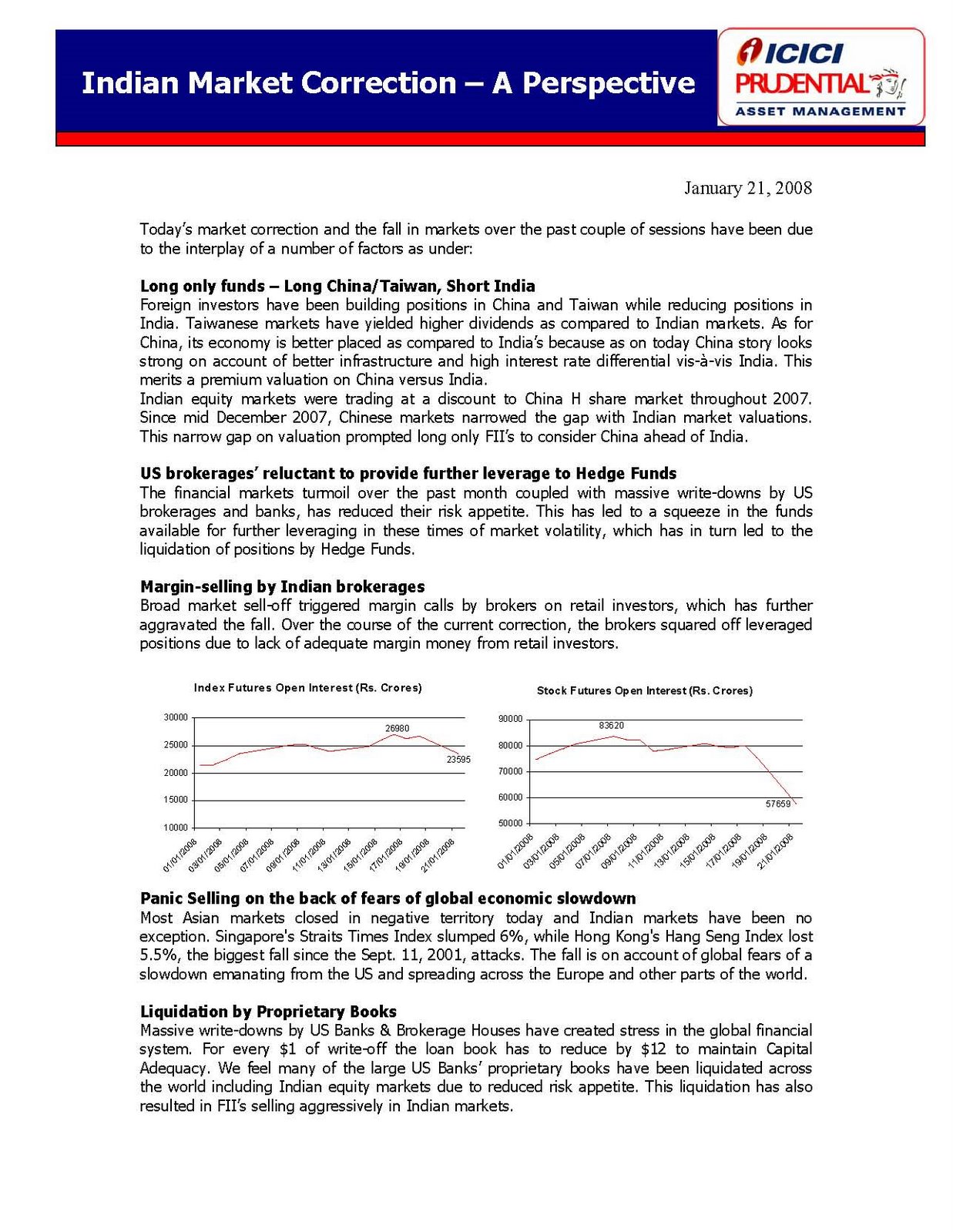
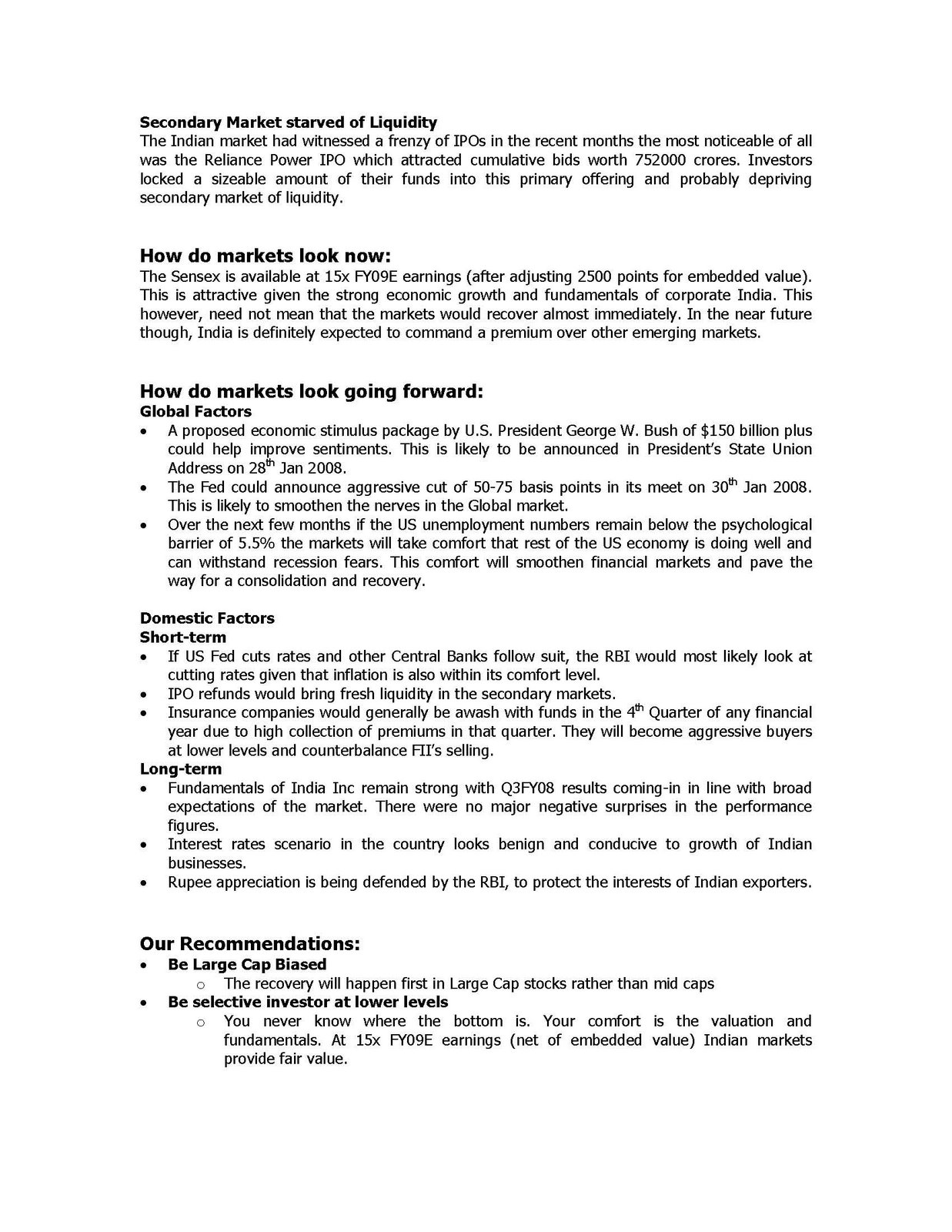
A must read for every investor -Recent Indian Market Volatility
Dear All:
Attached please find a very good report from Prudential AMC which has not
only taken into consideration the domestic factors but also the
international factors that have resulted in the drastic fall in Indian as
well as all global markets.
It is a mail, which each and every investor should read.
One get only one or two such occasions in a year to make entry into the
equity market. This is one golden opportunity. Don’t miss it. The following
Indian as well as Offshore funds are strongly recommended. Please avoid
funds that have exposure to Pharma, IT and FMCG. Concentrate on funds that
are more domestically oriented like Infrastructure Funds, Capex
Opportunities Fund, UTI Infrastructure Fund, ING Domestic Opportunity Fund,
power sector fund and in the Midcap space Reliance Growth Fund.
It will be a great idea to get investors sign up for ING ZIP and choose ING
Domestic Opportunities Fund as it give an investor Daily Rupee Cost
averaging facility. Please don’t ignore this fund any more as responsible
Advisor.
On the offshore front our top recommendation is Prudential IOIF
Infrastructure Fund.
Stay away from SE Asian markets and European markets which may get badly hit
on account US economy slowdown. Our only recommendations beyond the
boundaries of India is Templeton BRIC Fund.
Apart from this recommend Birla Sunlife India Advantage Fund.
Finally, in view of the attractive valuation one of the biggest beneficiary
will be Reliance Natural Resources Fund NFO. The fund is having fresh funds
and it is getting deployed at very attractive valuations. I am sure this
will be on the top of the performance chart 1 year from now. Stocks which
the fund proposes to invest into have got battered and are available at
substantial discount.
With today’s fall the Indian Markets are trading at around 13.5 forward p/e;
which is something no investor can afford to ignore.
Anyone who is weak hearted make he/she may invest in ICICI Prudential FMP
(which is currently on) which can deliver a return of over 15% p.a. with
capital protection at the downside.
With warm regards,
Ramesh Krishnamurthy
Senior Vice President
Barjeel Geojit Securities LLC
Tel: +9714 3555900 Extn 202
Fax:+9714 3555903
Cell: +97150 6244740
Email: ramesh@barjeel.ae


Investors lose trillions; FM says don’t panic
Investors lose trillions;FM says don’t panic
January 22, 2008 11:32 IST
Last Updated: January 22, 2008 13:11 IST
Finance Minister P Chidambaram sought to calm investors panicked by a meltdown of over 2,000 points on Tuesday morning leading to suspension of trading, saying that enough liquidity would be provided to market players.
Investors lost over Rs 6 lakh crore (Rs 6 trillion) within minutes of the opening of the Bombay Stock Exchange on Tuesday.
“I am assured by the Reserve Bank of India [Get Quote] and all the banks that enough liquidity will be provided to brokers and market players. Liquidity will not be an issue,” Chidambaram said.
Ahead to his visit to Davos for participating in the World Economic Forum, Chidambaram exuded confidence that investors would return to market as fundamentals of the economy were strong.
“Worries of western world should not be allowed to overwhelm us… our economy is very different from some economies of developed countries. Our economy is a strong economy and corporate sector is very strong,” he said after the exchange authorities suspended trading within minutes after the bourses witnessed a sharp plunge.
Even after the market opened at 1100 hours, the sentiments were heavily toward sell and within an hour the BSE Sensex was reading down by over 2200 points.
To a query, Chidambaram said there is no ground for sentiments to be negative in the long run as fundamentals of Indian economy are strong.
“We will grow at nine per cent this year. Even Rangarajan Committee (Prime Minister’s Economic Advisory Council) has said we will grow at 8.5 per cent next year,” the finance minister said.
Banks have reported that investments in the economy are running very high as the demand for credit is strong, he said.
“RBI has stated that investment in pipeline is also strong. Fundamentals (of the economy) are very sound. Corporate profits are high and corporate income tax is at an all-time high,” he said.
When asked whether institutions would be advised to buy stocks at this moment, Chidambaram said: “We are not advising institutions to do this or that. Institutions are good judge of what are valuations today.”
However, he said analysts and advisers have advised investors to stay calm. “I am sure investors will take informed and matured decisions and not give any room to unwarranted apprehensions and market rumours,” he added.
In the morning, stock market suspended trading for an hour after the benchmark Sensex hit the lower circuit limit.
Investors lose Rs 6 trillion within minutes of opening
Investors on Tuesday lost over Rs 6 lakh crore (Rs 6 trillion) within minutes of opening of the Bombay Stock Exchange, which was immediately suspended for an hour after the 30-share barometer index, Sensex, hit the circuit limit of 10 per cent.
This loss of Rs 6,54,887.85 crore (Rs 6.548 trillion) comes on top of over Rs 11 trillion loss suffered by investors on the Dalal Street [Get Quote] [Get Quote] in the last six days.
“Small investors should stay away from the markets as of now. Let the market normalise and the volatility reduce,” domestic brokerage firm SMC Global Vice President Rajesh Jain told PTI.
“Better to out when in doubt” he said, adding that there is too much of panic in the markets and it is better to stay away from it.
The Sensex lost 5,251.15 points in last seven trading sessions including today’s early morning trade till suspension, while investors’ wealth — measured in terms of cumulative market capitalisation of all the listed companies — has declined by a whopping Rs 18,40,173.31 crore (Rs 18.401 trillion).
As per information available on the Bombay Stock Exchange Web site, the total market capitalisation stood at Rs 59,53,525.87 crore (Rs 59.535 trillion) at the end of on Monday’s trading against Rs 71,38,810 crore (Rs 71.388 trillion) before bourses began business last week on January 14.
The 30-share barometer tumbled 2,029.05 points to 15,576.30 within minutes of start of trading. The barometer index on Monday lost 1,408 to 17,605.35 points on concerns regarding the US economy going into recession.
The 10 biggest falls in Sensex history
The 10 biggest falls in Sensex history
rediff Business Bureau
January 21, 2008
It is a Terrible Tuesday for the bourses. The Sensex saw its biggest intra-day fall today. The Sensex fell further to a low of 15,332, down 2,273 points from the previous close. The Nifty has fallen further to 4,470, down 738 points.
Trading was suspended for one hour at the Bombay Stock Exchange after the benchmark Sensex crashed to a low of 15,576.30 within minutes of opening, crossing the circuit limit of 10 per cent.
At the time of suspension, the Sensex was quoted at 15,576.30 points, plunging 2029 points (11.53 per cent) from Monday’s close.
Investors on Tuesday lost over Rs 6 lakh crore (Rs 6 trillion) within minutes of opening of the Bombay Stock Exchange, which was immediately suspended for an hour after the 30-share barometer index, Sensex, hit the circuit limit of 10 per cent.
This loss of Rs 6,54,887.85 crore (Rs 6.548 trillion) comes on top of over Rs 11 trillion loss suffered by investors on the Dalal Street [Get Quote] in the last six days.
The Sensex and Nifty saw its second biggest loss on Monday. Relentless selling saw the index crash to a low of 16,951 – down 2,063 points (10.8%) from the previous close, the largest ever loss in a single day.
The index shed 1408.35 points (7.1%) to close at 17,605.40, the biggest-ever loss in absolute terms and also the first-ever four digit loss for the index at close.
The Nifty lost 496.50 points (8.70%) to close at 5,208.80 points.
The Sensex saw its third biggest intra-day loss on October 17, 2007, when it plunged by 1,743 points. The Sensex hit a low of 17,307.90 points within minutes of opening, following which trading was suspended in the market for an hour.
The markets had crashed on the wake of Securities and Exchange Board of India’s (Sebi) proposal to tighten the rules for purchase of shares and bonds in Indian companies through the participatory note (PN) route.
Here are the 10 biggest falls in the Indian stock market history:
Jan 21, 2008: The Sensex saw its highest ever loss of 1,408 points at the end of the session on Monday. The Sensex recovered to close at 17,605.40 after it tumbled to the day’s low of 16,963.96, on high volatility as investors panicked following weak global cues amid fears of the US recession.
May 18, 2006: The Sensex registered a fall of 826 points (6.76 per cent) to close at 11,391, following heavy selling by FIIs, retail investors and a weakness in global markets. The Nifty crashed by 496.50 points (8.70%) points to close at 5,208.80 points.
December 17, 2007: A heavy bout of selling in the late noon deals saw the index plunge to a low of 19,177 – down 856 points from the day’s open. The Sensex finally ended with a huge loss of 769 points (3.8%) at 19,261. The NSE Nifty ended at 5,777, down 271 points.
October 18, 2007: Profit-taking in noon trades saw the index pare gains and slip into negative zone. The intensity of selling increased towards the closing bell, and the index tumbled all the way to a low of 17,771 – down 1,428 points from the day’s high. The Sensex finally ended with a hefty loss of 717 points (3.8%) at 17,998. The Nifty lost 208 points to close at 5,351.
January 18, 2008: Unabated selling in the last one hour of trade saw the index tumble to a low of 18,930 – down 786 points from the day’s high. The Sensex finally ended with a hefty loss of 687 points (3.5%) at 19,014. The index thus shed 8.7% (1,813 points) during the week. The NSE Nifty plunged 3.5% (208 points) to 5,705.
November 21, 2007: Mirroring weakness in other Asian markets, the Sensex saw relentless selling. The index tumbled to a low of 18,515 – down 766 points from the previous close. The Sensex finally ended with a loss of 678 points at 18,603. The Nifty lost 220 points to close at 5,561.
August 16, 2007: The Sensex, after languishing over 500 points lower for most of the trading sesion, slipped again towards the close to a low of 14,345. The index finally ended with a hefty loss of 643 points at 14,358.
April 02, 2007: The Sensex opened with a huge negative gap of 260 points at 12,812 following the Reserve Bank of India [Get Quote] decision to hike the cash reserve ratio and repo rate. Unabated selling, mainly in auto and banking stocks, saw the index drift to lower levels as the day progressed. The index tumbled to a low of 12,426 before finally settling with a hefty loss of 617 points (4.7%) at 12,455.
August 01, 2007: The Sensex opened with a negative gap of 207 points at 15,344 amid weak trends in the global market and slipped deeper into the red. Unabated selling across-the-board saw the index tumble to a low of 14,911. The Sensex finally ended with a hefty loss of 615 points at 14,936. The NSE Nifty ended at 4,346, down 183 points. This is the third biggest loss in absolute terms for the index.
April 28, 1992: The Sensex registered a fall of 570 points (12.77 per cent) to close at 3,870, following the coming to light of the Harshad Mehta securities scam.
 ClicksandWrites
You must be logged in to post a comment.