Information – Knowledge +
Info updates
Intelligent Spoon -Sensing the Properties of the Food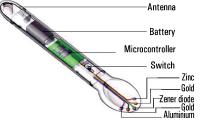
Two students,Connie Cheng andLeonardo Bonanni ofMIT Media Lab are behindthis sensor-laden smart spoon,which monitors the temperature,acidity, salinity and viscosity ofwhatever it happens to be stirringand feeds the information to acomputer for processing. Thisintelligent spoon has zinc, gold, zener diode, and aluminum sensors todetect the temperature, acidity, salinity, and viscosity levels of thehuman-feed it’s currently stirring.
The project aims to introduce computing into traditional culinaryutensils. It seeks to provide information, in an integrated manner, aboutany food the spoon is in contact with, and to offer suggestions to improvethe food. The built-in sensors evaluate the different properties of thefood, and send them to the computer for further processing.
Apart from consolidating measurements that are normally done byan array of equipment into a single spoon, the information obtained canbe used to advise the users what their next step should be; for example,it tells the user if there is not enough salt in the brine prepared to makepickles.
Plastic ..plastic
In the 1950s the world made less than 5 million tonnes of plastic products, now we produce 80 million tonnes!
Car Fuel from Food Waste
Chain of fast food eateries and restaurants world over, push out billions of gallons of animal fat and waste vegetable oil which is an untapped source of transportation fuel – cleaner-burning bio-diesel. As a fuel source, bio-diesel has distinct advantages over conventional diesel based on fossil fuels. When burned in cars, it produces far less carbon dioxide in most cases and can produce fewer sulfur compounds, claims advocates of bio-diesel.
In US, most food outlets currently pay 10 to 15 cents a gallon to waste disposal companies to haul away their food waste. The new bio-diesel companies entering the field, instead, will pay fast food outlets for their oil.
All are benefited, including the environment.
Humans as Professional Noses to Sniff out Pollution
For years, dogs have been man’s best friend when it comes to sniff out drugs. Now humans themselves are being trained as ‘professional noses’ to sniff for illegal emissions while patrolling the southern city of Guangzhou, in China.
Environmental experts train the selected people in the laboratory to differentiate between hundreds of odors and gauge their threat to human health. A dozen such sniffers will be employed by an environmental monitoring station in the city to detect noxious gases released by chemical and rubber factories, as well as from rubbish dumps and sewers. The sniffers expect to receive certificates that will officially let them commence their careers as professional noses. The certificates will be valid for just three years, though, because humans’ olfactory capabilities tend to decline with aging.
Universal Cell Phone Charger-Chinese Stipulation
We are now in an era of portable gadgets, predominantly cell phones, powered by batteries to be re-charged regularly. Thus the charger has become part and parcel of people on the move, with its inconvenience.
China is now taking the lead to enforce a compulsory universal cell phone charger standard. The aim is to reduce the number of chargers that are thrown away each year because of very high cell phone upgrades in China – nearly 100 million cell phones are destroyed by the non-invasive radio waves.
Navigation Skills of Homing Birds
One of nature’s most intriguing mysteries is how some birds are able to retrace their path after the seasonal migration to places thousands of kilometres away. It has long been recognized that birds possess the ability to use the Earth’s magnetic field for their navigation. But the real scientific basis behind this navigation skill has not been clarified until very recently. The recent discovery of iron-containing structures in the beaks of homing pigeons in a new study by scientists at the University of Frankfurt offers some insight into this complex issue.
In histological and physicochemical examinations, iron-containing subcellular particles of maghemite and magnetite werefound in sensory dendrites of the skin lining the upper beak of homing pigeons.
China promotes Solar Water Heating
Nearly 80 % of China’s hot water requirements are met through solar water heaters. According to a recent plan, the Chinese government is encouraging new buildings and major users of hot water—such as hospitals, restaurants, swimming pools etc. —to install solar water heaters as the technology has become mature and cost-effective.
A typical device, consisting of a two-square-meter collector with rows of glass tubes and a 180-litre storage tank, can provide hot water for a 3 to 4 person family at a minimum cost of around US$195. In 2006, the Chinese solar water heater industry had a turnover of more than US$2.6 billion and provided nearly 600,000 jobs. The total installed capacity of solar water heaters nationwide has reached some 90 million square meters, or roughly 60 percent of the world total.
Courtesy: Executive Knowledge Lines
Drunk-driver detection system
Drunk-driver detection system
Nissan, the third largest car maker of Japan has developed a Drunk-Driver
Detection System. Before starting the car, the driver has to blow into a
breathalyzer like unit on the dash which will decide whether he is drunk or not.
If drunk, ignition system will not work and car will not start Odour sensors on the
driver and passenger seats read alcohol levels, while a detector in the gear-shift
knob measures the perspiration of the driver’s palm when starting the car.
The car also includes a mounted camera that monitors alertness by eye
scan, ringing bells and issuing a voice message that a driver should pull over and rest.
Laser printers and health
Laser printers and health
Wednesday,22 August 2007 16:4 hrs IST/MALAYALA MANORAMA English edition
As per the air quality researcher Lidia Morawska and colleagues at the Queensland University of Technology, Australia, some home and office laser printers may spew out as much particulate matter as a cigarette smoker inhales, posing serious health problems to the users.
The study, measured particulate output of 62 laser printers, including models from all major brands. Particle emissions, believed to be toner – the finely-ground powder used to form images and characters on paper – were measured in an open office floor plan, then ranked.
They classified 17 of the 62 printers, or 27 per cent, as “high particle emitters”; one of the 17 pumped out particulates at a rate comparable with emissions from cigarette smoking, the study said.
Morawska called the emissions “a significant health threat” because of the particles’ small size, which makes them easy to inhale and easily lodged in the deepest and smallest passageways of the lungs. The effects, she said, can range from simple irritation to much more serious illnesses, including cardiovascular problems or cancer.
The research also found that office particulate levels increased fivefold during work hours because of laser printers. Generally, more particles were emitted when the printer was using a new toner cartridge, and when printing graphics or photographs that require larger amounts of toner than, say, text.
Morawska recommended that people make sure rooms at work and home with laser printers are well ventilated.
Blue eyes spell success

Blue eyes spell success
Monday,20 August 2007 20:7 hrs IST /Malayala Manoram
New York: Success lies in the colour of your eyes, and those with blue ones are likely to achieve more in life than their peers as they tend to study more effectively and perform better in exams, says a study conducted by US scientists. The study did not mention anything about people with black irises.
The tests showed that brown-eyed people had faster reaction time, but those with lighter eyes appeared to be better strategic thinkers.
Brown-eyed people succeeded in activities such as football and hockey, but lighter-eyed participants proved to be more successful in activities that required skills in time structuring and planning such as golf, cross-country running and studying for exams, the scientists said.
Louisville University professor Joanna Rowe, who conducted the tests, said the results suggested an unexplored link between eye colour and academic achievement.
“It is just observed, rather than explained,” she told ‘Herald Sun’. “There’s no scientific answer yet.”
Bedfordshire University senior psychology lecturer Tony Fallone, who has also studied eye colour, believed it should be taken more seriously as an indicator of personality and ability.
Blue-eyed academic successes include Stephen Hawking and Marie Curie who twice won the Nobel prize, for physics and chemistry.
Blue eyes contain low amounts of melanin within the iris stroma. The type of melanin present is eumelanin. People with blue eyes are relatively common throughout Europe and other areas with populations of European descent, such as Canada, the United States, Australia and some countries of the Middle East. Iranian states such as Afghanistan and Iran also have somewhat uncommon occurrences of blue-eyed people.
There are also populations in northern India and Pakistan that have naturally occurring blue eyes, although this is extremely rare. Throughout the rest of the world they are relatively rare. Around eight percent of the world’s population has blue eyes.
As melanin production generally increases during the first few years of life (especially if exposed to the sun), the blue eyes of some babies may darken as they get older. In the case of blue-green eyes, they must be more blue than green to be considered blue. Aqua blue is a good example of eyes that are more blue than green.
Team 1 news – 479 dt 15082007 – 60th Independence Day Special

Dear members,
A warm welcome to all of you to sit, relax and read through the 60th Independence Day Special edition of Team 1 news.
India is a land of tradition and 60th Birthday is one which all family members take pride and care to celebrate in the best way and pay tribute to those whom we love and lived with. On such occasions we all tend to give a gift of our choice. As a truly patriotic Indian, it is my simple and humble gift to my mother country and fellow Indians. If I am able to generate a Positive and Quality feeling in you to contribute and build our nation to a greater height, I will be more than satisfied. Making an effort is something which is always better than doing nothing. I believe totally in it.
Do not hold on to your thoughts and ideas. If you would like to contribute to Team 1 with your own articles, photos or any thing which is of Quality Value to our readers, please email them at team1dubai@gmail.com .
For a pdf version of the newsletter in full, please email your request to team1dubai@gmail.com.
God Bless,
Ramesh Menon
15082007

Great-great Grandma get Masters Degree

I always believe that education is a continuous process which should go on and on. And here is a news article about a grandma to support my belief.
Taken from Khaleej Times 04082007
Beauty of Maths!
Beauty of Maths!
1 x 8 + 1 = 9
12 x 8 + 2 = 98
123 x 8 + 3 = 987
1234 x 8 + 4 = 9876
12345 x 8 + 5 = 98765
123456 x 8 + 6 = 987654
1234567 x 8 + 7 = 9876543
12345678 x 8 + 8 = 98765432
123456789 x 8 + 9 = 987654321
1 x 9 + 2 = 11
12 x 9 + 3 = 111
123 x 9 + 4 = 1111
1234 x 9 + 5 = 11111
12345 x 9 + 6 = 111111
123456 x 9 + 7 = 1111111
1234567 x 9 + 8 = 11111111
12345678 x 9 + 9 = 111111111
123456789 x 9 +10= 1111111111
9 x 9 + 7 = 88
98 x 9 + 6 = 888
987 x 9 + 5 = 8888
9876 x 9 + 4 = 88888
98765 x 9 + 3 = 888888
987654 x 9 + 2 = 8888888
9876543 x 9 + 1 = 88888888
98765432 x 9 + 0 = 888888888
Brilliant, isn’t it?
And finally, take a look at this symmetry:
1 x 1 = 1
11 x 11 = 121
111 x 111 = 12321
1111 x 1111 = 1234321
11111 x 11111 = 123454321
111111 x 111111 = 12345654321
1111111 x 1111111 = 1234567654321
11111111 x 11111111 = 123456787654321
111111111 x 111111111=12345678987654321
Yes MATHS is really like that – Full of wonders.
You should also know the POWER OF 9.
Anything multiplied by 9 , it’s sum total is 9
Contribution from Barkha Temle Member CiteHR.
Can Alzheimer’s disease be prevented?
Can Alzheimer’s disease be prevented?
Malayala Manorma English Edition Monday,30 July 2007 20:48 hrs IST
Alzheimer’s disease is the most common form of dementia, a group of conditions that all gradually destroy brain cells and lead to progressive decline in mental functions like memory, ability to learn, reason, make judgments, communicate, carry out daily activities etc. As Alzheimer’s progresses, individuals may also experience changes impersonality and behavior, such as anxiety, suspiciousness or agitation, as well as delusions or hallucinations.
In US alone, there are over 5 million people with Alzheimer’s disease. However, people in India have an unusually low incidence of Alzheimer’s disease, it is observed. Although there is currently no cure for Alzheimer’s, new treatments are emerging as a result of better insight into the biology of the disease.
It is well known that Alzheimer’s occurs less commonly in well-educated people and studies show that life long learning is a good way to combat this disease.
Regular mental stimulation through work, continuing education, extensive reading, playing mentally challenging games like solving mathematical puzzles of sudoku and magic square, or learning a new language or musical instrument etc. can help keep the mental capabilities finely tuned. Such mental activities cause brain cells to grow more numerous connections that aid communication with adjoining brain cells. Scientists have discovered that, even in old age, some areas of the brain can actually create new cells in response to stimulation. Participating in interesting social or leisure activities is found to diminish the July 2007 Executive Knowledge Lines 5risk of the disease.
In a study researchers found those who engaged in the greatest variety of leisure activities-including hobbies, going on outings, visiting family or friends, volunteering, or joining group social events-had the lowest risk of mental decline. Physical exercise also helps keep our cognitive abilities in good shape. Exercise enhances mental agility and alertness, perhaps by improving blood flow to the brain. In a study of exercise patterns in women, researchers found worsening mental abilities in 24%, who walked little, a half-mile each week. But in women who walked the most-an average of 18 miles a week-only 17% showed signs of mental decline. Stress reduction with techniques like meditation, yoga, and breathing or relaxation exercises is also found to help in managing the disease.
Finally, good nutrition is also an important factor. A high-fat diet and obesity are factors that increase the risk for Alzheimer’s. Some of the nutrients that may offer protection include B-complex vitamins, monounsaturated fats such as olive oil, omega-3fatty acids in fish and flax seeds, antioxidant vitamins C and E in fruits, vegetables, and whole grains (especially blueberries, spinach, and seaweed), turmeric etc.
 ClicksandWrites
You must be logged in to post a comment.