Education +
Tackling cases of severe disabilities

Isphana Al Khatib, Director of Al Noor Centre says that it takes around Dh35,000 to train a child with special needs.
Tackling cases of severe disabilities
By Siham Al Najami, Staff Reporter GULF NEWS Published: January 10, 2008, 23:32
Dubai: Al Noor Training Centre for Children with Special Needs caters to children with severe cases of disability or with multiple disabilities especially to help parents with very low incomes.
The centre offers individualised academic programmes, vocational training, self awareness programme, behaviour modification programmes, physical education and computer training along with work placement and therapy.
Isphana Al Khatib, Director of Al Noor Centre said that it takes around Dh35,000 to train a child with special needs and faced many challenged cases as parents are not aware of early intervention procedures or where to take their children.
Since graduates from most special needs centre do not get an official graduation degree, Al Noor Centre in collaboration with the National Institute of Open Schooling based in India offered 7 of their students the opportunity to register for courses with which the graduate gets an official certificate on the courses completed such as English, word processing, economics, business studies, and home sciences.
“The area of special needs has developed in the country but still we have a long way to go especially on public awareness. We need structured systems to support people with special needs. From a medical point of view, we need more extensive diagnosis and certainly early intervention. Most people with special needs go without care or support in their first five years, which is the most crucial for their physical and mental growth,” she said.
The director of a special needs centre in Abu Dhabi, who wished to remain unnamed, said a number of her students are fit to join regular schools but face limitations and endless procedures from the Education Ministry and Education zone. “The ones that succeed in getting their children into mainstream schools battle passionately to get permission from senior officials and pay a lot of money to hire an assistant teacher with the special needs child to accompany and monitor the pupil,” he said.
Wheelchairs fail to ground 10-year-old pupil’s dreams

Wheelchairs fail to ground 10-year-old pupil’s dreams
By Siham Al Najami, Staff Reporter GULF NEWS Published: January 10, 2008, 23:32
Dubai: Abdullah is a 10-year-old boy born with spina bifida – a neurospinal disease that causes paralysis from waist down.
He has been using a wheelchair for years. Other than his physical disadvantage Abdullah has no other health problems, and is mentally and socially capable and sound.
Yet the ambitious child faces a tremendous challenge daily since society does not cater to the basic needs of people with special needs. Abdullah’s parents worry every year about his schooling.
Last year he was forced to leave a school because of his physical disability and missed the first three weeks of the academic year. Most schools in the UAE do not have ramps or are inaccessible for people with special needs.
Fatima, his sister, is frustrated by the education system and believes there should be a department or authority willing to cater and support children with special needs.
“The Ministry of Education couldn’t do anything about the previous school or help direct me to a school accessible for people using wheelchairs,” she said.
In his previous school, Abdullah was enrolled in grade 4 with the hope of progressing to grade 5 in the same establishment despite the fact it is on the second floor.
Now Abdullah is in a different private school after visiting 15 schools and contacting over 25 schools to find one that is willing to enrol him and has the necessary facilities. Although he likes his new school and is well-adjusted, he still faces the same challenge of having the upper level classes on the second floor along with the laboratories.
Teenager wins right to join class
By Siham Al Najami, Staff Reporter GULF NEWS Published: January 10, 2008, 23:32
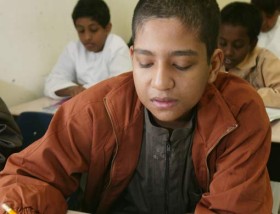
Dubai: Thirteen-year-old Abu Bakr Shaikh Al Alawi recently joined a public school after his parents battled fiercely for over four years to convince the authorities that he is fit to be in a mainstream school.
“My son is very talented. He memorised the Quran and won a lot of prizes and passed his exams set by the Ministry of Education. So I questioned myself: why can’t he be enrolled in a regular school?” asked his Emirati father.
The ministry agreed to integrate Abu Bakr, a child with autism, on condition that a special tutor monitors his progress in school and at home, said his father.
He said he finally found a teacher in Saudi Arabia. “Even though it is the duty of the ministry to cater to the needs of my son I had to find him a teacher for him to get accepted into a regular school,” said the father.
Abu Bakr is the first child with autism to be fully integrated into a regular school. “Abu Bakr is a very good child and deserves to have the same opportunities as the rest of the students,” said Amal, Abu Bakr’s older sister. Her brother had to go through unnecessary procedures such as repeating the same curriculum as he moved between many schools to prove he is capable of being a “normal student in a regular school”.
His teacher, Mustafa Mahmoud, at the Abu Dhabi Autism Centre praised the efforts of parents.
First UAE student to learn Mandarin graduates
First UAE student to learn Mandarin graduates
WAM Published: January 10, 2008, 17:59
Beijing: The first UAE student to study Mandarin language graduated here on Thursday.
In a ceremony organised by the Beijing Language and Culture University (BLCU), Hassan Hussain Zafer was awarded a Bachelor’s degree in Mandarin, becoming the first UAE national to study the Chinese language.
BLCU is the only institution in China which teaches Chinese language and culture to foreign students, according to the BLCU website. The graduation ceremony was attended by UAE Ambassador Mohammad Rashid Al Boot, BLCU President and faculty members.
Power Tips for Improving Communication Skill
Power Tips for Improving Communication Skill
It might sound an over-simplification, but it’s true. The best way of improving communication skill is through practice. There are some easy and fun ways that you can improve your communication skill, though, so you needn’t worry about it being too hard to do. You will probably be really glad in a short space of time that you bothered to improve your communication skill.
Remember that communication can be either written or spoken. Both of these improve with practice and here are some fun ways to do that:
1. Write down your thoughts
Just write down anything. It can be impromptu and you Don’t have to show these ideas to anyone. This helps you to be able to order your thoughts logically.
However, if you find that you enjoy this way of expressing yourself, you could join an online community or article database which will publish your articles. There are lots of opportunities like this online and some even offer payment, but what is probably more important and more gratifying is knowing that people are reading your opinions.
You may even find a site where articles are ranked by your peers. If you dare to subject yourself to such ranking, then you can be pleasantly surprised at how highly regarded your writing becomes.
2. Learn from other communicators
Watch speakers on TV or go to lectures. See how the experts do it. You can learn a lot this way, seeing what you liked about their way of putting their message across.
In improving communication skill, it’s important to have the confidence to get your own style. Getting some tips from others is fine, but no-one has all the answers and you may well have some good ideas yourself. Your communication style needs to be individual to you and you need to feel comfortable communicating in this way for it to be really effective.
3. Try the telephone
Telephone conversations take a different set of skills. Obviously, one big difference is that you can’t read body language of the person you’re talking to on the end of the telephone line. Also, without this body language to read, silences can seem much longer over the phone.
They are still important pauses to allow people to think, though, so you need to learn not to be frightened of these pauses in conversation.
4. Chat to people
Try holding a conversation with anyone you meet – the bank cashier or the man you pay for your gas when You fill up the car. Anyone. It’s the practice that matters.
5. Strike up a debate
One way of improving communication skill that you may not have considered is getting a few friends together and having a friendly debate. Pick a current topic in which you are all interested. It doesn’t have to be anything weighty or in any way controversial; in fact, whilst you are just starting out improving your communication skill, it really should be something light and fun in which everyone can participate.
Serve up the coffee and have fun with the debate. It can be casual and low-key and if you really want to have fun with it, which not switch to argue on the opposite side a little way into the debate. That’s a great way of improving communication skill. Keep it impersonal and remember not to directly attack anyone and you can have a really fun time and also learn a lot in the process.
So, try a few of these tips and see how much more comfortable you feel in communicating with other people, both people you know and strangers. You will soon be improving communication skills in all areas of your life and you should be enjoying it too.
Knowledge Village to phase out use of halogen lamps
Knowledge Village to phase out use of halogen lamps
Staff Report GULF NEWS Published: January 03, 2008, 01:31
Dubai: As part of its efforts to conserve the environment and mitigate air pollution, Dubai Knowledge Village with the support of Sustainable Energy and Environment Division, have launched a campaign to phase out the use of halogen lamps in the Knowledge Village premises.
The Sustainable Energy and Environment Division (SEED) was created by Tecom Investments as one of its key initiatives under the Sustainable Development Policy, in line with the vision of His Highness Shaikh Mohammad Bin Rashid Al Maktoum, Vice-President and Prime Minister of the UAE and Ruler of Dubai, to make the emirate a sustainable place to live in.
Initiative
The Dubai Knowledge Village’s (DKV) initiative is estimated to reduce at least 174 tonnes of CO2 emission per year, which is equivalent to one passenger abstaining from 26 round trip flights from Dubai to New York.
Dr Ayoub Kazim, Executive Director, DKV and Dubai International Academic City, said: “[DKV] has come a long way since its launch in 2003. However, we know that success comes with a responsibility to contribute something of benefit to the community that has impacted our growth.
“We are expressing this through a series of initiatives towards safe guarding the environment, which we believe will not only have a sustainable impact on our immediate surroundings but also motivate others to emulate our example.
“In April 2007, we rolled out a comprehensive Energy and Water Conservation Programme that reduced CO2 emissions by 1,148 tonnes within seven months. Two months ago, we erected the first and largest solar tracker in the Middle East in front of DKV buildings on Al Soufouh road.
“This year, we have accomplished a major feat in switching off the halogen lamps in our indoor areas at DKV.
“Our next step is to involve our business partners in the initiative, and we are currently discussing the extension of the programme to their offices,” said Dr Kazim.
Ali Bin Towaih, Director, Seed, said: “We are extremely pleased with the commitment that DKV has shown toward this project, which has already generated sound results. Switching off the halogen lamps not only helps reduce energy consumption, it also makes indoor areas cooler and comfortable by eliminating the harsh glare that is emitted by the lamps.
“We hope the initiative will encourage the participation of every facility in Dubai as studies have shown that approximately 270,000 tonnes of CO2 emission can be stopped from reaching the atmosphere if everyone switches off or replaces their halogen lamps, using of course, certain assumptions and conservative extrapolations.”
SEED has carried out several sustainable development initiatives across all entities of Tecom Investments, while playing a vital role in setting up the Energy and Environment Park (Enpark) as a comprehensive eco-friendly community for both commercial and residential use.
IIT-Bombay to air lectures from today
IIT-Bombay to air lectures from today
2 Jan 2008, 0337 hrs IST,TNN
MUMBAI: For lakhs of aspirants who don’t make it to the Indian Institutes of Technology (IITs), the new year has brought in cheer—this tech school is opening its classrooms beginning Wednesday for engineering colleges across the country.
As reported by TOI on December 8, IIT-Bombay will broadcast its lectures live through Edusat, the satellite which caters exclusively to the educational sector. Students of any engineering institute will now not only have real-time access to IIT-B tutoring, but can also interact with resident faculty at Powai.
Inaugurating the live interactive classroom, former TCS vice chairman F C Kohli said he had visited the MIT’s classrooms of the future and India needs to harness technology in education to a great extent. “I will not call this distance learning, but a classroom redesigned. This is virtual live education,” said Kohli, speaking on the IITB-ISRO initiative.
Hinting at the poor quality of education imparted in tier two engineering colleges, he said institutions need to realise they are not graduating “progressive technicians, but progressive thinkers and knowledge workers.” Kohli, who is also the chairman of the board of governors at the College of Engineering, Pune, which had invested in setting up a dedicated fibre optic line to transmit lectures from IIT-B, said engineering colleges will have to work on “pre-requisites” before exposing their students to IIT-B lectures. “Basic pre-requisites, attendance when the course is on and follow-up are three essentials that colleges will have to keep in mind if they want to start offering the IIT courses,” the father of Indian IT said. Additional chief secretary (higher and technical education) Joyce Shankaran suggested that IITs look beyond engineering colleges and transmit lectures to polytechnics and science colleges too.
For IIT-B, director Ashok Misra pointed out that the initiative will go a long way in furthering the cause of education. IIT will start transmitting lectures from 8.30 am to 8 pm. Head of IIT’s centre for distance engineering education programme Kannan Moudgalya said almost 100 engineering colleges had already purchased ISRO receivers to access the live IIT-B lectures. To begin with, IIT-B will broadcast lectures in 13 courses, including software engineering, information systems, computation fluid dynamics, embedded systems, instrumentation and process control and fibre optics communication. “Besides, this initiative should be seen as an inclusive effort of all the IITs. Subject experts from other IITs and engineering colleges can also come to IIT-B and deliver lectures,” added Moudgalya.
toireporter@timesgroup.com
Ministry in deal to raise quality of education
Ministry in deal to raise quality of education By Dina El Shammaa, Staff Reporter GULF NEWS Published: January 01, 2008, 23:09
Abu Dhabi: The Ministry of Education (MoE) and the Abu Dhabi Education Council (ADEC) signed a Memorandum of Understanding (MoU) to raise the quality of education across the UAE and encourage international educational standards.
The agreement was signed by Abdullah Al Mussabbeh, Executive Director at the ministry, and Mubarak Saeed Al Shamsi, Director General, ADEC.
“We want to develop governmental and non-governmental schools following the GCC strategy. We will focus on students from kindergarten till 12th grade and are going to start immediately after the signing of this memorandum,” said Al Mussabbeh.
ADEC is responsible for the education process in Abu Dhabi and focuses on planning, future development, implementation processes across the nation and in dealing with day to day problems in schools.
Responsibilities
The MoU stated the following: the council is responsible for all employees that work in the education sector in Abu Dhabi as from the date of signing the agreement; the council is responsible to deal with all administrative problems and supervises employees in Abu Dhabi, including school principals, employees, administrators and teachers; the MoE to still pay salaries and pensions as well as compensations that are due to the employees working in Abu Dhabi during the transitional period.
“The ministry during the transitional period will keep paying the salaries of the employees, then the council will take over in all the duties done by the ministry in Abu Dhabi to reach a high level of performance,” said Al Mussabeh.
In addition, the ministry is giving all the information concerning Abu Dhabi to the council who aim to evolve the school curriculum allowing students reach international standards, deal with standards of teaching and school maintenance.
The agreement also mentions the number of classes to be given weekly, the beginning and end of the school year, exam dates, holidays and the official working hours; in addition to testing the education level of students through exams that will provide students a chance to go into universities under the supervision of the Ministry and the council held as responsible.
IGNOU aims to increase gross enrolment ratio
IGNOU aims to increase gross enrolment ratio
University launches ‘Convergence of Conventional Education and Distance Learning’ scheme
Convergence seems to be Indira Gandhi National Open University’s (IGNOU) new mantra to take education to the remotest corners of the country.
Aimed at tapping the best of conventional education and distance learning, the university had recently launched a novel scheme.
Called the ‘Convergence of Conventional Education and Distance Learning’, the project is expected to increase the gross enrolment ratio of students.
Vice-Chancellor V. N. Rajasekharan Pillai elaborates:
Increasing role
“The nationwide scheme will also increase the role of technology-augmented education and promote satellite-based education. It will expand the reach of education along with social inclusiveness.”
Prof. Pillai says that the expansion of education globally and in India, in particular, has been tremendous.
These days it is not one single mode but multiple modes of education that are utilised, making use of Internet, information and communication technology, satellites and other different media.
Through a convergence of conventional and distance modes of education, we can enhance the reach as well as the quality of both the systems. This union stands to benefit both, he says.
The scheme
As per the scheme, students pursuing courses in colleges through the conventional system can simultaneously enrol for the same level degrees at Indira Gandhi National Open University.
For this purpose, a student needs to complete the first year of the course through the conventional system.
However, the second year can be pursued via the distance mode.
The credit transfer will be made possible through a memorandum of understanding (MoU) between IGNOU and the university concerned.
Furthermore, IGNOU would identify some new programmes in collaboration with the interested university to offer degrees jointly to students. The programme will be jointly formulated and Indira Gandhi National Open University will supplement the face-to-face instruction offered by the conventional university with an Open and Distance Learning (ODL) component.
Programmes offered:
Institutions can offer undergraduate/ postgraduate programmes of IGNOU.
The scheme provides for the combined use of printed self-learning course material and face-to-face academic counselling enabled by technology for the benefit of the undergraduate/ postgraduate students of the respective college and adjoining institutions who may enrol for Certificate/ Diploma Programmes of IGNOU as a value-added programme.
The mode
The mode of programme transaction will be either face-to-face or ODL. In both cases, IGNOU will provide the course materials. The university will continue to hold discussions on the nature of convergence of conventional and distance modes of education; areas in which convergence is needed; strategies to be adopted towards desirable, effective, viable and cost-effective convergence; possible outcomes of convergence and utilisation by various stakeholders.
GER
According to IGNOU, the targeted Gross Enrolment Ratio (GER) of the 16-21 age group in higher education during the XI Plan is 20, about double that of today.
Prof. Pillai says that this requires doubling of the physical faculties and human resource in higher education institutions, which is a rather difficult proposition by conventional expansion.
“We believe that open and distance learning is a tool for education — it does not have to be utilised only by the Open University system,” he says.
IGNOU is also looking at a mixed model that links face-to-face learning and distance learning systems. This is the state-of-the-art open system of education in the world now.
We are also looking at technology in science-related areas — at how virtual laboratories can be created for a practical mode of teaching.
This is when convergence will occur and forms the background of the joint activity of AICTE, UGC and ODL, he says.
Ravi Mathai the living legend
Ravi Mathai the living legend
IIM Ahmedabad turned 46 earlier this week. This is as good an occasion as any to recall the services of its legendary founder-director Ravi Mathai.
Ravi Mathai, son of John Mathai, finance minister in Nehru’s Cabinet, was appointed the first full-time director of IIMA in 1965. (Vikram Sarabhai had been honorary director until then). The choice of Mathai was in itself remarkable. He was not an “insider” — the Institute had been set up earlier.
He did not have an advanced academic degree — he was a corporate executive who had only recently joined IIM Calcutta as professor. In a country that is still gerontocratic, he was obscenely young — he was 38.
It is a tribute to Sarabhai’s own leadership qualities that he made absolutely the right choice. By 1972, when he stepped down as director, Mathai had not only put IIMA on the national map, he had laid secure foundations for its continued success.
If IIMA has since gone from strength to strength, it is very substantially because of the strategic decisions taken in Mathai’s time as well as the culture, systems and processes he put in place.
In my nine-year association with IIMA, I have often been struck by the abiding impress of its founder-director. I remember attending the then director’s welcome address to the incoming post-graduate batch soon after I had joined. In the course of a 20 minute address, the director invoked Mathai’s name four times.
In the initial years, I noted with astonishment how almost any significant process would be traced back to Mathai. (“Oh, that happened in Ravi Mathai’s time”). Heads of institutions fade into oblivion within weeks of demitting office. Mathai is remembered at IIMA all the time.
What explains Mathai’s success and his profound impact on IIMA? First, a clear sense of purpose. IIMA’s concern, as Mathai put it, was “with the application of knowledge”. This meant that the Institute would be involved in teaching, research and consulting. The impact “would be greatest if it were the combined result of all activities”, so faculty must engage in all three activities.
Mathai saw clearly that to focus merely on business would limit IIMA. It would also expose it to charges of being elitist in its orientation. IIMA’s ambit needed to be wider: it would be an institute of management, not just a business school. It would develop expertise in important sectors, including agriculture.
Secondly, Mathai’s conviction that academic activities can flourish only when faculty are given the fullest freedom. In an academic institution, excellence cannot be ordered. It springs forth when people are given the space to grow and to express themselves freely.
Thirdly, the idea of a faculty-governed institute where decision-making rests primarily with the faculty and not with the director or the board. An example is the admissions committee that is independent of the director. The mechanism has been crucial in insulating admissions from unhealthy influence.
Fourthly, what is, perhaps, Mathai’s greatest bequest to IIMA: the principle of a single term for the director. After six years as director, Mathai stunned the community by announcing his decision to step down and stay on as professor. He gave two reasons for doing so.
One, leaders of academic institutions tended to use their positions for career advancement; this was not good for the institutions. Two, it was important to establish the principle that the director’s position is not hierarchical; he is only first among equals. You are professor, you become director and then you become professor again.
This one contribution of Mathai’s cannot be overstated. In the present scheme of things, the director has sweeping powers. The board of governors does not quite have the monitoring authority of a corporate board. Faculty governance can work only to the extent the director is willing to let it work.
Limiting the director to one term is vital to good governance. It is the knowledge that a director’s actions can be looked into once he has reverted to a faculty role, the certainty that he will be cut dead in the corridors by colleagues whom he has mistreated that acts as a check, however inadequate, on the incumbent.
There is more to Mathai’s enduring impact than his grasp of the principles of good governance in academic institutions. He managed the relationship with government with great skill. He was a superb man-manager with the gift of drawing out the best in people. Above all, he had moral authority: he brought to his office high integrity, a spirit of sacrifice and self-effacement.
India has been fortunate in having had great institution builders. At the national level, we had people of the make of Nehru, Patel and Ambedkar. At the organisational level, we have had the likes of Homi Bhabha, Vikram Sarabhai and RK Talwar (of SBI). In that constellation of institution builders, Ravi Mathai shines brightly.
 ClicksandWrites
You must be logged in to post a comment.