Month: June 2012

Our life – a train journey

Posted on Updated on

Whenever I go to my native, I pass by the railway station. It is a great feeling to stand there on that railway platform and watch the trains passing by. Some trains stop there, some not. Sitting on one of the benches and watching the passengers who continue the journey or getting down or getting in, we could read lot of emotions and expressions. Within that few minutes, everything is over, and the train continues it’s journey, controlled by the engine driver and the numerous signals.
Thinking about it more, our life is just similar to that of a train journey. We get in at some point in it, att some station. We come across many inside and see many from distance and even outside. With some we try and make conversations and then become friends, with some, we may get annoyed and even end up in confronting situation.. We get down where we want to or they get down wherever they have to.
The only difference is in our train journey of “life” we may not have the choice of getting in and obviously getting out whenever or wherever we want to.
So, let us live our life peacefully, beautifully and gracefully well.

Tenancy contract and utility bill mandatory for UAE residence visa

Posted on

Tenancy contract and utility bill mandatory for UAE residence visa

Rule will be implemented after summer break and people will be informed about it: top official
By Iman Sherif, Staff Reporter/GULF NEWS
Abu Dhabi: The authorities’ new requirement of a tenancy contract and copies of utility bills to get a residence visa has not been reverted but only postponed, a top official has confirmed to Gulf News.
“The implementation of the decree is not immediate, as the authorities are allowing a grace period for people to return from the summer holidays, and people will be informed of the dates when this becomes mandatory,” the official said.
“ The decision is not targeting any party or property group but it will serve those departments seeking accurate data about foreigners’ residences ”
Major General Nasser Al Awadi Al Menhali Earlier, the rule was to be implemented from June 1
According to Major General Nasser Al Awadi Al Menhali, the Assistant Undersecretary of the Ministry of Interior for Naturalisation, Residency and Ports Affair, requesting a copy of the housing contract or electricity and water invoice to issue a residency visa, is an administrative decision aimed at maintaining accurate records of people’s places of residence.
“Many residents change their addresses, and it has become difficult for the authorities to reach them. Labourers, whose companies provide them with group housing, have to provide a document that states their address along with a letter from the company, or any contract document, that proves where they live,” Al Menhali said.
Gulf News broke the story last week that tenancy contracts and electricity bills would be mandatory to renew a residence visa or to apply for a new one from June 1.
Security purposes
“The decree aims primarily to provide addresses of all residents for security purposes. The decree does not target a specific category of people, but rather provides the residency sector with accurate, updated and correctly documented database,” Al Menhali said.
“The procedure will be unified across the UAE. It is a procedure that is applied worldwide and not only in the UAE,” he added.
A residency official told Gulf News that the new decision is aimed at improving living conditions, as well as maintaining an accurate census of families living in the UAE and the number of members in each family.
“This procedure is to prevent more than one family from living together as currently four or five families share the same housing,” he said.
“Families will not be allowed to share housing,” he added.
Responding to queries Al Menhali said those sharing accommodation must also present proof of their residence by submitting a tenancy contract or utility bill in their names.
“Those working with companies which provide them with collective accommodation must present proof of their residence, an address and a letter from the employer showing where he resides,” he added.
Al Menhali underlined that the new rule is primarily aimed at verifying the residence of all expatriates living in the UAE for security and procedural reasons.
“It is a security, administrative and service decision taken by the immigration and foreign affairs departments in the country”.
“The decision is not targeting any party or property group but it will serve those departments seeking accurate data about foreigners’ residences,” he added.
My comments as follows:
Thank you for the clarifications on the tenancy contract requirements. This is not a new requirement for visa processing. However, the implementation of attestation process and procedures for residency proof documents, like direct tenancy contract with owners, rental agreement with agencies, and attestation of electricity and telephone bills, if mandatory should be done through an appropriate attestation desk controlled by the authorities. These attestation offices should be set up either at the immigration offices or at specific public points and should function throughout after office hours. This will help residents avoid running around from one office to another and can reduce waste of professional man hours for processing residency permits. Linking important facility ownership details with UAE ID cards will help assist this process of verification. Currently, car ownership is done in a similar manner and can incorporate the ones like tenancy details, etisalat and dewa account details etc. 

Ramesh Menon, Abu Dhabi, United Arab Emirates

To read it in original, please visit GULF NEWS online.

Confusion over change to residence UAE visa rules

Posted on

Confusion over change to residence UAE visa rules

ABU DHABI // Confused applicants for residence visas faced the third change in less than two weeks yesterday, and the second in 24 hours.

Earlier, interior ministry authorities had said that from June 1 new or renewed visas would be issued only on production of attested copies of a valid lease contract and utility bills as proof of address.

On Sunday, the ministry reversed that change and said no such documents were required. Yesterday, however, it clarified that the documents were indeed required, but they need not be attested.

The confusion was evident yesterday at immigration offices. In Al Ain, authorities were asking visa applicants to produce a copy of their tenancy contracts. In Abu Dhabi, they did not.

Long queues built up at the customer care desk in Al Ain immigration department as residents gathered to inquire about the new rules.

One, Joshep Ereira, said: “I have been to the immigration office and found out that they are still asking for the tenancy contract and utility bills. There are now endless woes and frustration, not to mention the long lines at the information counter of people all trying to find out about the new residence visa law.

“I am not exactly sure what the region of Al Ain is trying to achieve from all this. People are really going to get more and more frustrated from lack of information about laws changing from time to time in Abu Dhabi and having no effect in Al Ain.”

Meanwhile in Abu Dhabi city another resident applying for a visa for his family was not asked for either a tenancy contract or utility bills yesterday, and immigration officials were processing paperwork as usual.

Maj Gen Nasser Al Menhali, the assistant undersecretary at the Ministry of Interior responsible for residency, said yesterday the revised rules would be implemented nationwide in an effort by the ministry to compile a database of residents’ addresses.

It was necessary to have the addresses in order to reach residents quickly in case of emergency, and the old addresses were unclear, imprecise and hard to find in a timely manner, he said.

Maj Gen Al Menhali said: “No attestation of the tenancy contract is required from the municipality and this rule is going to be implemented across the Emirates.”

He said the decision by the General Directorate of Residency and Foreigner Affairs in Abu Dhabi to require the extra documentation was “an administrative decision meant to ease the process of identifying people’s domiciles and to ascertain their place of residence”.

Responding to requests for clarification of the decision and its impact on those living in shared accommodation, Maj Gen Al Menhali said: “The decision applies to anyone who has a home address and will be applicable to all the Emirates.”

A tenancy contract or a water and electricity bill must be attached to the visa renewal application as proof of the applicant’s place of residence, he said.

Labourers who work for companies that offer collective housing must also bring proof of where they live, providing an address and a letter from their employer to that effect, or any form of contract that substantiates their place of residence, he said.

The requirement is intended “first and foremost to verify the addresses of all residents in the country for security and procedural purposes”, he said.

Maj Gen Al Menhali added: “It is a security, service-related and administrative measure taken by the General Directorates for Residency and Foreigner Affairs in the nation. It does not target any particular social segment or property developer; it simply serves residency departments in updating their data, establishing the addresses of people residing in the country and documenting them properly.”

He also said the requirements were not unique to the UAE, and were common in many developed countries.

News from : The National / anwar@thenational.ae
To read it in original, please visit THE NATIONAL online


My comments as follows:


It was indeed confusing reports in the last few days regarding the documentation process for residence visa. However, the requirement of tenancy contract is not a new one. However, the new procedure of implementation of attestation process for residency proof documents, like direct tenancy contract with owners, rental agreement with agencies, and attestation of electricity and telephone bills, if mandatory should be done through an appropriate attestation desk controlled by the authorities. These attestation offices should be set up either at the immigration offices or at specific public points and should function throughout after office hours. This will help residents avoid running around from one office to another and can reduce waste of professional man hours for processing residency permits. Linking important facility ownership details with UAE ID cards will help assist this process of verification. Currently, car ownership is done in a similar manner and can incorporate the ones like tenancy details, etisalat and dewa account details etc. Best wishes to UAE authorities in regulating illegal residents and always keeping accurate on information on its resident population.

Art work – Monsoon

Posted on Updated on

Art work prepared using Powerpoint, paint and Adobe. Its simple and easy, try it out.

Art work – Om Sri Ganeshaya Namah

Posted on Updated on

Art work prepared using Powerpoint and Paint. It is simple and easy. Try it out. 

Just for fun

Posted on Updated on

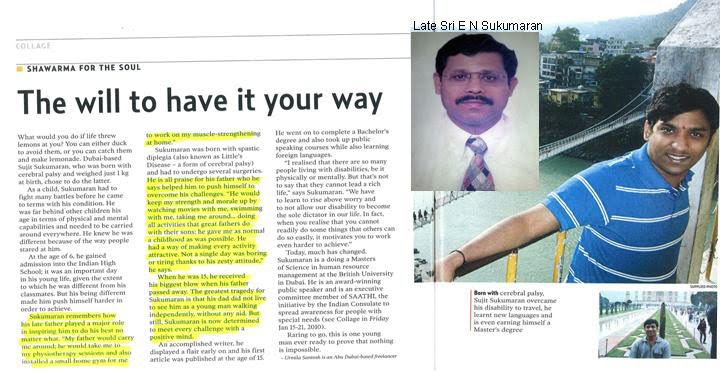
SUJIT SUKUMARAN – The will to have it your way – ALL THE WAY – an inspiration from an inspiration "unlimited"
Posted on Updated on

In the beginning of 1990s, when I landed with my first job in the emirate of Dubai, I happened to stay as guest with a family in Karama. I was moving to Dubai for the first time, after a disastrous start in Abu Dhabi and then looking for a good break here and there and nowhere like. I was made comfortable in the initial days by the ever smiling presence of a young man and his wife and two children. I am always attracted to children who has sparks of brilliance or creativity in them and I really blended well with them. It was a scene of surprise and awe for me as this little boy who could barely walk a few steps and then fall down in front of me but had a tremendous will power in him to get up and walk the remaining steps towards his goal. 

His father was his inspiration and his mother and elder sister support and solace. Without no lift to come down from the third floor apartment, his father used to carry him down and take him to the school bus and school and then the numerous medical treatment and therapies including swimming. 
Life moved on and I too moved on from them and this little boy grew bigger, better, stronger, intelligent and ambitious to be one among us. 
In between we lost contact for several years. After some 7 or 8 years, I reconnected with them one day and as fate has its own way in our life, his ever loving and smiling father passed away on a Friday morning within a short period of our meeting. I was back to Abu Dhabi by then and immediately rushed down to Dubai hearing this sad news. 
His father, Late Sri E N Sukumaran, was an inspiration to many of his friends and well wishers. Those who all know him never misses his presence, even so many years after his death. That was the personality of the man and there were numerous friends and well wishers in that home at that moment. Seeing me amongst the crowd, Sujit, emotionless and in shock leaned on to me and remained with me for the next two days till his father’s body was repatriated for funeral. My tributes and prayers to his soul, once again, while posting this message here.
The connection we made during my short stay remains everlasting and the little boy of that time has grown leaps and bounds and now a self made enterprising individual as any one of us.
Sujit Sukumaran is now an established Toast Master in UAE. Add a very good writer, a professional Resume Maker, a promoter of vegetarianism and Indian culture along with a “no physical or personal difficulties can hold me from moving on in my life attitude”; you will get a picture of Sujit. Oops sorry, add one more precious quality – an eligible bachelor for those numerous young girls out there!!

I invite you to please take a 30 minutes of free time from your life and read the two articles below and carefully listen to what Sujit has to say in his 19.02 minutes video to the world during his recent speech at TEDxAlAin 2012.


His is an inspiring story of exceptional courage, of triumph over the most difficult challenges. It is also an outstanding example of what a human being can achieve if he has the determination to succeed and the support of devoted parents, dedicated doctors and helpful teachers and friends.
By Jyoti KalsiPublished for GULF NEWS December 7, 2002
Strong family and willpower have enabled Dubai resident Sujit Sukumaran defeat cerebral palsy
  
His is an inspiring story of exceptional courage, of triumph over the most difficult challenges. It is also an outstanding example of what a human being can achieve if he has the determination to succeed and the support of devoted parents, dedicated doctors and helpful teachers and friends.
Sujit Sukumaran weighed just one kilogram at birth. Oxygen deficiency after birth resulted in cerebral palsy, leaving him with several physical disabilities. He started crawling when he was 18 months old. He took his first steps, on crutches, when he was four and was unable to walk without support till the age of 12.
He has known the discomfort of daily physiotherapy since he was nine months old and he has spent every school vacation in hospital undergoing medical treatment.
Not only did he have to overcome physical challenges but he also had to deal with the pain of losing his father at the tender age of 15. Yet, today the young man of 17 strides confidently towards a bright future, free from physical or emotional crutches.
“I prefer to count my blessings. Most cerebral palsy patients have some amount of brain damage, but I am lucky that my brain is in pristine condition,” says Sujit.
Life has forced him to grow up quickly but he speaks about his struggle without the slightest trace of self-consciousness or self-pity, and a lot of humour. And a struggle it has indeed been.
Sujit’s tryst with physiotherapy began at nine months. “The stretching and bending was extremely painful and I remember that I always went in crying, kicking and shouting all the way. But four years later I was able to stand with the help of callipers. Today I am very grateful to the physiotherapists at Al Wasl and Rashid Hospitals,” he acknowledges.
Sujit’s main sources of strength were his mother Ramani and his father E. N. Sukumaran. “God gives special children to special parents and whatever I am today, I owe to it my parents,” he says. He was particularly close to his father. “Dad was my friend, guide and mentor. He was a self-made man with a very positive outlook. He always pushed me to aim for the impossible and taught me that problems only exist because we create them,” reminisces Sujit.
His nursery school teachers recommended that he be sent to a regular school. Sujit did well in the entrance exam of The Indian High School, Dubai, and despite initial reservations, the school agreed to admit him.
“The happiest day of my life was the first day I went to a regular school. With my callipers on and holding the hands of both my parents I walked shakily into school, but this was my first step into a normal life,” states Sujit emphatically.
He strongly feels that regular schools should be open to admitting students like him. “A special needs child can never be pushed to improve in a special school environment however good it may be. Whatever I am today is largely due to what Indian High School was able to do for me,” he insists.
A helper carried Sujit and his bag from the school bus to his class everyday and his teachers were always encouraging.
“A major milestone for me was when in the fifth standard a friend suggested that he would carry my bag instead of the helper and others followed suit. I am fortunate to have such friends who do these things for me with love,” says Sujit, adding with a smile that the front seat in the bus was always reserved for him.
Being in a regular school also had its share of problems and disappointments. Children stared at him all the time. “When I asked dad why they did that, he would explain that people stare at anything that is different. They will stare at Aishwarya Rai also if they see her at close quarters, he would say. And eventually it was their curiosity to know which strange planet I came from that helped me to make friends with them,” he laughs.
Sujit felt particularly miserable when the class went out to play. “I sat on my bench and watched them running around and felt really angry. I would pray that someday I could join them and luckily for me, even though it took 15 years, that prayer has been answered,” he says happily.
His most disappointing experience was his first school picnic to Mushrif Park. “Dad had given me money and told me to try all the rides, but the teachers were too scared to let me go on them. So I just sat on the grass and watched the others,” he recalls sadly. But Sujit immediately brightens up at the memory of his parents taking him back the same evening to all the rides in the same park. “And recently I went to Wild Wadi with my class and enjoyed the 80 foot Jumeirah Sceirah, one of the scariest rides in the park,” he says beaming with pride.
Big strides
While he made big strides academically and socially at school, his medical treatment continued. Every morning before school he went for two-hour physiotherapy sessions and there was some surgery scheduled during every vacation.
The first operation, at the age of eight, was a dorsal rhizotomy performed in Hyderabad, India, to treat his spasticity. In a five-and-a-half-hour operation, the doctors opened his back and cut off a series of nerve fibres from the spinal cord. “This was my first experience with big time pain. The physiotherapy was just a trailer while this was the movie,” he jokes.
For 15 days he lay in hospital on his stomach and had to stay in bed for two months. He could not sit and any movement was painful. “The anticipation of a better future, prayer and my ability to make friends with doctors, nurses and other patients is what kept me going,” recalls Sujit.
He finds a positive side even in this traumatic experience. “The doctor gave me a set of books called the ‘children’s knowledge bank’. This is what got me interested in reading and in quizzing. And though I still had to wear calf splints, after this surgery I could walk better and the spasticity reduced considerably,” he reflects.
His 11th birthday was again spent in hospital. This time it was to loosen his hamstrings. “Instead of cake, I got some chloroform. Both my legs were in plaster for two months and the itching felt like there was a swarm of ants in there,” describes Sujit.
As usual he had read up everything he could about the surgery and even watched part of it under local anesthesia. The physiotherapy after the prolonged immobility was extremely painful once again.
“There is no gain without pain,” he says nonchalantly. “At least now I had total freedom of muscular movement. I could touch my feet and tie my own shoe laces, though I still had to wear support pads to protect the muscles,” says Sujit with typical optimism. He has yet another scar from a tendon lengthening operation done during yet another vacation.
Around this time Sujit took part in a poetry recitation contest. “The cruel remarks of some boys triggered the desire to prove myself on stage. The confidence I gained led to participation in quiz contests and other such competitions,” he admits. He remembers with pride his first stage experience as a compere at a variety show organised by the Al Wasl Ladies Club for special needs children and their parents.

Best wishes Sujit, Good luck and keep travelling – you are an inspiring personality to all of us.

Ramesh Uncle
08 June 2012

Om Sai Ram

Posted on Updated on

Om Sai Ram

Posted on Updated on