Month: November 2010
Exploring Abu Dhabi – through Clicks and Writes – Winners Takes it all
Exploring Abu Dhabi – through Clicks and Writes – Winners Takes it all

Indian Sports and Cultural Centre Abu Dhabi (ISCC) encourage sporting activities amongst its members and public. Here is a display of trophies waiting for winners of an annual event.
CLEAN YOUR KIDNEYS IN LESS THAN Rs 1.00
CLEAN YOUR KIDNEYS IN LESS THAN Rs 1.00
Years pass by and our kidneys are filtering the blood by removing salt, poison and any unwanted food entering our body. With time, the salt accumulates and this needs to undergo cleaning treatments and how are we going to overcome this?

Drink one glass daily and all salt and other accumulated poison will come out of your kidney by urination. Also you will be able to notice the difference in your health, which you never felt before.
My Letters – GULF NEWS – The cost of dying: What to expect when it’s not expected

The cost of dying: What to expect when it’s not expected
Death comes to us all — but careful planning can take the pain out of dying for your family and friends
By Deena Kamel Yousef, Staff Reporter
Published: 00:00 November 6, 2010
Reader comments (2)
Dying in Dubai is expensive: families must start saving money and preparing for the death of a loved one to avoid financial and legal problems after the event.
Image Credit: Supplied
We are confronted with images of death and dying on television everyday, yet it is an uncomfortable topic that many families are unwilling to talk or think about. Often a cultural taboo, discussing the death of a family member and how to deal with the body and the estate is considered offensive to the elders.
PDF: Grave charges
Every day four people die in Dubai and every three out of those four will be expatriates, according to statistics.
It’s a sobering fact that does not usually occur to Dubai’s young population, here to pursue a better living standard and higher income.
Why open a can of worms, you say?
Consider the facts: The costs that a family must bear if a relative dies on the other side of the world from home can run into thousands of dirhams. Families are usually unprepared for the bureaucracy and red tape of getting the paperwork, organising the embalming, or sending the body home—all in the middle of grieving for a loved one.
The person’s accounts are frozen and visa is cancelled—leaving the dependants without enough money for survival and forced to leave the country. Life insurance may not be paid out immediately and the court may take months, if not years, to distribute the person’s estate. Those that do not set aside a lump sum of money behind for the family leave behind a knot of financial problems for their family to sort.
Dying in Dubai is expensive: families must start saving money and preparing for the death of a loved one to avoid financial and legal problems after the event.
The Valley of Love, a non-government organization, last year reported 100 cases of families facing financial problems following the death of a relative.
Gulf News takes you through the paper trail and cost of death in Dubai, providing experts’ advice on how to prepare for the event.
Additional specifics on Repatriation costs:
– Calculated by kilo of body and coffin weight. Varies by destination, airlines and total weight. Saving tip: repatriate the body in a cheaper and lighter coffin and transfer to a more elaborate one at home.
– Repatriation to India: Air India transports human remains to any Indian city for free. Other airlines will ship to India with a 50 per cent discount on IATA rates. Charge is approximately Dh20 per kilo. Total cargo cost is Dh1,500.
– Repatriation to Pakistan: Pakistan International Airlines (PIA) ships human remains and provides the accompanying person’s ticket for free
– Repatriation to the UK, Dh65-Dh70 per kilo.
– Repatriation to Africa, Dh95-Dh100 per kilo. It is the most expensive destination.
– Repatriation to Egypt or Lebanon, Dh20-Dh30 per kilo
– Total cost to Europe, Dh20,000 (includes documentation, fees, repatriation).
– Total cost to the Middle East, Dh10,000
– Total cost to Africa, Dh25,000- Dh30,000
– Shipping surcharges: Security surcharge (Dh0.20 to 0.80 per kilo), Fuel surcharges (Dh1 to Dh3 per kilo, depending on fuel prices), screening charge (Dh0.11 per kilo)
– Help line: Call Emirates Sky Cargo services for further details on 04-2184218
Sources:
Abhay Pathak, Regional Manager, Gulf, Middle East and Africa, Air India
Craig Holding, financial adviser and associate director of Acuma Wealth Management.
Helen Williams, Bereavement counsellor, Keith Nicholl Medical Centre, Dubai
Joseph Bobby, Vice President of the Valley of Love, a non-profit organization
Mohammed Marria, senior estate planner for Just Wills, a firm specializing in succession planning
Roy Gaunt, Chartered insurance broker, Nexus Insurance Brokers
Vivian Albertyn, Managing Partner of Middle East Funeral Services, Dubai
DNATA Cargo
Have you experienced financial trouble after the death of a loved on? Have you taken steps to avoid similar issues in the future?
My Comments:
Two excellent and must read articles for expats in UAE. Could be be termed as “Thoughts before we die” in UAE. Personally, I have been with several friends in such situation and and know the enormous paper work money and procedures involved here and India to repatriate or cremate a deceased. Thanks for bringing up these for the benefit of every reader or resident in UAE. Death cannot be planned, but what the situation may be with regards to the close ones could some what be planned or detailed in advance with a bit of timely guidance and attention by such articles.
Ramesh Menon, Abu Dhabi, United Arab Emirates
To read it in original, please visit GULF NEWS Online.
Please also read:
How to save and prepare for death
- By Deena Kamel Yousef, Staff Reporter
- Published: 13:25 November 6, 2010

- Dying in Dubai is expensive: families must start saving money and preparing for the death of a loved one to avoid financial and legal problems after the event.
- Image Credit: Supplied
2. Put some money in a bank account under a family member or loved one’s name.
3. Set aside emergency funds overseas.
PDF: Grave charges
4. Have an honest and open discussion with your spouse or family about your finances.
5. Draw up a will detailing how to split your assets among inheritors. Will cost, Dh3,000; legal costs, Dh1,500-Dh2,000; execution of will in court, Dh45,000-Dh50,000.
6. Buy life insurance: Check the benefits, clauses and time period between the death and the payment. Choose between term insurance and whole of life insurance. You can opt for Islamic life insurance (Takaful) or term insurance which does not rely on investments and is Sharia compliant. Men, older people, and those with risky hobbies have higher premiums. Suicide within the first two years of buying a policy is not covered.
7. Get free advice. Some lawyers and funeral service providers give free advice on steps to take after the person’s death.
8. Approach local non-government organizations or your embassy for financial assistance.
9. Death is the ultimate abandonment. Bereavement counselling is available in Dubai for those unable to deal with loss of a loved one. A 90-minute session costs Dh450.
10. Check your work package if you have funeral and repatriation coverage. Check medical insurance for repatriation costs.
11. Save about 25 per cent of your salary, not just for your death but for your family’s life.
12. Before the deceased’s account is unfrozen, debts must be paid out first from those accounts. Pay your debts regularly to avoid from piling up.
13. Make a list of your assets, liabilities, insurance, stock or investments here and abroad, so the will executor knows where to locate the money.
14. Get off your partner’s visa and onto your employer’s sponsorship if you are working. The deceased’s visa gets cancelled and you will have to leave the country.
15. Don’t rely on your company for death and services benefits.
16. Nominate beneficiaries for your life insurance so they can receive the money.
17. Draft a will and email it to your relatives. Keep the original at home or with a lawyer for records.
18. Write how you would like your body dealt with after death.
19. Write a list of emergency contacts.
20. It is cheaper to be cremated in the UAE than repatriated. Budget airlines do not provide a repatriation service.
http://gulfnews.com/business/your-money/how-to-save-and-prepare-for-death-1.707169
Short Take – Gulf Today – Dt. 06.11.2010 – Changed Attitude
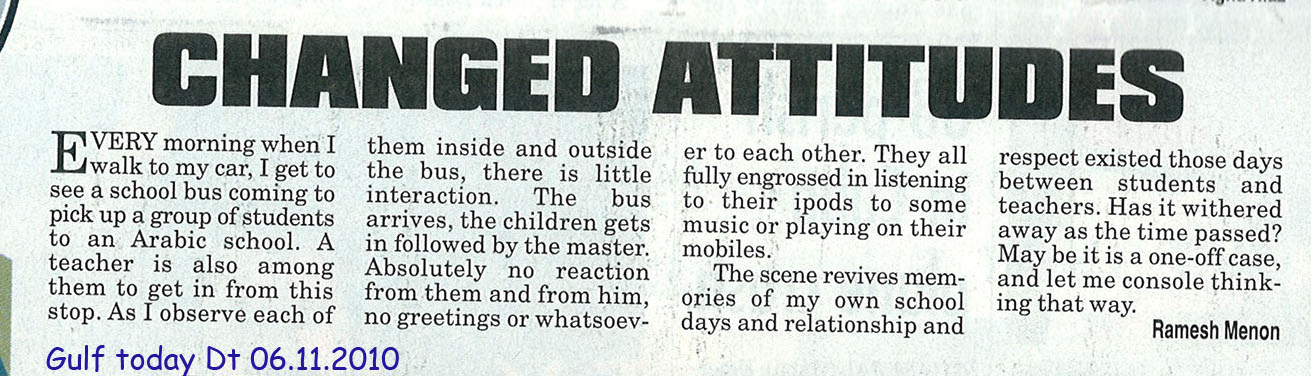
Changed attitudes
Every morning when I walk to my car, I get to see a school bus coming to pick up a group of students to an Arabic school. A teacher is also among them to get in from this stop. As I observe each of them inside and outside the bus, there is little interaction. The bus arrives, the children gets in followed by the master. Absolutely no reaction from them and from him, no greetings or whatsoever to each other. They all fully engrossed in listening to their ipods to some music or playing on their mobiles.
The scene revives memories of my own school days and relationship and respect existed those days between students and teachers. Has it withered away as the time passed? May be it is a one-off case, and let me console thinking that way.
Ramesh Menon
To read it in original, please visit GULF TODAY online.
Happy Diwali – 2010
Festival of lights


Festival of lights
Wish you all a very happy Diwali and prosperous year ahead.
Ramesh Menon & family Abu Dhabi
Exploring Abu Dhabi – through Clicks and Writes – ADIPEC 2010
Exploring Abu Dhabi – through Clicks and Writes – ADIPEC 2010


Exploring Abu Dhabi – through Clicks and Writes – ADIPEC 2010
Exploring Abu Dhabi – through Clicks and Writes – ADIPEC 2010


Indian Football team arrives in Dubai for training

03 November 2010 (report in Mathrubhumi)

You may support this campaign by joining i’ts Fan page on Campain PASS on Face Book.
Credit chaos – My Letters – Khaleej Times – Dt. 03.11.2010
My Letters – Khaleej Times – Dt. 03.11.2010 – Credit chaos

Credit chaos
3 November 2010
A friend who lost his job recently sought my help with regard to his credit card. He was holding a credit card with a local bank, which had a limit of Dh 2500. Upon receiving his termination letter, he informed the bank about it and he was told to clear all his outstanding before his departure.
He duly paid an outstanding of Dh 1300 on it before he left the country. All the information was appropriately conveyed to the bank through its telephone banking system. There was no payment outstanding and he had not used his card during his notice period of one month. Now, after two months, he is getting calls for an outstanding amount of Dh 250. Before leaving the country he spoke with the bank whether he could avail an exemption using the insurance policy on the card considering the job retrenchment scenario. But, unfortunately, that facility was not approved stating that he had delayed his monthly payment one or two times. He is still fighting for clearing his name.
It is, therefore, important for all to take care of the payment dates and if payments are delayed, make sure your insurance coverage is still valid with your bank. If they do not, it is better to cancel the coverage, as it is no longer of any use. It is always important to get an all clearance letter from the bank before leaving the country.
Ramesh Menon, Abu Dhabi
To read it in original, please visit Khaleej Times online.
How to Get Blood in an Emergency (for those in India)
| Now it has become easier to get the blood we need. (For those in India) Just type “BLOOD and send SMS to “96000 97000” ( India ) Ex : “BLOOD B+” A BLOOD DONOR WILL CALL YOU within minutes … Please pass this message to all. It certainly would save many lives. It’s a Must to Know and Share. Please do it now … |
As received from a reliable source
- ← Previous
- 1
- 2
- 3
- 4
- Next →
 ClicksandWrites
You must be logged in to post a comment.