Month: June 2008
MY DRIVING EXPERIENCES IN CHENNAI by Mrs Usha Sridhar
MY DRIVING EXPERIENCES IN CHENNAI
by Mrs. Usha Sridhar, Chennai
Chennai road rules broadly operate within the domain of karma where you do your best, and leave the results to your insurance company. The hints are as follows: Do we drive on the left or right of road? The answer is ‘both’. Basically you start on the left of the road, unless it is occupied. In that case, go to the right, unless that is also occupied. Then proceed by occupying the next available gap, as in chess. Just trust your instincts, ascertain the direction, and proceed. Adherence to road rules leads to much misery and occasional fatality. Most drivers don’t drive, but just aim their vehicles in the generally intended direction.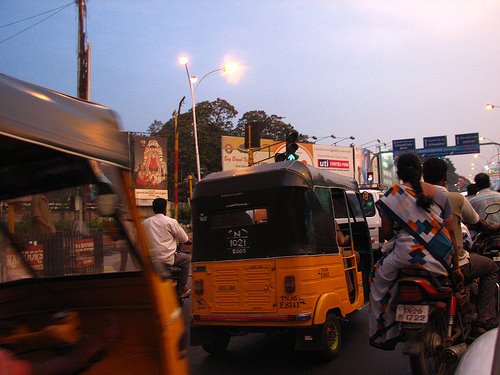
Don’t you get discouraged or underestimate yourself except for a belief in reincarnation; the other drivers are not in any better position. Don’t stop at pedestrian crossings just because some one wants to cross the road. You may do so only if you enjoy being bumped in the back. Pedestrians have been strictly instructed to cross only when traffic is moving slowly or has come to a dead stop because some minister is in town. Still some idiot may try to wade across, but then, let us not talk ill of the dead.
Blowing your horn is not a sign of protest as in most countries. We horn to express joy, resentment, frustration and romance (two brisk blasts),or just mobilize a dozing cow in the middle of the bazaar. Keep informative books in the glove compartment. You may read them during traffic jams, while awaiting the chief minister’s motorcade, or waiting for the rainwater to recede when over ground traffic meets underground drainage.
Auto Rickshaws are the main villains of the road. This triangular vehicle carries iron rods, gas cylinders or passengers three times its weight and dimension, at an unspecified fare. After careful geometric calculations, children are folded and packed into these auto rickshaws until some children in the periphery are not in contact with the vehicle at all. Then their school bags are pushed into the microscopic gaps all round so those minor collisions with other vehicles on the road cause no permanent damage. Of course, the peripheral children are charged half the fare and also learn Newton ‘s laws of motion enroute to school. Auto-rickshaw drivers follow the road rules depicted in the film Ben Hur, and are licensed to irritate.
Mopeds runs 30 miles on a teaspoon of petrol and travels at break-bottom speed. As the sides of the road are too rough for a ride, the moped drivers tend to drive in the middle of the road; they would rather drive under heavier vehicles instead of around them and are often ‘mopped’ off the tarmac. The same is opposite for other two wheelers.
Most bus passengers are hanging off other passengers, who in turn hang off the railings and the overloaded bus leans dangerously, defying laws of gravity but obeying laws of surface tension. Steer clear of these buses by a width of three passengers.

I seriously think that one-way Street are put up by traffic people to add jest in their otherwise drab lives. Don’t stick to the literal meaning and proceed in one direction. In metaphysical terms, it means that you cannot proceed in two directions at once. So drive as you like, in reverse throughout, if you are the fussy type. Least I sound hypercritical, I must add a positive point also. Rash and fast driving in residential areas has been prevented by providing a ‘speed breaker’; two for each house. This mound, incidentally, covers the water and drainage pipes for that residence and is left untarred for easy identification by the corporation authorities, should they want to recover the pipe for year-end accounting.
Night driving on Chennai roads can be an exhilarating experience for those with the mental make up of Genghis Khan. In a way, it is like playing Russian roulette, because you do not know who amongst the drivers is loaded. What looks like premature dawn on the horizon turns out to be a truck attempting a speed record. On encountering it, just pull partly into the field adjoining the road until the phenomenon passes. Do not blink your lights expecting reciprocation. The only dim thing in the truck is the driver, and with the peg of illicit alcohol he has had at the last stop, his total cerebral functions add up to little more than a naught. Truck drivers are the James Bonds of India, and are licensed to kill. Often you may encounter a single powerful beam of light about six feet above the ground. This is not a super motorbike, but a truck approaching you with a single light on, usually the left one. It could be the right one, but never get too close to investigate. You may prove your point posthumously!!!
The writer Mrs. Usha Sridhar, wife of Dr. Sridhar, is now based in Chennai. She was a long time resident of UAE and Sridhar family is enjoying their home coming to India and we hope we get regular updates of their experience and exploration of the new India they are discovering after a long stint abroad.
Mr Muscle’s Adonis Complex

Mr Muscle’s Adonis Complex
By Hina Navin, Freelance Writer for GULF NEWSPublished: June 06, 2008, 00:12
Mirror, mirror on the wall once worried women, but today it has become everyone’s call… including men.
If the extra centimetres around your belly keep you up at night, if you devote two hours a day to toning your biceps and you’re desperately unhappy because your six-pack is not an eight-pack, then you may be part of a fraternity of men that suffers from muscle dysmorphia – an obsession with what men perceive (often inaccurately) as the underdevelopment of their bodies.
Understanding muscle dysmorphia
“Adonis Complex, technically known as muscle dysmorphia, is not a formal diagnosis. It is a type of body dysmorphic disorder, or a preoccupation of thought with a slight or imagined defect in appearance,” says Maya Fleifel Sidani, clinical psychologist at Dubai’s Human Relations Institute.
“There is another and equally interesting side to muscle dysmorphia. It refers to all types of body image preoccupation in boys and men. Some boys and men worry that they are not muscular enough; others worry that they are not lean enough and still others worry that they have some unattractive feature, like their hair or facial features. All of these worries represent different forms of the Adonis Complex.”
How severe can it get?
“Men’s body image concerns range from minor annoyances to serious and sometimes life-threatening obsessions. They can present manageable dissatisfaction at one end of the spectrum to extreme psychiatric body image disorders.
Men who find themselves caught up in these obsessions may find life spiralling out of control. Their lives are often dramatically affected, jeopardising careers as well as relationships with friends and loved ones,” she explains.
In a drive to achieve their goals, some men compulsively pump iron and monitor minute changes in their body composition. Other men may take steroids or muscle-building drugs, despite a catalogue of potential health risks.
Media as an influence
“Adonis was a figure of Greek mythology. He was said to be half man and half deity, and was considered the ultimate in masculine beauty. An Adonis body, according to 16th-century perspectives, was representative of the ultimate in male physique.
The myth goes that Adonis was so beautiful in physique that he won the love of Aphrodite, queen of all deities,” says Maya.
The media has a strong hold on people’s lives. The modern Adonis – extremely fit, muscled men with washboard abs, silky skin and rippling biceps and triceps – can sell everything from branded perfume to accessories.
These muscled hunks can be seen around the city on billboards, on television and in magazines.
Like women, men are driven by the same insecurities when faced with media portrayals of the handsome hunks, and the changed attitude of women adds to their anxiety. “The development of the Adonis Complex shows that men are being targeted as vigorously as women have been for decades,” says Maya.
“The image of the ‘good man’ is related to the protector and the breadwinner. Muscles are a sign of his strength. In addition, the media associates beauty in men with muscularity, and it is a natural phenomenon to like what is beautiful. Therefore muscularity is associated with masculinity.”
Recognise your obsession
Harrison Pope, Katharine Phillips and Roberto Olivardia reveal the hidden signs and symptoms of the male obsession in their book The Adonis Complex.
According to the three American experts, men struggle with the same enormous pressure to achieve physical perfection that women have dealt with for centuries.
From compulsive weightlifting to steroid use and hair plugs to cosmetic surgery, growing numbers of men are taking the quest for perfect muscles, skin, and hair too far – crossing the line from normal interest to pathological obsession.
The new obsession with appearance can afflict men of all ages and all occupations, and in more severe forms it poses a health threat that is as deadly as eating disorders are for women.
“If your self-esteem depends entirely on your appearance, and your exercise regime disrupts your social and working life, then you may be suffering from a body image disorder. Engaging in dangerous practices like fasting, dehydration and steroid use are red flags that the pursuit of muscularity has become excessive.
At its most extreme, this is known as muscle dysmorphia or bigorexia,” Maya explains.
Dangers of this obsession
Men are under pressure: both the pressure they impose on themselves, and the pressure exerted on them by their peers or partner. This makes them set unrealistic goals for themselves and they end up doing more harm to themselves than good.
Some men even lie to their partners about their fitness routine or exaggerate the weightlifting capacity and their actual weight in order to impress their mates. Their obsession becomes their compulsive routine, which they follow without understanding the side effects they may be facing on their mental and physical health.
Health advice
“Each person has a different capacity for exercise that depends on his fitness level. Too much exercise leads to muscle fatigue, injuries to muscles and joints, stagnation of performance, a lack of sleep and other health problems. My advice to everyone is that pre-screening tests be done before starting a new exercise regime so that you are aware of the results of overdoing either cardio or body building workouts,” says Dr Deepa Dhavjekar, spa and recreation manager at the Taj Palace Dubai.
“Remember, you should set realistic goals. In my experience, people join the gym and say ‘I want to lose 10 kg in one month’. Weight reduction takes place gradually through a systematic plan,” she explains.
“Men are actively working harder to look good. They are more conscious about their looks and trying to keep fit. They yearn to have a good physique that will improve their personality and give them self-confidence,” she adds.
“But as many women can tell you after years of striving for perfection, a good physique doesn’t equal a better personality or self-confidence. That’s something you’ll have to work on from the inside.”
Visitors face Dh500 fee in visa overhaul
Visitors face Dh500 fee in visa overhaul
Haneen Dajani and Meera al Sayegh for THE NATIONAL
Last Updated: June 08. 2008 11:18PM UAE / June 8. 2008 7:18PM GMT
Miriam Najam, an immigration officer, deals with people at passport control, in the departures section of Dubai International Airport. Randi Sokoloff / The National
Many visitors will have to pay at least Dh500 (US$136) to enter the UAE under an overhaul of the visa system announced yesterday that is also intended to enable authorities to keep better track of them.
Four extra categories of visas will be added when the changes come into force on August 1, and a series of charges will be levied for some types of stays, including a Dh500 fee for a 30-day visitor’s visa.
Major Gen Mohammed al Khaili, the director general of the Naturalisation and Residence Department, also outlined several amendments to the current visa rules, following a decision by General Sheikh Saif bin Zayed, the Interior Minister.
“As the country is constantly growing and developing, there are more reasons for people to visit, therefore it is necessary to develop the current visa system to match the various types of visits,” said Major Gen Khalili.
The shake-up will create another layer of security at the country’s borders, with more detailed information sought on exactly why each visitor is here.
The new categories include a study visa, a medical visa for those obtaining treatment, an “exhibition and conference” visa and one for guests of the Government.
Other amendments include creating two types of visit visas – short-term and long-term – that will allow holders to stay for 30 days and 90 days, respectively.
At Dh1,000, the cost of the 90-day visa will be double that for a 30-day visit and the fees will apply to people visiting the country to stay with friends or relatives. The 30-day visa can be renewed for a further 30 days, at a cost of Dh500 per person.
For tourists who book into hotels or who book holidays through a registered tour operator or agency, the visit visa will not be required. Instead, they must carry a tourist visa, costing Dh100, which can be issued through the hotel or agency. The tourist company will have to pay Dh75,000 to the Government when opening the agency and a refundable Dh1,000 for every visa for tourists from certain countries.
The company must be able to provide a full itinerary for the traveller for their stay. The visa requirements, which also stipulate that an individual must have health insurance valid for the period of his stay, will apply to all nationalities.
An official, who asked not to be named, said the proposed changes followed an investigation by the Ministry of Interior into visa violations that showed that many visitors misunderstood the conditions.
“The study concluded that narrower categories would make the entry system easier to navigate,” said the official. “The new categories are also intended to curb abuse of visit visas, which are used by many job-seekers to get into the country and then search for employment.”
The need for a medical visa had been identified, he said, “because many violators were using medical treatment as an excuse for overstaying their deadline”. The new visas would make it easier for visitors, said Col Darwish al Meheri, manager of the Department of Entry and Residency Permits.
“For instance, there was no category for students who come to the UAE for short-term courses, such as summer courses,” he said. “Under the new system, such visas could be issued by accredited research and educational facilities.”
A 90-day medical treatment permit will cost Dh1,000 and could be renewed for 90 days at a cost of Dh500. A student visa for short-term courses will be valid for 60 days at a cost of Dh1,000 and could be renewed twice for the same period at a cost of Dh500.
In addition, a visa to attend a conference or exhibition for a period of 30 days from date of entry could be issued at a cost of Dh100, in co-ordination with the event organiser. Applicants will pay a refundable Dh1,000 deposit, to ensure they leave on time. The visa issued by the Government for special guests has no time limit or fee.
Under the current system, foreigners can obtain a “multiple-visit visa” valid for six months, allowing 30-day visits, at a cost of Dh1,000. Under the new system each visit will be limited to 14 days, at a cost of Dh2,000.
A 96-hour transit visa will cost Dh100, used while passing through the country’s airports. The traveller must have a valid ticket for the next flight.
Gen Sheikh Saif bin Zayed promised Federal National Council officials last March that he would submit to the Cabinet new travel regulations for different visa types.
The council has asked the Ministry of Interior to tighten the procedures for issuing visitor visas amid fears that increasing numbers of criminals and beggars are entering the country.
hdajani@thenational.ae
Four new types of visit visas
Four new types of visit visas
By Ahmed Abdul Aziz (Our staff reporter)Khaleej Times 9 June 2008
ABU DHABI — The Director-General of Federal Naturalisation and Residency Department (FNRD) in the Ministry of Interior, Lieutenant-General Mohammed Salim Al Khaili, yesterday introduced four new types of visit visas and announced the new fees structure for various types of visit visas that would be implemented from August 1.
Addressing media at the FNRD Directorate-General in the capital, Lt-Gen. Al Khaili said visa fees have been revised as per the Cabinet’s decision No.16 of 2008.
Colonel Darwish Eid Ebaid Al Meheri, Manager of Entry and Residency Department, pointed out that all visas would be issued after the sponsor or the company paid for and provided health insurance because the visitors who come to the country should have health insurance cover.
About the new types of visas, Lt-Gen. Al Khaili said, “This is to meet the developments that the UAE is witnessing as part of the economic boom and the huge contracting and tourism projects across the country.”
The new fees approved for the six-month multiple entry visa is Dh2,000. However, under this category visitors would not be allowed to stay for more than 14 days in the country on each visit. The visa can be renewed for another six months on payment of Dh2,000.
The new visit visas will be of two types: the long stay (three months) that would cost Dh1,000, and the short (one month) costing Dh500. Both are not renewable.
Lt-Gen. Al Khaili told Khaleej Times that the Ministry of Interior is keen on protecting the workers’ rights and stressed that the companies must abide by the laws when bringing workers to the UAE. The visit visas should be sought only for visitors, not workers, he clarified.
“We work in cooperation with the authorities concerned to protect the rights of workers such as wages, air tickets and health insurance that would not be available to them if they entered the country on visit visas,”, he pointed out, noting that
the firms can apply for three-month mission visas to bring in workers.
The non-renewable mission visa would allow a stay of three months and cost Dh200 and the non-renewable transit visa would allow a stay of 14 days and cost Dh100.
Visit visas for GCC residents would allow a stay of one month and cost Dh100, and could be renewed for another month for a fee of Dh500.
Visit visas for those accompanying GCC nationals would allow a stay of one month and cost Dh100 and could be renewed for another month at a fee of Dh200.
The duration of the new education visas would be fixed depending on the universities’ courses and programmes taken by the students and each authorised academic institute must apply to issue visas for that particular course. The education visa would cost Dh1,000 and could be renewed for a fee of Dh500.
For the medical treatment visas, Col. Al Meheri said they would be issued to expatriates who want to come to the country for medical treatment and would cost Dh1,000 for three months and could be renewed at a cost of Dh500 for another three months.
He added that the tourism visas would cost Dh100, and allow one-month stay and could be renewed for another month at a cost of Dh500.
Lt-Gen. Al Khaili said the travel and tourism agencies would have to pay a refundable guarantee of Dh1,000 per visa at the time of issuance.
Visit visas issued for conferences and exhibitions would cost Dh100 for a stay of one month and would be non-renewable.
Visit visa to the UAE will cost Dh500 from August
Visit visa to the UAE will cost Dh500 from August
By Rayeesa Absal, Staff Reporter GULF NEWS Last updated: June 08, 2008, 16:55
Abu Dhabi: Visit visas to the UAE will cost Dh500 from August 1 following the revamp of the structure and charges of entry documents in line with a cabinet decision, a senior official said. New types of visas have also been introduced.
“Visit visas valid for 30 days will cost Dh500. This cannot be renewed,” said Lieutenant General Mohammad Salem Al Khaili, Director-General of Federal Naturalisation and Residency Department.
“If a person wishes to stay for an extended period, he or she must obtain a visa valid for 90 days which costs Dh1,000.”
A health insurance policy is mandatory for visitors and a Dh1,000 deposit will be collected by the department before issuing visas.
Residents can apply for the visa for their spouse or blood relatives. Sponsoring other relatives will need the approval of senior officials. Only UAE nationals can sponsor friends.
Multiple entries
Some 16 types of visit visas have been defined by the FNRD specifying the reason for visit, such as education, treatment, or for participating in an exhibition or conference.
“A multiple entry visa has also been introduced. The visa [costing Dh2,000] is valid for six months, but a person can stay in the country only for 14 days at a stretch, ” said Al Khaili.
“New types of visas are introduced to keep up with the fastpaced development of the country,” he added.
Student visit visas will cost Dh1,000. To obtain this, a person must be registered in one of the universities in the UAE and must obtain health insurance. Additionally a refundable deposit of Dh1000 must be paid.
Those wishing to undergo treatment must take visit visa for treatment purpose that costs Dh1,000 for 90 day duration.
This can be renewed for a similar period at Dh500.
Those visiting to attend conferences or exhibitions can obtain a visa for this purpose at Dh100.
One-month long tourist visas will cost Dh100, as before. This may be renewed only once. Transit visas will cost Dh100 while mission visas will cost Dh200.
Apart from the 16 new types of visas, complimentary visit visas could be issued by all government departments free of cost to delegates, dignitaries and others.
VISA FEES
Type of visa Fees in Dhs
Short Entry (visit) Visa 500 (1 month)
Long Entry (visit) Visa 1,000 (3 months)
Multiple Entry Visa 2,000
Entry Visa for Study 1,000
Renewal of Study Visa 500
Entry Visa for Medical Treatment 1,000
Renewal of Medical Treatment Visa 500
Entry Visa for Expos and Conferences 100
Tourism Entry Visa 100
Renewal of Tourism Visa 500
Entry Visa for GCC State Residents 100
Renewal of GCC State Resident’s Visa 500
Entry Visa for GCC State Resident’s Companions 100
Renewal of GCC State Residents Companions’ Visa 200
Mission Entry Visa 200
Transit Entry Visa 100
A step into the future

A step into the future
By Manal Ismail GULF NEWS Published: June 08, 2008, 00:06
“Today is the day we’ve all been waiting for. The day we graduate, the day we step up, the day we start upon the road leading us toward the rest of our lives.” Those were the words of Hind Hussam, mass communications graduate and Class Speaker for the 2008 graduation ceremony at the American University of Sharjah (AUS), as he addressed 463 other young graduates.
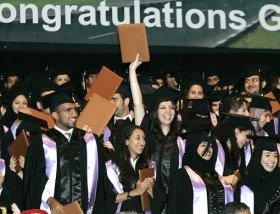
There wouldn’t be a more perfect way to describe the day than as the start of a new beginning. Parents, friends and families flocked to the Sharjah University City Hall, some in tears, others with smiles, yet all expressing the same emotion – happiness.
However there couldn’t have been anyone happier than the graduates themselves. As they proceeded into the hall, each graduate conveyed a different feeling – nervousness, anxiety, pride and anticipation.
Yet each one walked up to the stage with a sense of accomplishment knowing that this day was the culmination of years of hard work and dedication.
His Highness Dr Shaikh Sultan Bin Mohammad Al Qasimi, Supreme Council Member and Ruler of Sharjah, Founder and President of AUS, congratulated the graduates and urged them to inculcate a spirit of cultural understanding and contribute to the development of their societies.
“Education and knowledge are not limited to a nationality or a country,” he said. “Tolerance and understanding are the means to the betterment of the world.”
It’s time to celebrate
The clapping and stomps of eager students shook the hall every time a school or college was called to stand up prior to receiving their diplomas. Their chants of triumph echoed through the hall. “We did it! We did it!” they would shout. During intermittent periods of silence, however, you could overhear the murmur of students discussing what they were going to do after this moment was over.
“I can’t believe it has ended,” said business graduate Amar Ali. “University consumes so much of your time. You can’t help but wonder, what life has in store for us next?”
It’s true that the future is unknown, however most students said they had their lives mapped out. For international relations graduate Sidra Shahid, graduation does not mark the end of her academic life.
She hopes to pursue higher education, lead an independent life and make a difference in society. “My ultimate dream would be to get a master’s and PhD and join the United Nations,” she said. “Although this may be a farfetched dream, no matter what I do in the future I want to be an active member towards making the world a better place.”
The power of the present
In her speech, Hind Hussam advised fellow classmates that the key ingredient to true success and happiness is integrity.
“Today’s world is constantly trying to change us, trying to turn us into people who compromise their values in order to overcome life’s obstacles,” she said. “To maintain a sense of who we are and the values we hold – whether we attain the heights of success or experience the deepest defeat – is the most important challenge that we are going to face,” she said.
Hussam emphasised the importance of the power of now.
She advised students that with every decision they make comes a consequence – one that will either take them on the path to success or another that may cause them to deviate from their goals.
“Now is the time for us to prove ourselves… and to shine!” she said. “Now is the time to make choices and to show the world that we have chosen right over wrong, good over evil and truth over falsehood. We are stepping into the future, my fellow graduates. The world is waiting for us to make our choice and to take that step. And the time is now!”
And the award winners are…
Graduates Ali Yousuf Al Amouri and Murtaza Ali Abbas won the President’s Cup this year. Each year the university awards the cup to the graduates who achieved the highest grade point average. The names of the honourees are engraved on the cup, which is permanently displayed on campus. The two graduates have achieved the full grade point average of 4.0 out of 4.0.
Graduate Emmad Abu Yousuf was also awarded the Chancellor’s Cup for an outstanding combination of scholarship, character, leadership and service to the university.
Class of 2008
– 464 total number of graduating students
– 435 received undergraduate degrees
– 29 received graduate degrees
– 214 males received degrees:
– 250 females received degrees
By school/college:
– 63 students graduated from the College of Arts and Sciences
– 157 students graduated from the College of Engineering
– 84 students graduated from the School of Architecture and Design
– 160 students graduated from the School of Business and Administration.
Dubai address system revamp will help public locate places easily
Dubai address system revamp will help public locate places easily
By Ashfaq Ahmed, Chief Reporter GULF NEWS Published: June 08, 2008, 00:06
Dubai: Dubai will radically revamp the addressing system to help the public locate addresses easily in the fast growing city.
“The expansion of the city warrants the need to have a state-of-the-art addressing system,”said Mattar Al Tayer, Chairman of the Board and Executive Director of the Dubai Roads and Transport Authority (RTA).
He said the RTA has decided to improve the existing addressing system to make it simpler for residents and visitors.
The existing road numbering system will be abolished and the new system will be based on the street names and house or building numbers. A new Directional Signage System will be introduced to make it easier to locate an address.
“The authority wants residents to shift from the landmark-based address system to real address system, because the city is expanding. The new system will also help materialise plans to deliver mail and utility bills at doorsteps in addition to making it easier for people to locate addresses,” a senior official told Gulf News.
Committee
He said the RTA wants people to use real addresses instead of post box numbers.
A committee consisting of top officials from leading government departments, including the Dubai Road and Transport Authority, Dubai Police, Dubai Municipality, Emirates Posts Holding Group, Civil Defence Department, Dubai Ambulance Services and Emirates Telecommunications Corporation, met at the RTA office to deliberate on the new addressing system and decided to bring major changes to the existing one.
“After meetings with our strategic partners, we have decided to overhaul the existing addressing system in a way that help residents, visitors and emergency services reach the desired destinations easily,” Al Tayer said.
The project for the comprehensive address system, including the building numbers, roads and street names and numbers, and the community numbers had first started in the early 1980s in Dubai. So far, about 70 per cent of the city has so far been covered.
The decision was taken after a study conducted by a RTA consultant that revealed difficulties currently being experienced by residents and visitors of Dubai in locating their whereabouts.
The consultant also revealed that that even police and the Civil Defence vehicles found difficult in locating venues of emergency callers as they are unable to accurately describe their locations.
Also, majority of the people do not understand the existing addressing system because it is complicated.
The new addressing system, which will be implemented in phases, will use road names and sectors as a basis for the addressing system.
“The new system does not require to modify the existing building numbers and it will be easy to integrate the addressing system with the Directional Signs System,” said Al Tayer. Currently, road and street numbers are used in most of the areas for directional signs. Al Tayer revealed the change will be made only to directional signs and not the overhead support signage; a matter which will save time and effort as signage will have to be modified in accordance with the requirements at site.
The pilot project for the new addressing system will run for a three-month period after which the results of the experiment will be evaluated.
The Jumeirah-3 area has been selected for introducing the new addressing system, and a sector of Shaikh Zayed Road from the 2nd to the 4th Interchange has also been selected to implement the Directional Signs System.
Maps required for the system will be produced and intensive awareness campaigns will be carried out to educate the public on the optimum use of maps.
An intense media and promotional campaign will be launched to introduce the system to the public and how best they can benefit from it.
How it works
* Under the new system, road names will be used instead of the road numbers such as (24Abu Hurairah Road/Jumeirah, Dubai). It has also been agreed to replace road numbers with new ones.
* Areas will be divided into sectors consisting of several districts, but building numbers will remain the same.
* Names of roads and sectors will be used on the new directional signs instead of names of areas, as is the case in the applicable system.
* The project, which is modelled on the global positioning systems, includes designing and production of Traffic Control Means Guide, and preparing maps of directional sign locations using Geographical Information Systems (GIS) and other similar systems.
UK to give waterless washing machine a spin
UK to give waterless washing machine a spin
9 Jun 2008, 1526 hrs IST,REUTERS
Xeros Ltd, which has been spun out of the University of Leeds to commercialise the technology, said on Monday the new machines would use less than 2 per cent of the water and energy of a conventional washing machine.
Plastic chips are used to remove dirt and stains from clothes, leaving them dry and reducing energy consumption as there is no need to use a dryer after the washing cycle, Xeros said in a statement.
The firm, which recently secured investment of almost 500,000 pounds ($984,400) from IP Group Plc, said that the price of the new machines was “not expected to be dramatically different from (conventional) washing machines.”
Washing machine usage has risen by 23 per cent in the past 15 years. The average UK household uses almost 21 litres of water daily on clothes washing, 13 per cent of daily household water consumption, according to Waterwise, a non-government organisation focused on decreasing water wastage in Britain.
A typical washing machine uses about 35 kilograms of water for every kilogram of clothes, in addition to the power needed to heat the water and dry the clothes
There are more than two million washing machines sold in Britain annually, with a value of about 1 billion pounds, Xeros said.
Toenails indicate women’s cardio risk
Toenails indicate women’s cardio risk
7 Jun 2008, 1309 hrs IST,ANI
LONDON: Assessing the nicotine content in toenail clippings may help predict a woman’s risk of developing heart disease, says a new study.
The US study on nurses suggests that measuring the nicotine content in toenail clippings can help in calculating the risk.
The researchers analysed the toenails of more than 62,500 women, who showed double the level of nicotine in those with heart disease than those without the condition.
The team believes that the test can bring out more accurate results than simply asking a person about their smoking history.
It is well established that smokers have a higher risk of heart disease.
There are existing tests for the presence of nicotine in the body, for example testing the amount of nicotine breakdown products in saliva or urine, but they only reflect recent exposure to cigarette smoke.
Lead researcher Dr Wael Al-Delaimy from University of California, San Diego said because toenails grow slowly – at a rate of around 1cm a year – they may offer a longer-term estimate of a person’s total exposure to tobacco smoke, whether active or passive.
“The use of toenail nicotine is a novel way to objectively measure exposure to tobacco smoke and could become a useful test to identify high-risk individuals in the future,” BBC quoted him, as saying.
During the study 900 women were diagnosed with heart disease. The women in the top fifth for toenail nicotine content were thinner, less active, heavier drinkers, and more likely to have high blood pressure or diabetes, as well as a family history of heart attack, compared to those with less nicotine in their toenails.
Ellen Mason, a cardiac nurse at the British Heart Foundation (BHF) said the study emphasised that smokers are storing up health problems for the future.
“Men and women who smoke are around twice as likely to suffer a heart attack in their life time as those who don’t, and quitting smoking is one of the most effective ways to reduce this risk,” she said.
 ClicksandWrites
You must be logged in to post a comment.