Month: May 2008
E-pet could soon replace passwords
E-pet could soon replace passwords
3 May 2008, 0016 hrs IST,PTI
LONDON: If scientists are to be believed, portable electronic pets able to recognise their owner’s voice and walking style could soon replace passwords and PINs as a way to keep personal details and accounts secure.
A British team, led by Pamela Briggs of Northumbria University, is developing a gadget called biometric daemons which will match the security of biometric security systems and avoid the privacy fears these systems raise.
According to Briggs, instead of a person’s biometric signature being stored on a distant database, they will reside only in the daemon carried around by its owner.
Like a real pet, that daemon would learn to imprint itself on its owner. After that it would thrive on their unique biometric signals, such as voiceprint, fingerprints or walking style.
The human-daemon bond would be further cemented by games and interaction between the two. “Think how people bond with babies. You would do the same things with your daemon – cuddle it, stroke it, play verbal games,” Briggs said.
In the presence of its owner, those nourishing signals make the daemon “happy” and able to verify the owner’s identity, just like a PIN or password. However, separated from its owner, a daemon would no longer receive nourishment in this way and would pine away and die.
The researchers are reluctant to discuss exactly what form that the daemons would take. “The key thing is not the daemon’s physical form, but the way one interacts with it,” Briggs was quoted by the media as saying.
According to her, the daemon could be made in any form, she says, depending on what people relate to best – for example, a toy animal. “If a person lost their daemon, their access to their online life would be lost too, so a way to get a new one would be needed.”
Reaction to the idea from security experts is mixed. “Work on agents and daemons do not tend to be very rigorous,” says John Daugman at the University of Cambridge, UK. “It is difficult to find very much scientific or mathematical content to sink one’s teeth into.”
Alec Yasinsac at Florida State University, Tallahassee, US, says the idea is interesting, but so far immature. “It is hard to predict its potential,” says Yasinsac.
Tree effect on Asthma
Tree effect on Asthma
Indo-Asian News Service
New York, May 01,
Growing more trees might not only make for a less polluted environment but also lower the incidence of asthma among children, according to a study.
Researchers here based their findings on a study of the city’s children in the 4- to 5-year age group. The city has an average of 613 street trees per square kilometre, and nine percent of its children have asthma.
The study found that asthma rates in this age group fell by almost a quarter for every standard deviation increase in tree density, equivalent to 343 trees per square kilometre.
This pattern held true even after taking account sources of pollution, levels of affluence, and population density, all factors likely to influence the results.
The study has been published in the latest issue of the Journal of Epidemiology and Community Health.
Asthma happens to be one of the leading causes of hospitalisation among New York’s children.
Trees may be helping to curb asthma rates by encouraging children to play outdoors more or by improving air quality, the study said.
New York City is planning to plant a million extra trees by 2017, which could provide the perfect opportunity to discover exactly what impact tree density has on asthma, the authors of the study added.
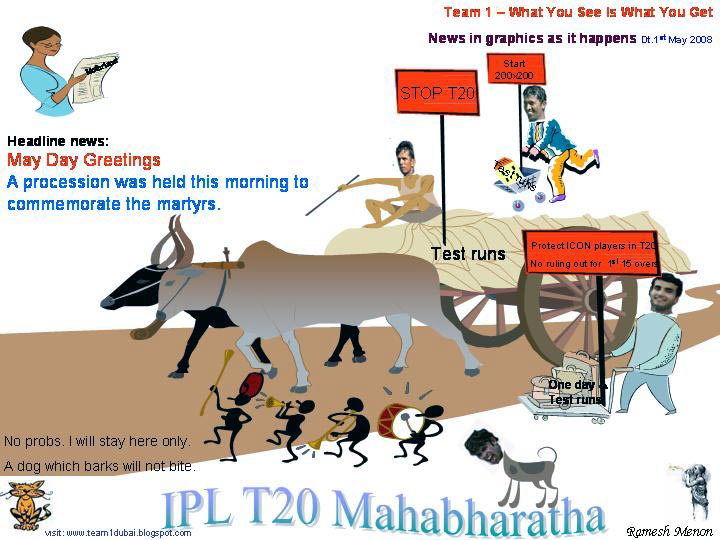
Gopumon finally got it
Gopumon asked several persons for it.
First it was Symonds, then Hayden..
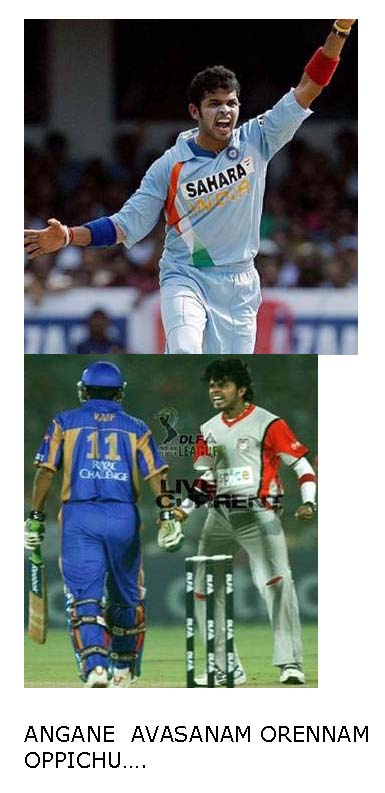

Finally, he got what he wanted. From our Bhaaji.
Hiring friend’s maid easy
Hiring friend’s maid easyBy Ahmed Abdul Aziz (Our staff reporter)/KHALEEJ TIMES1 May 2008
ABU DHABI — Ever wondered, and wished, how you could’ve hired the maid of your friend/acquaintance going home, for a short period? May be till only the time they flew back! Well, it’s now in the realm of possibility.
According to Colonel Nassir Al Awadi Al Minhali, Director of the Abu Dhabi Naturalisation and Residency Department (ADNRD), domestic helps can be hired on a temporary sponsorship transfer basis from one sponsor to another, for a maximum of three months. There is a catch though. This transfer can be effected only once during the residency period of the domestic helps, who include housemaids, drivers, cookers, nannies, and farm workers. Al Minhali told a Press conference held at the ADNRD office here that the temporary sponsorship transfer would be done after the endorsement of the NRDs, and after the concerned officials have studied the applications received from sponsors.
The original sponsor must submit the passport of the domestic help to the NRDs officers after the endorsement to issue a temporary sponsorship permit.
Shaikh Saif bin Zayed, Minister of Interior, has recently signed a decision to this effect, which aims at weeding out the illegals. The decision also aims at facilitating the procedures to find domestic helps.
“As the peak summer approaches, it’ll soon be time for families to travel abroad. They can let their maids work temporarily with another sponsor. The decision applies for all emirates,” Al Minhali pointed out.
Responsibility
The temporary sponsors would be responsible to pay all the dues and other financial entitlements to the maids, as well to provide them with suitable accommodation, food and medical treatment during the three months.
Al Minhali also explained that the temporary sponsors would be held responsible in case the maids abscond.
To avoid the punishments, the sponsors must file absconding reports to the NRDs.
AT A GLANCE
· 90-day temporarily permits
· Cannot be renewed
· Costs Dh500
· Original sponsor can give permission only once for each maid during the residency period
· Temporary sponsors face responsibility in case maids abscond
· No-Objection Certificate (NoC) from the original sponsor is a must
· Companies’ workers are not allowed
WHO CAN ISSUE IT?
· Nationals and expatriates whose salaries are above Dh6,000 a month
· Professionals only (doctors, engineers, accountants, bankers, officers, journalists)
· Government departments’ staff
School buses do not meet international standards
School buses do not meet international standards
By Ahmed Abdul Aziz KHALEEJ TIMES 1 May 2008
ABU DHABI — School buses in the country do not meet the international standards of safety, a top official has said.
In an exclusive interview with Khaleej Times, Mohammad Ahmed Al Shabibi, Head of Transport Office of the Administration Department at Abu Dhabi Education Zone (ADEZ), said this lack of the best safety standards puts the lives of students at risk.
The official was commenting on the spate of accidents involving school buses, and of the recent incident, in which a four-year-old boy died after being left alone in a school bus in Abu Dhabi.
Currently, there are 620 school buses in the emirate of Abu Dhabi and some 5 per cent of them have completed their service life but are still in use, Al Shabibi said.
“In fact, all of these buses fail to meet the international safety standards, as there are no seatbelts, back doors, and emergency exits,” said Al Shabibi.
“We can make the comparison with any school vehicle imported from the US or Japan and we can see the difference,” pointed out Al Shabibi.
As for the bus conductors, he stressed that the schools — both public and private — must ensure that they are qualified and well-trained.
Minibus for kids
The 61-seater school buses are for students aged above 8, he said. “However, these 61-seater buses shouldn’t be used for small kids aged 3-7. The schools must use minibuses with air-conditioning as in without the ACs, the temperature inside the closed buses may even reach 60 degrees. In such high temperatures, even an adult can die in 15 minutes. The kids wouldn’t be able to survive even 10 minutes,” Al Shabibi explained.
UAE to sign $10bn gas deal
UAE to sign $10bn gas deal
Tamsin Carlisle, THE NATIONAL
Last Updated: April 30. 2008 3:51AM UAE / April 29. 2008 11:51PM GMT
Conoco was among the four bidders on the Shah project. Tim Johnson / Bloomberg News
ConocoPhillips rumored to be partner
A long delayed contract to develop big new natural gas reserves will be signed within a week, according to a senior official from the Abu Dhabi National Oil Company (Adnoc).
The US$10bn (Dh37bn) Shah gas project, which is key to providing new fuel needed for power plants to meet soaring domestic electricity demand, has been in limbo for eight months.
“There are no delays, no problems,” said Omair Suwaina, a senior Adnoc official, who was speaking yesterday while attending an industry conference in Abu Dhabi. “We expect to sign within a week,” he told the Reuters news agency.
Mr Suwaina declined to confirm the identity of the contract winner, widely expected to be ConocoPhillips, the US energy company.
Once under way, the project will produce up to one billion cubic feet a day of gas at the Shah field near Abu Dhabi’s southern border with Saudi Arabia. This will be the first of a series of similar projects that the Government wants to undertake.
The Shah project is scheduled to start in 2012. It was first tendered in April 2007 as part of a larger project, but no winning bidder was selected. Adnoc invited four foreign companies including ConocoPhillips to bid again on the Shah development in July of that year. It has since been evaluating the bids.
Deborah Algosaibi, a ConocoPhillips external affairs co-ordinator said Adnoc’s long delay in formally announcing the development could be related to smoothing out contract details. “Perhaps they are dotting an ‘i’,” she said.
Craig McMahon, an analyst with Wood Mackenzie, a British research and consulting company, suggested the delay could be related to the size and complexity of the project, which could involve the parties crafting a detailed commercial agreement. “The devil is always in the details,” he said.
The Shah project is the largest Abu Dhabi upstream development in the past year open to bids by international companies. The gas involved is known as “sour gas” because it contains high levels of acidic and toxic hydrogen sulphide, which makes the project costly and dangerous. Cost projections by analysts have doubled within a year in line with global inflation in the industry. Last April, when Adnoc was proposing the simultaneous development of Shah and Bab, another sour gas field, they pegged the cost for both developments at US$10bn.
Mr Suwaina, who declined to disclose Adnoc’s cost projection for Shah, told the conference that rising costs for energy development worldwide had pushed up the investment required for sour gas projects. He said the UAE would go ahead with plans to develop several sour gas fields to supply its power needs.
“There will be more developments. It is necessary and we have to do it,” he said.
However, sensitivities surround the proposed Bab field and are more pronounced than that of Shah because the toxic gas deposit is close to residential settlements. Bab, and the offshore Hail sour gas field, are next in line for development.
While costs for Abu Dhabi’s technically challenging sour gas projects could be four or five times higher than the emirate has traditionally paid for gas, the rising price of sulphur could sweeten the deal. Hydrogen sulphide stripped out of the gas stream can either be pumped back into the ground for storage or, with favourable economics, processed to yield sulphur. This month, the price of sulphur exported from Abu Dhabi surpassed US$600 a tonne, a stunning increase from about US$20 a tonne just a few years ago. Mr Suwaina said estimates for sulphur contracts were based on spot prices of $700 to $800 a tonne.
The UAE holds the world’s fifth-largest gas reserves at nearly 214 trillion cubic feet., much of it “ultra-sour” with a hydrogen sulphide content of 30 per cent or higher. Although deposits with a similar composition have been developed in other countries, safety concerns, technical challenges and rising costs have held back exploitation here.
tcarlisle@thenational.ae

- ← Previous
- 1
- …
- 6
- 7
 ClicksandWrites
