Month: January 2008
One killed and another injured in horrific car crash

One killed and another injured in horrific car crash By Alia Al Theeb, Staff Reporter GULF NEWS Last updated: January 27, 2008, 21:32
Dubai: A man was killed and another injured after a car overturned on Emirates Road on Sunday.
The victim, who was said to be speeding during poor weather conditions, lost control over the car. The vehicle flipped over, swerved and hit a signboard on the right side of the road.
The driver was killed on the spot while a passenger was injured and was taken to Rashid Hospital. The accident took place on Emirates Road near the bridge that leads to Al Ain.
Brigadier Mohammad Saif Al Zafein, Director of Dubai Police’s Traffic Department, called on motorists to be more cautious during bad weather conditions, including rain.
Speeding may cause the vehicle to skid and the driver may lose control.
He said the chances of road accidents increase during rain, storm and fog and motorists should abide by safe driving guidelines during low visibility.
Brigadier Al Zafein said five per cent of all accidents occur during foggy or rainy weather.
He called for extra caution on main roads such as Shaikh Zayed Road, Emirates Ring Road and the Dubai-Al Ain Road.
Market crash: A quick guide for young investors
Market crash: A quick guide for young investors
rediff Get Ahead Bureau
If you are young and restless and into the stock markets then this is for you.
For the Indian stock markets are caught in a whirlwind and you might need a straw to hold on to something. Some words of wisdom, some nuggets that may help you to relax, howsoever often you may have heard them before.
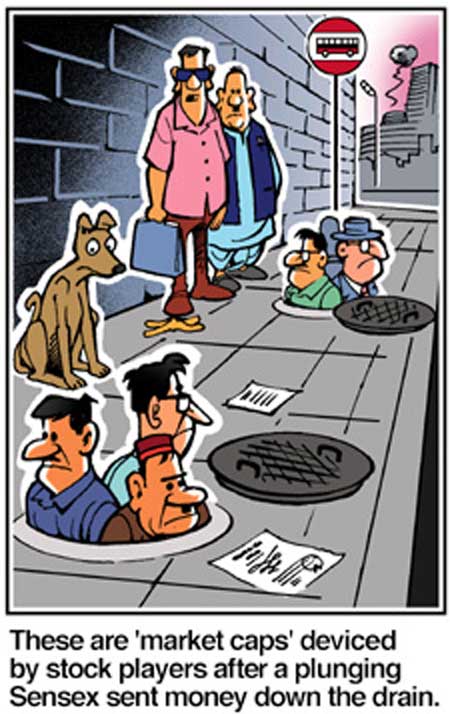
Waking up this morning would you have imagined the 30-stock benchmark index, the Sensex, would crash by more than 1,500 points after noon?
The US markets seemed a bit stable with the Dow Jones down by about 0.5 per cent. The Indian stocks too had been on a downslide since January 15. However, the shock and awe that the Sensex witnessed today must have made a few of the weak-hearted amongst you stop and take heed.
Weak-hearted we all are but if you also have some patience — considering your age — here’s what you should keep in mind to weather stock market turbulences.
1. Start nibbling in
If you believe in India’s growth story every steep fall should be seen as a buying opportunity. If you haven’t yet entered the market but want to then tighten your belts. Market crash like the one today is an ideal time to buy. However, since these are very tumultuous times don’t put all your eggs in one basket.
That is, if you have Rs 100 to invest then put only Rs 25 or even less during such crashes. If you have heart for some risk then put Rs 25 out of that Rs 100 today and keep the rest for later. However, do this only if you are willing to stake your money for at least five-seven years. The long-term stock market story in India still looks positive.
2. Don’t panic
If you are already invested in the market and are sitting on huge losses, don’t panic. The macro economic story in India led by the consumption, infrastructure and engineering sectors still have chances to remain insulated from what’s happening in the US markets. This because many believe that the US recession is responsible for the current weakness across global markets.
If the US can’t buy our goods, no problem. India and Indians have the purchasing capacity believe some experts, who say that the US recession will not have a huge impact on the Indian growth story.
Moreover, India’s demographics, skewed heavily in favour of the young, will help India overcome external pressures in the long run. Young Indians like you are spending more on their daily needs thereby increasing the consumption demand.
So if you are a brave heart and believe that there are bound to be minor hiccups along the way this is your time. Add more and good quality stocks to your portfolio.
3. Avoid averaging
If you are a short-term trader and think that you can buy more of the same stocks to average your buying price then you may be in for a rough ride. Nobody knows for sure about which direction the markets will take in the weeks ahead.
Any bad news coming from global giants like the US, Europe and China can only have multiplier effects. If the markets were to tank further your losses are likely to increase manifold. So book your losses and get out of the market.
However, if you want to invest with a long-term perspective start nibbling in on good quality stocks.
4. Don’t go by tips
If you are young and eager to make money then you are an ideal target for those who give stock tips. They will start flying thick and fast from tomorrow. Or may have started doing rounds even today for all we know. Some of your friends will ask you to buy stocks; some other will advise you to sell them.
Agreed you will find a lot many stocks at prices far lower than what they were a fortnight ago. Check for their credentials. For this is the time when gullible investors go for the bait thrown by stock market manipulators. Don’t buy any stock merely because a broker or a market punter advised you to.
Similarly, there will be a host of technical advisors jostling for your attention. “This particular stock looks weak on the charts. Traders can make some profits by selling them now and buying the same at lower levels with strict stop losses.” Shun the thought. For you never know when the markets will bounce back.
Bottom line: don’t trade on tips. Better still don’t trade at all. Go for long-term investments. For the time being forget what Lord Maynard Keynes said: “In the long-term we are all dead.”
God knows what will happen in the long-term but in the current scenario if you were to act on tips then you will only be responsible for your own ruin.
5. Mutual funds are your best friends
In such times let experts manage your money if you find stock markets to be a hot potato. Put your money in mutual funds for the mutual fund manager is a market expert and is assisted by a big team of market specialists. A decision made by a team of experts will help you make far greater profits than what you will try to do on your own.
The stock market hammering of the last few days should be taken as an opportunity to buy into good diversified equity funds. For, they put their money into the markets irrespective of any sector, theme, or market cap limitation.
When the markets will bounce back they will have a far higher chance of appreciating faster than any other type of mutual funds.
6. Don’t try to time the markets
As an individual you are in no way going to buy when the market falls and sell when the market rises. Believe in investing money into stocks or mutual funds’ systematic investment plans, SIPs, regularly. This is the only key to avoid getting ruined in the stock markets.
The stock market crashes — like the one witnessed today — get evened out by long-term gains. For instance, those who had been regularly investing from the time markets crashed steeply during the May 2006 crash would not feel bothered about the crash today.
The market had crashed to some 12,000 points then from about 16,000 levels in just a month’s time. Today even after the crash the market was trading at 17,000 plus levels.
Remember that age is on your side. If you are in your early, mid or late twenties then this is the right time for you to put your money in stock markets. Historically, stock market gains have outweighed gains from other asset classes over 10-year, 15-year and 20-year time horizons.
Who knows, by the time you are in your 40s or 50s, twenty years from this day, you might look back at this crash as your first stepping stone towards building wealth for yourself and your family.
Barjeel Geojit opens online mutual funds trading platform for NRIs
Barjeel Geojit opens online mutual funds trading platform for NRIs By Babu Das Augustine, Banking Editor GULF NEWS Published: January 25, 2008, 00:04
Dubai: Barjeel Geojit Securities, a UAE-based brokerage and financial services provider has launched Mutual Funds Online, a new web-based trading platform of Indian mutual funds for non-resident Indian (NRI) investors from the UAE.
“We are the first independent financial intermediary to launch such a service, designed to make the investment process paperless, hassle free and seamless,” said Krishnan Ramachandran, CEO of Barjeel Geojit Securities.
Barjeel Geojit Securities, a partnership between Indian brokerage company, Geojit Financial Services, and Al Saud Group of Sharjah were the first financial services firm in the UAE to offer direct brokerage investment services to the NRI community in the UAE.
Expansion
The company has five offices and plans to open two more – in Al Ain and another in Fujairah – this year. “The NRI community in the UAE is increasingly participating in the Indian capital markets and are taking advantage of the Indian economic growth,” said Shaikh Sultan Bin Saud Al Qasimi, chairman of Barjeel Geojit Securities.
Despite the high volatility experienced by the Indian market along with other global markets during the recent weeks, Shaikh Sultan said, the Indian growth story is built of solid fundamentals and Investors should have longer term outlook.
Along with the online services, Barjeel Geojit will offer investment advisory services on Indian mutual funds and capital markets.
“Although the number of NRI investors in Indian markets has increased significantly, many have missed the opportunity. The recent market corrections offers them the chance to enter the market at attractive prices,” said KV Shamsudin, director of Barjeel Geojit.
Chairman of the Association of Mutual Funds of India, A.P. Kurian, said: “Mutual funds are emerging as one of the best investment options. Even those funds which give a small return perform better than other investment alternatives for NRIs.”
More informations can be obtained by logging on to:
http://www.barjeel.ae
or on phone:
Abu Dhabi : +9712 6441555
Dubai: + 9714 3555900
Sharjah: + 9716 5732555
Ras Al Khaimah: + 9717 2277468
Oman: +968 9232067
or in India: Geojit
Phone: = 91 484 2445501
http://www.geojit.com
Beat poet

Beat poet
Staff Report GULF NEWS Published: January 24, 2008, 00:06
Tabla legend Zakir Hussain is sure to enthrall you as he matches beats with other renowned artistes on February 1.
Get set for the ultimate fusion concert, headlined by renowned percussionist Zakir Hussain. A classical tabla virtuoso, his consistently brilliant and exciting performances have not only established him as a national treasure in India, but gained him worldwide fame.
The favourite accompanist for many of India’s greatest classical musicians and dancers, from Ali Akbar Khan and Ravi Shankar to Birju Maharaj and Shivkumar Sharma, he has not let his genius rest there. His playing is marked by uncanny intuition and masterful improvisational dexterity, founded in formidable knowledge and study.
Widely considered a chief architect of the contemporary world music movement, Zakir’s contribution to world music has been unique, with many historic collaborations including Shakti, which he founded with John McLaughlin and L. Shankar, the Diga Rhythm Band, Making Music, Planet Drum with Mickey Hart, and recordings and performances with artistes as diverse as George Harrison, Joe Henderson, Van Morrison and the New Orleans Symphony orchestra.
This time around in Dubai, he will be joined by Vinni Colaiuta (The lead drummer for Sting); banjo player Bela Fleck; bassist Edgar Meyer; U. Srinivas (The first exponent of the electric mandolin in India); V. Selva Ganesh (The Kanjira maestro); Niladari Kumar (The finest young sitar virtuoso today) and Taufiq Qureshi ( a percussionist and folk drummers from Rajasthan).
With Zakir’s fingers creating superb music and Viinie Colaiuta’s impeccable strokes, rhythm is going to hit new highs.
Date: February 1
Venue: Tennis Stadium, Aviation Club
Tickets: Dh1,000 (Paradise); Dh700 (Tranquility); Dh400 (Serenity); Dh300; Dh200 and Dh100
Time: 7pm (Show begins at 8pm)
Contact: 050 4216250 or http://www.ticketingboxoffice.com
Let’s play the game, not politics
Let’s play the game, not politics
20 Jan 2008, 0414 hrs IST,Shashi Tharoor
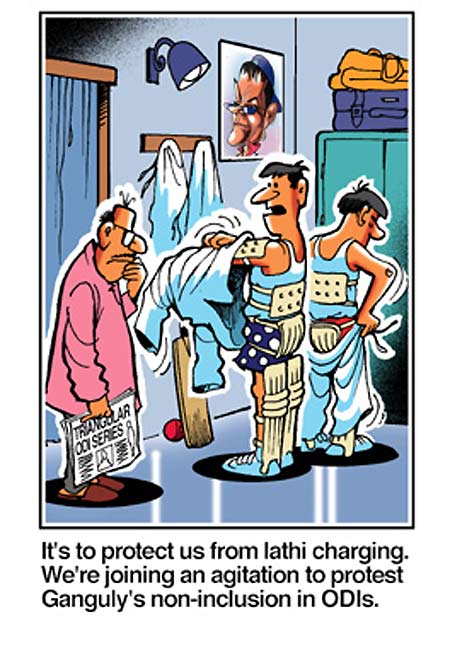
It is dangerous to act as if the undoubted financial weight of India in world cricket entitles us to our own set of rules. Despite the witty private comment to me of a senior BCCI official – “why shouldn’t we now behave in the ICC as the US has always behaved in the WTO?” – we should not destroy world cricket over a misplaced sense of national pride. Racism is as abhorrent when a bunch of under-educated young Indians in our stadiums make monkey-like gestures as Symonds comes out to bat, as it was when Mike Procter walked routinely into a dressing-room from which coloured players were barred.
With the Perth Test underway as I write, the news that the Harbhajan case is on hold till the end of the month, when his (and India’s) appeal against his three-Test ban for alleged racial abuse will be heard, offers a brief respite in which to consider some of the broader issues that have emerged from the recent cricket fracas in Australia.
The cricketing aspects of the controversy are clear enough. India suffered from umpiring that was incompetent and quite conceivably biased, and it was right to make it clear that Steve Bucknor no longer enjoyed the confidence of the touring team. What appears to have been overlooked, though, is the question of why the BCCI did not object to Mr Bucknor’s standing well before the series even began. This is hardly the first time the egregious gentleman has erred against Indian players, denied reasonable appeals, and refused to take recourse to available technology which in multiple cases would have vindicated the Indian side. Indeed I can hardly recall a Test match involving India in which Mr Bucknor has stood in the last decade which was not replete with such incidents: Tendulkar has been a repeated victim. Could the BCCI not, with all appropriate discretion, have privately indicated that Mr Bucknor was not welcome to stand in matches involving India, well before he was appointed (yet again) for a series? Did we have to wait for him to cost us a Test match before we finally declared that enough was enough?
Again, was there nothing that could have been done about the Harbhajan crisis before the dung hit the fan? Australia is the world capital of sledging in sports; the very tactic was invented by them. Australian cricketers pride themselves on their mental toughness and believe other teams are deficient in this attribute; they therefore resort to unpleasant comments, usually involving references to the opposing players’ mothers, sisters or wives, in an effort to disturb the opponents’ concentration and distract them into making errors. The approach involves crude psychology, and while it is rarely witty (“how’s your wife and my kids?” is how an Australian slip fielder once greeted a homesick English batsman arriving at the crease), it is often effective: angry players make rash mistakes. Does the BCCI provide anti-sledging counselling to our players, training them to ignore such provocations and instructing them not to offer any of their own? Was any special attention paid to the hotter-headed amongst our team members, a category into which Harbhajan clearly falls? Would a cooler head have tapped Brett Lee on the posterior with a bat, thereby prompting Andrew Symonds to unleash the diatribe that in turn allegedly provoked Harbhajan’s punishable response? Cooler heads are not just born, they can be made; but there is little evidence that our team management thought that counselling on such on-field matters was likely to be as important as net practice.
Once the complaint was lodged, how hard did we work to get it withdrawn before it came to a hearing? It is not clear that we did; instead of Kumble speaking to the insolent Ponting when the latter said it was already too late, could a higher-level approach to Cricket Australia, pointing to the likely consequences for the tour if this matter got out of hand, have prevented matters coming to a head? The nationwide outrage at the three-Test ban that followed caught our administrators by surprise. But was it wise to imply that the very charge was unacceptable? (Indians are hardly incapable of racism, despite the country’s long and honourable record of opposition to South African apartheid, a system within which Mike Procter played and flourished before discovering its evils in Sydney.)
Once we have lodged an appeal, though, we have every obligation, as a responsible and law-abiding country, to honour its findings. To imply that we would reject any guilty verdict as a slight to our national honour is to undermine the very process in which we have engaged. Once again, the best thing would be to see if the complaint can be withdrawn and the proceedings quashed. But if that is now legally impossible, we have no choice but to present our best arguments to the appeals judge — a professional who, unlike Procter, actually understands the rules of evidence and the meaning of the phrase “beyond a reasonable doubt” — and then to accept his verdict in good grace, whatever it is.
If the judge finds that Harbhajan did say what the Australians accuse him of saying, and that the intent was to disparage Symonds’ racial origins, then we must accept the punishment he imposes, without further cavil. It is dangerous to act as if the undoubted financial weight of India in world cricket entitles us to our own set of rules.
Despite the witty private comment to me of a senior BCCI official — “why shouldn’t we now behave in the ICC as the US has always behaved in the WTO?” — we should not destroy world cricket over a misplaced sense of national pride. Racism is as abhorrent when a bunch of under-educated young Indians in our stadiums make monkey-like gestures as Symonds comes out to bat, as it was when Mike Procter walked routinely into a dressing-room from which coloured players were barred.
Yet one area in which India should definitely use its financial clout is in denying the benefits of Indian corporate sponsorship to players who have violated the spirit of the game. After the appalling behaviour of young Michael Clarke in Sydney, I wouldn’t trust him to tell me the time of day, let alone buy a product he endorses. It seems to me entirely reasonable that Indian companies should rethink the value of associating with such behaviour. If Australian cricketers want to win at all costs, let them realize that there will be costs — to them. But let us always, whatever the provocation, play the game.






Can’t focus on work? Hire a mind trainer
Can’t focus on work? Hire a mind trainer
20 Jan 2008, 0329 hrs IST,Amrita Singh,TNN
January is usually the time for resolutions. But if you find yourself breaking them as you slip into February, don’t lose heart. Try hiring a mind trainer. That’s someone who would help you understand your emotions and show why you haven’t been able to keep your promises. Mind trainers work on making your brain more fit so you are better equipped to excel in life and face various situations with a collected mind.
However, it’s not as easy as it sounds. Training the mind involves an understanding of how your mind works, visualisation techniques and exercises for the brain — popularly called brain gym.
There are people who swear by its effectiveness. Indian cricket coach Gary Kirsten has requested the BCCI for a mental conditioning coach for the team and even recommended his own mind coach Paddy Upton for the job. Kirsten apparently believes Upton was instrumental in shaping his career by making him understand and deal with his emotions while batting.
But it’s not just Team India who is getting a mental coach. As urban Indians are feeling the stress of a more competitive life, even young professionals, students and sportspersons are hiring a mind trainer to help them excel.
In the last two years, several mind training institutes like Brainobrain, Mindtrainers and Mind Gym have come up in the country. At the Delhi Police Public School’s brain gym center, students are encouraged to try out exercises that help them keep their mind strong and agile. Chennai-based SIP Academy, that uses brain exercises to make children learn faster, has grown at more than 60% annually and has over 300 branches in India now. Even individual mind trainers have never had it better. N Renuka, a mind trainer based in Hyderabad, has interacted with over 150 clients in the last two years.
The current interest in mind training focusses on enhancing performance. “Broadly, all the mind trainers, irrespective of the technique they use, work on making the brain cognitively fit,” says Pawan Choudhary, mind coach and author of the book When you are sinking, become a submarine. Among the most popular options for mind training is the brain gym. Sareylom Poole, one of the two instructors approved for India by the US-based Braingym International Foundation, says, “Brain exercises could help just about anyone, whether you are wanting to lose weight or learn faster or improve sales.”
“Brain gym exercises increase the flow of energy between the right and left brain, which in turn increases alertness, concentration, focus and other brain functions,” says Dinesh Victor, a master trainer who also happens to be cricketer Sreesanth’s coach.
To start with, a private session with a gym instructor is recommended, which typically lasts one-two hours and focusses on a specific goal like increasing creativity, imagination, focus etc. At the end of the session, says Sareylom, one typically experiences what is termed as a ‘balance’, which means that the process of learning is complete.
Though the concept of a mind coach has been there for centuries (in the Mahabharata, for instance, Krishna turned into a mind coach for Arjun, while Napoleon is said to have employed the services of Indian hypnotist Abbe Faria, who even accompanied him to several battlefields, including the wars against Italy and England), mind training in the country is at a very nascent stage. Which is why, before you settle on a mind coach for yourself, ask for past experience and proof and only then, enroll for a mind training session.
amrita.singh@timesgroup.com
Chocolate is injurious to bones
Chocolate is injurious to bones
25 Jan 2008, 1109 hrs IST,PTI
NEW YORK: Chocolate, the most widely and frequently craved food, may be good for your heart. But, if a study is to be believed, its regular consumption could weaken your bones and raise the risk of suffering a fracture.
A team of researchers has carried out the study and found that people who eat chocolates daily are likely to have less dense and weak bones, which in turn could increase the risk of health problems such as osteoporosis and fracture.
“Cocoa and chocolate have been promoted as having a range of beneficial cardiovascular properties. But the effect of chocolate intake on other organ systems has not been studied,” according to lead researcher Jonathan Hodgson of the University of Western Australia.
In fact, according to him, though chocolate contains flavones and calcium, both linked to having a positive effect on bone density, it also contains oxalate an inhibitor of calcium absorption and sugar, linked to calcium excretion.
The team came to the conclusion after analyzing the effect of chocolates on a group of 1,000 women aged between 70 and 85, who were randomly assigned either calcium supplements or a matched placebo for a period of several weeks.
During this period, the participants were also asked to keep a dairy of how often they consumed chocolate.
Metro man gets public service vote

Metro man gets public service vote
HT Correspondent New Delhi, January 25, 2008
Anybody who can bring order to a mad city like Delhi deserves the highest award in the world. Delhiites are monumentally unruly on road, and famously callous with public property. They love to scribble graffiti on monuments, rip open bus seat covers, etch romantic messages (for God knows who) on trees and, worse, of it all, relieve themselves whenever it becomes unbearable.
Next time you ride the metro, look for all the familiar signs associated with Delhiites. You won’t find many. People are magically behaving themselves – it’s hard to believe but it’s true.
And making all this happen is, of course, the Metro chief E Sreedharan. And the best part is, he is known more for the other things that he has brought to the city – a good and efficient public transport. Sreedharan is changing Delhi, its geography and its attitude. He is the choice of voters and the jury of the Indian of Year award — instituted by CNN-IBN in partnership with the Hindustan Times – from the category of people in public service.
Former police officer Kiran Bedi, who has a long and eventful association with Delhi, says this for Sreedharan: “What he has done for his country and at his age (70 years) is remarkable. People think it’s time to retire and live in the past but he has given the metro concept to this country with commitment, integrity, vision and remarkable professionalism…”
The metro chief fought off competition for the slot from Bangalore surgeon Dr Sharan Patil, HIV campaigner Kousalya, Sushma Iyengar of the Kutch Nav Nirman Abhiyan, Patna teachers Abhay anand and Anand Kumar and Dr Oscar Rebello of the Goa Bachao Abhiyan.
Sreedharan now joins finance minister P Chidambaram, SBI chairman O P Bhatt, Chak de director Shimit Amin and scriptwriter Jaideep Sahni and chess champion Vishwanathan Anand as category winners in the fray for the Indian of the Year. These nominees have been elected/selected by votes sent through SMS or online and a jury comprising six eminent Indians – lawyer Soli Sorabjee (he is the chairman of the jury), HDFC chairman Deepak Parekh, actor Mohanlal Viswanathan Nair, Hindustan Times Media Limited vice-chairperson and editorial director Shobhana Bhartia, billiards champion Geet Sethi, Infosys co-chairman Nandan Nilekani and former police officer Kiran Bedi.
The Indian of the Year will be declared on January 29.
‘Fight with spouse & live longer’
‘Fight with spouse & live longer’
24 Jan 2008, 0038 hrs IST,REUTERS
NEW YORK: Fighting with your spouse can actually be good for your health with people who bottle it all up found to die earlier, a new study shows.
Researchers at the University of Michigan School of Public Health and its psychology department released preliminary findings after 17 years of following 192 couples.
The couples fell into four categories: where both partners expressed anger when they felt unfairly attacked, where neither partner expressed their anger, and one category each for where the wife suppressed her feelings and where the husband did so.
“I would say that if you don’t express your feelings to your partner and tell them what the problem is when you’re unfairly attacked, then you’re in trouble,” said Ernest Harburg, lead author of the study, in an interview.
The study found that those who kept their anger in were twice as likely to die earlier than those who don’t.
There were 13 deaths in the group of 26 pairs where both partners suppressed their emotions, as opposed to only 41 deaths in the remaining 166 pairs. “When couples get together, one of their main jobs is reconciliation about conflict,” Harburg said.
“Usually nobody is trained to do this. If they have good parents, they can imitate, that’s fine, but usually the couple is ignorant about the process of resolving conflict.”
Harburg said resentment was the real threat – and suppressing anger led to resentment.
He said it is the resentment that interacts with any medical vulnerabilities, a person might have, increasing their chances of succumbing to that medical problem.
“It’s healthy to recognise that you’re being attacked unfairly and it’s even more healthy to speak up and to talk about it and try to resolve the problem if you want to live longer,” said Harburg.
This study comes within a week of a survey that said that it is the price of divorce that is holding many couples together.
In a survey of married men and women in Britain, the majority of wives – 59% – said they would divorce immediately if their future economic security was assured.
Among both sexes, more than one in ten wished they had married someone else. The survey found than half of husbands thought their marriage was “loveless”. Relationship experts in the United Kingdom have warned couples to avoid getting stuck in a rut – or risk the trauma of divorce.
 ClicksandWrites
You must be logged in to post a comment.