Month: December 2007
Silence yourself, not others!
Silence yourself, not others!
Pramahamsa Sri Nithyananda
In the olden days, people in India did not stitch clothes after sunset. This is because all stitching was done by hand with a needle. In the dim candle or kerosene lamp light it was not possible to see properly and one could get hurt by poking the fingers with needle.
Even now in India, some people will not stitch with a needle after sunset. Even seamstresses and tailors will not do it, though we now have electricity and lights. They may not even stitch using machines!
When we don’t have the necessary understanding of a practice, it becomes a dead rule, a superstition. With understanding, any rule can become a technique, a tool that helps us to lead life happily.
With deep understanding, it will dawn upon us that all rules were basically created to help people live blissfully and happily. The rules were meant to ensure that you were in peace with yourself and the others around you. Today, we have forgotten the basis for these rules. We create hell for ourselves and others with these rules.
There are people who truly believe that meditation and prayer will save their lives. They have been told so! They fuss a lot before they begin to meditate at home. They silence the children and all others around. They turn the whole household upside down. All for the sake of ten minutes of meditation!
Let us see how the meditation proceeds. The moment meditation begins, they doze off! After a minute or two, they will start swatting mosquitoes. A couple of minutes later, a major itch manifests on some part of their body. Then, the back will begin to ache. Enough is enough, they decide, “I will continue this tomorrow. It is enough for today.”
Meditation is done for the sake of peace and silence. Why meditate at all, if inner awareness cannot be created?
It is like a speaker trying to silence the listeners by out-shouting at them. Will it help? If the listener is not interested however much one shouts, it is of no use. You cannot silence your inner chatter by making others quiet. You need to become silent, not others.
We follow rules and tradition blindly. That is why religion has such a powerful hold on us. Let us awaken to the powers that are within us! Nature has endowed us with unimaginable energy to be free. Be alert, awake and reach for this liberation!
Ravi Mathai the living legend
Ravi Mathai the living legend
IIM Ahmedabad turned 46 earlier this week. This is as good an occasion as any to recall the services of its legendary founder-director Ravi Mathai.
Ravi Mathai, son of John Mathai, finance minister in Nehru’s Cabinet, was appointed the first full-time director of IIMA in 1965. (Vikram Sarabhai had been honorary director until then). The choice of Mathai was in itself remarkable. He was not an “insider” — the Institute had been set up earlier.
He did not have an advanced academic degree — he was a corporate executive who had only recently joined IIM Calcutta as professor. In a country that is still gerontocratic, he was obscenely young — he was 38.
It is a tribute to Sarabhai’s own leadership qualities that he made absolutely the right choice. By 1972, when he stepped down as director, Mathai had not only put IIMA on the national map, he had laid secure foundations for its continued success.
If IIMA has since gone from strength to strength, it is very substantially because of the strategic decisions taken in Mathai’s time as well as the culture, systems and processes he put in place.
In my nine-year association with IIMA, I have often been struck by the abiding impress of its founder-director. I remember attending the then director’s welcome address to the incoming post-graduate batch soon after I had joined. In the course of a 20 minute address, the director invoked Mathai’s name four times.
In the initial years, I noted with astonishment how almost any significant process would be traced back to Mathai. (“Oh, that happened in Ravi Mathai’s time”). Heads of institutions fade into oblivion within weeks of demitting office. Mathai is remembered at IIMA all the time.
What explains Mathai’s success and his profound impact on IIMA? First, a clear sense of purpose. IIMA’s concern, as Mathai put it, was “with the application of knowledge”. This meant that the Institute would be involved in teaching, research and consulting. The impact “would be greatest if it were the combined result of all activities”, so faculty must engage in all three activities.
Mathai saw clearly that to focus merely on business would limit IIMA. It would also expose it to charges of being elitist in its orientation. IIMA’s ambit needed to be wider: it would be an institute of management, not just a business school. It would develop expertise in important sectors, including agriculture.
Secondly, Mathai’s conviction that academic activities can flourish only when faculty are given the fullest freedom. In an academic institution, excellence cannot be ordered. It springs forth when people are given the space to grow and to express themselves freely.
Thirdly, the idea of a faculty-governed institute where decision-making rests primarily with the faculty and not with the director or the board. An example is the admissions committee that is independent of the director. The mechanism has been crucial in insulating admissions from unhealthy influence.
Fourthly, what is, perhaps, Mathai’s greatest bequest to IIMA: the principle of a single term for the director. After six years as director, Mathai stunned the community by announcing his decision to step down and stay on as professor. He gave two reasons for doing so.
One, leaders of academic institutions tended to use their positions for career advancement; this was not good for the institutions. Two, it was important to establish the principle that the director’s position is not hierarchical; he is only first among equals. You are professor, you become director and then you become professor again.
This one contribution of Mathai’s cannot be overstated. In the present scheme of things, the director has sweeping powers. The board of governors does not quite have the monitoring authority of a corporate board. Faculty governance can work only to the extent the director is willing to let it work.
Limiting the director to one term is vital to good governance. It is the knowledge that a director’s actions can be looked into once he has reverted to a faculty role, the certainty that he will be cut dead in the corridors by colleagues whom he has mistreated that acts as a check, however inadequate, on the incumbent.
There is more to Mathai’s enduring impact than his grasp of the principles of good governance in academic institutions. He managed the relationship with government with great skill. He was a superb man-manager with the gift of drawing out the best in people. Above all, he had moral authority: he brought to his office high integrity, a spirit of sacrifice and self-effacement.
India has been fortunate in having had great institution builders. At the national level, we had people of the make of Nehru, Patel and Ambedkar. At the organisational level, we have had the likes of Homi Bhabha, Vikram Sarabhai and RK Talwar (of SBI). In that constellation of institution builders, Ravi Mathai shines brightly.
Laser scanner for 3D view of tumours
Laser scanner for 3D view of tumours
ANI
LONDON: Scientists have developed a new laser scanner that can give 3D view of the deformed blood vessels inside tumours.
This scanner could prove beneficial to doctors in determining the boundary between cancerous and healthy tissue during surgery.
A novel form of non-invasive imaging called photoacoustic tomography is used by the scanner. A laser light to “twang” cells is utilized so that they emit an ultrasound wave, which is then detected and used to form a 3D image.
The present day ultrasound scanners capture images by aiming high-frequency sound waves at the body. These waves are reflected whenever the density of tissue changes, for example at the boundary between muscle and bone. The “echoes” that result then used to create a picture.
However, these scanners can be useful in capturing images of high-contrast subjects like antenatal scans, but gives rise to only low-contrast images of the inside of a tumor, as the density of blood vessels is similar to that of the surrounding tissue.
The high-resolution photoacoustic tomography scanner offers a solution for this problem. It has been developed by Paul Beard and colleagues at University College London, UK.
Very short pulses of non-harmful near-infrared laser light are thrown at the tumor. When this light is absorbed by tissue, the cells get heated up and expand a little, creating an ultrasound wave that can be detected by a sensor.
The intensity of the ultrasound wave depends on how well the tissue absorbs the near-infrared radiation. This results in high-contrast images of blood vessels because haemoglobin is very absorbent at these wavelengths.
“It’s very scalable,” NewScientist.com quoted Beard, as saying.
He added: “Our scanner is best suited to providing high-resolutions images at a short range, but the technique could be used to image tumours a few centimetres into the breast.”
The researchers also created a new ultrasound sensor so as to convert the reflected ultrasound into a high-resolution 3D image.
It comprised of a thin layer of a polymer sandwiched between two reflective layers. The outer layers only reflect certain wavelengths of light and the laser light used to penetrate a patient’s tissue shines straight through all three layers.
The polymer layer then picked up the acoustic signal generated using the infrared.
“This work demonstrates progress,” said Hao Zhang, an expert on medical imaging at Washington University in St Louis, US.
He added: “In my opinion, it is important for more precise quantitative measurements.”
However, Zhang points out two potential problems. At the moment it takes a relatively long time to capture the image, while the laser scans each reflective surface. In addition, the sensor is flat making it difficult to scan images over curved parts of the body.
However, Jeremy Skepper, a physiologist at the University of Cambridge in the UK said that the ability to image blood vessels at this resolution is very striking.
“It’s less expensive and more portable than other solutions,” he says. “It’s a powerful additional tool to the ones we already have,” he said.
Skepper also suggested that the device could prove to be highly portable in future owing to advances in laser diode technology.
Need to stop waffling between flip & flop
Need to stop waffling between flip & flop
Vithal C Nadkarni
In his new movie, I Am Legend, Will Smith plays the last human survivor in virus-ridden New York. Real life is different: with four of his most recent movies — The Pursuit of Happiness, Hitch, Shark Tale and I, Robot — each grossing more than $300 million, the actor has already become a legend in a notoriously fickle industry.
What’s more, his trademark artlessness on screen is said to be the result of “one of Hollywood’s most meticulously planned and executed careers”. But it wasn’t always so. When he was 16, his first girlfriend walked out on him. That turned out to be a defining moment, he recalls, “In my mind, she cheated because I wasn’t good enough. I remember making the decision that I will never not be good enough again.”
His very first album as a rapper went on to win the first Grammy for a hip-hop act. At 21, when a friend suggested that they should probably have a goal now that they were going to LA, Smith replied without batting an eyelid: “I want to be the biggest movie star in the world.” He also backed his resolve with the notion that education was “the elixir for all problems”.
For all that initial success, “in the first five years in Los Angeles, Smith couldn’t get a meeting with a director or studio,” reports Time. They just didn’t seem to care. Here he was, a rapper who had gotten a most lucky break on the charts and a luckier run in a successful TV sitcom; if that was all he was supposed to be good at, wasn’t it time he resigned himself to a graceful exit euphemistically termed ‘Plan B’? “I don’t want to get too metaphysical,” Smith replies, “but by even contemplating a Plan B, you almost create the necessity for a Plan B.” Which is another way of stating his original resolve: take no survivors; don’t ever admit second-best options or the so-called parachute clause. Paradoxically, only when you deliberately cut off your exit thus do you stop waffling between flip and flop.
That’s when you hit upon that wonderful clarity of mind former US secretary of state Henry Kissinger extolled, which he said was born out of an absence of alternatives (or excuses). The Bhagvad Gita calls it atma-vinigraha the mental resolve necessary for attaining even satvic goals. But resolution backed by persistent present action is absolutely not to be confused with living in the future or hankering after the results. As a student of ‘universal patterns’, Smith knows this better than most.
Photo Speaks – Mother Care
Many of us might have seen this scene back home during our childhood days. But for the new generation, this is something quite unusual and out of the moon. A mother bird laying eggs and hatching it. And another member from the family does the surveillance protecting it from the predators. All happening at my balcony – hopefully in a few days time Team 1 members will have their Christmas/New year Gift – two new members to this world of TQM and Positive Thinking.




Opec to raise quotas in Feb
Opec to raise quotas in Feb
(Bloomberg)17 December 2007
NEW YORK — Opec, producer of more than 40 per cent of the world’s crude oil, may increase output quotas when it meets on February 1 because stronger demand is expected during the winter season, Algerian Oil Minister Chakib Khelil said.
“The forecasts now point toward a cold winter, and the economy seems to be improving. That means stronger demand” for oil, Khelil said yesterday in an interview in Limassol, Cyprus.
“The chances that we could decide to increase output are greater than reducing output.”
The Algerian oil official will become the Organisation of Petroleum Exporting Countries president on the first of the year for a 12-month term. Venezuela’s Oil Minister Rafael Ramirez said earlier this month that the oil exporters group may decide to reduce output when it meets in February to discuss output policy at its headquarters in Vienna.
Oil prices in New York closed in New York on December 14 at $91.27 a barrel, up more than 4 per cent since Opec decided to keep production quotas unchanged at its December 5 meeting.
Opec’s production ceiling now stands at 29.673 million barrels a day for 12 of its members.
War-torn Iraq is the only member without a quota.
Khelil is in Cyprus this week to attend a conference of European and Mediterranean energy ministers which starts tomorrow.
Residents book eggs ahead to beat shortage

Residents book eggs ahead to beat shortage
By Binsal Abdul Kader, Staff Reporter GULF NEWS Last updated: December 16, 2007, 23:13
Abu Dhabi: Residents have now turned to bookings eggs to purchase the food item.
Supermarkets and groceries must keep one more record in addition to their day to day accounts now that they are listing customers who book the eggs in advance.
The acute shortage of eggs has led to a new system of ‘sale on booking’, especially by small supermarkets and groceries, said market sources.
Those wanting eggs can reserve them by leaving their names and contact numbers with the grocer or supermarket. They will deliver a maximum of one tray when the stock arrives.
Some outlets took the opportunity to show loyalty to their regular customers. A grocery on Salam Street in Abu Dhabi, which displayed only one tray of eggs, told Gulf News it was kept for a regular customer who had reserved it.
Gulf News has learned that there is no uniformity of prices for local produce in the various emirates. The chaos has created a 50 to 100 per cent price rise in the past three weeks, said the sources.
A tray of 30 medium sized local eggs, which cost Dh12 to Dh13 earlier, now costs Dh18 to Dh22.
Wholesale dealers said medium sized eggs are scarce, but the larger ones are available for Dh24 to Dh28 per tray of 30, up from Dh15 to Dh17. Most of the groceries sell medium sized eggs for Dh1 each and the large ones for Dh1.25, said customers.
Some unscrupulous suppliers are trying to cash in on the shortage, some customers claim. “My grocer is selling a tray of medium sized eggs for Dh25 which is about 60 per cent more,” said Abdul Majeed, a resident of Al Muteena in Deira.
Warning effect
The Ministry of Economy’s warning has prompted some outlets to stop selling eggs at all to avoid penal action for price hike. “I have not been selling eggs for the past three days as I did not buy the stock at higher prices,” said a grocer in Ras Al Khaimah.
71 reckless motorists made to clean streets and schools
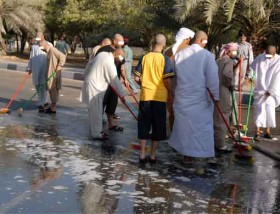
71 reckless motorists made to clean streets and schools By Rayeesa Absal, Staff Reporter GULF NEWS Last updated: December 16, 2007, 22:53
Abu Dhabi: More than 70 motorists were booked for reckless driving and made to do community service as part of the new traffic rule implemented last Sunday.
According to the rule, any driver caught driving recklessly will have to spend two days doing community service and five days in prison with the confiscation of the vehicle for a month.
The driver will be made to clean the streets of the city for a day and clean a school for another, as per the rule implemented under the instructions of Lieutenant General Shaikh Saif Bin Zayed Al Nahyan, Minister of Interior.
“Some 39 motorists have been caught driving dangerously in Abu Dhabi and 32 were caught in Al Ain over the last week. These motorists will remain in custody for a week. This includes two days of community service,” said Colonel Hamad Adil Al Shamsi, Director of the Abdu Dhabi Department of Traffic and Patrol Police, during a press conference yesterday.
“The rule will curb the menace of reckless driving and will make people think twice before performing dangerous stunts on the roads,” he said, adding that the rule will be implemented regardless of whether the motorists are male or female. Female drivers may be exempted from cleaning the streets and may be asked to clean schools for two days, he said. No female driver has been arrested so far.
The new rule has already brought in changes, the official said: “There is a marked decline in the number of violations with almost a 50 per cent reduction.”
Youngsters
“Most of the drivers who were arrested were youngsters. Twenty students were also arrested but they have been released temporarily to complete their college exams. Once their exams finish, they will be made go through the same punishment like other drivers,” he said.
The rule came in the wake of violations committed during National Day celebrations.
Offence: in the fast lane
Major Engineer Hussain Al Harthy, head of the Road Engineering and Traffic Management section of the Abu Dhabi Police Traffic Department, said the speed limit from Sas Al Nakhl to Shahama has been reduced to 100km/hr from 160km/hr.
He said if a motorist speeds up to 160km/hr a fine is issued. If the speed is between 160km/hr to 200km/hr the licence of the driver is taken away and he is asked to come to the traffic department. “In case the speed is above 200km/hr, the vehicle is confiscated,” said Al Harthy.
Free car parking in Dubai during Eid
Free car parking in Dubai during Eid
Staff Report GULF NEWS Published: December 16, 2007, 23:12
Dubai: Car parking will be free in Dubai during Eid Al Adha holidays from December 18 to 20, said an official at the Dubai Roads and Transport Authority.
Engineer Maitha Obaid Bin Udai, Chief Executive Officer (CEO) of Traffic and Road Agency at the RTA, said that parking would be free during Eid holidays but parking fines would be issued for motorists for violating parking regulations.
“Any motorist parking illegally blocking the traffic, double parking or parking on the pavement, would be given fines,” she said.
Mohammad: Ministers told to be proactive
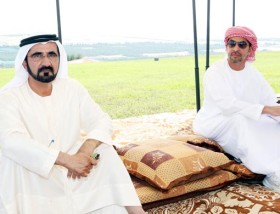
Shaikh Mohammad with Shaikh Hamdan Bin Zayed Al Nahyan, Deputy Prime Minister, during the final special Cabinet session in the garden of President His Highness Shaikh Khalifa Bin Zayed Al Nahyan’s palace in Liwa.
Mohammad: Ministers told to be proactive
Gulf News Report Last updated: December 17, 2007, 00:03
Dubai: The federal government strategy, ushering a new era of efficiency and transparency, has been completed and is ready for implementation as of January next year, it was announced on Sunday.
“This historic national accomplishment ushers in a new dawn” of progress, His Highness Shaikh Mohammad Bin Rashid Al Maktoum, Vice-President and Prime Minister of the UAE and Ruler of Dubai, was quoted as saying by WAM.
He was referring to the federal government strategy, which has been completed by the various government bodies in six months. It was ordered by Shaikh Mohammad in April.
“It is a great achievement and could not have been done without your efforts, your teamwork and your new ideas,” he told members of the Cabinet, which held its third and final special session in the garden of President His Highness Shaikh Khalifa Bin Zayed Al Nahyan’s palace in Liwa, 220km west of Abu Dhabi.
Right to housing
Shaikh Mohammad told the ministers it was time for them to get out of their offices and become acquainted with the problems of citizens, offer “the best services” to them and eliminate red tape and bureaucracy.
“Our people expect more of us in education, health, housing and job opportunities, which should be available to every citizen across the country,” he added, stressing the right of widows and divorcees to have suitable housing.
“At the end of this three-day historic meeting… I would like to also thank Shaikh Mansour Bin Zayed Al Nahyan [Minister of Presidential Affairs] on his efforts to lead the meeting of the ministerial council for services which has saved us a lot of time and effort,” he said.
Eid Al Adha: 377 prisoners pardoned
His Highness Shaikh Mohammad Bin Rashid Al Maktoum, Vice-President and Prime Minister of the UAE and Ruler of Dubai, has pardoned 377 Emirati and expatriate prisoners to mark Eid Al Adha.
The amnesty is to help those who have served part of their sentences, and enable them to share the occasion with their families.
– WAM
 ClicksandWrites
You must be logged in to post a comment.