Month: December 2007
Why our kids run amok
Why our kids run amok
Rup Narayan Das
Depression is fast emerging like a silent killer without any warning unlike physical ailments.
People argue that it is because of depression that some of us commit suicide or are alcoholic. But the root cause of such manifest symptoms goes deeper.
Society is passing through a crisis. We have ceased to be traditional without becoming modern.
Urbanisation and modernisation coupled with the mindless pursuit of career are not only robbing us of the finer sensitivities and qualities but also spoiling our peace and tranquility, our societal and familial harmony.
The symptoms of depression are all-pervasive and manifest in road-rage, street brawls, ill temper, intemperate language, lack of civility and delinquent behaviour.
The cushioning effects of the joint family is no more and there is unbridled materialism and consumerism fueled by easy loan and credit cards, enticed by advertisement which drives one to the deadly debt trap.
There is a mismatch between aspiration and ability to achieve, leading to frustration and depression.
Loneliness of children, particularly in cities, has affected their mental growth and emotional nourishment.
The old world bonhomie of the neighbourhood and interpersonal interaction have also disappeared. Psychological and clinical therapy alone cannot address such ailments Mental depression needs to be addressed spiritually and socially.
We must address the basic reasons of depression which are the flipsides of urbanisation and modernisation. The very premise of development through material prosperity alone needs to be questioned.
No wonder then that a small country like Bhutan has questioned the paradigm of development and coined the term ‘gross domestic happiness’ in place of gross domestic product as an index of development, honoured by the UN. Isn’t it time we had a spiritual and ethical foundation to our material prosperity?
What’s short-selling of shares?
What’s short-selling of shares?
TNN
What is short-selling?
Short-selling, in the context of the stock market, is the practice where an investor sells shares that he does not own at the time of selling them. He sells them in the hope that the price of those shares will decline, and he will profit by buying back those shares at a lower price. In India, there is no prohibition on short-selling by retail investors. Institutional investors —domestic mutual funds and foreign institutional investors registered with the Securities and Exchange Board of India (Sebi), banks and insurance companies — are prohibited from short-selling and are mandatorily required to settle on the basis of deliveries of securities owned and held by them.
How is short-selling beneficial?
Short-selling is considered an essential feature of the securities market not just for providing liquidity, but also for helping price corrections in over valued stocks. Supporters of short-selling claim its absence distort efficient price discovery, gives promoters the unfettered freedom to manipulate prices and favours manipulators than rational investors. Securities market regulators in most countries, and in particular, all developed securities markets, recognise short-selling as a legitimate investment activity. The International Organisation of Securities Commissions (IOSCO) has also reviewed short-selling and securities lending practices across markets and has recommended transparency of short-selling, rather than prohibit it.
Are there any drawbacks of short-selling?
Critics of short-selling feel selling, directly or indirectly, poses potential risks and can easily destabilise the market. They believe that short-selling can exacerbate declining trend in share prices, increase share price volatility, and force the price of individual stocks down to levels that might not otherwise be reached. They also argue that declining trend in the share prices of a company can even impact its fund raising capability and undermine the commercial confidence of the company. In a bear market in particular, short-selling can contribute to disorderly trading, give rise to heightened short-term price volatility and could be used in manipulative trading strategies.
Will institutional investors in India be allowed to short-sell securities?
Sebi is working on a proposal to introduce a stock borrowing and lending mechanism. This will allow institutional investors to short-sell by borrowing shares. Under this arrangement, an investor A, who feels that a certain stock is overpriced, borrows those shares for a charge from investor B, who is willing to lend those shares. Investor A then sells those shares in the market, hoping that the price declines so that he can buy cheap and return them to investor B.
What is the difference between covered short sales and naked short sales?
Covered short sales are those in which the seller arranges for the delivery of shares he has sold by borrowing them. Naked short sales are those in which the seller does not intend to provide for the delivery of shares he has sold. Most international securities market regulators have prohibited naked short-selling and require the client to have documentary evidence of borrowing/tie-up with lenders before executing the sale transaction. This is because naked short sales in huge quantities can destabilise the market.
How does the stock lending and borrowing mechanism function in other markets?
World over, securities lending and borrowing transactions are, by and large, over-the-counter (OTC) contractual obligations executed between lenders and borrowers. International securities market regulators do not directly regulate the lending and borrowing transactions. In many international markets, entities like custodians and depositories run the lending and borrowing scheme and have their own screens for meeting the demand and supply of securities from their clients.
( With inputs from the Sebi discussion paper on short-selling and stock lending )
A temple must be in the heart
A temple must be in the heart
Mukul Sharma, TNN
As most of us well know, temples — and to more or less varying degrees churches, mosques, synagogues, etc — are not really places of worship, but social constructs. They were designed specifically for people of chosen faiths to congregate and continually reaffirm their bonds of that oneness that draws them together.
Which is why the heavy ceremonies, “Sunday best” dressing, body purifying processes and mannered interactivity. Praying, or any form of spiritual union with the divine is, at best, a solemn add-on initiative. However, it’s integral to the function of a temple to make at least a passing reference to God, otherwise its reason for existence crumbles.
Priests of all faiths realise this ironic fact only too well to properly disguise their intentions. They know, for instance, that the foundation on which their sanctuaries of veneration are built are on pretty shaky ground. On the one hand they goad us the godhead is inside ourselves, all around us and omnipresent, yet on the other, they need to demand our physical presence and time inside temples. Ultimately it turns out that it’s the only place where He can be appropriately addressed and that, too, after adhering to a series of ritualised practices.
Is it any wonder then that some people see through this masquerade from time to time? But that’s when astute templars who have the pulse of their flock right, up the devotional ante exponentially with historical crusades, mandatory pilgrimages and annual melas. Suddenly, for a small moment in time (which may actually last centuries in some cases), people get to focus clearly as the temple gets its act right.
But, like miracles, these sacred journeys of the mind have no real staying power, or if they do it’s only in a cyclical fashion. In the main, whole sections of society tire of that forced connect. In Japan which professes to be officially three-quarters Buddhist, monks have had to hit the catwalk recently in Tokyo to lure youths back to shrines. Buddhism is in a crisis in that country, they say.
Perhaps, the process of an inner devotion needs to be emphasised instead; one that recognises no iconic signposts leading the way to supposed salvation. Otherwise, young people in Japan — or for that matter anywhere in the world — will end up holding communion with whatever they believe in, only in their hearts. But come to think of it, how bad is that either?
You too can get enlightened!
You too can get enlightened!
PARAMAHAMSA SRI NITHYANANDA, TNN
We all live at three levels. At the first level, we live in our head. We live using our intellect and logic. The second level is our heart. When we live with our heart, we use our emotions. In the third level we live at the core of our very being. We live in our identity.
When our intellect is heightened, when it ripens, it shines forth as common sense or intelligence. Although called common sense, it is a rare treasure, an uncommon thing on this planet Earth. Emotions can ripen. Deep emotions ripen into faith. When our being ripens it leads to enlightenment.
What is enlightenment? People have several strange notions about this word and concept. Let me explain it in simple words. Enlightenment is simply the experience of our inner energy. Enlightenment is related to the understanding and experience of our inner energy. It is not based on our physical activities, as we presume.
This concept although simple is not easy for people to understand or follow. Many people misunderstand this concept. Be clear: enlightenment is our individual experience. It is our experience of the inner energy.
There is no one who is barred for any reason, an alcoholic, man or woman, this caste or that caste, a criminal, each one is equally eligible for enlightenment as any one else is. A man has no edge over a woman. In fact, a woman lives in a higher energy plane than a man.
A person who claims to have led a pure and chaste life may not get enlightened at all. He has no edge over another who may be considered a sinner by religion and society. They both have the same chance of achieving enlightenment. Anyone can attain this status.
If you ask me, I will say that neither our activities nor actions are related to enlightenment. Enlightenment is within the reach of one and all. Everyone is eligible for enlightenment. Many people may take this as a licence to do whatever they want to do. They can create even bigger problems in the world.
Masters realise the potential problems this assertion can cause to the uninitiated public. That is why they don’t speak about it, freely and generally in public. Let us all work towards our enlightenment. Everyone can reach it, everyone is eligible and everyone is entitled to it. Nothing we do can stop us from reaching that state.
Have Your Say – Dubai Municipality Suggestions and Notifications Site
Dubai Municipality Suggestions and Notifications Site
Dubai Municipality welcomes ideas and suggestions from all its employees and customers on any issues related to its services. Let’s work together to open doors of free thinking and feasible ideas that lead to action. Share your valuable ideas with us.
What is the suggestion?
A New idea that contributes to the development, innovation or invention of a work style or work tool. The term ‘suggestion’ also implies remarks on an existing system or procedure which will bring forth practical benefits and make remarkable, positive impact in any field of material or human resources application, customer satisfaction , quality, efficiency, effectiveness and productivity of work, work environment and other field to the tasks and functions of the municipality.
Facts About DM Suggestion System
1.DM Suggestion System was approved by Administrative Decision No 122-2000.
2.The Suggestion System Higher Committee was issues established by Administrative Decision No 123-2000.
3.The categories rewarding and honoring list was approved by Administrative Decision No 190-2001.
4.DM Suggestion system was launched on DM website on 29th Dec 2002.
5. DM Suggestion system is member in :
• EIA .
• Ideas UK.
• Ideas Arabia
Objectives of the Suggestions Scheme in Dubai Municipality:
•To participate in applying the rules of total quality.
• Through continuous improvement of work methods,
• To enhance the quality of service and products.
• To emphasize on the principle of positive Participation of employees and residents in the Emirate through bringing out their hidden potentials and original ideas into practice.
• To participant in reducing expenses, saving time, effort and money. To promote the motto of co-operation by providing an opportunity to benefit from the ideas and experiences of others.
• To simplify work procedures by shortening time and speeding up responses.
• To improve the over all organizational performance
How to submit your Suggestion?
By visiting the website of the municipality. ‘‘ http://www.dm.gov.ae ’’.
– By filling up the form and depositing it in the suggestions box.
– By sending your suggestion to: Dubai Municipality, Administrative Development & Quality Department, P.O.Box 67, Dubai, UAE.
– By calling the Customer Care Section on 04-2064859
– By calling the Customer Enquiry Service on 8004567
– By calling Dubai Municipality switch board on 04-2215555
– By calling Dubai Municipality Emergency office on 04-2232323
– By sending a fax to 04-2064478
– By visiting the Customer Care section on the 8th floor, Municipality main building
– By speaking with the co-coordinator of suggestions in the respective organizational unit of Dubai Municipality
DM unveils vital public amenity project in the city

DM unveils vital public amenity project in the city
Dubai Municipality in cooperation with Med K & K Advertising and Marketing Company announced yesterday one of the latest urban projects that many of the advanced big cities of the world are lacking, public amenities. The Dhs50 million project, which is aimed at building 100 public toilets in different areas of the city of Dubai, especially along the roads and squares, will be commenced from 2008. The toilets will be built as per high international standards both in its modernity and hygiene angle. Eng. Abdullah Rafeeu, Assistant Director General for Environment and Public Health Affairs announced the project in the presence of Mona Makki from Med K&K Advertising and marketing and George Chehwane of Group Plus at the joint press conference. He said according to the World Health Organization statistics one third of the world population is suffering from this problem as they use open areas for this purpose thereby posing the threat of spreading contagious diseases of which 1.8 million people, 90% of them children less than five years, die annually. Rafeeu said Dubai Municipality has initiated setting up and management of public health amenities from the beginning itself in the sixties. “This project goes along with the development currently being witnessed by the city. We have provided public health amenities in public places with excellent hygiene specifications matching the best technical applications available in the most advanced cities of the world,” he said.
“In fact, Dubai city, which has a promising future, is facing a lot challenges in the field of public health and environment. The growth of trade and tourism, which will result in the presence of an increased number of people on the streets, markets and public places, will demand provision of public hygiene amenities in all places and markets. Dubai Municipality controls these facilities and takes care of cleaning them in order to prevent the spread of any communicable disease,” said Rafeeu. He said the public health services, cleaning and protection of the environment will benefit all the individuals of all categories in the society.
Rafeeu said public health amenities in Dubai are not new, but it is undergoing continuous enhancement in order to keep pace with the urban development, economic prosperity and global tourism witnessed by Dubai.
“It also becomes another step in beautifying the image of the city with an attractive and beautiful design, which could be seen on our streets by August 2008,” he said. “Dubai has gained the nickname of “city of business and tourism.” It is not just one of the emirates in the UAE but it has been accepted by people in all countries of the word,” said Mona Makki of Med K & K Advertising and Marketing Company, “This achievement of the city has not come as a surprise but as a result of the great effort and hard work as well as the insistence for uniqueness and excellence by sincere people, on top of them is UAE Vice President, Prime Minister and Ruler of Dubai His Highness Sheikh Mohammed Bin Rashid Al Maktoum,” she said.
“This has made Dubai match the big developed cities of the world in terms of modern road network, communications and buildings, festivals and exhibitions with global dimensions, technology and media,” said Makki.
The project, which is going to be taken up by the city of Dubai, is a pioneering project in the whole Middle East, she said, adding that a nominal amount of Dhs2 will be charged for the users of the toilet.
“While designing these facilities, we have taken into consideration the religious aspect and the climate of the region. A team, in coordination with Dubai Municipality, had visited Italy for getting briefed about the operation of such facilities and their construction techniques. The team had also held a meeting with an authority formed by Milan Municipality there,” said Makki.
Giving details of the specifications of the project George Chehwane, Managing Director of Group Plus said the doors of the toilets cannot be opened except by the person inside. “The toilets also will have fire fighting equipments and emergency phone facilities. The toilets will have most modern facilities such as the ones available in cities like New York, Paris and Rome. The advertisement boards on the toilets will add colour and beauty to the city. The toilets will also have automatic cleaning facility so that it remains clean and dry all the time,” he said.
“Studies by world class laboratories have proven that the cleaning facility in these types of toilets exterminates 99.9% of germs and bacteria compared to 30-40% of manual cleaning in the ordinary public health amenities. It is similar to the sterilization of surgery rooms of the operation theatres,” said Chehwane.
Prominent features of the amenity include automatic sensing system for flushing water, sanitizing liquid, tissue papers and hand drier to avoid germs infection; system for washing, cleaning, purifying and sterilizing the walls, toilet seats and floor after each use with water and air with high pressure; automatic opening and closing of doors; due to safety reasons these facilities will be automatically closed from midnight to morning; air conditioning system; automatic voice messages to inform and warn people about the specialties; facilities are controlled online to get accurate statistics and information about the usage, break down and preventive maintenance works; the units are environment friendly as they are designed to consume the lowest amount of electricity and water; protection to resist natural elements, scratches and graffiti; equipped to receive people with special needs; equipped with weight sensing system to prevent doors from locking in case a single child or two adults together; availability of water sprayer to wash the toilet after each use; equipped to set up advertisements inside and outside. This facility is considered to be one of the most important public sector projects implemented by private sector.
Chehwane said the first phase of the project had started way back in September 2005 and the first unit will be operational early 2008 and all units would become operational by next August.
“Dubai will become the first city in the Middle East to have set up such a system. By this Dubai will maintain its position of a pioneering city,” he said.
DM issues guide to regulate smoking in public places
DM issues guide to regulate smoking in public places
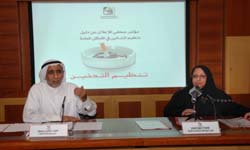
Dubai Municipality has issued a guide to help shopping malls, hotels, restaurants, cafes and other public facilities in the city to effectively regulate smoking in public places. The guide clearly defines areas where smoking is prohibited, where it is permitted, and lays down conditions for designated areas for smoking, licensing requirements, health and safety regulations. The guide also lists types of violations and the proposed fines for them. This was announced in a press conference held by the municipality and attended by Salem Bin Mesmar, Director of Public Health Department, and Zohoor Al Sabbagh, Head of Clinic and Community Health Section. Mesmar said the municipality’s decision to regulate smoking comes in line with the Dubai Strategic Plan (2007-2015) which seeks to protect public health and improve quality of life for nationals and expatriates residing in Dubai and in line with the Strategic Plan of Dubai Municipality which provides for ensuring purity of interior air and prevention of smoking in public buildings.
He noted that the municipality had already undertaken two phases of this programme under which smoking has been regulated in all shopping centres and malls with effect from 15 September 2007 and in all restaurants and cafes with effect from 18 November 2007. During the next phase, smoking will be regulated in hotels and hotel establishments including motels, resorts, dormitories and furnished apartments.
He said the guide would offer management of the public facilities, where smoking is being regulated, general instructions on the dos and don’ts of the programme that will help them effectively implement it. It would also help educate the general public on areas where smoking is not permitted inside a facility such as entrances, walkways, lifts & escalators, stair cases, lavatories, amusement & entertainment areas, places of employees, offices, cinemas, meeting & conference halls, stores, food courts, prayer rooms & ablution areas, closed car parking lots, shops & showrooms, reception & waiting areas, rest areas, and places close to food services. It also lists areas where smoking is permitted such as the specially-designated areas in the public buildings.
The types of violations, as listed in the guide, include violation of rules and regulations pertaining to import and distribution of tobacco and tobacco products, violation of rules and regulations pertaining to sale of tobacco, smoking in a prohibited place – individuals (, non-adherence by shopping malls, hotels and hotel establishments with the guide, non-adherence by restaurants and cafes with the guide, non-adherence by mass accommodations and health establishments with the guide, non-adherence by amusement and recreational centres with the guide, non-adherence by owners of public libraries, theatres, clubs, music party halls, museums, art galleries, wedding halls…etc, and violation of general rules and regulations on areas designated for smoking.
BP to work on LNG safety programme with Qatar
BP to work on LNG safety programme with Qatar
By Himendra Mohan Kumar, Staff Reporter GULF NEWS Published: December 19, 2007, 23:54
Abu Dhabi: Global energy major BP and Qatar Petro-leum have signed a memorandum of understanding to develop and fund a world-class liquefied natural gas safety research programme in Qatar.
The MoU is in partnership with the Qatar Foundation, and Texas A&M University and its affiliates. The agreement was signed by Mohammad Bin Saleh Al Sada, Qatar’s minister of state for energy and industry affairs.
“We at Qatar Petroleum believe that this MoU represents a significant step in our quest to develop the Qatari human resources, and we are sure partnerships with leading institutions will contribute to the advancement of science, and enhance technical skills of safety in the LNG industry,” said Al Sada.
“We are proud to be a part of this programme which will certainly be a remarkable achievement for Qatar Petroleum and the oil and gas industry in Qatar,” he added.
The programme, which will extend and complement the existing BP-sponsored programme run at the Texas A&M University in College Station, Texas, will help advance the technical understanding of key safety issues impacting the worldwide LNG industry.
The research will be carried out at the Texas A&M University branch campus within the Qatar Foundation university campus in Doha and will encompass practical testing at Qatar Petroleum’s Ras Laffan Emergency and Safety College which is currently being constructed at Ras Laffan Industrial City.
“As Qatar continues to develop its leading role in the LNG world, such activities will facilitate the transfer of relevant technologies and build human capacity in LNG safety for the benefit not only of Qatar but also the LNG industry worldwide,” said Steve Peacock, president of BP’s Middle East and South Asia Exploration and Production Unit.
Qatar is the world’s largest exporter of LNG and aims to more than double its exports to 77 million tonnes per year by 2011 on the back of multibillion dollar projects.
Linde sets up joint gas venture with Adnoc
Linde sets up joint gas venture with Adnoc Reuters Published: December 19, 2007, 23:54
Frankfurt: Germany’s Linde has set up a joint venture with the Abu Dhabi National Oil Co (Adnoc) for the production and long-term supply of industrial gases to customers there, it said yesterday.
Gases and engineering group Linde said it held 49 per cent of the venture, named Elixier, and that state-run Adnoc owned the remaining 51 per cent.
“This joint venture is of major strategic importance to us and is the logical expansion of the previous collaboration of our engineering division with Adnic in the petrochemical industry,” Linde executive board member Aldo Belloni said.
Adnoc has access to about 90 per cent of Abu Dhabi’s oil and gas reserves, considered the fourth-largest in the world.
In the first phase of the joint venture, the companies will build a $65 million air-separation plant in the industrial zone of Ruwais, Abu Dhabi.
By the end of 2009, the plant will supply nitrogen to industrial customers in Ruwais and will produce liquefied nitrogen and oxygen.
All for fun and fun for all
All for fun and fun for all By Cindy L Bailey, Staff Writer GULF NEWS Published: December 18, 2007, 22:59
Families in the UAE are spoilt for choice when settling for
a weekend of serious fun.
A hard week in office demands a fun weekend. Now, having fun may be a state of mind in some hick town due to a lack of options, but not in the UAE. Dubai and the other emirates throw up seemingly endless opportunities for the family for a weekend of fun and frolic. Seek and you shall find.
Whether it’s spending time at the many beaches or parks in Dubai, visiting the exciting water parks or enjoying the adrenalin rush while indulging in some serious dune bashing in one of the seven emirates in your four wheel or on an ATV (All Terrain Vehicle), the UAE prides itself in having something for every outdoor enthusiast.
Clare Hadley, mother of two children, Alexander, four, and Daniel, one, says, “As my boys are so young I can only really take them to the beach. We are quite limited to what we can participate in due to their age.
“Parks are great, Alexander likes to ride his bike (in the park.).
There are so many things to do in Dubai. There are a lot of options, although we tend to observe rather than join in. There are powerboat and hot air balloon shows. They all cater well for children. We do like to go to the Jebel Ali Sailing Club, the boys can play in the pool and play with the other children there.”
Kay Robinson, mother of Summer-Jane, seven, and Megan, five, shares what she does to keep her daughters entertained. “My girls love the beach. They love to build sand castles and play in the sea. Wild Wadi is also one of their favourite haunts. I’m happy to take them wherever they can get fresh air, I don’t like to keep them inside all day. Dubai’s weather is great and I like to take full advantage of that, obviously we have to be very careful during the summer months, but on the whole I like to involve them in anything that keeps them active.”
The beach isn’t just for children as parents can also take advantage by sitting back and relaxing while watching their children play and enjoy the sun, sand and sea.
Andrew Kirk, a Dubai resident, is father of Jessica, 11, and Adam, nine and describes what his family likes to do in their free time.
“The beach is always a popular choice with my kids, they never get bored with it. Whether they are playing soccer, volleyball or just rolling in the waves, they are always entertained. And it’s always nice for Sarah (his wife) and me to have some down time too.
“We always try and go to a water park once every few weeks. Now that the weather has cooled down we will be spending a lot more time on the beach, it was a little too hot for the kids during the summer. We could only take them before noon or after 3 pm. Our favourite water park is Wild Wadi with Juha’s Dhow being quite high in the popularity stakes.
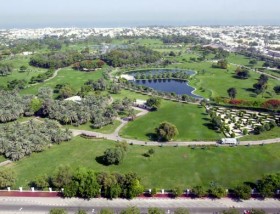
“Of late, a personal favourite is spending the day at Dubai Creek Park. It has a great picnic area and we play rounders — Jessica and Adam love it. We have a great time. That is one of the things I love about Dubai. There are so many places that parents can spend quality time with their children.”
Wild Wadi is not the only water park where families can enjoy quality time together, Wonderland, Dubai, also includes a family water park.
“The park is divided into three areas: the main street that includes a special water mist cinema show, (films are projected on to a thin layer of water) the theme park that has roller coasters, go carts and restaurants, and Splashland water park with a host of water-based activities and pastimes to keep the whole family amused. The park also offers a ‘families only’ special on Thursdays.
“Wonderland is a family favourite. It’s an amusement park and water park rolled into one and keeps my whole family entertained; we love spending the odd weekend there,” says Marcus Bumby, father of two children, Cameron Reece, eight, and Annalise, four.
“My son loves to play football, so I take him to the park or beach most days after school. I am very conscious about keeping my children active. I want them both to be as healthy as possible and I believe an active lifestyle will ensure that.
“I don’t really like them playing videogames and watching TV all the time so my wife and I try to rustle up activities that involve them. Annalise loves to just join in with anything that Cameron does, whether it’s kicking a ball around on the beach or playing at the park.”
 ClicksandWrites
You must be logged in to post a comment.