Month: November 2007
Curvy women are cleverer too: Study
Curvy women are cleverer too: Study
11 Nov 2007, 1203 hrs IST,PTI
LONDON: Curvy women have been admired for their sensual figures. But, a new study has found that ladies with large hips and small waists are cleverer too, than those with apple-shaped bodies.
In fact, according to international researchers, women with an hourglass figure are not only intelligent, they also give birth to brighter children, The Sunday Times reported in London on Sunday.
“The fat around fuller hips and thighs holds higher levels of omega3 fatty acids which are essential for the growth of the brain during pregnancy,” the researchers were quoted as saying.
The scientists at the Universities of Pittsburgh and California came to the conclusion after analysing data from a study of 16,000 women and girls, which collected details of their body measurements and their scores in cognitive tests.
The team found that those women with a greater difference between the waist and hips scored significantly higher on the tests, as did their children — “possibly a result of higher levels of Omega3 fatty acids on the hips”.
The research has explained why children born to teenage mothers do worse in cognitive tests: Their mothers may have had insufficient stores of the best fatty acids.
“The cognitive development of their children is reduced, and their own cognitive development is impaired compared with those mothers with a later first birth,” the researchers were quoted as saying.
The study also noted, however, that children born to teenage girls with traditional hourglass figures seemed to be protected from this phenomenon and did better in tests.
‘Indian elite emit most CO2’
‘Indian elite emit most CO2’
13 Nov 2007, 1819 hrs IST,INDIATIMES NEWS NETWORK
NEW DELHI: Greenpeace on Tuesday released a survey based report named “hiding behind the poor” which reveals that the highest income group in India, constituting merely 1% of the population emits four-and-a-half times as much CO2 as the lowest income group consisting 38% of the population. It demands that common but differentiated responsibility for CO2 emissions reduction, which the government is justifiably advocating at a global level be implemented in India. With less than a month to go for the United Nations Climate Change Council conference in Bali, the report challenges the Indian government’s hard line of not committing to GHG gases reduction on grounds of development and makes an argument about why India must de-carbonize its development.
According to the proposed national strategy on climate change India will not abide by any international commitment to mandatory reduction of greenhouse gas emission. India ‘s approach of measuring world GHG emissions is per capita emission rather than country-wise emissions which is the approach of the developed nations. Although India is the sixth largest carbon emitter in the world, it has one of the lowest per capita emission rates.
G Ananthapadmanabhan, Executive Director, Greenpeace India said “While the government continues to point at low average per capita emissions to justify non reduction of India ‘s CO2 emissions, over 150 Million Indians are emitting above the sustainable limit which needs to be maintained to restrict global temperature rise below 2 degree centigrade. India ‘s low average per capita emissions is due to the over 800 million poor population whose emissions are negligible and the difference in emissions between the highest and the lowest income groups in India is almost as glaring as the difference in the average per capita emissions between the EU and India .”
‘hiding behind the poor’ is based on face-to-face surveys of 819 households from the seven different income classes across the four metros, medium and small towns and rural areas for energy consumption patters. According to the report, the average CO2 emissions of an individual from the highest income group of above Rs 30,000 (1494 KG) is 4.5 times that of one from the lowest income group of below Rs 3000 per month (335 Kg).
Ananth further added “Electricity production in India is already extremely carbon intensive, emitting more then twice as much CO2 per kilowatt-hour than in the EU. The government’s objective, as in the 11th five year plan to base India’s future power generation on a massive expansion of coal power plants will further enhance climate instability and expose the most vulnerable poor population to increasing impacts of climate change. While rightfully demanding that developed nations reduce Co2 emissions and provide developing nations the carbon space to grow, the Indian government must not hide India ‘s emissions behind the vast poor population. The principle of climate justice must be included in the national development plan.”
The poor population, while contributing the least to global warming, is highly exposed to and has the lowest capacity to adapt to the impacts of climate change. The report recommends that funds be created by mechanisms like carbon credits and carbon tax to be used for mitigation and adaptation projects to protect the poor from climate change impacts.
Inching closer to spinal cord repair
Inching closer to spinal cord repair
14 Nov 2007, 0148 hrs IST,ANI
WASHINGTON: A new study has identified key elements that may make the regeneration of nerve cells using the body’s own stem cells following spinal cord injury a possibility.
The seminal study, co-lead by Dr Philip Horner, neuroscientist at the University of Washington, Dr Tim Kennedy, neuroscientist at the Montreal Neurological Institute of McGill University, might help in providing novel therapies for repairing previously irreversible nerve damage in the injured spinal cord.
In the study, the researchers tested numerous proteins and identified netrin-1 as the key molecule responsible for the migratory pattern of stem cells following injury. “Because of their regenerative role, it is crucial to understand the movements of stem cells following brain or spinal cord injury,” Horner said.
“We know that stem cells are present within the spinal cord, but it was not known why they could not function to repair the damage. Surprisingly, we discovered that they actually migrate away from the lesion and the question became why — what signal is telling the stem cells to move,” he said.
In the developing nervous system, netrin-1 acts as a repulsive or attractive signal, guiding nerve cells to their proper targets.
The team found that in the adult spinal cord, netrin-1 specifically repelled stem cells away from the injury site, thereby preventing stem cells from replenishing nerve cells. Very little knowledge is known as to why a wound to the skin repairs itself but the adult nervous system is unable to repair itself following spinal injury. This is in contrast to the developing brain and non-mammals, which can repair, and regenerate after severe injuries.
The sole clue from these systems has been the role of stem cells and their potential to develop into different cell types.
Telling the life and times of Khalifa through images
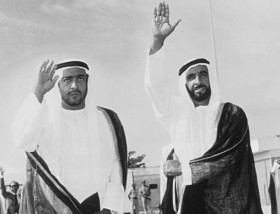
Telling the life and times of Khalifa through images
By Daniel Bardsley, Staff Reporter GULF NEWS
Published: November 14, 2007, 00:18
Dubai: A book that details the life of President His Highness Shaikh Khalifa Bin Zayed Al Nahyan – and which also acts as a history of Abu Dhabi and the UAE – has been published.
Shaikh Khalifa – Life and Times features more than 200 pictures by acclaimed UAE royal photographer Noor Ali Rashid.
At a launch in Dubai organised by Motivate Publishing, Shaikh Nahyan Bin Mubarak Al Nahyan, Minister of Higher Education, hailed the book as “very valuable”.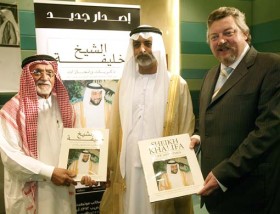
The volume is the latest in a series that so far also includes books on Abu Dhabi, Dubai, the UAE, the late Shaikh Zayed Bin Sultan Al Nahyan and the late Shaikh Maktoum Bin Rashid Al Maktoum.
“These books are sought after not just in the UAE but outside as well because they very clearly show the history of the UAE in pictures and in writing,” said Shaikh Nahyan.
The new book has a forward by His Highness Shaikh Mohammad Bin Rashid Al Maktoum, Vice-President and Prime Minister of the UAE and Ruler of Dubai, and General Shaikh Mohammad Bin Zayed Al Nahyan, Abu Dhabi Crown Prince and Deputy Supreme Commander of the UAE Armed Forces. The book is available in Arabic and English.
As well as featuring many pictures of Shaikh Khalifa, the book also includes photos that trace the development of Abu Dhabi and the UAE.
There are black and white images from decades past of camel races and the souqs of Al Ain, while more recent colour pictures show, for example, the shiny high-rise buildings of modern Abu Dhabi and the new Shaikh Zayed Grand Mosque.
Noor Ali Rashid, who landed in Dubai in 1958, said: “I am the only person who has, consistently for five decades, recorded the history of this area.”
Jonathan Griffiths, General Manager – Books at Motivate Publishing, said the book’s first print run of about 12,000 copies was sold out and it was being reprinted.
Heavy fog covers Abu Dhabi
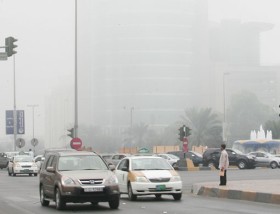
Heavy fog covers Abu Dhabi
By Binsal Abdul Kader, Staff Reporter GULF NEWS
Published: November 13, 2007, 12:27
Abu Dhabi: The heavy fog on Tuesday morning, which affected the visibility in Abu Dhabi, will continue on Wednesday, the meteorological department told Gulf News.
“The visibility was reduced to about 50 meters in the city, the surrounding areas and the south west desert in the morning,” said forecaster Mohammad Al Tal. “The fog did not affect other emirates where the visibility was about 4,000 metres.”
Al Tal forecasted the same phenomenon in the emirate for Wednesday morning, but said that the density of the fog will be lighter, with visibility at about 1,000 metres.
Al Tal said the fog was brought about by regular weather change in November.
The fog slowed down traffic on the roads. “It took me one hour to reach the city from Mussafah instead of half an hour,” said motorist Mohammad Ayoob.
Majority of residents suffer spine problems
Majority of residents suffer spine problems
By Dina El Shamma, Staff Reporter GULF NEWS
Published: November 14, 2007, 00:18
Abu Dhabi: More than 60 per cent of the UAE population suffers from spine-related problems and majority are unaware of the condition, according to an expert.
Dr Aslam Khan, Founder of Khan Kinetic Treatment (KKT), told Gulf News that structural disorders and spinal problems are a growing concern that have been left ignored or undetected by a large number of people throughout the UAE; and if detected is usually treated via surgical procedures which he found to be unnecessary through his research.
“In many cases, people may have their whole nervous system partially shut down and not be aware of it or revert to surgery. KKT research involves acoustics of sound with specific treatments and angels and we are currently reverting to biosynthesis by measuring the DNA level and allowing KKT regenerate damaged tissues in the body,” said Khan.
KKT spinal treatment is a refined non-invasive procedure, utilising sound waves to address the core spinal distortions and disturbances.
The procedure takes a couple of minutes. It involves lying on a KKT table with a device placed on the precise region of the spine, sound waves are then applied to the spine, waves reposition vertebrae and the entire body is re-positioned. Healthy blood flow is restored to the brain and neural communication is re-established.
Dr Khan said the treatment is now available in the UAE at a KKT centre he opened with Emirati doctor Omar Salem.
Abu Dhabi diverts flights after thick blanket of fog reduces visibility
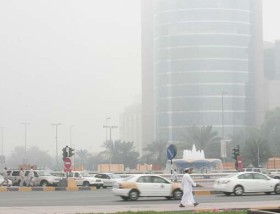
Abu Dhabi diverts flights after thick blanket of fog reduces visibility By Binsal Abdul Kader and Rayeesa Absal, Staff Reporters GULF NEWS
Published: November 13, 2007, 22:04
Abu Dhabi: Thick fog covered the skies of the capital city yesterday morning, significantly affecting visibility of road users.
However, no serious accidents were reported, according to traffic officials.
Abu Dhabi airport diverted five flights to Al Ain and Muscat airports.
Meteorological Department told Gulf News that heavy fog is expected today morning also.
“The visibility was reduced to about 50 metres in the city, the surrounding areas and the south west desert in the morning,” said forecaster Mohammad Al Tal.
“The fog did not affect other emirates where the visibility was about 4,000 metres.”
Al Tal forecasted fog in Abu Dhabi today morning, but said the visibility will be better at about 1,000 metres. He said the fog was brought about by regular weather change in November.
Minor accidents
The Abu Dhabi Police Traffic department said three accidents took place yesterday.
“The accidents were minor ones, but the main issue was slowing down of traffic on most of the roads,” said Colonel Hamad Adil Al Shamsi, Head of the Department of Traffic and Patrol Police.
Urging motorists to exercise caution, especially during peak hours, Col Al Shamsi asked them to avoid using hazard lights.
“People commonly use the hazard lights during foggy weather, this should be avoided. Instead, Headlights should be switched on.”
“Though the fog affects the visibility, it is careless driving by certain drivers that result in accidents,” he added.
He also advised drivers to slow down and maintain safe distance between vehicles to avoid accidents.
Commuters were also surprised by the thick fog cover in the morning and were late to office.
“It took me one hour to reach the city from Mussafah instead of half-an-hour,” said motorist Mohammad Ayoob.
About Five flights to Abu Dhabi Airport were diverted to Al Ain and Muscat airports due to bad weather conditions, Abu Dhabi Airports company told Gulf News.
While flights from Paris (EY038), Cochin (EY280), Brussels (EY056) and Bahrain (EY370) were diverted to Al Ain, a flight from Chittagong (BBC027) was diverted to Muscat, said a statement.
Bus driver questioned after fatal Deira crash
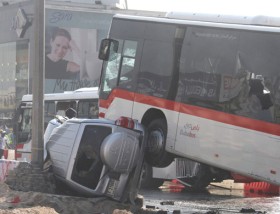
Bus driver questioned after fatal Deira crash
By Bassam Za’za’ and Alia Al Theeb, Staff Reporters GULF NEWS
Published: November 13, 2007, 22:39
Dubai: A Roads and Transport Authority bus driver who reportedly drove “recklessly and at speed” is being questioned for accidentally killing one person and injuring ten others in a collision on Tuesday morning.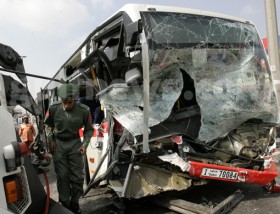
Police sources said the bus driver had jumped a red signal before hitting four vehicles, including another bus.
Salah Bu Farrousha, Head of the Traffic Public Prosecution Department in Dubai, did not confirm the driver had jumped a red signal and said the actual cause of the accident would be determined after technical reports by the Roads and Transport Authority (RTA) and the police and pictures from cameras installed on the interchange.
The Indian driver is being questioned for alleged speeding and reckless driving. The accident happened on Salahuddin Road at 10am, it resulted in massive traffic jams in Deira.
The RTA bus hit two vehicles when it swerved to the left side of the road then hit a bus which was dropping passengers off after it veered off to the right before it landed on a four-wheel drive killing a Pakistani passenger,” Bu Farrousha told Gulf News.
Caught fire
The bus caught fire due to the impact of the accident. According to investigations, the Indian driver claimed that “when he pressed the brakes they didn’t function properly,” said Bu Farrousha.
He confirmed the driver had been speeding and described the crash as a major accident.
“A Pakistani man sustained serious injuries while his two compatriot males, three Indian men, two Filipinas, a Nepali man and a Bangladeshi woman escaped with minor injuries,” said Bu Farrousha.
The deceased succumbed to serious head injuries shortly after the accident.
Khalifa Bin Darai, Executive Manager of Dubai Ambulance Services Centre, told Gulf News that nine ambulances attended the scene.
A witness, Ahmad, described the accident as “horrible” as he saw the bus on top of one of the cars. Another witness said he heard a bang and the sound of brakes.
“I saw people trying to help the victims by pulling them out of their cars before the police came,” he said.
Joanna Huang, Communications Manager at Traders Hotel near where the accident happened, said: “When we realised an accident had occurred we quickly mobilised our emergency response team”
One motorist stuck in the jam said he was wary when near a bus because the drivers were “unpredictable.”
Road safety: 16,000 offences recorded in a week
Newly-formed traffic control teams recorded more than 16,000 traffic offences in one week.
Lieutenant General Dahi Khalfan Tamim, Chief of Dubai Police, had ordered the formation of traffic control teams from the traffic department.
The teams issued 16,185 fines and confiscated 128 vehicles between October 23 to 30.
Benefits of workplace rituals
Benefits of workplace rituals
13 Nov, 2007, 0657 hrs IST,
Think about your typical day: You take the same route to the office, listen to a specific radio station in the car, buy a cup of coffee or newspaper from a particular vendor, and exchange a standard joke with the receptionist or security guard. You don your favorite clothes for an important meeting, consistently choose the same mug, and reward yourself with a treat for completing a dreaded task.
For the most part we choose to think about work as rational, goal-driven , and devoid of sentiment . However, the research of psychologists, anthropologists, and sociologists increasingly shows that the modern workplace may be among the most complex ritual systems ever developed. Familiar practices and rituals support collaboration in the workplace and allow individuals to create meaning in their work.
Employees embrace workplace rituals as a way of gaining control over situations or to help them cope with daily stresses and strains. Rituals also have a positive impact on morale, making workers more confident and creating a sense of security. This sense of security may include scrawling our names on staplers, rulers, and hole-punchers . More importantly, it is a way for members of a work team to create and share bonds, ideals, and a sense of commitment to what they are doing.
Mallary Tytel
President and Founder
Healthy Workplaces,Sioux Falls, SD
Soft skill planning
Soft skill planning
13 Nov, 2007, 0658 hrs IST, TNN
Try to do your planning at the same time every day. Use this time to review past accomplishments as well. Look at your schedule for tomorrow and note your available or non-scheduled time. Use one planner to keep track of your appointments . Keeping a separate business &personal planner creates confusion. Write out a To Do list every day.
Include items that can be completed, such as “Prepare exhibits for monthly report” , rather than just “Work on report.” Separate your To Do list into A, B and C priorities . “A” items are important to your long term success, “B” may be urgent but not as important and “C” are those that would be nice to do if you get the time. Start with the A items. Don’t work on a C just because it’s easy to do.
Also, break your A items into small manageable chunks, so they’re easy to accomplish. Check off items as you complete them to give yourself a sense of accomplishment. Block off time in your planner for major activities . Schedule loosely. Leave yourself enough free time to deal with interruptions and emergencies . Make a daily appointment with yourself for at least 30 minutes (sixty minutes is better). Close your door. Work on whatever must be done.
 ClicksandWrites
You must be logged in to post a comment.